Ripple Enters the Financing Business of Leveraged US Stock Funds. Should XRP Holders Be Excited?

marsbitPublished on 2026-10-08Last updated on 2026-10-08

Abstract

Ripple, through its institutional brokerage arm Ripple Prime, has entered the traditional finance business of providing funding for leveraged stock ETFs. By charging retail-focused funds an estimated 8% annual financing cost, Ripple generates a new fiat revenue stream. However, XRP's price has shown no positive reaction to this news. This capability stems from Ripple's $1.25 billion acquisition of Hidden Road (renamed Ripple Prime), which holds the necessary licenses and relationships. The business involves funds using total return swaps to gain leveraged exposure, with Ripple Prime acting as the financing counterparty. A core issue for XRP holders is that the profits from this Wall Street-style business flow directly to Ripple the company, not to XRP token holders. There is no mechanism for distributing the financing income or using it to buy back XRP. The primary potential benefit for XRP lies in increased institutional adoption if new clients use Ripple Prime's services for XRP spot trading or collateral management. Usage of the XRP Ledger for settlement would generate minimal token demand due to its low, fixed transaction fees. While expanding Ripple's traditional finance footprint, this move highlights the disconnect between the company's profitable ventures and direct value accrual to its native XRP token.

Author: Claude, Deep Tide TechFlow

Deep Tide TechFlow Introduction: Ripple is extending its business tentacles into a hidden profit zone of traditional Wall Street: providing financing for leveraged equity ETFs. By charging retail investors pursuing amplified returns an annualized financing cost of approximately 8%, Ripple has successfully opened up a new fiat revenue stream. However, the XRP price has reacted coolly. For token holders, the core contradiction lies in this: the Wall Street spreads earned by Ripple at the company level are not, by mechanism, converted into genuine buy-side demand for XRP.
In the US stock market, if investors want to magnify their daily returns through a 2x long ETF, the fund issuer must borrow capital from financial institutions to maintain the leveraged exposure, paying ongoing financing fees for it. This business, long monopolized by traditional banks and prime brokers, is now seeing the entry of crypto players.

Citing a report from *The Wall Street Journal*, CoinDesk notes that Ripple's institutional brokerage business, Ripple Prime, has officially entered the financing service for leveraged equity ETFs. Taking the Tradr 2x long SanDisk fund mentioned in the report as an example, this fund pays the overnight bank funding rate plus a 4-percentage-point premium. Calculated at current market levels, this financing cost equates to approximately 8% annualized.

This means that while retail investors on the front end pay for and bear the decay of stock volatility, Ripple is at the back end, as the capital provider, steadily extracting this liquidity premium.

But the price of XRP has not responded accordingly yet. As of the time of writing on October 8th, XRP is approximately $1.41, down about 3.8% over the past 24 hours and down about 6.5% over the past seven days. It closed around $1.49 on September 30th and was around $1.42 on October 7th. There was also no significant pre-announcement price surge.

A $1.25 Billion Wall Street Business

Ripple's ability to charge stock funds relies on an acquired brokerage business.

In 2025, it spent $1.25 billion to acquire Hidden Road, rebranding it as Ripple Prime after completing the transaction in October. Funds can trade, clear, and obtain financing through this company without needing to find separate counterparties for each asset type.

The contracts purchased by the funds are called total return swaps. The broker agrees to pay the fund the returns corresponding to the stock's gains and losses, while the fund pays a financing fee; the broker then manages its risk by holding the actual stock, etc. The leveraged ETFs that retail investors buy on exchanges are backed by these institutional contracts.

Traders hold the fund, the broker sells the leverage. The more capital drawn in by stock market trends, the more financing the funds require, creating more fee opportunities for Ripple.

On August 27th of this year, Ripple formally launched swap services for US stocks, indices, and digital assets. On October 6th, hedge fund management firm Brevan Howard expanded its cooperation with Ripple, adopting its cross-asset brokerage, clearing, and financing services.

Today's report adds specific client and fee details. The licenses, teams, and institutional relationships Ripple bought are now starting to receive business.
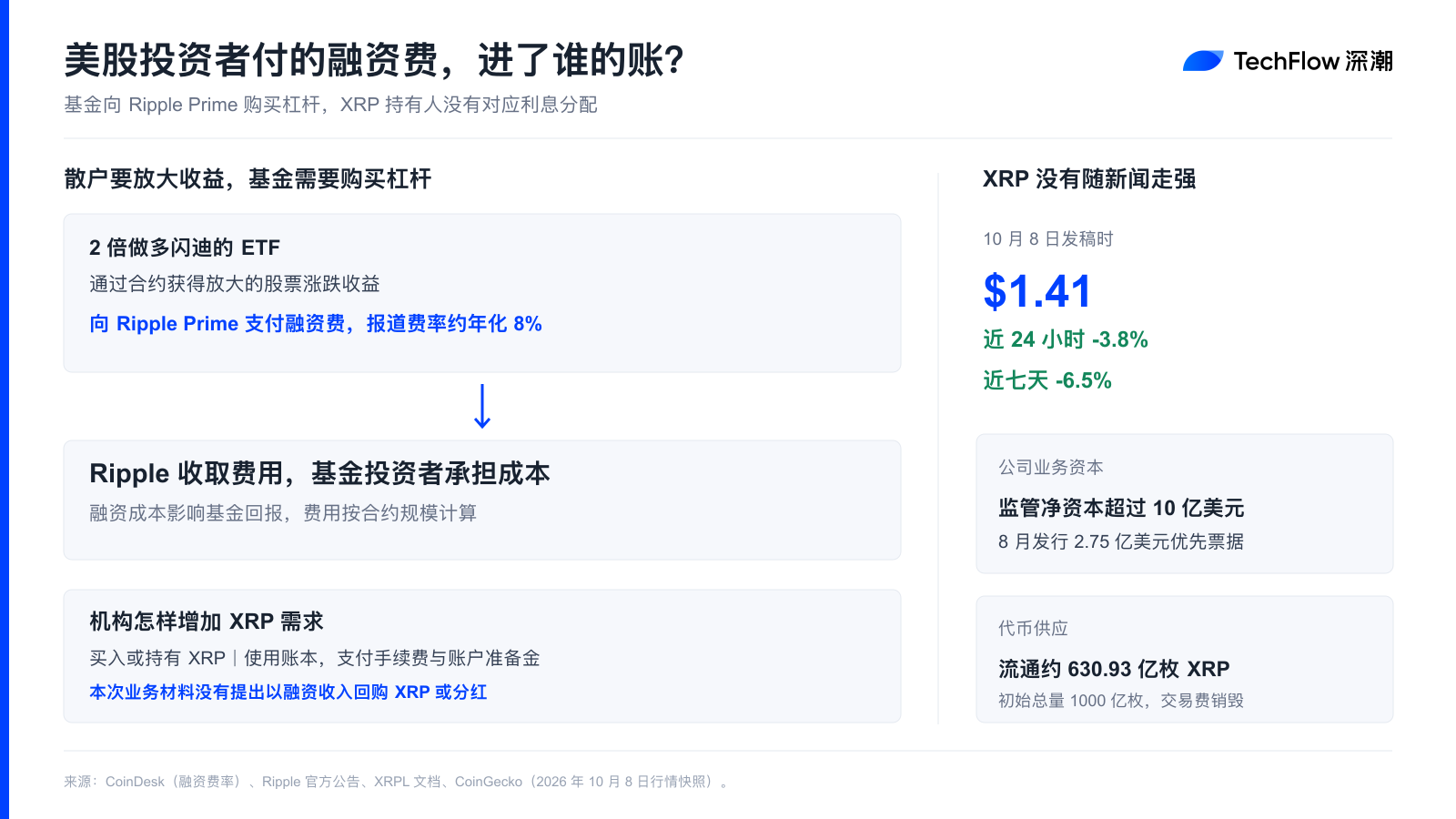
Chart: ETF investors bear the cost of obtaining leverage, the fund pays financing fees to Ripple Prime. XRP gains usage demand through institutional holdings, on-chain fees, and account reserve requirements.

But financing companies also need to borrow money.

Official disclosures state Ripple Prime's regulatory net capital exceeds $1 billion. In August, it issued $275 million in senior unsecured notes and had previously secured $200 million in debt financing. The roughly 8% financing fee paid by clients needs to cover funding, hedging, and operational costs; what remains is profit. Therefore, it remains to be seen whether this business shift will ultimately be profitable.

What XRP Holders Actually Get

Under the currently disclosed arrangement, this financing revenue is collected by Ripple Prime. Holding XRP does not entitle one to a corresponding interest distribution, and the business announcement did not propose using this money to buy back XRP. The addition of new clients first expands the company's business.

Ripple had already outlined how to connect the brokerage to its products during the acquisition. The plans at the time included using the USD stablecoin RLUSD as collateral and migrating some post-trade processing to the XRP Ledger. Funds could manage collateral with the stablecoin, and brokers could use the ledger to reduce settlement and operational costs.

For XRP, the relationship is more direct with actual institutional token holdings and trading.

Ripple Prime already offers OTC spot trading for XRP, and institutions can also manage margin by combining XRP spot holdings with other digital asset positions. If new clients increase their XRP allocations through these services, capital would flow into the token market.

Merely using the ledger generates far less demand. The standard base fee for a regular transaction is 0.00001 XRP, which is directly burned after payment; new accounts currently require reserving 1 XRP. Calculating with the standard base fee, one million regular transactions burn 10 XRP. Low costs facilitate institutional adoption but also indicate that large-scale US stock financing cannot be directly translated into large-scale XRP consumption.

The new revenue also doesn't change the XRP supply arrangement.

Approximately 63.093 billion XRP are currently in circulation. A snapshot from June 30th shown on Ripple's website indicates about 32.6 billion more were still in escrow lock-up. The escrow releases monthly, with unused portions re-locked for subsequent months. This stock financing business announcement did not disclose conditions requiring additional XRP lock-ups.

If you buy XRP because of this news, you are betting that Ripple's new clients will ultimately also become users of XRP. But holding XRP will not entitle you to receive, for instance, the interest paid by the SanDisk leveraged equity fund, nor is this a direct model where business revenue is used for token buybacks.

Or, one might say, many old crypto projects aligning with traditional finance is a current trend, but their original tokens have not been updated to be part of that new calculus.


Related Questions

QWhat is the core contradiction for XRP holders regarding Ripple's new leverage ETF financing business, according to the article?

AThe core contradiction is that while Ripple the company is generating new fiat revenue streams from this traditional finance business, the earnings are not directly converted into real buying demand for the XRP token itself. The revenue goes to Ripple Prime, and there is no mechanism for distributing profits to token holders or using the money for XRP buybacks.

QHow did Ripple acquire the capability to offer financing services to leverage stock ETFs?

ARipple acquired this capability by spending $1.25 billion to purchase the brokerage firm Hidden Road in 2025. After the acquisition was completed in October, it was renamed Ripple Prime, which provides the trading, clearing, and financing services that allow Ripple to enter this business.

QAccording to the article, what are the two main ways for Ripple's new business to potentially generate demand for the XRP token?

AThe two main ways are: 1. If Ripple Prime's institutional clients increase their XRP spot holdings and manage them alongside other digital assets using the platform. 2. By migrating parts of the post-trade settlement processes onto the XRP Ledger, which would generate minimal standard transaction fees (paid in XRP and burned) and potentially require XRP for account reserves.

QWhy is the direct positive impact of this business on the XRP token considered limited, as explained in the article?

AThe impact is considered limited because the transaction fees on the XRP Ledger are very low (e.g., 0.00001 XRP per standard transaction, which is burned), and only a small amount of XRP is needed for new account reserves. Therefore, the large-scale financing business for stock ETFs cannot be directly translated into a significant consumption or demand for XRP tokens.

QWhat did the price of XRP do around the time of the report on this new business development, and what does the article suggest this indicates?

AThe price of XRP did not show a positive response. At the time of writing (October 8), it was around $1.41, down approximately 3.8% in 24 hours and 6.5% over the previous week. There was no noticeable price increase preceding the report either. This suggests the market did not view the news as a direct catalyst for XRP token value.

Related Reads

CPI and AI Earnings Dominate Market Rhythm: This Week's Hot Assets Preview | WEEX VIP Weekly Report (November 2 – November 8, 2026)

The article discusses market developments for the week of November 2–8, 2026, highlighting how CPI data and AI earnings dominate market节奏. Last week, Democratic midterm election gains triggered concerns over tighter AI regulation and data center policies, causing a sharp tech selloff—the Nasdaq fell over 5% in a single day and entered technical correction. Crypto markets moved in tandem with cross-asset risk aversion: Bitcoin briefly dropped below $76,000 before showing resilience, with BTC and ETH posting weekly losses of about 4.5% and 6.5% respectively. Spot ETFs saw significant outflows, and the Fear & Greed Index stayed in "fear" territory for six days. Total crypto market cap fell from about $2.7 trillion to $2.54 trillion. In traditional markets, the 10-year Treasury yield hovered at 4.84%–4.95%, gold rebounded above $4,000, while oil plunged over 11%. Tech and semiconductor stocks were hit hard—the Philadelphia Semiconductor Index fell 12% in one day, with AMD down over 17% and Nvidia down over 9%. Defensive sectors outperformed. This week's focus is Tuesday's October CPI release, with headline CPI expected at 3.3%–3.5% and core CPI at 3.1%–3.2%. PPI, Fed speakers, and earnings from AMAT and CSCO are also key. Crypto token unlocks include RAIN (~$121 million), ALLO, JCT, and AZTEC. Investors are advised to maintain defensive positioning, reduce high-beta tech exposure, and wait for inflation data and AI earnings signals before adjusting risk allocations.

marsbit35m ago

CPI and AI Earnings Dominate Market Rhythm: This Week's Hot Assets Preview | WEEX VIP Weekly Report (November 2 – November 8, 2026)

marsbit35m ago

SEC Greenlights On-Chain US Stocks: Five-Year Regulatory Exemption, Uniswap v4 Targets $79 Trillion Market

The SEC's innovation exemption, effective September 17, 2026, creates a new category called Tokenized Securities Venues (TSVs), granting qualifying venues a five-year exemption from registration as exchanges or ATSs, provided they trade tokenized NMS stocks through permissioned liquidity pools on public blockchains. Liquidity providers meeting the order's conditions would also avoid dealer registration. Over $20 billion in tokenized stocks has already traded on Uniswap, and the US equity market represents $79 trillion. AMMs automate much of the work of professional market makers, letting anyone supply liquidity via smart contracts, broadening participation and competition. Pools run 24/7, support trading pairs beyond USD (e.g., NVIDIA paired with tokenized S&P 500 funds), and reach global distribution through thousands of frontends. On TSVs, trading and settlement occur atomically on-chain without a central counterparty, and listed companies must receive 30-day notice with an opportunity to object. To meet compliance requirements such as fee disclosure, access controls, listing and volume limits, and trading halts, Uniswap v4 hooks—especially Permissioned Pools—provide the infrastructure. Uniswap has processed over $4.5 trillion across 30+ chains without core contract exploits. Uniswap Labs invites TSV operators, asset issuers, and LPs to collaborate, while noting it does not operate any TSV and that the exemption is temporary and conditional.

marsbit46m ago

SEC Greenlights On-Chain US Stocks: Five-Year Regulatory Exemption, Uniswap v4 Targets $79 Trillion Market

marsbit46m ago

Polkadot’s first batch of parachain champions can’t hold on either: Acala and Karura plan to halt their chains in February next year

Acala, the flagship DeFi parachain on Polkadot, has submitted governance referendum Acala #195 proposing to shut down the network, with sister chain Karura launching Karura #137 in parallel. If passed, both chains will stop producing blocks on February 10, 2027. In a letter to the community, the team said Polkadot's multi-parachain architecture has deeply fragmented ecosystem funds, leaving DeFi liquidity severely insufficient, with node and network maintenance costs persistently exceeding actual revenue. The exit of a flagship network after seven years of building and operation raises direct questions about application sustainability under the multi-chain vision. The shutdown plan sets clear cross-chain withdrawal deadlines. Holders must move DOT, KSM, and bridged assets such as USDT and USDC to other networks before February 10, 2027. Native assets ACA and KAR cannot be exported cross-chain and will remain permanently in their respective ledgers after the shutdown. Liquid staking products have staggered unbonding deadlines: Polkadot's standard unbonding takes 28 days, and LDOT bound to specific validators requires an additional 28 days, so applications must be filed by December 16, 2026; the unbonding deadlines for regular LDOT and LKSM are January 12 and February 2, 2027, respectively. The early clearing window is driven by technical security concerns: after the shutdown, network code and historical state ledgers will be public, and any third party could recompile and restart the chain. With AI-assisted code audit tools becoming widespread, legacy systems lacking ongoing maintenance are prone to exposing governance vulnerabilities, so clearing retained assets early can block potential theft of stranded funds. Looking back at Polkadot's first parachain auction in November 2021, Acala won the network's first slot, attracting over 81,000 on-chain addresses to participate in the crowdloan and locking more than 32.5 million DOT. The 96-week lease term secured shared security from the relay chain but also caused massive funds to sit idle for long periods, constraining capital turnover efficiency. Five years later, most of the first batch of winning projects have exited or stalled. Moonbeam stopped producing blocks around July 31, 2026 and migrated GLMR to Base; Parallel Finance closed its products after a security incident; Clover also left its original parachain identity, leaving only Astar still actively maintained and upgraded. The multi-chain structure and separate cross-chain wallet interactions worsen the fragmented experience, and scarce on-chain liquidity is continually diluted. Although Polkadot has now shifted to the elastic coretime model described in its Agile Coretime documentation and is advancing the parallel computing upgrade outlined in the JAM protocol gray paper, early ecosystem funds that flowed out are unlikely to return in the short term. The shutdown plan is currently at the signaling vote stage. Subsquare on-chain data shows Acala Referendum #195 has about 23.1 million ACA in favor and Karura Referendum #137 about 1.28 million KAR in favor, with zero opposing votes so far. After the signaling vote passes, the team will initiate an on-chain execution proposal to implement the shutdown. The team pledges to maintain node operation and coretime availability before the shutdown; external assets not withdrawn by the deadline will be returned to the corresponding Asset Hub addresses on a best-effort basis without a full guarantee, while treasury external assets are planned to be donated to the corresponding relay chain treasury.

marsbit1h ago

Polkadot’s first batch of parachain champions can’t hold on either: Acala and Karura plan to halt their chains in February next year

marsbit1h ago

Trading

Spot
活动图片