New York permanently bars Celsius founder Mashinsky in $35M fraud settlement

cointelegraphPublished on 2026-10-10Last updated on 2026-10-10

Abstract

New York Attorney General Letitia James has permanently barred former Celsius CEO Alex Mashinsky from the cryptocurrency, securities, and commodities industries as part of a fraud settlement involving up to $35 million. The settlement resolves a 2023 civil lawsuit alleging Mashinsky misled hundreds of thousands of investors about the safety of Celsius before its 2022 collapse. He must pay $25 million if he fails to forfeit an additional $10 million to the federal government and another $10 million if he does not complete his 12-year federal prison sentence for fraud, which includes a separate forfeiture of over $48 million. The lawsuit stated Mashinsky promoted Celsius as a safe alternative to banks, offering yields up to 17% while allegedly hiding risky investments and mounting losses. Celsius froze withdrawals in June 2022 and filed for bankruptcy shortly after, revealing a $1 billion shortfall. Over $3.4 billion has been distributed to creditors through bankruptcy proceedings as of August 2026. This New York agreement follows prior federal settlements with the CFTC and FTC, which also barred Mashinsky from the industry. The SEC reached a separate settlement in principle in September. Meanwhile, Mashinsky, representing himself, is attempting to overturn his federal conviction, a motion prosecutors have called "without merit."

Former Celsius CEO Alex Mashinsky has been permanently barred from the cryptocurrency, securities and commodities industries under a settlement with New York Attorney General Letitia James that includes up to $35 million in conditional payments.

The New York agreement, announced Friday, settles a 2023 civil lawsuit accusing Mashinsky of misleading hundreds of thousands of investors about the safety of Celsius before its collapse in 2022.

Under the settlement, Mashinsky must pay New York $25 million if he fails to forfeit an additional $10 million in ill-gotten gains to the federal government beyond assets already forfeited, and another $10 million if he does not serve his full prison sentence.

Mashinsky is serving a 12-year federal prison sentence for fraud and was separately ordered to forfeit more than $48 million. The federal sentence stems from his December 2024 guilty plea to securities and commodities fraud.

“Alex Mashinsky promised New Yorkers that his company was a secure place to invest their hard-earned savings, only to leave them penniless when his risky investments collapsed,” James said in Friday’s announcement.

Related: S&P Global brings risk assessments to growing crypto lending vault sector

Celsius promised high yields before collapse

According to the 2023 lawsuit, Mashinsky promoted Celsius as a safer alternative to banks, offering yields as high as 17% while allegedly concealing risky investments and mounting losses.

By early 2022, Celsius had attracted roughly $20 billion in digital assets, but struggled to generate enough revenue to sustain its promised returns, prompting increasingly risky investments, according to the CFTC.
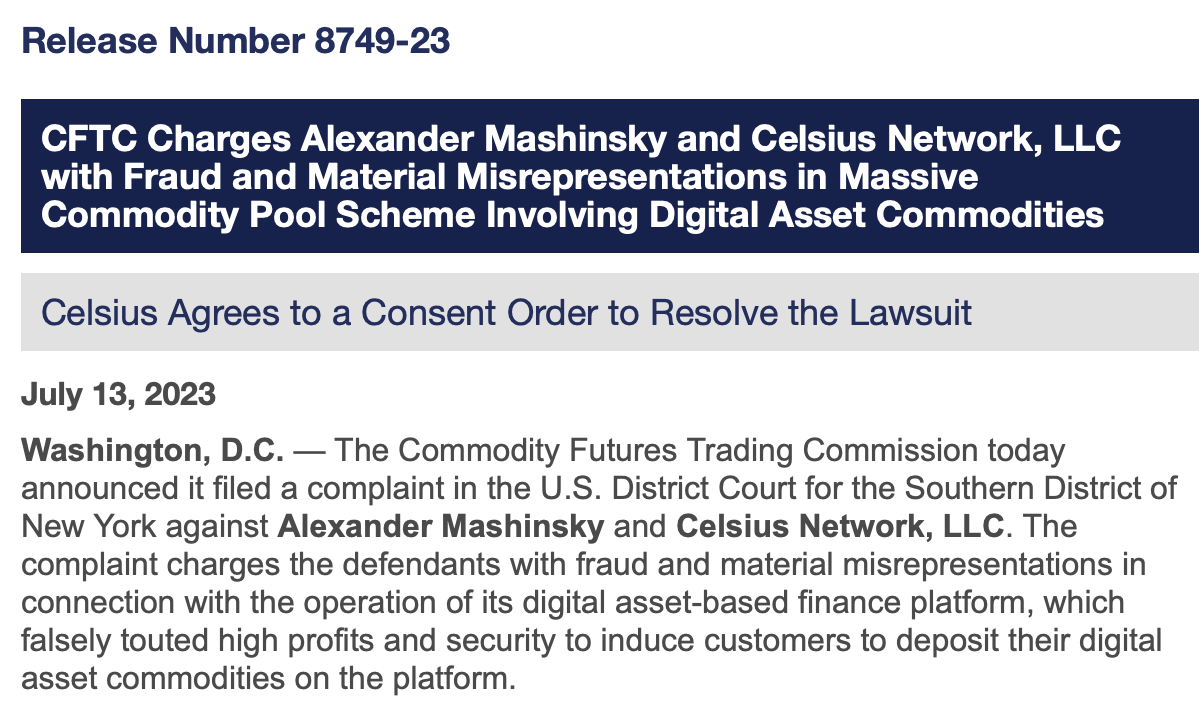
CFTC’s July 2023 fraud charges against Alex Mashinsky and Celsius Network. Source: CFTC

Celsius froze customer withdrawals in June 2022 and filed for bankruptcy the following month, disclosing a shortfall of more than $1 billion between its assets and liabilities.

As of August 2026, more than $3.4 billion had been distributed to Celsius creditors through the bankruptcy proceedings, according to the New York Attorney General’s Office.

Related: Netflix drops trailer for series based on FTX’s SBF and Caroline Ellison

Previous federal settlements and legal challenges

The New York agreement follows separate settlements with federal regulators earlier this year. In June, the Commodity Futures Trading Commission (CFTC) permanently barred Mashinsky from trading and registering with the agency. An April settlement with the Federal Trade Commission had already barred him from working in crypto and finance and required a $10 million payment, along with a largely suspended $4.72 billion judgment.

The Securities and Exchange Commission (SEC) also reached an agreement in principle with Mashinsky in September to settle its separate civil lawsuit, which a federal judge dismissed without prejudice on Sept. 29 pending finalization of the settlement.

Since May, Mashinsky has been seeking to vacate his federal conviction and sentence, representing himself in the proceedings. Federal prosecutors opposed his motion in August, calling his arguments “without merit.”

A judge denied his request for discovery, and an Oct. 5 order left that decision unchanged. Mashinsky has until Dec. 11 to respond to the government’s opposition to his petition.

Magazine: Crypto lending rises again... but have they solved the risks?

Related Questions

QWho has been permanently barred from the cryptocurrency, securities, and commodities industries in New York, and what are the financial terms of his settlement?

AFormer Celsius CEO Alex Mashinsky has been permanently barred. Under the settlement with the New York Attorney General, he must pay New York $25 million if he fails to forfeit an additional $10 million to the federal government, and another $10 million if he does not serve his full federal prison sentence.

QWhat was Mashinsky's federal sentence for, and what is its length?

AAlex Mashinsky is serving a 12-year federal prison sentence for securities and commodities fraud. This stems from his guilty plea in December 2024.

QWhat were the allegations in the 2023 civil lawsuit filed by the New York Attorney General against Alex Mashinsky?

AThe 2023 civil lawsuit accused Alex Mashinsky of misleading hundreds of thousands of investors about the safety of Celsius and concealing its risky investments and mounting losses before its collapse in 2022.

QWhat happened to Celsius Network in June and July of 2022?

ACelsius froze customer withdrawals in June 2022 and filed for bankruptcy the following month (July 2022), disclosing a shortfall of more than $1 billion between its assets and liabilities.

QWhat is Mashinsky's current legal status regarding his federal conviction, and what is the next deadline for him?

AMashinsky is currently seeking to vacate his federal conviction and sentence, representing himself. He has until December 11 to respond to the government's opposition to his petition.

Related Reads

Monad's $909 Million Credit Economics: How a High-Performance Public Chain Breaks Through via Lending

Monad, developed by former Jump Trading quant engineers, has seen its on-chain revenue model shift dramatically from high-frequency trading to lending interest. Over the ten months to September 2026, global DeFi TVL fell from $111.4B to $95.5B, yet Monad's market share rose from 0.14% to 1.09%—an nearly eightfold increase—ranking tenth among all chains by DeFi TVL. Lending now dominates fee revenue: in September, lending apps contributed 71% of application fees versus just 16% from trading, with borrowers paying roughly 6.2% annualized interest on an average $903M loan book. Monad's capital efficiency is notably high, with every $1 of TVL generating $0.89 in borrowings versus 42% on Ethereum and 45% on Base. Institutional credit vaults hold $287M in uncollateralized loans—second only to Ethereum mainnet—with Accountable at 33% and Aave at 29% of lending balances. Aave's Monad market became its third-largest fee-generating deployment globally within 46 days. Spot trading fees fell to 1.2 basis points as monthly volume surged to $4B. MON trades at just 0.25x its DeFi TVL versus 7–12x for peers like AVAX, SUI, SOL, and SEI, and has outperformed competitors since its first full trading day. Annualized interest income stands at about $56.5M at current levels, with each additional $100M in loans adding $6.2M yearly—upside supported by upcoming Aave V4, infiniFi Prime, StraitsX stablecoins, and Category Labs' institutional clearing domain.

marsbit12m ago

Monad's $909 Million Credit Economics: How a High-Performance Public Chain Breaks Through via Lending

marsbit12m ago

BTC Short-Term Bottoming and Gathering Momentum, HYPE Triple Support Faces Critical Test | Guest Analysis

Last week, the crypto market was driven by news. On Nov 4, midterm election news sparked a 3.92% Bitcoin rally above $80K, but a day later, US stock declines triggered a 5.48% drop to ~$75,222, a new low since Sept 21, with fear index near 25. HYPE also fell 15.19% weekly, erasing prior gains and returning to ~$75. Key points: Bitcoin has held above the 52-week MA for eight weeks, satisfying the "price breakout principle," but the pullback confirmation signal is not yet issued and the 52-week MA (~$76,110) remains downward-sloping. The rebound from the July 1 low of $57,820 is still classified as an oversold bounce, not a confirmed bull market. On the daily chart, price remains in a descending channel, has broken below the key MA crossover (~$77,200), but holds above the 0.382 Fibonacci level ($76,130). The correction (wave i) has run 48 trading days with a max drawdown of 15.9%; a wave ii rebound is expected but not yet started. The "Shijie Ribbon" model still signals a long market. Strategy: mid-term stay in cash; short-term use 30% position for range trading, favoring buying dips near $72,500–73,500 with strict stops. HYPE: the weekly bearish engulfing candle was driven by external shocks, not fundamentals. Three support layers: the ribbon upper band (~$74.05, lower ~$71), the box lower edge (~$75, which triggered a 20% bounce on Oct 24), and the long-term uptrend line (~$68). Key support zones: $74–75 (ribbon upper + box bottom), $71 (ribbon lower), $68 (long-term trendline). Strategy: if price stabilizes at $74–75 or $68–71, consider light long positions (≤30%) with strict stops. Special rules: set initial stop at entry; move to breakeven at +1% profit; trail stop 1% per 1% gain. All analysis is personal technical opinion, not investment advice; markets carry risk.

Odaily星球日报27m ago

BTC Short-Term Bottoming and Gathering Momentum, HYPE Triple Support Faces Critical Test | Guest Analysis

Odaily星球日报27m ago

Canton Foundation Launches Official Daml 3 Certification, Expanding Developer Access and Establishing Institutional Finance Standards

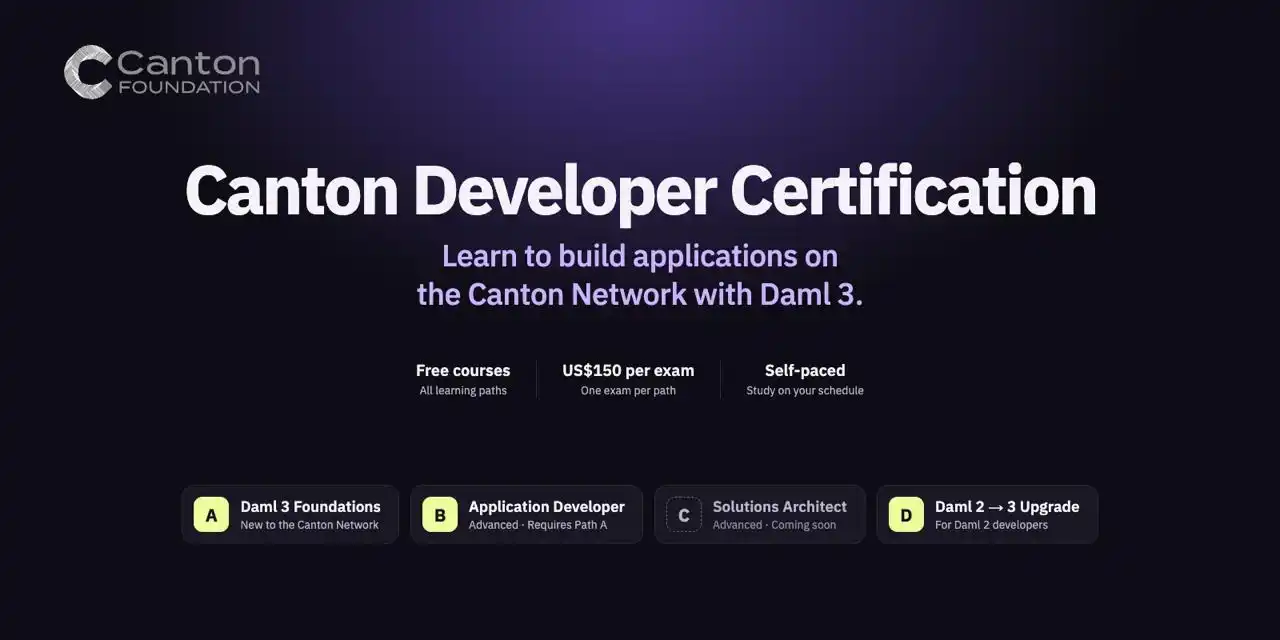
Canton Foundation has launched the Canton Developer Certification, an official certification program for Daml 3, the smart contract language of the Canton Network. Combining a self-paced course with a certification exam, it offers developers worldwide a structured path to building applications for regulated financial markets. Canton Network is a public, permissionless blockchain designed for regulated finance, with over $6 trillion in on-chain assets processed by its supported applications. Daml is built to manage who may act on a contract and who may access its terms; the certification validates practical mastery of these authorization and privacy principles, establishing a recognized standard intended to strengthen institutional confidence in applications built on the network. The program is based on Daml 3 and Canton 3.x, the current technology underlying the network, letting newcomers start on the latest stack, helping production engineers deepen expertise, enabling institutional architects to design and integrate Canton deployments, and allowing existing Daml 2 developers to migrate their skills and codebases to Daml 3, unifying the community on a single, current platform. For ecosystem partners—financial institutions, application providers, system integrators, and validators—the certification provides a common technical foundation and a consistent way to assess developers' understanding of authorization and privacy requirements. Canton Foundation COO Amanda Martin said financial institutions need confidence that the applications they rely on are built by developers who understand regulated market requirements, and that the program both opens opportunities for developers globally and establishes a shared professional standard, building a stronger foundation for Canton's future growth by bringing the community together on Daml 3. The certification is now live at certification.canton.foundation; the course is self-paced and free to all developers, and the exam costs $150 per attempt. Canton Foundation is an independent nonprofit responsible for the governance and long-term development of Canton Network's shared infrastructure, supporting transparent and decentralized governance, ecosystem coordination, and broad participation by Global Synchronizer operators and network stakeholders, while working with financial institutions, technology providers, developers, and other participants to support the network's continued global growth and adoption.

marsbit38m ago

Canton Foundation Launches Official Daml 3 Certification, Expanding Developer Access and Establishing Institutional Finance Standards

marsbit38m ago

Nvidia Faces Independent Investigation, Bernstein Maintains $400 Target Price

Nvidia's board has launched an independent investigation following reports about CEO Jensen Huang's contacts with Megaspeed executive Alice Huang, though it says there is no reason to believe U.S. national security or company secrets were compromised. Three Republican House committee chairs have requested Huang attend a closed-door briefing on November 18 to explain the contacts and Nvidia's internal procedures for countering foreign intelligence activities, and Democratic Senator Chris Coons said Congress will investigate. Some reports suggested Alice Huang may have influenced Huang's lobbying to ease chip export restrictions to China, a claim Bernstein doubts, noting Huang has long publicly pushed to expand sales in China and that revenue from mainland China and Hong Kong has fallen sharply since export controls. Only H20 and limited H200 chips were approved for China sales, well behind Nvidia's most advanced products, and Bernstein sees limited room for recovery as Chinese customers prioritize domestic alternatives. Regulatory pressure may persist, with hawkish lawmakers potentially revisiting export limits. Bernstein maintains an Outperform rating and a $400 target price, about 114% above the November 6 close of $186.64, citing data center demand and earnings growth. It projects adjusted EPS of $4.77 for FY2026, $9.20 for FY2027 and $15.80 for FY2028. The target is based on average FY2028-2029 non-GAAP EPS of $19.04 at about 21x. Bernstein also flags Huang's succession as a key risk, given his central role and roughly 60 direct reports.

marsbit48m ago

Nvidia Faces Independent Investigation, Bernstein Maintains $400 Target Price

marsbit48m ago

Two Blocks Hit in 7 Hours: Two Retail Miners Take on the Entire Network's Hashrate and Walk Away with $476,000

Two individual solo miners using home mining rigs hit two Bitcoin blocks within seven hours on November 7, earning a combined $476,000. One miner using a Canaan AvalonQ home miner with roughly 80–87 TH/s earned about $239,000; the other earned roughly $237,000. A CKPool solo platform took about 2% (0.0629 BTC) as a service fee, with the rest going directly to the miners' wallets. Given current network difficulty of about 148.4 trillion, such a rig would normally need over a century to find a block, making the win a luck value of over 10,000%. This is part of a broader trend: in 2026 so far, solo miners have found 36 blocks, nearly one lucky winner per week. Earlier examples include a 6.5 TH/s Avalon Nano 3S worth a few hundred dollars earning $250,000 on October 27, another Nano 3S earning $232,000 on May 30, and a $150 Bitaxe Gamma earning $200,000 on July 10. Home solo mining is often called "plug-in lottery": a 1.2 TH/s mini miner has about a 1-in-16,000 annual chance of winning, far better than Powerball's 1-in-292 million, but rigs cost thousands of dollars and electricity runs $400–$1,100 monthly, with zero income until a block is found. Each viral win serves as free advertising for the industry. Rig manufacturers sell the dream of "maybe I'll win too"; solo pool platforms collect a steady ~2% fee from any winner; and the Bitcoin network preserves its "anyone can participate" narrative despite mining being dominated by large farms. The people paying for it all are ordinary buyers who purchase miners and pay electricity bills hoping for a life-changing jackpot.

marsbit1h ago

Two Blocks Hit in 7 Hours: Two Retail Miners Take on the Entire Network's Hashrate and Walk Away with $476,000

marsbit1h ago

Trading

Spot
活动图片