Just Now, Meta Open-Sources Muse Gadgets, Enabling Global Developers to 'Build AI Peripherals' Themselves

marsbitPublished on 2026-10-03Last updated on 2026-10-03

Abstract

Meta has officially open-sourced the "Muse Gadgets" project, empowering global developers and makers to build custom hardware peripherals for its personal AI Agent, Muse. This initiative provides tools like an ESP32-compatible firmware and a Linux SDK, enabling developers to run Muse on devices ranging from microcontrollers to Raspberry Pi 5. Example DIY projects include E Ink displays for schedules, HDMI dongles for screen sharing, and portable touch devices for on-the-go interaction. The process involves obtaining an API token, using AI coding assistants for rapid development, and flashing the firmware. Meta also introduced an official device, the "Muse Home Link," which connects Muse to home networks for smart home control. Company figures like Alexandr Wang emphasize the goal of unlocking developer creativity to explore novel hardware ideas. Early adopters have already created devices like a MagSafe-attached E Ink display and a wine cellar inventory system. This move signals a shift in AI hardware strategy, focusing on a powerful, extensible AI Agent platform that can inhabit various devices created by the community, rather than solely relying on proprietary hardware.

Meta's Muse is still heating up.

This personal AI Agent, launched not long ago, has become an important product in Meta's AI strategy this year. Unlike traditional chatbots, Muse is designed as an intelligent assistant capable of performing tasks for users: handling emails, shopping, planning trips, and even continuously completing complex operations in the background.

And just now, Meta announced another new move: officially launching the Muse Gadgets open-source project, fully releasing hardware capabilities, and allowing global makers and developers to build dedicated peripheral hardware devices for Muse.
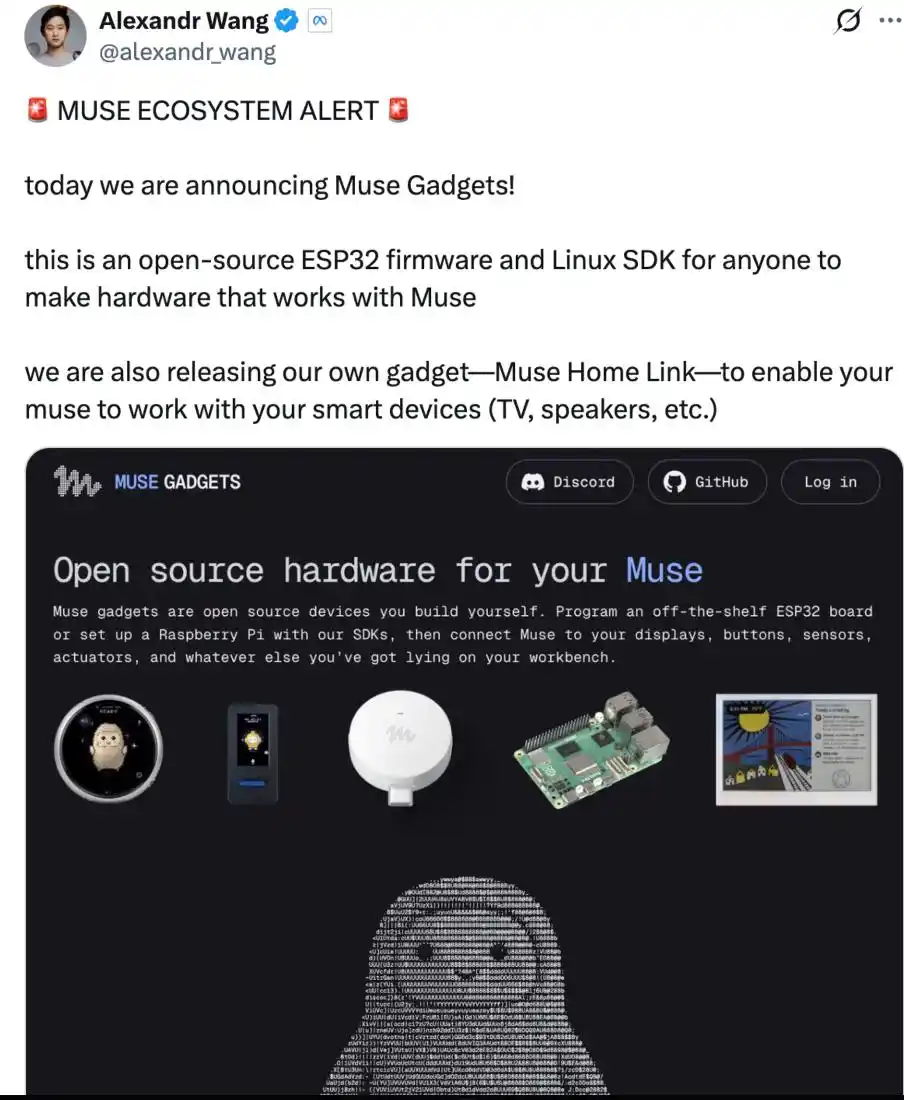
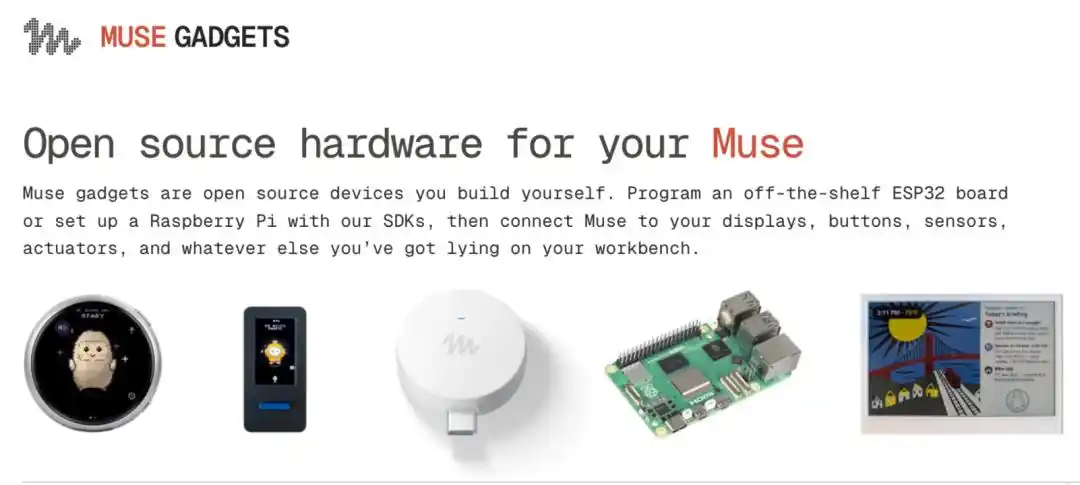
According to information released by Meta, developers can use ESP32 development boards to run Muse firmware, or use the Linux SDK to connect more complex devices. This means developers can not only deploy Muse interaction logic on low-cost microcontrollers but also run Muse clients directly on more powerful edge computing devices like Raspberry Pi 5.

The official list also includes several highly practical DIY form factor references:

Color E Ink Display: Acts as a low-power desktop notifier or smart display, showing Muse-synced schedules and to-do lists in real-time.

HDMI Display Stick / Large Screen Extension: Projects the Muse Agent's interface or interactions directly to a TV or external monitor.

Touchscreen Handheld Pendant: Create a portable interaction terminal similar to the Muse Charm, allowing conversation with the Agent anytime without needing smart glasses.

For developers eager to get hands-on, they can start building their own Muse peripherals right now by following these steps:

Obtain Credentials: Visit gadgets.muse.ai to register and claim a personal API Token;

Connect Development Tools: Import the official GitHub repository into your preferred AI programming assistant (like Claude Code, Cursor, GitHub Copilot CLI, etc.) and leverage Agentic Coding capabilities to quickly understand the protocol and generate peripheral driver code;

Firmware Flashing & Debugging: Flash the code onto an ESP32 development board or run the SDK client on a Linux / Raspberry Pi device to establish real-time two-way communication between the hardware terminal and Muse.
At the same time, Meta also launched an official device: Muse Home Link, a small device powered via USB-C. It allows Muse to connect to your home network, enabling communication with smart home devices like TVs, speakers, and any device supporting HTTPS interfaces, further integrating the AI Agent into real-life scenarios.
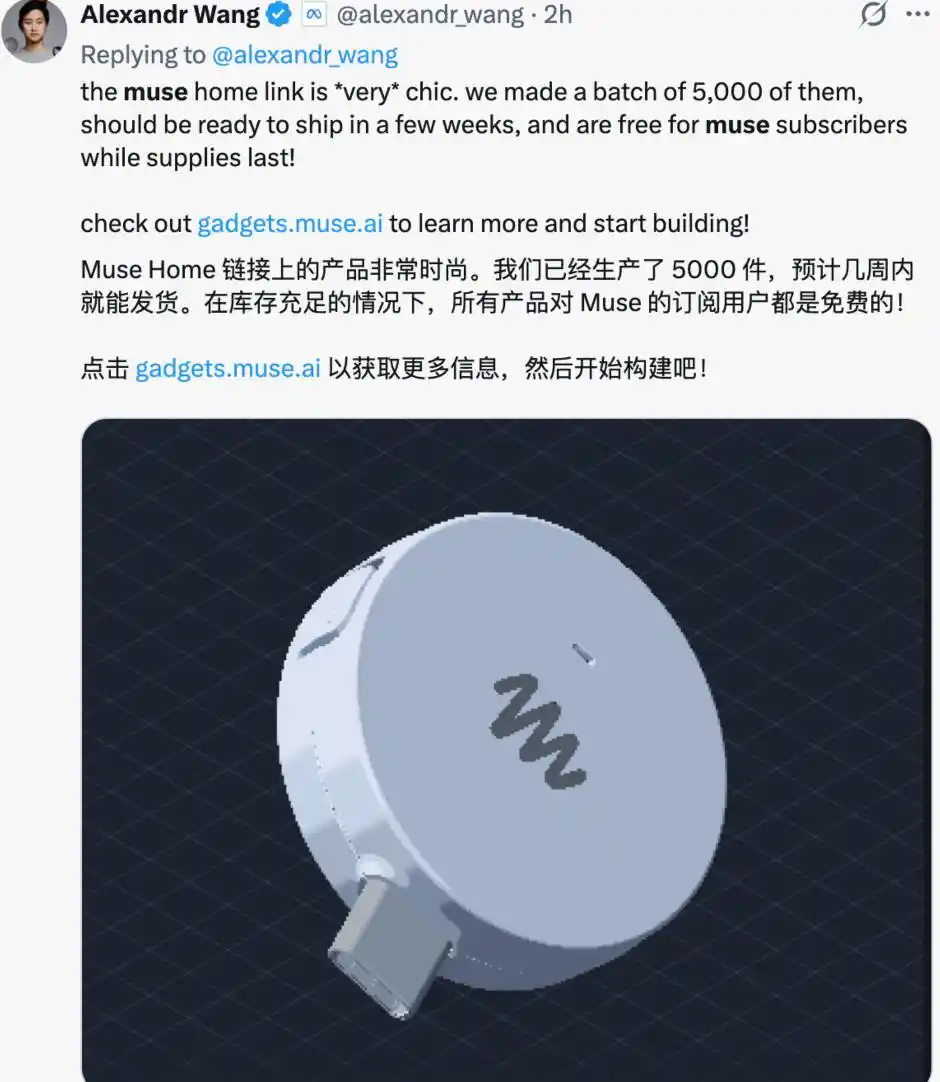
Officials stated that the Muse Home Link has initially produced 5,000 units for trial, expected to begin shipping in the coming weeks. During the period of sufficient inventory, it will be distributed for free to eligible Muse subscribers for experience.

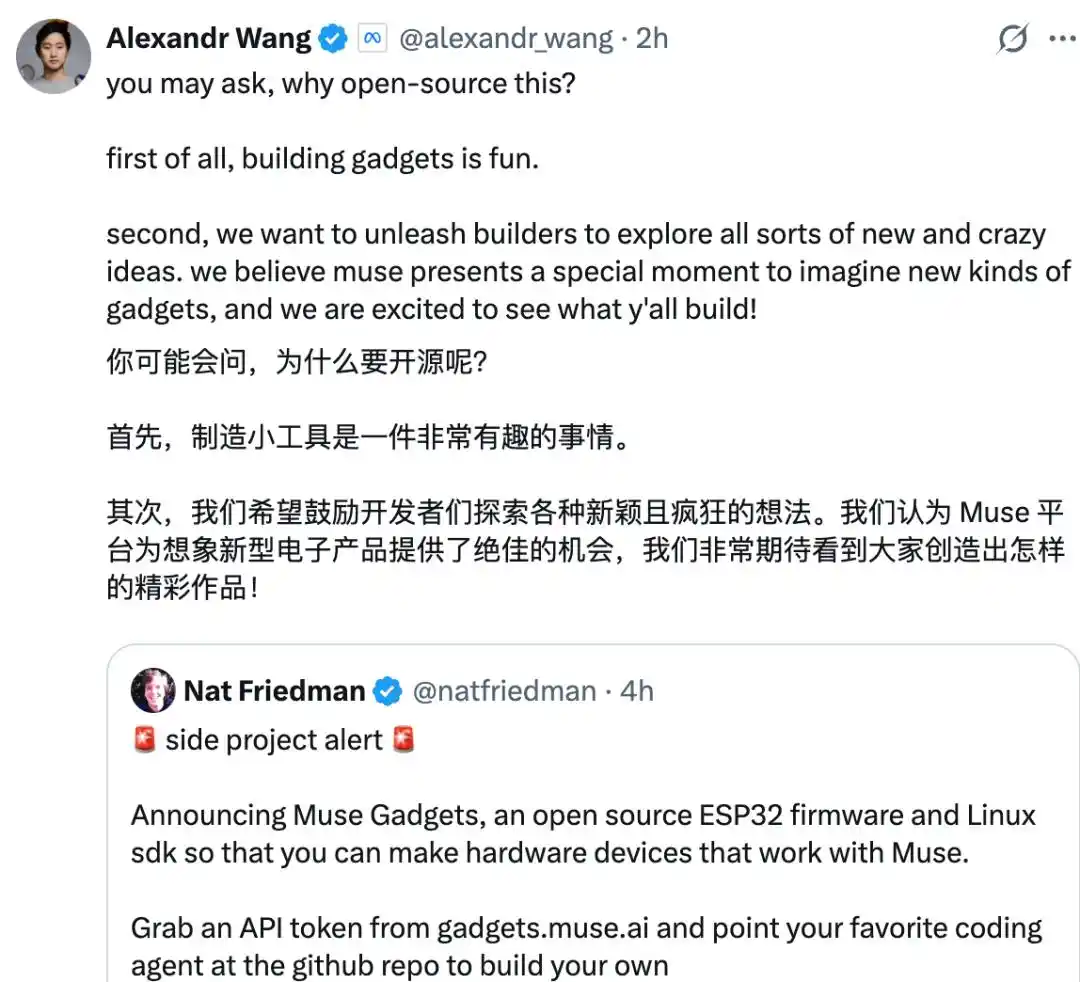
Addressing curiosity about why Meta chose to open-source, Alexandr Wang said, "First, building various gadgets is inherently a lot of fun.

Second, we want to unleash developers' creativity, letting everyone explore all sorts of new and even wild ideas. We believe Muse is at a special moment; it offers infinite possibilities for people to create new types of hardware devices, and we're very excited to see what everyone ultimately builds!"
From this perspective, Meta seems to want Muse to be not just an official product, but a platform that can be extended.

Following its release, the project immediately caught the attention of netizens, with some already diving in and DIY-ing their own Muse devices.

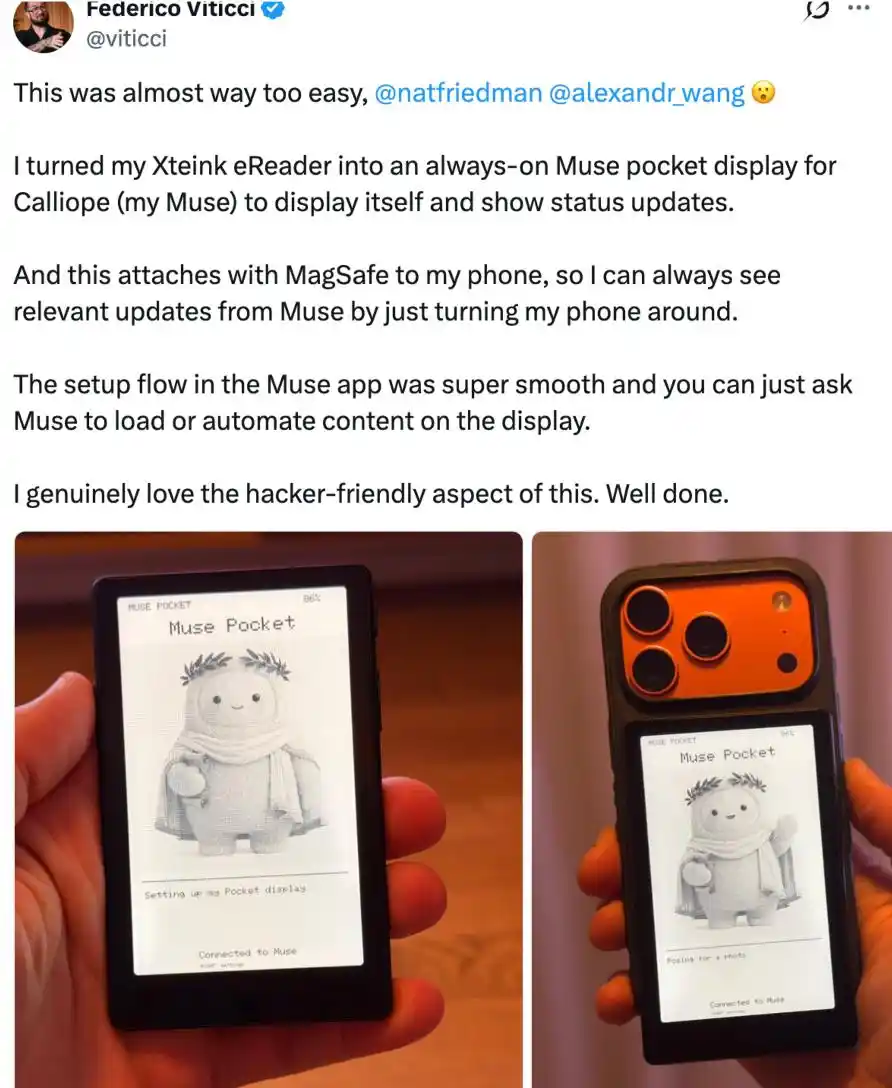
User Federico Viticci@viticci tried turning his Xteink e-ink reader into an always-on Muse portable display. Muse (Calliope) can display its avatar and show status updates on it. Moreover, the device can be magnetically attached to the back of the blogger's phone via MagSafe, so simply flipping the phone over allows checking Muse-pushed updates at any time.

"The Muse App setup process is very smooth. You can even have Muse load content directly or automate controlling the information on the display. I really like this hacker and developer-friendly design philosophy."
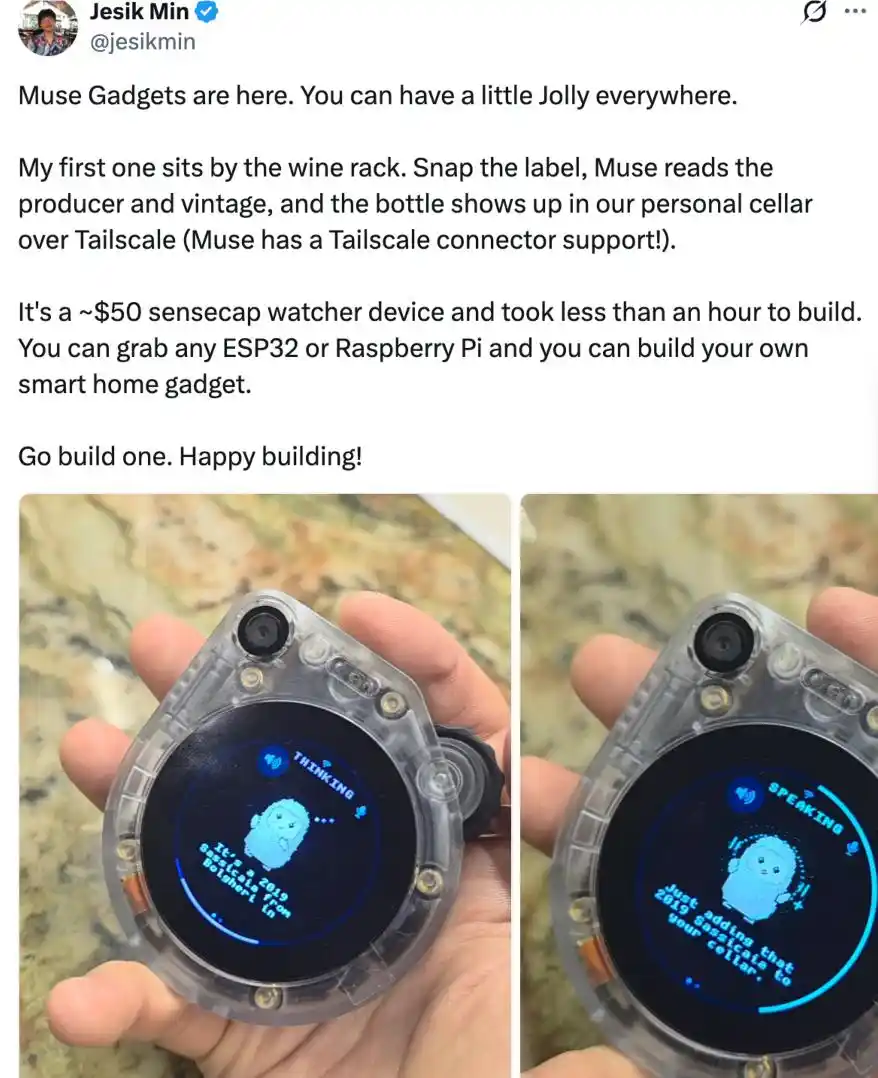
Another developer used a roughly $50 SenseCAP Watcher device to create a smart hardware piece connecting to a personal wine cellar. Users simply take a photo of the wine label, and Muse can identify the winery and vintage, syncing the information to the personal cellar system via a Tailscale connector. The entire device was built and operational in under an hour.
There are many more user cases like these. Through Muse's attempt, we can also see a shift in the Agent era: in the past, the development path for smart hardware was typically: company designs hardware — user purchases device — apps are developed. But AI Agents might head towards another model: company provides the model and Agent capabilities — developers create devices of various forms.

In fact, the industry has explored AI hardware a lot, from AI Pin and others, attempting to replace the smartphone as an entry point with independent devices, but many products faced issues like functional limitations and interaction experience. Now, manufacturers seem to be switching to a different approach: first directly build a powerful AI Agent, then let it enter different hardware.

Meta's route is perhaps exactly this: Muse handles the intelligent capabilities, developers are responsible for creating various carriers. In the future, Muse might exist in smartphones, smart glasses, various home devices, and even in new hardware created by developers......

What about you? How do you view Meta's attempt? Feel free to leave your thoughts and exchange ideas in the comments section!

Reference Links:

https://x.com/alexandr_wang/status/2106113742266089526

https://www.theverge.com/tech/1004330/meta-muse-ai-gadgets-home-link

https://gadgets.muse.ai/

https://x.com/viticci/status/2106139174604816765

This article is from the WeChat public account "Almost Human" (ID: almosthuman2014), author: Focus on AI

Related Questions

QWhat is the Muse Gadgets open-source project announced by Meta, and what does it allow developers to do?

AThe Muse Gadgets open-source project is a new initiative by Meta that enables global developers and creators to build their own custom peripheral hardware devices for the Muse AI agent. It provides the hardware capabilities for developers to create dedicated gadgets that interface with Muse, allowing for personalized AI hardware extensions.

QWhat are some of the DIY hardware form factors suggested by Meta for Muse Gadgets, as mentioned in the article?

AMeta suggests several DIY hardware form factors, including: a Color E Ink Display for low-power desktop notifications or smart dashboards, an HDMI Display Stick or large-screen extension to project Muse's interface onto TVs or monitors, and a Touch Handheld Device similar to the Muse Charm for portable interaction without needing smart glasses.

QWhat is the Muse Home Link, and what is its purpose?

AMuse Home Link is an official, small USB-C powered device from Meta. Its purpose is to connect the Muse AI agent to a user's home network, enabling communication with smart home devices such as TVs, speakers, and any devices with an HTTPS interface. This allows the AI agent to operate in real-life home scenarios.

QAccording to the article, what is a key reason Alexandr Wang gives for Meta's decision to open-source the Muse Gadgets project?

AAlexandr Wang cites that a key reason for open-sourcing the Muse Gadgets project is to unleash the creativity of developers, allowing them to explore new and even 'crazy' ideas. He believes Muse is at a special moment that provides infinite possibilities for creating new types of hardware devices and is excited to see what the community builds.

QHow does the article contrast the development path of traditional smart hardware with the emerging pattern for AI Agent hardware, using Muse as an example?

AThe article contrasts the traditional smart hardware path—where a company designs the hardware, users buy it, and then apps are developed—with an emerging pattern for AI Agent hardware. In this new model, exemplified by Meta's approach with Muse, the company provides the core AI model and agent capabilities, and then developers are empowered to create various physical form factors or devices to host that intelligence.

Related Reads

Mercado Bitcoin begins post-hack reopening without a timeline for withdrawals

Mercado Bitcoin, one of Brazil's largest crypto exchanges, began restoring read-only access to customer accounts in phases on Monday, a week after attackers drained an estimated $49 million from the platform. Access started at 19:00 UTC, with all accounts expected to be viewable by 21:00 UTC, showing holdings as they stood on Nov. 2, the day of the hack. The exchange has yet to say when customers will be able to withdraw funds. Fabricio Tota, vice president of new business, said the exchange hoped read-only access would reassure customers that their assets were still recorded on the platform. He explained that the company opted for "a more conservative approach" to reactivating accounts "to ensure our return happens with the utmost security." The caution follows concerns from blockchain security analysts that attackers were able to access addresses, draining funds through standard transfers rather than a smart contract exploit. Blockchain analysts traced some of the stolen funds to customer deposit addresses, but Mercado Bitcoin says customers won't bear the losses. Tota said the vast majority of assets were never even touched by anyone and were not involved in the incident. On Nov. 4, Mercado Bitcoin pledged to cover all losses with company funds, bolstered by a $20 million investment from stablecoin issuer Tether in July. Tota highlighted that a portion of the stolen funds were also frozen in the hours after the company announced the attack. The next phase of recovery will require users to confirm their registration details before they can move funds. The exchange plans to restore withdrawals via Pix, Brazil's instant payment system, initially allowing customers to withdraw only to accounts in their own name. Tota gave no date for either step. Mercado Bitcoin has yet to explain how the attackers gained access to its wallets. Blockchain data company Bitquery found that as of Nov. 4, wallets linked to the attacker held most of the stolen funds that had escaped freezes, including 106.07 BTC.

cointelegraph5h ago

Mercado Bitcoin begins post-hack reopening without a timeline for withdrawals

cointelegraph5h ago

Avalanche’s AVAX leads crypto gains following NYSE tokenization deal

Avalanche's AVAX token rose as much as 10% on Monday, becoming the top gainer among the 100 largest cryptocurrencies, after the New York Stock Exchange announced plans to use Avalanche's blockchain to settle trades on a new platform for trading tokenized stocks around the clock. AVAX later eased to $8.86, still up over 8% on the day, with a market cap of around $3.95 billion and $439.7 million traded in the past 24 hours. Avalanche's total value locked stands at $633 million, up 4% over the past day. NYSE's head of digital issuance, Dennis Lee, said the exchange is examining how blockchain technology can expand its equities offerings and is picking the right technology for each job. The deal underscores Wall Street's growing effort to use blockchain to make stock trading faster and enable trading outside regular market hours; traditional US markets are open 9:30 am to 4:00 pm EST on weekdays, with trades often taking at least one business day to settle. The NYSE first announced plans for the platform in January, and Ava Labs revealed in September that the exchange had spent about a year testing Avalanche, though the final selection was not confirmed until Monday. Avalanche will record stock trades and help complete transactions on the platform, which will let investors buy and sell digital versions of stocks across different blockchains. Lee said the settlement ledger needs to be fast, reliable, permissioned, cost-predictable, and backed by a large developer community—all of which Avalanche meets. The platform could launch before the end of 2026 pending regulatory approval. Ava Labs chief business officer John Nahas said first conversations with the NYSE began nearly a year ago and called it an important step toward blockchain becoming foundational financial infrastructure. The news comes as other major firms invest in blockchain for faster, round-the-clock trading: Nasdaq plans to invest $100 million in Kraken's parent Payward to launch tokenized stocks by Q2 2027, and the DTCC launched a service in October allowing firms to turn traditional securities into digital tokens. The NYSE deal follows other efforts to bring traditional assets onto Avalanche, including Progmat moving over 452 billion yen in digital securities onto a dedicated Avalanche blockchain in July and Aave Labs' plans for a lending service using tokenized assets as collateral.

cointelegraph5h ago

Avalanche’s AVAX leads crypto gains following NYSE tokenization deal

cointelegraph5h ago

Trading

Spot
活动图片