AI is really entering a math proof sweep mode now.
Just now, a math enthusiast used GPT-6 Astra to take a major step forward on a 57-year-old math problem.

The problem sounds not very complicated:
Given N disks of radius 1, how do you pack them into a large circle so that the radius of the large circle is as small as possible?
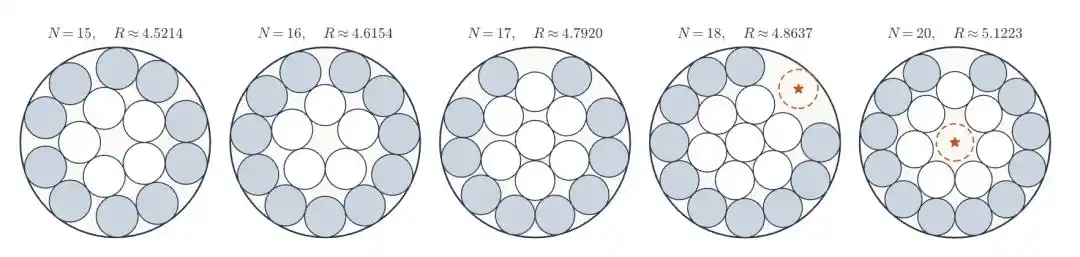
In fact, mathematicians did come up with beautiful packing arrangements back in 1969, but...... for 57 years, no one has been able to rigorously prove that they are the optimal solutions.
So this time, math enthusiast "nor" pulled out GPT-6 Astra...... and in one go, provided rigorous proofs for the 5 remaining cases for N≤20: namely N=15, 16, 17, 18, and 20......
Previously, only cases for N≤14 and N=19 had been verified.
Oh, and reaching N=20 is not the AI's limit; it's just that nor didn't intend to prove further cases......

A Proof Stalled for Half a Century
Let's first formalize this problem in a more mathematical way.
Assume there are N disks, each of radius 1, and a large circle of radius R.
Requirements:
All small disks must lie entirely inside the large circle; they can be tangent to the large circle's boundary but cannot extend beyond it.
Any two small disks cannot overlap internally, but they are allowed to be tangent to each other.
The small disks can be moved and arranged arbitrarily within the large circle, with no restrictions on the arrangement.
The question is: For a given positive integer N, what is the smallest possible radius R for the large circle?
It looks like a simple olympiad-style problem, but in reality, finding the optimal arrangement is just the first layer. The true difficulty lies in rigorously proving mathematically that the arrangement has reached its limit and that no better packing exists.
In 1968, American mathematician Ronald Graham proved the cases for N≤7.
In 1969, researcher Udo Pirl pushed the proven range to 10 disks and further studied packing schemes for 11-19 disks.
But it wasn't until around 2003 that cases for N≤14 and N=19 were rigorously proven.
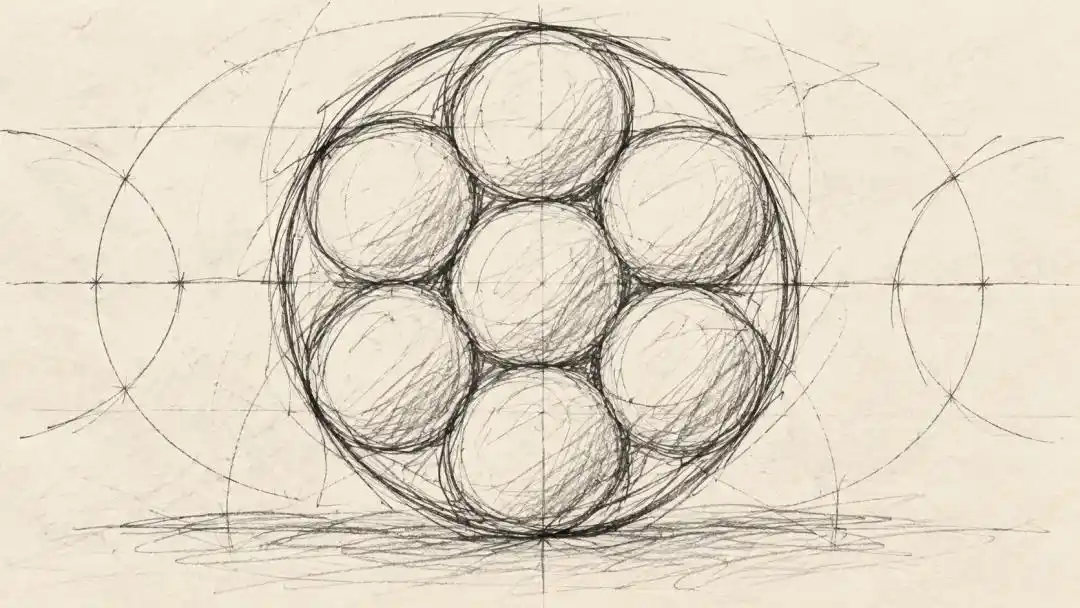
nor is a technical writer who has long been involved in research on mathematics, machine learning, and optimization algorithms, and has frequently participated publicly in AI-assisted mathematics research.
He personally started following this problem over a decade ago, and indeed, there hasn't been much progress on it in the past ten-plus years......
So what else is there to say? Might as well toss it to GPT-6 Astra (bushi).
nor took a step-by-step approach: first had GPT-6 Astra handle the N=15 case; after the model solved it, he had it extend the same method to 16, 17, as well as 18 and 20...... GPT-6 Astra successfully provided proof results for all of them.
It's just that......
The proof process is, as always, obscure and difficult to understand.

Simply put, the core idea of GPT-6 Astra is:
Instead of directly searching for the optimal solution, it uses geometric constraints to reduce the infinite number of possible arrangements to a finite set of cases, then uses a computer to eliminate them one by one, ultimately rigorously proving that the classic arrangement is optimal.

The proof process consists of 5 steps:
Push outer disks towards the boundary. Proves that under specific conditions, disks near the outer circle can be pushed outward without causing overlap. This divides the disks into a group on the boundary and a group in the interior.
Use angular relations to eliminate many arrangements. Since disks cannot overlap, they must maintain a certain angular separation. If a certain arrangement requires a total angular sum exceeding 360°, it can be directly eliminated.
Let the computer enumerate remaining possibilities. Instead of searching for the specific coordinates of each disk, it checks the distance intervals of the disks from the center and their cyclic order.
Use geometric rigidity to prove precise optimality. The previous search can only prove that all feasible arrangements are very close to the known classic arrangement. Next, using contact constraints between disks, it proves that these arrangements cannot undergo permissible tiny deformations, thus elevating "very close" to "strictly identical". The case for 15 disks uses another odd-cycle argument.
Restore the original arrangement. Finally, it proves that in the original arrangement, at least one disk must be in contact with the outer circle's boundary. This means it's impossible to pack all disks into an outer circle with a smaller radius, thus completing the optimality proof.
It's worth emphasizing that it's not like nor gave a single prompt and Astra immediately proved everything in one go.
In his blog post, nor writes that his contributions as a human in this work included:
Determining problem feasibility, guiding the model, battling the buggy web user interface, enduring poor copywriting, fixing subtle issues, repeatedly refining explanations, manually verifying validity, and re-checking everything using Astra and Opus 5.5.
One More Thing
A rather interesting thing is that once nor posted the results, he found quite a few fellow travelers using AI to research the same problem.


Some netizens also commented that AI's breakthroughs are making mathematics easier to understand, "I had no idea the math community could have such a strong exploratory atmosphere."
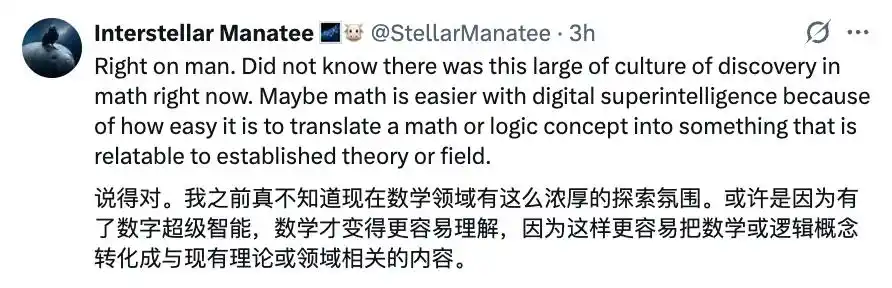
From the perspective of math enthusiasts, it's also a new phenomenon in the era of Mathematics 2.0.
Original links:
[1]https://nor-blog.pages.dev/posts/2026-10-11-circle-in-circle-packing-15-20/
[2]https://x.com/norxornor/status/2109078411251454017
This article is from the WeChat public account "QbitAI", author: Focus on Frontier Technology