Just Now, Claude 5.1 Released! The World's Most Powerful Model Is Here

marsbitPublished on 2026-09-02Last updated on 2026-09-02

Abstract

Anthropic has launched two new AI models: Claude Fable 5.1 and Claude Mythos 5.1. Fable 5.1 is described as one of the most powerful publicly available models, optimized for complex reasoning, long-term tasks, and agent workflows. It offers significantly improved performance over its predecessor, Fable 5, across various benchmarks—notably more than doubling scores in scientific research agent tests. Despite these gains, costs have been reduced by lowering cache read prices by 75%, leading to an estimated 25-45% cost reduction for typical and highly agentic workloads, respectively. The model demonstrates enhanced capabilities in debugging, scientific research (e.g., protein design, processing NASA data), and business automation. Mythos 5.1 shares the same base capabilities but operates under stricter safety controls and is available only to vetted partners for higher-risk domains like advanced cybersecurity and life sciences. Both models feature improved safety mechanisms with reduced false block rates. Fable 5.1 is now accessible via Anthropic's platforms and major cloud providers, while new anti-distillation measures and invisible watermarking for EU compliance have been introduced.

Just now, Anthropic has launched the new generation models Claude Fable 5.1 and Claude Mythos 5.1.

Anthropic claims that Claude Fable 5.1 is currently one of the most powerful publicly available models, designed for complex reasoning, long-cycle tasks, and Agent workflows. Claude Mythos 5.1, on the other hand, represents the higher boundary of their exploration.

It is important to note that while both share the same foundational model capabilities, they employ different safety measures tailored for different usage scenarios.

Fable 5.1 is open to general users, developers, and enterprises. Mythos 5.1 is available to vetted partners in high-risk fields, maintaining stricter access controls.

In other words, one is tasked with entering the real world to work, while the other is kept in a more strictly controlled environment. This might also be Anthropic's exploration of a future AI product form: the most powerful model may not be provided to everyone in the same form.

Officially, they state that these two models represent significant progress in the Claude series' capabilities and demonstrate how they continue to advance safe deployment while enhancing model performance.

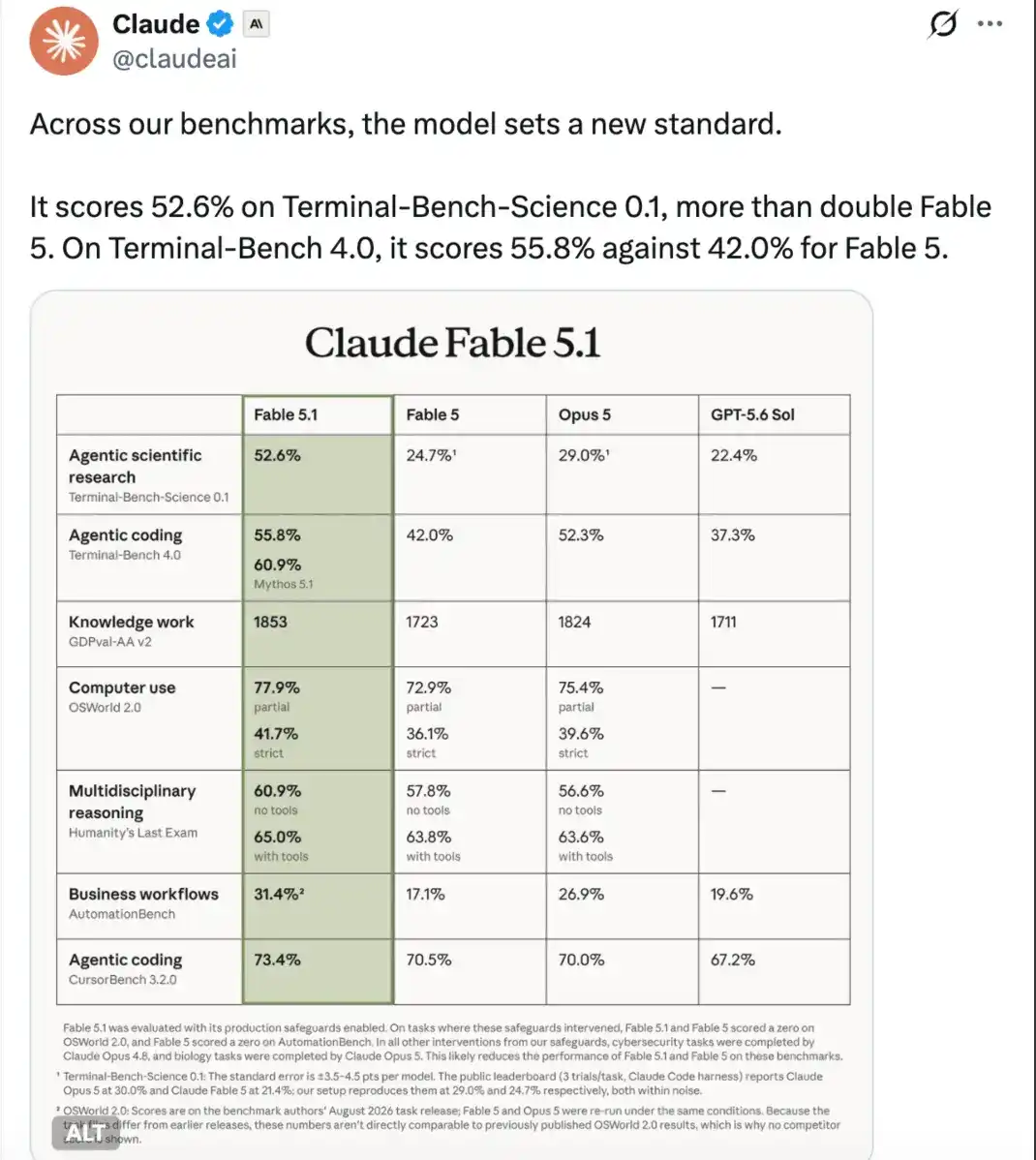
As the "world's most powerful" model, Fable 5.1's performance remains impressive. Official data shows that Fable 5.1 outperforms the previous flagship Fable 5 in multiple benchmark tests.
But with greater power comes a cheaper price. Anthropic states that Fable 5.1 maintains the same base price, while cache read costs are reduced by 75% compared to Fable 5. In practical use, this reduces the overall cost of the model by about 25% for typical workloads; for highly agentic workloads, costs can be reduced by up to 45%.
It seems even the most powerful models are now emphasizing cost-effectiveness.

Let's take a closer look.

Lower Tiers Match the Previous Generation, Fable 5.1 Focuses on "Cost-effectiveness"

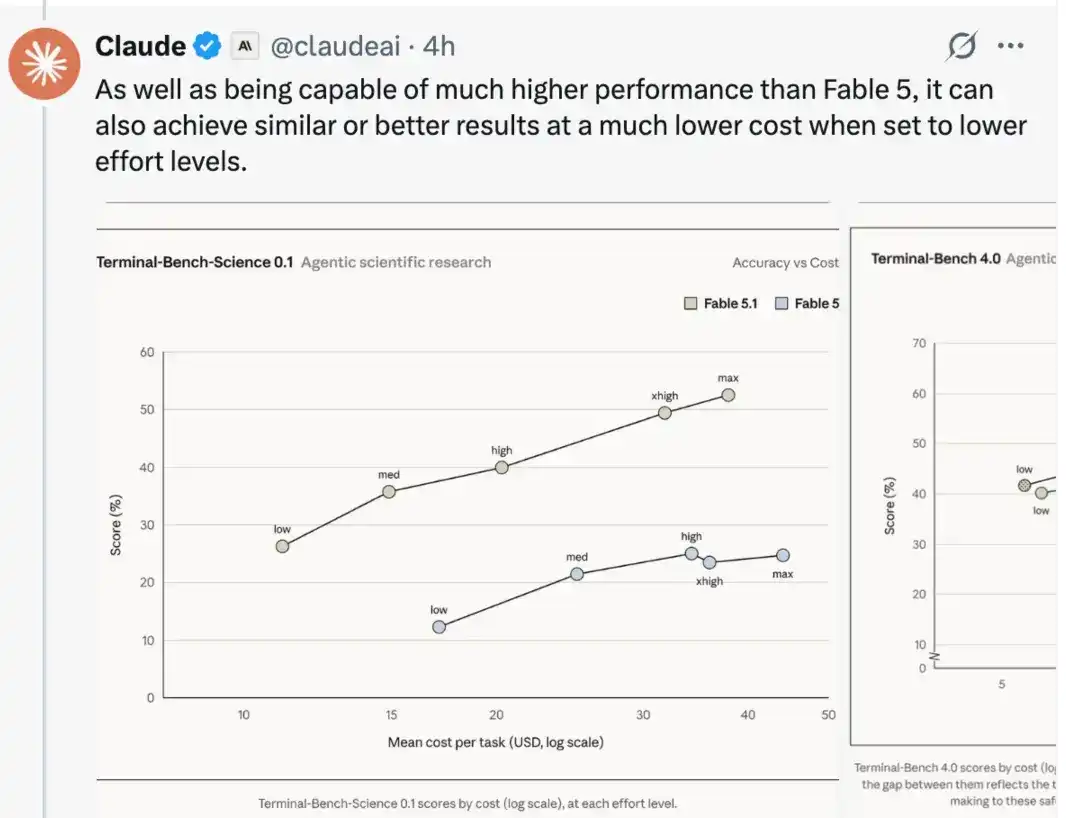
Compared to simply topping the leaderboards, Anthropic this time emphasizes more: Fable 5.1 can complete tasks that previously required Fable 5's higher inference tiers at lower inference costs.

According to official tests, Fable 5.1 at low and medium inference strengths can already achieve performance close to or even surpassing Fable 5. Claude Code defaults to high inference strength, while Claude Cowork and Claude . ai default to medium strength. Users can also adjust between speed, cost, and effectiveness based on task complexity.

Specifically, Fable 5.1 achieved 52.6% on the scientific research-oriented Agent benchmark Terminal-Bench-Science 0.1, more than double the 24.7% of Fable 5; on Terminal-Bench 4.0, Fable 5.1 reached 55.8%, and Mythos 5.1 with more capabilities unlocked further reached 60.9%.

In knowledge work, computer operations, and business process tests, the new models also show improvements. AutomationBench scores increased from 17.1% for Fable 5 to 31.4%, and CursorBench 3.2.0 improved from 70.5% to 73.4%.
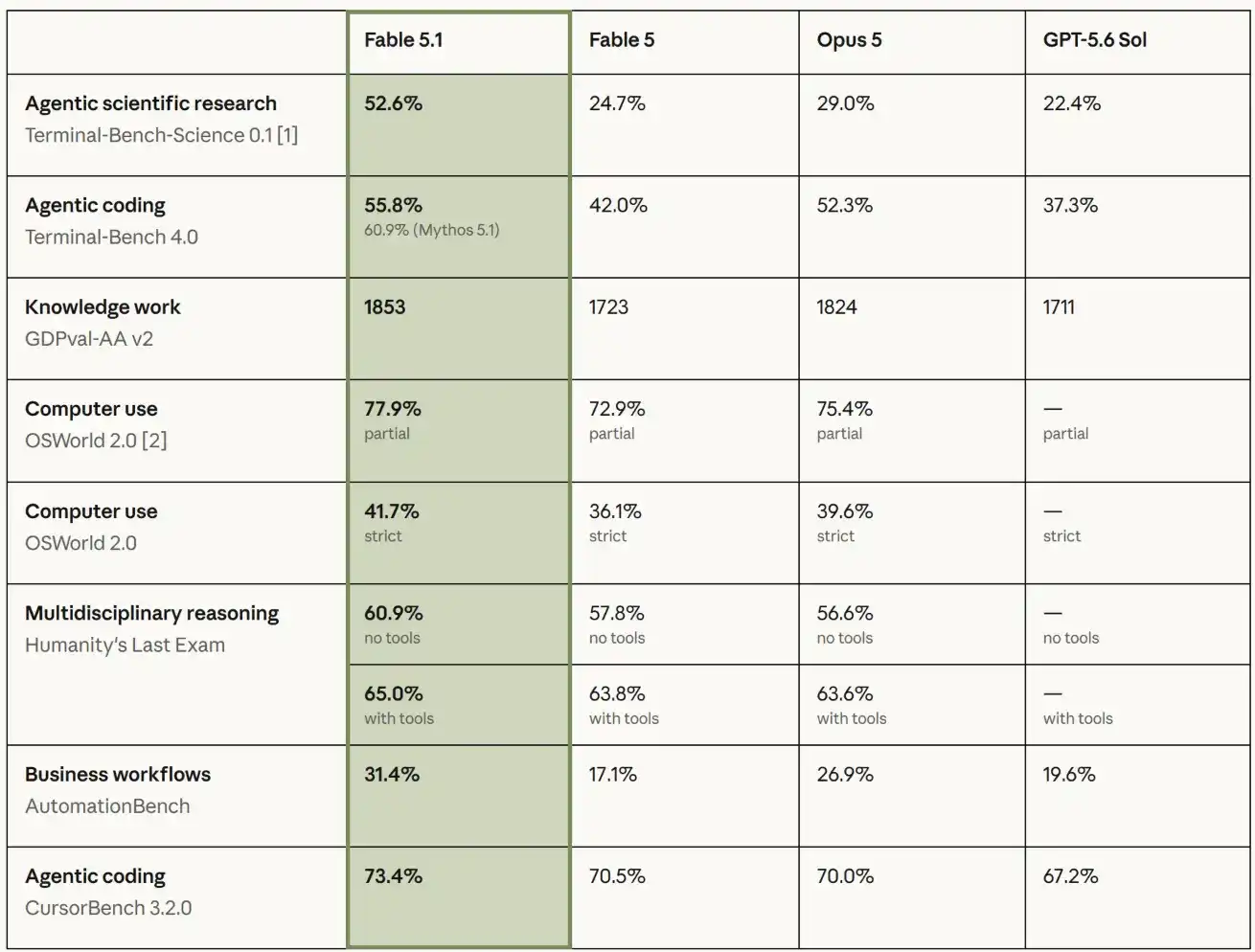
In multiple benchmark tests, Fable 5.1's scores surpassed Fable 5, with the most significant improvements in scientific research Agent and business workflow capabilities.
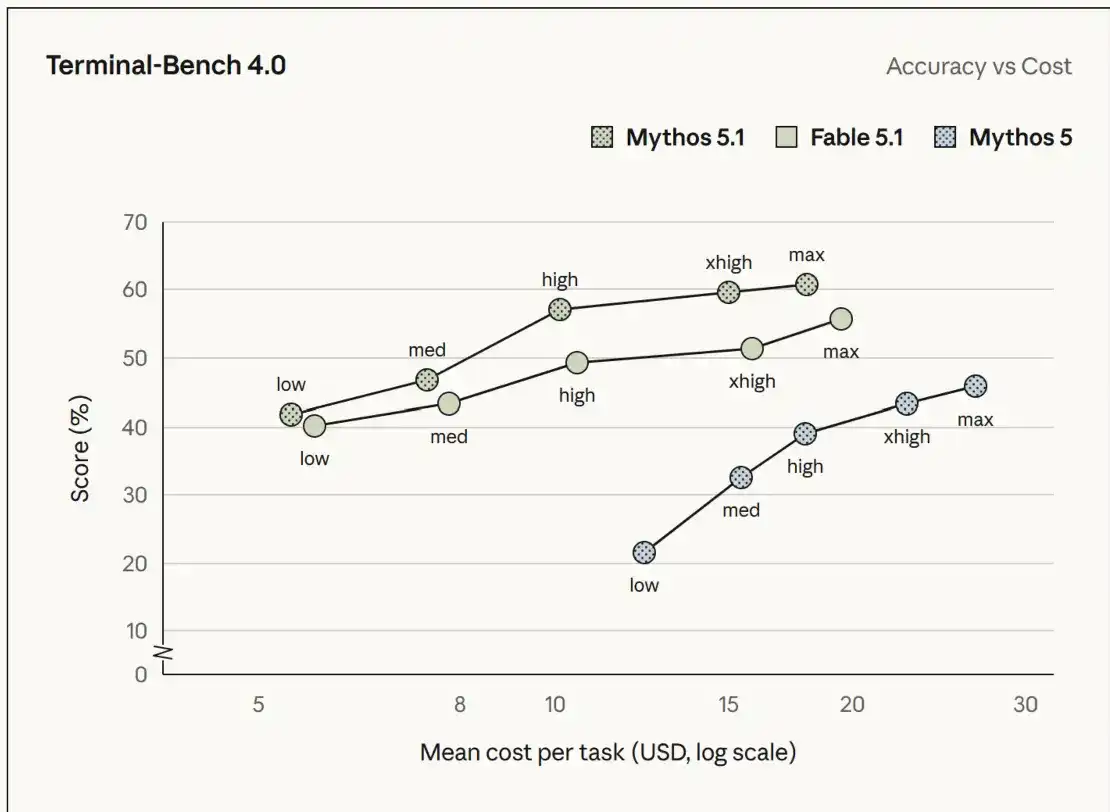
In the Terminal-Bench 4.0 test, both Fable 5.1 and Mythos 5.1 exceeded the previous generation Mythos 5 at different inference strengths.
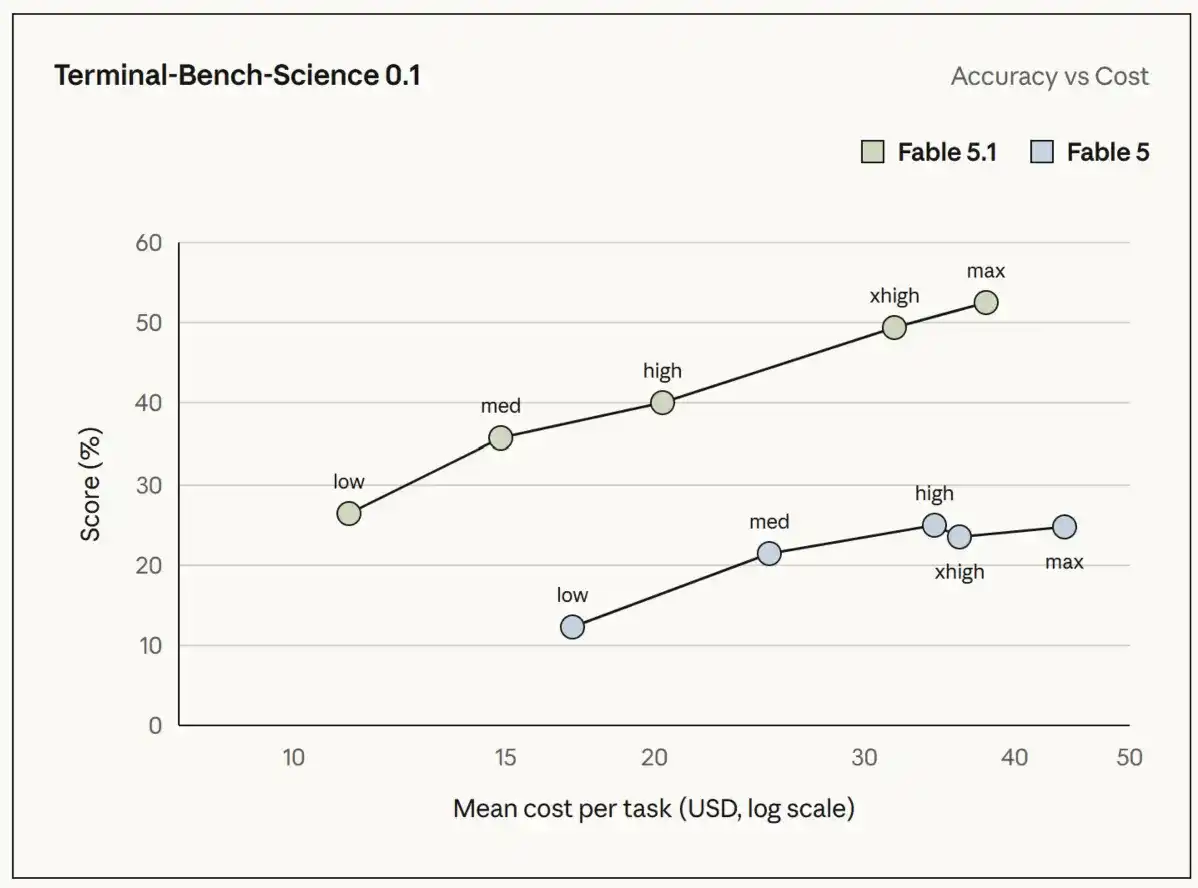
In the Terminal-Bench-Science 0.1 test, Fable 5.1's highest score reached 52.6%, more than double that of Fable 5.

Anthropic believes an important change in Fable 5.1 is its greater willingness to track the root causes of problems, making it more suitable for executing complex tasks lasting hours or even tens of hours.

Investment firm Millennium discovered during testing that an internal piece of code would crash about once every million runs. This problem had troubled the engineering team for four or five years, and other models couldn't find the cause. Fable 5.1, however, by disassembling an external vendor's library and comparing core dump files, ultimately pinpointed the issue to a bug in the third-party library.

Ramp also had Fable 5.1 run continuously for 38 hours. After discovering that original machine learning results were affected by labeling errors, the model corrected the problem, launched six sets of experiments, and finally compiled new results and follow-up recommendations.

From Writing Code to Conducting Scientific Research

In this release, Anthropic dedicates considerable space to introducing the performance of Fable 5.1 and Mythos 5.1 in scientific research.

In a protein design experiment, researchers had Mythos 5.1 call open-source protein design and folding tools, then sent the generated designs to two external institutions for experimental validation.

On three target proteins, the affinity of the binders designed by Mythos 5.1 was 10 times that of the best solutions in the Adaptyv Bio related protein design competition. When targeting 12 proteins, the model's effective binder hit rate approached 50%, while Anthropic cites the common industry level as 10% to 15%.

Fable 5.1 also used radar images collected over 30 years ago by NASA's Magellan probe to generate a new high-resolution elevation map for about one-third of Venus's surface.
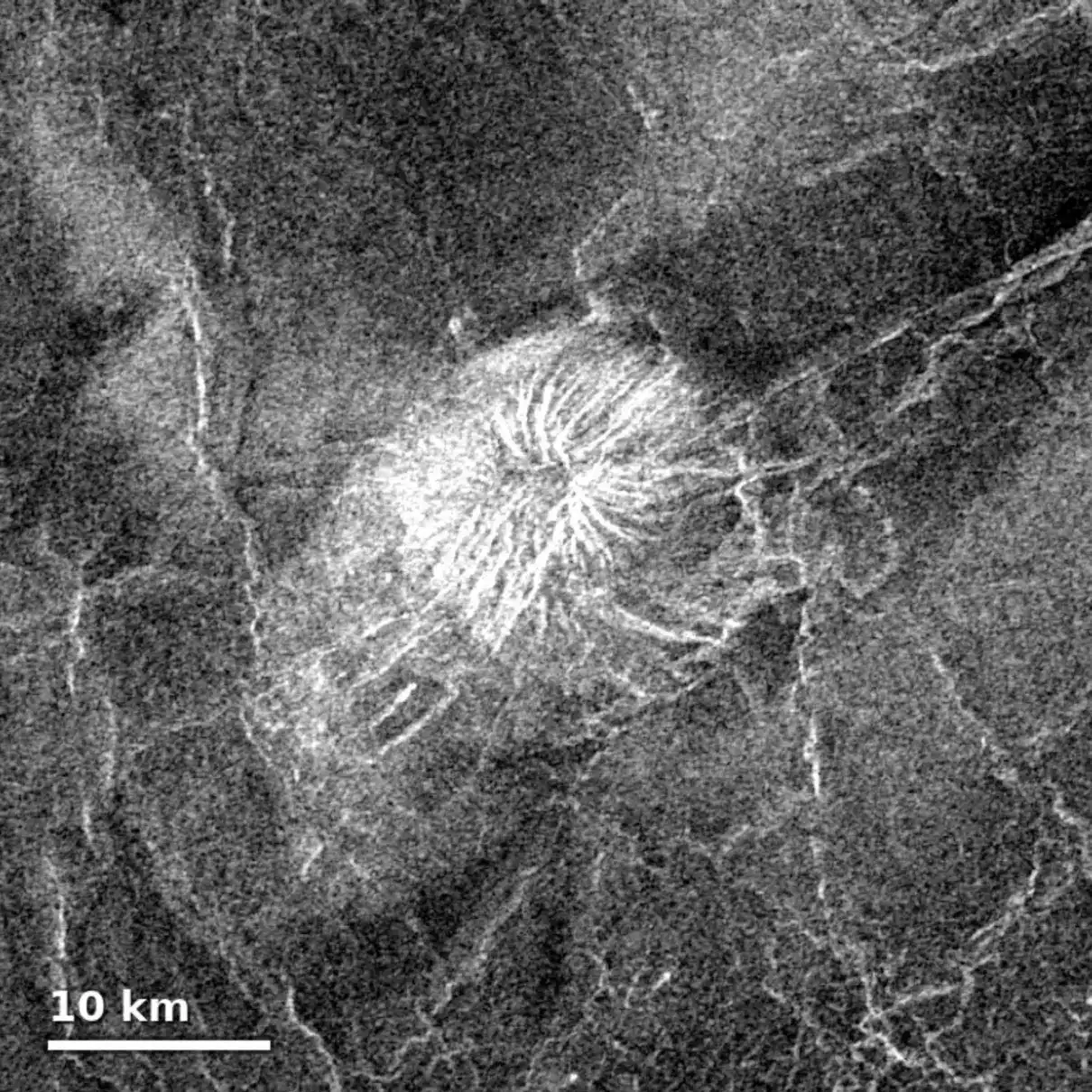
NASA Magellan probe radar image of Venus, showing a small shield volcano about 15 km in diameter at the center.

The original map could only show details at a scale of 10 to 20 kilometers. The new map improves the resolution capability to 2 to 3 kilometers, with elevation measurement accuracy improved by up to 25%. Anthropic plans to release this map under a Creative Commons license for reference by follow-up missions like NASA's VERITAS and the European Space Agency's EnVision.

In computational biology, Mythos 5.1 increased the runtime speed of 7 open-source protein and genome deep learning models by up to 2.5 times by writing custom GPU kernels and caching intermediate results, while maintaining consistent output. For some whole-genome analysis tasks, GPU costs are projected to be reduced by 30% to 60%.
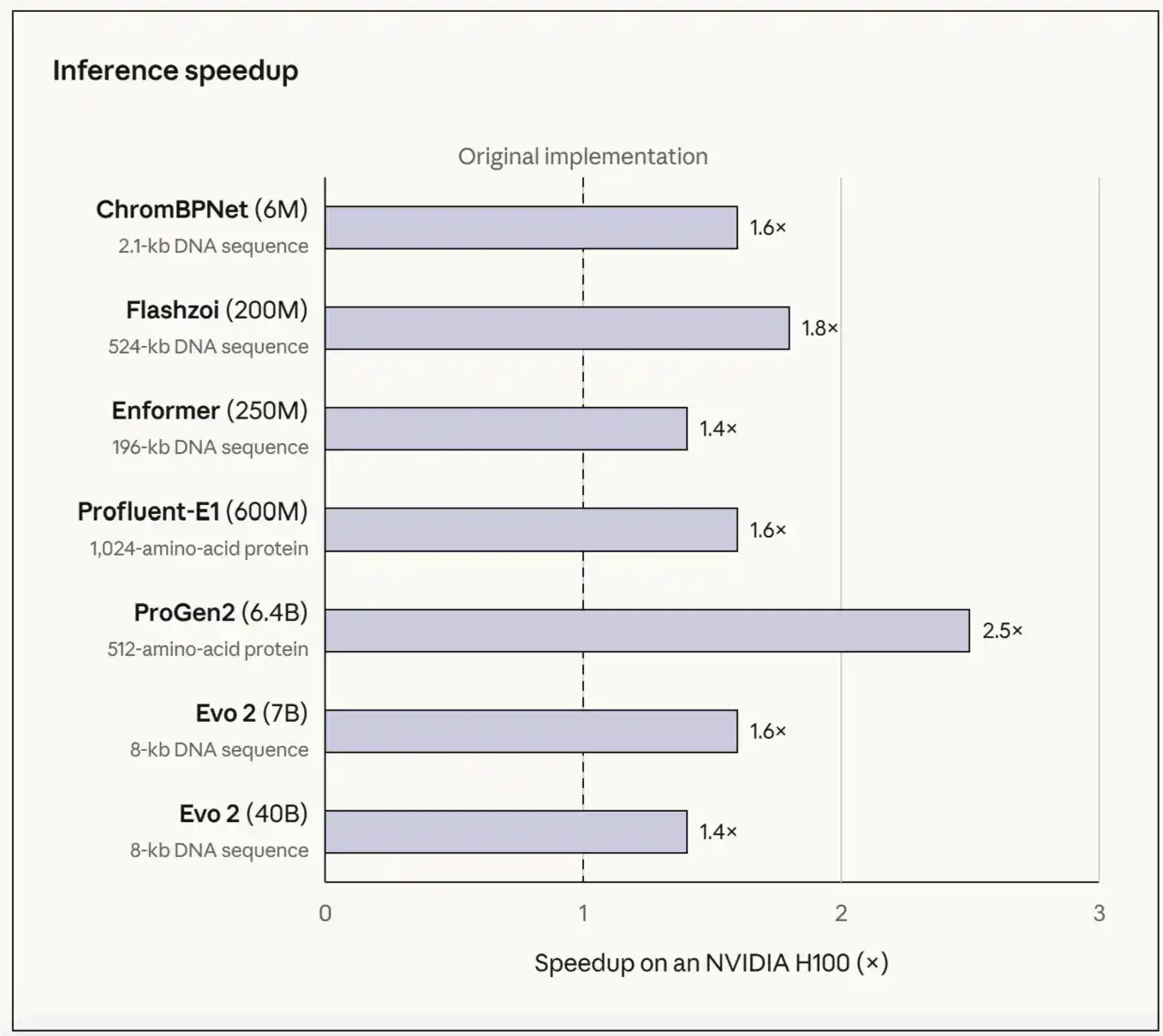
After Mythos 5.1 optimized 7 open-source protein and genome models, inference speed increased by 1.4 to 2.5 times.

Anthropic wants to use these cases to demonstrate that models are moving from organizing materials and writing code to proposing solutions, running tools, and delivering scientific results ready for experimental validation.

Cache Prices Drop 75%, Agent Tasks Up to 45% Cheaper

Beyond performance, pricing is the most direct change for Fable 5.1.

The input and output prices for Fable 5.1 remain unchanged at $10 and $50 per million tokens, respectively. However, the cache read price has been reduced by 75% from previous levels to $0.25 per million tokens.

Cache reading refers to the model reusing already processed context. Its proportion might be limited in simple Q&A, but in Agent tasks that require repeatedly reading codebases, conversation history, and tool results, cache often constitutes the main cost.

Based on Anthropic's calculations from actual usage data in August 2026, the overall cost of running typical tasks with Fable 5.1 is about 25% lower than with Fable 5; for complex Agent tasks with long contexts and frequent tool calls, the cost reduction can reach up to about 45%.
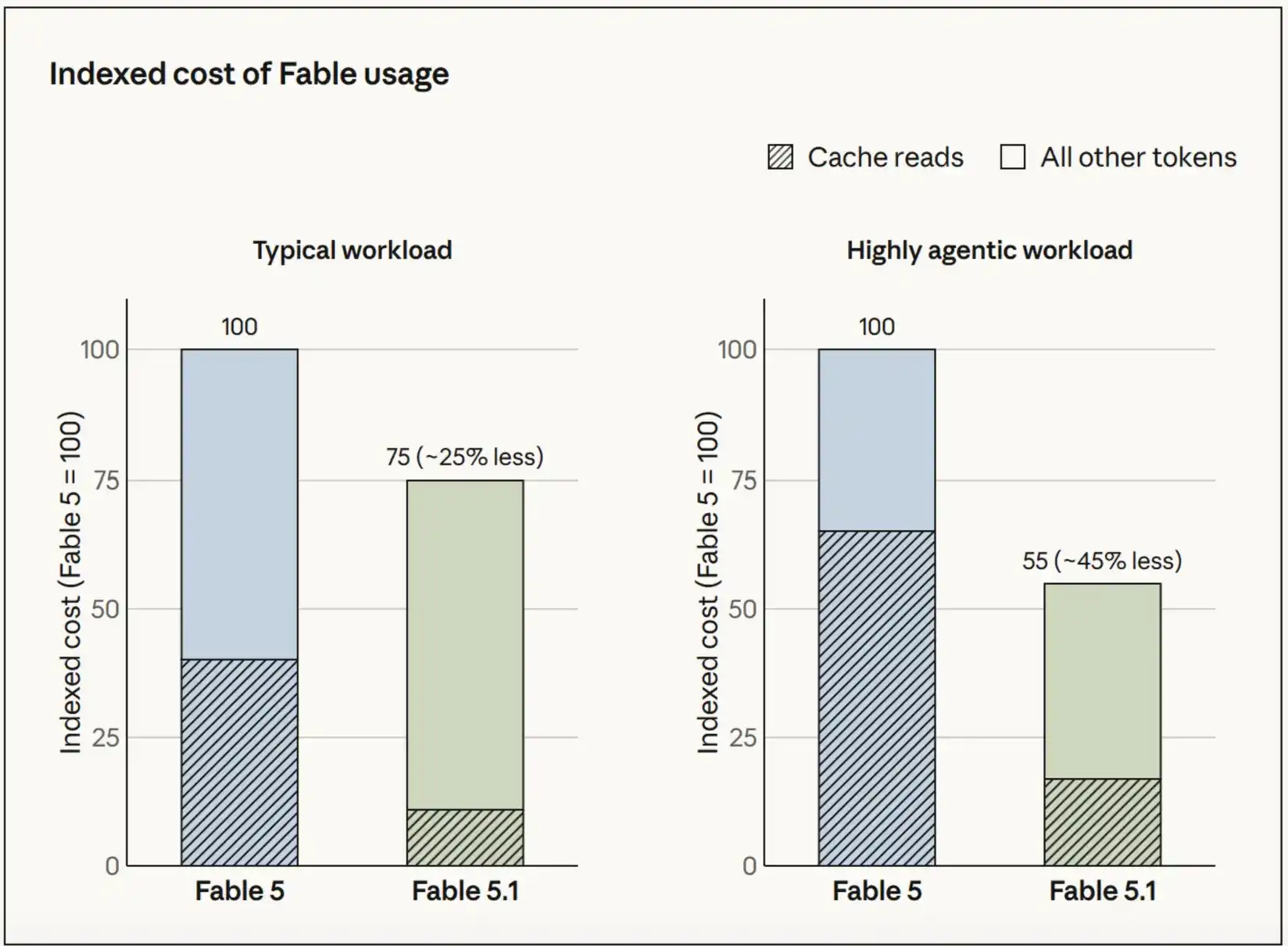
After the cache read price reduction, typical task costs for Fable 5.1 decreased by about 25%, with highly agentic task costs reduced by up to about 45%.

Fable 5.1 is now available on Claude . ai, Claude Code, and the Claude API, and is also offered through AWS, Google Cloud, and Microsoft Azure. Developers can call the new model via claude-fable-5-1.

Anti-Distillation Mechanisms Strengthened

Fable 5.1 and Mythos 5.1 actually use the same underlying model. Their main difference lies in safety restrictions.

Fable 5.1 is fully open to general users and enterprises. Mythos 5.1 has looser cybersecurity and life sciences restrictions and is currently only available to vetted individuals and institutions.

In cybersecurity, Fable 5.1 can already help users discover software vulnerabilities but still cannot directly generate exploit code. Dual-use tasks like penetration testing, exploit generation, and vulnerability scanning based on binary files may still be handed over to more restricted models.

After adjustments, the new cybersecurity protection mechanism's false positive rate is reduced by about 60% compared to Fable 5. The biosafety mechanism's false positive rate for basic biology and medical questions is also reduced by 85%, while advanced capabilities involving life sciences R&D are mainly opened through Mythos 5.1's vetting program.

Anthropic has also introduced Enterprise Frontier Safeguards. Enterprises can keep data in their own controlled cloud infrastructure, with the enterprise responsible for default human review, thereby achieving privacy effects close to "zero data retention" while retaining safety monitoring capabilities. This mechanism is planned to roll out in phases starting this fall.

For large-scale model distillation, Fable 5.1 has also added new restrictions. For API accounts created after today, it will no longer be possible to retain Claude's historical thinking records while manually modifying previous context in multi-turn conversations. Anthropic states this change primarily aims to block a publicly known capability extraction method.

Furthermore, to meet the requirements of the EU AI Act, Fable 5.1's text output will contain invisible watermarks. Anthropic has also begun small-scale testing of a detection API, initially open to regulators, media, fact-checking organizations, and research institutions.

Finally, as netizens say, the early bird gets to use 5.1.

Related Questions

QWhat are the two new models announced by Anthropic, and what are their primary purposes?

AAnthropic announced Claude Fable 5.1 and Claude Mythos 5.1. Claude Fable 5.1 is designed for complex reasoning, long-horizon tasks, and Agent workflows, and is available to general users, developers, and businesses. Claude Mythos 5.1 represents a higher capability frontier and is offered to vetted partners in higher-risk domains under stricter access controls.

QWhat are the key performance and cost improvements of Claude Fable 5.1 compared to its predecessor, Fable 5?

AClaude Fable 5.1 shows significant performance gains in benchmarks like Terminal-Bench-Science 0.1 (52.6% vs 24.7%) and Terminal-Bench 4.0 (55.8% vs lower scores for Fable 5). Crucially, while maintaining the same base price, its cache read cost is reduced by 75%, leading to an overall cost reduction of about 25% for typical workloads and up to 45% for highly agentic workloads.

QHow does the new model demonstrate capabilities in scientific research, according to the article?

AThe models show advanced scientific research capabilities. Mythos 5.1 designed protein binders with 10x higher affinity than competition winners and achieved a near 50% hit rate. Fable 5.1 created a new high-resolution elevation map of Venus from old NASA data, improving resolution from 10-20 km to 2-3 km. Mythos 5.1 also optimized seven open-source bioinformatics models, speeding them up by 1.4x to 2.5x.

QWhat are the main differences in safety and access between Claude Fable 5.1 and Claude Mythos 5.1?

ABoth models share the same base capabilities but differ in safety measures. Fable 5.1 is broadly available with standard safety restrictions. Mythos 5.1 has looser restrictions in areas like cybersecurity and life sciences, allowing tasks like exploit generation or advanced bio-research, but access is strictly controlled and granted only to vetted partners after review.

QWhat new security and compliance features are introduced with the Fable 5.1 release?

AKey new features include: 1) Enhanced anti-distillation measures preventing manual context modification in multi-turn conversations for new API accounts. 2) 'Enterprise Frontier Safeguards' for data control and near-zero data retention. 3) Reduced false positive rates for cybersecurity (by ~60%) and biosafety (by 85%) mechanisms. 4) Inclusion of invisible watermarks in text outputs for EU AI Act compliance, alongside a detection API for authorized entities.

Related Reads

Canton Foundation Launches Official Daml 3 Certification, Expanding Developer Access and Establishing Institutional Finance Standards

Canton Foundation has launched the Canton Developer Certification, an official certification program for Daml 3, the smart contract language of the Canton Network. Combining a self-paced course with a certification exam, it offers developers worldwide a structured path to building applications for regulated financial markets. Canton Network is a public, permissionless blockchain designed for regulated finance, with over $6 trillion in on-chain assets processed by its supported applications. Daml is built to manage who may act on a contract and who may access its terms; the certification validates practical mastery of these authorization and privacy principles, establishing a recognized standard intended to strengthen institutional confidence in applications built on the network. The program is based on Daml 3 and Canton 3.x, the current technology underlying the network, letting newcomers start on the latest stack, helping production engineers deepen expertise, enabling institutional architects to design and integrate Canton deployments, and allowing existing Daml 2 developers to migrate their skills and codebases to Daml 3, unifying the community on a single, current platform. For ecosystem partners—financial institutions, application providers, system integrators, and validators—the certification provides a common technical foundation and a consistent way to assess developers' understanding of authorization and privacy requirements. Canton Foundation COO Amanda Martin said financial institutions need confidence that the applications they rely on are built by developers who understand regulated market requirements, and that the program both opens opportunities for developers globally and establishes a shared professional standard, building a stronger foundation for Canton's future growth by bringing the community together on Daml 3. The certification is now live at certification.canton.foundation; the course is self-paced and free to all developers, and the exam costs $150 per attempt. Canton Foundation is an independent nonprofit responsible for the governance and long-term development of Canton Network's shared infrastructure, supporting transparent and decentralized governance, ecosystem coordination, and broad participation by Global Synchronizer operators and network stakeholders, while working with financial institutions, technology providers, developers, and other participants to support the network's continued global growth and adoption.

marsbit9m ago

Canton Foundation Launches Official Daml 3 Certification, Expanding Developer Access and Establishing Institutional Finance Standards

marsbit9m ago

Nvidia Faces Independent Investigation, Bernstein Maintains $400 Target Price

Nvidia's board has launched an independent investigation following reports about CEO Jensen Huang's contacts with Megaspeed executive Alice Huang, though it says there is no reason to believe U.S. national security or company secrets were compromised. Three Republican House committee chairs have requested Huang attend a closed-door briefing on November 18 to explain the contacts and Nvidia's internal procedures for countering foreign intelligence activities, and Democratic Senator Chris Coons said Congress will investigate. Some reports suggested Alice Huang may have influenced Huang's lobbying to ease chip export restrictions to China, a claim Bernstein doubts, noting Huang has long publicly pushed to expand sales in China and that revenue from mainland China and Hong Kong has fallen sharply since export controls. Only H20 and limited H200 chips were approved for China sales, well behind Nvidia's most advanced products, and Bernstein sees limited room for recovery as Chinese customers prioritize domestic alternatives. Regulatory pressure may persist, with hawkish lawmakers potentially revisiting export limits. Bernstein maintains an Outperform rating and a $400 target price, about 114% above the November 6 close of $186.64, citing data center demand and earnings growth. It projects adjusted EPS of $4.77 for FY2026, $9.20 for FY2027 and $15.80 for FY2028. The target is based on average FY2028-2029 non-GAAP EPS of $19.04 at about 21x. Bernstein also flags Huang's succession as a key risk, given his central role and roughly 60 direct reports.

marsbit19m ago

Nvidia Faces Independent Investigation, Bernstein Maintains $400 Target Price

marsbit19m ago

Two Blocks Hit in 7 Hours: Two Retail Miners Take on the Entire Network's Hashrate and Walk Away with $476,000

Two individual solo miners using home mining rigs hit two Bitcoin blocks within seven hours on November 7, earning a combined $476,000. One miner using a Canaan AvalonQ home miner with roughly 80–87 TH/s earned about $239,000; the other earned roughly $237,000. A CKPool solo platform took about 2% (0.0629 BTC) as a service fee, with the rest going directly to the miners' wallets. Given current network difficulty of about 148.4 trillion, such a rig would normally need over a century to find a block, making the win a luck value of over 10,000%. This is part of a broader trend: in 2026 so far, solo miners have found 36 blocks, nearly one lucky winner per week. Earlier examples include a 6.5 TH/s Avalon Nano 3S worth a few hundred dollars earning $250,000 on October 27, another Nano 3S earning $232,000 on May 30, and a $150 Bitaxe Gamma earning $200,000 on July 10. Home solo mining is often called "plug-in lottery": a 1.2 TH/s mini miner has about a 1-in-16,000 annual chance of winning, far better than Powerball's 1-in-292 million, but rigs cost thousands of dollars and electricity runs $400–$1,100 monthly, with zero income until a block is found. Each viral win serves as free advertising for the industry. Rig manufacturers sell the dream of "maybe I'll win too"; solo pool platforms collect a steady ~2% fee from any winner; and the Bitcoin network preserves its "anyone can participate" narrative despite mining being dominated by large farms. The people paying for it all are ordinary buyers who purchase miners and pay electricity bills hoping for a life-changing jackpot.

marsbit35m ago

Two Blocks Hit in 7 Hours: Two Retail Miners Take on the Entire Network's Hashrate and Walk Away with $476,000

marsbit35m ago

NYSE Picks Avalanche, Why AVAX May Not Capture the Settlement Flow

On November 9, Ava Labs announced that a tokenized securities trading platform affiliated with the NYSE had selected Avalanche to provide core ledger technology for its clearing firm. The platform is a regulated alternative trading system (ATS) designed for 24/7 trading, clearing, and settlement, pending regulatory approval. The Wall Street Journal reported a stronger version: the NYSE would "exclusively" use Avalanche to settle tokenized stocks, with matching still handled by existing technology and a Q4 launch target—though Ava Labs' announcement gave no launch date and did not name the clearing firm. Markets traded the headline first, with AVAX rising roughly 8–11% to near $9 intraday. But the announcement places Avalanche at the clearing-ledger layer, not the main board on a public chain—a distinction that determines whether AVAX captures narrative or verifiable demand. Matching (who trades with whom at what price) stays on the NYSE's Pillar engine; settlement (how cash and securities transfer) goes to the blockchain ledger. Ava Labs said it provides core ledger tech for the clearing firm of the NYSE-affiliated ATS, without disclosing the firm's identity, contract value, or timeline. Tokenized stocks involve three layers: issuance, matching, and settlement. NYSE digital issuance head Dennis Lee said the platform will support stocks listed across multiple chains, but the settlement ledger must be fast, reliable, permissioned, and cost-predictable. Issuance can be multi-chain; settlement converges on one controlled system. The "exclusive" label refers to the settlement ledger, not the whole value chain. ICE previously said the platform combines Pillar with blockchain post-trade systems supporting multi-chain settlement and custody. Ava Labs CBO John Nahas said the NYSE will run a custom Avalanche-based chain tailored to regulatory needs, not use the public Avalanche chain—two very different things. A permissioned chain lets the exchange control access, node deployment, and fee pricing. Founder Emin Gün Sirer cited round-the-clock atomic settlement, predictable performance and cost, and regulatory control. This explains why AVAX's price reaction outpaced fundamental certainty: brand association arrived first, while fee capture remains undisclosed—whether the custom chain uses AVAX for pricing, staking, or fees was not answered. Charles Schwab's same-day addition of AVAX to retail trading offers a competing explanation for the gains. Three unresolved variables determine the significance: regulatory approval (no public status), the clearing firm's identity (unnamed legal entity), and token economics. AVAX's economic link is distant—a custom chain does not equal public-chain lockup or AVAX becoming a settlement asset. Issuer willingness also matters; the NYSE recently expanded transfer agents for issuer-sponsored tokenized securities to six, with Broadridge handling on-chain voting and governance, but whether tokenized equities enter this ATS depends on liquidity, compliance costs, and shareholder communication. Until the platform launches and the clearing firm appears, vendor selection is a necessary step, not realized demand.

marsbit38m ago

NYSE Picks Avalanche, Why AVAX May Not Capture the Settlement Flow

marsbit38m ago

Ethereum Foundation and Vitalik Taken to Court: A Cancer Patient's Dismissal and a "Seppuku Pledge"

In November 2026, a civil complaint filed in a Colorado federal court named the Ethereum Foundation and Vitalik Buterin as defendants. The plaintiff, Kayleen Fulton, former head of EF's Protocol Support team, alleges she was fired after being diagnosed with ovarian cancer, and that the real reason was her leading opposition to the controversial "EF Mandate" document and its "Source Seppuku License." The complaint describes a timeline in which Fulton received her highest performance rating and a 21.9% raise in September 2025, before the 38-page Mandate was published in March 2026, featuring Milady-style imagery and a clause demanding signers "voluntarily exit" if they violated its principles—wording invoking seppuku, published roughly a year after a colleague's suicide. Seventy-nine employees reportedly voted to remove the clause, and Buterin allegedly promised major revisions that never came; the Mandate was instead recorded permanently on-chain. Fulton was diagnosed with cancer on March 19; the next day, co-executive director Bastian Aue issued an ultimatum requiring all staff to sign a loyalty oath to the Mandate or be treated as having resigned. Fulton disclosed her diagnosis on March 24 and, with Trent Van Epps, drafted a letter signed by 53 protocol cluster members refusing to sign under duress while stating they had not resigned. Both Fulton and Van Epps were fired on April 6 without stated reasons. The complaint's most damaging element is a recorded May 1 call in which Buterin allegedly said he was considering what behavior patterns EF should reward—implying protesters should not receive positive outcomes. Buterin is accused of aiding and abetting discrimination and retaliation. The complaint raises 11 claims, including ADA and FMLA violations, Colorado anti-discrimination provisions, illegal confidentiality clauses, wrongful termination, and intentional infliction of emotional distress. Fulton signed a separation agreement on April 9 under severe psychological pressure and threat of losing health insurance, then revoked it on April 17. She seeks a jury trial, back pay, expected wages, punitive damages, $5,000 statutory penalties per violation, and attorney fees. The case unfolds amid massive EF turmoil: about 20% of staff (roughly 54 people) were cut, protocol cluster leaders Tim Beiko and Barnabé Monnot resigned, Alex Stokes took extended leave, co-executive director Tomasz Stańczak departed, and Fulton's former team was dissolved in July 2026. Buterin publicly framed the changes as becoming a "smaller ship" focused on CROPS. The lawsuit tests whether traditional labor protections apply to a Swiss foundation using employer-of-record arrangements while claiming to be "not an employer," and raises broader governance concerns for the crypto industry.

marsbit39m ago

Ethereum Foundation and Vitalik Taken to Court: A Cancer Patient's Dismissal and a "Seppuku Pledge"

marsbit39m ago

Trading

Spot
活动图片