Japan is dragging the world down with it

marsbitPublished on 2026-09-10Last updated on 2026-09-10

Abstract

Japan's 10-year government bond yield surpassed 3% for the first time since 1996. According to a Nomura Research Institute report, the primary driver of this global rise in long-term interest rates is Japan's domestic factors, not external influences. A key contributor is the heightened risk premium due to concerns over Japan's deteriorating fiscal situation, which outweighs the impact of inflation expectations and monetary policy shifts. The report identifies three main factors behind the yield surge: expectations of Federal Reserve rate hikes, anticipation of a Bank of Japan policy rate increase, and significant risks from Japan's expanding fiscal budget. Notably, fiscal risk premiums are the largest single factor pushing yields higher. The Trump administration has unusually intervened in Japan's economic policy, urging both monetary tightening and fiscal consolidation. This move aims to mitigate potential global negative spillovers from a weak yen and rising Japanese bond yields. Nomura warns that this Japan-originated rise in global long-term rates poses systemic risks. It could increase government debt servicing costs, destabilize financial institutions' balance sheets, and depress risk asset prices, particularly in real estate and equities. Tech and AI-related stocks, being highly sensitive to interest rates, could see a significant cooling-off in investment enthusiasm. This scenario might trigger not just a gradual economic slowdown but a sudden deceleration, explai...

Original Author: Zhao Ying

Original Source: Wall Street News

Japanese government bond (JGB) yields have surpassed 3% for the first time in 30 years. Nomura Research Institute warns that the source of this round of global long-term interest rate increases is Japan itself, not external factors. The combination of Japan's fiscal risks and the expectation of monetary policy normalization is spreading to the global market through the bond market, posing a systemic threat to tech stocks, AI investment, and even the real economy.

The yield on 10-year Japanese Government Bonds (JGBs) briefly exceeded 3.0% during trading in Tokyo, marking the first time since September 1996. According to Feng Chasing Trading Desk, Takahide Kiuchi, Executive Economist at Nomura Research Institute, noted in a recent report that over the past year, the yield on 10-year JGBs has risen by approximately 1.4 percentage points, while the increase in the U.S. 10-year Treasury yield was only about half of Japan's. This suggests the rise in JGB yields is primarily driven by domestic factors, not transmission from overseas markets.

Takahide Kiuchi argues that, in terms of absolute yield levels, Japanese bonds have hit a 30-year high, while U.S. Treasuries have only returned to levels seen since January 2025. The yield on German 10-year government bonds is at its highest since 2011, and the yield on UK 10-year gilts is at its highest since 2008. In a comprehensive comparison, Japan is more likely to be the source pushing global long-term rates higher, rather than a passive follower. Meanwhile, the Trump administration has begun unusually intervening in Japan's economic policies, pressuring the Bank of Japan to raise interest rates and urging the Kishida government to scale back fiscal expansion.

Three factors pushing Japanese bond yields above 3%

According to the Nomura Research Institute report, the 10-year JGB yield approached the 3% mark in August and finally breached this integer level intraday on September 1, driven by three main forces.

First, rising expectations for Fed rate hikes. Recent comments by Fed Chair Kevin Warsh at the Jackson Hole symposium reinforced market expectations for a rate hike at the Fed's September Federal Open Market Committee (FOMC) meeting, putting pressure on global bond markets.

Second, rising expectations for BOJ rate hikes. The market widely expects the Bank of Japan to raise its policy rate at its September monetary policy meeting, further pushing up JGB yields.

Third, intensifying risks of Japanese fiscal expansion. By the end of August, the total budget requests from various Japanese ministries for the 2027 fiscal year's general account exceeded the 2026 fiscal year's budget by about 20 trillion yen, significantly heightening market concerns about the deterioration of Japan's fiscal situation.

Fiscal risk is the primary cause of yield increases

Nomura Research Institute conducted a decomposition analysis of the factors behind the 1.4 percentage point increase in the 10-year JGB yield over the past year. The results show that rising inflation expectations contributed approximately 0.49 percentage points, changes in the BOJ's JGB holdings contributed about 0.08 percentage points, the rise in U.S. 10-year Treasury yields contributed about 0.08 percentage points, changes in expectations for the real policy rate contributed about 0.15 percentage points, and "other" factors contributed a substantial 0.60 percentage points—a category believed to primarily reflect the risk premium associated with the deterioration of Japan's fiscal condition.
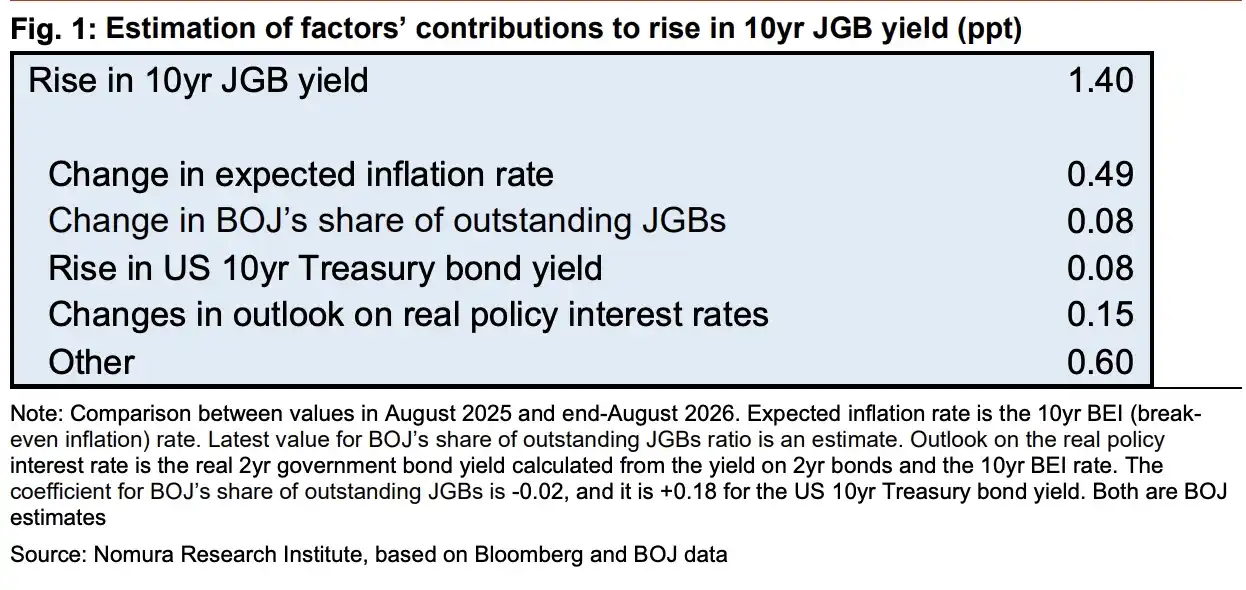
This means that among all factors pushing JGB yields higher, the fiscal risk premium is the single largest contributor, far exceeding the impact of inflation expectations and monetary policy expectations.

Takahide Kiuchi points out that rising long-term interest rates are not always a "bad thing"—if they stem from increased economic growth potential or rising inflation expectations, real interest rates may not necessarily follow suit, limiting negative shocks to the economy. However, if the increase is primarily due to fiscal risk, it often has a substantial negative impact on economic activity, and this type of shock is typically more lagged and harder to detect than increases in short-term rates.

Unusual intervention by the Trump administration in Japan's economic policy

The Trump administration has begun intervening in Japan's economic policies in an unusual manner. At a recent G20 meeting of finance ministers and central bank governors, U.S. Treasury Secretary Bessant explicitly told Japan's Finance Minister, Tsutsumi Satsuki, and Bank of Japan Governor, Kazuo Ueda, that Japan needs to clearly communicate its path to fiscal sustainability and its plans for raising interest rates.

Previously, after the end of the joint U.S.-Japan foreign exchange intervention in late July, Bessant had publicly expressed anticipation for a BOJ rate hike. Nomura Research Institute believes the logic behind the Trump administration's move is: the sustained depreciation of the yen and the fall in Japanese bond prices (rising yields) could have negative spillover effects on U.S. and even global markets. Therefore, Washington is seeking to more proactively intervene in the direction of Japan's economic policy, urging the BOJ to hike rates and pushing the Kishida government to scale back its fiscal expansion stance.

The report notes that if the Kishida government gradually adjusts its aggressive fiscal policy stance, the risk of Japan's fiscal deterioration would decline, and upward pressure on 10-year JGB yields would also ease.

Rising Japanese bond yields could trigger global financial market turmoil and cool the AI boom

Nomura Research Institute warns that the potential impact of the Japan-originated rise in global long-term interest rates on the economy and financial system should not be underestimated.

From a macro perspective, rising long-term rates will increase interest expenses for governments worldwide, potentially triggering a negative "fiscal deterioration—rising yields" spiral. At the same time, it will depress the market value of bonds held in financial institutions' asset portfolios, shaking the stability of their balance sheets. Furthermore, rising interest rates will also put downward pressure on the prices of risk assets such as real estate and stocks.

Particular attention should be paid to technology and AI-related stocks. These assets are especially sensitive to rising interest rates. Takahide Kiuchi points out in the report that if the Japan-centered rise in long-term interest rates persists, it could trigger a cooling of the AI boom in the stock market. A decline in AI-related stock prices would further weaken the ability of related companies to raise large-scale investment funds through equity or debt financing, thereby putting the brakes on the expansion of physical asset investment in AI infrastructure.

"This may not be just a gradual cooling of global economic activity, but could potentially trigger a sudden economic slowdown," the report states. Nomura Research Institute believes this also partly explains why the Trump administration has chosen to take the unusual step of direct intervention, urging Japan to avoid policies that could further depress the yen and push long-term yields higher.


Related Questions

QWhat major warning did the Nomura Research Institute issue regarding Japan's rising government bond yields?

AThe Nomura Research Institute warned that the surge in Japan's long-term government bond yields, which recently surpassed 3% for the first time in 30 years, is the source of a global rise in long-term interest rates. This poses a systemic threat to technology stocks, AI investments, and the real economy.

QAccording to the article, what are the three main factors driving the 10-year Japanese Government Bond (JGB) yield above 3%?

AThe three main driving factors are: 1) Heightened expectations for a Federal Reserve interest rate hike. 2) Increased market anticipation of a Bank of Japan rate hike. 3) Aggravated risks from Japan's fiscal expansion, with a significant increase in budget requests for the 2027 fiscal year.

QWhat did the decomposition analysis by Nomura Research Institute identify as the single largest contributor to the rise in Japan's 10-year bond yield over the past year?

AThe analysis identified the risk premium associated with the deterioration of Japan's fiscal situation (categorized as 'other' factors) as the single largest contributor, accounting for approximately 0.60 percentage points of the total 1.4 percentage point increase.

QHow is the Trump administration reportedly intervening in Japan's economic policy, and why?

AThe Trump administration, through U.S. Treasury Secretary Besant, is pressuring the Bank of Japan to raise interest rates and the Kishida government to scale back its fiscal expansion. This intervention aims to prevent further yen depreciation and rising global long-term yields, which could negatively impact U.S. and global markets.

QWhy are technology and AI-related stocks particularly vulnerable to the rising long-term interest rates originating from Japan?

ATechnology and AI-related stocks are highly sensitive to interest rate increases. Sustained rises in long-term rates could trigger a cooling of the AI investment boom by lowering the stock prices of these companies. This, in turn, would weaken their ability to raise capital for large-scale investments, potentially putting a sudden brake on the expansion of AI infrastructure and leading to an economic slowdown.

Related Reads

Nobel Laureate Hassabis Delivers Another Masterpiece: AlphaGenome 2 Deciphers 98% of Human DNA 'Dark Matter'

DeepMind has unveiled AlphaGenome 2, a next-generation DNA foundation model led by Nobel laureate Demis Hassabis. While AlphaFold decoded only the 2% of the human genome that encodes proteins, AlphaGenome 2 targets the remaining 98% of non-coding "dark matter," which harbors gene-regulatory switches and over 90% of disease-causing mutations. Released alongside a 78-page technical report, the model delivers four major breakthroughs. First, it achieves single-cell resolution, trained on over 107 million single cells across 68 human tissues, doubling the rate at which it identifies pathogenic mutations—raising detection from 16% to 30% and directional accuracy from 23% to 43% on the TenK10K immune-cell benchmark. Second, it reproduces years of Nature-published research purely through computation: with zero wet-lab experiments, it correctly identified a distant regulatory mutation that over-activates ETS2 across 290,000 bases to cause inflammatory bowel disease, and precisely located the regulatory site and GATAA core sequence targeted by approved sickle-cell CRISPR therapy. Third, a new cell encoder lets the model interpret previously unseen diseases from just dozens of patient cells without retraining—identifying 41% of pathogenic mutations in unseen Parkinson's brain samples versus 17% for a specialized model, and uncovering a hidden severe-COVID mutation active only in immune-activated T cells. Finally, DeepMind released free databases covering 640 real human cell types and impact scores for nearly 7 million genetic variants across 510 cell states, with APIs and Colab tutorials open for non-commercial research. The model will soon be packaged as Skills and integrated into Google Antigravity for direct use by Gemini 4, promising to dramatically shorten the cycle of disease investigation and drug discovery.

marsbit38m ago

Nobel Laureate Hassabis Delivers Another Masterpiece: AlphaGenome 2 Deciphers 98% of Human DNA 'Dark Matter'

marsbit38m ago

Midterm Elections Settled, What Lies Ahead for the CLARITY Act?

The CLARITY Act (Digital Asset Market Clarity Act), which had already struggled before the election, now faces dim prospects after Democrats swept both chambers in the midterms. On September 15, a Senate cloture motion on the House-passed bill failed 49-50, eleven votes short of the 60-vote threshold. All 49 yes votes came from Republicans; the opposition included all Democrats present, two independents, and four Republicans (Collins, Hawley, Moran, Tillis). Even if absentee Democrat Coons had voted yes and the four Republicans had flipped, the tally would have reached only 54—still short. The bill's core compromise would make the CFTC the primary regulator for digital commodities and trading platforms while preserving clear SEC authority; jurisdictional division and added ethics provisions are the main disputes. Democrats will control both chambers when the new Congress opens January 3, 2027, leaving little incentive to cooperate during the lame-duck session. Only two theoretical paths remain before the 119th Congress ends: renegotiate the text and hold another cloture vote via Tillis's reconsideration motion, or attach crypto market structure provisions to must-pass December legislation such as government funding (expiring December 11) or the NDAA. Both are unlikely, given the tight legislative calendar and Democratic leverage. Stablecoin oversight continues separately under the GENIUS Act and OCC rulemaking. If the bill dies, it must be reintroduced in the 120th Congress, where Democrats—likely led by Elizabeth Warren and Maxine Waters—are expected to draft a very different framework expanding SEC authority and narrowing the CFTC's role. Key things to watch before January 3: any new cloture vote or revised text, any attempt to attach provisions to funding or defense bills, outstanding vote counts in Alaska, Mississippi, and House districts, and the incoming committee chair selections. Absent such developments, the CLARITY Act is effectively finished as a 2026 legislative project.

marsbit38m ago

Midterm Elections Settled, What Lies Ahead for the CLARITY Act?

marsbit38m ago

4.8 Billion Dollars: Tether's Hand Has Reached Into 13 U.S. Public Companies

Tether, the world's largest stablecoin issuer, holds roughly $4.8 billion in public-market exposure across 13 U.S.-listed companies, according to a Protos review of regulatory filings. Its holdings span a controversial video platform, gold royalty companies, a satellite firm, bitcoin miners, and a bitcoin treasury project. Key positions include a 50.3% stake (including warrants) in Rumble (RUM), though voting power is capped below 9.9%; Rumble has also acquired Tether's Northern Data and counts Tether as its most important advertising client, committed to $50 million annually for two years. Tether and Bitfinex are controlling shareholders of Twenty One Capital (XXI), with rights to nominate four of seven directors, including Tether CEO Paolo Ardoino; the company trades at about 60% of its bitcoin value. In gold, Tether holds about 27% of Elemental Royalty (ELE), 12.6% of Gold.com (GOLD), 12.6% of Versamet Royalties (VMET), 14.6% of Metalla (MTA), 14.4% of Gold Royalty (GROY), 12% of Aurelion (AURE), and about 8% of Antalpha (ANTA). It also holds 19.7% of Bitdeer (BTDR) and a stake in Adecoagro (AGRO), plus shares in Satellogic (SATL), 9.9% of SDEV (down about 99%), and a stake in VCI Global (VCIG) via Oobit. Powerlaw Corp (PWRL) claims roughly $20 million in Tether equity. The exposure is concentrated in a few large holdings—Twenty One, Rumble, and Adecoagro—showing Tether's growing role as a multi-sector financial institution that also places executives in key positions.

marsbit1h ago

4.8 Billion Dollars: Tether's Hand Has Reached Into 13 U.S. Public Companies

marsbit1h ago

Trading

Spot
活动图片