G7 Warning on Quantum Attacks Accelerates Transition to New Cryptographic Security System

cryptonews.ruPublished on 2026-09-06Last updated on 2026-09-06

Abstract

The G7 cybersecurity working group urges countries and businesses to immediately begin transitioning to post-quantum cryptography, a warning directly relevant to crypto networks, exchanges, and custodians who must undertake costly system upgrades before quantum computers threaten modern encryption. Their report, while not mentioning cryptocurrencies specifically, highlights the risk quantum computing poses to public-key cryptography, which underpins crypto transactions. A key concern is the "harvest now, decrypt later" strategy, where encrypted data is collected for future decryption, a threat also applicable to blockchain's publicly visible keys. Europe has set concrete deadlines, mandating that all EU member states begin their transition by the end of 2026, with high-risk systems completing it by 2030. This shifts quantum readiness from a technical issue to a regulatory and competitive necessity. Bitcoin and Ethereum are pursuing different upgrade paths. Bitcoin's BIP-360 proposal aims to mitigate long-term quantum vulnerabilities, while Ethereum's broader roadmap targets upgrades to validator signatures, commitments, and zero-knowledge proofs by 2029. A major challenge is the increased data size of post-quantum signatures, which could raise storage, bandwidth, and transaction costs. The immediate market risk is not a quantum attack itself, but the complex preparation for it: governance debates, protocol development, infrastructure changes, and the vulnerability of old w...

The G7 Cybersecurity Working Group is calling on countries and businesses to immediately begin transitioning to post-quantum cryptography. This warning is directly relevant to crypto networks, exchanges, and custodians, who need to undertake costly upgrades of their systems before quantum computers become a threat to modern cryptography.

The working group published a document on September 3, 2026, titled "Preparing for the Post-Quantum Era: A Call to Action," which frames quantum computing as a business and cybersecurity risk that organizations must be prepared for before the emergence of a cryptographically viable machine.

Why a report that nowhere mentions the word 'cryptocurrency' still strikes a blow at the crypto market

The G7 document contains no specific mentions of cryptocurrencies, although the concept is directly related to blockchain technology. Decrypt notes that cryptocurrency transactions and fund management are based on public-key cryptography.

While exact timelines are unknown, a number of recent advances suggest that in the future, quantum computers capable of breaking widely used public-key cryptography mechanisms will emerge.

— G7 Cybersecurity Working Group

The concern is not only about the possibility of future attacks.

Harvest now, decrypt later.

— G7 Cybersecurity Working Group

The strategy involves collecting encrypted data today and decrypting it in the future when quantum technology becomes sufficiently advanced. A similar problem exists with blockchains, where public keys and transaction history may remain visible forever, making keys vulnerable to future hacking.

The G7 proposes efforts in areas such as raising awareness, national policy, research, collaboration between public and private sectors, and post-quantum procurement requirements.

Europe has already put dates on the calendar

Europe has gone further by setting deadlines. In June 2025, the EU adopted a coordinated roadmap for transitioning to Post-Quantum Cryptography (PQC).

The European Commission's Post-Quantum Cryptography (PQC) policy insists that all member states begin transitioning to the new system by the end of 2026, while high-risk systems must transition immediately and by 2030.

This means quantum readiness has ceased to be merely a technical issue. As new requirements concerning post-quantum technology become part of procurement and cybersecurity legislation, companies without a proper migration policy may face compliance and competitiveness challenges.

Bitcoin and Ethereum take different paths

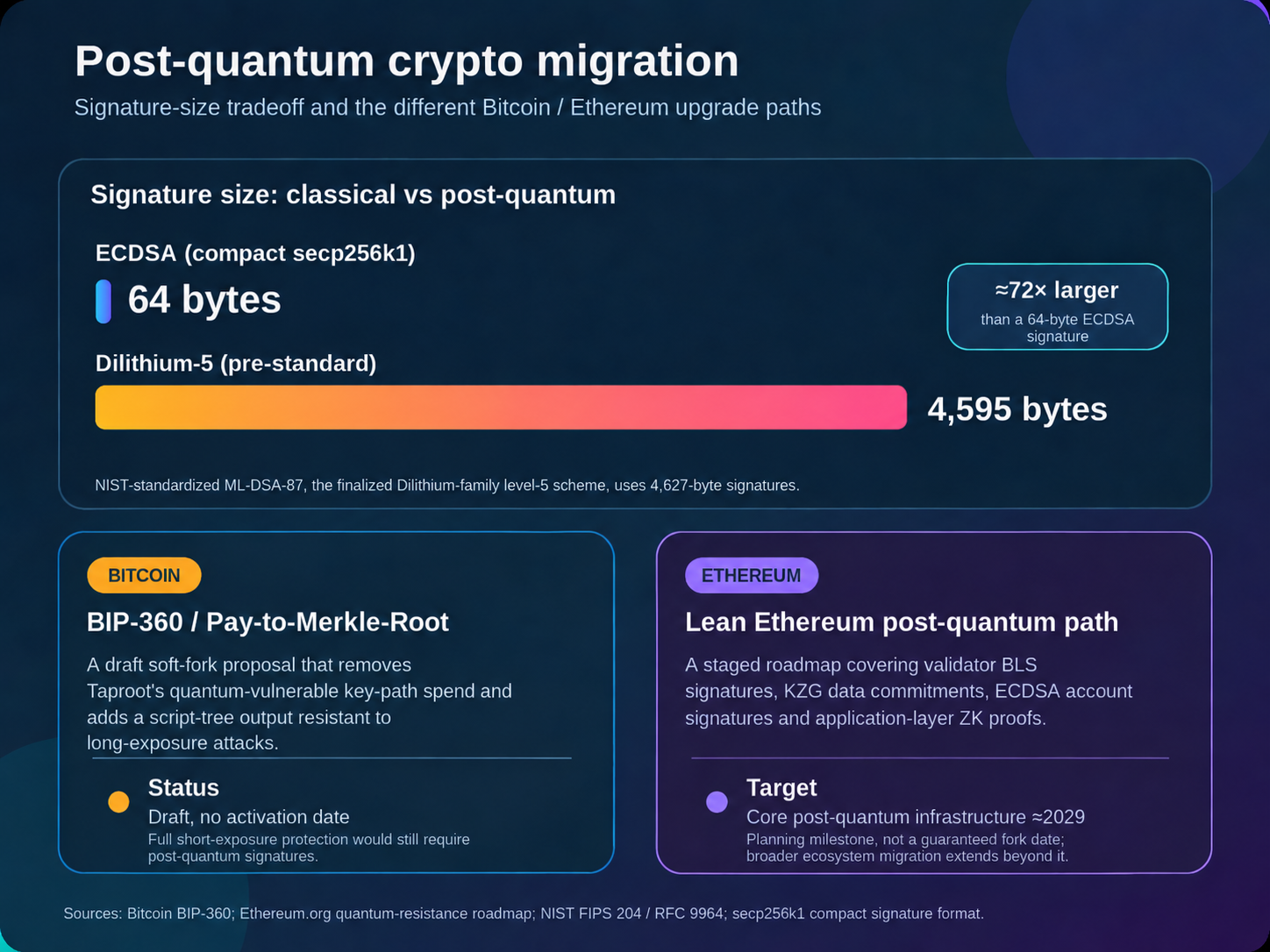
BIP-360 (Pay-to-Merkle-Root) is considered by Bitcoin as a soft fork proposal aimed at reducing vulnerability to long-term quantum computer attacks. BIP-360 requires the disabling of the Taproot key spending mechanism, which is susceptible to quantum processing, although its creators acknowledge that faster attacks on transactions in the mempool will still depend on the implementation of post-quantum digital signatures. The activation date for BIP-360 is not yet determined.

Ethereum is working on a broader post-quantum security system. In his roadmap update for February 2026, Vitalik Buterin mentioned four components that need upgrading: validator BLS signatures, KZG commitments, account ECDSA signatures, and application-layer zero-knowledge proofs. Ethereum plans to build the core post-quantum infrastructure in 2029, although the process of migrating to this new technology may take some additional time.

The cost is high. A compact secp256k1 ECDSA signature occupies about 64 bytes, while an older parameter set, Dilithium-5, used approximately 4595 bytes. The NIST-approved ML-DSA standard uses ML-DSA-87 signatures, which occupy about 4627 bytes. Thus, the signature size may also increase storage requirements, bandwidth, and transaction costs.
The short-term risk lies in the migration itself

Consequently, the immediate market risk is not about when a quantum computer will break Bitcoin. Rather, it's everything related to preparing for it: governance disputes, protocol development, larger key signatures, infrastructure changes, and old wallets whose public keys have been exposed.

An article published in March 2026 by Google Quantum AI argued that breaking 256-bit elliptic curve cryptography would require far fewer resources than previously thought. Google even announced the completion of its own systems migration by 2029.

NIST presented draft IR 8547, which recommends phasing out 112-bit ECDSA after 2030 and banning the use of ECDSA after 2035.

Previously, Cryptopolitan published a report claiming that quantum readiness may ultimately be incorporated into institutional custody criteria and investor due diligence standards, making a network's migration plan a competitive advantage.


Related Questions

QWhat is the main warning issued by the G7's cybersecurity working group, and which sectors are most directly impacted?

AThe G7's cybersecurity working group warns countries and businesses to immediately begin the transition to post-quantum cryptography. This warning is directly relevant to crypto networks, exchanges, and cryptocurrency custodians, who need to undertake costly upgrades before quantum computers become a threat to modern cryptography.

QAccording to the G7 document, what is the 'Harvest Now, Decrypt Later' strategy?

AThe 'Harvest Now, Decrypt Later' strategy involves collecting encrypted data today and decrypting it in the future once quantum technology becomes sufficiently advanced. This presents a similar problem for blockchains, where public keys and transaction history remain visible forever, making keys vulnerable to future hacking.

QWhat specific deadline has the European Union set for the transition to post-quantum cryptography (PQC), and what is required by this timeline?

AThe European Union, through its coordinated PQC roadmap adopted in June 2025, insists that all member states must begin the transition to the new system by the end of 2026. Furthermore, high-risk systems are required to transition immediately and must complete the transition by 2030.

QHow are the approaches of Bitcoin and Ethereum to post-quantum security different as described in the article?

ABitcoin is considering BIP-360 (Pay-to-Merkle-Root), a soft-fork proposal aimed at mitigating vulnerability to long-term quantum computer attacks by deprecating the quantum-vulnerable Taproot key-spend mechanism. Ethereum is working on a broader post-quantum security system, planning to upgrade four key components and build a core post-quantum infrastructure by 2029.

QWhat is identified as the immediate market risk regarding quantum computing, rather than a quantum computer breaking Bitcoin?

AThe immediate market risk is not when a quantum computer will crack Bitcoin, but rather everything involved in preparing for it. This includes governance disputes, protocol development, larger key signatures, infrastructure changes, and the vulnerability of old wallets whose public keys have been exposed.

Related Reads

Strategy stock sheds 5% amid MSCI index removal, Bitcoin sell-off

Strategy (Michael Saylor's Bitcoin treasury company) fell 6.49% on Thursday to close at $114.41, after MSCI confirmed the company's removal from its global equity indexes, compounded by a broader crypto market sell-off. The removal takes effect after the Nov. 30 market close and could trigger selling by index-tracking funds; JPMorgan previously estimated roughly $2.8 billion in potential selling pressure. Ryan Kirkley, CEO of Global Settlement Network, said the decision could distinguish Bitcoin treasury companies from traditional operating businesses and limit indirect crypto exposure for passive investors, noting that index inclusion had given ordinary passive investors leveraged Bitcoin exposure they never chose. He added it raises questions about whether such companies should be classified alongside traditional operating businesses, arguing that buying and holding an asset isn't an operating business but rather a fund that doesn't follow fund rules. In its Aug. 31 response to MSCI's proposed rules, Strategy called the changes a pretext for targeting digital asset treasury companies and downplayed the impact, saying MSCI-linked funds held about 13 million of its shares, just 3.1% of basic shares outstanding. The decline coincided with a broader crypto sell-off, with Bitcoin near $71,340, down 4.3% in 24 hours, and total crypto market capitalization down 3% to about $2.49 trillion.

cointelegraph26m ago

Strategy stock sheds 5% amid MSCI index removal, Bitcoin sell-off

cointelegraph26m ago

US Justice Department, business groups and DeFi firms challenge Illinois crypto tax

The US Department of Justice, business and financial industry groups, and a coalition of DeFi firms have backed a legal challenge to Illinois' 0.2% digital asset tax, arguing it unfairly targets crypto transactions and could impose taxes even without profit. The Justice Department filed a statement of interest, while the US Chamber of Commerce and SIFMA submitted an amicus filing. A coalition including Andreessen Horowitz, Paradigm, Uniswap and Aave Labs also filed a brief. The law, enacted in June, taxes the value of digital assets exchanged, transferred or stored regardless of profit. The Digital Chamber sued Illinois officials in July, followed by a separate challenge from the Blockchain Association and Crypto Council for Innovation in August. Originally set for Jan. 1, 2027, the tax was delayed to July 1, 2027. Illinois projected $60 million in fiscal year 2027 revenue. SIFMA and the Chamber warned the tax would affect banks, broker-dealers, custodians and asset managers nationwide, exposing them to compliance costs and burdening customers—someone who loses money owes the same tax as someone who profits, and moving assets between accounts could trigger tax without a sale or gain. They argued it discriminates against digital assets and may violate federal internet tax protections and constitutional interstate commerce requirements. The DOJ said the tax undermines federal efforts to promote crypto innovation, citing the Strategic Bitcoin Reserve and GENIUS Act. The DeFi coalition warned the rules could impose obligations on software developers and blockchain participants lacking customer information or control over funds.

cointelegraph1h ago

US Justice Department, business groups and DeFi firms challenge Illinois crypto tax

cointelegraph1h ago

DTCC Plans Solana Expansion as Wallet Rules Limit Access

DTCC plans to connect its tokenization service to Solana in the second half of 2027, allowing certain securities held by its DTC subsidiary to be converted into digital tokens on the network. Analysts say the move could attract more traditional financial institutions to Solana, which is known for fast transactions and low fees and had about $4.94 billion in total value locked as of Nov. 12. However, the impact may be limited by US regulatory rules. Alex Lin of Reforge noted that Solana's experience handling memecoin trading served as a public stress test, giving the network credibility to handle retail-scale volume reliably. Still, under a December 2025 SEC no-action letter, DTC participants must register wallets to hold tokenized securities, and tokens can only be transferred between registered wallets. Lin said the near-term impact is overstated because the tokens remain in a walled garden, inaccessible to permissionless retail and DeFi liquidity until regulators allow these assets to function as true onchain collateral. DTCC launched its tokenization service on the Canton Network and its private Besu network on Oct. 28, with 20 DTC participants signed on, though it has not said whether any plan to use Solana. Kha Nguyen of Birdeye said Solana has already seen growing demand for tokenized stocks, with trading volume reaching around $4.9 billion in H1 2026 and over 1 million accounts holding tokenized stocks by late September. However, broader Solana activity has slowed, with transactions down nearly 40%, DEX volume down 34.4%, and fees down 39%, while tokenized RWA value rose almost 7% to $4.76 billion. Nguyen said DTCC's integration would need banks, brokers, and issuers to actively issue, trade, and settle on Solana, with enough liquidity for large trades. He stressed that assets must be active rather than idle—traded around the clock, used as collateral, and earning yield. Lin agreed that long-term impact depends on where assets are used for secondary trading and collateral activity, not where they are issued.

cointelegraph2h ago

DTCC Plans Solana Expansion as Wallet Rules Limit Access

cointelegraph2h ago

Trading

Spot
活动图片