CoreWeave Default Probability Exceeds 60%! Huang Renxun 'Puts Out Fire': Financing Costs Declining, No Need for NVIDIA to Provide Backstop

marsbitPublished on 2026-10-16Last updated on 2026-10-16

Abstract

CoreWeave, a major AI cloud service provider and key NVIDIA customer, is facing heightened credit market concerns. Its five-year credit default swap (CDS) spreads soared to a record high of over 1190 basis points, implying a perceived default probability exceeding 60%. Concurrently, its bond prices plummeted, with yields surging above 15-16%, reflecting intense investor worries about its ability to service nearly $50 billion in debt while remaining unprofitable. This stress is spreading within the AI infrastructure sector. CDS spreads for companies like Oracle, SoftBank, NVIDIA, and others also widened significantly, indicating a broader market reassessment of the debt risks behind massive AI capital expenditures. In response, NVIDIA CEO Jensen Huang publicly expressed confidence in CoreWeave, stating its "financial strength is growing daily" and its cost of capital is declining. He explicitly stated NVIDIA sees no need to provide a financial backstop for CoreWeave, in which it holds a roughly 10% stake. His comments helped CoreWeave's stock recover from early losses. The core issue under scrutiny is whether the future cash flows from AI investments can cover the enormous upfront costs and interest burdens, especially as financing becomes more expensive. The situation highlights a critical shift in market focus: from purely evaluating AI compute demand to questioning the sustainability of the debt-fueled expansion models used to build that capacity.

Author: Li Dan


As CoreWeave's default risk soars to a record high, with a market-implied five-year cumulative default probability exceeding 60%, NVIDIA CEO Huang Renxun stepped out to "put out the fire," stating that CoreWeave's financial strength continues to improve, its financing costs are declining, and there is no need for NVIDIA to provide a backstop.

On Thursday, October 15th, U.S. Eastern Time, CoreWeave's five-year credit default swap (CDS) spread, an indicator reflecting the cost of insuring against a company's debt default, surged by 74.5 basis points at one point, reaching 1194.5 basis points, a record intraday high. Concurrently, yields on some of the company's bonds climbed above 15% to 16%, reflecting a sharp increase in investor concerns about its debt repayment ability.

At an event in Sweden the same day, Huang Renxun told media in an interview: "CoreWeave's strength is growing day by day." He expressed optimism about the company, noting that its "cost of capital is actually coming down." Addressing market concerns about whether NVIDIA needed to provide financial backing for CoreWeave, Huang Renxun explicitly stated he did not believe it was necessary.

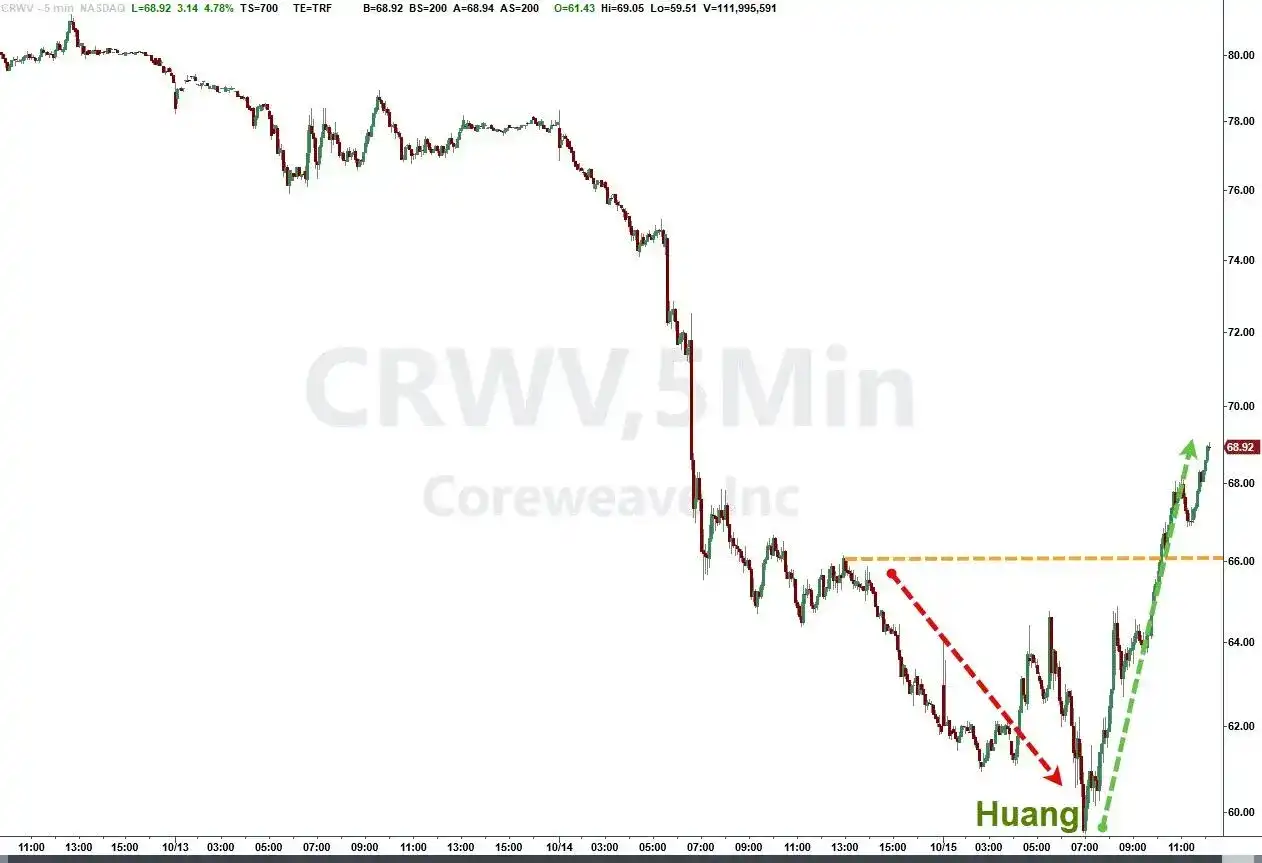
On Thursday, CoreWeave (CRWV) stock opened sharply lower by 6.6%, with losses widening to 9.5% in the morning session. After Huang Renxun's remarks, it accelerated its recovery, turning positive in the afternoon session and continuing to rise. By late afternoon, gains had reached just over 6%, rebounding roughly 17% from its intraday low hit earlier in the day. The stock closed up more than 5.9%, snapping a three-day losing streak and paring its weekly loss to around 15%.
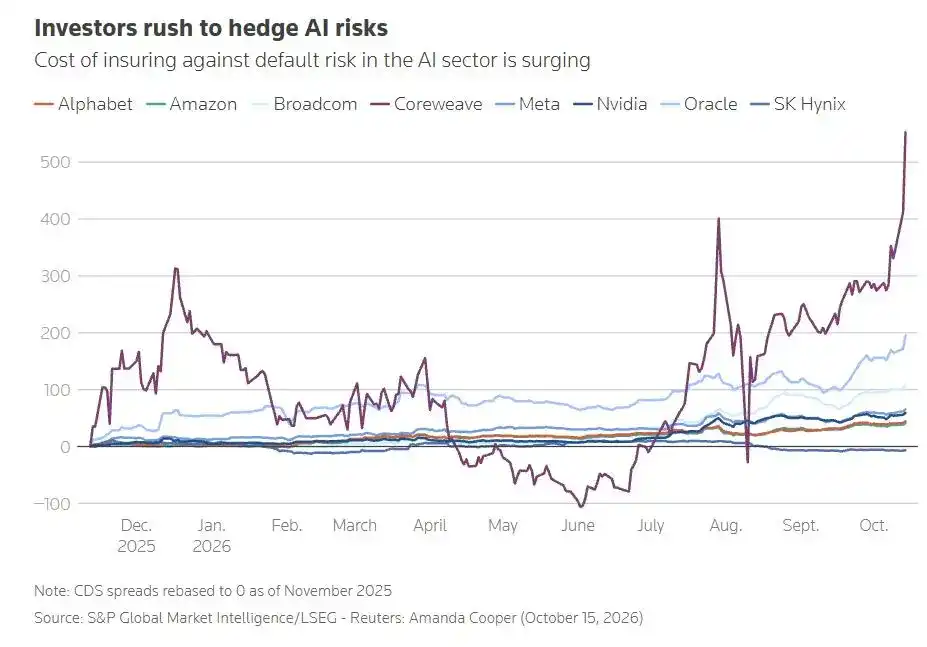
More alarmingly, the nervousness in the credit markets is spreading, indicating investors are reassessing the debt risks behind AI infrastructure investments. Media reports note that Oracle's five-year CDS spread was nearing 300 basis points on Thursday, widening about 31 basis points over four days this week. CDS spreads for Amazon, Google's parent Alphabet, and Meta are also at record highs; SoftBank's five-year CDS spread widened by 24 basis points in a single day; while CDS spreads for NVIDIA, STMicroelectronics, and SpaceX have also risen notably.
Five-Year CDS Breaks 1190 bps, CoreWeave Bonds Sold Off

CoreWeave is facing selling pressure in both stocks and bonds.

ICE Data Services data shows CoreWeave's five-year CDS spread intraday surged to 1194.5 basis points on Thursday, a record high since records began, with associated pricing implying a cumulative five-year default probability exceeding 60%. LSEG and S&P Global Market Intelligence data indicate CoreWeave's CDS spread intraday broke through 1100 basis points on Thursday, implying a five-year default risk of about 64%, higher than the roughly 30% level a year ago.

CDS are credit derivatives used to hedge against debt default risk; their spreads typically rise as market worries about an issuer's repayment ability intensify. However, the implied default probability from CDS depends on the pricing model and related assumptions, and does not mean the company's actual probability of default over the next five years has been precisely determined.

The bond market performance is equally severe. Citing trading data, Bloomberg reported that intraday on Thursday, the price of CoreWeave's 9% coupon bonds maturing in 2031 fell about 3.3 cents to 79.9 cents per dollar of face value, with the yield rising to 15.6%; another bond with a 9.75% coupon, also maturing in 2031, fell about 2.6 cents to 78.65 cents, with the yield climbing to 16.2%.

Reuters reported that CoreWeave bonds maturing in 2032 were trading at about 78 cents per dollar of face value on the Tradeweb platform, with yields exceeding 16%. Different bonds have varying maturities, coupon rates, and trading prices, but all show investors are demanding higher risk compensation.

Bond prices significantly below face value and soaring yields mean CoreWeave may face higher costs for future bond market financing or refinancing.

CoreWeave co-founder Brannin McBee recently told the Financial Times that the company hopes to achieve an investment-grade credit rating, thereby opening access to a broader pool of funding, potentially even being able to borrow from an "infinite" pool of capital. This goal contrasts starkly with the current high bond yields: amid investor concerns about repayment ability that have yet to ease, whether the company can consistently secure financing at lower costs remains to be tested by the market.

Oracle, SoftBank, and Other AI-Related Firms See CDS Widen as Credit Risk Diffuses Across Sector

CoreWeave is not the only AI-related company experiencing pressure in credit markets.

Intraday Thursday, Oracle's five-year CDS spread was quoted at 288 basis points, flat with the previous session but 28 basis points wider than the 260 basis points a week earlier; SoftBank's five-year CDS spread widened by 24 basis points in a single day to 424 basis points. Meanwhile, CDS spreads for NVIDIA, STMicroelectronics, and SpaceX also widened notably.

According to LSEG and S&P Global Market Intelligence data, CDS spreads for Amazon, Alphabet, and Meta have also climbed to record highs, though their overall ascent has been slower than that of Oracle and CoreWeave. The cost of credit insurance for these tech giants is similarly affected by the reassessment of AI investment financing risks.

CDS spreads measure the cost investors pay to insure against debt default risk. A widening spread means the market demands higher risk compensation, but it is not equivalent to an imminent corporate default, nor should different companies' CDS spreads be directly compared as comparable default probabilities.

Rising credit insurance costs for multiple AI-related companies reflect that investors are re-evaluating the financing methods for AI infrastructure investments. The large-scale borrowing needs of companies like Oracle are drawing attention, while CoreWeave, due to its heavy debt load, unprofitability, and high reliance on external financing, has become the most concentrated case of market pressure.

Reuters pointed out that U.S. inflation data exceeding expectations and renewed market concerns about the future path of interest rates have exacerbated investor doubts about the return cycle for massive AI capital expenditures. As the industry increasingly relies on debt rather than free cash flow to finance AI construction, the market's focus is shifting from the growth in computing power demand itself towards whether related companies can generate sufficient profits and cash flow in time to cover rising interest expenses.

Burdened by Approximately $50 Billion Debt, CoreWeave's Expansion Model Questioned

The core issue facing CoreWeave is the balance between capital expenditure growth and cash flow and financing capacity.

Media reports point out that this AI cloud computing company carries nearly $50 billion in debt and remains in a loss-making state. The company relies on large-scale purchases of NVIDIA GPUs, building data centers, and expanding computing capacity to meet customer demand. Such investments typically require significant capital outlays before revenue gradually materializes.

CoreWeave has aggressively increased capital expenditures to capture a share of the fast-growing AI computing power market. During periods of strong demand, debt-fueled expansion can enable companies to build infrastructure ahead of time and use long-term customer contracts to support investment plans. However, data center construction cycles are long and equipment investments are substantial. If financing costs rise, projects are delayed, or customer demand growth falls short of expectations, companies may face funding gaps and debt repayment pressure.

Therefore, CoreWeave's problem is not just its high debt level; the market is questioning whether its future cash flow can cover capital expenditures, interest expenses, and other operating costs. Rising bond yields further raise the threshold for new financing, making this issue more prominent.

CoreWeave's management emphasizes strong order backlogs and believes the market has misjudged its financial situation. However, order backlogs are not equivalent to cash received: long-term contracts can provide some revenue visibility but do not automatically eliminate risks like construction cost overruns, delivery delays, changing financing conditions, and customer concentration. Investors need to judge whether these contracts can ultimately translate into sufficient cash flow and sustainable profits.

Why NVIDIA Stepped Up to 'Put Out the Fire': Intertwined Supplier Financing and Customer Demand

Huang Renxun publicly expressed confidence in CoreWeave, reflecting the close commercial and capital ties between NVIDIA and this AI cloud service provider.

NVIDIA holds approximately a 10% stake in CoreWeave, making it the second-largest shareholder. At the same time, CoreWeave is a significant purchaser of NVIDIA GPUs. Its business model relies on purchasing NVIDIA chips, building data centers, and then leasing computing power to AI developers and large tech companies.

If CoreWeave faces financing difficulties, subsequent data center construction, GPU procurement, and computing power delivery could all be affected. Even if existing orders are not immediately canceled, rising financing costs could alter project construction schedules and capital return expectations, thereby impacting market judgments about the growth of NVIDIA's AI demand.

A more sensitive issue is that arrangements where suppliers invest in customers and customers purchase suppliers' products can easily raise market concerns about "circular financing."

Such transactions themselves do not imply misconduct, but when a company relies on borrowing to buy a supplier's products, and the supplier holds an equity stake in the company, investors will ask: How much of the industry chain's growth comes from genuine end-customer demand, and how much depends on financing-driven continuous expansion?

Huang Renxun's emphasis that CoreWeave's financing costs are declining and his explicit statement that NVIDIA need not provide a backstop serves both to maintain market confidence in a key partner and to prevent the market from directly interpreting their commercial ties as implying NVIDIA must bear CoreWeave's debt risk.

However, these remarks are not a substitute for scrutiny of CoreWeave's balance sheet. NVIDIA holding equity does not equate to providing a guarantee for its debt, and Huang Renxun's optimistic assessment cannot directly solve the company's financing needs, interest burden, and cash flow issues.

Can AI Investment Returns Cover Massive Capital Expenditures? This Becomes the Core Market Question

CoreWeave's credit turmoil is becoming a stress test for AI infrastructure investment.

Amid rapid generative AI demand growth, tech companies and computing power operators are aggressively building data centers, trying to capture the future market. However, infrastructure investment often precedes revenue realization, especially for new cloud service providers relying on external financing, who need to continuously borrow to purchase GPUs, build facilities, and pay for energy and operational costs.

When interest rate expectations rise and bond investors demand higher risk compensation, this model faces stricter scrutiny. Increased financing costs not only compress profits but may also force companies to slow expansion; if expansion slows, it could impact future revenue growth and the return on existing investments.

Deutsche Bank strategist Jim Reid noted that this is not the first time significant market volatility has been experienced due to AI concerns, but as the AI capital expenditure cycle is increasingly financed by debt rather than free cash flow, investors must pay more attention to price signals from credit markets. "Overall, financing costs related to AI are not yet high, but there are worrying signs at the fringes."

This judgment highlights a key contradiction the industry faces: growth in computing power demand does not automatically mean computing power operators can secure sufficient profits; order growth does not necessarily mean debt can be easily repaid.

For CoreWeave, the real test is whether it can control debt growth, continuously secure financing, and translate its massive order backlog into sustainable operating cash flow. For NVIDIA and the broader AI industry chain, the market's focus is shifting from "how much more computing power is needed" to "who will pay for computing power construction, and whether these investments can ultimately generate sufficient returns."

Huang Renxun attempted to soothe the market, but CoreWeave's high bond yields, record credit insurance premiums, and widening CDS spreads for companies like Oracle and SoftBank indicate that investors' examination of the AI financing model is deepening. In the future, valuations in the AI industry chain will depend not only on whether computing power demand continues to grow but increasingly on whether companies can transform this capital expenditure race into real, sustainable cash flow at affordable financing costs.

Trending Cryptos

Related Questions

QWhat caused the sharp rise in CoreWeave's five-year credit default swap (CDS) spread and what was the implied probability of default?

ACoreWeave's five-year CDS spread surged to a record high of 1194.5 basis points on October 15th. According to ICE Data Services and LSEG/S&P Global data, this implied a probability of default over the next five years exceeding 60% (or around 64% as per some sources), compared to approximately 30% a year prior.

QHow did NVIDIA CEO Jensen Huang respond to concerns about CoreWeave's financial health?

AJensen Huang downplayed concerns by stating that CoreWeave's financial strength is increasing and its cost of capital is actually declining. He expressed optimism about the company and explicitly stated that he did not believe NVIDIA needed to provide any financial backstop for CoreWeave.

QWhich other major AI-related companies saw rising credit insurance costs, indicating broader market concern?

ACredit market tensions spread to several other companies. Oracle's five-year CDS spread widened significantly to around 288 basis points. SoftBank's CDS spread also increased by 24 bps to 424 bps. Furthermore, the CDS spreads for NVIDIA, STMicroelectronics, SpaceX, Amazon, Alphabet, and Meta all rose to or remained at historically high levels.

QWhat are the core financial challenges CoreWeave faces according to the article?

ACoreWeave faces a core challenge of balancing massive capital expenditures against its ability to generate cash flow and secure affordable financing. The company carries nearly $50 billion in debt, remains unprofitable, and relies heavily on external funding for its aggressive expansion via purchasing NVIDIA GPUs and building data centers. The sharp rise in its bond yields makes future financing even more expensive.

QWhat is the relationship between NVIDIA and CoreWeave that motivated Huang's public support?

ANVIDIA holds approximately a 10% stake in CoreWeave, making it the second-largest shareholder. CoreWeave is also a major buyer of NVIDIA's GPUs, building its business on leasing AI computing power. This close commercial and capital link means that any significant financial distress at CoreWeave could impact its ability to purchase GPUs and build out capacity, potentially affecting market perceptions of NVIDIA's future demand.

Related Reads

From Harshly Criticizing Stablecoins to Building an L1: Airwallex's Jack Zhang Isn't "Converting" — the Battle for the Settlement Layer Has Begun

In June 2025, Airwallex CEO Jack Zhang publicly questioned stablecoins, arguing that fiat conversion costs outweighed their cross-border payment benefits and that crypto had failed to solve real-world problems for 15 years. Yet just 17 months later, in November 2026, Zhang emerged as co-founder of Alta, a blockchain project that raised $80 million (a $47.5 million Series A led by Index Ventures plus a $32.5 million seed round). Rather than a change of heart, the move reflects commercial necessity: a battle over the stablecoin settlement layer is underway, and payment giants that stay out risk becoming mere interfaces atop someone else's chain. Alta is not a general-purpose public chain but a compliant Layer 1 built for banks and licensed payment institutions. Co-founder Loong Wang, previously of Ren Protocol, says existing chains like Ethereum and Solana cannot simultaneously meet institutional demands for privacy, compliance, integration with local financial systems, and liquidity. Alta uses recursive zero-knowledge proofs to enable on-chain compliance checks without exposing identities or transaction amounts, and builds in programmable compliance modules, native identity authorization, and anti-airdrop protections. Co-founder Catherine Porter previously led Meta's Libra (Diem) partnerships. Airwallex itself is Alta's key advantage: with $287 billion in annualized volume, $1.3 billion in revenue, 200 countries, and 90 currencies, it will channel enterprise clients onto the new chain. Zhang's apparent reversal is consistent: he criticized stablecoins as cheap remittance tools, but now bets on tokenized fiat settlement infrastructure. Competitive pressure comes from Stripe, which acquired Bridge for $1.1 billion, bought Privy, and incubated the Tempo chain (raising $500 million at a $50 billion valuation, with OpenAI, Shopify, Deutsche Bank, and Visa as partners). Circle's Arc, Fireblocks, and Canton Network are also competing. With stablecoin market cap exceeding $320 billion and 2025 on-chain volume surpassing $33 trillion, the real contest is over who controls minting, clearing, and fiat redemption. Success will depend less on technology than on three factors: genuine adoption by traditional financial institutions, compliance adaptation across jurisdictions, and efficient on- and off-ramps to real banking systems. The paradigm has shifted: instead of disrupting banks, fintech giants now aim to build infrastructure that lets traditional finance voluntarily move on-chain. Pragmatism, not ideology, now dominates the race.

marsbit1h ago

From Harshly Criticizing Stablecoins to Building an L1: Airwallex's Jack Zhang Isn't "Converting" — the Battle for the Settlement Layer Has Begun

marsbit1h ago

"Everyone is too conservative with AI!" Head of Claude Code: My approach is more ambitious

Felix Rieseberg, who leads Claude Code's desktop app, argues that most people use AI too conservatively and should set more ambitious goals. His central trick: set unreasonably aggressive targets and insist they're achievable—for example, instead of cutting website load time from 10 seconds to 5, aim for 0.2 seconds, and when the model protests, keep telling it the problem is solvable and to try again. He organizes ambition into four categories: speed (doing the same work faster), height (raising the abstraction level to focus on desired outcomes rather than individual tasks), depth (working like top experts, using their real tools, data, and methods), and breadth (drawing on ideas from other fields). For height, he suggests asking what you ultimately want to happen and what the goal behind the goal is—e.g., instead of fixing single crashes, require the app to never crash. For a quarterly business review, move from filling in a template to understanding what changed and why, identifying the most urgent decisions, and redesigning the review process itself. For depth, he advises insisting on the tools top professionals actually use (databases and statistical models rather than Markdown tables), setting "unreasonable" targets, challenging your own assumptions against raw data, hunting for new knowledge, and using external validation rather than letting the model grade itself. A useful prompt asks the model what top experts would do that you haven't requested, what raw materials and tools they'd use, and what besides the model and you could prove the result correct. For breadth, he recommends replacing nouns with verbs (not "make a PPT" but "in 30 minutes, convince busy people of an explanation and drive a decision under uncertainty"), assembling cross-disciplinary teams, and using multi-agent setups—while avoiding mere role-play in favor of adopting other fields' actual methods. He closes with self-efficacy research: people given clear, challenging goals outperform those told to do their best, and believing difficult things are possible—as with the four-minute mile—unlocks achievement. In an era of rapid capability gains, updating our beliefs about what's possible matters more than ever.

marsbit1h ago

"Everyone is too conservative with AI!" Head of Claude Code: My approach is more ambitious

marsbit1h ago

The Traditional Santa Rally: Will It Happen in US Stocks This Year?

US stocks have suffered a sharp selloff, but technical and positioning conditions are repairing, with Goldman Sachs, Morgan Stanley and JPMorgan all signaling a potential year-end rally. Goldman strategist Cosimo Codacci-Pisanelli argues that aggressive deleveraging (the most intense in a decade), valuation multiples back near 35-year averages (MSCI world forward P/E at 15.6x), upward EPS revisions, and seasonal factors create conditions for a year-end short squeeze. Morgan Stanley data shows hedge funds are now underweight AI for the first time since 2023, with the longest deleveraging streak in over 15 years; JPMorgan calls poor sentiment a bullish signal. However, the report flags a paradox: when all three banks call the same trade, the contrarian "year-end squeeze" becomes a crowded consensus trade. Worse, inflation pressure is building faster than during the pandemic: global manufacturing import price inflation is running at about 24% annualized, and the share of import categories with annualized gains above 5% has jumped to 25-40% across major economies. Firms are absorbing costs via margin compression, but upstream pressures typically pass through to consumers in 6-12 months, meaning the bill arrives in Q1. January is historically the month with the most price resets, and Goldman has added a third Fed hike to its forecast. A reflexive loop means a rally that loosens financial conditions removes the rationale for central bank caution, effectively borrowing from future returns. Goldman recommends long front-end inflation as a portfolio hedge, and notes the best rule for 2026 is to short every consensus trade.

marsbit1h ago

The Traditional Santa Rally: Will It Happen in US Stocks This Year?

marsbit1h ago

Claude Deciphers Gödel's Cryptic Manuscripts: 80-Year-Old Notes Shake the Mathematics World

In 1978, logician Kurt Gödel left behind thousands of pages of unpublished notes written in Gabelsberger shorthand, a nearly extinct German stenography system understood by only a handful of people. In 2017, Finnish logician Jan von Plato, upon reaching mandatory retirement age, set out to decode 16 workbooks comprising 1,009 pages that Gödel wrote after settling in Princeton in 1940. After years of manually transcribing the shorthand into modern English, his team could barely digest one page per week—until computer scientists suggested using Claude. Fed the transcripts, von Plato's own books, and modern literature, Claude produced a 650-page interpretation within days, later expanding to 1,084 pages. The AI identified 663 theorem-like results, around 440 of which were confirmed as new theorems through formal verification—suggesting Gödel proved nearly one theorem every two days in the early 1940s. Claude also revealed that Gödel came within a hair of proving the independence of the Axiom of Choice two decades before Paul Cohen's 1963 forcing method earned him a Fields Medal; Gödel had constructed an equivalent framework but made an error in a key definition of "finite support," a result later verified in Coq and praised by Gödel expert Akihiro Kanamori. The notes also contain results rediscovered only in the 1970s–80s, 14 unexplored research topics, and physics work including early use of the Lüders rule (proposed in 1951) and serious study of time-travel via his rotating "Gödel universe." Gödel died in 1978 of starvation caused by paranoia.

marsbit1h ago

Claude Deciphers Gödel's Cryptic Manuscripts: 80-Year-Old Notes Shake the Mathematics World

marsbit1h ago

Trading

Spot

Hot Articles

How to Buy NVDA

Welcome to HTX.com! We've made purchasing Nvidia (NVDA) simple and convenient. Follow our step-by-step guide to embark on your crypto journey.Step 1: Create Your HTX AccountUse your email or phone number to sign up for a free account on HTX. Experience a hassle-free registration journey and unlock all features.Get My AccountStep 2: Go to Buy Crypto and Choose Your Payment MethodCredit/Debit Card: Use your Visa or Mastercard to buy Nvidia (NVDA) instantly.Balance: Use funds from your HTX account balance to trade seamlessly.Third Parties: We've added popular payment methods such as Google Pay and Apple Pay to enhance convenience.P2P: Trade directly with other users on HTX.Over-the-Counter (OTC): We offer tailor-made services and competitive exchange rates for traders.Step 3: Store Your Nvidia (NVDA)After purchasing your Nvidia (NVDA), store it in your HTX account. Alternatively, you can send it elsewhere via blockchain transfer or use it to trade other cryptocurrencies.Step 4: Trade Nvidia (NVDA)Easily trade Nvidia (NVDA) on HTX's spot market. Simply access your account, select your trading pair, execute your trades, and monitor in real-time. We offer a user-friendly experience for both beginners and seasoned traders.

1.6k Total ViewsPublished 2026.08.08Updated 2026.11.11

How to Buy NVDA

Discussions

Welcome to the HTX Community. Here, you can stay informed about the latest platform developments and gain access to professional market insights. Users' opinions on the price of NVDA (NVDA) are presented below.

活动图片