Claude Code Desktop Version Drastically Upgraded: One Person Commands an AI Army to Speed-Code

marsbitPublished on 2026-10-15Last updated on 2026-10-15

Abstract

Anthropic's Claude Code Desktop receives a major "v2-like" overhaul, transforming it into a multi-agent collaboration workspace. Its standout feature is automated nested sessions: users can define multiple coding tasks in a main chat, and Claude automatically spawns parallel sub-sessions to execute them concurrently. Each sub-session works independently, preventing intermediate logs and errors from cluttering the main thread. Upon completion, results are neatly summarized back to the primary session. Other key enhancements include a redesigned session sidebar for monitoring agent status, one-click environment reuse for complex project setups, and Git Worktree isolation to prevent code conflicts during parallel work. A new `/btw` command allows users to ask contextual side questions in a separate tab without interrupting the main workflow. Claude Code also proactively recommends follow-up tasks and features "idle compaction" to optimize token usage. This update marks a shift from AI as a single coding assistant to a platform for managing a coordinated "AI engineering corps," where developers oversee multiple parallel agents, streamlining complex project development.

Claude Code has evolved overnight!

Just today, Anthropic officially released an epic-level update for the Claude Code desktop version!

It can now launch multiple conversations simultaneously, running tasks multi-threaded, and whoever finishes first throws the result back to the main session.

Furthermore, the new interface has completely revamped session management.

It not only supports environment reuse and one-click launching of subsequent tasks but also allows you to type /btw to instantly switch to a new tab and start running tasks separately.

Almost instantly, the global developer community was flooded with the same news.

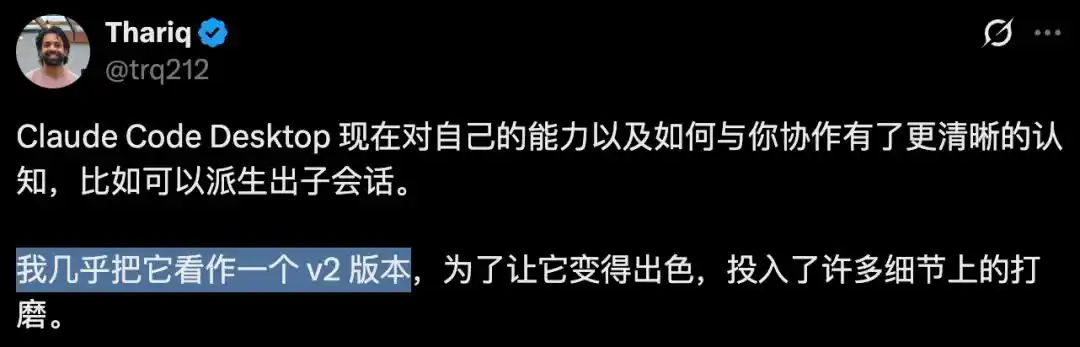
Anthropic engineer Thariq could hardly contain his excitement, exclaiming, "This is almost a v2 version"!
Claude Auto-Splits Itself, Multiple Sessions Work Simultaneously

First, let's look at the most eye-catching feature this time: automatic creation of nested sessions.

Previously, if you wanted the AI to do three things at once, you had to manually open three windows and then check the results one by one yourself.

Worse, with too many tasks, the main thread would turn into a disaster zone: front-end code mixed with back-end error messages, and to trace back a specific modification step, you had to frantically scroll your mouse in front of the screen.

Now, this logic has completely changed.

In the new Claude Code desktop version, you only need to hand over all tasks at once in the main dialog.

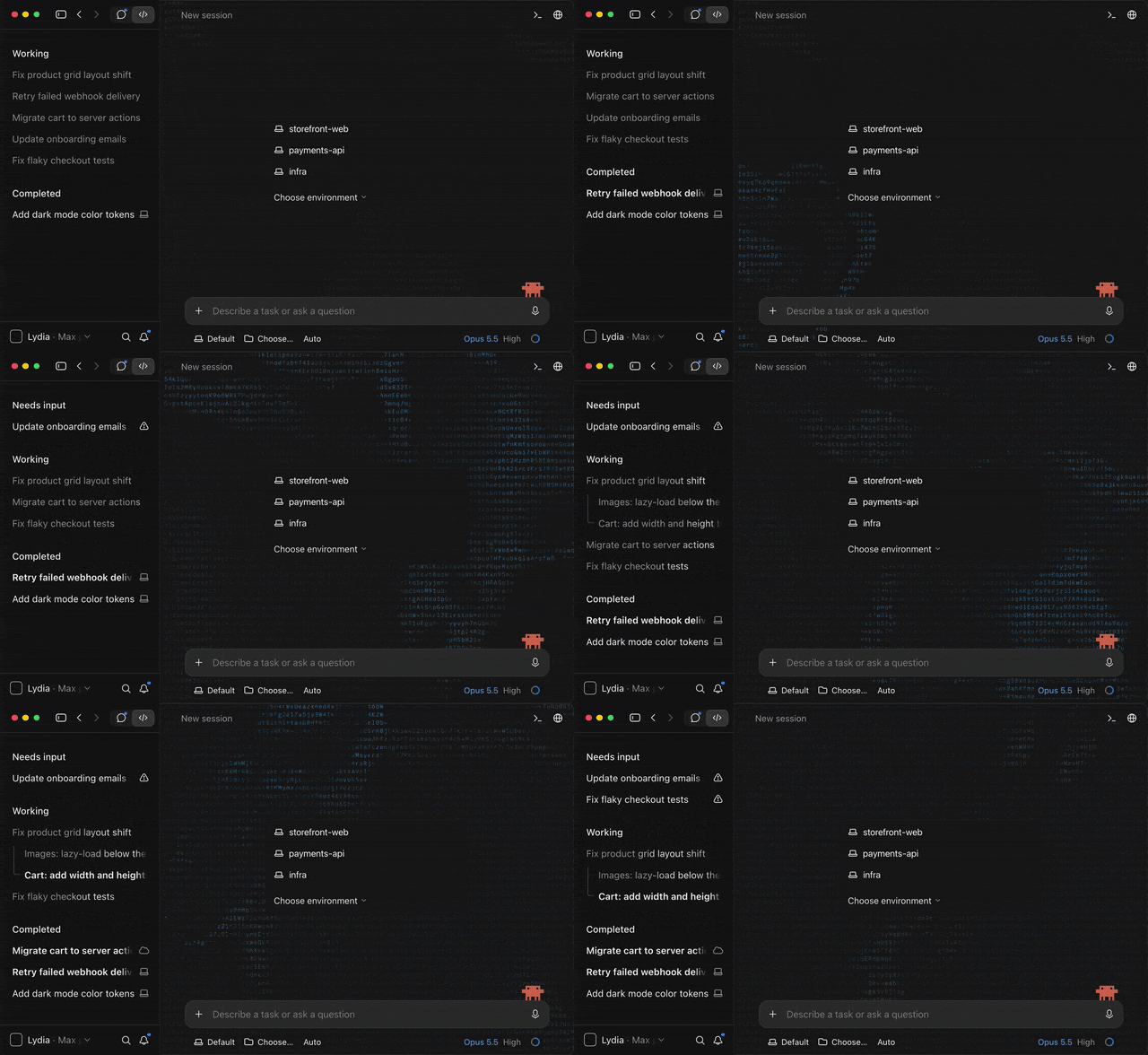
When Claude recognizes that these tasks can be processed in parallel, it instantly performs a "Shadow Clone Jutsu"—automatically creating an independent nested session for each subtask!
Even better is its information flow mechanism:

Underlying Concurrent Execution: Several sub-sessions start working simultaneously in the background, each reading context, modifying code, running tests, without interfering with each other.

Extremely Clean Main Thread: Their tedious intermediate trial-and-error and hundreds of lines of terminal output won't pollute the main conversation interface at all.

Automatic Summary and Reporting: When each sub-session finishes its work, it automatically reports the final execution results back to the main session neatly, just like a subordinate reporting to a director.

This way, the main thread maintains extremely high readability from start to finish.

Humans don't need to worry about the process of debugging those hundreds of lines of error messages in between. They can just sit in the main session, reviewing the final answers submitted by each AI like approving official documents.

If a Claude clone gets stuck or you want to see the details, you can click through to the underlying session at any time.

This round of upgrades makes it easier for the AI to work separately. But engineering acceptance still requires human oversight.

How Can a Person Keep Track of a Pile of AI Conversations?

When several Clauses start working together, you immediately run into another problem: who should you look at?

One is still analyzing code, one is running commands, and another might have stopped waiting for your decision. If you can only click into each one to check the records, the waiting time you saved gets eaten up by switching windows.

The new version moves these statuses to more visible positions.

The sidebar allows users to clearly see which sessions are working and which require personal intervention.

After entering a session, a real-time to-do list follows Claude's plan as it progresses; when it needs a user response, a review card will summarize the situation of this round.
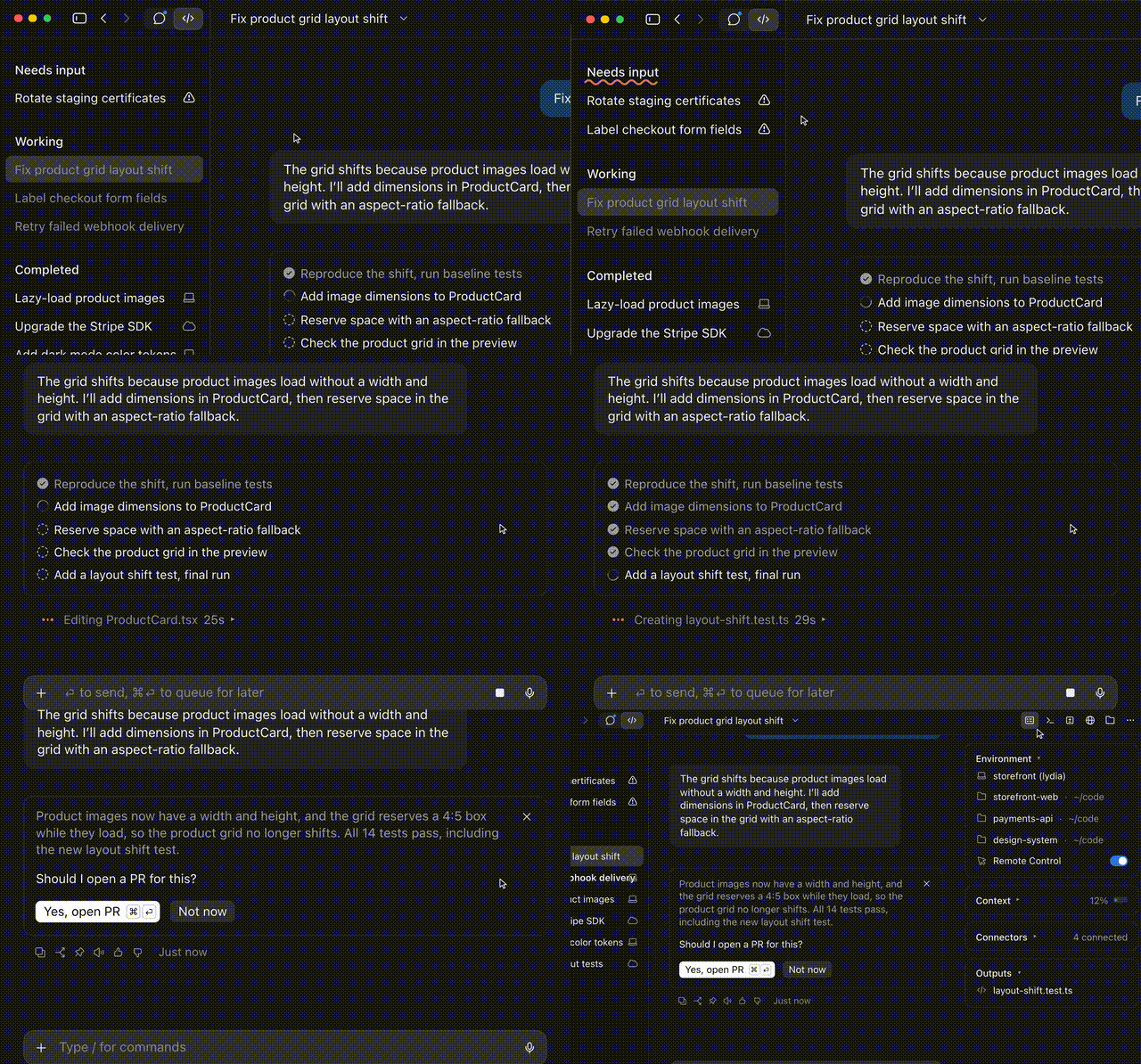
The side information bar displays the task's running location, context, and code changes.

Second-Level Entry into the "Battlefield," One-Click Environment Reuse

Besides concurrency during task execution, Anthropic has also taken "pre-work preparation" to the extreme this time.

Many full-stack architects' daily development environments are very complex: the front-end is in one folder, backend microservices are in another, and some long-running tasks even need to be run in the cloud.

Every time you restart the software or switch projects, it takes a long time just to configure these directories and connections properly.

The new Claude Code has drastically restructured the "new session interface."

The core goal is four words: seamless continuation.

One-Click Access to Commonly Used Directories

When you open the interface, "Recently used folders" are directly placed in the most prominent position. No need to search through the system directory tree—just one click and you can start working right away.

Custom "Environment" Packaged and Saved

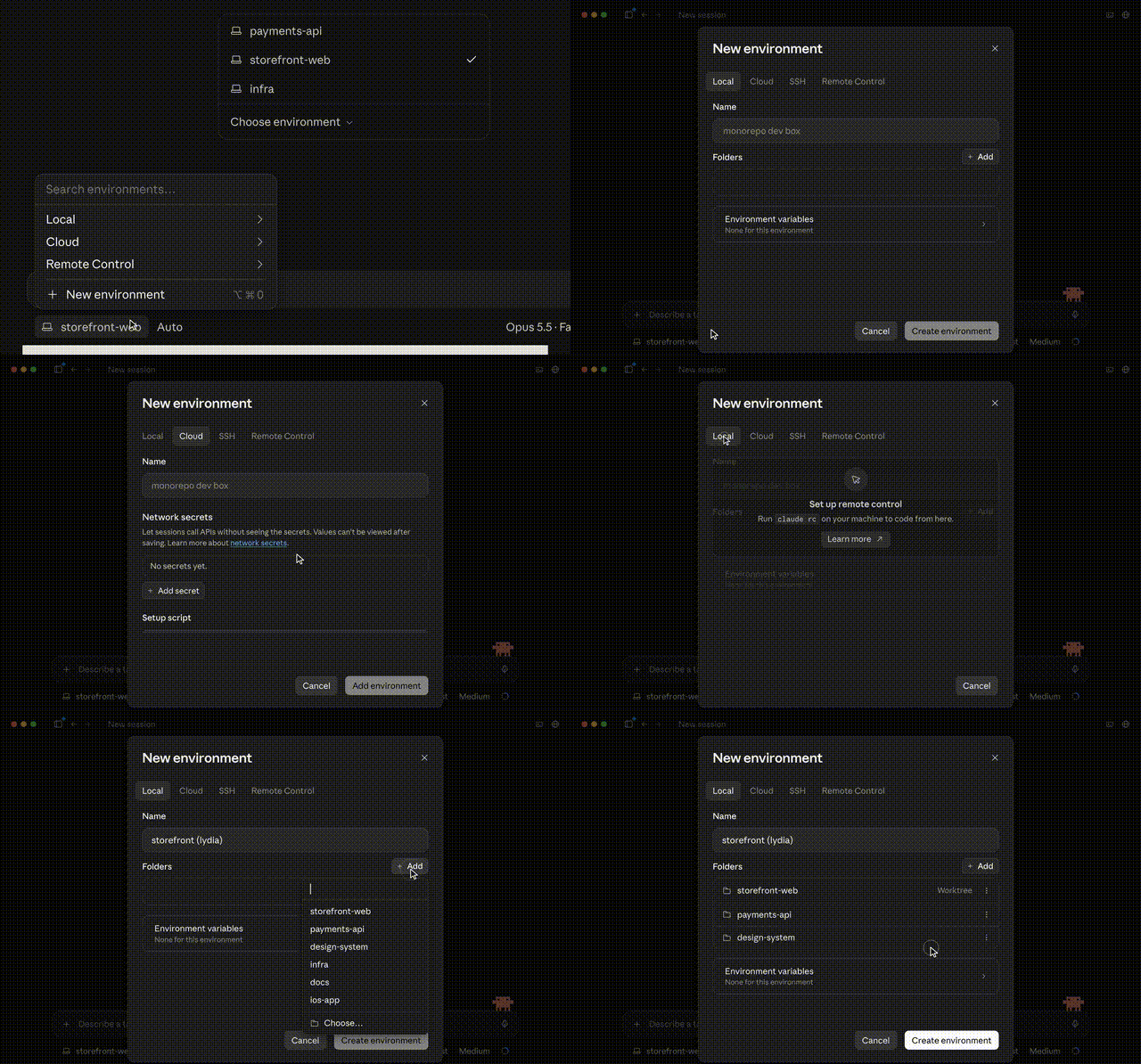
Now, you can package and save an entire complex development configuration directly as a named "Environment."

For example, a combination of several local folders, a specific SSH remote host, or a cloud runtime environment. The next time you need to use it, you can instantly launch the entire multi-directory, cross-end workbench with one click.
Native-Level Git Worktree Isolation

Since there are multiple concurrent sessions, wouldn't it be a problem if two AIs modify code in the same local folder simultaneously?

Anthropic has already thought of this for you!

When launching multiple sessions, the new CC directly provides the option for "Independent Worktree for each folder."

Just tick the box, and Claude will automatically use Git Worktree to pull up independent worktree branches for different parallel sessions.

Session A refactors the underlying architecture, Session B fixes an urgent online bug—both are physically isolated at the file level. No more worrying about code overwriting each other or the local environment crashing.

Detail-Obsessed, /btw to Chime in Anytime, Actively Recommends Follow-up Tasks

Why did Thariq marvel that the new Claude Code desktop version has "an extremely strong sense of self-awareness of its own capabilities"?

The answer lies in two clever interactive details: proactive recommendations and the /btw side conversation.

Previous AI tools were like "abacus beads"—you had to push them to move.

The new CC, while working, actively recommends the next steps based on the current changes.

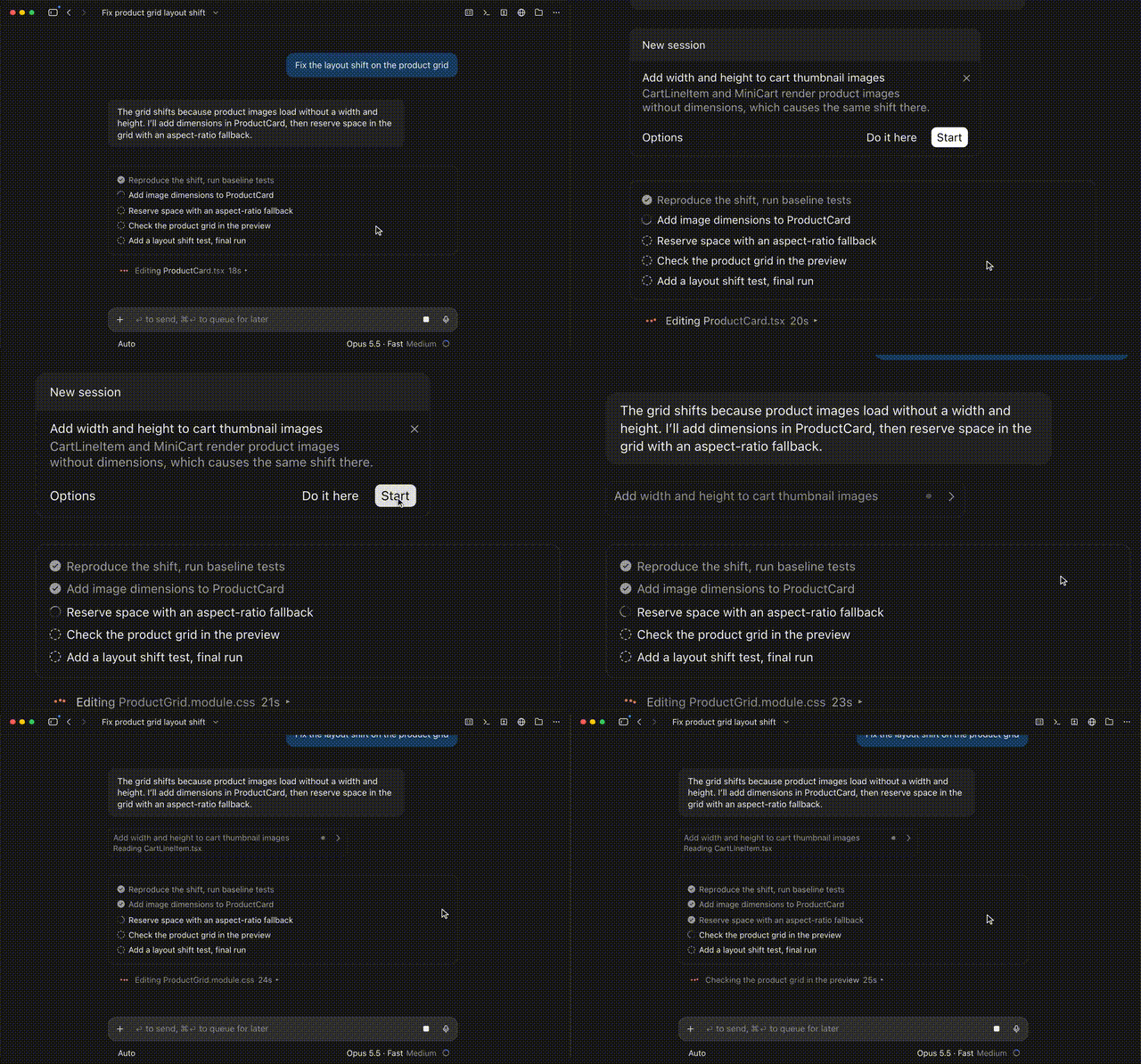
No need to type for confirmation; just click once, and the follow-up suggestions will directly start running in the background as independent sessions! Additionally, the empty input box will intelligently display grey prompt suggestions, which can be instantly adopted by pressing the Tab key.
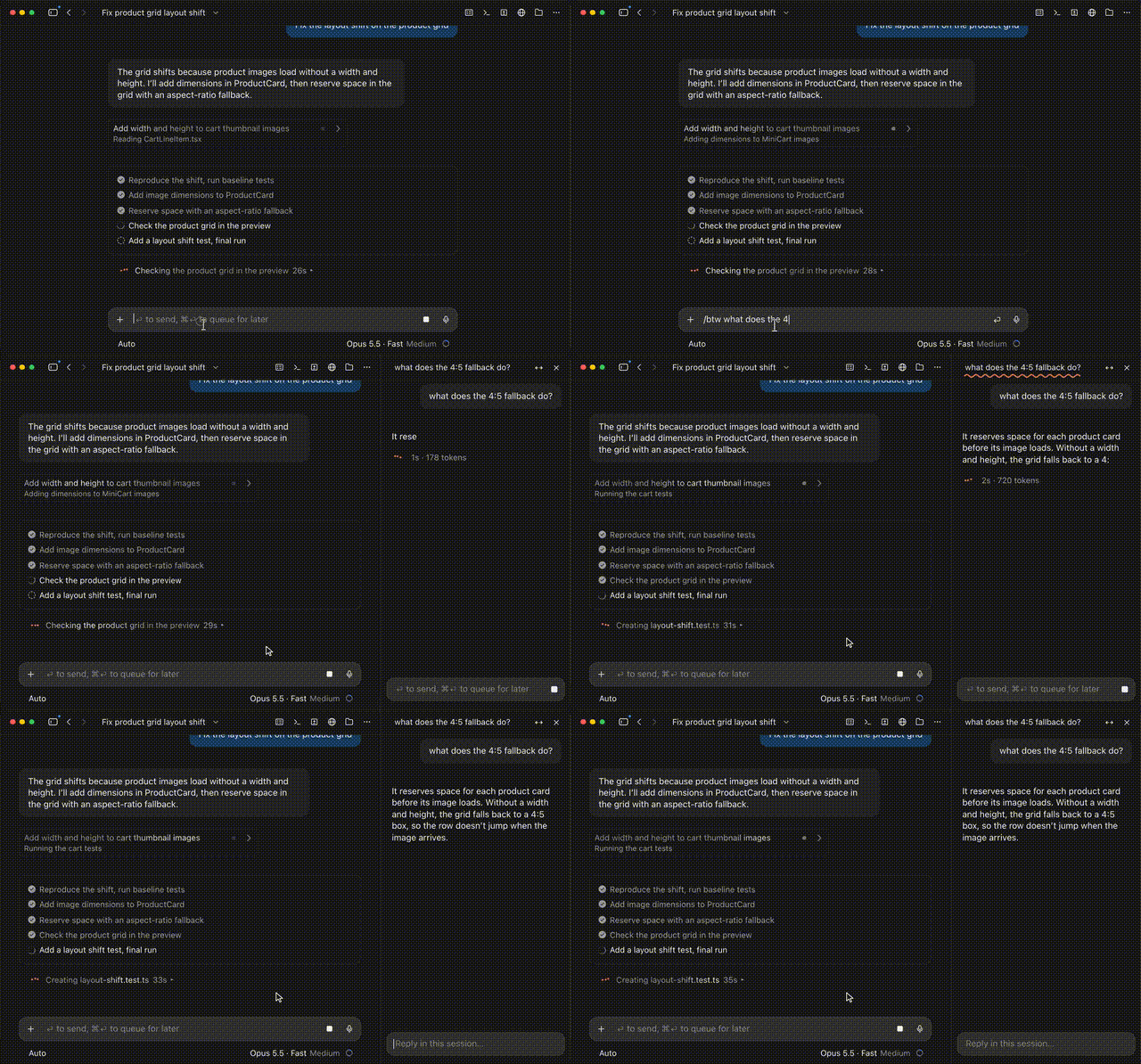
Another design that makes programmers applaud is the newly added /btw command (by the way).

During the main task progression, you inevitably have temporary questions, like "By the way, what's the default expiration time for this authentication token?"

Now, in CC, just type /btw (or use the shortcut Cmd + ; / Ctrl + ;):

The system immediately opens a side conversation in an independent tab, fully inheriting all the context from the main session up to that point, with no need to re-explain the background.

The main session continues at full speed, completely undisturbed! The side question will never pollute the main thread record. Once you resolve your doubt and close the tab, the main work remains clean.

This feature seems simple, but it solves a very fundamental pain point: The "flow state" should not be interrupted.

Programmers fear the "context-switching tax" the most. Every time they are interrupted and try to return to a state of deep work, it might take over ten minutes.

/btw allows people to resolve temporary questions without interrupting the main workflow. Often, efficiency is saved bit by bit in this way.
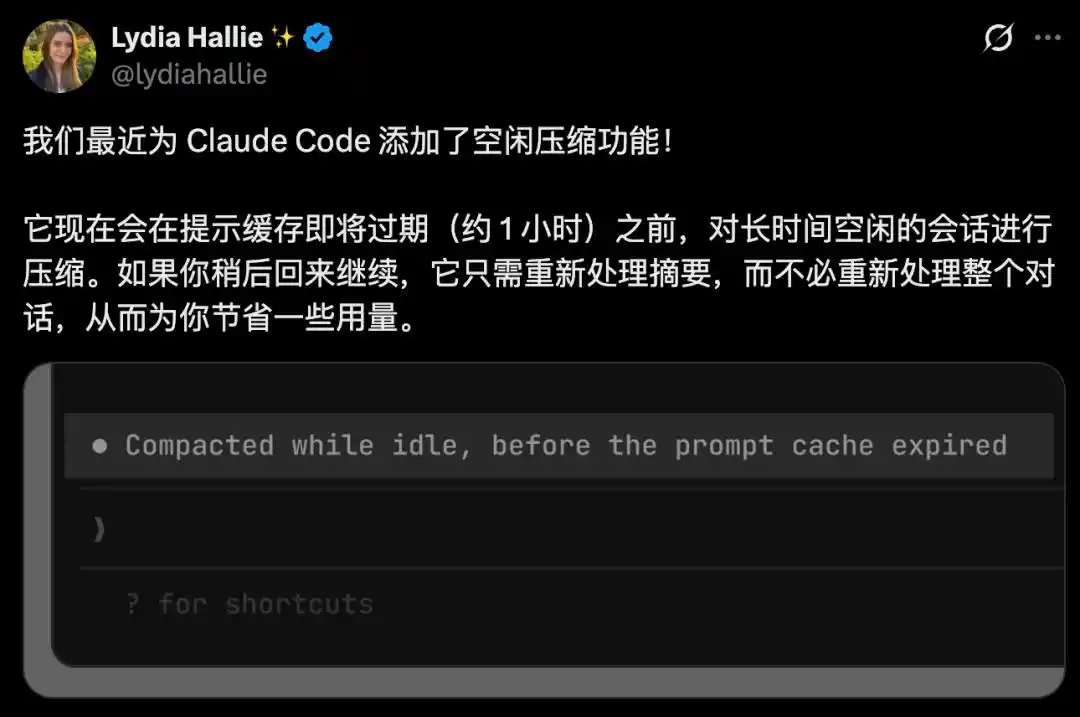
Moreover, Claude Code has added an "Idle Compaction" feature.

When a session remains idle for a long time, CC will automatically compress the session context before the prompt cache is about to expire (around 1 hour).

This retains critical context while reducing token consumption, saving on usage quotas.
The Second Half of AI Programming: Competing on "Team Leadership"

To put it bluntly, this major overhaul of the Claude Code desktop version directly pushes AI programming into its second half.

It's evolving from a single "AI Programming Assistant" into a full-fledged "Multi-Agent Collaboration Workbench."

Over the past two years, the AI coding competition focused on single-point capabilities—code completion, single-generation accuracy, scores on benchmarks like SWE-bench.

But today, the bottleneck has become "How can the AI simultaneously advance the development of ten modules without messing up the engineering?"

As Thariq said, Claude Code is highly aware of its capabilities and knows how to cooperate with humans by spawning sub-sessions.
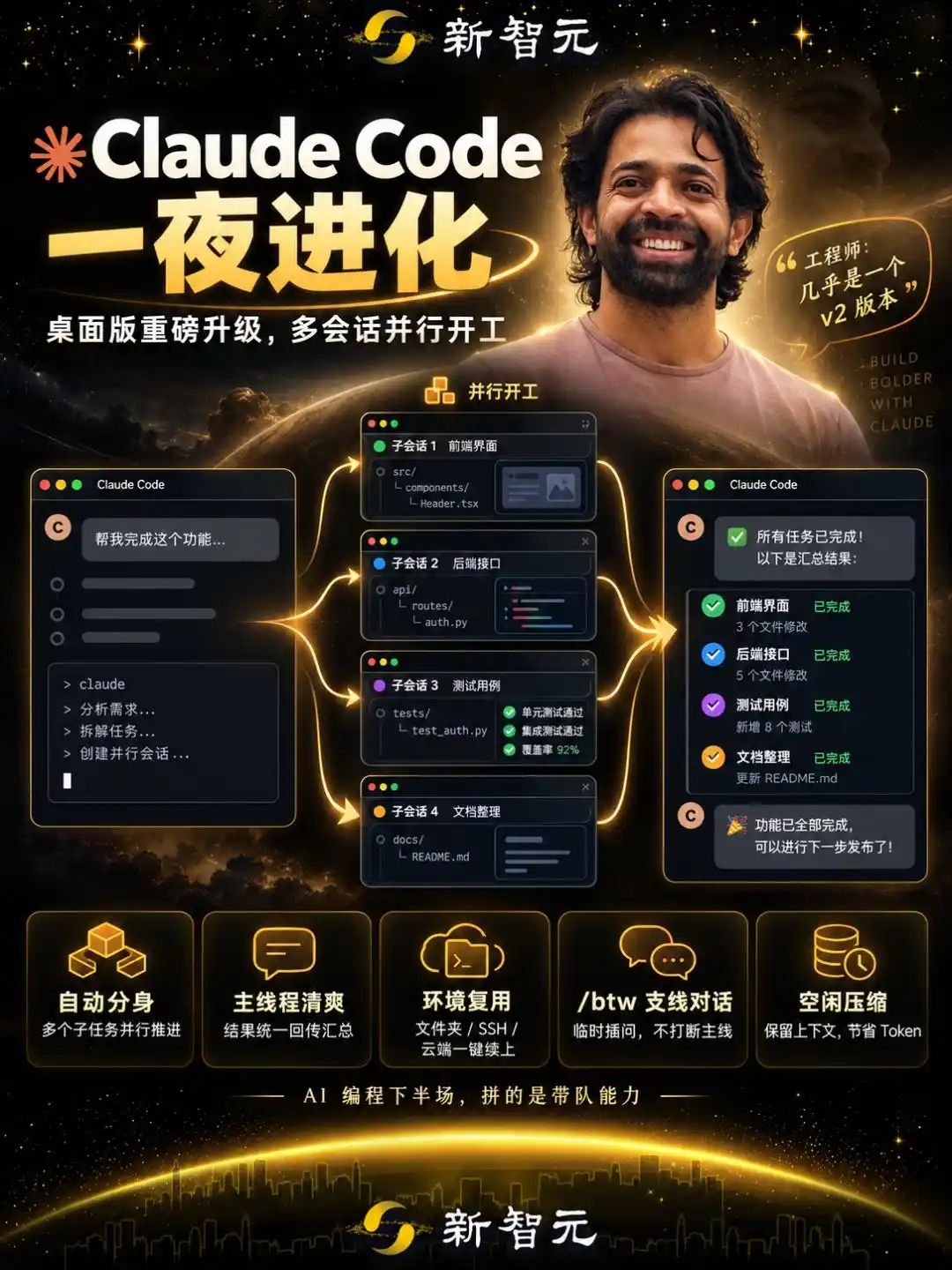
Most importantly, under this new paradigm, the role of human developers has fundamentally shifted.

The era of single-threaded work is ending. The "Multi-Agent Parallel Engineering Army" for each individual is officially launched today.

References:

https://x.com/ClaudeDevs/status/2110445849516101743

https://code.claude.com/docs/en/desktop-quickstart

https://x.com/trq212/status/2110463962877989276

This article is from the WeChat public account "Xin Zhiyuan," author: Peach (Taozi).

Trending Cryptos

Related Questions

QWhat is the most significant new feature of the updated Claude Code desktop version?

AThe most significant new feature is the ability to automatically create nested sessions for parallel task execution, allowing multiple AI agents to work on different tasks concurrently and report results back to the main session without cluttering it.

QHow does the new Claude Code handle multiple sessions to prevent human oversight from becoming overwhelming?

AIt provides a side navigation bar showing the status of all sessions (e.g., working, waiting for input). It also uses real-time task lists and review cards within sessions to clearly summarize progress and indicate when human intervention is needed.

QWhat problem does the '/btw' command in Claude Code solve for developers?

AThe '/btw' command (meaning 'by the way') solves the problem of context-switching and broken 'flow state'. It allows developers to ask a follow-up or clarifying question in a separate tab with full context inheritance, without interrupting or polluting the main session's progress and conversation history.

QWhat is the purpose of the 'Idle Compaction' feature mentioned in the article?

AThe 'Idle Compaction' feature automatically compresses the context of a session that has been idle for a long time (around an hour) before the prompt cache expires. This preserves key context while reducing token consumption and saving on usage limits.

QAccording to the article, how is Claude Code's role evolving with this major update?

AClaude Code is evolving from a single 'AI programming assistant' into a 'multi-Agent collaboration workstation'. The competition is shifting from single-point capabilities (like code completion) to managing and coordinating multiple AI agents to handle complex, parallel engineering tasks effectively.

Related Reads

From QR Codes to Physical Goods: How Consumer RWA Verifies Products and Rights

A single QR code can be printed on two bottles and scanned twice to open the same page, so verifying a physical item requires confirming the binding between the bottle in hand and its listed number. Consumer RWA verification has two parts: whether the goods or services are real, and whether the rights recorded in the digital credential are valid. For rights provenance, take a co-branded gift box: authorization documents define the term and scope in which a brand may use the co-branded mark, production and warehousing records show whether the box was stocked by batch, and rights registration states what holders can redeem and who delivers it. Linking all three lets consumers check authorization scope, supply, and their own eligibility. Identifiers, events, and evidence must work together. High-value items can use unique serial numbers, uniform-spec goods can use batch numbers, and courses or events can use session numbers. Events such as warehousing, sampling, outbound shipment, receipt, and redemption should be tied to the corresponding object, with operation time and responsible party retained. Test reports correspond to submitted samples; linking results to specific goods also requires checking the sample, batch, and inbound/outbound records. Ordinary batch goods can combine serialized QR codes with abnormal-scan records, while high-value items may add tamper-evident labels or independent authentication. Trusted records must also reflect current status. If a coffee batch has 500 bags at warehousing, 10 used for sampling, and 100 reserved for other channels, then absent other changes, 390 bags remain available for new rights. The warehousing record shows historical quantity; current redeemable quantity must be updated based on actual occupancy. A query page should at minimum state the goods or service, evidence source, last update time, and whether the credential is currently usable.

marsbit23m ago

From QR Codes to Physical Goods: How Consumer RWA Verifies Products and Rights

marsbit23m ago

10 Years Is Too Slow: Gu Quanquan's Team Challenges Dario, Compressing Cancer Cure to 4 Years

A UCLA professor, Quanquan Gu, has founded Geodesic Intelligence, a 15-person startup that after only five months has released NovaAtom-Lite, an all-atom structure prediction model that outperforms DeepMind's Isomorphic Labs flagship IsoDDE on FoldBench, the toughest biomolecular benchmark. The model predicts the 3D coordinates of every heavy atom in protein, DNA, RNA, and ligand complexes with near-experimental precision. NovaAtom-Lite posted top scores on two core pharma tests: antibody-antigen binding (79.07% success, 31 points above AlphaFold 3 and 3.5 above IsoDDE, with 2.2x AlphaFold 3's accuracy at high-precision thresholds) and protein-ligand binding (top 1 on both RMSD and contact metrics). On the Runs N' Poses benchmark, which separates memorization from genuine physics understanding, NovaAtom-Lite's lead grows on the most novel, out-of-distribution ligands (47.6% vs AlphaFold 3's 24%), showing it learns transferable physical rules rather than memorizing structures. The model also supports test-time scaling—raising sampling from 1 to 100 seeds lifts antibody success from 74.3% to 83.1%—and condition constraints, where a single contact-pair hint boosts success to 91.28% and full pocket hints lift hard-case ligand accuracy by nearly 16 points. It solved two nightmare cases: a wildly flexible 22-residue MERS nanobody loop (0.56 Å error, all 25 samples correct) and the KRAS G13D hidden switch-II pocket (0.98 Å ligand RMSD vs OpenDDE's 17.74 Å). Gu previously led ByteDance's SeedFold, the first model to beat AlphaFold 3 on FoldBench, forcing Isomorphic Labs to respond with IsoDDE. A stronger NovaAtom-Pro is coming. Days after launch, a16z cited NovaAtom-Lite in a report arguing pharma is entering its "GPT-3 moment," naming Geodesic as the sole company highlighted in its industry map. Geodesic's closed loop spans structure prediction, scientific reasoning, and wet-lab validation—aiming to compress drug discovery from a decade to four years.

marsbit38m ago

10 Years Is Too Slow: Gu Quanquan's Team Challenges Dario, Compressing Cancer Cure to 4 Years

marsbit38m ago

Anthropic Misses Out on 'Largest IPO in History'—Who Should Foot the Bill?

Anthropic's IPO has gone from being touted as a potential record-breaking "largest IPO in history" to falling short of that title. Months ago, analysts estimated its IPO could surpass SpaceX, but current data shows it will not. Both its fundraising size and initial market capitalization fall below SpaceX's records of $75 billion raised and $1.78 trillion initial valuation. Anthropic's IPO is priced at $70–78 per share, offering 825 million shares, for a base fundraising of roughly $57.75–64.35 billion. Even with the 15% over-allotment fully exercised, proceeds would reach about $74 billion—still below SpaceX's $75 billion initial raise (and SpaceX's final over-allotment total of $86.25 billion). Anthropic's initial market cap is estimated at $1.26–1.41 trillion, well below both the earlier $2 trillion expectations and SpaceX's $1.78 trillion. However, combined with a $26 billion private placement, Anthropic's total fundraising could approach $100 billion. Three main factors are cited for the setback. First, after Democrats swept both chambers in the U.S. midterm elections, they pushed aggressive AI regulation, with some lawmakers calling for a pause on advanced AI development and a ban on superintelligence. Second, Nvidia founder Jensen Huang resigned as CEO amid a scandal, disrupting the AI supply chain; Nvidia was expected to subscribe about $10 billion of Anthropic's $26 billion private placement, and its instability threatens market confidence. Third, Anthropic's Q3 results show hidden concerns: revenue hit $16.956 billion (up ~11.27x year-over-year), but sequential growth slowed from 144.2% to 46.7%, new quarterly revenue fell from $6.824 billion to $5.401 billion, GAAP operating profit swung from a $974 million gain to a $567 million loss, and adjusted operating margin dropped from 19% to 15%. Notably, reports suggest Huang's ouster involved Democratic figures and media, and that Anthropic founder Dario and the company itself provided funding to related political organizations and donated tens of millions to Democratic midterm campaigns. In this light, Anthropic's dashed "largest IPO" dream is tied to its political bets.

Odaily星球日报1h ago

Anthropic Misses Out on 'Largest IPO in History'—Who Should Foot the Bill?

Odaily星球日报1h ago

Trading

Spot

Hot Articles

How to Buy ONE

Welcome to HTX.com! We've made purchasing Harmony (ONE) simple and convenient. Follow our step-by-step guide to embark on your crypto journey.Step 1: Create Your HTX AccountUse your email or phone number to sign up for a free account on HTX. Experience a hassle-free registration journey and unlock all features.Get My AccountStep 2: Go to Buy Crypto and Choose Your Payment MethodCredit/Debit Card: Use your Visa or Mastercard to buy Harmony (ONE) instantly.Balance: Use funds from your HTX account balance to trade seamlessly.Third Parties: We've added popular payment methods such as Google Pay and Apple Pay to enhance convenience.P2P: Trade directly with other users on HTX.Over-the-Counter (OTC): We offer tailor-made services and competitive exchange rates for traders.Step 3: Store Your Harmony (ONE)After purchasing your Harmony (ONE), store it in your HTX account. Alternatively, you can send it elsewhere via blockchain transfer or use it to trade other cryptocurrencies.Step 4: Trade Harmony (ONE)Easily trade Harmony (ONE) on HTX's spot market. Simply access your account, select your trading pair, execute your trades, and monitor in real-time. We offer a user-friendly experience for both beginners and seasoned traders.

8.1k Total ViewsPublished 2024.03.29Updated 2026.09.28

How to Buy ONE

Discussions

Welcome to the HTX Community. Here, you can stay informed about the latest platform developments and gain access to professional market insights. Users' opinions on the price of ONE (ONE) are presented below.

活动图片