Bitcoin monthly ‘new money’ inflows near $5B as BTC price rally stalls

cointelegraphPublished on 2026-10-08Last updated on 2026-10-08

Abstract

Analysis warns Bitcoin's price gains are not yet fueled by sufficient new capital entering the market. According to Glassnode, monthly "new money" inflows from sources like ETFs and corporate treasuries reached $4.9 billion by October 5. However, this covered less than two-fifths of the $12.8 billion growth in Bitcoin's realized cap over the same period, indicating most of the market's expansion is due to existing investors trading coins at higher prices. This divergence is notable compared to larger inflows seen during the 2024-2025 rallies. Meanwhile, recent price attempts above $87,000 have stalled. As Bitcoin briefly closed above $85,000, profit-taking intensified dramatically, with short-term holders (holding less than 155 days) accounting for over 80% of coins moved to exchanges for profit—the highest share in a year. Their aggregate cost basis remains around $78,250, keeping this cohort in net profit. The data suggests the current price move depends heavily on existing holders, with new capital inflows remaining modest.

Bitcoin (BTC) price gains do not yet reflect enough new capital entering the market, analysis warns.

Key points:

  • Rolling 30-day cumulative inflows of “new money” to Bitcoin reached $4.9 billion on Oct. 5, per Glassnode data.
  • Existing investors still accounted for three-fifths of the $12.8 billion growth in realized cap in that period.
  • Short-term holders accounted for more than 80% of profit-taking above $85,000.


Bitcoin capital inflows not responsible for realized cap growth


In the latest edition of its regular newsletter, The Week Onchain, crypto research platform Glassnode revealed that existing holders were behind much of Bitcoin’s recent upside.

“New money” inflows into Bitcoin — purchases by corporate treasuries, “stablecoin growth” and inflows to the US spot Bitcoin exchange-traded funds (ETFs) — totaled around $4.9 billion in the 30 days to Oct. 5.

Bitcoin’s realized cap, which values each coin at the price it last moved onchain, grew by $12.8 billion, more than twice as much over the same period.

“New money therefore covers less than two fifths of that rise. The rest is coins changing hands at higher prices among money already in the market,” Glassnode commented.
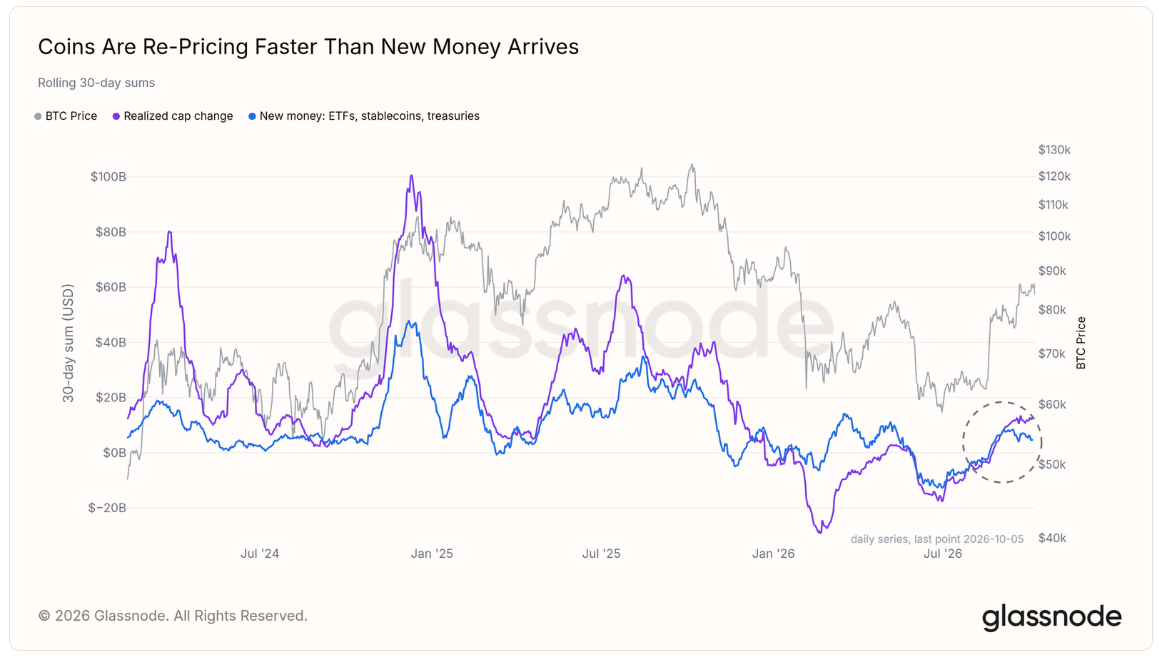
Bitcoin new money inflows vs. realized cap (screenshot). Source: Glassnode


Accompanying data shows that recent rallies in BTC/USD have showed the same divergence since the ETFs launched in January 2024. Currently, however, conditions are different, with inflows still modest compared to short-term realized-cap gains.

“The rallies of 2024 and 2025 showed a similar mix, but on far larger inflows,” Glassnode added.

“Until those inflows pick up, the move depends on existing holders paying more.”


Newer investor profit-taking surged at $85,000


Since Sept. 21, Bitcoin has attempted to rise beyond $87,000 four times. Each of these attempts failed as buyers faced thickening overhead ask liquidity on exchange order books. BTC/USD circled $83,000 at the time of writing on Thursday, down 1% month-to-date.

Related: Bitcoin price drops to $82.7K October low as bond sell-off resumes on Iran nerves

Continuing, Glassnode flagged increased profit-taking among recent buyers over the weekend, when Bitcoin saw its first weekly close above $85,000 since January.

“Of all the coins sent to exchanges that day, about 86% came from short-term holders, those holding for less than 155 days, moving coins at a profit. That is the highest share of any day in the past year; on a typical day it is under two fifths,” it continued.
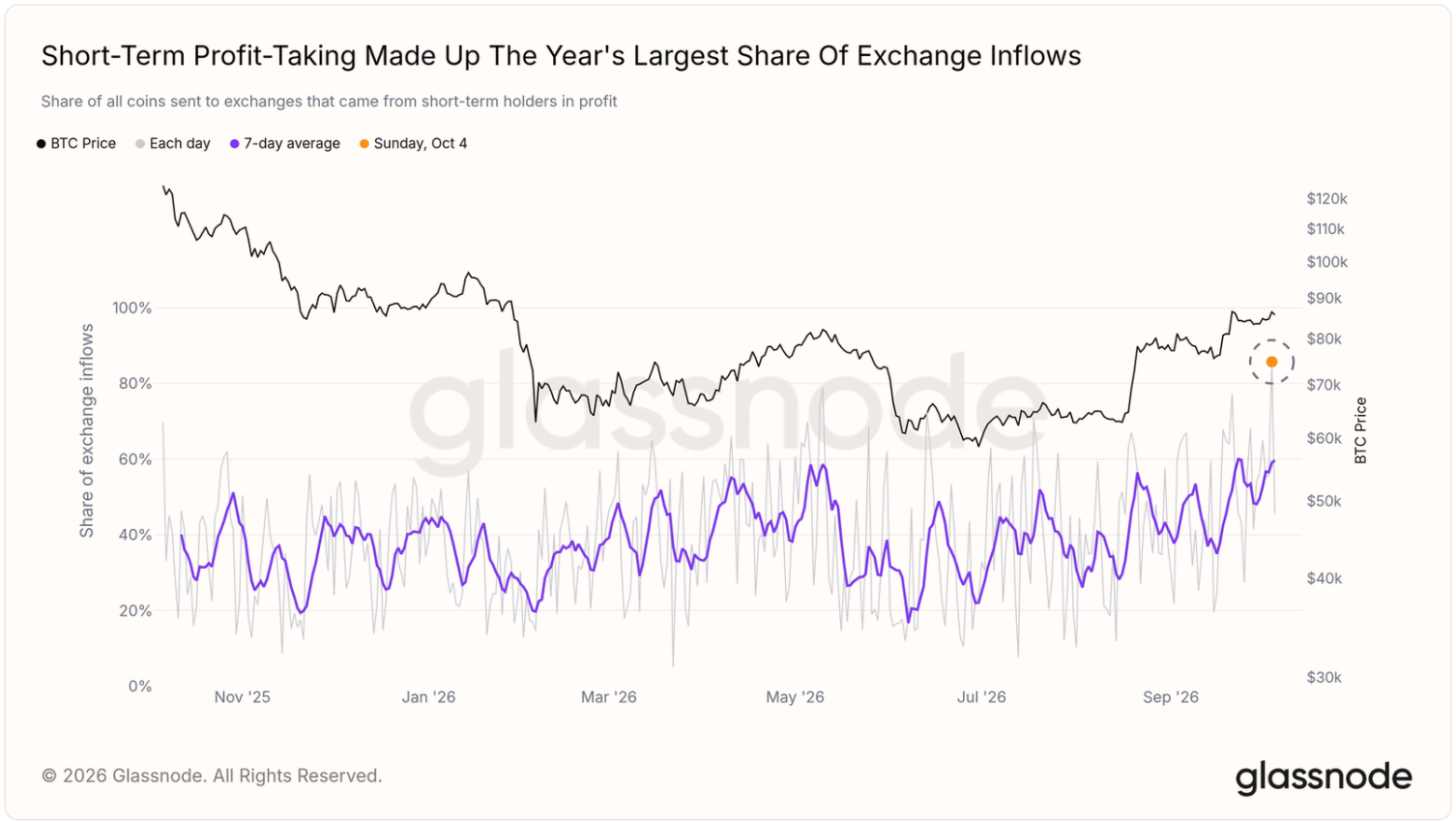
Bitcoin STH profit-taking data (screenshot). Source: Glassnode


Short-term holders are traditionally considered to be more sensitive to price volatility. The cohort remains in net profit, with its aggregate cost basis, also known as realized price, still at around $78,250 as of Oct. 7, per data from CryptoQuant.
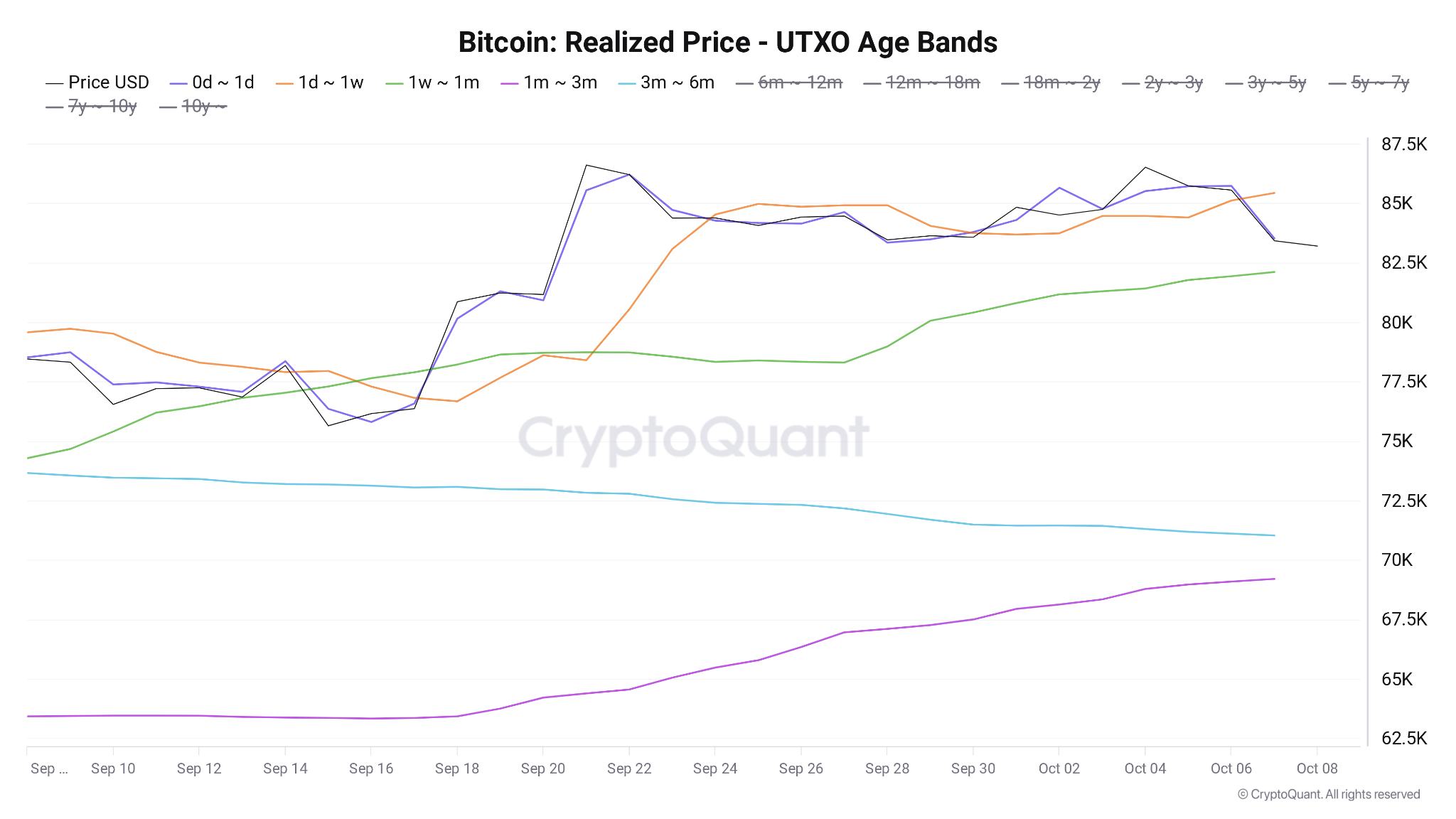

Bitcoin STH realized price by transaction age. Source: CryptoQuant


Trending Cryptos

Related Questions

QWhat is the amount of 'new money' inflows to Bitcoin in the 30 days to Oct. 5, according to Glassnode?

ARolling 30-day cumulative inflows of 'new money' to Bitcoin reached $4.9 billion on Oct. 5, according to Glassnode data.

QHow much did Bitcoin's realized cap grow in the 30-day period ending Oct. 5?

ABitcoin's realized cap grew by $12.8 billion in the 30-day period ending Oct. 5.

QWhat percentage of the profit-taking above $85,000 was attributed to short-term holders?

AShort-term holders accounted for more than 80% (specifically about 86% on the day of the first weekly close above $85,000) of profit-taking above $85,000.

QAccording to Glassnode, who is primarily responsible for Bitcoin's recent realized cap growth?

AAccording to Glassnode, existing investors holding money already in the market were primarily responsible for Bitcoin's recent realized cap growth, accounting for three-fifths of the $12.8 billion increase.

QWhat is the aggregate cost basis (realized price) for Bitcoin short-term holders as of Oct. 7, per CryptoQuant data?

AAs of Oct. 7, the aggregate cost basis (realized price) for Bitcoin short-term holders is approximately $78,250, according to CryptoQuant data.

Related Reads

Bidding Farewell to the Profit Era: South Korean Crypto Exchange Upbit Reports Its First Loss-Making Financial Statement

Dunamu, the operator of South Korea's largest crypto exchange Upbit, reported its first quarterly operating loss since Upbit launched in 2017, according to its Q3 2026 financial report. Operating revenue fell 60.7% year-on-year to 151.7 billion won, with an operating loss of 3.5 billion won and a net loss of 18.6 billion won. The downturn stems mainly from cooling crypto trading activity. Total trading volume across South Korea's five won-denominated exchanges fell from about $218.8 billion in Q1 to $133.2 billion in Q3, a 38.9% decline. Upbit's Q3 trading volume dropped 7.57% quarter-on-quarter, while Bithumb fell 13.45%. Dunamu's cumulative revenue for the first three quarters fell 52.9% year-on-year, and operating profit plunged 86.2%. Bithumb's Q3 revenue dropped 69.7% year-on-year to 59.4 billion won, with an operating loss of 8.1 billion won and net losses for three consecutive quarters. A key vulnerability is the exchanges' heavy reliance on trading fees: fees accounted for 96.04% of Dunamu's total revenue in the first three quarters, and 99.99% for Bithumb. Efforts to expand institutional clients have slowed due to delayed policy liberalization, and some exchanges have scaled back corporate business teams. Meanwhile, regulatory pressure is mounting. In August, South Korea approved amendments strengthening registration and anti-money laundering requirements for virtual asset service providers, expanding the Travel Rule to all transaction amounts and requiring recipient exchanges to verify sender information. Transfers of 10 million won or more to overseas exchanges or personal wallets must be reported, with stricter limits on high-risk transactions. Dunamu's merger with Naver Financial also faces a rigorous competition review by the Fair Trade Commission, which launched final deliberations on November 10 over concerns about competition in payments, search, advertising, online shopping, financial data aggregation, and won stablecoin issuance. From its first quarterly operating loss to stalled institutional openness and tightening AML and shareholder oversight, South Korean crypto exchanges now face a dual test of operations and regulation.

marsbit9m ago

Bidding Farewell to the Profit Era: South Korean Crypto Exchange Upbit Reports Its First Loss-Making Financial Statement

marsbit9m ago

Google says hackers use AI agents to find and exploit software flaws

Google Threat Intelligence Group (GTIG) has for the first time identified attackers using AI large language model frameworks to automate software vulnerability discovery and exploitation without step-by-step human direction. In a report published Monday, researchers described a tool found on an exposed staging server that compared software versions, identified potential flaws, and generated and executed exploit code. GTIG said threat actors used LLM frameworks to fully automate vulnerability discovery and exploitation without a human in the loop, hosting a multi-agent vulnerability research and weaponization framework designed to conduct continuous differential analysis comparing code before and after patch announcements on popular web applications, autonomously discovering and exploiting software vulnerabilities. Google warned these automated workflows give organizations less time to apply security patches before attackers develop ways to exploit vulnerable systems. Attackers are leveraging AI agent frameworks to automate patch reverse engineering via differential analysis and weaponizing N-day vulnerabilities. Vulnerability disclosures more than doubled between January and August, with exploited zero-days averaging eight per month in 2025 and 11 per month from January through August 2026, reaching 22 in August. Automated workflows also accelerate attackers' ability to move from initial access to domain administrator access, as cited in an August 2026 PaperCut campaign where attackers achieved that control within minutes. GTIG said two PHP vulnerabilities involved in exploitation attempts were discovered using LLM analysis. Anthropic also warned that AI-assisted attacks have evolved into multi-agent operations automating most of the cyberattack cycle from discovery to exploitation and data theft.

cointelegraph1h ago

Google says hackers use AI agents to find and exploit software flaws

cointelegraph1h ago

Coin-Stock Trend Indicator丨Third-largest BTC treasury company Twenty One Capital buys $10 million in BTC for the first time since July 2025; Bitmine total holdings value drops $2.5 billion in a week (November 17)

This week's crypto stock snapshot notes that the recent US equity move was merely an oversold rebound rather than a new high, with the impact of the Democratic midterm election win still spreading and Nvidia founder Jensen Huang's resignation controversy evolving into a broader AI-sector storm. The week's biggest US market event is Anthropic's IPO on November 19, though its fundraising and valuation fall short of SpaceX's record. Japanese stocks remain favored by Morgan Stanley analysts despite AI-related weakness, while Korean stocks fell 2.59% to 4,968.45, their lowest since February 2. In crypto stocks, last week's market crash hit DAT treasury companies hard, with ETH treasury firm Bitmine's holdings value dropping from $14.3 billion to $11.8 billion in a week, nearly all due to ETH's price decline. Listed companies (excluding miners) bought a net $51.86 million in Bitcoin last week, down 45.2% week-over-week. Strategy bought 485 BTC at $68,887 each for about $33.4 million, bringing total holdings to 850,849 BTC; Metaplanet bought none. Capital B bought 12 BTC at $77,500.2, holding 3,550 BTC; Strive bought 251 BTC at $69,853 for about $17.53 million, holding about 43,404 BTC. Total tracked holdings reached 1,171,317 BTC, up 0.04% week-over-week, worth about $75.53 billion, or 5.8% of Bitcoin's circulating market cap. Twenty One Capital bought 154.32 BTC for about $10 million in cash, its first purchase since July 2025, bringing holdings to about 43,700 BTC and making it the third-largest listed Bitcoin treasury; CEO Rapha Zagury said volatility creates opportunity and the firm bought the dip. BitMine added 7,653 ETH last week, holding 6,077,745 ETH (4.97% of total supply, 0.03% short of its 5% goal) plus 216 BTC, a $180 million investment in Beast Industries, $67 million in Eightco Holdings, and $448 million in cash and securities; its ETH holdings are worth about $11.1 billion at $1,823 per ETH. Chairman Tom Lee attributed ETH's 28% two-week drop to Nvidia-related turmoil triggering Asian margin selling and investors raising cash for Anthropic's reported November 18 IPO, saying it contradicts improving fundamentals. DeFi Development Corp. added 9,482 SOL, with Solana treasury holdings reaching about 2.62 million tokens, growing for a 10th straight week; its CHAD preferred stock raised enough to buy over 230 SOL today. CZ said Japan-listed ASIAN STAR will distribute 8 million yen worth of BNB to shareholders and pursue Japanese real estate tokenization on BNB Chain. DeFi Technologies reported Q3 2026 revenue of $18.3 million (down about 18% year-over-year), operating income of $7 million, and net profit of $22.3 million, with $53.4 million in cash and stablecoins and $48.2 million in digital assets. Ripple-backed Evernorth disclosed its 346 million XRP was booked at $342 million versus an initial $847 million record value, with cumulative impairments of $505 million, a nearly 60% decline.

marsbit1h ago

Coin-Stock Trend Indicator丨Third-largest BTC treasury company Twenty One Capital buys $10 million in BTC for the first time since July 2025; Bitmine total holdings value drops $2.5 billion in a week (November 17)

marsbit1h ago

Trading

Spot

Hot Articles

What is $BITCOIN

DIGITAL GOLD ($BITCOIN): A Comprehensive Analysis Introduction to DIGITAL GOLD ($BITCOIN) DIGITAL GOLD ($BITCOIN) is a blockchain-based project operating on the Solana network, which aims to combine the characteristics of traditional precious metals with the innovation of decentralized technologies. While it shares a name with Bitcoin, often referred to as “digital gold” due to its perception as a store of value, DIGITAL GOLD is a separate token designed to create a unique ecosystem within the Web3 landscape. Its goal is to position itself as a viable alternative digital asset, although specifics regarding its applications and functionalities are still developing. What is DIGITAL GOLD ($BITCOIN)? DIGITAL GOLD ($BITCOIN) is a cryptocurrency token explicitly designed for use on the Solana blockchain. In contrast to Bitcoin, which provides a widely recognized value storage role, this token appears to focus on broader applications and characteristics. Notable aspects include: Blockchain Infrastructure: The token is built on the Solana blockchain, known for its capacity to handle high-speed and low-cost transactions. Supply Dynamics: DIGITAL GOLD has a maximum supply capped at 100 quadrillion tokens (100P $BITCOIN), although details regarding its circulating supply are currently undisclosed. Utility: While precise functionalities are not explicitly outlined, there are indications that the token could be utilized for various applications, potentially involving decentralized applications (dApps) or asset tokenization strategies. Who is the Creator of DIGITAL GOLD ($BITCOIN)? At present, the identity of the creators and development team behind DIGITAL GOLD ($BITCOIN) remains unknown. This situation is typical among many innovative projects within the blockchain space, particularly those aligning with decentralized finance and meme coin phenomena. While such anonymity may foster a community-driven culture, it intensifies concerns about governance and accountability. Who are the Investors of DIGITAL GOLD ($BITCOIN)? The available information indicates that DIGITAL GOLD ($BITCOIN) does not have any known institutional backers or prominent venture capital investments. The project seems to operate on a peer-to-peer model focused on community support and adoption rather than traditional funding routes. Its activity and liquidity are primarily situated on decentralized exchanges (DEXs), such as PumpSwap, rather than established centralized trading platforms, further highlighting its grassroots approach. How DIGITAL GOLD ($BITCOIN) Works The operational mechanics of DIGITAL GOLD ($BITCOIN) can be elaborated on based on its blockchain design and network attributes: Consensus Mechanism: By leveraging Solana’s unique proof-of-history (PoH) combined with a proof-of-stake (PoS) model, the project ensures efficient transaction validation contributing to the network's high performance. Tokenomics: While specific deflationary mechanisms have not been extensively detailed, the vast maximum token supply implies that it may cater to microtransactions or niche use cases that are still to be defined. Interoperability: There exists the potential for integration with Solana’s broader ecosystem, including various decentralized finance (DeFi) platforms. However, the details regarding specific integrations remain unspecified. Timeline of Key Events Here is a timeline that highlights significant milestones concerning DIGITAL GOLD ($BITCOIN): 2023: The initial deployment of the token occurs on the Solana blockchain, marked by its contract address. 2024: DIGITAL GOLD gains visibility as it becomes available for trading on decentralized exchanges like PumpSwap, allowing users to trade it against SOL. 2025: The project witnesses sporadic trading activity and potential interest in community-led engagements, although no noteworthy partnerships or technical advancements have been documented as of yet. Critical Analysis Strengths Scalability: The underlying Solana infrastructure supports high transaction volumes, which could enhance the utility of $BITCOIN in various transaction scenarios. Accessibility: The potential low trading price per token could attract retail investors, facilitating wider participation due to fractional ownership opportunities. Risks Lack of Transparency: The absence of publicly known backers, developers, or an audit process may yield skepticism regarding the project's sustainability and trustworthiness. Market Volatility: The trading activity is heavily reliant on speculative behavior, which can result in significant price volatility and uncertainty for investors. Conclusion DIGITAL GOLD ($BITCOIN) emerges as an intriguing yet ambiguous project within the rapidly evolving Solana ecosystem. While it attempts to leverage the “digital gold” narrative, its departure from Bitcoin's established role as a store of value underscores the need for a clearer differentiation of its intended utility and governance structure. Future acceptance and adoption will likely depend on addressing the current opacity and defining its operational and economic strategies more explicitly. Note: This report encompasses synthesised information available as of October 2023, and developments may have transpired beyond the research period.

5.5k Total ViewsPublished 2025.05.14Updated 2025.05.14

What is $BITCOIN

Discussions

Welcome to the HTX Community. Here, you can stay informed about the latest platform developments and gain access to professional market insights. Users' opinions on the price of BTC (BTC) are presented below.

活动图片