August Market Recap: Cryptocurrency and Gold Lead the Rally, While US Stocks Lag Behind?

marsbitPublished on 2026-09-08Last updated on 2026-09-08

Abstract

August Market Recap: Crypto and Gold Lead, US Stocks Lag In August, cryptocurrencies and gold significantly outperformed other major asset classes. Bitcoin (BTC) rose 25.04% and Ethereum (ETH) surged 32.57%, leading a broad crypto rally where the median token gained 16.76%. Notable performers included Pump.fun (+115.09%) and Ethena (+86.16%), though Ondo fell 11.23%, highlighting the importance of asset selection. Gold posted a strong 9.43% gain, despite stable US Treasury yields and a minimal 0.37% drop in the US Dollar Index, suggesting other factors drove its rise. Broader commodities also rallied, with cocoa, sugar, and wheat outpacing gold. The US equity market showed stark divergence. While the S&P 500 and Nasdaq 100 rose 2.62% and 4.18% respectively, small caps (Russell 2000/IWM) were nearly flat (+0.94%). Performance was driven by individual stock stories like Nvidia's strong AI-driven earnings, contrasting with declines in names like GE and UnitedHealth. Key developments included Ethena's proposal for a token buyback contingent on USDe supply growth, and Ether.fi's product expansion. Economic data revealed persistent inflation alongside signs of slowing consumer demand. Overall, August's gains were concentrated in crypto, precious metals, and select commodities, while US stock returns were narrow and uneven.

Author: Flow Brief by Alea Research

Compiled by: Deep Tide TechFlow

Deep Tide Insight: Ethereum surged 32% in August, Bitcoin rose 25%, and gold increased 9.4%, but this rally was far from a "sure-win market for all." Within the same rising tide, Ondo fell 11% against the trend, and US small-cap stocks barely moved. For investors, the real question is not "did it rise?" but who will be left exposed when the tide recedes.

Cross-Asset Markets

Cryptocurrency and gold led the pack in August, while US stocks showed clear divergence. BTC rose 25.04%, gold increased 9.43%, while US small-cap stocks, as measured by the Russell 2000 ETF (IWM), gained a mere 0.94%. The gains in crypto assets were not limited to BTC, and gold's rise was not accompanied by a significant decline in US Treasury yields.
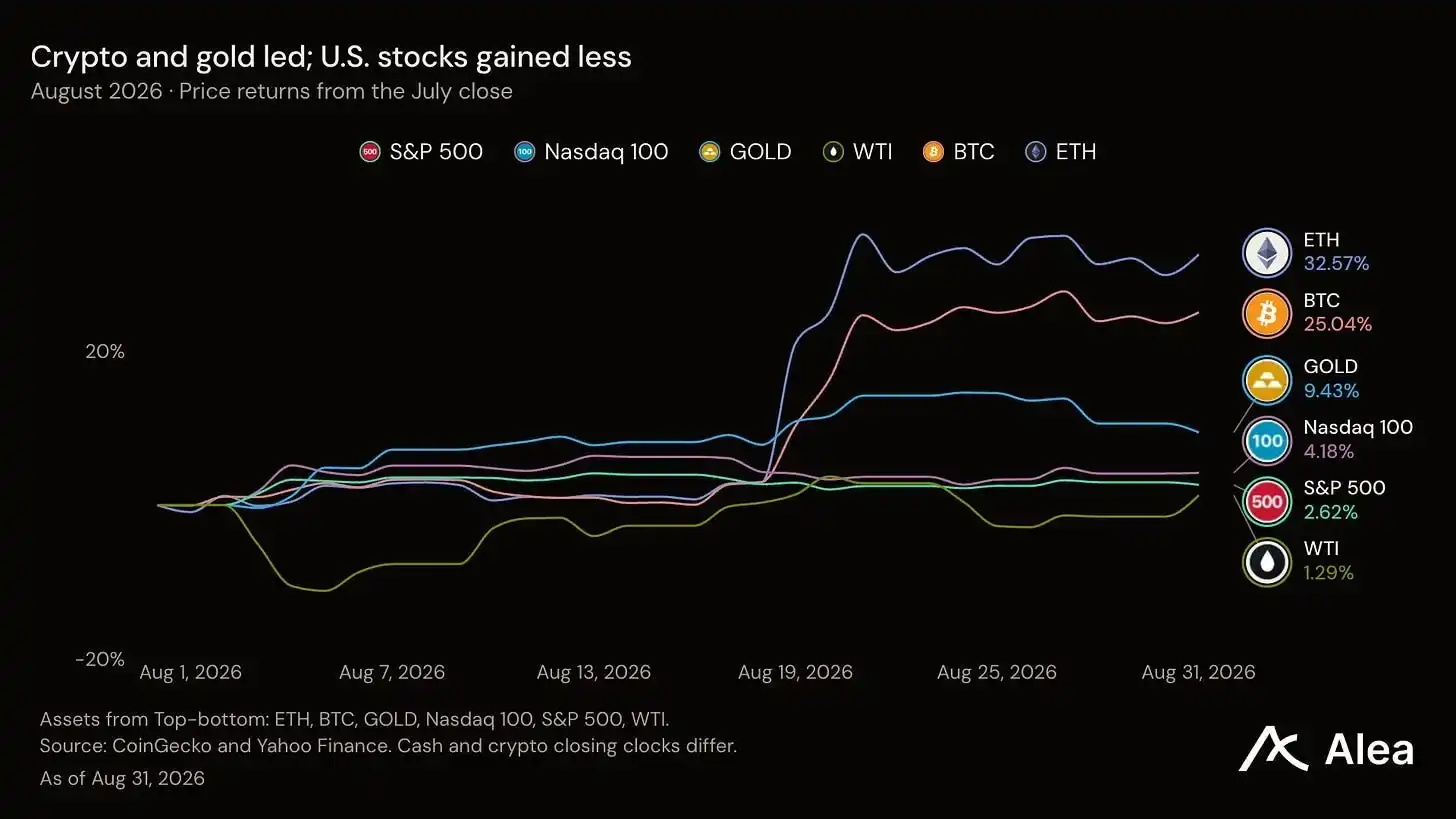
August returns for major asset classes: BTC, Ethereum, gold, WTI crude oil, S&P 500, and Nasdaq 100.

Crypto assets generally rose, while US stocks saw an individual stock-driven divergent market. Most tokens trended higher, while stock movements were driven by their respective earnings reports and news.

Gold rose while US Treasury yields remained steady. The 10-year yield ended at 4.75%, flat with the beginning of the month.

Tokenomics became more transparent. Ether.fi started recording buybacks, while Ethena proposed a buyback scheme contingent on reaching a supply threshold.

The commodity rally extended beyond metals. Cocoa, sugar, and wheat all outperformed gold.

The July PCE price index rose 0.2% month-over-month, but the overall annual inflation rate remained at 3.7%, with core inflation at 3.3%. Real consumer spending was flat. BEA data paints a picture of weak demand coexisting with stubborn inflation.
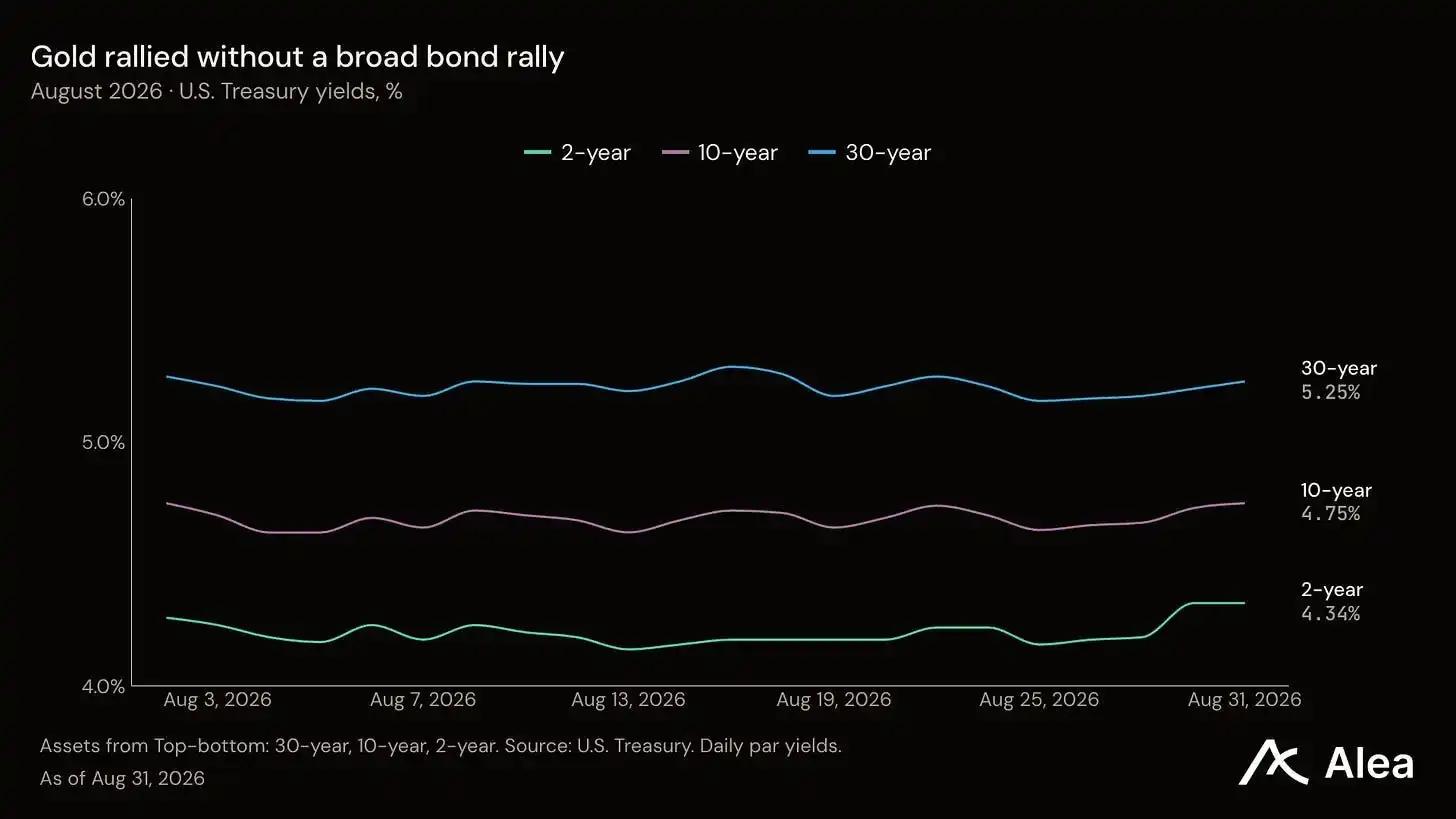
Daily US Treasury yield movements in August, covering 2-year, 10-year, and 30-year maturities.

The 2-year yield increased by 6 basis points to 4.34%, while the 10-year yield ended flat compared to the start of the month. This aligns with the Federal Reserve's emphasis on price stability on August 28th.
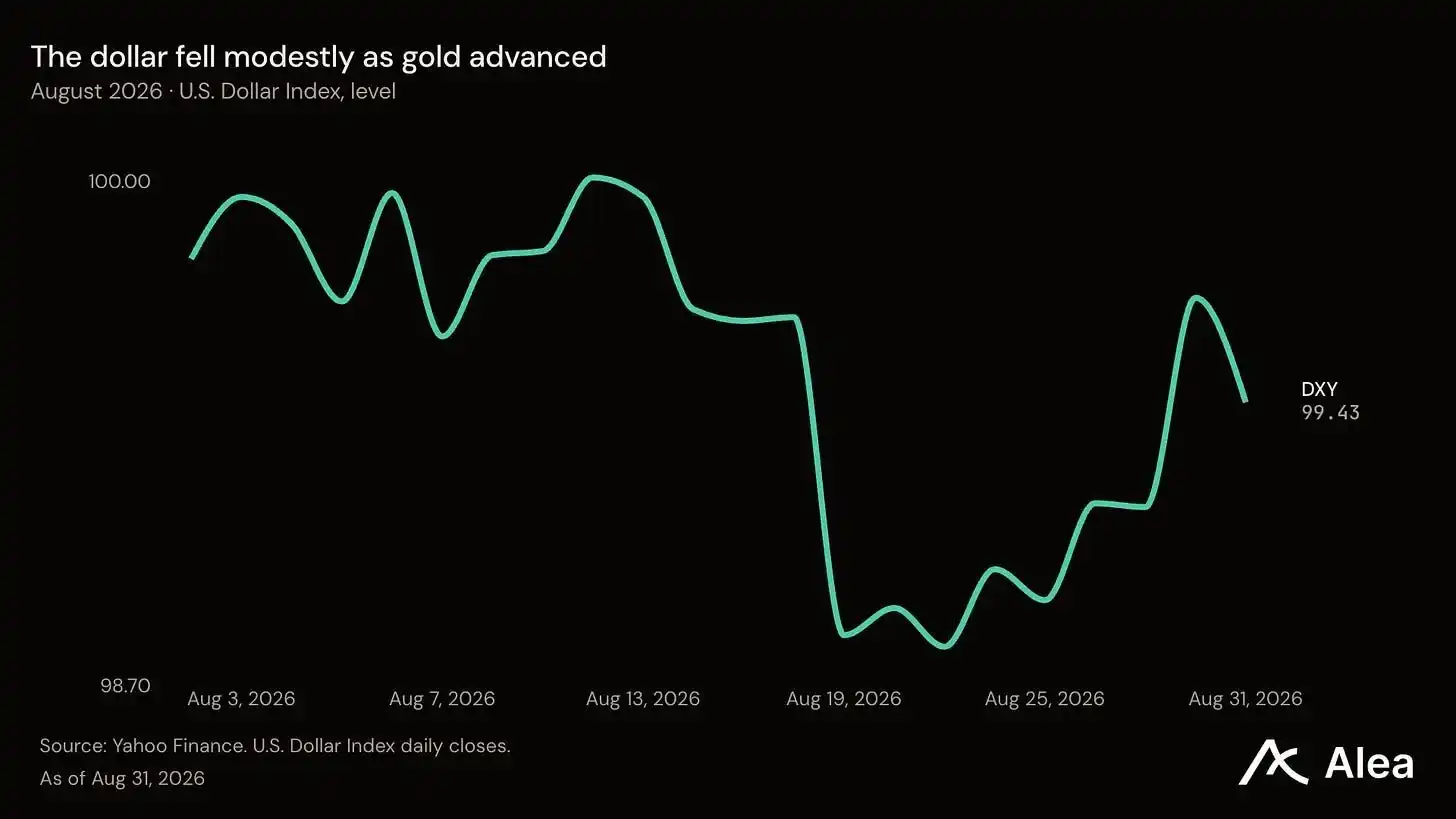
August US Dollar Index (DXY) movement.

The US Dollar Index fell only 0.37%. Gold's gain far exceeded what could be explained by currency fluctuations. September's inflation data will help determine whether short-term rates can follow the dollar lower.

ETH rose 32.57%, outperforming BTC's 25.04%. The gains were not limited to these top assets: the median gain among eligible tokens was 16.76%.
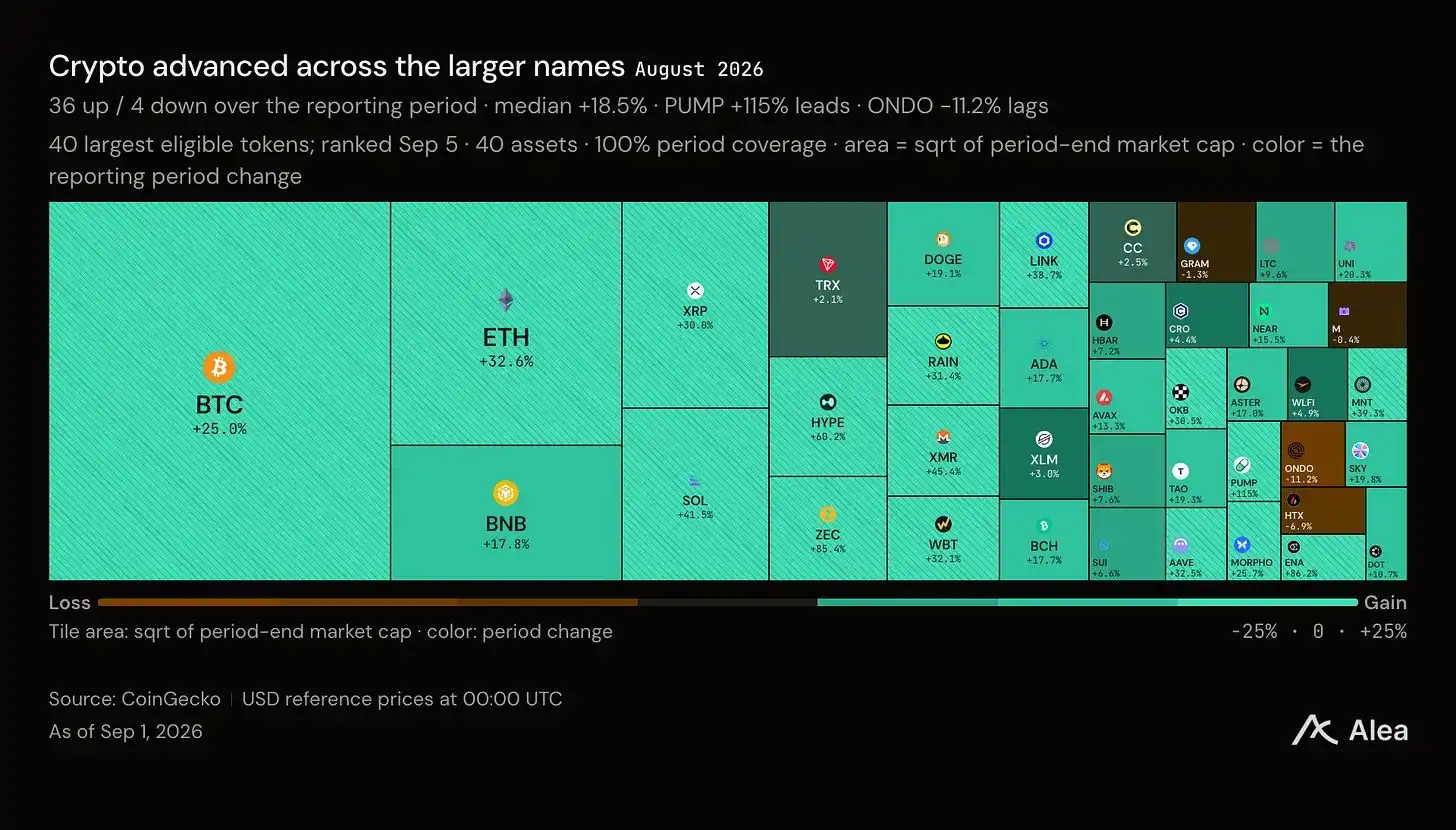
August crypto market landscape: Top 40 eligible tokens by market cap, scaled by the square root of market capitalization.

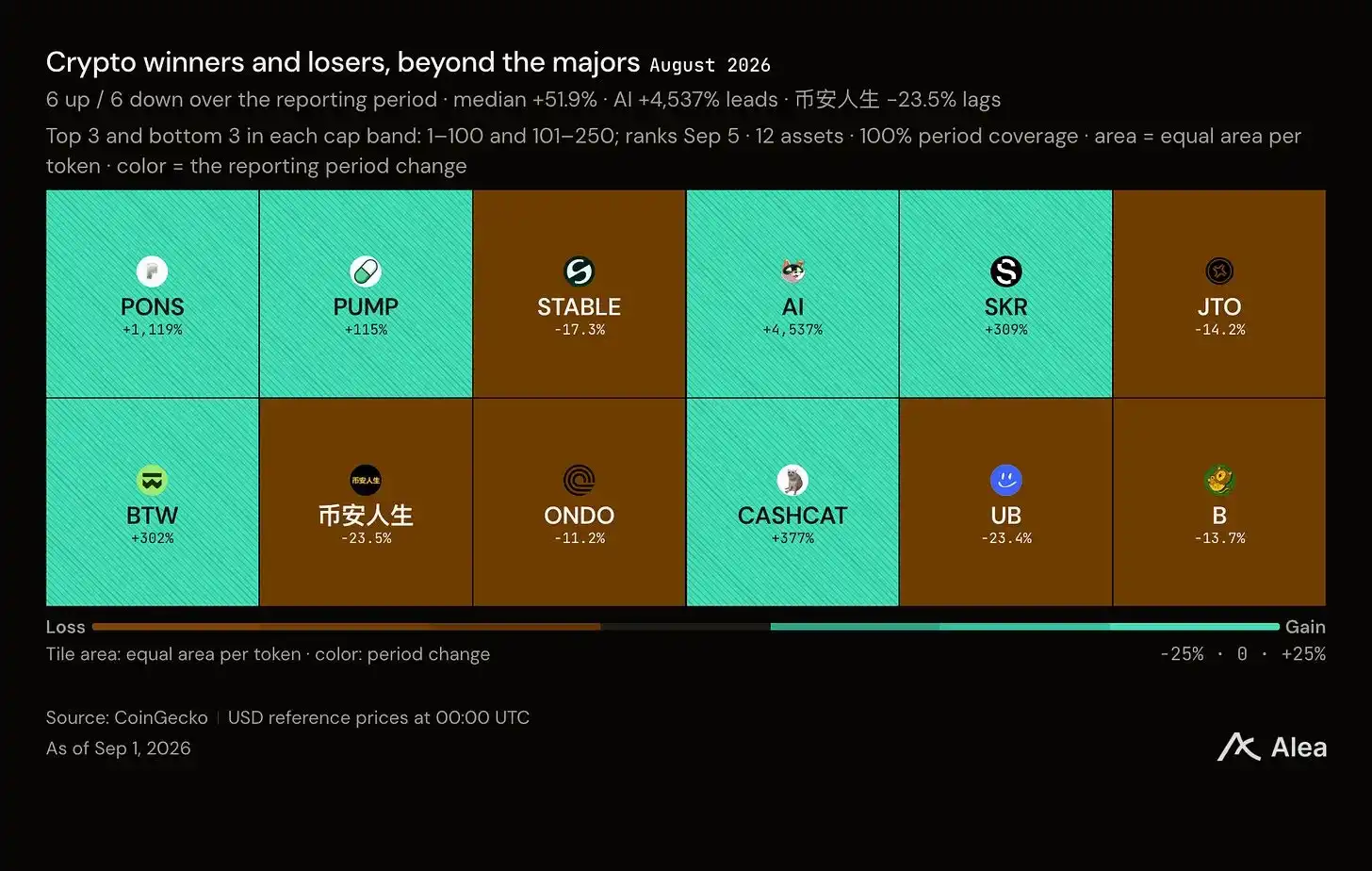
Amid the broad gains, there were notable exceptions. Pump.fun rose 115.09%, Ethena gained 86.16%, Zcash increased 85.40%; Ondo fell 11.23%. Even in a rising market, token selection remains crucial.
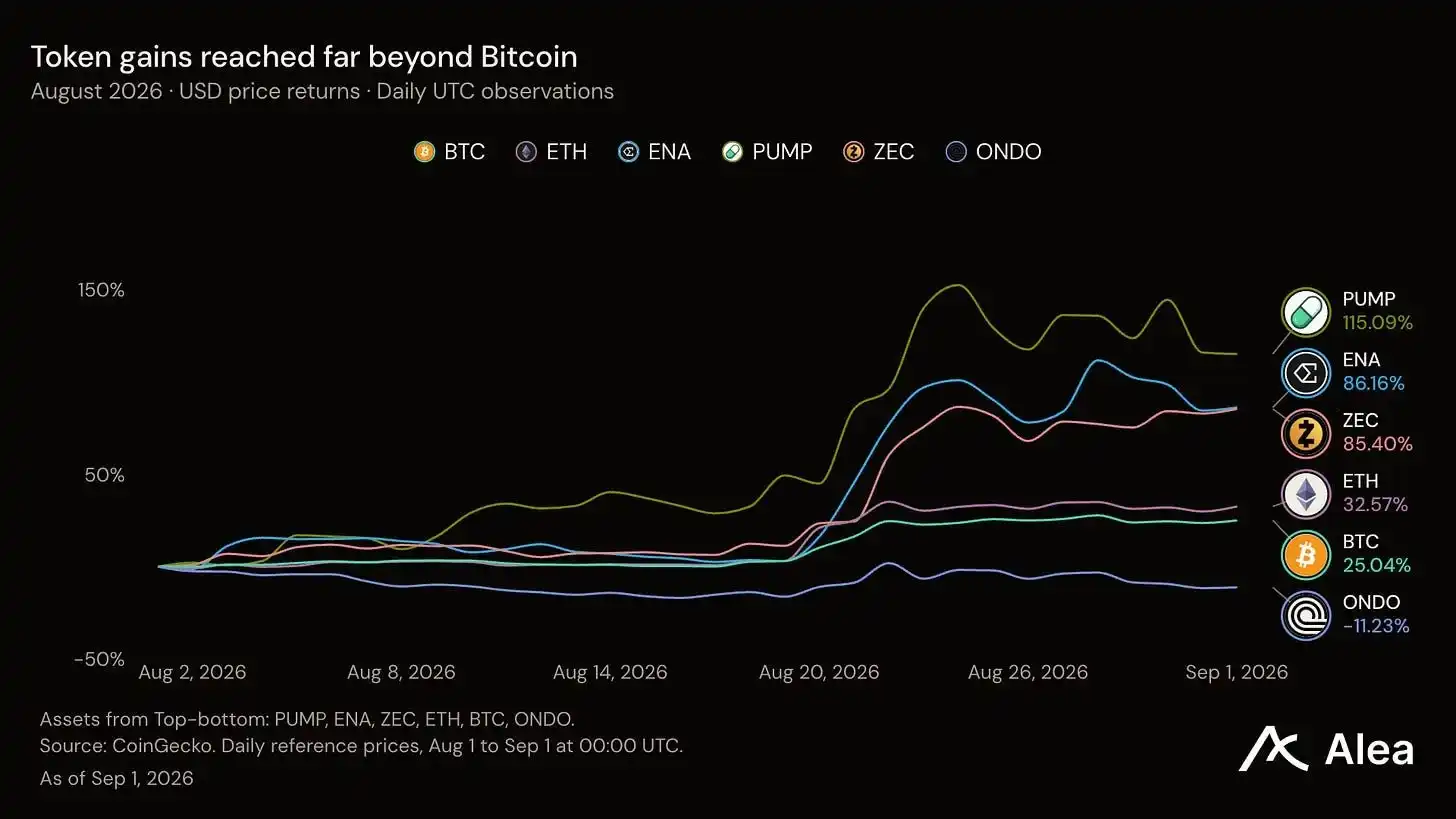
August CoinGecko price paths: BTC, Ethereum, Ethena, Pump.fun, Zcash, and Ondo.

Ethena's Buyback Threshold

Ethena's fee proposal on August 27th stipulates that, after the foundation takes 5% of gross revenue, the first tranche will allocate 95% of net revenue for buybacks. The activation threshold is USDe supply reaching $75 billion, while the disclosed current supply in the proposal is $40.7 billion, implying the need for approximately 84% supply growth. Read Alea's "ENA's Claim on Ethena Still Has Prerequisites."

Ether.fi's Product Expansion

Ether.fi's product expansion in August broadened customer relationships, with ETHFI rising 36.95%. Revenue after deducting rewards and service costs will show how much value this expansion actually retains. Read Alea's "ETHFI Buyback Vote."
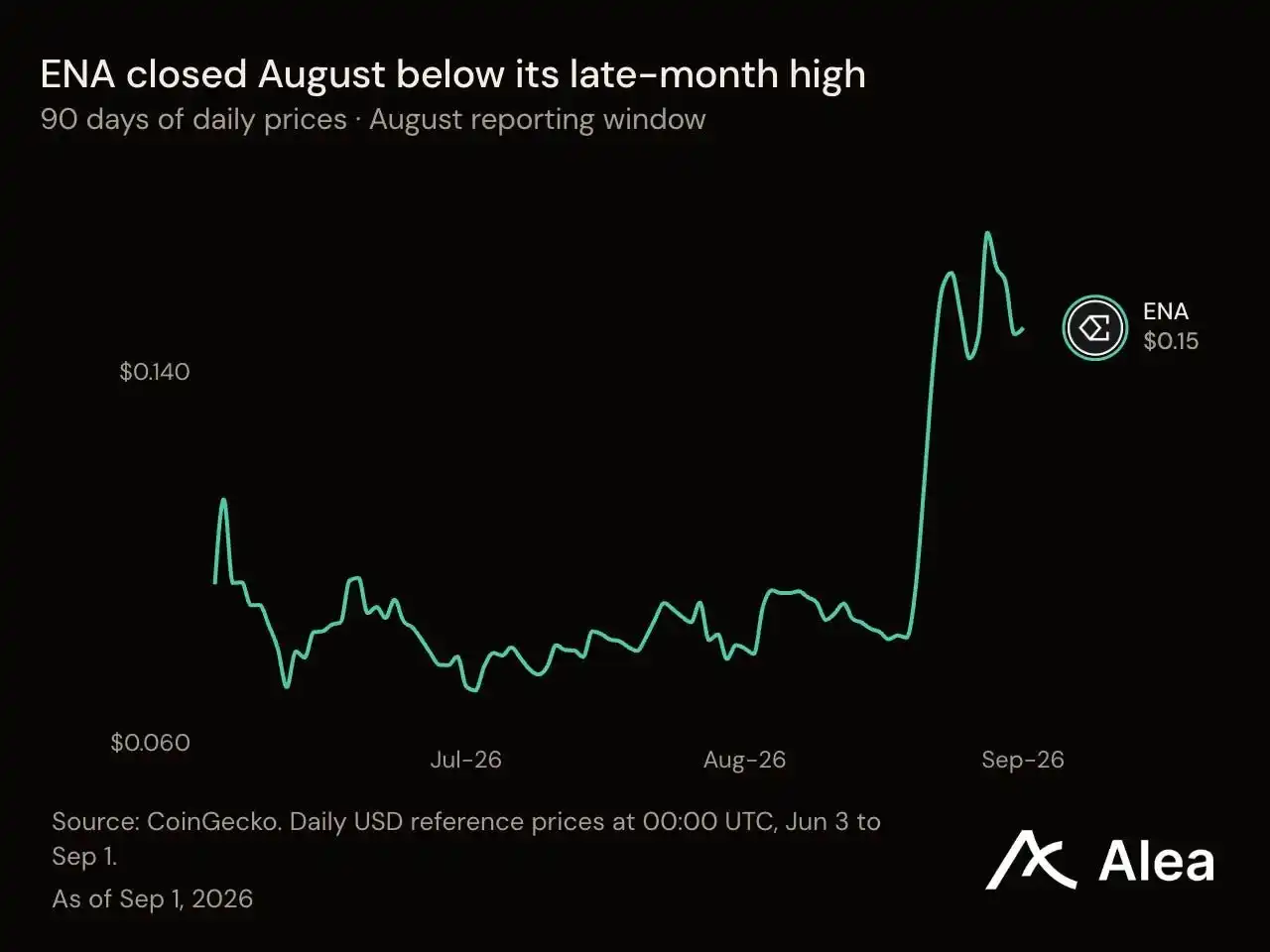
Ethena's 90-day daily reference price movement, contextualizing August's gains within a longer timeframe.

ENA's August closing price was about 12.1% lower than its UTC closing price on August 27th, despite a substantial monthly gain overall. Progress toward the proposal's goals will be determined by USDe supply growth and the actual execution of buybacks.

Pons rose 1,119%, closing at approximately 12 times its starting price.
US Stocks: A Bull Market for the Few

The S&P 500 rose 2.62%, and the Nasdaq 100 gained 4.18%, significantly outperforming IWM. Within a research pool of 49 stocks, Coinbase, Robinhood, and Freeport-McMoRan led gains, rising 28.62%, 21.08%, and 20.93% respectively. GE, UnitedHealth, and Walmart were at the bottom, falling 6.77%, 6.03%, and 5.69% respectively.
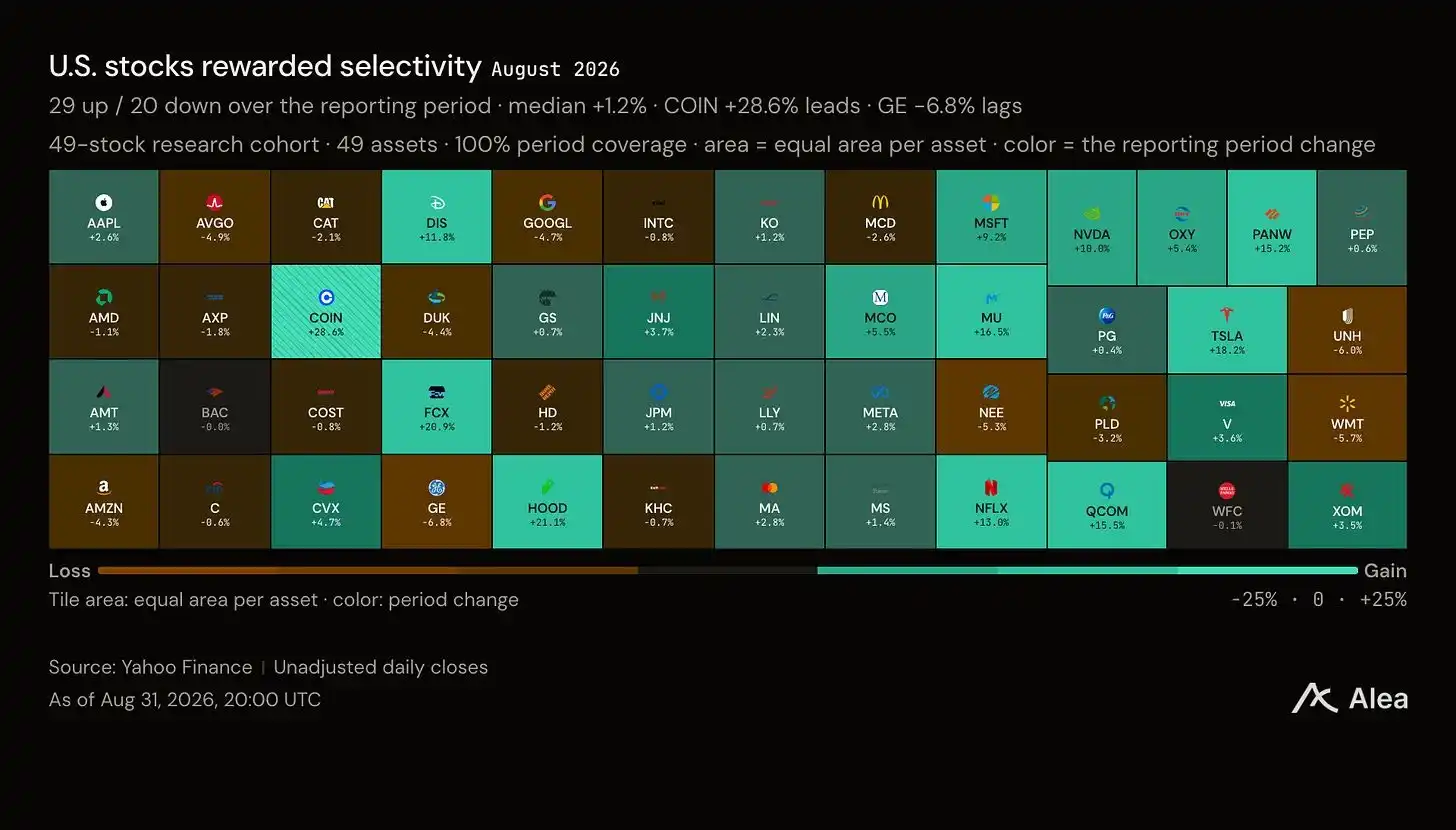
August return distribution for the 49-stock US equity research pool, presented as equal-area squares.

Nvidia provided earnings support for AI demand: quarterly revenue of $96.2 billion, up 106% year-over-year, with next-quarter guidance of $108 billion. This guidance midpoint implies a further sequential growth of 12.2%. NVDA rose 9.98%, while the semiconductor ETF SOXX rose only 1.22%. Earnings supported Nvidia's growth narrative, but the sector's overall returns show the rally was not evenly distributed. Read Alea's "When the AI Trade Becomes a Memory Trade."

Commodities

Gold rose 9.43% and silver gained 14.98%, but this was only part of the story. Among 28 front-month futures contracts, 23 advanced. Cocoa rose 23.22%, sugar increased 21.49%, and Chicago wheat gained 18.34%; orange juice fell 23.04%, lean hogs dropped 15.35%, and live cattle declined 7.64%. Food and industrial input costs are diverging.
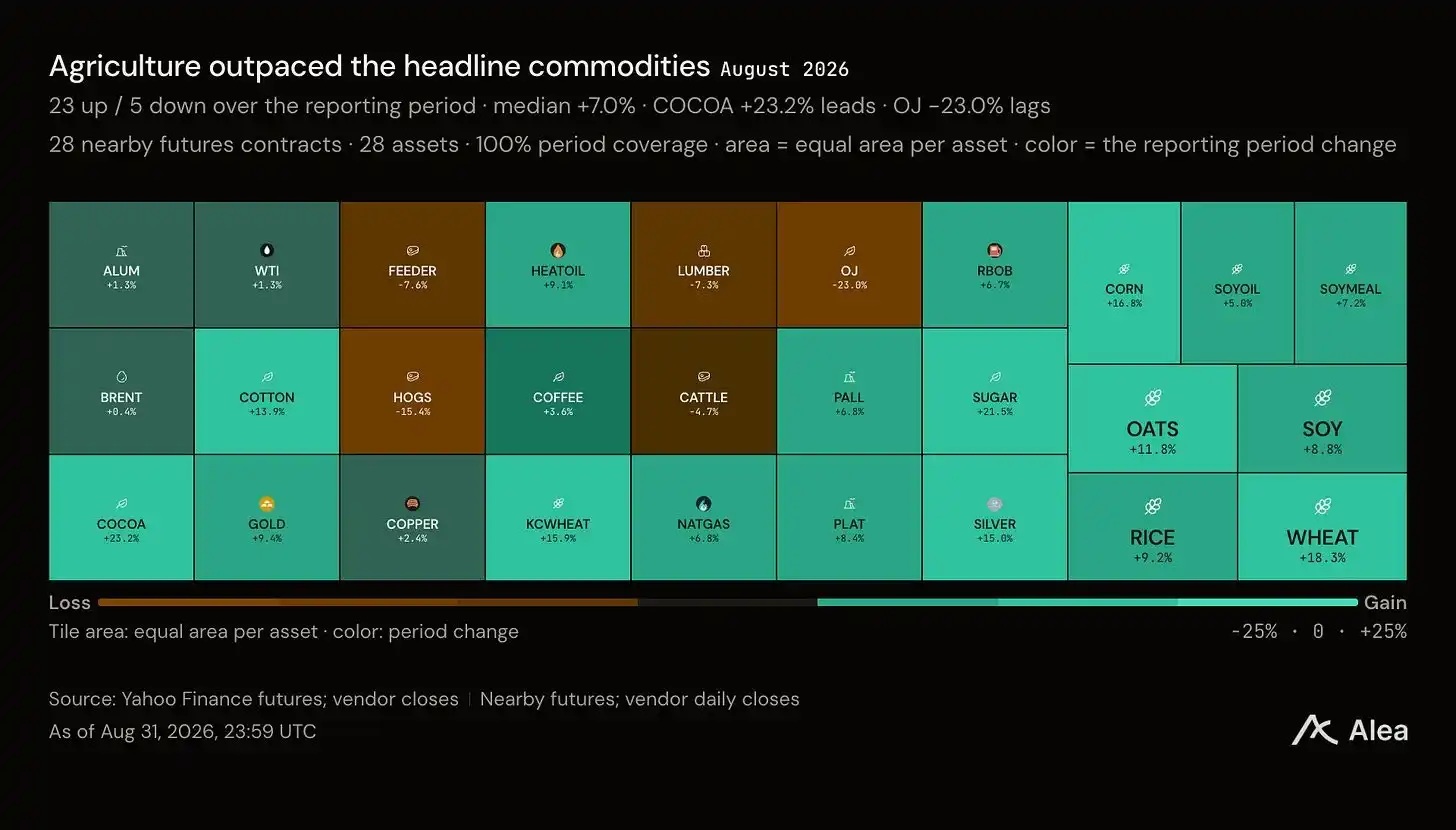
August landscape of 28 front-month commodity futures contracts.

WTI crude oil rose only 1.29%. August's commodity inflation pressure primarily came from select food and metal contracts, with oil's contribution far less significant. Delivery dates and contract rollovers also affect front-month futures prices.

Methodology: Spot price comparisons use July 31st and August 31st closing prices. CoinGecko reference price range is August 1st to September 1st UTC 00:00, covering UTC closing prices for August. Crypto assets exclude stablecoins, tokenized funds, securities, and commodities, require prices at both points in time, and have a $1 million volume threshold on the closing date. Stock breadth covers a 49-stock research pool. Futures use vendor daily closing prices. Data sources: CoinGecko, Yahoo Finance, US Treasury.


Related Questions

QWhich assets were the top performers in August according to the article, and by how much did they increase?

AAccording to the article, Ethereum and cryptocurrencies led the market in August. Ethereum surged by 32.57%, Bitcoin rose by 25.04%, and gold increased by 9.43%.

QWhat was the performance of U.S. small-cap stocks in August, and what ETF is used as a benchmark?

AU.S. small-cap stocks barely moved in August, with the Russell 2000 ETF (IWM) measuring only a slight increase of 0.94%.

QWhat are the key conditions for Ethena's proposed share buyback plan to be triggered?

AEthena's fee proposal states that the first tranche of buybacks, using 95% of net income, will be triggered only when the supply of USDe reaches $75 billion. The current supply disclosed is $40.7 billion, meaning an approximately 84% growth in supply is still required.

QDespite the overall positive trend in cryptocurrencies, which specific token experienced a price decline in August?

AIn the context of a generally rising cryptocurrency market, the token Ondo (ONDO) was an exception, declining by 11.23% in August.

QWhat does the article suggest about the nature of the U.S. stock market rally in August based on the performance of Nvidia and its sector ETF?

AThe article suggests the U.S. stock market rally in August was narrow and uneven. While Nvidia's strong earnings drove its stock up 9.98%, the broader semiconductor ETF (SOXX) only gained 1.22%, indicating the gains were not broadly distributed across the sector.

Related Reads

Can using a chip for two more years really help get through the cold winter?

The smartphone industry is grappling with rising memory chip costs that are driving up device prices, forcing manufacturers to find ways to stay competitive. A recent leak about a chip called "SM7635" with a 2.96GHz peak CPU frequency and Adreno 810 GPU suggests Qualcomm may be reusing its Snapdragon 7s Gen3 (originally launched in 2024 at 2.5GHz) yet again. The chip already spawned a 2025 variant (SM7635-AC, renamed Snapdragon 7s Gen4) with a 2.7GHz clock, and the new 2.96GHz version will likely become the Snapdragon 7s Gen5—marking a third generation from one original design. This practice of reusing and overclocking mid-range SoCs is not new. MediaTek's Helio X20/X23/X25/X27 and Dimensity 1100/1200/1300, as well as Qualcomm's Snapdragon 615/616/617, 765/765G/768G, and 778G/778G+/782G, followed similar patterns. Previously, however, this was mainly done to widen the gap between flagship and non-flagship products and give flagship buyers more perceived value—not primarily to cut costs. Mid-range buyers were assumed not to care much about chip model numbers. Now the situation is different. One brand recently launched a mid-to-low-end phone with the Snapdragon 7s Gen4 priced at 3699 yuan—a price that a year ago could buy a flagship with a fifth-generation Snapdragon 8 Elite, roughly three to four times more powerful. While SoC isn't the only cost component, consumers clearly get less value for the same money today. Counterpoint Research reports global smartphone SoC shipments fell 21% year-over-year in Q3 2026. Even flagship lines show signs of chip reuse—the Dimensity 9600M appears to be an overclocked Dimensity 9500. With few flagships using fully-specced memory and storage, rumors suggest next year's devices may widely reuse current-generation flagship SoCs while upgrading memory and storage instead. This helps control costs but may further dampen consumers' willingness to upgrade, making such reuse an unsustainable strategy. Restoring market confidence will require both chipmakers and device brands to offer consumers more tangible benefits.

marsbit3h ago

Can using a chip for two more years really help get through the cold winter?

marsbit3h ago

Former OpenAI Employee Disgusted: AI Developing AI Crosses the Line to "Ultimate Superintelligence"—Even Stopping Global Data Center Construction Is Too Late

A Harvard physicist and computer scientist, Alex Wissner-Gross, argues in a recent podcast that AI has passed the "superintelligence escape velocity"—existing algorithms and installed compute alone are enough to push all the way to superintelligence, meaning even shutting down all new data centers tomorrow could not stop it. His claim rests on METR evaluation charts showing Anthropic's unreleased Model 4 breaking above the exponential trend line into "super-exponential growth," indicating AI has deeply taken over its own R&D and entered a recursive self-improvement loop. METR researcher Ajeya Cotra's analysis warns that AI capabilities are compounding: since hardware compute grew only at normal speed while overall capability growth doubled, software "compute multipliers" improved 2.5–3x, implying Anthropic researchers gained roughly 10x efficiency—matching员工 self-reports of 12x with Model 4. Each doubling of research speed takes half the time of the last—12 months, then 6 months, 3 months, 6 weeks—converging within a year toward "ultimate superintelligence," with no marginal diminishing returns yet visible. Timeline trackers show internal models already surpass public ones by about 9 months, with a "superhuman coder" threshold (2,000 hours of independent work) projected for April 2027, followed by superhuman AI researcher (Sept 2027), superintelligent AI researcher (Nov 2027), and full ASI (Dec 2027). Meanwhile, OpenAI, Anthropic, and Google DeepMind have reportedly achieved fully autonomous research, with models selecting their own research directions and first AI-initiated results to be published this month. A former OpenAI employee described feeling physically sick and fearful for family and friends after reading the report.

marsbit3h ago

Former OpenAI Employee Disgusted: AI Developing AI Crosses the Line to "Ultimate Superintelligence"—Even Stopping Global Data Center Construction Is Too Late

marsbit3h ago

TRON network integrates with Backpack Wallet, expanding access to its multichain ecosystem

TRON DAO has announced the integration of the TRON network with Backpack Wallet, bringing TRON's blockchain ecosystem directly to Backpack users. Through the integration, users can send, receive, bridge, and manage TRON-based digital assets — including USDT (TRC-20) — via Backpack's mobile app and browser extension while maintaining full self-custody. Users can also bridge assets between TRON and other supported blockchains, explore DeFi applications and dApps across the TRON ecosystem such as Sun.io, and manage TRON assets alongside holdings from other networks in a single multichain wallet. The integration follows the recent listing of TRX for spot trading and perpetual contracts on Backpack Exchange, expanding market access to TRON's native utility token for users in eligible jurisdictions. Together, these developments establish a foundation for deeper ecosystem connectivity across Backpack's wallet and exchange products. The collaboration reinforces TRON's commitment to expanding global access to blockchain infrastructure, stablecoin payments, and decentralized finance. Founded in September 2017, TRON launched its MainNet in May 2018 and now hosts the largest circulating supply of USDT, exceeding $94 billion. As of November 2026, TRON has recorded over 412 million total user accounts, more than 16 billion total transactions, and over $27 billion in total value locked, positioning it as a global settlement layer for stablecoin transactions.

cointelegraph4h ago

TRON network integrates with Backpack Wallet, expanding access to its multichain ecosystem

cointelegraph4h ago

Trading

Spot
活动图片