Latest Research Report from the Publisher of "AI Doomsday Report": Agents and RWA Reshape the Crypto Industry

marsbitPublished on 2026-10-11Last updated on 2026-10-11

Abstract

The report "AI & Asset Tokenization" by Citrini Research argues that the rise of AI Agents and the tokenization of real-world assets (RWA) are converging to provide a crucial use case for blockchain technology. It posits that traditional financial systems, designed for human interaction, are ill-suited for a future where AI Agents will autonomously manage finances, seek optimal yields, and execute transactions 24/7. Blockchains, with their programmable, always-on infrastructure, are presented as the natural solution. The report highlights that while crypto initially lacked mainstream assets, this is changing rapidly with the tokenization of stocks, Treasuries, and other RWAs onto blockchains. Key recent developments include the off-platform circulation of stock tokens (e.g., via Robinhood), surging on-chain DEX activity, and evolving U.S. regulatory stances that are bringing these assets into regulated markets. The core thesis is that AI Agents need programmable finance, and tokenization brings desired assets on-chain, finally giving blockchain a clear utility. The focus for investors should shift from questioning tokenization's viability to identifying which platforms and applications will capture the revenue and profits from this growing fusion of traditional finance and crypto.

Author: Citrini Research

Compiled by: Jiahuan, ChainCatcher

AI and Asset Tokenization

Imagine your personal AI having access to all your financial information. It could easily put idle funds to work, make investment decisions for you, and secure the most favorable mortgage terms on your behalf.

"Claude, help me find the lowest-cost $500,000 loan to refinance my current one."

Pushing this scenario further, the outlook starts to become unsettling. What happens when millions of AI Agents—autonomous AI programs that can execute tasks—continuously shift deposits to institutions offering the highest interest rates? Could banks lose the low-cost funding they rely on? Could an AI Agent-induced bank run be on the horizon?

As consumer-facing Agents become more widespread, a scenario that sounded like a Hollywood sci-fi premise just a few years ago is no longer so distant.

The existing financial system wasn't designed for such a future. It's slow, operates in silos, and access to financial services is restricted by intermediaries, regulatory requirements, and customer identity verification. This system was built by and for humans.

These limitations were originally intended to protect the financial system from risks posed by human behavior, but they also objectively block Agent intervention. As we noted in *Agentic Reality*, in some respects, consumer-facing software is easier for Agents to disrupt first. Agents can already operate websites and apps; with authorization, they can operate our phones and other devices. Software that previously required humans to search, compare, click, and trade can now be entrusted to Agents.

The old financial world is different, and understandably so. But we are already beginning to see cracks in the wall.

We are rapidly moving towards a world where information and resources are increasingly machine-readable, programmatically controlled, and transferable across systems. This trend isn't limited to consumer data; it applies to funds, bandwidth, computing power, and will ultimately extend to financial assets themselves.

It follows logically that money and financial assets will ultimately gain the same capability to operate programmatically across applications 24/7, just as AI Agents can.

Broadly speaking, there are only two paths to achieving this. Either existing consumer-facing financial institutions rebuild themselves according to more open, programmable standards, or they are ultimately replaced by a new system that adopts these standards.

This brings us back to an industry that, for most of the past decade, seemed to have developed the technology first and then looked for problems to solve: the crypto industry.

The blockchain industry spent fifteen years building something unexpectedly practical for the Agent era: a 24/7, programmable financial infrastructure capable of holding assets, recording ownership, and settling transactions within the same system.

Until recently, this technology had limited utility. There were no Agents back then; humans had to struggle with seed phrases, wallet permissions, cross-chain bridges, and gas fees, all for the opportunity to buy the latest Shiba Inu-themed meme coin. Meanwhile, stocks, treasury bonds, credit, commodities, and other financial assets people actually wanted to hold remained within the traditional financial system.

Now, both things are changing.

Financial assets are entering blockchains in tokenized form, merging traditional finance with the crypto world. At the same time, Agents have become a new user class that doesn't care about the poor user experience of blockchain explorers.

Blockchain has finally found its purpose.

At the risk of sounding cliché, I must say: we've seen this story before. Do you know what HTTPS, TCP, and IP are? Maybe. How do they work? Probably not. Unless you're a tech enthusiast, you shouldn't need to know. The internet reached billions not because people learned network protocols, but because browsers ultimately hid the underlying technology in the background, so people no longer had to think about it.

Isn't it ironic that an industry that has burned vast amounts of capital and is considered by most mainstream investors as having no prospects ultimately gave birth to a truly important technology? And as these assets collectively emerge from the cyclical trough, does this also signal an attractive entry point for investors?

This led me to think: if our judgment is correct, the question investors truly need to ask isn't just whether more assets will be tokenized, but rather, who will ultimately capture the revenues and profits generated by related businesses.

Instead of guessing, we decided to investigate firsthand. Whenever a major investment theme emerges, thematic investors can't help but want to explore. So, I downloaded Coinbase Wallet, deposited $1,000, and entered a place few investors have managed to leave profitably: the live battlefield of on-chain trading.

I was prepared for scams, but the reality surprised me.

I discovered that while most investors, including us at Citrini Research, were still busy debating GPU and memory bottlenecks, an ecosystem of financial applications had quietly taken shape, resembling the existing traditional finance in many ways.

It's far more than the usual "get rich quick" schemes: from tokenized treasury bonds, stocks, and options, to debt products governed by smart contracts, lending, payments, yield-generating DeFi protocols, and various financial applications that didn't exist just a few years ago.

This experience changed our perspective on the crypto industry and led us to reconsider the investment opportunities within it.

The Long-Awaited Moment for the Crypto Industry

Over the past decade, it hasn't been difficult to view crypto as a technology that consistently failed to deliver on its promises. To be more direct, you could even cite failures like FTX as evidence that it has caused many losses.

The problem has always been that DeFi and Wall Street existed in separate worlds, each with its own assets, basic financial modules, and infrastructure. DeFi technology was interesting, but what was the point if it could only be used to bet on meme coins and transfer dollars?
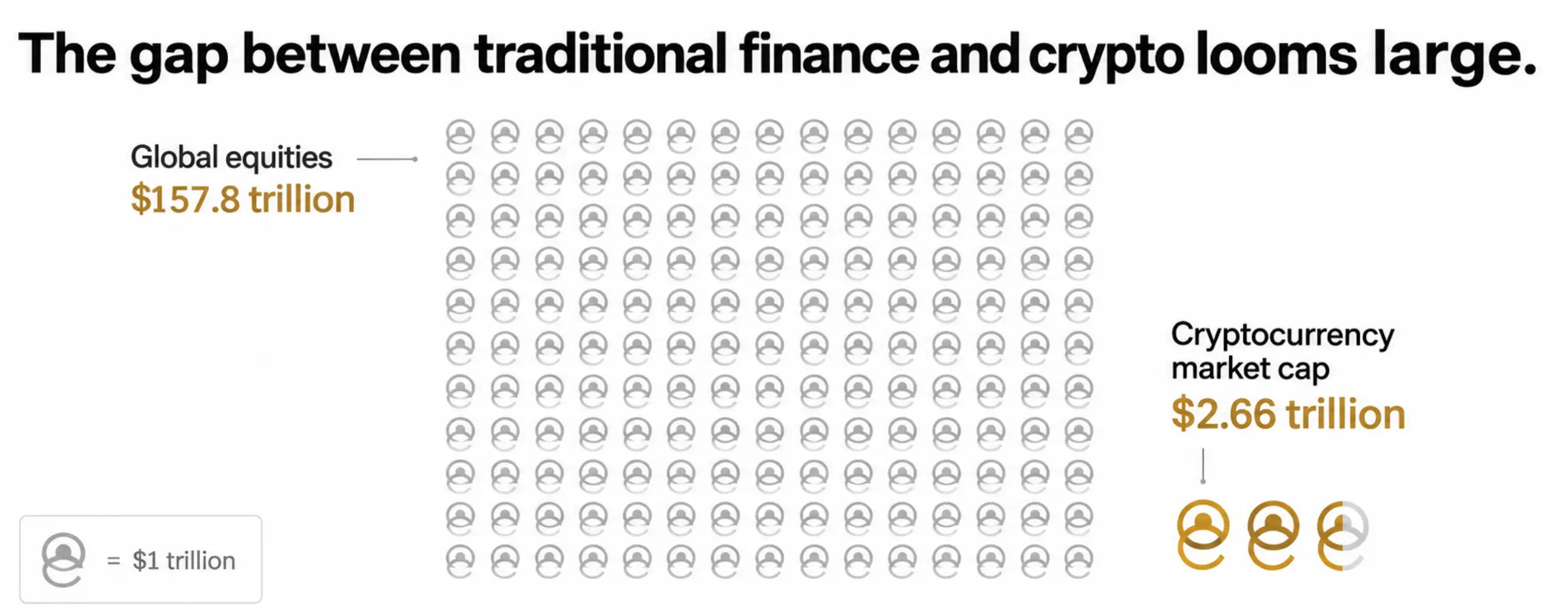
Real-World Asset (RWA) tokenization involves issuing on-chain tokens representing assets like gold, NVIDIA stock, U.S. Treasury bonds, or debt. The envisioned future is that any asset can be tokenized, circulating globally 24/7, with price discovery occurring outside the traditional financial system.

This may not have made headlines, but for years, technological progress has been gradually accumulating, and regulatory attitudes have quietly shifted towards acceptance.

However, what first made many truly realize the utility of on-chain markets was a weekend in March. As tensions with Iran escalated, Hyperliquid became one of the few markets with sufficient liquidity for traders to price crude oil.

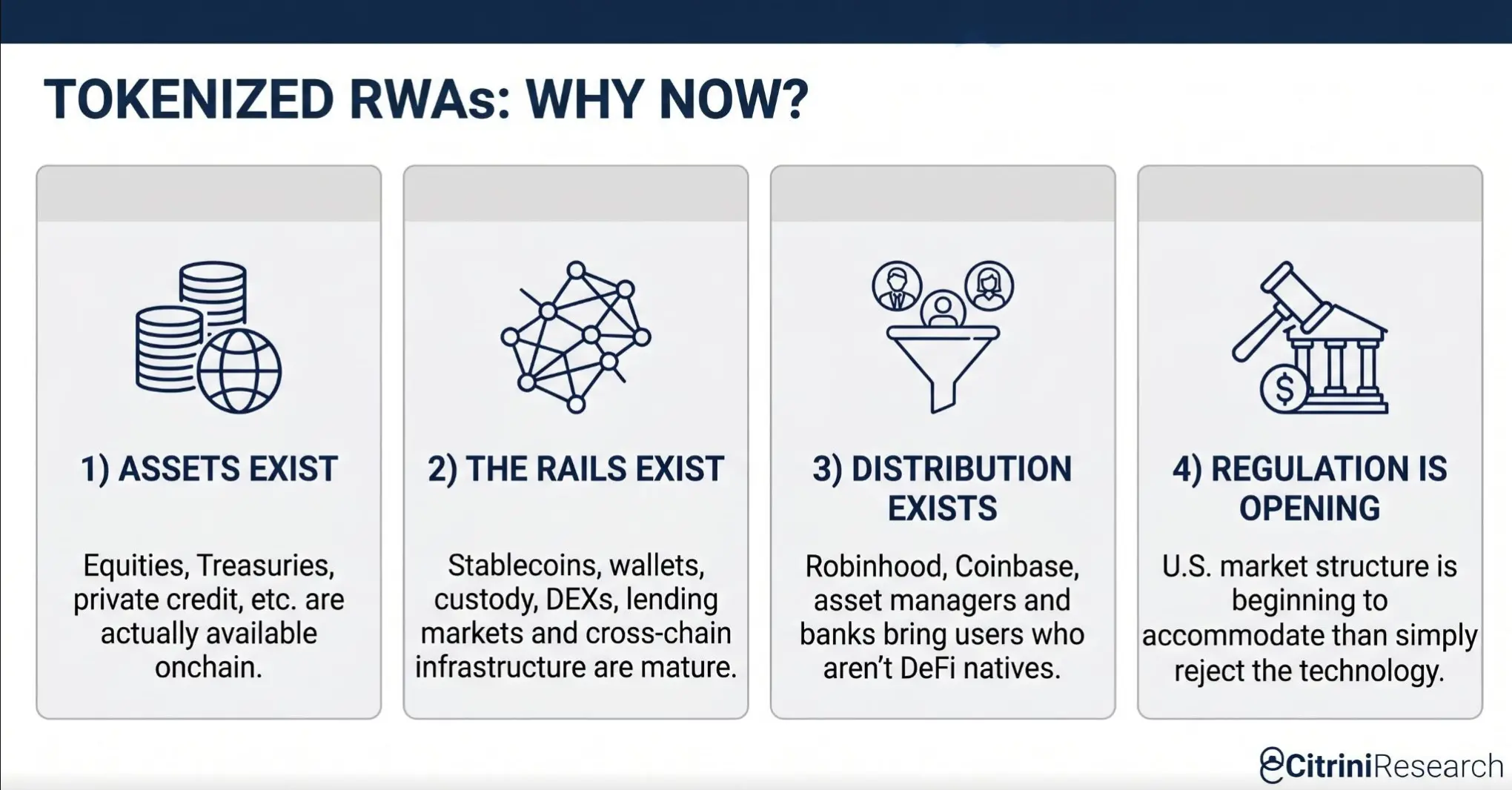
Since then, RWA adoption has clearly accelerated. Over the past month, we've seen a series of major developments across the crypto industry, seemingly reaching an inflection point.

So, what exactly happened?
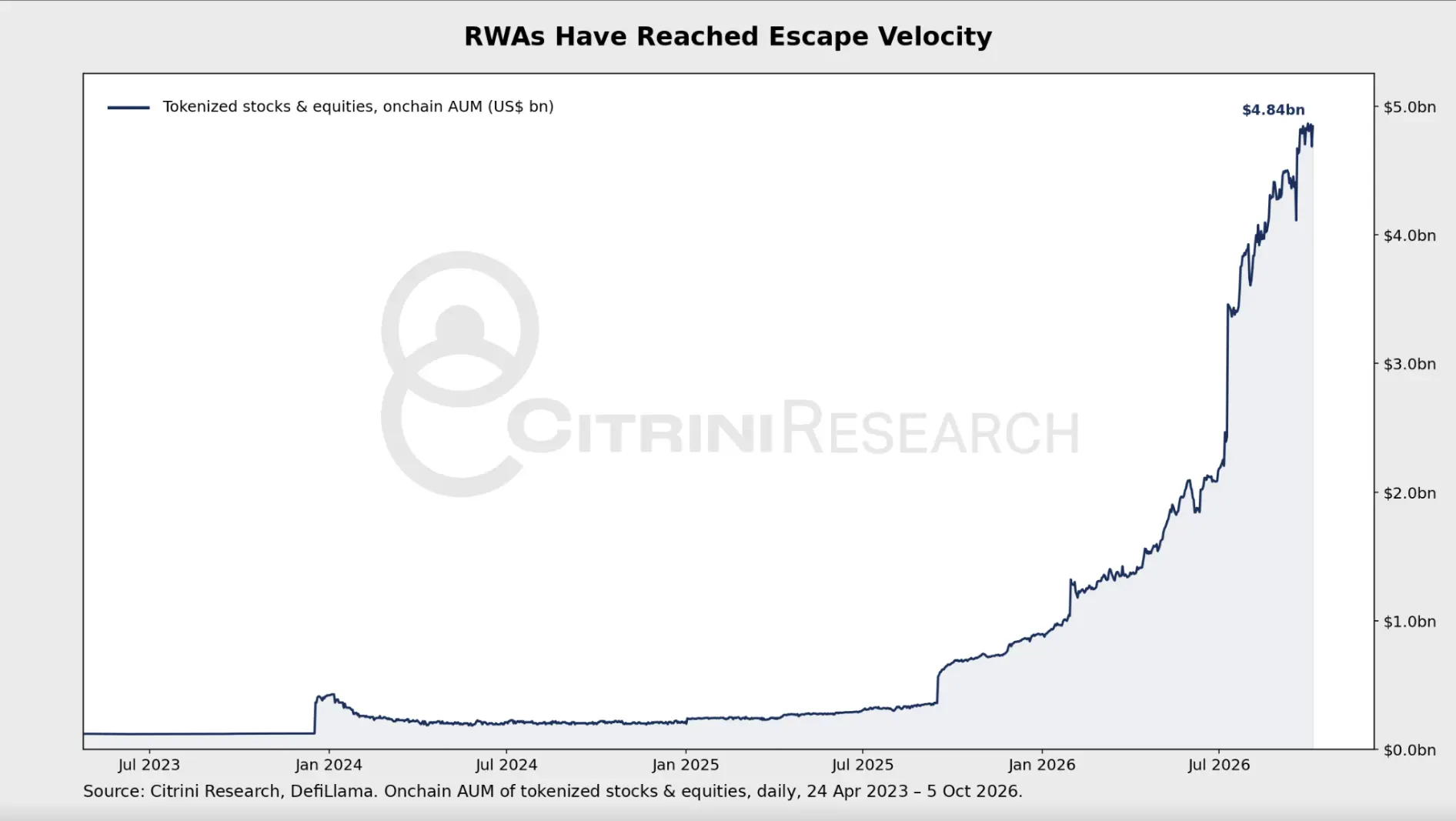
First, stock tokens can now circulate beyond their issuer's platform and be used by other on-chain applications. This means that, unlike the situation on Hyperliquid, these assets can be transferred across different applications and financial infrastructures that previously could only handle stablecoins and native crypto assets. Robinhood Chain (HOOD US) led the way with "stock tokens." Since then, this trend has snowballed onto more blockchains, driving significant growth in on-chain activity.
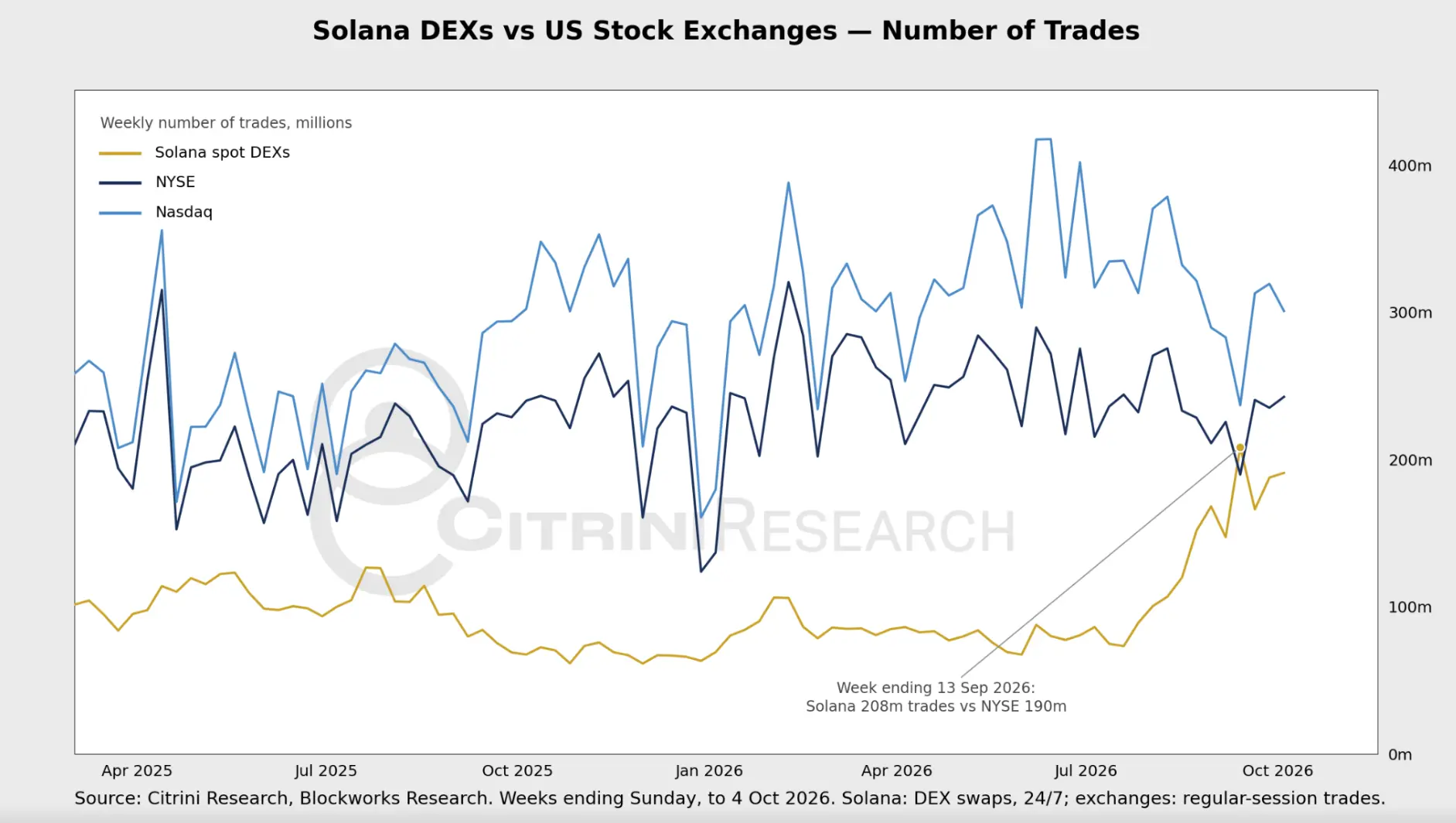
Some data highlights the scale: in September, the number of trades on Solana's spot decentralized exchanges (DEXs) briefly surpassed those on the New York Stock Exchange. While undoubtedly a large portion of this activity came from bots, meme coin pairs, and other less meaningful trades, it still demonstrates that on-chain trading is becoming more active.
Second, regulators are pushing tokenized assets from offshore experimentation into U.S.-regulated financial markets. Two days after the CLARITY Act failed in the Senate, the U.S. Securities and Exchange Commission (SEC) introduced an innovation exemption for trading tokenized stocks, providing regulatory relief under specific conditions.

Simultaneously, the next direction is U.S. equity perpetual contracts—contracts that track the price of U.S. stocks without a fixed expiry. Coinbase's proposed related product is now listed as "pending approval" by the U.S. Commodity Futures Trading Commission (CFTC).

Even Bloomberg Terminal, a bastion of traditional finance, has started displaying Hyperliquid's perpetual contracts and token data. The direction is clear.
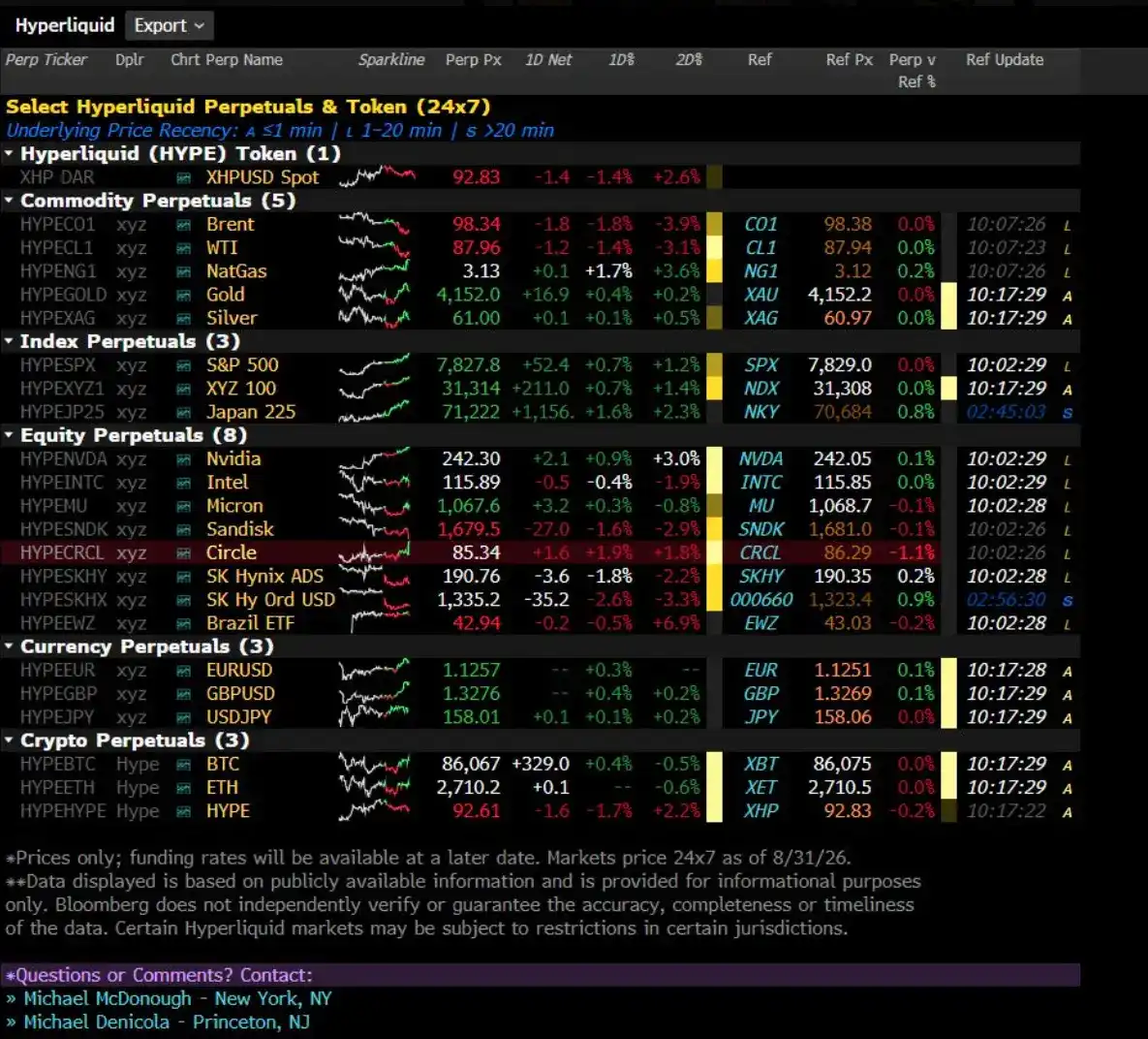
For the first time, we see institutions and individuals both able and willing to participate in a diverse range of RWA markets.

In our view, regardless of whether a comprehensive bill passes, the relevant regulatory framework is being established piece by piece. The question for investors should shift from "Will tokenization be legally recognized?" to "Once these products finally enter the U.S. market, who will capture the revenues and profits?"

AI Agents need a financial system that can operate 24/7 and be programmatically directed; asset tokenization brings assets people actually want to hold—like stocks and bonds—on-chain. These two waves of change are converging, making blockchain's utility clearer.

The wall between traditional finance and the crypto world is loosening. For investors, what deserves attention next is which platforms and financial applications can meet this demand, and whether they can convert the growing on-chain activity into sustainable revenue.

Related Questions

QAccording to the article, how is the convergence of AI Agents and Real World Asset (RWA) tokenization changing the perceived role of the crypto industry?

AThe article argues that the convergence is fundamentally reshaping crypto's role. It states that for years, blockchain technology seemed like a solution looking for a problem, often used mainly for trading meme coins. However, AI Agents require a financial system that is always-on and programmable, while RWA tokenization brings traditional assets (like stocks and bonds) on-chain. These two trends are meeting on blockchain infrastructure, which was built over fifteen years to be exactly that: a programmable, 24/7 financial system for asset custody, ownership, and settlement. Therefore, blockchain is finally finding its purpose as the essential backbone for an AI-driven, automated financial future.

QWhat specific events or developments from the past month does the author cite as indicators of a potential "inflection point" for crypto and RWA adoption?

AThe author highlights several key developments: 1) The ability for stock tokens to circulate freely off their issuer's platform and be utilized by other on-chain applications, starting with Robinhood Chain and expanding to more blockchains, leading to a surge in activity. 2) Regulatory shifts, including the SEC's introduction of an innovation exemption for tokenized stock trading shortly after the CLARITY Act failed in the Senate. 3) The CFTC listing Coinbase's proposed U.S. stock perpetual contracts as "pending approval." 4) The integration of data from crypto platforms like Hyperliquid into traditional financial bastions like Bloomberg Terminal.

QWhat potential systemic risk related to AI Agents does the author describe at the beginning of the article?

AThe author describes the risk of an AI Agent-induced bank run. They envision a future where millions of AI Agents, acting autonomously to maximize returns for users, could continuously move deposits to institutions offering the highest interest rates. This behavior could deprive traditional banks of their low-cost deposit funding base, potentially triggering a rapid, automated withdrawal of funds that the current financial system is not designed to handle.

QWhat is the author's key investment recommendation as the focus shifts from whether tokenization will be legal to how it will be implemented?

AThe author suggests that investors should shift their focus. The critical question is no longer *if* more assets will be tokenized and gain legal acceptance, but *who* will capture the resulting revenue and profits. The investment opportunity lies in identifying which platforms, applications, and financial infrastructure will successfully onboard this new wave of activity and, crucially, be able to translate the growing on-chain activity into sustainable revenue streams.

QWhat analogy does the author draw between the evolution of the internet and the current state of blockchain/crypto technology?

AThe author draws an analogy to internet protocols like HTTPS, TCP, and IP. Most people use the internet without understanding these underlying protocols because browsers abstracted away the complexity. Similarly, blockchain technology has so far required users to deal with complexities like private keys, wallet permissions, and gas fees. The author implies that for mass adoption, the underlying blockchain technology needs to be hidden in the background, just as internet protocols were, with user-friendly interfaces (potentially powered by AI Agents) handling the complexity.

Related Reads

Mercado Bitcoin begins post-hack reopening without a timeline for withdrawals

Mercado Bitcoin, one of Brazil's largest crypto exchanges, began restoring read-only access to customer accounts in phases on Monday, a week after attackers drained an estimated $49 million from the platform. Access started at 19:00 UTC, with all accounts expected to be viewable by 21:00 UTC, showing holdings as they stood on Nov. 2, the day of the hack. The exchange has yet to say when customers will be able to withdraw funds. Fabricio Tota, vice president of new business, said the exchange hoped read-only access would reassure customers that their assets were still recorded on the platform. He explained that the company opted for "a more conservative approach" to reactivating accounts "to ensure our return happens with the utmost security." The caution follows concerns from blockchain security analysts that attackers were able to access addresses, draining funds through standard transfers rather than a smart contract exploit. Blockchain analysts traced some of the stolen funds to customer deposit addresses, but Mercado Bitcoin says customers won't bear the losses. Tota said the vast majority of assets were never even touched by anyone and were not involved in the incident. On Nov. 4, Mercado Bitcoin pledged to cover all losses with company funds, bolstered by a $20 million investment from stablecoin issuer Tether in July. Tota highlighted that a portion of the stolen funds were also frozen in the hours after the company announced the attack. The next phase of recovery will require users to confirm their registration details before they can move funds. The exchange plans to restore withdrawals via Pix, Brazil's instant payment system, initially allowing customers to withdraw only to accounts in their own name. Tota gave no date for either step. Mercado Bitcoin has yet to explain how the attackers gained access to its wallets. Blockchain data company Bitquery found that as of Nov. 4, wallets linked to the attacker held most of the stolen funds that had escaped freezes, including 106.07 BTC.

cointelegraph2h ago

Mercado Bitcoin begins post-hack reopening without a timeline for withdrawals

cointelegraph2h ago

Avalanche’s AVAX leads crypto gains following NYSE tokenization deal

Avalanche's AVAX token rose as much as 10% on Monday, becoming the top gainer among the 100 largest cryptocurrencies, after the New York Stock Exchange announced plans to use Avalanche's blockchain to settle trades on a new platform for trading tokenized stocks around the clock. AVAX later eased to $8.86, still up over 8% on the day, with a market cap of around $3.95 billion and $439.7 million traded in the past 24 hours. Avalanche's total value locked stands at $633 million, up 4% over the past day. NYSE's head of digital issuance, Dennis Lee, said the exchange is examining how blockchain technology can expand its equities offerings and is picking the right technology for each job. The deal underscores Wall Street's growing effort to use blockchain to make stock trading faster and enable trading outside regular market hours; traditional US markets are open 9:30 am to 4:00 pm EST on weekdays, with trades often taking at least one business day to settle. The NYSE first announced plans for the platform in January, and Ava Labs revealed in September that the exchange had spent about a year testing Avalanche, though the final selection was not confirmed until Monday. Avalanche will record stock trades and help complete transactions on the platform, which will let investors buy and sell digital versions of stocks across different blockchains. Lee said the settlement ledger needs to be fast, reliable, permissioned, cost-predictable, and backed by a large developer community—all of which Avalanche meets. The platform could launch before the end of 2026 pending regulatory approval. Ava Labs chief business officer John Nahas said first conversations with the NYSE began nearly a year ago and called it an important step toward blockchain becoming foundational financial infrastructure. The news comes as other major firms invest in blockchain for faster, round-the-clock trading: Nasdaq plans to invest $100 million in Kraken's parent Payward to launch tokenized stocks by Q2 2027, and the DTCC launched a service in October allowing firms to turn traditional securities into digital tokens. The NYSE deal follows other efforts to bring traditional assets onto Avalanche, including Progmat moving over 452 billion yen in digital securities onto a dedicated Avalanche blockchain in July and Aave Labs' plans for a lending service using tokenized assets as collateral.

cointelegraph3h ago

Avalanche’s AVAX leads crypto gains following NYSE tokenization deal

cointelegraph3h ago

Trading

Spot
活动图片




