From Token-Stock Pairs to Pooling Everything: Dissecting the Playbook of Robinhood Chain's New Platform $CME

marsbitPublished on 2026-09-11Last updated on 2026-09-11

Abstract

From "Crypto-Stock Pairing" to "Pairing with Everything": Decoding Robinhood Chain's New Platform $CME While liquidity recently dipped on Robinhood Chain, speculative capital remains, now shifting from the previous "crypto-stock pairing" narrative (using tokens like Nvidia to price memes) to a new, more abstract model pioneered by the Commodity Market Exchange (CME). Its token, $CME, has surged past a $15M market cap. CME introduces "pairing with everything," allowing meme tokens to be paired with 94 synthetic assets representing real-world commodities and non-standard items—from gold and crude oil to Big Macs, CS2 skins, and Pokémon cards. This is enabled not by real asset backing, but through a lightweight synthetic asset system: the platform mints ERC-20 "commodity tokens" pegged to real-time prices via oracles, paired in single-sided Uniswap pools with a stablecoin. $CME's rapid growth is fueled by an aggressive tokenomics model: 40% of trading fees are auto-distributed in the paired commodity tokens to holders every 15 minutes; 30% is used for permanent $CME buyback-and-burn; and 0% goes to creators, removing developer fees. Assets launch directly into Uniswap v4 pools from genesis. In essence, CME leverages pure meme culture and speculation to bootstrap a synthetic commodity liquidity network. While reliant on oracles and single-sided pools carries risks, this "pair with everything" experiment marks a new, decentralized chapter in asset issuance on Robinhood Chain.

Author: Jamie, Deep Tide TechFlow

A few days ago, the whole internet was discussing how Robinhood Chain's 24-hour DEX trading volume had fallen back from $3 billion due to liquidity fragmentation. Today, it seems the brief on-chain bear market has already ended.

Some leading tokens on RH Chain like Pons and Cashcat have experienced a rebound to some extent. Meanwhile, the speculative capital on-chain hasn't really left; it's just searching for the next narrative driver.

If the past two weeks saw platforms like Pons and Long push the "token-stock pairing" model—"pricing Meme tokens with Nvidia and Tesla tokens"—to its peak;

then today, capital on RH Chain has already grown weary of the homogeneous stock-based memecoins. Replacing them is a newly launched platform, Commodity Market Exchange; its token $CME has soared past a market cap of $15 million, with daily trading volume approaching the $10 million mark.
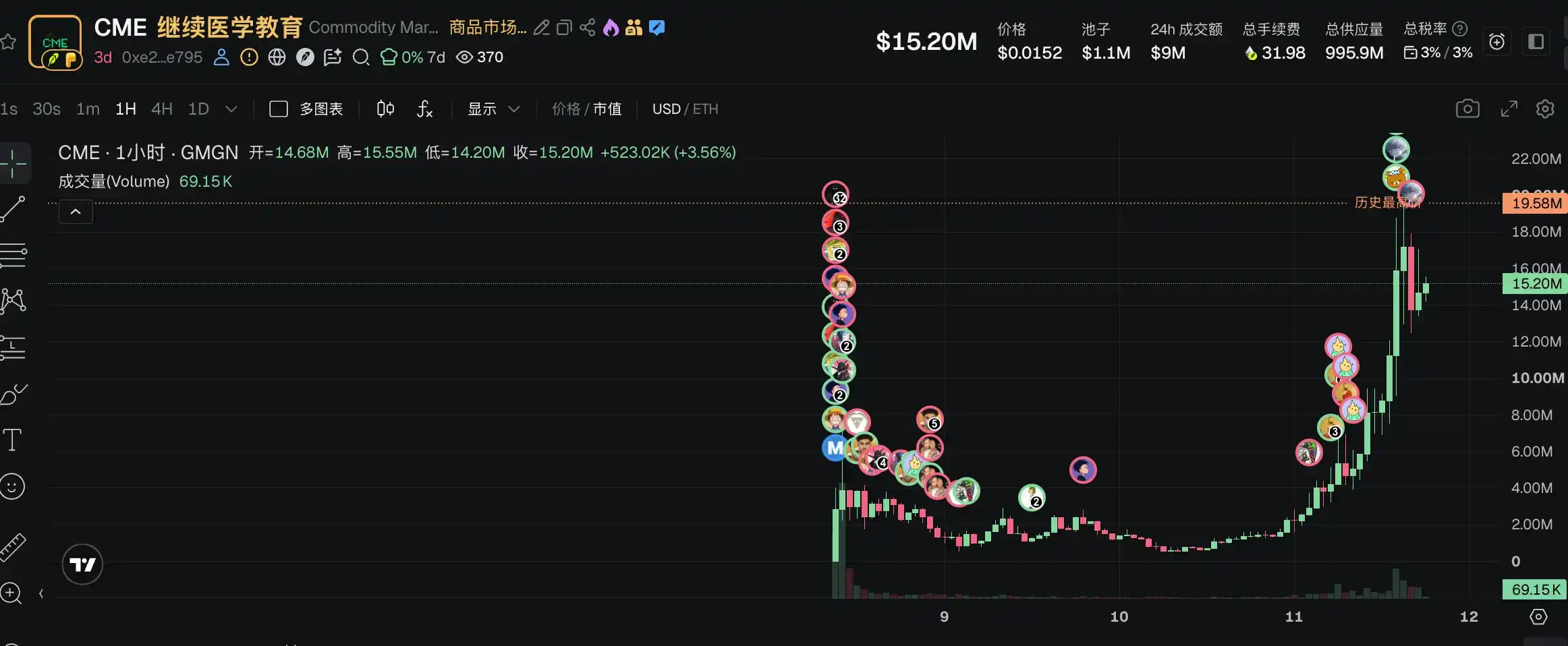
So, what exactly are people FOMO-ing into? The answer is that it has pioneered an incredibly abstract yet entirely new token launch playbook distinct from token-stock pairing:

Token-Commodity pairing, or "Everything can be paired".

If you thought the previous wave's "token-stock pairing," which used Nvidia and Tesla to price Memes, was novel enough, then CME pushes this playbook to another dimension entirely.

Can All Commodities Be MEME-Priced Assets?

When it comes to creating dramatic effects, crypto never disappoints.

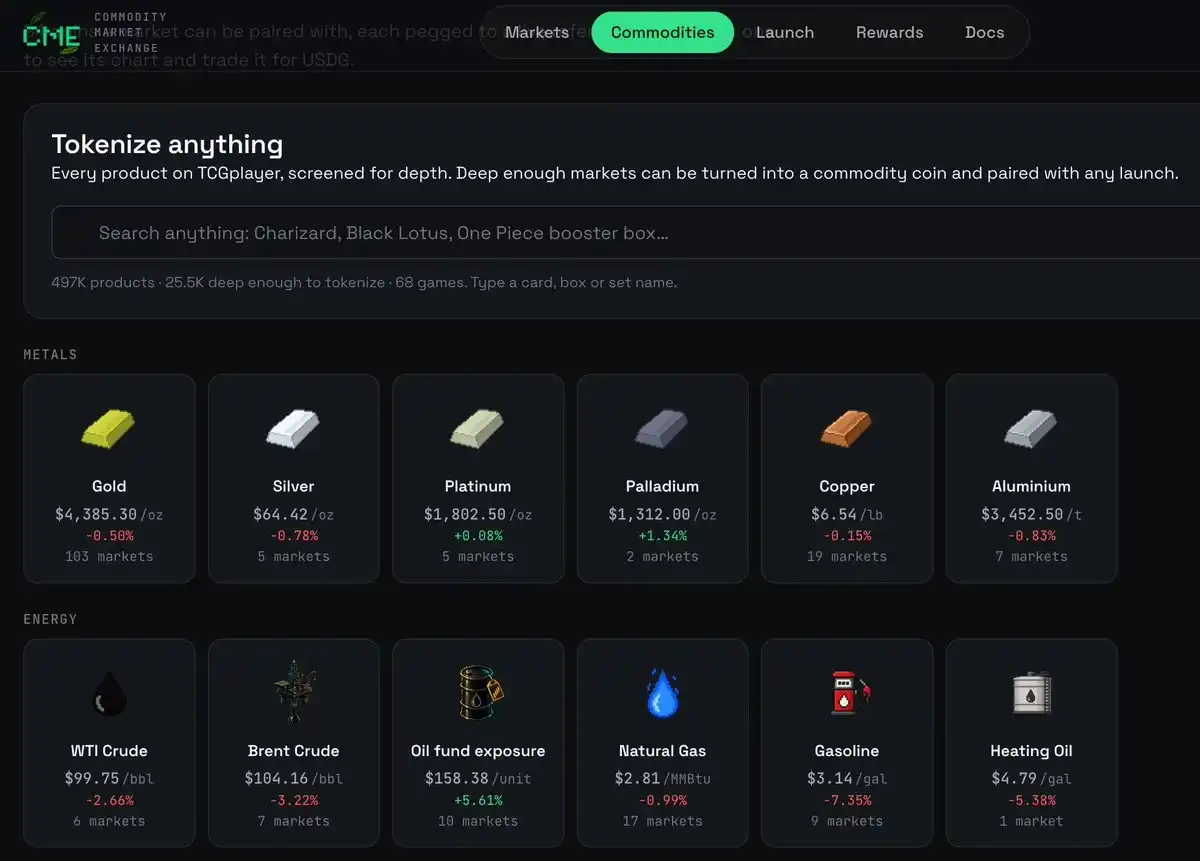
In traditional DEXs, Meme asset trading pairs are usually stablecoins, ETH, or the current on-chain stocks from the token-stock model. Now, this platform's liquidity pool assets have expanded to 94 real-world commodities and non-standard assets.

For example, parodying real-world goods: $FART, a fart-themed token paired with a natural gas token; $MILKERS paired with on-chain milk prices; agricultural product tokens paired with crude oil and corn.

Furthermore, you can even pair meme tokens with non-standard consumer goods, such as pairing a meme with a McDonald's Big Mac, a Dragon Lore skin from CS2, or a first-generation Charizard Pokémon card, and so on.

And this freewheeling playstyle has allowed meme traders to get creative. Buying $WEN, which pairs with a "Lamborghini" pool, roughly plays on the self-deprecating joke of "wen (when) will I be able to buy a Lamborghini?"
No Real Assets, Just Unilateral Pools and Oracles

The biggest misconception for many first-time users is: "By buying a gold-paired Meme, am I indirectly holding real gold?"

The answer is obviously no. Unlike the tokenized US stocks (Stock Tokens) or precious metal ETFs within Robinhood's official compliant brokerage system, the commodities on the CME platform do not involve actual physical delivery or warehouse receipt custody off-chain.

To enable Memes to be paired with virtually everything in the real world, the platform has built its own lightweight synthetic asset system:

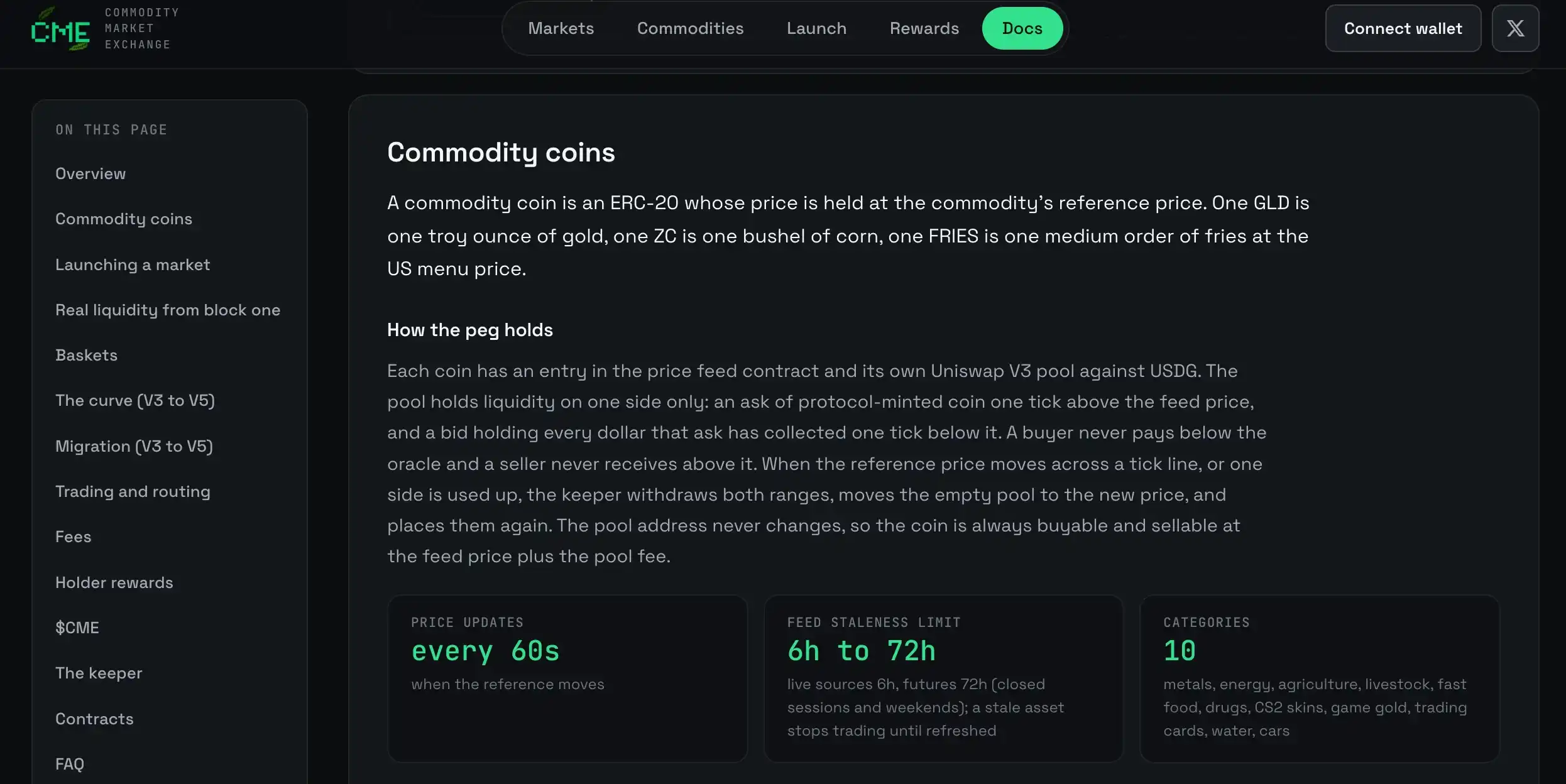
Issuing 94 ERC-20 Commodity Tokens: The platform itself mints tokens like Gold Coin, Crude Oil Coin, Milk Coin, etc., each representing the price of a corresponding unit of the commodity (e.g., 1 bushel of corn or 1 ounce of gold).

The protocol then scrapes real-time reference prices from sources like near-month commodity futures prices, fast-food menu prices, and TCGplayer card listings, with an update cycle of about 60 seconds.

It establishes unilateral Uniswap pools between the commodity tokens and the stablecoin USDG. The protocol's sell orders are placed one tick above the reference price, and buy orders are placed one tick below. When real-world prices change or one side of liquidity is depleted, off-chain Keeper bots quickly cancel orders and migrate the pool to the latest price.
So, in essence, what players are actually interacting with is not physical assets, but a set of "commodity synthetic stablecoins" whose price exposure is maintained by algorithms and oracles. This synthetic asset playbook isn't new in nature, but riding the narrative wave of token-stock pairing and "everything can be paired," it has also piqued the interest of on-chain degens this time around.

Aggressive Distribution Model Attracts Capital

Without wealth creation expectations and a distribution model favoring participants, any on-chain micro-innovation would struggle to siphon liquidity on day one. The reason $CME, the platform token, managed to drive its market cap into the $15 million range in a short time lies in the aggressive adjustments to its business model and tokenomics:

40% Commodity Fee Auto-Dividends: 40% of the platform's transaction fees are automatically distributed to token holders in "the corresponding commodity tokens" based on their holdings, settled every 15 minutes without requiring manual claiming. Buying a milk-themed Meme will result in "milk" deposits every quarter-hour. This immediate, tangible reward greatly amplifies the viral effect of holding the token.

30% Permanent Buyback and Burn: 30% of the fees are converted to ETH, used to continuously buy back and permanently burn the platform token $CME on the secondary market, giving the platform token a strong deflationary expectation.

0% Creator Share (Anti-Grind Mechanism): Unlike most launchpads that reserve high fee percentages for developers, CME's subsequent market completely eliminates dev profit sharing, forcing token launchers and ordinary players to compete on a level playing field within the same pool.

V6 Architecture Enables Genesis as Real v4 Pools: Abandoning the traditional "internal/external market" model of waiting for a bonding curve to fill before migration, assets are deployed directly into Uniswap v4 pools from the genesis block itself. Various DEX aggregators and trading terminals can route trades directly from the very first transaction.

The lifespan of a single Meme might only be a few days, but as long as new projects continuously choose to launch tokens with pools backed by gold, corn, crude oil, or even unimaginable assets, the transaction fees and capital deposited by retail traders will accumulate deeper and deeper within this shared commodity exchange pool.

And this perhaps constitutes a surreal yet genuine metaphor for the Web3 industry.

Large institutions aiming to do RWA are bogged down by licensing, custody, and lengthy compliance audits; meanwhile, on-chain degens, driven purely by speculative desire and absurd Meme culture, have inadvertently and bottom-up cultivated a synthetic commodity liquidity network with deep price discovery capabilities for the entire public chain.

Of course, the unilateral pool and oracle-reliant Keeper system still carry the physical risk of depegging when facing extreme one-sided market movements or network delays.

But undoubtedly, on the liquidity map of Robinhood Chain, this asset issuance experiment of "everything can be pooled" has only just begun.


Related Questions

QWhat is the core innovation introduced by the Commodity Market Exchange (CME) platform on Robinhood Chain, as described in the article?

AThe core innovation is a new token issuance model called '币商(品)配对' or 'everything can be paired'. It expands beyond meme-stock pairing to allow meme tokens to be paired with a wide array of 94 real-world commodities and non-standard consumer goods (like Big Macs, CS2 skins, and Pokémon cards) through a synthetic asset system, creating a 'universal pairing' paradigm.

QAccording to the article, how does the CME platform technically enable meme tokens to be paired with real-world commodity prices?

AIt uses a lightweight synthetic asset system. The platform mints 94 ERC-20 'commodity tokens' (e.g., gold, oil, milk). An oracle fetches real-time reference prices from sources like commodity futures. Uniswap v4 pools are set up between these commodity tokens and the stablecoin USDG, with sell orders placed above and buy orders below the reference price. A Keeper bot migrates the pool to the latest price, creating algorithmically-pegged 'commodity synthetic stablecoins' for pairing with memes.

QWhat are two key aspects of the $CME platform token's tokenomics that drive its value and user adoption, as mentioned in the article?

A1. **40% Auto-Dividend in Commodity Tokens**: 40% of platform trading fees are automatically distributed every 15 minutes to $CME holders in the form of the specific commodity tokens from the paired trades, requiring no manual claim. 2. **30% Permanent Buyback & Burn**: 30% of fees are used to buy ETH and then permanently buy back and burn $CME tokens on the secondary market, creating strong deflationary pressure.

QHow does the article describe the fundamental difference between the assets on CME and Robinhood's official tokenized stocks or precious metal ETFs?

AThe article states that CME's commodities are NOT backed by real-world physical delivery or custodial warehouse receipts. Unlike Robinhood's official, compliant tokenized assets, CME offers synthetic representations maintained by oracles and algorithms. Users do not gain indirect ownership of real gold or oil; they interact with price-exposure tokens pegged by the system.

QWhat broader industry implication or 'metaphor' does the article suggest is illustrated by the CME phenomenon on Robinhood Chain?

AThe article suggests it is an 'absurd yet real metaphor' for Web3. While large institutions struggle with licenses, custody, and compliance to build Real World Assets (RWA), on-chain degenerates are 'accidentally' fostering a deep, price-discovery-capable synthetic commodity liquidity network from the bottom up, driven purely by speculative desire and meme culture.

Related Reads

Tech Veteran: Anthropic IPO Will Be the Peak of the US AI Rally, Will "Go Big on China AI" If Conditions Allow

Veteran tech investor Jack Selby, head of Copper Sky and managing partner of Peter Thiel's family office, warns that Anthropic's planned IPO—aiming to raise up to $100 billion—could mark the peak of the AI market rally. He cautions that if the highly anticipated IPO prices well below expectations, the expiry of lock-up periods could trigger significant selling pressure and a large-scale AI market correction. Selby names SoftBank and Oracle as "canaries in the coal mine," flagging Oracle's higher debt ratio as a bigger risk, and suggests investors needing AI exposure consider Google instead. Selby also questions Anthropic's fundamentals: over 80% of its revenue is non-recurring and vulnerable to competitors closing the technology gap within six to nine months. He notes the business is extremely capital-intensive—requiring costly data, energy, data centers, and chips—and that with interest rates no longer near zero, calling it a trillion-dollar company seems far-fetched. He further highlights Chinese competition, saying DeepSeek and other Chinese AI models trail Anthropic by only about six months, posing a direct threat. Selby says he would "aggressively go long on Chinese AI" if conditions allow, arguing that Anthropic cannot claim all its business must rely on U.S. models, since most AI use cases resemble basic tool applications, leaving room for Chinese alternatives.

marsbit2h ago

Tech Veteran: Anthropic IPO Will Be the Peak of the US AI Rally, Will "Go Big on China AI" If Conditions Allow

marsbit2h ago

Grayscale's $1 Million Sponsorship Can't Save It: Why ZEC, Once Hyped as the Belle of the Ball, Crashed Again?

Grayscale announced a $1 million ecosystem sponsorship for Zcash on November 10, pledging to return all first-year management fees from its Zcash ETF (ZCSH) to network development and marketing, with the first $100,000 distributed to four nonprofit organizations. Yet the same day, ZEC plunged 11.3% to around $1,043, extending its 30-day decline to nearly 20%. After two months of hype from overseas KOLs and institutions touting ZEC as a "second spring for old coins," the token quickly turned into a slow bleed under the weight of $2.3 billion in open interest. The article argues that Wall Street's narrative halo and Grayscale's PR subsidy have been exhausted, and ZEC—lacking fundamental support—has once again become an ATM for highly leveraged speculators to cash out on good news. Grayscale's pledge, while seemingly generous, is voluntary and can be modified or terminated at any time; only $400,000 of the $1 million has actually been paid, making it more brand marketing for its own ETF than genuine ecosystem donation. The sum is negligible relative to Zcash's market cap, and the Zcash ETF has not attracted sustained institutional capital the way Bitcoin or Ethereum ETFs did. Without new external liquidity, the inflated narrative cannot hold. The core problem is market structure: ZEC perpetual futures open interest stands at roughly $2.3 billion, dominated by high-volatility leveraged gamblers. The article contends that the earlier social media hype was a precise harvest of derivatives liquidity—promoters used the "first privacy ETF" theme to lure retail into leveraged longs, then exited as open interest peaked and the sponsorship news landed. Compounding this, Zcash's privacy pool suffered a critical vulnerability about three months before the ETF listing, halving the price and shattering conservative investors' confidence despite a July fix. The piece concludes that "old coin re-hype" follows a familiar script: find a traditional-finance-approved angle, package a grand revaluation narrative, use KOLs to drive retail buying, then distribute chips at peak liquidity. Those who hyped ZEC have largely cashed out, leaving behind a broken price and $2.3 billion in unsettled leverage. Grayscale's advertising cannot save Zcash; a real revival requires far more than Wall Street's charity.

marsbit3h ago

Grayscale's $1 Million Sponsorship Can't Save It: Why ZEC, Once Hyped as the Belle of the Ball, Crashed Again?

marsbit3h ago

Trading

Spot
活动图片