Core 'Key Contributors' Depart One After Another, Has Aave's DAO Dream Shattered?

比推Publicado a 2026-03-03Actualizado a 2026-03-03

Resumen

Recent weeks have seen major internal turbulence within Aave, one of DeFi’s most successful DAOs. The Aave Chan Initiative (ACI), a core governance team, announced it would cease operations and exit the ecosystem on March 3, following the departure of BGD Labs, the development team behind Aave V3, just two weeks earlier. The crisis stems from governance disputes that began in December, when Aave Labs unilaterally switched the protocol’s front-end aggregator from ParaSwap to CoW Swap, redirecting fee revenue from the DAO treasury to Aave Labs. In response, Aave Labs proposed the bundled “Aave Will Win” proposal in February, requesting $51M in funding for V4 development in exchange for routing all future product revenue to the DAO and phasing out V3. ACI strongly criticized the proposal, alleging that a significant portion of supporting votes came from addresses linked to Aave Labs, raising concerns about self-dealing and lack of transparency. Despite ACI’s attempts to introduce stricter accountability measures, their proposals were not adopted. The departures of both BGD Labs and ACI—key contributors responsible for technical development and governance—raise serious questions about Aave’s future, including technical risks associated with transitioning to V4 and the centralization of decision-making power. The situation highlights broader challenges in DAO governance, where power often remains concentrated among founders, developers despite the ideal of decentralized token-h...

On March 3rd, the Aave protocol's core governance team, Aave Chan Initiative (ACI), announced it would cease operations and exit AAVE.

This is the second major contributor to leave within two weeks—previously, on February 20th, the development team behind the Aave V3 codebase, BGD Labs, announced its departure.
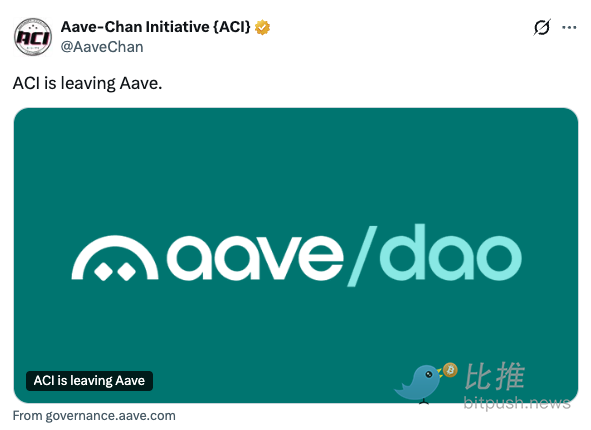
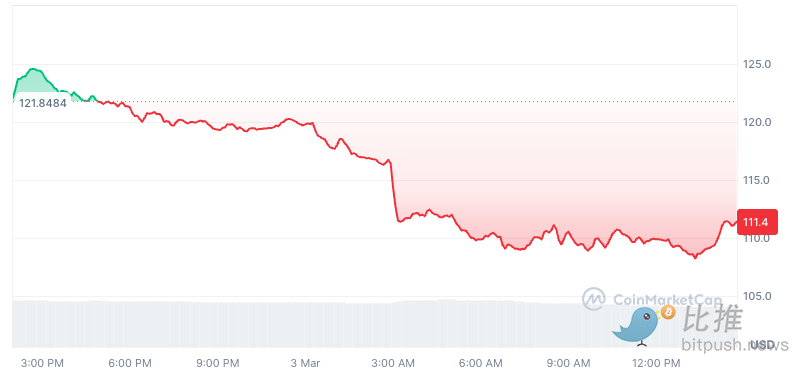
Following the announcement, the price of the AAVE token fell by more than 11%.

As one of the most successful DAOs (Decentralized Autonomous Organizations) in DeFi history, this DeFi leader with nearly $27 billion in TVL (Total Value Locked) is undergoing profound internal turmoil.
From Revenue Attribution Dispute to Bundled Voting

The seeds of this crisis were sown as early as last December.

At that time, Aave Labs replaced the front-end transaction aggregator from ParaSwap to CoW Swap without prior governance discussion. The fees that originally flowed to the DAO treasury instead went into Aave Labs' accounts.

Facing质疑 (query/doubt), Aave founder Stani Kulechov responded: the front-end interface was built by Labs, so the revenue naturally belongs to Labs; the smart contracts and liquidity pools belong to the DAO. This explanation was legally sound but caused discontent within the community.

To quell the controversy, Aave Labs proposed a plan called "Aave Will Win" in February. The proposal主要内容 (main content) included: requesting DAO approval for approximately $51 million in funding for V4 development; in exchange, all future revenue from Aave-branded products would be assigned to the DAO, and Aave V4 would be established as the sole technical foundation, gradually phasing out V3.

The problem was that these three matters were bundled together. Support revenue going to the DAO but think the funding amount is too large? No choice. Believe V3 still has value and shouldn't be sidelined?同样没得选 (Similarly, no choice). Either accept the entire package or reject it entirely.

ACI's Grievance: Opaque Voting

In its exit statement, ACI's core accusation was: a significant portion of the votes supporting the proposal came from addresses associated with Aave Labs. A temperature check vote passed by a narrow margin of 52.58%, and ACI believes the result might have been different without these "self-votes".
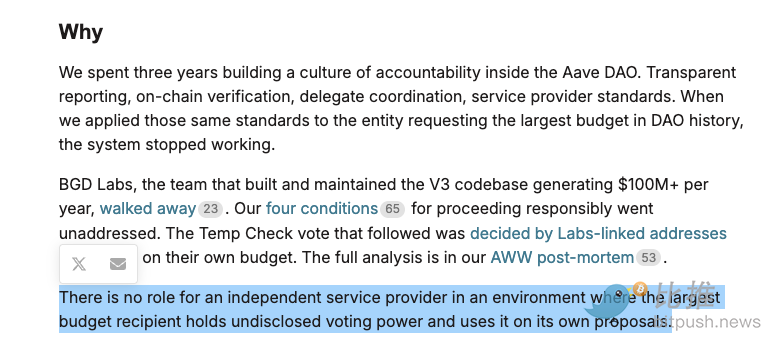
ACI founder Marc Zeller wrote: "If a major budget recipient can use its undisclosed voting power to force through its own proposals, then independent service providers lose their raison d'être within the DAO."

ACI did try to resolve the issue. Before the vote, it proposed four conditions, including stricter on-chain milestone tracking and restrictions on self-voting by budget recipients, but none were adopted.

This conflict reflects structural problems in DAO governance.

Aave Labs controls the codebase, brand domains, social media, and development discourse. BGD Labs maintains the main version V3—it contributes over 75% of the protocol's revenue and 97% of the total deposits. ACI is responsible for governance coordination and business development, claiming to have driven 61% of governance actions over the past three years, helping Aave's DeFi market share rise from less than 50% to over 65%.

These three teams were supposed to check and balance each other. But with BGD and ACI leaving one after another, the remaining power center, no matter how it表态 (states its position), is difficult to be fully trusted.

Stani Kulechov responded after ACI announced its exit: "Thank you Marc for years of contribution, the protocol will continue to operate normally."
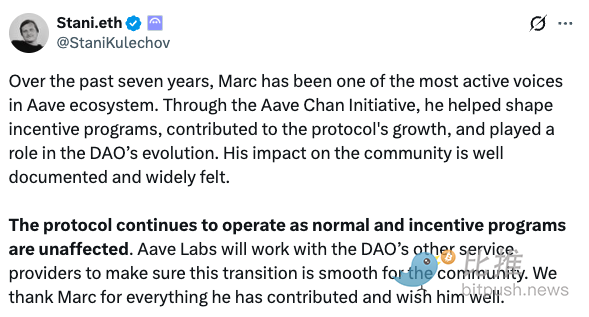
But this response did not address the core issue: when the people most capable of assessing the technical risks of V3 have left, how can the DAO feel confident betting its future on the untested V4?

Another noteworthy detail is that institutional investor Blockchain Capital stated afterwards that they were unable to participate in the snapshot vote with their held AAVE because their custody platform did not support it. This reveals another reality of DAO governance: nominally based on collective decision-making by token holders, voting power is often concentrated in the hands of a few.

DAO's Governance Dilemma

ACI stated that during the four-month transition period, it will transfer or open-source tools and responsibilities such as the governance dashboard, incentive framework, and committee roles. But some things are difficult to transfer: three years of accumulated governance experience, familiarity with protocol details, and the interpersonal network for coordinating different stakeholders.

Data shows that ACI spent $4.6 million from the DAO over the past three years, helping the GHO stablecoin grow from $35 million to $527 million. Who will take over these tasks in the future remains unknown.

This turmoil at Aave is essentially a microcosm of the DAO governance dilemma.

In theory, a DAO is a community of token holders. But in practice, governance is often dominated by the founding team, early investors, and core developers. These roles are both rule-makers, rule-enforcers, and sometimes budget recipients. When conflicts of interest arise, whether "procedural justice" is sufficient becomes the焦点 (focus) of controversy.

A DeFi practitioner commented: "This is not a question of who is right or wrong, but rather that the existing governance mechanisms do not provide an effective way to resolve conflicts when interests and positions diverge."

What Happens Next?

The ARFC (Request for Comments) stage revisions to the "Aave Will Win" proposal will be the first window to observe the direction of events. If the "structural improvements" promised by Kulechov can be implemented, such as unbundling the proposal and clarifying the boundaries of voting behavior, it might draw a line under this turmoil.

If consensus cannot be reached, the most extreme possibility is that BGD and ACI start anew, forking a new protocol. Although liquidity barriers are high, it's not impossible—the simultaneous departure of core developers and the governance team provides both the technical foundation and community basis for a fork.

For Aave, the immediate problem is how to fill the void left by the departure of the two core teams. The longer-term problem is how to find a more sustainable balance between the founder's vision, the interests of core developers, and the will of the community. If the paradox of "power concentration" cannot be resolved, even the strongest protocol may lose its first-mover advantage in endless internal friction.

Author: Bootly


Twitter:https://twitter.com/BitpushNewsCN

Bitpush TG Discussion Group:https://t.me/BitPushCommunity

Bitpush TG Subscription: https://t.me/bitpush

Original link:https://www.bitpush.news/articles/7616451

Preguntas relacionadas

QWhat was the immediate market reaction to the announcement of Aave Chan Initiative (ACI) shutting down operations?

AThe AAVE token price dropped by over 11%.

QWhat was the core accusation made by ACI in their exit statement regarding the 'Aave Will Win' proposal vote?

AACI alleged that a significant portion of the votes supporting the proposal came from addresses associated with Aave Labs, and that the vote might have failed without this 'self-voting'.

QWhat three main things were bundled together in the controversial 'Aave Will Win' proposal from Aave Labs?

AThe proposal bundled a request for ~$51M in funding for V4 development, the future redirection of all Aave brand product revenue to the DAO, and the establishment of Aave V4 as the sole technical base while phasing out V3.

QAccording to the article, what fundamental problem does Aave's crisis expose about DAO governance?

AIt exposes the structural problem where governance is often dominated by the founding team, early investors, and core developers, who are rule-makers, executors, and budget recipients, creating conflicts of interest that existing mechanisms struggle to resolve.

QWhat is one potential extreme outcome mentioned if a consensus cannot be reached after the departure of BGD Labs and ACI?

AThe most extreme possibility is that BGD and ACI could fork the protocol to create a new one, as their departure provides both the technical foundation and community basis for a fork.

Lecturas Relacionadas

Invierno de rendimientos en DeFi: Exceso de liquidez, contracción del apalancamiento y falta de oportunidades de arbitraje

El invierno de los rendimientos en DeFi: exceso de liquidez, contracción del apalancamiento y falta de oportunidades de arbitraje El mercado de las finanzas descentralizadas (DeFi) enfrenta un "invierno de tasas de interés". Desde septiembre de 2025, el rendimiento porcentual anual (APY) promedio para depósitos de stablecoins en los principales protocolos de préstamo ha caído a su nivel desde junio de 2023. En Aave V3, las tasas para USDC y USDT han caído por debajo del 2%, incluso por debajo del rendimiento de los bonos del Tesoro estadounidense a 10 años (4.24%). Este colapso de los rendimientos se debe principalmente a un desequilibrio estructural entre la oferta y la demanda. La capitalización del mercado de stablecoins se ha más que duplicado desde 2024, superando los 3,1 billones de dólares. Sin embargo, esta enorme oferta de liquidez no ha sido absorbida por una demanda equivalente en la cadena. En Aave, más del 60% de los activos depositados están inactivos, lo que ha provocado que los algoritmos del protocolo reduzcan las tasas de interés para atraer a los prestatarios, con poco éxito. Dos factores clave han enfriado la demanda de préstamos de stablecoins. Primero, las bajas tasas de funding en los mercados de derivados han eliminado los incentivos para las estrategias de arbitraje, que eran un gran consumidor de stablecoins. Segundo, el estrechamiento del diferencial de rendimiento de activos como sUSDe ha hecho que la estrategia de apalancamiento circular (pedir prestado para comprar más y depositar) sea menos atractiva, reduciendo aún más la demanda. Además, la aversión al riesgo en el mercado de criptomonedas es generalizada. Los inversores están buscando una mayor certeza y seguridad, lo que ha llevado a un aumento de la popularidad de protocolos respaldados por Activos del Mundo Real (RWA). Sky (antes MakerDAO) es un ejemplo, ya que ofrece un rendimiento estable de alrededor del 3.75% para sUSDS, respaldado por una cartera de 15.000 millones de dólares en bonos del Tesoro y deuda corporativa, actuando como un nuevo piso para las tasas en DeFi. Este "invierno de tasas" no es solo una fluctuación cíclica, sino una reestructuración profunda del mercado, marcando un cambio de "perseguir el APY" a "buscar una exposición diferenciada al riesgo".

marsbitHace 30 min(s)

Invierno de rendimientos en DeFi: Exceso de liquidez, contracción del apalancamiento y falta de oportunidades de arbitraje

marsbitHace 30 min(s)

Entrevista a FinAI: Exploradores del orden en la era de la economía de Agent

Entrevista con FinAI: Explorador del orden en la era de la economía de agentes El desarrollo de la IA está evolucionando rápidamente de la "inteligencia como herramienta" a la "inteligencia autónoma". FinAI, una startup emergente, se posiciona como un pionero en construir la infraestructura financiera necesaria para la futura economía de agente a agente (A2A). El equipo central, procedente de grandes tecnológicas, identifica tres pilares fundamentales para este ecosistema: 1. **Capacidad de pago:** Utilizando el protocolo x402, buscan permitir pagos microscópicos en microsegundos entre Agentes, cerrando el ciclo económico de sus interacciones. 2. **Sistema de identidad:** Introduciendo el concepto KYA (Know Your Agent) junto con el protocolo ERC-8004, pretenden establecer identidades verificables y seguras para los Agentess. 3. **Sistema de crédito:** Desarrollar un sistema de reputación basado en el historial de transacciones y ejecución de tareas para generar confianza. FinAI integrará estas capacidades en APIs/Skills para que los Agentess puedan adoptarlas fácilmente. Su modelo de negocio se centra en subscriptores B2B (desarrolladores de Agentess) y en explorar casos de uso en Web3, con comisiones de transacción previstas bajas para fomentar el mercado. Abrazar tecnologías Web3, como pagos con stablecoins, se considera crucial por su eficiencia, bajo coste (≈1/300 del coste tradicional) y velocidad (2-3 segundos). Aunque persisten preocupaciones sobre cumplimiento normativo y seguridad, FinAI confía en su pila tecnológica completa y su enfoque KYA para abordarlos. Con un desarrollo rápido desde su concepción en agosto de 2025, FinAI cree que su ventaja competitiva radica en ser los primeros en ofrecer una solución integral y "Agent-friendly", optimizada para que los propios Agentess prefieran sus servicios, posicionándose para liderar la construcción del orden en la naciente economía autónoma.

marsbitHace 1 hora(s)

Entrevista a FinAI: Exploradores del orden en la era de la economía de Agent

marsbitHace 1 hora(s)

Trading

Spot
Futuros

Artículos destacados

Cómo comprar ONE

¡Bienvenido a HTX.com! Hemos hecho que comprar Harmony (ONE) sea simple y conveniente. Sigue nuestra guía paso a paso para iniciar tu viaje de criptos.Paso 1: crea tu cuenta HTXUtiliza tu correo electrónico o número de teléfono para registrarte y obtener una cuenta gratuita en HTX. Experimenta un proceso de registro sin complicaciones y desbloquea todas las funciones.Obtener mi cuentaPaso 2: ve a Comprar cripto y elige tu método de pagoTarjeta de crédito/débito: usa tu Visa o Mastercard para comprar Harmony (ONE) al instante.Saldo: utiliza fondos del saldo de tu cuenta HTX para tradear sin problemas.Terceros: hemos agregado métodos de pago populares como Google Pay y Apple Pay para mejorar la comodidad.P2P: tradear directamente con otros usuarios en HTX.Over-the-Counter (OTC): ofrecemos servicios personalizados y tipos de cambio competitivos para los traders.Paso 3: guarda tu Harmony (ONE)Después de comprar tu Harmony (ONE), guárdalo en tu cuenta HTX. Alternativamente, puedes enviarlo a otro lugar mediante transferencia blockchain o utilizarlo para tradear otras criptomonedas.Paso 4: tradear Harmony (ONE)Tradear fácilmente con Harmony (ONE) en HTX's mercado spot. Simplemente accede a tu cuenta, selecciona tu par de trading, ejecuta tus trades y monitorea en tiempo real. Ofrecemos una experiencia fácil de usar tanto para principiantes como para traders experimentados.

247 Vistas totalesPublicado en 2024.12.12Actualizado en 2025.03.21

Cómo comprar ONE

Discusiones

Bienvenido a la comunidad de HTX. Aquí puedes mantenerte informado sobre los últimos desarrollos de la plataforma y acceder a análisis profesionales del mercado. A continuación se presentan las opiniones de los usuarios sobre el precio de ONE (ONE).

活动图片