Las Salidas de Fondos de los ETF de Bitcoin y Ethereum Persisten: Los Flujos Netos Mensuales Siguen en Rojo

bitcoinistPublished on 2025-12-31Last updated on 2025-12-31

Abstract

Los fondos cotizados (ETF) de Bitcoin y Ethereum continúan registrando salidas netas de capital, con flujos negativos de -656 millones de dólares para BTC y -422 millones para ETH en los últimos 30 días. Esta tendencia refleja una demanda débil similar a la observada en la primera mitad de 2025, aunque históricamente estos periodos han sido seguidos por recuperaciones explosivas. Paralelamente, las reservas corporativas y gubernamentales de criptoactivos superan los 185.000 millones de dólares, con empresas controlando el 73% del total. Mientras, el precio de Bitcoin se mantiene estable alrededor de los 88.100 dólares, mostrando una fase de consolidación en el mercado.

Los datos muestran que el flujo neto de ETF a 30 días sigue siendo negativo tanto para Bitcoin como para Ethereum, lo que sugiere que el capital ha estado saliendo de los activos digitales.

Los Flujos Netos de los ETF de Bitcoin y Ethereum Han Sido Negativos Recientemente

Como explicó el analista comunitario de CryptoQuant, Maartunn, en una nueva publicación en X, los fondos cotizados en bolsa (ETF) spot de Bitcoin y Ethereum han enfrentado un flujo neto negativo durante el último mes.

Los ETF spot son vehículos de inversión que permiten a los inversores obtener exposición indirecta a los movimientos de precio de un activo subyacente. En el contexto de las criptomonedas, esto significa que un inversor en ETF nunca tiene que interactuar on-chain; el fondo compra y custodia los tokens en su nombre.

Los ETF spot estadounidenses son un fenómeno relativamente nuevo en el sector de los activos digitales, que solo obtuvieron la aprobación de la Comisión de Bolsa y Valores (SEC) en enero de 2024 para Bitcoin y en julio de 2024 para Ethereum.

Los ETF spot pueden parecer un modo conveniente de inversión para los traders no familiarizados con los monederos y exchanges de criptomonedas. Las entidades institucionales, en particular, prefieren obtener exposición a través de ellos.

Desde su llegada, estos vehículos de inversión han ganado popularidad rápidamente al aprovechar esta demanda de los inversores tradicionales y se han establecido como uno de los pilares del sector.

A continuación se muestra un gráfico que muestra cómo han cambiado los flujos netos a 30 días relacionados con los ETF spot de Bitcoin y Ethereum durante su existencia hasta ahora.
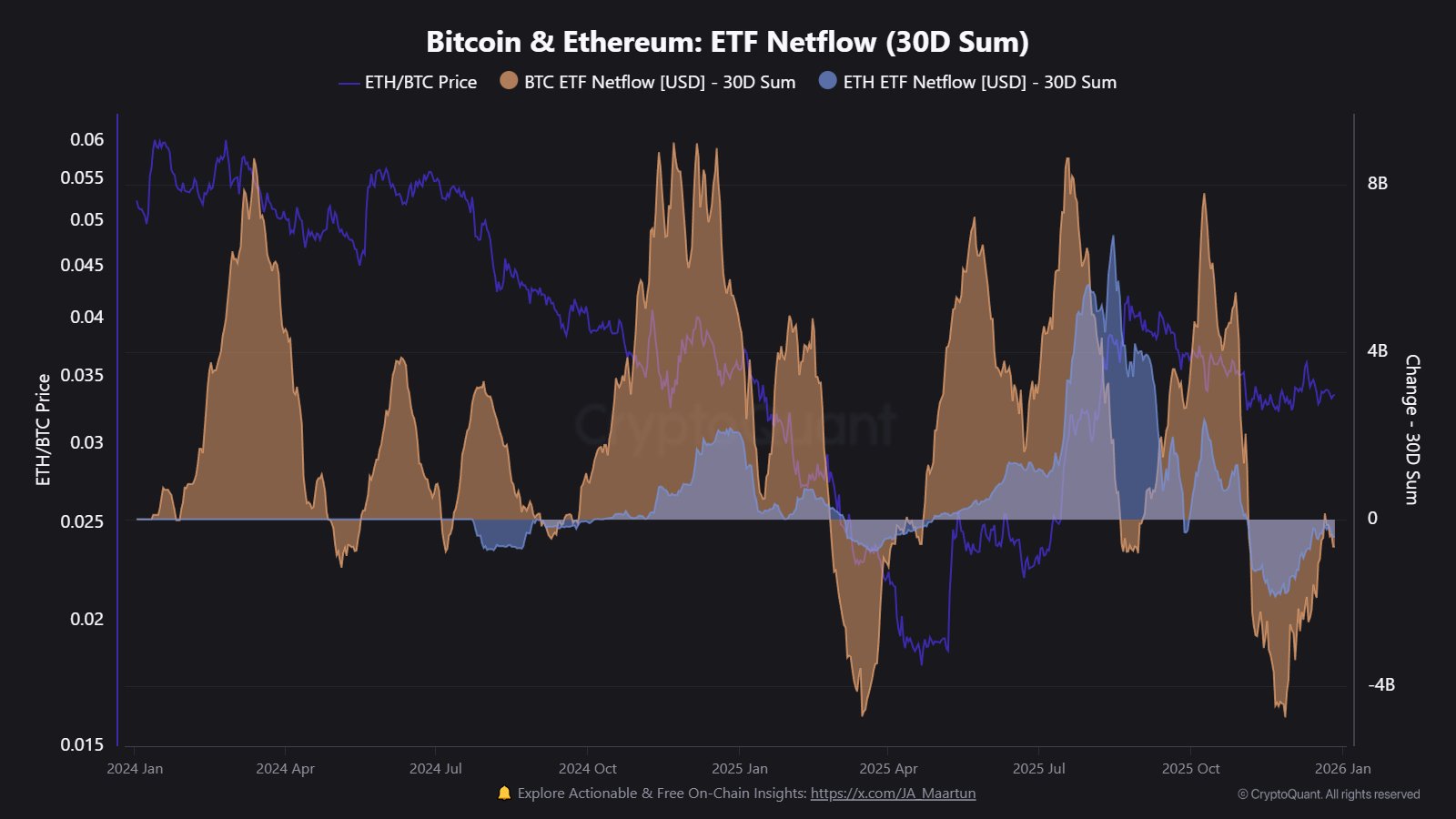
Parece que el valor del indicador ha sido negativo para ambos activos en las últimas semanas | Fuente: @JA_Maartun en X

Como es visible en el gráfico, el flujo neto de ETF spot a 30 días ha sido negativo tanto para Bitcoin como para Ethereum desde hace un tiempo, lo que sugiere que los fondos han estado experimentando salidas netas sostenidas.

La situación ha mejorado un poco más recientemente, pero el indicador sigue en rojo para ambos activos, situándose en -$656 millones para BTC y -$422 millones para ETH. La débil demanda en el mercado es similar a la fase de salidas de fondos de la primera mitad de 2025.

En aquel entonces, la demanda finalmente hizo un retorno explosivo, con Bitcoin y Ethereum experimentando fuertes subidas de precios. Ahora queda por ver si ocurrirá un regreso esta vez o si la desaceleración de la demanda se mantendrá por ahora.

Otra fuente de demanda relativamente reciente en el mercado son las tesorerías de activos digitales. Como destacó el proveedor de soluciones DeFi institucionales Sentora en una nueva publicación en X, las tenencias de las tesorerías de criptomonedas ahora superan los $185 mil millones en 368 entidades.
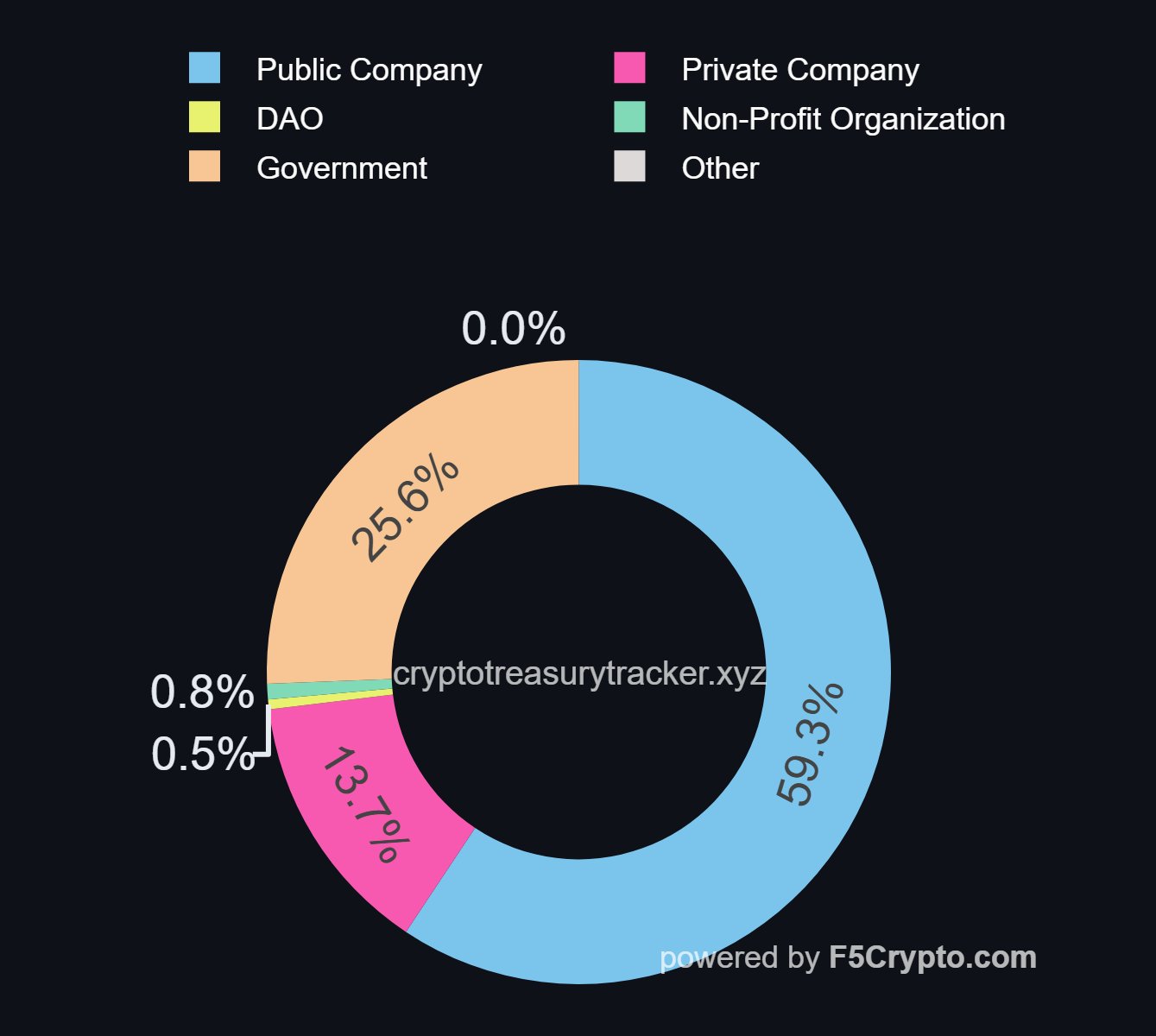
El desglose de las tesorerías en varios sectores | Fuente: Sentora en X

De esta cantidad, el 73% de las tesorerías de activos digitales están controladas por empresas, mientras que el resto está en manos de gobiernos.

Precio de BTC

Al momento de escribir, Bitcoin se negocia alrededor de $88,100, sin cambios desde la semana pasada.

El precio de la moneda parece haber estado consolidándose recientemente | Fuente: BTCUSDT en TradingView

Trending Cryptos

Related Questions

Q¿Qué indican los flujos netos negativos de los ETF de Bitcoin y Ethereum en los últimos 30 días?

ALos flujos netos negativos indican que el capital ha estado saliendo de estos activos digitales, lo que sugiere una disminución en la demanda de los ETF en el corto plazo.

Q¿Cuándo fueron aprobados los ETF spot de Bitcoin y Ethereum por la SEC en Estados Unidos?

ALos ETF spot de Bitcoin fueron aprobados en enero de 2024, mientras que los de Ethereum obtuvieron la aprobación en julio de 2024.

Q¿A cuánto ascienden actualmente los flujos netos negativos de BTC y ETH según el artículo?

ALos flujos netos negativos son de -656 millones de dólares para Bitcoin y -422 millones de dólares para Ethereum.

Q¿Qué similitud menciona el artículo entre la situación actual y la primera mitad de 2025?

ALa débil demanda actual es similar a la fase de salidas de capitales de la primera mitad de 2025, que luego fue seguida por una recuperación explosiva de los precios.

Q¿Qué otro fenómeno reciente de demanda en el mercado de criptoactivos se destaca además de los ETF?

ASe destaca el crecimiento de las tesorerías de activos digitales, que actualmente superan los 185 mil millones de dólares en manos de 368 entidades, principalmente empresas y gobiernos.

Related Reads

How Various Assets Have Performed So Far This Year: Bitcoin at -22% Return, Dead Last

As of November 13, 2026, Bitcoin has posted a -22.0% year-to-date return, ranking last among major asset classes. In contrast, the Philadelphia Semiconductor Index gained 43.2% despite a sharp pullback from its mid-year peak of 106.6%, while the S&P 500 and Nasdaq Composite held steady gains of roughly 8% to 10%. Even the CSI 300 (-13.3%) and gold GLD (-10.3%) outperformed Bitcoin. The article argues the key difference lies in the presence of real buying support. Semiconductors are backed by massive capital expenditure and order backlogs from major tech companies, giving them an earnings floor even after steep corrections. Bitcoin, by contrast, lacks such support. After spot ETFs helped Wall Street finish building core positions in 2024–2025, 2026 brought neither broad macro liquidity nor a new narrative capable of drawing fresh capital. ETF inflows slowed from a flood to a seasonal trickle. Without sustained new buyers, Bitcoin's high beta works only to the downside: in a stock-picking, zero-sum market it becomes the asset everyone wants to sell into strength. The article further notes that Bitcoin's positioning is losing focus. It has failed to act as either a "digital gold" hedge or a high-beta proxy for tech stocks. It lagged the Nasdaq and S&P 500 during the tech rally, and fell harder than gold when global assets contracted in November. The conclusion: Wall Street treats Bitcoin not as a safe haven but as a highly liquid, 24/7 liquidation tool—the first asset sold when institutions need to meet margin calls or lock in yearly profits. Crypto has been admitted to the table, but often as the one picked to pay the bill.

marsbit23m ago

How Various Assets Have Performed So Far This Year: Bitcoin at -22% Return, Dead Last

marsbit23m ago

From QR Codes to Physical Goods: How Consumer RWA Verifies Products and Rights

A single QR code can be printed on two bottles and scanned twice to open the same page, so verifying a physical item requires confirming the binding between the bottle in hand and its listed number. Consumer RWA verification has two parts: whether the goods or services are real, and whether the rights recorded in the digital credential are valid. For rights provenance, take a co-branded gift box: authorization documents define the term and scope in which a brand may use the co-branded mark, production and warehousing records show whether the box was stocked by batch, and rights registration states what holders can redeem and who delivers it. Linking all three lets consumers check authorization scope, supply, and their own eligibility. Identifiers, events, and evidence must work together. High-value items can use unique serial numbers, uniform-spec goods can use batch numbers, and courses or events can use session numbers. Events such as warehousing, sampling, outbound shipment, receipt, and redemption should be tied to the corresponding object, with operation time and responsible party retained. Test reports correspond to submitted samples; linking results to specific goods also requires checking the sample, batch, and inbound/outbound records. Ordinary batch goods can combine serialized QR codes with abnormal-scan records, while high-value items may add tamper-evident labels or independent authentication. Trusted records must also reflect current status. If a coffee batch has 500 bags at warehousing, 10 used for sampling, and 100 reserved for other channels, then absent other changes, 390 bags remain available for new rights. The warehousing record shows historical quantity; current redeemable quantity must be updated based on actual occupancy. A query page should at minimum state the goods or service, evidence source, last update time, and whether the credential is currently usable.

marsbit58m ago

From QR Codes to Physical Goods: How Consumer RWA Verifies Products and Rights

marsbit58m ago

10 Years Is Too Slow: Gu Quanquan's Team Challenges Dario, Compressing Cancer Cure to 4 Years

A UCLA professor, Quanquan Gu, has founded Geodesic Intelligence, a 15-person startup that after only five months has released NovaAtom-Lite, an all-atom structure prediction model that outperforms DeepMind's Isomorphic Labs flagship IsoDDE on FoldBench, the toughest biomolecular benchmark. The model predicts the 3D coordinates of every heavy atom in protein, DNA, RNA, and ligand complexes with near-experimental precision. NovaAtom-Lite posted top scores on two core pharma tests: antibody-antigen binding (79.07% success, 31 points above AlphaFold 3 and 3.5 above IsoDDE, with 2.2x AlphaFold 3's accuracy at high-precision thresholds) and protein-ligand binding (top 1 on both RMSD and contact metrics). On the Runs N' Poses benchmark, which separates memorization from genuine physics understanding, NovaAtom-Lite's lead grows on the most novel, out-of-distribution ligands (47.6% vs AlphaFold 3's 24%), showing it learns transferable physical rules rather than memorizing structures. The model also supports test-time scaling—raising sampling from 1 to 100 seeds lifts antibody success from 74.3% to 83.1%—and condition constraints, where a single contact-pair hint boosts success to 91.28% and full pocket hints lift hard-case ligand accuracy by nearly 16 points. It solved two nightmare cases: a wildly flexible 22-residue MERS nanobody loop (0.56 Å error, all 25 samples correct) and the KRAS G13D hidden switch-II pocket (0.98 Å ligand RMSD vs OpenDDE's 17.74 Å). Gu previously led ByteDance's SeedFold, the first model to beat AlphaFold 3 on FoldBench, forcing Isomorphic Labs to respond with IsoDDE. A stronger NovaAtom-Pro is coming. Days after launch, a16z cited NovaAtom-Lite in a report arguing pharma is entering its "GPT-3 moment," naming Geodesic as the sole company highlighted in its industry map. Geodesic's closed loop spans structure prediction, scientific reasoning, and wet-lab validation—aiming to compress drug discovery from a decade to four years.

marsbit1h ago

10 Years Is Too Slow: Gu Quanquan's Team Challenges Dario, Compressing Cancer Cure to 4 Years

marsbit1h ago

Trading

Spot

Hot Articles

How to Buy RED

Welcome to HTX.com! We've made purchasing RedStone (RED) simple and convenient. Follow our step-by-step guide to embark on your crypto journey.Step 1: Create Your HTX AccountUse your email or phone number to sign up for a free account on HTX. Experience a hassle-free registration journey and unlock all features.Get My AccountStep 2: Go to Buy Crypto and Choose Your Payment MethodCredit/Debit Card: Use your Visa or Mastercard to buy RedStone (RED) instantly.Balance: Use funds from your HTX account balance to trade seamlessly.Third Parties: We've added popular payment methods such as Google Pay and Apple Pay to enhance convenience.P2P: Trade directly with other users on HTX.Over-the-Counter (OTC): We offer tailor-made services and competitive exchange rates for traders.Step 3: Store Your RedStone (RED)After purchasing your RedStone (RED), store it in your HTX account. Alternatively, you can send it elsewhere via blockchain transfer or use it to trade other cryptocurrencies.Step 4: Trade RedStone (RED)Easily trade RedStone (RED) on HTX's spot market. Simply access your account, select your trading pair, execute your trades, and monitor in real-time. We offer a user-friendly experience for both beginners and seasoned traders.

8.3k Total ViewsPublished 2025.03.05Updated 2026.07.21

How to Buy RED

Discussions

Welcome to the HTX Community. Here, you can stay informed about the latest platform developments and gain access to professional market insights. Users' opinions on the price of RED (RED) are presented below.

活动图片