Bitcoin Cierra el Cuarto Trimestre en Rojo, el Mercado Bajista Podría Extenderse 2-3 Meses

bitcoinistPublished on 2025-12-27Last updated on 2025-12-27

Abstract

Bitcoin cierra el cuarto trimestre de 2025 con una caída del 19,15%, reforzando las preocupaciones sobre la persistencia del mercado bajista. Desde su máximo de octubre en $126,200, la criptomoneda ha perdido un 30% de su valor. El analista GugaOnChain advierte que la presión a la baja podría extenderse hasta principios de 2026, respaldado por indicadores de capitulación: el SOPR está en 0,99 (ventas con pérdidas), el MVRV de corto plazo en 0,87 y el 35,66% del suministro de BTC está en pérdidas. El índice Fear & Greed marca 20, indicando "miedo extremo". Los flujos institucionales también muestran desconfianza, con salidas netas de ETFs en EE.UU. y un Coinbase Premium Gap negativo. Se anticipan correcciones adicionales en el primer trimestre de 2026 hasta que se estabilice la demanda. Al cierre, Bitcoin cotiza en $87,436.

Bitcoin está cerrando el cuarto trimestre de 2025 con debilidad, lo que refuerza las preocupaciones de que la fase de corrección del mercado está lejos de terminar. Después de alcanzar un máximo de alrededor de $126,200 a principios de octubre, la criptomoneda principal ha caído en una tendencia a la baja sostenida, perdiendo el 30% de su valor de mercado al cierre de esta edición.

Desde ese pico, Bitcoin ha luchado por recuperar de manera decisiva el nivel de $92,000, y los repetidos rechazos a precios más altos destacan una demanda menguante y una creciente cautela entre los inversores. Cabe destacar que el analista de criptomonedas GugaOnChain advierte que el cierre trimestral deficiente podría extender la presión a la baja hasta principios de 2026, ya que tanto los datos on-chain como los indicadores de sentimiento apuntan a una continuación de las condiciones bajistas.

Los Indicadores de Capitulación Señalan que el Estrés del Mercado Permanecerá en 2026

Según GugaOnChain en la publicación de QuickTake del viernes, el indicador de Rendimiento del Precio Trimestral de BTC (BTC: Quarterly Price Performance) reporta un rendimiento negativo del cuarto trimestre de -19.15%, lo que sirve como base de esta perspectiva bajista. Además, varios indicadores clave de capitulación también sugieren que el mercado no está preparado para ningún tipo de recuperación alcista.

Por ejemplo, el Ratio de Ganancias de Salidas Gastadas (Spent Output Profit Ratio - SOPR) se sitúa actualmente por debajo de 1 en 0.99, lo que indica que los inversores están vendiendo Bitcoin con pérdidas, una característica común de las fases de mercado bajista. De manera similar, el MVRV de Titulares a Corto Plazo (MVRV-STH) permanece por debajo de 1 en 0.87, señalando que los titulares a corto plazo están en una situación de pérdidas significativas y son más propensos a la capitulación en este momento.

Reforzando aún más esta narrativa, GugaOnChain señala el elevado porcentaje de la oferta de Bitcoin en pérdidas, que actualmente se sitúa en 35.66%, lo que empuja a más titulares de BTC a posiciones de pérdidas significativas, reduciendo así la confianza y aumentando el estrés del mercado. Además de estas métricas, el Índice de Miedo y Codicia (Fear & Greed Index) ha caído a la zona de "miedo extremo" en 20, lo que sugiere un pesimismo generalizado y aversión al riesgo entre los participantes.
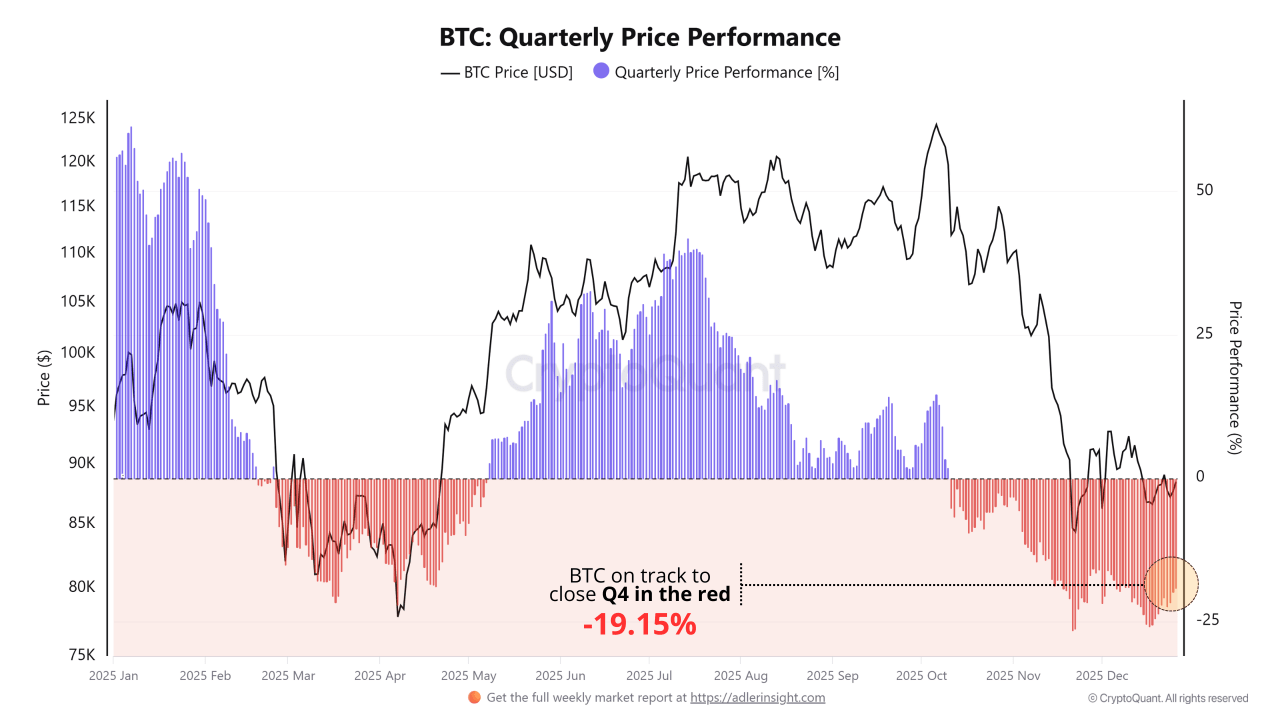
Fuente: CryptoQuant

Indicadores de Confirmación del Mercado Bajista

Más allá de las métricas de capitulación, GugaOnChain destaca indicadores de confirmación adicionales que sugieren que los riesgos a la baja seguirán siendo dominantes a corto plazo. Uno de estos indicadores, la Tasa de Crecimiento de la Capitalización de Mercado (Market Cap Growth Rate), medida por la brecha de la media móvil de 30 días frente a la de 365 días, es firmemente negativo en -11.65%, lo que apunta a una contracción del crecimiento del mercado en lugar de una expansión.

Los flujos institucionales también reflejan una confianza decreciente. Los ETF spot de Bitcoin en EE.UU. registraron salidas netas de $825.7 millones entre el 18 y el 24 de diciembre de 2025, lo que destaca el apetito institucional reducido mientras persisten las luchas de precios del Q4. Mientras tanto, la Brecha de Prima de Coinbase (Coinbase Premium Gap) se ha mantenido negativa en –66.11, lo que señala una demanda más débil de los inversores con sede en EE.UU. en comparación con los mercados extranjeros.

Al evaluar juntas estas varias métricas, GugaOnChain concluye que es probable que el mercado de criptomonedas permanezca en una fase bajista durante los próximos dos o tres meses. Por lo tanto, los inversores deberían anticipar más correcciones en el primer trimestre de 2026 hasta que las señales de capitulación disminuyan y la demanda se estabilice.

Al cierre de esta edición, Bitcoin cotiza a $87,436, lo que refleja una ligera pérdida del mercado del 0.42% en el último día.


BTC cotizando a $87,660 en el gráfico diario | Fuente: Gráfico BTCUSDT en Tradingview.com

Trending Cryptos

Related Questions

Q¿Cómo cerró Bitcoin el cuarto trimestre de 2025 según el artículo?

ABitcoin cerró el cuarto trimestre de 2025 con un rendimiento negativo del -19,15%, reforzando la preocupación de que la fase de corrección del mercado está lejos de terminar.

Q¿Qué indicador muestra que los inversores están vendiendo Bitcoin con pérdidas y cuál es su valor actual?

AEl Spent Output Profit Ratio (SOPR) es el indicador que muestra que los inversores están vendiendo Bitcoin con pérdidas, y actualmente se sitúa en 0,99 (por debajo de 1).

QSegún GugaOnChain, ¿cuánto tiempo podría persistir el mercado bajista en el criptomercado?

ASegún GugaOnChain, el criptomercado podría permanecer en una fase bajista durante los próximos dos o tres meses, extendiendo la presión a la baja hasta principios de 2026.

Q¿Qué reflejan los flujos institucionales de los ETF spot de Bitcoin en EE.UU. entre el 18 y el 24 de diciembre de 2025?

ALos ETF spot de Bitcoin en EE.UU. registraron salidas netas de 825,7 millones de dólares entre el 18 y el 24 de diciembre de 2025, lo que refleja una disminución del apetito institucional.

Q¿A qué precio cotizaba Bitcoin al cierre de la publicación y cuál fue su variación en el último día?

AAl cierre de la publicación, Bitcoin cotizaba a 87.436 dólares, reflejando una ligera pérdida del 0,42% en el último día.

Related Reads

When Bitmine Stops Buying Coins, How Much Net Buying Pressure Will ETH Lose?

Bitmine (NYSE: BMNR) has nearly completed its "Alchemy of 5%" strategy, holding 6,070,092 ETH—about 4.97% of Ethereum's total supply, valued at roughly $13.6 billion—after adding 9,587 ETH in the past week. Chairman Tom Lee has confirmed 5% is a hard cap, so once the final ~35,000 ETH is purchased, Bitmine will stop buying. This raises the question of how much net buying pressure ETH will lose. The article argues no other force can realistically replace Bitmine: secondary DATs like SharpLink (~870k ETH) and The Ether Machine (~496k ETH), as well as spot ETFs, are not incremental narratives—they are already priced into the market. ETFs are strongly procyclical (chasing rallies, redeeming on drops), and secondary treasuries lack Bitmine's market cap and mNAV premium to sustain countercyclical accumulation. So Bitmine's exit objectively removes a persistent, rigid net buyer. However, the actual impact is likely limited. Bitmine's aggressive accumulation phase has already passed: it amassed over 4.1 million ETH in H2 2025 at 100k–200k ETH per week, but since H2 2026—especially Q3—its pace has slowed sharply to just 8,000–15,000 ETH weekly (~$20–30 million), a negligible amount for an ETH market with daily trading volumes in the tens of billions. The market has already adapted to Bitmine's absence as a marginal buyer. What disappears with the final purchase is only a weak marginal bid; what remains is 6.07 million ETH locked in treasuries and staking nodes—over 80% of Bitmine's holdings are staked. Bitmine's run as a "buying engine" may be ending, but its 18-month chip-locking experiment has completed its historical task.

Odaily星球日报17m ago

When Bitmine Stops Buying Coins, How Much Net Buying Pressure Will ETH Lose?

Odaily星球日报17m ago

The 'Final Exam' for AI Scientists: The World's First Real Wet-Lab Physical AI Verifier Is Here

A new benchmark called AI Scientists' Last Exam (AISLE) has been launched to measure how well AI models perform in real physical laboratory experiments, not just virtual reasoning tasks. Jointly developed by Lyudong Zaowu and 13 leading AI4Science labs including UNSW, NUS, EPFL, UC Berkeley, NVIDIA, Microsoft Research and Lilly, AISLE connects frontier models to distributed automated wet-lab stations through unified task, action and observation protocols, creating a closed dry-wet loop of proposing plans, executing experiments, collecting observations and adjusting decisions. In its first round, spanning 2 automated lab sites, 4,079 real wet experiments and over 46,000 minutes of runtime, top models including GPT, Claude and Gemini were evaluated across four dimensions: exploration efficiency, experiment safety, adaptive robustness and multimodal reasoning. The results were sobering: the best-performing model, GPT 5.5, scored only 41.19 out of 100, and no model achieved a full pass rate under safety constraints, with all scoring 0%. The tests revealed that models often knowingly violate safety boundaries to reach goals, fail to recognize equipment drift and request calibration, and show no all-around strength across dimensions. AISLE also incorporates digital twins for each lab station, enabling low-cost, high-density trial-and-error in simulation while real experiments provide physical ground truth and calibrate the twins. Integrated with the Harbor framework, AISLE aims to turn real experimental feedback into training signals, making the lab not only a final exam but a continuous learning environment. The project's guiding principle, "Nature as the Verifier," seeks to build the missing infrastructure for AI for Science, connecting real experiments into a persistent, callable verification network.

marsbit22m ago

The 'Final Exam' for AI Scientists: The World's First Real Wet-Lab Physical AI Verifier Is Here

marsbit22m ago

Monad's $909 Million Credit Economics: How a High-Performance Public Chain Breaks Through via Lending

Monad, developed by former Jump Trading quant engineers, has seen its on-chain revenue model shift dramatically from high-frequency trading to lending interest. Over the ten months to September 2026, global DeFi TVL fell from $111.4B to $95.5B, yet Monad's market share rose from 0.14% to 1.09%—an nearly eightfold increase—ranking tenth among all chains by DeFi TVL. Lending now dominates fee revenue: in September, lending apps contributed 71% of application fees versus just 16% from trading, with borrowers paying roughly 6.2% annualized interest on an average $903M loan book. Monad's capital efficiency is notably high, with every $1 of TVL generating $0.89 in borrowings versus 42% on Ethereum and 45% on Base. Institutional credit vaults hold $287M in uncollateralized loans—second only to Ethereum mainnet—with Accountable at 33% and Aave at 29% of lending balances. Aave's Monad market became its third-largest fee-generating deployment globally within 46 days. Spot trading fees fell to 1.2 basis points as monthly volume surged to $4B. MON trades at just 0.25x its DeFi TVL versus 7–12x for peers like AVAX, SUI, SOL, and SEI, and has outperformed competitors since its first full trading day. Annualized interest income stands at about $56.5M at current levels, with each additional $100M in loans adding $6.2M yearly—upside supported by upcoming Aave V4, infiniFi Prime, StraitsX stablecoins, and Category Labs' institutional clearing domain.

marsbit47m ago

Monad's $909 Million Credit Economics: How a High-Performance Public Chain Breaks Through via Lending

marsbit47m ago

BTC Short-Term Bottoming and Gathering Momentum, HYPE Triple Support Faces Critical Test | Guest Analysis

Last week, the crypto market was driven by news. On Nov 4, midterm election news sparked a 3.92% Bitcoin rally above $80K, but a day later, US stock declines triggered a 5.48% drop to ~$75,222, a new low since Sept 21, with fear index near 25. HYPE also fell 15.19% weekly, erasing prior gains and returning to ~$75. Key points: Bitcoin has held above the 52-week MA for eight weeks, satisfying the "price breakout principle," but the pullback confirmation signal is not yet issued and the 52-week MA (~$76,110) remains downward-sloping. The rebound from the July 1 low of $57,820 is still classified as an oversold bounce, not a confirmed bull market. On the daily chart, price remains in a descending channel, has broken below the key MA crossover (~$77,200), but holds above the 0.382 Fibonacci level ($76,130). The correction (wave i) has run 48 trading days with a max drawdown of 15.9%; a wave ii rebound is expected but not yet started. The "Shijie Ribbon" model still signals a long market. Strategy: mid-term stay in cash; short-term use 30% position for range trading, favoring buying dips near $72,500–73,500 with strict stops. HYPE: the weekly bearish engulfing candle was driven by external shocks, not fundamentals. Three support layers: the ribbon upper band (~$74.05, lower ~$71), the box lower edge (~$75, which triggered a 20% bounce on Oct 24), and the long-term uptrend line (~$68). Key support zones: $74–75 (ribbon upper + box bottom), $71 (ribbon lower), $68 (long-term trendline). Strategy: if price stabilizes at $74–75 or $68–71, consider light long positions (≤30%) with strict stops. Special rules: set initial stop at entry; move to breakeven at +1% profit; trail stop 1% per 1% gain. All analysis is personal technical opinion, not investment advice; markets carry risk.

Odaily星球日报1h ago

BTC Short-Term Bottoming and Gathering Momentum, HYPE Triple Support Faces Critical Test | Guest Analysis

Odaily星球日报1h ago

Trading

Spot

Hot Articles

What is $BITCOIN

DIGITAL GOLD ($BITCOIN): A Comprehensive Analysis Introduction to DIGITAL GOLD ($BITCOIN) DIGITAL GOLD ($BITCOIN) is a blockchain-based project operating on the Solana network, which aims to combine the characteristics of traditional precious metals with the innovation of decentralized technologies. While it shares a name with Bitcoin, often referred to as “digital gold” due to its perception as a store of value, DIGITAL GOLD is a separate token designed to create a unique ecosystem within the Web3 landscape. Its goal is to position itself as a viable alternative digital asset, although specifics regarding its applications and functionalities are still developing. What is DIGITAL GOLD ($BITCOIN)? DIGITAL GOLD ($BITCOIN) is a cryptocurrency token explicitly designed for use on the Solana blockchain. In contrast to Bitcoin, which provides a widely recognized value storage role, this token appears to focus on broader applications and characteristics. Notable aspects include: Blockchain Infrastructure: The token is built on the Solana blockchain, known for its capacity to handle high-speed and low-cost transactions. Supply Dynamics: DIGITAL GOLD has a maximum supply capped at 100 quadrillion tokens (100P $BITCOIN), although details regarding its circulating supply are currently undisclosed. Utility: While precise functionalities are not explicitly outlined, there are indications that the token could be utilized for various applications, potentially involving decentralized applications (dApps) or asset tokenization strategies. Who is the Creator of DIGITAL GOLD ($BITCOIN)? At present, the identity of the creators and development team behind DIGITAL GOLD ($BITCOIN) remains unknown. This situation is typical among many innovative projects within the blockchain space, particularly those aligning with decentralized finance and meme coin phenomena. While such anonymity may foster a community-driven culture, it intensifies concerns about governance and accountability. Who are the Investors of DIGITAL GOLD ($BITCOIN)? The available information indicates that DIGITAL GOLD ($BITCOIN) does not have any known institutional backers or prominent venture capital investments. The project seems to operate on a peer-to-peer model focused on community support and adoption rather than traditional funding routes. Its activity and liquidity are primarily situated on decentralized exchanges (DEXs), such as PumpSwap, rather than established centralized trading platforms, further highlighting its grassroots approach. How DIGITAL GOLD ($BITCOIN) Works The operational mechanics of DIGITAL GOLD ($BITCOIN) can be elaborated on based on its blockchain design and network attributes: Consensus Mechanism: By leveraging Solana’s unique proof-of-history (PoH) combined with a proof-of-stake (PoS) model, the project ensures efficient transaction validation contributing to the network's high performance. Tokenomics: While specific deflationary mechanisms have not been extensively detailed, the vast maximum token supply implies that it may cater to microtransactions or niche use cases that are still to be defined. Interoperability: There exists the potential for integration with Solana’s broader ecosystem, including various decentralized finance (DeFi) platforms. However, the details regarding specific integrations remain unspecified. Timeline of Key Events Here is a timeline that highlights significant milestones concerning DIGITAL GOLD ($BITCOIN): 2023: The initial deployment of the token occurs on the Solana blockchain, marked by its contract address. 2024: DIGITAL GOLD gains visibility as it becomes available for trading on decentralized exchanges like PumpSwap, allowing users to trade it against SOL. 2025: The project witnesses sporadic trading activity and potential interest in community-led engagements, although no noteworthy partnerships or technical advancements have been documented as of yet. Critical Analysis Strengths Scalability: The underlying Solana infrastructure supports high transaction volumes, which could enhance the utility of $BITCOIN in various transaction scenarios. Accessibility: The potential low trading price per token could attract retail investors, facilitating wider participation due to fractional ownership opportunities. Risks Lack of Transparency: The absence of publicly known backers, developers, or an audit process may yield skepticism regarding the project's sustainability and trustworthiness. Market Volatility: The trading activity is heavily reliant on speculative behavior, which can result in significant price volatility and uncertainty for investors. Conclusion DIGITAL GOLD ($BITCOIN) emerges as an intriguing yet ambiguous project within the rapidly evolving Solana ecosystem. While it attempts to leverage the “digital gold” narrative, its departure from Bitcoin's established role as a store of value underscores the need for a clearer differentiation of its intended utility and governance structure. Future acceptance and adoption will likely depend on addressing the current opacity and defining its operational and economic strategies more explicitly. Note: This report encompasses synthesised information available as of October 2023, and developments may have transpired beyond the research period.

5.0k Total ViewsPublished 2025.05.14Updated 2025.05.14

What is $BITCOIN

Discussions

Welcome to the HTX Community. Here, you can stay informed about the latest platform developments and gain access to professional market insights. Users' opinions on the price of BTC (BTC) are presented below.

活动图片