Podcast Notes | Tom Lee: Ethereum Could Hit $50K This Cycle, Tokenization is a Disruptive Force on Wall Street

marsbitPublished on 2026-10-10Last updated on 2026-10-10

Abstract

**Podcast Summary | Tom Lee: Ethereum Could Hit $50K This Cycle, Tokenization is Wall Street’s Disruptive Force** In a discussion at TOKEN2049, Fundstrat co-founder and BitMine Chairman Tom Lee shared his outlook on crypto markets, AI, and the future of finance. Lee asserts the crypto bear market is over and a new bull cycle has begun, driven significantly by institutional adoption and real innovation, unlike previous retail-driven cycles like ICOs or NFTs. He highlights Asia as a key region for blockchain and tokenization progress. A central theme is the vast potential of asset tokenization. While on-chain assets currently total $3-4 trillion, the traditional capital pool is around $200 trillion, with ~$7 trillion in new liquid assets annually. Lee sees this as a massive opportunity to bring wealth on-chain, particularly from illiquid private markets. On AI, Lee argues the current phase is not a bubble but resembles 1997 in the internet era. He notes comparable infrastructure spending (~$30 trillion for AI vs. ~$35 trillion for internet/mobile) and suggests a potential AI bubble peak may not arrive until around 2033. Lee is exceptionally bullish on Ethereum, which BitMine's balance sheet is heavily invested in. He calls ETH "severely undervalued," predicting it could reach $2,500 to $5,000 by year-end (breaking its all-time high) and potentially $25,000 to $50,000 in this cycle, citing its role as a neutral settlement layer and robust developer community. Tokenization,...

Compiled & Translated: Deep Tide TechFlow
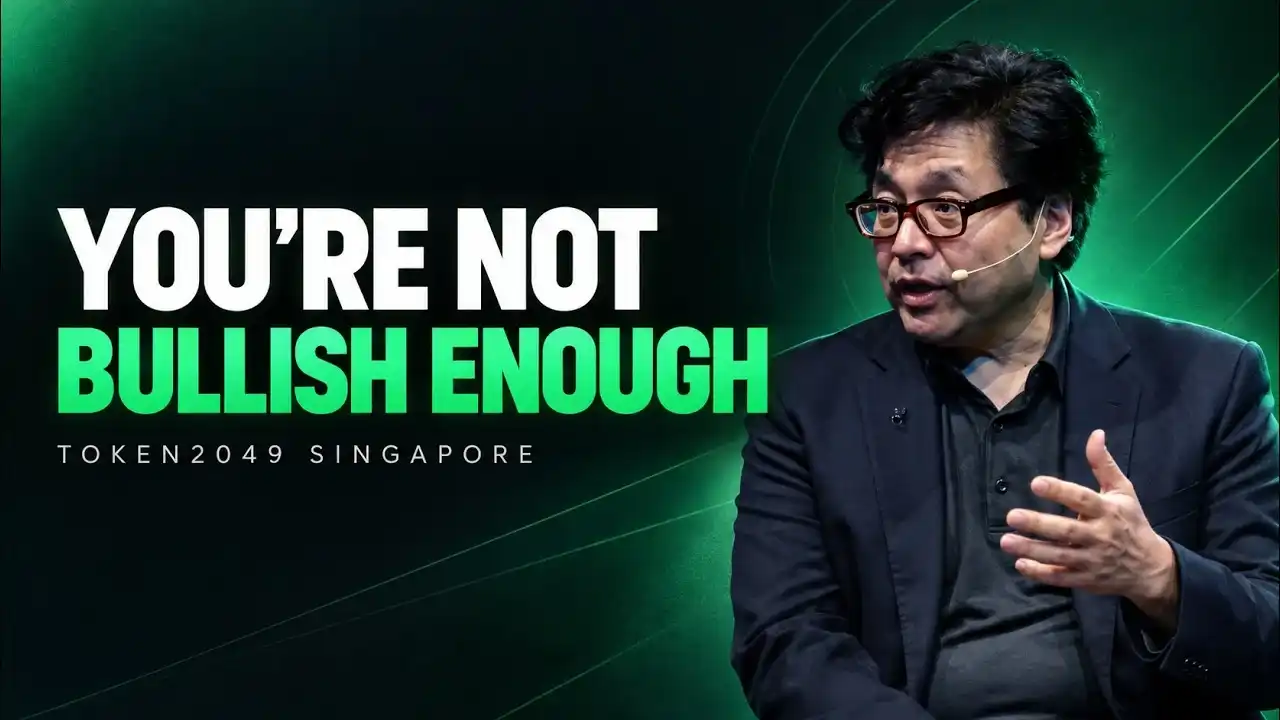
Guest: Tom Lee (Co-founder of Fundstrat, Chairman of BitMine Board, Senior Wall Street Strategist)

Host: Ondo Finance Special Session Host

Podcast Source: TOKEN2049 × Ondo Finance Special Session (YouTube)

Original Title: Tom Lee: Ethereum Could Reach $50K This Cycle | TOKEN2049 | Ondo Finance

Release Date: 2026-10-08

Key Takeaways

  • Bull Market Returns: The past 12 months were a crypto winter, but after the KBW conference, the market has entered a full bull market. Asia is the right place to be.
  • Tokenization Blue Ocean: On-chain assets amount to only 3-4 trillion USD, while the traditional capital pool is as high as 200 trillion USD, with about 7 trillion USD in new liquid assets added annually.
  • AI is Not a Bubble: Compared to the internet in the 90s, current AI infrastructure spending is about 30 trillion USD, similar to the 35 trillion USD for internet and mobile networks back then. We are roughly in 1997, with the AI bubble peak potentially around 2033.
  • Extremely Bullish on ETH: BitMine is betting on Ethereum as the future settlement layer, believing ETH is severely undervalued and could reach 25,000 to 50,000 USD this cycle.
  • Institutions Driving the New Cycle: This cycle differs from the retail-driven ICO (2017) and NFT (2021) booms; it is driven by institutional products and real innovation.
  • Tokenization Deconstructs Banking: Enables trading fractional assets like Alphabet, Starlink, Tesla FSD, etc. The asset management industry will adopt it first; Wall Street overall will be very slow.

II. Notable Insights

  • "I've never seen a bubble that everyone thinks is a bubble. If you think it's a bubble, you won't push it into a bubble."
  • "We are roughly in 1997. Cisco didn't peak until 2000, and it halved twice between 1993 and 2000. So I think we're far from a bubble."
  • "Ethereum is severely undervalued. In this bull cycle, it could easily reach 25,000 or 50,000 USD."
  • "By the end of this year, Ethereum should break its all-time high, meaning above 5,000 USD; Bitcoin will exceed 100,000 USD, which would put Ethereum around 7,500 USD."
  • "If you want to position for tokenization, the asset management industry is embracing it, while Wall Street as a whole will be very slow."
  • "Many large financial institutions risk becoming the NCRs and MCIs of this era if they don't establish a crypto rail or crypto strategy."

III. Full Text

1. Asian Energy & Bull Market Return

Host: You've attended many events in Asia recently. What's your most direct impression?

Tom Lee: The past 12 months were essentially a crypto winter, but after the KBW conference, especially this week, you can clearly feel a shift; the market has fully returned to a bull market. I think being in Asia is right because a lot of the substantive progress in tokenization, banks advancing blockchain and crypto, is happening in Asia.

2. Tokenization: A 200 Trillion USD Blue Ocean

Host: Everyone is talking about tokenization. How big do you think the real potential is?

Tom Lee: Currently, on-chain assets are only about 3 to 4 trillion USD, but the traditional capital pool is immense: public equities alone are 150 trillion USD, fixed income about 250 trillion USD, and there's roughly 7 trillion USD in new liquid assets searching for a home each year. More importantly, a huge amount of capital is locked in private equity and private credit with 4-10 year exit times, offering returns barely matching money market funds. Convincing affluent individuals to move their wealth on-chain while outperforming traditional allocations is the core of this transformation. This is a massive addressable market.

3. The AI Bubble Debate: We're Still in 1997

Host: Is AI already in a bubble?

Tom Lee: The average fund manager today is about 35 years old. Most started in the industry around 2016, never experienced the 2008 financial crisis, nor the dot-com bubble. I often say, "I've never seen a bubble that everyone thinks is a bubble." Looking at the data is clearer: The public internet started in 1994. By 2026, the total build-out cost of internet plus mobile networks is about 35 trillion USD. Current AI infrastructure spending is around 30 trillion USD, a comparable cost. Cisco didn't peak until 2000, halving twice in between. So I judge the current state to be closer to 1997. The peak of the AI bubble might be around 2033.

4. The Underlying Logic for Heavy Bet on Ethereum

Host: Why have you bet BitMine's balance sheet heavily on Ethereum?

Tom Lee: Ethereum is the most neutral future settlement layer. It has the largest developer community and has maintained 100% uptime for the past 15 months. ETH is around $2,700 now, having been range-bound for 5 years. The longer the consolidation, the bigger the breakout tends to be. I believe ETH is severely undervalued and could reach 25,000 to 50,000 USD this cycle. For year-end, I predict ETH will break its all-time high, standing above 5,000 USD, with Bitcoin exceeding 100,000 USD, pushing ETH to around 7,500 USD.

5. The Institution-Driven New Cycle

Host: How is this cycle different from the previous ICO and NFT booms?

Tom Lee: 2016-2017 was ICO, driven by retail. 2019-2021 was NFT, also retail-focused. In this cycle, institutions are building a lot of products, and there's real innovation, like what Ondo announced that very day regarding private market business. The participants are larger, with more capital. This will be a much larger cycle than before. The market is actually not bullish enough, and crypto prices will see some sharp volatility.

6. How Tokenization Deconstructs Banking

Host: What does tokenization mean for the banking system?

Tom Lee: Investors always love liquidity, low cost, and information advantages. The greater significance of tokenization lies in deconstructing assets: For example, at KBW, a company announced the ability to trade Alphabet stock within Google. In the future, people might buy fractional assets like Starlink or Tesla's Full Self-Driving. I think the asset management industry will embrace tokenization first because its fee model is based on assets under management and won't be disrupted. But banking functions relying on capital allocation, trust, or insurance elements become unnecessary in a tokenized world, posing significant risk. Buy-side will clearly push the sell-side to adapt.

7. The Future of the Financial System and a Warning

Host: Looking ten years ahead, what will the financial system look like?

Tom Lee: The financial system now accounts for half the economy. In the age of agents and robots, the financial sector might even become the largest sector in the economy because financial activities in the digital world are greater. Another often overlooked statistic: 46% of people in the US don't even have a bank account; prepaid cards are their bank, which is a very expensive way to store value. One of the significances of crypto is to provide financial services to more people. Finally, a warning to traditional finance Chief Investment Officers: If you don't establish a crypto rail or strategy, you risk becoming the NCRs (missed PCs) and MCIs (missed mobile networks) of this era.

Trending Cryptos

Related Questions

QAccording to Tom Lee, what are his price predictions for Ethereum and Bitcoin by the end of the year discussed?

ATom Lee predicts that by the end of the year, Ethereum will break its all-time high and reach $5,000, while Bitcoin will exceed $100,000, which could subsequently drive Ethereum to around $7,500.

QHow does Tom Lee compare the current state of AI development to the historical internet bubble?

ATom Lee compares the current AI infrastructure spending (approximately $30 trillion) to the total construction scale of the internet and mobile networks up to 2026 (about $35 trillion). He suggests the current AI stage is analogous to 1997 in the internet era, with the potential bubble peak possibly not arriving until around 2033.

QWhat is the core opportunity Tom Lee identifies in the tokenization of assets?

ATom Lee identifies the core opportunity as convincing affluent individuals to move their wealth on-chain to achieve better returns than traditional allocations. He highlights the massive potential market, noting the traditional capital pool is around $200 trillion, while on-chain assets are only $3-4 trillion, with $7 trillion in new liquid assets seeking destinations annually.

QHow does Tom Lee characterize the current crypto market cycle compared to the 2017 ICO and 2021 NFT cycles?

ATom Lee characterizes the current cycle as being driven by institutional players and genuine innovation, contrasting it with the 2017 ICO and 2021 NFT cycles, which were primarily retail-driven. He states that larger participants and more substantial capital are involved, making this a significantly larger cycle.

QWhat warning does Tom Lee give to traditional financial institutions regarding crypto adoption?

ATom Lee warns that many large financial institutions risk becoming obsolete, like NCR (which missed the personal computer) and MCI (which missed mobile networks), if they do not establish a crypto rail or crypto strategy to adapt to the evolving financial landscape.

Related Reads

Bernstein Research Report Interpretation: Fiscal 2028 Revenue to Top $740 Billion, Yet Only a Neutral Rating for Nvidia

Nvidia reported Q3 FY2027 revenue of $115.844 billion, beating consensus of $109.330 billion, with adjusted EPS of $2.68 versus $2.47 expected. Data Center revenue reached $107.610 billion, up 21% QoQ and 110% YoY, driven by the Vera Rubin architecture, which contributed about $20 billion in its first quarter, alongside continued Blackwell Ultra shipments. Hyperscale cloud revenue was $60.136 billion, while AI cloud and enterprise customers reached $47.474 billion, up 195% YoY. Networking contributed about $21 billion, and adjusted gross margin came in at 74.9%. Q4 FY2027 guidance stands at $130 billion, above the $125.1 billion consensus, but Bernstein notes this includes an extra accounting week worth roughly $5-10 billion; excluding it, the normalized outlook is slightly below consensus. Q3 also benefited from about $2.4 billion in Hopper sales to China, which are excluded from Q4 guidance. Q4 gross margin is guided at 71.5%, expected to be the cycle trough before price increases lift margins to 72-73% in FY2028. Management raised FY2028 revenue growth guidance to about 75% from 70%, implying revenue above $740 billion, saying strong global demand offsets new export controls. Supply commitments rose to $390 billion, or $518 billion including cloud, leasing, and equity commitments. Inventory climbed to $39.7 billion. Free cash flow was $43.8 billion, with $22.1 billion in buybacks and a new $150 billion authorization. Bernstein raised its FY2028 revenue forecast to $742.4 billion and EPS to $17.18. Despite strong fundamentals, Bernstein maintains a Market-Perform rating and $200 target price, citing governance and long-term execution risks following management changes. The board has said it does not intend to bring back Jensen Huang and is searching for a new leader, raising questions about supplier negotiations, product roadmap, decision speed, and talent retention, plus potential investigation risks. At around $155.46, the stock trades at just 9.0x FY2028 EPS, or about 10x the $200 target based on average FY2028-29 EPS of $20.59. Bernstein remains on the sidelines pending clarity.

marsbit7m ago

Bernstein Research Report Interpretation: Fiscal 2028 Revenue to Top $740 Billion, Yet Only a Neutral Rating for Nvidia

marsbit7m ago

Bitcoin Volatility Falls to 43%, Below Nearly One-Fifth of S&P 500 Constituents: Is the Crypto Asset Risk Narrative Being Rewritten?

Grayscale Research argues that Bitcoin's risk profile has structurally changed and that investors' framework for assessing crypto risk needs a fundamental reset. Bitcoin's one-year realized volatility has fallen from roughly 64% a decade ago and 81% five years ago to about 43% today, placing it within the normal range of S&P 500 large-cap stocks and below roughly 19% of S&P 500 constituents. This decline reflects deeper institutional market-making, spot ETP launches, and established regulatory boundaries. The report cautions against judging Bitcoin by volatility alone. Its returns exhibit fat tails and momentum clustering, with the bulk of long-term compound gains concentrated in a handful of best trading days; missing the top 10 days would erase most cumulative returns. Downside-only measures such as the Sortino ratio therefore flatter Bitcoin more than the Sharpe ratio does. Although drawdowns exceeding 50% have occurred, risk-parity-adjusted drawdowns look less exceptional versus traditional assets. Crucially, Bitcoin's returns are poorly explained by traditional macro factors, giving it low correlation with equities, bonds, and commodities. Backtests show that adding a 1–5% Bitcoin allocation to a classic 60/40 portfolio improves risk-adjusted returns without proportionally worsening maximum drawdown. Beyond Bitcoin, crypto sub-sectors are structurally decoupling: Bitcoin now explains only about 50% of overall crypto return variance. Smart contract platforms show roughly 58% volatility driven by on-chain fundamentals, while consumer and AI sectors show 76% and 85% respectively, driven by distinct narratives. This rotation creates room for bottom-up alpha. Institutions should adopt a two-layer approach: Bitcoin as a macro diversifier, plus selective exposure to vertical-sector infrastructure, managed through volatility budgeting and disciplined rebalancing.

marsbit47m ago

Bitcoin Volatility Falls to 43%, Below Nearly One-Fifth of S&P 500 Constituents: Is the Crypto Asset Risk Narrative Being Rewritten?

marsbit47m ago

Strategy Removed from MSCI: Will BlackRock's 123,000 Shares Really Hit the Market?

After Nov 30, MSCI will remove Strategy (Michael Saylor's bitcoin-holding company) from several indices, effective Dec 1, under new eligibility rules for "non-operating" companies. Investors expect selling pressure, since index-tracking funds that bought Strategy solely to mirror the index no longer have a reason to hold it. But two BlackRock funds tracking the same MSCI USA Index illustrate why holdings can't simply be summed into one sell order: iShares MSCI USA ETF (MLRG) holds Strategy shares directly (5,227 shares as of Nov 13), while iShares MSCI USA Swap UCITS ETF (MUSD) gets index exposure via total return swaps, so its counterparties may adjust their own positions without disclosure. BlackRock's URTH (29,300 shares) and ACWI (88,500 shares) also hold Strategy, bringing the three identified funds to 123,000 shares worth about $13.74 million — a specific snapshot, not the full universe of affected funds. USXF holds 16,100 shares but its specialized index adjustment is pending. Strategy says index funds collectively hold about 13 million shares, or 3.1% of free float. Crucially, shrinking holdings don't prove selling: ETFs grow and shrink with creations and redemptions, and shares can leave a fund via in-kind redemptions without exchange sales. Index removal may weaken demand for Strategy's stock and complicate its bitcoin-funding model, but it does not require Strategy to sell any bitcoin.

marsbit48m ago

Strategy Removed from MSCI: Will BlackRock's 123,000 Shares Really Hit the Market?

marsbit48m ago

US Chip Controls Extend from Overseas Compute to Lithography Machines: Why ASML May Be Hurt More Than Nvidia?

The article discusses how U.S. chip export controls are expanding from overseas computing power to lithography machines, arguing that ASML may be more vulnerable than Nvidia. It notes that after Jensen Huang's sudden resignation as Nvidia CEO, the U.S. Commerce Department's BIS issued an interim final rule on November 16 extending semiconductor export controls to third-country offshore AI data centers, requiring licenses for advanced chip and high-bandwidth network equipment exports to overseas data centers that may serve restricted entities. The rule closes loopholes by aggregating distributed cluster computing power, covering indirect training arrangements, mandating KYC checks, and giving existing data centers a 90-day transition period. For Nvidia, the direct exposure is mainly in Southeast Asia, where Singapore alone accounts for about 10% of revenue, but strong capex from North American hyperscalers like Microsoft, Meta, and Amazon should absorb any diverted GPU capacity, making the new rule more a compliance cost than a revenue cliff. The bigger risk is the bipartisan MATCH Act, which would turn administrative discretion into hard federal law, permanently locking in restrictions on DUV lithography and advanced etching and deposition equipment. The article argues this would hit upstream equipment makers—ASML, Lam Research, and Applied Materials—harder than downstream chip designers, since cutting off their largest cash-flow market without sufficient domestic fab subsidies would pressure both profits and valuations. It also warns that markets are underestimating retaliation risks in rare earths and critical minerals, and notes ASML's China shipment share once jumped from 11% to 39% during the last semiconductor downturn.

marsbit1h ago

US Chip Controls Extend from Overseas Compute to Lithography Machines: Why ASML May Be Hurt More Than Nvidia?

marsbit1h ago

Trading

Spot

Hot Articles

Discussions

Welcome to the HTX Community. Here, you can stay informed about the latest platform developments and gain access to professional market insights. Users' opinions on the price of ETH (ETH) are presented below.

活动图片