M-Soaring Nearly Threefold in a Month, The Launch of the First Spot ETF for NEAR Should Not Be Chased as "Good News"

marsbitPublished on 2026-09-30Last updated on 2026-09-30

Abstract

In late September, the launch of the first U.S. spot NEAR ETF (NRR) by Bitwise ignited market excitement, following NEAR's near-triple price surge from $1.6 to $5.4 over the previous month. However, analysis suggests this rally largely priced in the ETF approval itself. The ETF establishes a compliant entry for traditional capital, but sustained inflows are not guaranteed. The fund’s structure involves staking for yield, yet early hype may have exhausted short-term upside. The true driver behind NEAR’s recent performance is a strategic rebranding from an "Ethereum killer" to a machine currency and cross-chain settlement layer for the AI agent era. Its NEAR Intents protocol, with over $32B in historical cross-chain volume, and new Confidential Intents feature for private transactions, position it for this narrative. NEAR’s updated tokenomics aim for sustainability: annual inflation was halved to 2.5%, and a fee switch directs protocol revenue to buybacks. However, with estimated annual net revenue around $20M versus ~$150M in new inflation (at current market cap), buybacks currently offset only about 13% of inflationary pressure. True deflation remains a distant target dependent on sustained high transaction volume. Market fears of a large unlock at $6.66 were addressed: the associated 666,666 NEAR reward pool (~$4.4M) is negligible relative to NEAR’s multi-billion dollar market cap and daily volume, with strict distribution conditions yet to be announced. Going forward, N...

Author: Geminy, Deep Tide TechFlow

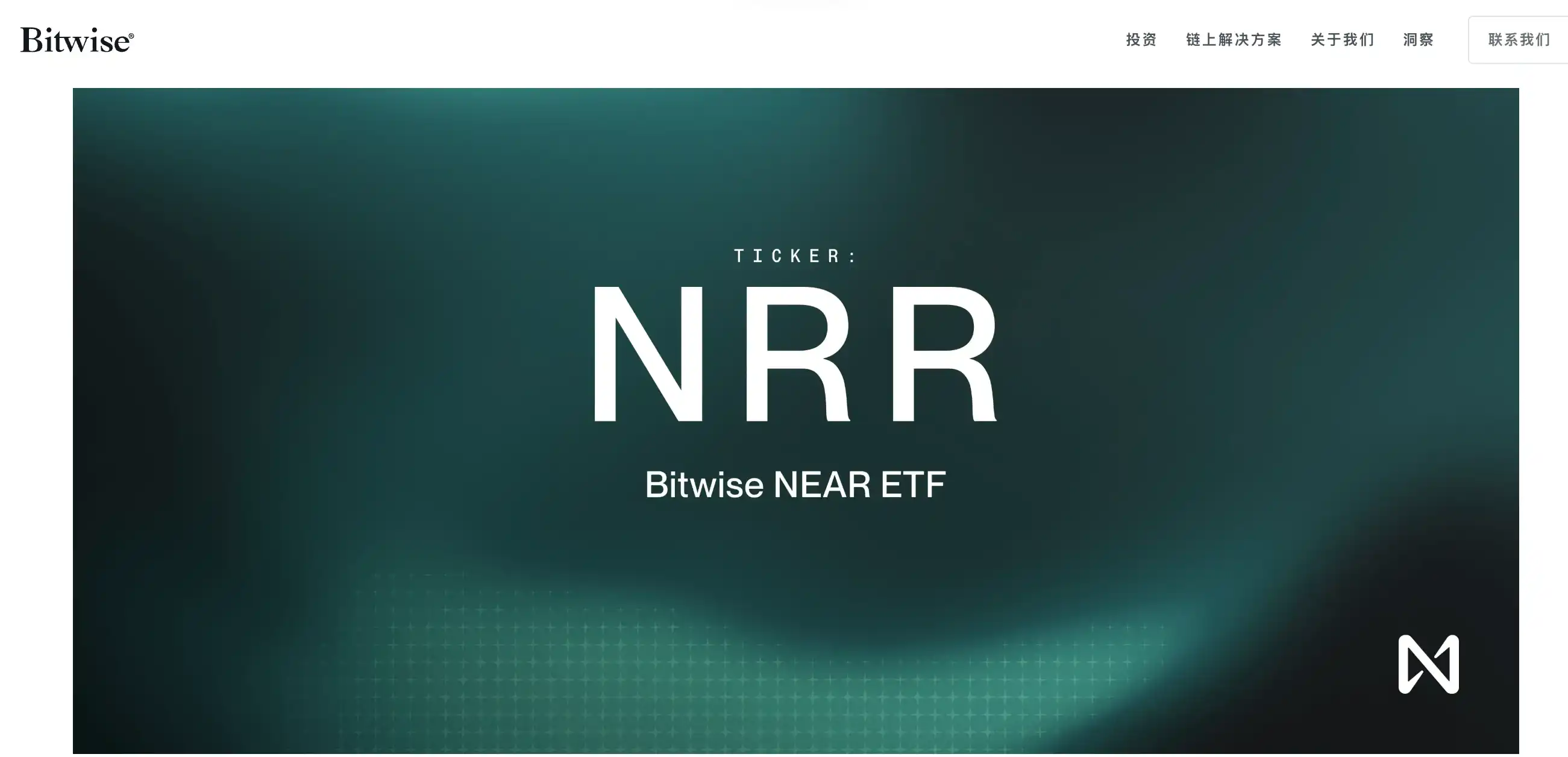
On September 29, Bitwise officially listed the first US spot ETF for NEAR (ticker: NRR) on NYSE Arca. The news once again stirred the nerves of the entire crypto market. After all, in the past month alone, NEAR surged from lows around $1.6 to $5.4, delivering nearly threefold gains.
Amid the fervent bullish atmosphere, many investors instinctively viewed this ETF as a clarion call for traditional institutional capital to flood in.

However, upon dissecting the fund's underlying terms and comparing them with the actual business changes NEAR underwent over the past two months, it becomes clear that the market's complexion is more complex than press releases suggest.

For the NEAR token, this is not the beginning of a new wave of institutional-driven bullishness; the market has already front-run the expectations.

The Pipeline Isn't a Water Faucet: The Wall Street Gateway Has Been Discounted Prematurely

The core significance of the first single-asset spot ETF's launch lies in creating a compliant entry path for traditional US capital, but building a pipeline does not guarantee immediate capital inflow.

According to product details disclosed by Decrypt, Bitwise designed a "spot holdings plus staking" model for NRR:

The fund charges a 0.75% annual management fee and stakes all underlying tokens on-chain to obtain approximately 5% annualized returns. To cover node setup and custody costs, Bitwise takes 33% of the staking rewards, with the remaining two-thirds added back to the fund's net asset value.

This structure is logically sound: as long as there is net subscription from off-market funds, custodian Coinbase must purchase an equivalent amount of tokens in the spot market and lock them up.

The crux of the problem, however, is the time lag.

The near threefold surge from late August through late September has, in fact, already exhausted the market's positive expectations for "approval" and "first listing." Until Bitwise discloses substantial, sustained daily net subscription data, NRR is merely an entry ticket displayed in the shop window. If the anticipated influx of off-market buying pressure fails to materialize, excessive leverage and crowded positioning could easily face brutal selling from profit-takers.

Intents Network and AI Agents

If the ETF itself is merely a point of expectation realization, what drove NEAR's strong independent performance in Q3 was actually a fundamental revaluation of its ecosystem positioning.

In its marketing materials for Wall Street, Bitwise completely abandoned the outdated "Ethereum killer" narrative, instead repositioning NEAR as the machine currency and cross-chain settlement layer for the era of autonomous agents. This positioning precisely hits the current primary market's enthusiasm for AI infrastructure.

More importantly, NEAR delivered verifiable business carriers.
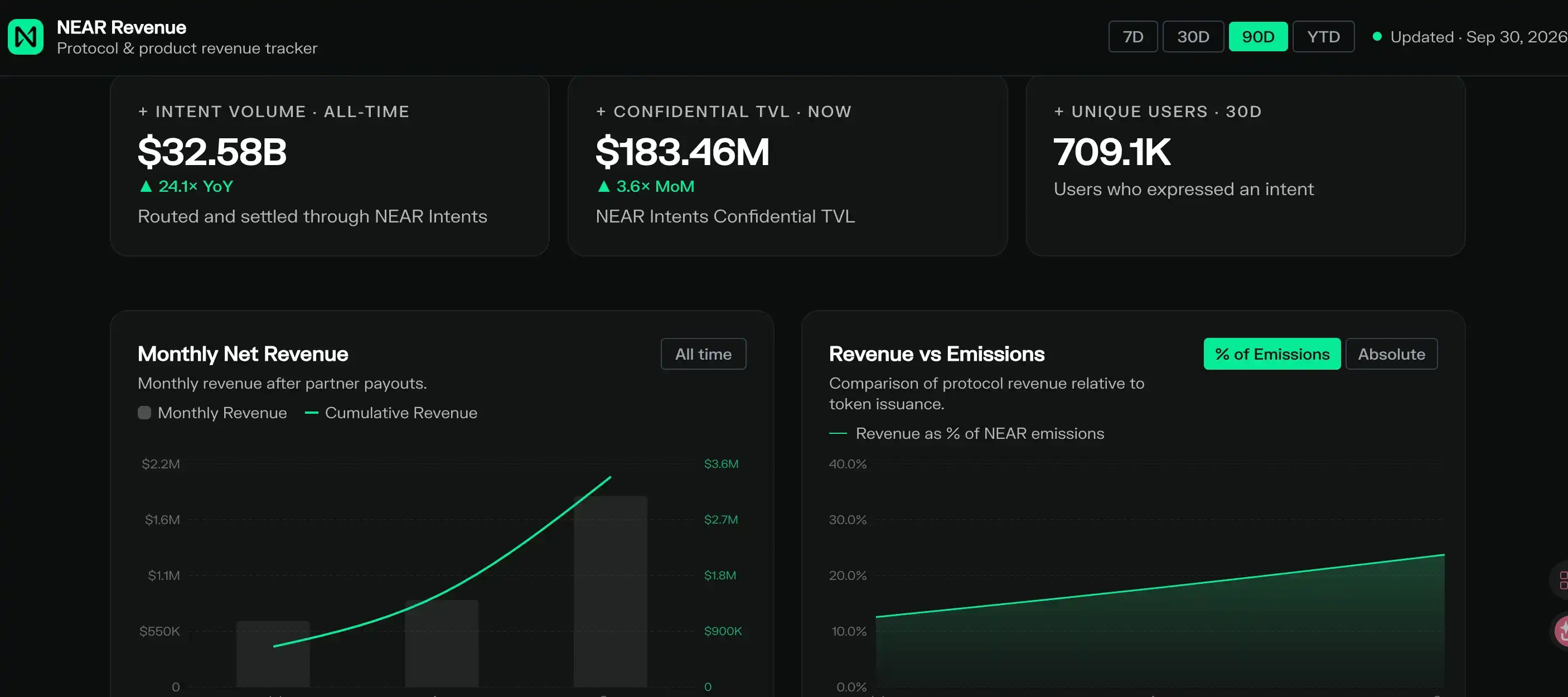
Powered by its cross-chain intent protocol (NEAR Intents), its cumulative transaction volume has surpassed $32 billion, connecting dozens of public blockchains. For future AI agents engaging in high-frequency on-chain interactions, they require funding channels that are non-custodial, low-friction, and responsive. Leveraging chain signature technology, NEAR has positioned itself precisely at this ecosystem niche for machine routing. Furthermore, following the mid-September launch of its Confidential Intents, throughput in the private channel surged rapidly, capturing nearly half of the front-end share for a time, aligning with the industry's renewed focus on on-chain private transactions.
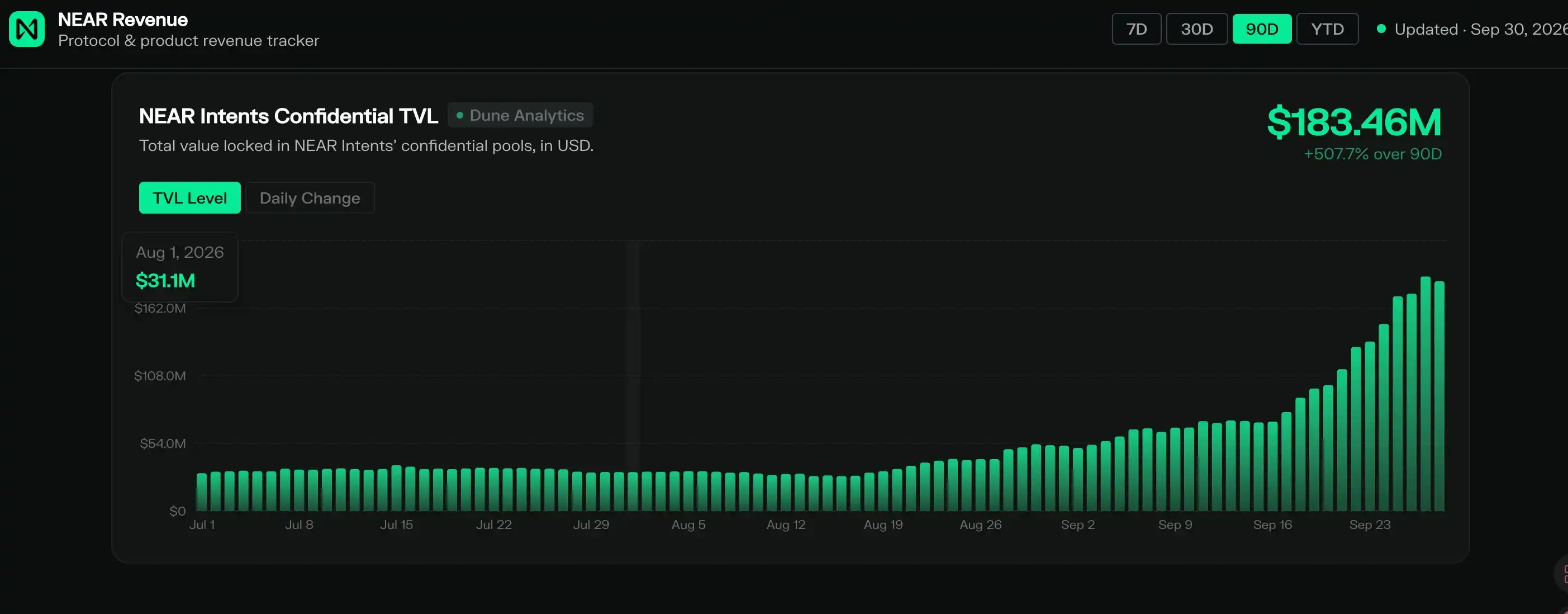
The market is no longer discounting NEAR based on traditional Layer 1 hardware logic but has elevated it to the status of a global settlement entry point for the AI era. This is the core narrative fueling the bullish buying spree.

$20 Million Revenue vs. $150 Million Inflation

Amid the surge in network usage, NEAR seized the opportunity to rewrite its token economic model, hopping onto the currently popular "protocol buyback" bandwagon.

Currently, the protocol has halved its annual inflation cap from 5% to 2.5%. The token vesting schedules for early investors and the team concluded entirely last fall, removing the threat of massive unlock cliffs. More crucially, the protocol activated its fee switch this year, using the fees generated by the Intents protocol to buy back tokens in the open market with real money.

This closed-loop mechanism appears attractive, but careful scrutiny of the actual numbers reveals it remains in a fragile early-stage equilibrium. Based on current data estimates, NEAR protocol's net annual revenue is around the $20 million range. Meanwhile, with a market cap exceeding $6 billion, the 2.5% annual inflation implies approximately $150 million in new selling pressure is created each year.

This means the current fee buybacks can only offset about 13% of the new inflation. The concept of "buybacks equaling deflation" remains a distant theoretical threshold. The higher the token price rises, the larger the USD-denominated value of the inflation becomes, pushing the required daily trading volume threshold for the protocol to achieve financial balance even higher. Should the transaction volume of the cross-chain intent protocol decline subsequently, this self-sustaining flywheel based on perfect assumptions could face disproof at any moment.

Clarifying Misconceptions

During the rapid price surge, community fears emerged about "massive unlocks triggering sell-offs if the token reaches $6.66." This panic intensified around September 26th when NEAR's official Twitter account posted a teaser poster saying "[email protected] next."

While the official did set $6.66 as the trigger condition for the next round of activities and explicitly marked a prize pool of 666,666 NEAR for unlocking in the poster, many investors instinctively viewed it as impending selling pressure. However, a simple calculation shows this concern lacks common sense.
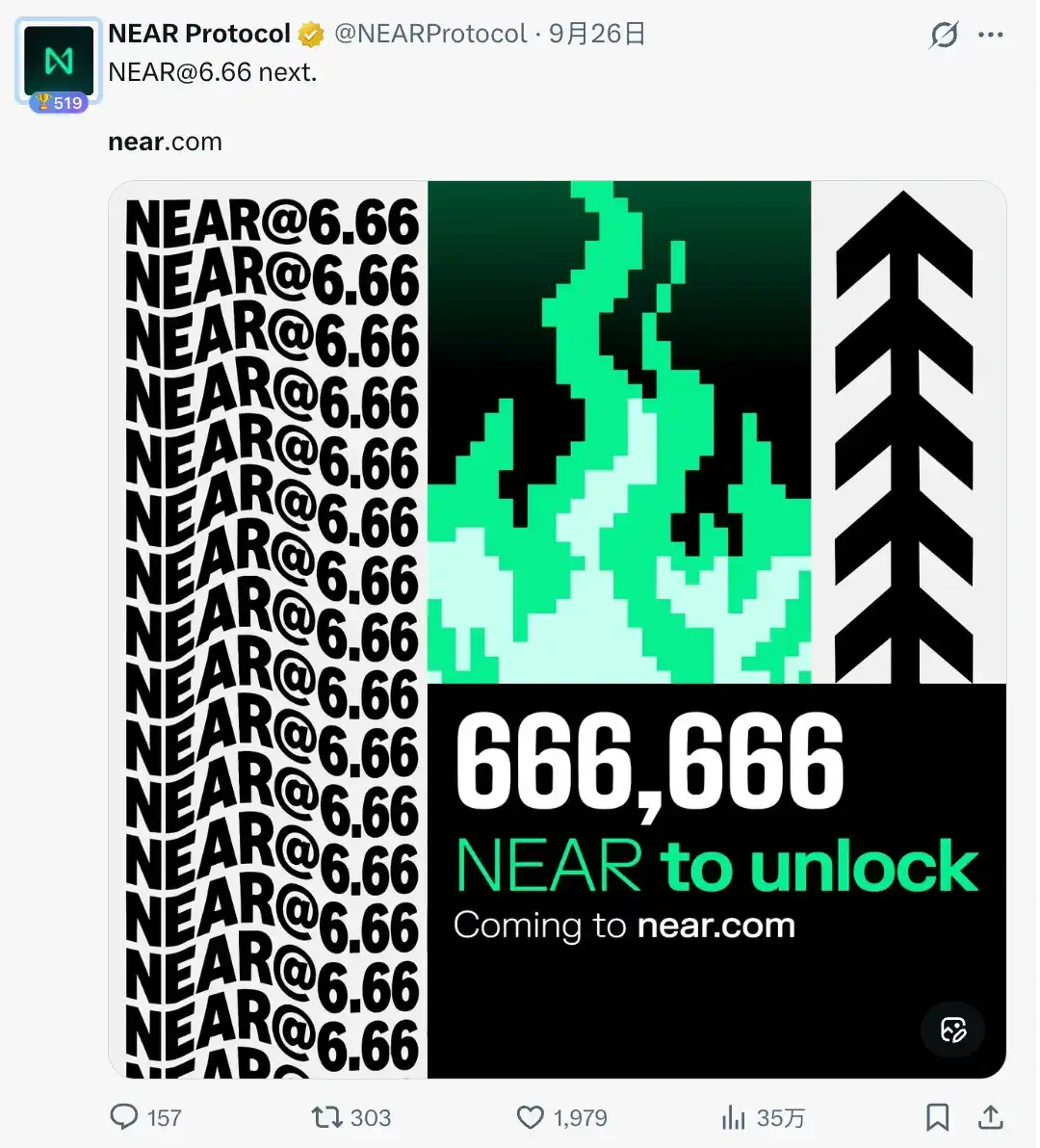
Firstly, the quantity is extremely small. Even if all 666,666 tokens are eventually released into circulation at the $6.66 price, their total value would be only around $4.4 million. For an asset with a circulating market cap exceeding $6 billion and daily trading volume often in the hundreds of millions of dollars, this activity fund accounts for less than 0.07% of the market cap, hardly making a ripple if sold into the market.

Secondly, the rules are not yet finalized. Referring to the official's previous $3.33 reward mechanism, token distribution required meeting two stringent conditions simultaneously: "privacy application TVL reaching a target" and "the price maintaining at the target level for several days." Currently, the official has only released a teaser poster; specific TVL thresholds and maintenance periods have not been announced.

Setting aside these speculative noises, the reality check for all traders from this rally is stark. The narrative is fully priced in, the ETF is listed. What determines whether NEAR stabilizes at the $5+ level or slides into a downtrend boils down to two undeniable metrics:

First, whether Bitwise discloses continuous and substantial ETF net inflows in the coming trading sessions, proving traditional financial capital genuinely buys into this AI narrative. Second, whether the NEAR Intents protocol can sustain weekly transaction volume stably above $800 million to $1 billion, providing a steady stream of ammunition for buybacks. Until the data provides answers, blindly treating a freshly launched compliant entry point as a reason to chase highs often comes with a heavy liquidity cost.
Trending Cryptos

Related Questions

QWhat is the core argument of the article regarding NEAR's recent price surge and the launch of its first US spot ETF?

AThe article argues that the launch of the NEAR spot ETF (NRR) should not be seen as a new bullish catalyst to chase. The major price surge (nearly 300% in a month) has already priced in the 'good news' of the ETF's approval and listing. The article warns that without substantial and sustained net inflows into the ETF and continued strong fundamentals, the high price is vulnerable to a sell-off.

QAccording to the article, what is the primary purpose of the NEAR spot ETF, and what is a key concern about its immediate impact?

AThe primary purpose of the NEAR spot ETF is to provide a compliant entry path for traditional US capital into the NEAR token. A key concern is the 'time lag' or 'time difference.' The market has already front-run the news of the ETF's launch. If significant net inflows from traditional investors do not materialize as expected post-launch, the inflated price could face downward pressure from profit-taking.

QHow has NEAR's core narrative and valuation framework shifted, according to the Bitwise investment materials cited?

ABitwise's materials have shifted NEAR's narrative away from the outdated 'Ethereum killer' label. It is now positioned as 'the machine money and cross-chain settlement layer for the era of autonomous agents,' targeting the AI infrastructure trend. This reframing aims to justify a higher valuation based on its role in the AI ecosystem, particularly through its NEAR Intents protocol for cross-chain transactions.

QWhat are the two critical, data-driven factors that will determine NEAR's price stability after the ETF launch, as outlined in the article?

AThe two critical factors are: 1) Continuous and solid net inflow data into the Bitwise NEAR ETF (NRR), proving traditional capital is buying into the AI narrative. 2) NEAR Intents maintaining a weekly transaction volume stably above $8-10 billion to provide sufficient protocol revenue for token buybacks, which are needed to offset ongoing inflation.

QHow does the article assess the current effectiveness of NEAR's 'protocol buyback' mechanism in relation to its token inflation?

AThe article states the mechanism is currently in a 'fragile early-stage balance.' With annual protocol revenue estimated at around $20 million and annual inflation (at a 2.5% rate) creating approximately $150 million worth of new token supply, the buybacks can only offset about 13% of the new inflation. The 'buyback equals deflation' scenario is described as a distant expectation, dependent on vastly higher transaction volumes.

Related Reads

Monad's $909 Million Credit Economics: How a High-Performance Public Chain Breaks Through via Lending

Monad, developed by former Jump Trading quant engineers, has seen its on-chain revenue model shift dramatically from high-frequency trading to lending interest. Over the ten months to September 2026, global DeFi TVL fell from $111.4B to $95.5B, yet Monad's market share rose from 0.14% to 1.09%—an nearly eightfold increase—ranking tenth among all chains by DeFi TVL. Lending now dominates fee revenue: in September, lending apps contributed 71% of application fees versus just 16% from trading, with borrowers paying roughly 6.2% annualized interest on an average $903M loan book. Monad's capital efficiency is notably high, with every $1 of TVL generating $0.89 in borrowings versus 42% on Ethereum and 45% on Base. Institutional credit vaults hold $287M in uncollateralized loans—second only to Ethereum mainnet—with Accountable at 33% and Aave at 29% of lending balances. Aave's Monad market became its third-largest fee-generating deployment globally within 46 days. Spot trading fees fell to 1.2 basis points as monthly volume surged to $4B. MON trades at just 0.25x its DeFi TVL versus 7–12x for peers like AVAX, SUI, SOL, and SEI, and has outperformed competitors since its first full trading day. Annualized interest income stands at about $56.5M at current levels, with each additional $100M in loans adding $6.2M yearly—upside supported by upcoming Aave V4, infiniFi Prime, StraitsX stablecoins, and Category Labs' institutional clearing domain.

marsbit21m ago

Monad's $909 Million Credit Economics: How a High-Performance Public Chain Breaks Through via Lending

marsbit21m ago

BTC Short-Term Bottoming and Gathering Momentum, HYPE Triple Support Faces Critical Test | Guest Analysis

Last week, the crypto market was driven by news. On Nov 4, midterm election news sparked a 3.92% Bitcoin rally above $80K, but a day later, US stock declines triggered a 5.48% drop to ~$75,222, a new low since Sept 21, with fear index near 25. HYPE also fell 15.19% weekly, erasing prior gains and returning to ~$75. Key points: Bitcoin has held above the 52-week MA for eight weeks, satisfying the "price breakout principle," but the pullback confirmation signal is not yet issued and the 52-week MA (~$76,110) remains downward-sloping. The rebound from the July 1 low of $57,820 is still classified as an oversold bounce, not a confirmed bull market. On the daily chart, price remains in a descending channel, has broken below the key MA crossover (~$77,200), but holds above the 0.382 Fibonacci level ($76,130). The correction (wave i) has run 48 trading days with a max drawdown of 15.9%; a wave ii rebound is expected but not yet started. The "Shijie Ribbon" model still signals a long market. Strategy: mid-term stay in cash; short-term use 30% position for range trading, favoring buying dips near $72,500–73,500 with strict stops. HYPE: the weekly bearish engulfing candle was driven by external shocks, not fundamentals. Three support layers: the ribbon upper band (~$74.05, lower ~$71), the box lower edge (~$75, which triggered a 20% bounce on Oct 24), and the long-term uptrend line (~$68). Key support zones: $74–75 (ribbon upper + box bottom), $71 (ribbon lower), $68 (long-term trendline). Strategy: if price stabilizes at $74–75 or $68–71, consider light long positions (≤30%) with strict stops. Special rules: set initial stop at entry; move to breakeven at +1% profit; trail stop 1% per 1% gain. All analysis is personal technical opinion, not investment advice; markets carry risk.

Odaily星球日报36m ago

BTC Short-Term Bottoming and Gathering Momentum, HYPE Triple Support Faces Critical Test | Guest Analysis

Odaily星球日报36m ago

Canton Foundation Launches Official Daml 3 Certification, Expanding Developer Access and Establishing Institutional Finance Standards

Canton Foundation has launched the Canton Developer Certification, an official certification program for Daml 3, the smart contract language of the Canton Network. Combining a self-paced course with a certification exam, it offers developers worldwide a structured path to building applications for regulated financial markets. Canton Network is a public, permissionless blockchain designed for regulated finance, with over $6 trillion in on-chain assets processed by its supported applications. Daml is built to manage who may act on a contract and who may access its terms; the certification validates practical mastery of these authorization and privacy principles, establishing a recognized standard intended to strengthen institutional confidence in applications built on the network. The program is based on Daml 3 and Canton 3.x, the current technology underlying the network, letting newcomers start on the latest stack, helping production engineers deepen expertise, enabling institutional architects to design and integrate Canton deployments, and allowing existing Daml 2 developers to migrate their skills and codebases to Daml 3, unifying the community on a single, current platform. For ecosystem partners—financial institutions, application providers, system integrators, and validators—the certification provides a common technical foundation and a consistent way to assess developers' understanding of authorization and privacy requirements. Canton Foundation COO Amanda Martin said financial institutions need confidence that the applications they rely on are built by developers who understand regulated market requirements, and that the program both opens opportunities for developers globally and establishes a shared professional standard, building a stronger foundation for Canton's future growth by bringing the community together on Daml 3. The certification is now live at certification.canton.foundation; the course is self-paced and free to all developers, and the exam costs $150 per attempt. Canton Foundation is an independent nonprofit responsible for the governance and long-term development of Canton Network's shared infrastructure, supporting transparent and decentralized governance, ecosystem coordination, and broad participation by Global Synchronizer operators and network stakeholders, while working with financial institutions, technology providers, developers, and other participants to support the network's continued global growth and adoption.

marsbit47m ago

Canton Foundation Launches Official Daml 3 Certification, Expanding Developer Access and Establishing Institutional Finance Standards

marsbit47m ago

Nvidia Faces Independent Investigation, Bernstein Maintains $400 Target Price

Nvidia's board has launched an independent investigation following reports about CEO Jensen Huang's contacts with Megaspeed executive Alice Huang, though it says there is no reason to believe U.S. national security or company secrets were compromised. Three Republican House committee chairs have requested Huang attend a closed-door briefing on November 18 to explain the contacts and Nvidia's internal procedures for countering foreign intelligence activities, and Democratic Senator Chris Coons said Congress will investigate. Some reports suggested Alice Huang may have influenced Huang's lobbying to ease chip export restrictions to China, a claim Bernstein doubts, noting Huang has long publicly pushed to expand sales in China and that revenue from mainland China and Hong Kong has fallen sharply since export controls. Only H20 and limited H200 chips were approved for China sales, well behind Nvidia's most advanced products, and Bernstein sees limited room for recovery as Chinese customers prioritize domestic alternatives. Regulatory pressure may persist, with hawkish lawmakers potentially revisiting export limits. Bernstein maintains an Outperform rating and a $400 target price, about 114% above the November 6 close of $186.64, citing data center demand and earnings growth. It projects adjusted EPS of $4.77 for FY2026, $9.20 for FY2027 and $15.80 for FY2028. The target is based on average FY2028-2029 non-GAAP EPS of $19.04 at about 21x. Bernstein also flags Huang's succession as a key risk, given his central role and roughly 60 direct reports.

marsbit57m ago

Nvidia Faces Independent Investigation, Bernstein Maintains $400 Target Price

marsbit57m ago

Trading

Spot

Hot Articles

What is DOGE M

Doge Matrix ($doge m): The New Breed of Community-Driven Cryptocurrency Introduction In the ever-evolving landscape of cryptocurrency, new projects constantly emerge, each aiming to capture the interest of investors and enthusiasts alike. One of the latest entrants to this domain is Doge Matrix, represented by the ticker symbol $doge m. This project has attracted attention thanks to its roots in the popular meme culture surrounding Dogecoin, establishing its place within the web3 space. This article aims to provide a comprehensive analysis of Doge Matrix, covering its overview, creator, investors, functionality, timeline, and notable aspects. What is Doge Matrix ($doge m)? Doge Matrix is a community-driven cryptocurrency project that seemingly builds upon the widespread appeal of Dogecoin, a digital currency known for its Shiba Inu mascot and its meme origins. While the overarching objectives of Doge Matrix are not extensively defined, it is characterized by a commitment to harnessing community involvement and support. Unlike traditional cryptocurrencies that often emphasize utility or intrinsic value through underlying technologies, Doge Matrix positions itself within a space that embraces the cultural phenomenon of cryptocurrencies, particularly appealing to those who resonate with the ethos of meme-based assets. Drawing on the strengths of the Dogecoin community, Doge Matrix operates as part of a broader ecosystem, inviting participation and engagement from users who share an interest in cryptocurrency and the digital landscape. Who is the Creator of Doge Matrix ($doge m)? The identity of the creator of Doge Matrix remains unknown. This lack of transparency is not an uncommon occurrence in the cryptocurrency space, where some projects are launched without revealing the identities of their founders. The absence of information regarding the founding team can raise questions among potential investors about the project’s accountability and direction. Who are the Investors of Doge Matrix ($doge m)? As it stands, there is no publicly available information detailing the investors or investment foundations that back Doge Matrix. The project appears to rely primarily on community support rather than institutional investment. This model aligns with the community-driven nature of the initiative, fostering an environment where the direction of the project is shaped by its participants rather than being dictated by a select few financial backers. How Does Doge Matrix ($doge m) Work? The specifics regarding the operational mechanisms of Doge Matrix are somewhat vague, reflecting a broader trend of projects in the meme coin space where innovative functionalities are not always clearly articulated. Nonetheless, Doge Matrix seems designed to tap into the existing cryptocurrency ecosystem by encouraging user participation while tapping into the familiar cultural references associated with Dogecoin. Its potentially unique characteristics derive from community interactions rather than technological advancements, emphasizing shared experiences and collaboration among token holders. While the exact innovations have not been explicitly outlined, the project appears to create a space where community members can engage, share ideas, and propel the project's potential forward. Timeline of Doge Matrix ($doge m) Reflecting on the project’s timeline reveals notable events that have defined its journey thus far: November 25, 2024: Doge Matrix reached its all-time high value, marking a significant milestone in its early history. January 1, 2025: Conversely, Doge Matrix hit its all-time low value, illustrating the volatility often associated with cryptocurrencies, especially in the early stages of a project's lifecycle. Ongoing: The project continues to be actively traded and supported by its community, although specific future milestones or objectives have yet to be disclosed. Key Points About Doge Matrix ($doge m) Community Focus At the heart of Doge Matrix is a commitment to community engagement. The project thrives on the premise of collaboration and shared objectives among its members, emphasizing the importance of collective effort. Unlike centralized projects that often have a defined leadership structure, Doge Matrix at present showcases a more fluid approach to governance, where every community member's voice matters. Volatility The cryptocurrency market is notorious for its volatility, and Doge Matrix is no exception. Its price history reflects significant fluctuations between high and low values, which is typical of many new cryptocurrencies but underscores the risks associated with investment in emerging tokens. Lack of Detailed Information One of the most striking features about Doge Matrix is the scarcity of detailed information regarding its technological underpinnings and operational mechanisms. This ambiguity necessitates that potential investors conduct thorough due diligence before engaging with the project. Conclusion In summary, Doge Matrix ($doge m) illustrates a new wave of cryptocurrency projects that lean heavily on community engagement and cultural relevance. While lacking in certain specifics—such as clear leadership, defined objectives, and detailed functionality—the project has managed to generate interest within the crypto community, leveraging the established appeal of meme culture. As with any investment in the cryptocurrency space, understanding the inherent risks and conducting comprehensive research is essential for potential participants. Doge Matrix stands as a reminder of the dynamic, sometimes unpredictable nature of the crypto industry, marked by constant evolution and enthusiasm for community-driven initiatives.

6.6k Total ViewsPublished 2025.02.03Updated 2025.02.03

What is DOGE M

What is $M

Understanding Mantis ($M): A New Era in Cross-Chain Interoperability In the continually evolving landscape of Web3 and cryptocurrency, new projects strive to offer innovative solutions aimed at enhancing the user experience and expanding functional possibilities within the decentralized financial ecosystem. One such project garnering attention is Mantis ($M), a pioneering protocol founded on the principles of cross-chain interoperability and intent-based settlements. This article delves into the essential aspects of Mantis, including its core functionality, creators, investment backing, innovative features, and critical milestones. What is Mantis ($M)? Mantis is described as a multi-domain intent settlement protocol that simplifies cross-chain interactions, enabling users to execute complex financial transactions across various blockchain platforms seamlessly. The protocol operates through three primary layers: Intent Expression: Users can articulate their transaction goals using natural language facilitated by the DISE LLM, an advanced AI language model. For instance, a user might express a desire to swap Ethereum (ETH) for Solana (SOL) with a specific slippage tolerance of 1%. Execution: This layer employs a network of solvers that compete to fulfill user intents. Transactions are executed using mechanisms such as Coincidence of Wants (CoWs) and Order Flow Auctions (OFAs), which ensure that user demands are met optimally. Settlement: Leveraging the Inter-Blockchain Communication (IBC) protocol, Mantis enables atomic cross-chain transactions, allowing users to operate across various supported chains, including Ethereum, Solana, and Cosmos. Mantis is engineered to introduce native yield generation for idle assets, employing cryptographic proofs to maintain the integrity of transactions throughout the entire process. Creators & Development Team Mantis was conceived by the Composable Foundation, a research-driven organization notable for its emphasis on blockchain interoperability solutions. This foundation collaborates with esteemed academic institutions, including Harvard University and the University of Lisbon, contributing to extensive research and development efforts that inform Mantis's architecture and functionality. The Composable Foundation’s commitment to fostering innovation in the blockchain space positions Mantis as a robust solution for the growing demand for interoperability among multiple blockchain networks. Investors & Backing While specific details about individual investors have not been publicly disclosed, Mantis enjoys substantial backing from various entities, including: Ecosystem grants from IBC-enabled chains, which support the protocol's growth and integration within decentralized finance ecosystems. Strategic partnerships with infrastructure providers that enhance Mantis's network capabilities and deployment strategies. Funding through the Composable Foundation's treasury, ensuring sustained financial support for ongoing development and operational costs. These collaborative efforts reflect a consensus among stakeholders about the importance of enhancing cross-chain functionality and the potential utility of Mantis's infrastructural innovations. Key Innovations Mantis sets itself apart through several pioneering innovations that enhance its functionality and utility: Chain-Agnostic Intents: Users can initiate transactions from any supported chain while settling on another. This flexibility empowers users, driving increased interaction among different platforms. AI-Powered Interface: The integration of DISE LLM allows users to conduct complex DeFi operations using natural language, thereby simplifying interactions and making blockchain technology accessible to a broader audience. Cross-Domain MEV Capture: Mantis creates an internal market for maximal extractable value (MEV) through competitions among solvers. This innovative approach allows for greater efficiency and value extraction in complex transactions. Modular Settlement Layer: The protocol supports various verification methods, including zero-knowledge proofs and optimistic rollups, providing a versatile framework that can adapt to emerging blockchain technologies. Historical Timeline Mantis's development is marked by several critical milestones that chart its trajectory and growth: | Year | Milestone | |————|————————————————————————-| | 2022 | Initial concept development within the Composable Foundation's research division. | | Q3 2024 | Launch of the testnet with bridging capabilities between Solana and Ethereum. | | Q1 2025 | Anticipated Token Generation Event (TGE) alongside the mainnet launch. | | Q2 2025 | Expected integration of DISE LLM and expansion of cross-chain capabilities. | | 2025 H2 | Planned support for over 15 chains through further IBC upgrades. | This timeline outlines Mantis's evolution, from conceptual discussions to active implementation and future growth phases. Ecosystem Growth Strategy Mantis's strategy for ecosystem growth includes several initiatives designed to encourage user participation and developer engagement: Credits System: Users can earn protocol credits by providing liquidity and engaging in referral programs. These credits are redeemable for incentives in the future, fostering a robust user community. Modular Software Development Kit (SDK): This toolkit empowers developers to create applications based on intent-driven models utilizing Mantis's infrastructure, thus promoting innovation within its ecosystem. Governance Model: As the protocol matures, $M token holders will have a voice in protocol governance, allowing them to vote on proposed upgrades and changes, thereby enhancing community engagement and decentralization. Mantis represents a significant advancement in the realm of cross-chain architecture. By seamlessly integrating advanced AI algorithms with a robust settlement framework, Mantis seeks to tackle the problems of fragmentation within multi-chain ecosystems. Its innovative approach prioritizes improved user experiences while adhering to the foundational principles of decentralization and security, setting a new standard for the future interoperability of blockchain technologies. As Mantis continues its journey of growth and implementation, it promises to be a project to watch closely in the competitive landscape of Web3 and decentralized finance. With its focus on crossing boundaries and elevating user engagement, Mantis is poised to be an integral part of the future developments in the cryptocurrency space.

2.8k Total ViewsPublished 2025.03.18Updated 2025.03.18

What is $M

How to Buy M

Welcome to HTX.com! We've made purchasing MemeCore (M) simple and convenient. Follow our step-by-step guide to embark on your crypto journey.Step 1: Create Your HTX AccountUse your email or phone number to sign up for a free account on HTX. Experience a hassle-free registration journey and unlock all features.Get My AccountStep 2: Go to Buy Crypto and Choose Your Payment MethodCredit/Debit Card: Use your Visa or Mastercard to buy MemeCore (M) instantly.Balance: Use funds from your HTX account balance to trade seamlessly.Third Parties: We've added popular payment methods such as Google Pay and Apple Pay to enhance convenience.P2P: Trade directly with other users on HTX.Over-the-Counter (OTC): We offer tailor-made services and competitive exchange rates for traders.Step 3: Store Your MemeCore (M)After purchasing your MemeCore (M), store it in your HTX account. Alternatively, you can send it elsewhere via blockchain transfer or use it to trade other cryptocurrencies.Step 4: Trade MemeCore (M)Easily trade MemeCore (M) on HTX's spot market. Simply access your account, select your trading pair, execute your trades, and monitor in real-time. We offer a user-friendly experience for both beginners and seasoned traders.

13.3k Total ViewsPublished 2025.07.02Updated 2026.06.02

How to Buy M

Discussions

Welcome to the HTX Community. Here, you can stay informed about the latest platform developments and gain access to professional market insights. Users' opinions on the price of M (M) are presented below.

活动图片