CFTC and SEC Fulfill Regulatory Promises by Providing Exemptions, Despite Stalled CLARITY Act

cryptonews.ruPublished on 2026-09-18Last updated on 2026-09-18

Abstract

The CFTC's Market Participant Division issued a staff letter (No. 26-25) providing broad no-action relief for passive cryptocurrency trading software providers. This exempts them from registering as brokers if their software only passively connects users to regulated markets, without routing/executing orders, holding funds, or giving explicit trading signals. The move comes two days after the U.S. Senate blocked the CLARITY Act, a major digital asset market structure bill. CFTC Chairman Rostin Behnam expressed disappointment over the stalled legislation but affirmed the agency's commitment to using its existing authority. The relief outlines ten conditions, including disclosure requirements and written agreements with registered partners, but is non-binding and can be modified. In a parallel move, the SEC also issued a long-awaited exemption for innovation projects on the same day, with Commissioner Hester Peirce noting that truly decentralized systems may not need such exemptions.

The Commodity Futures Trading Commission’s (CFTC) Market Participants Division has extended a no-action position to providers of passive cryptocurrency trading software, exempting them from registering as brokers, two days after the Senate blocked the CLARITY Act.

The relief measures are outlined in CFTC Staff Letter No. 26-25, signed by Division Director D.J. Hennes. Staff stated they would not recommend enforcement action against eligible software providers for not registering as introducing brokers, nor against their personnel for not registering as associated persons of an introducing broker.

Similar relief was granted in March to a single company, Phantom Technologies. However, that position was specific to Phantom.

Other developers seeking similar protection had to submit their own requests. The latest CFTC Staff Letter No. 26-25 removes this limitation, offering relief on substantially the same terms to any passive software provider meeting the stated conditions.

Where is the Line Between Software and Broker?

The relief applies only to software that passively connects users to regulated markets. The provider can create and provide interfaces allowing users to check market data, view products, and send orders directly to registered platforms. It can also integrate this into a self-custody wallet.

The protection vanishes when brokerage activity enters the picture. Under these conditions, the service provider cannot decide how to route or execute an order. It cannot give explicit buy or sell signals and cannot hold user funds.
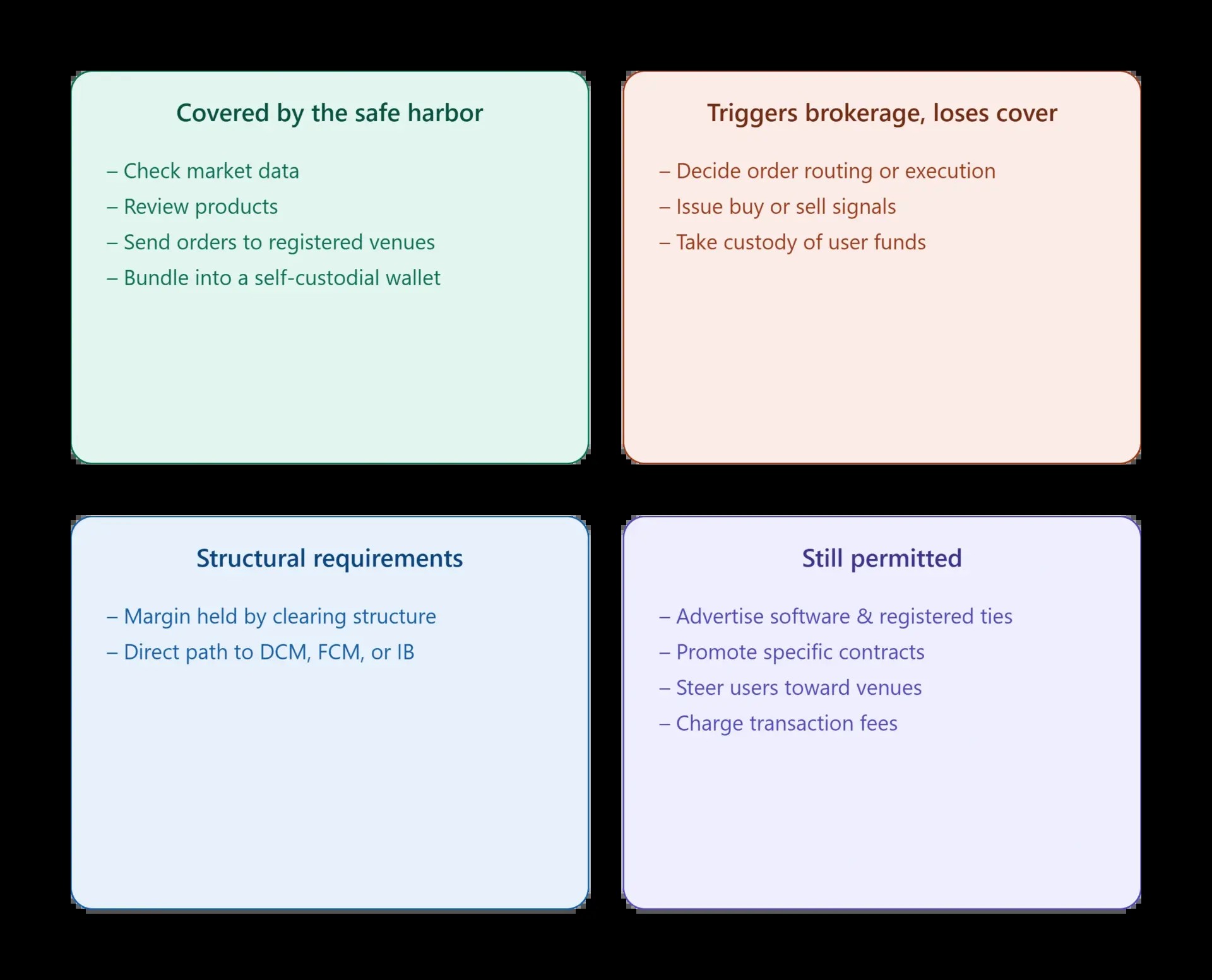
Funding for derivatives positions must be held by a clearing structure, not the software developer. Users must be able to contact the designated marktrac, futures commission merchant, or introducing broker without going through the software.

Authorized providers can advertise their software and its connections to registered firms. They can also promote specific derivative tracs and direct users to specific platforms. They can charge fees to registered counterparties and pay users per transaction.

Ten Conditions and One Caveat

The CFTC staff letter details ten types of permitted activities and their limitations. Among these, the service provider and its primary counterparty must not be disqualified under the law.

Service providers are required to disclose conflicts of interest and fee amounts, and retain proof that users reviewed risk information. Furthermore, they must have written agreements with each registered partner covering joint liability.

Providers are also obligated to notify the CFTC of any insolvency and to file a notice submitting to the agency’s jurisdiction.

However, there is a significant caveat: this position comes from the Market Participants Division. It states that it "does not necessarily reflect the position or view of the Commission or any other division or office of the Commission." Therefore, it is not binding on the CFTC.

The letter noted that the Division retains the discretion to modify, suspend, or terminate the relief. It added that it would become void if the CFTC ever issues formal guidance on how broker registration applies to software developers.

CFTC Chairman Michael Selig stated in May at the Consensus Miami conference that he wanted to formalize the Phantom position into a rule, calling the process "crawl, walk, run." To date, those rules have not been adopted.

An Interim Solution in Case CLARITY Stalls

The staff letter came about two days after the U.S. Senate rejected a cloture motion on the Digital Asset Market CLARITY Act by a vote of 49 to 50, eleven votes short of the required 60.

Among those voting against were four Republicans, and no Democrats voted in favor.

In response to the vote, Selig stated that the outcome was unfortunate. He wrote in his post on X: "Americans deserve regulatory clarity, legal certainty, and consumer protection in crypto asset markets."

He stated that the CFTC is fully committed to helpingdent Trump fulfill his promise of creating a "future-proof framework for crypto asset market regulation," writing: "One way or another, we will help get the job done, using our existing legislative authority."

The Securities and Exchange Commission (SEC) made a move on the same day, issuing a long-awaited exemption for innovation projects. Uniswap founder Hayden Adams pointed to an accompanying statement by SEC Commissioner Hester Peirce, quoting her saying that "Truly decentralized systems governed by autonomous software... do not need an exemption."


Related Questions

QWhat specific relief did the CFTC's Market Participants Division provide for passive crypto trading software providers?

AThe CFTC's Market Participants Division issued Staff Letter No. 26-25, stating it would not recommend enforcement actions against qualifying passive crypto trading software providers for not registering as introducing brokers (IBs), and their personnel for not registering as associated persons (APs) of an IB. This extends a case-by-case relief previously granted only to Phantom Technologies to all providers meeting the conditions.

QWhat are the key boundaries software providers must not cross to qualify for the CFTC's no-action relief?

ATo qualify, the software must be passive. The provider cannot: 1) decide how to route or execute orders, 2) provide explicit buy/sell signals, 3) custody user funds, or 4) hold margin for derivatives positions. Users must be able to contact the market counterparty or broker directly, bypassing the software.

QWhy is the CFTC's no-action relief considered a temporary solution, and what could replace it?

AThe relief is temporary because it comes from a staff division and does not bind the full Commission. It can be altered or withdrawn. The relief also expires if the CFTC ever adopts formal rules on the topic. CFTC Chairman Rostin Behnam has expressed a desire to formalize the Phantom position into a rule, a process he described as 'crawl, walk, run.'

QWhat legislative event prompted the CFTC to issue this no-action letter, and what was the outcome of that event?

AThe letter was issued about two days after the U.S. Senate failed to advance the Digital Asset Market CLARITY Act. A cloture vote failed 49-50, falling 11 votes short of the 60 needed to proceed. This legislative stall prompted the CFTC to provide regulatory clarity using its existing authority.

QWhat parallel action did the SEC take on the same day as the CFTC's announcement, according to the article?

AOn the same day, the SEC approved a long-awaited exemption for innovation projects. Commissioner Hester Peirce, in an accompanying statement cited by Uniswap founder Hayden Adams, noted that 'Genuinely decentralized systems run by autonomous software...do not need an exemption.'

Related Reads

Bitcoin carry trades could beat Treasury bills in 2027, Sygnum predicts

Bitcoin carry trades could regain their edge over US Treasury bills in 2027 as demand for leverage recovers, according to digital asset bank Sygnum. In its 2027 Sygnal Outlook report, Sygnum forecasts that the annualized premium on three-month Bitcoin futures at the Chicago Mercantile Exchange would average more than 2% above three-month US Treasury bill yields next year. A crypto carry trade involves buying Bitcoin while betting against its price through futures contracts, limiting exposure to price swings while collecting funding payments or futures premiums. Fabian Dori, Sygnum's chief investment officer, said returns could recover as investors become more willing to take risks and fewer hedge funds compete for the same profits. The basis trade had become very crowded, with many hedge funds running it through spot ETFs against short CME futures, but positioning data indicates those funds have now unwound much of their CME short positions. Sygnum cited a 67-day stretch of negative Bitcoin funding rates in 2026, and Talos research shows funding rates and futures premiums that peaked at 20%-40% annualized in early 2024 dropped to just 3%-5% this year, roughly matching the current three-month Treasury bill yield of around 4.25%. Bitcoin carry trades became popular after the launch of US spot Bitcoin ETFs in 2024, but as more investors entered, returns fell. Dori noted a more mature market pays less for the same trade but also attracts additional investors, potentially increasing demand for leverage. Talos found funding rates have started rising again since August, and Coinbase reported Bitcoin funding rates rose from around 4% annualized at the start of October to an average of 8.9% in the last week of the month, though Coinbase questioned whether this reflected meaningful demand given weaker spot buying. Sygnum expects wider institutional adoption, tokenization growth and rising AI demand to support leveraged Bitcoin exposure in 2027. Dori warned that a sharp market downturn, liquidity shortage, or interest rates staying higher for longer could prevent carry trade returns from recovering, and that even hedged positions can face margin calls. Carry can pay steadily for long periods and then turn quickly, he said, and when positioning gets crowded and funding reverses, the unwind is typically fast.

cointelegraph27m ago

Bitcoin carry trades could beat Treasury bills in 2027, Sygnum predicts

cointelegraph27m ago

Bernstein Research Report Interpretation: Fiscal 2028 Revenue to Top $740 Billion, Yet Only a Neutral Rating for Nvidia

Nvidia reported Q3 FY2027 revenue of $115.844 billion, beating consensus of $109.330 billion, with adjusted EPS of $2.68 versus $2.47 expected. Data Center revenue reached $107.610 billion, up 21% QoQ and 110% YoY, driven by the Vera Rubin architecture, which contributed about $20 billion in its first quarter, alongside continued Blackwell Ultra shipments. Hyperscale cloud revenue was $60.136 billion, while AI cloud and enterprise customers reached $47.474 billion, up 195% YoY. Networking contributed about $21 billion, and adjusted gross margin came in at 74.9%. Q4 FY2027 guidance stands at $130 billion, above the $125.1 billion consensus, but Bernstein notes this includes an extra accounting week worth roughly $5-10 billion; excluding it, the normalized outlook is slightly below consensus. Q3 also benefited from about $2.4 billion in Hopper sales to China, which are excluded from Q4 guidance. Q4 gross margin is guided at 71.5%, expected to be the cycle trough before price increases lift margins to 72-73% in FY2028. Management raised FY2028 revenue growth guidance to about 75% from 70%, implying revenue above $740 billion, saying strong global demand offsets new export controls. Supply commitments rose to $390 billion, or $518 billion including cloud, leasing, and equity commitments. Inventory climbed to $39.7 billion. Free cash flow was $43.8 billion, with $22.1 billion in buybacks and a new $150 billion authorization. Bernstein raised its FY2028 revenue forecast to $742.4 billion and EPS to $17.18. Despite strong fundamentals, Bernstein maintains a Market-Perform rating and $200 target price, citing governance and long-term execution risks following management changes. The board has said it does not intend to bring back Jensen Huang and is searching for a new leader, raising questions about supplier negotiations, product roadmap, decision speed, and talent retention, plus potential investigation risks. At around $155.46, the stock trades at just 9.0x FY2028 EPS, or about 10x the $200 target based on average FY2028-29 EPS of $20.59. Bernstein remains on the sidelines pending clarity.

marsbit1h ago

Bernstein Research Report Interpretation: Fiscal 2028 Revenue to Top $740 Billion, Yet Only a Neutral Rating for Nvidia

marsbit1h ago

Bitcoin Volatility Falls to 43%, Below Nearly One-Fifth of S&P 500 Constituents: Is the Crypto Asset Risk Narrative Being Rewritten?

Grayscale Research argues that Bitcoin's risk profile has structurally changed and that investors' framework for assessing crypto risk needs a fundamental reset. Bitcoin's one-year realized volatility has fallen from roughly 64% a decade ago and 81% five years ago to about 43% today, placing it within the normal range of S&P 500 large-cap stocks and below roughly 19% of S&P 500 constituents. This decline reflects deeper institutional market-making, spot ETP launches, and established regulatory boundaries. The report cautions against judging Bitcoin by volatility alone. Its returns exhibit fat tails and momentum clustering, with the bulk of long-term compound gains concentrated in a handful of best trading days; missing the top 10 days would erase most cumulative returns. Downside-only measures such as the Sortino ratio therefore flatter Bitcoin more than the Sharpe ratio does. Although drawdowns exceeding 50% have occurred, risk-parity-adjusted drawdowns look less exceptional versus traditional assets. Crucially, Bitcoin's returns are poorly explained by traditional macro factors, giving it low correlation with equities, bonds, and commodities. Backtests show that adding a 1–5% Bitcoin allocation to a classic 60/40 portfolio improves risk-adjusted returns without proportionally worsening maximum drawdown. Beyond Bitcoin, crypto sub-sectors are structurally decoupling: Bitcoin now explains only about 50% of overall crypto return variance. Smart contract platforms show roughly 58% volatility driven by on-chain fundamentals, while consumer and AI sectors show 76% and 85% respectively, driven by distinct narratives. This rotation creates room for bottom-up alpha. Institutions should adopt a two-layer approach: Bitcoin as a macro diversifier, plus selective exposure to vertical-sector infrastructure, managed through volatility budgeting and disciplined rebalancing.

marsbit2h ago

Bitcoin Volatility Falls to 43%, Below Nearly One-Fifth of S&P 500 Constituents: Is the Crypto Asset Risk Narrative Being Rewritten?

marsbit2h ago

Strategy Removed from MSCI: Will BlackRock's 123,000 Shares Really Hit the Market?

After Nov 30, MSCI will remove Strategy (Michael Saylor's bitcoin-holding company) from several indices, effective Dec 1, under new eligibility rules for "non-operating" companies. Investors expect selling pressure, since index-tracking funds that bought Strategy solely to mirror the index no longer have a reason to hold it. But two BlackRock funds tracking the same MSCI USA Index illustrate why holdings can't simply be summed into one sell order: iShares MSCI USA ETF (MLRG) holds Strategy shares directly (5,227 shares as of Nov 13), while iShares MSCI USA Swap UCITS ETF (MUSD) gets index exposure via total return swaps, so its counterparties may adjust their own positions without disclosure. BlackRock's URTH (29,300 shares) and ACWI (88,500 shares) also hold Strategy, bringing the three identified funds to 123,000 shares worth about $13.74 million — a specific snapshot, not the full universe of affected funds. USXF holds 16,100 shares but its specialized index adjustment is pending. Strategy says index funds collectively hold about 13 million shares, or 3.1% of free float. Crucially, shrinking holdings don't prove selling: ETFs grow and shrink with creations and redemptions, and shares can leave a fund via in-kind redemptions without exchange sales. Index removal may weaken demand for Strategy's stock and complicate its bitcoin-funding model, but it does not require Strategy to sell any bitcoin.

marsbit2h ago

Strategy Removed from MSCI: Will BlackRock's 123,000 Shares Really Hit the Market?

marsbit2h ago

Trading

Spot
活动图片