XRP Has Overtaken Solana And Ethereum In This Major Metric

bitcoinistPublished on 2026-05-22Last updated on 2026-05-22

Abstract

The article reports that XRP has surpassed both Solana and Ethereum in Real World Asset (RWA) growth over the past month. According to data from RWA.xyz, the XRP Ledger's total RWA value surged by approximately 55.4% to $3.9 billion, driven largely by a single commodity product, the Justoken Megawatt Hour (JMWH). In contrast, Ethereum's RWA value declined by 7.4%, while Solana's grew by 13.5%. This growth has propelled XRP from the 8th to the 5th position in global RWA rankings, ahead of chains like Solana, ZKSync Era, and BNB Chain. The network also saw significant increases in RWA transfer volume, distributed assets, and holder count.

The Real World Asset (RWA) sector has seen remarkable growth over the past month, with the XRP, Solana (SOL), and Ethereum (ETH) ecosystems recording a significant increase in market value and adoption. However, among these three leading cryptocurrencies, XRP stands above with the highest growth rate. The cryptocurrency has surpassed ETH and SOL’s RWA expansion by a wide margin, solidifying its position as one of the fastest-growing chains in the tokenization asset space.

XRP Beats Solana And Ethereum In RWA Growth

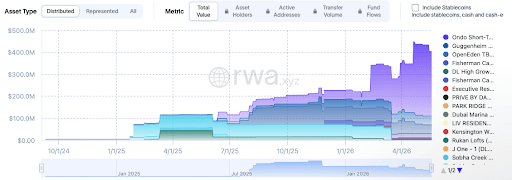
XRP has overtaken Solana and Ethereum to record the fastest RWA growth in the last 30 days. According to data from RWA.xyz, XRP Ledger’s (XRPL) total RWA value grew by approximately 55.4%, soaring to $3.9 billion after about $1.4 billion was added within that single period. As of this writing, the latest data show that the RWA value is up 57.03%.

This level of growth is striking because not only did XRP surpass two of the top altcoins, but it also outstripped Canton, a privacy-labeled L1 blockchain network that holds the number one position in global RWA tokenization rankings.
Source: RWA.xyz

While XRP recorded a 55.4% increase, Ethereum and Canton actually declined by 7.4% to $18.9 billion and 4.8% to $313.7 billion, respectively, in that same period. On the other hand, Solana’s RWA growth rate increased by 13.5%, reaching $2.8 billion.

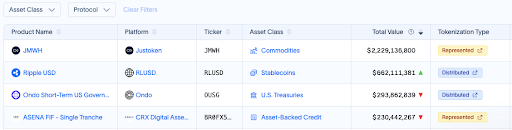
A significant portion of the growth in the XRP Ledger was reportedly driven by a single commodity product, the Justoken Megawatt Hour (JMWH), launched by the blockchain infrastructure firm Justoken. The product is issued exclusively on XRPL and currently accounts for roughly half of the network’s total RWA value.

Within a single day, JMWH’s value had spiked by nearly $900 million, rising from $861 million to $1.76 billion, serving as the primary catalyst behind XRP’s record-breaking RWA growth. At the time of writing, the XRP Ledger has exceeded the $4 billion RWA growth milestone, surpassing BNB Chain (BNB), which currently has a total RWA tokenization value of $3.6 billion.
Source: RWA.xyz

XRP Jumps From 8th To 5th In RWA Rankings Globally

About 30 days ago, the XRP Ledger held approximately $2.51 billion in total tokenized real-world assets, making it the eighth-largest chain by RWA value. At the time, the blockchain network had been ranked below ZKSync Era and Solana, with the former growing by about 5.45% to $3.2 billion while XRP skyrocketed by over 57%.

Since then, XRPL has witnessed a massive expansion, ranking fifth globally in total tokenized asset value. The latest figures now place the blockchain network ahead of ZKSync Era, Solana, Stella, and Avalanche in the rankings. Meanwhile, Ethereum still holds the position as the second-largest RWA tokenization network.

Beyond raw asset value, on-chain activity shows that RWA 30-day transfer volume on the XRP Ledger has risen to $145.1 million, up over 50% from the previous period. Moreover, the most recent data shows that XRPL has also recorded a 120.9% surge in distributed RWA over the last 30 days. Meanwhile, the number of RWA holders on the ledger grew by 151.72% over the past month, bringing the network to roughly 302 distinct RWA products.

Price continues sideways movements | Source: XRPUSDT on Tradingview.com

Related Questions

QAccording to the article, which cryptocurrency recorded the highest growth rate in the Real World Asset (RWA) sector over the past month?

AXRP recorded the highest growth rate in the RWA sector over the past month, surpassing both Ethereum (ETH) and Solana (SOL).

QWhat was the reported percentage increase in RWA value for the XRP Ledger (XRPL) according to data from RWA.xyz?

AThe XRP Ledger's total RWA value grew by approximately 55.4% (with later data showing a 57.03% increase) over the 30-day period.

QWhat specific commodity product was primarily responsible for driving the massive RWA growth on the XRP Ledger?

AThe growth was primarily driven by the Justoken Megawatt Hour (JMWH), a commodity product launched by Justoken, whose value spiked by nearly $900 million in a single day.

QHow did the RWA growth of Ethereum and Solana compare to XRP's during the same period?

AEthereum's RWA value actually declined by 7.4%, while Solana's increased by 13.5%. Both were significantly lower than XRP's 55.4%+ growth.

QWhat global ranking did the XRP Ledger achieve in total tokenized asset value after its recent growth, and what was its previous rank?

AThe XRP Ledger jumped from the 8th largest chain by RWA value to the 5th largest globally after its recent expansion.

Related Reads

DeepSeek Announces Permanent Price Cut, But Liang Wenfeng Is Not Trying to Be a "Cyber Bodhisattva"

DeepSeek has announced a permanent 75% discount on its V4-Pro API, significantly reducing its token prices. This move stands out as a major industry-wide price cut while competitors like Anthropic, OpenAI, and Google have been quietly raising theirs. The article contrasts this strategy with the broader trend of AI becoming more expensive, citing examples of companies like Microsoft and Uber struggling with high token costs as usage soars. While CEO Liang Wenfeng is hailed by some as a "Cyber Bodhisattva" for this普惠 approach, the article argues this is a strategic business choice, not mere altruism. DeepSeek's ability to maintain low prices is attributed to several structural advantages: lower-cost AI talent in China, the impending use of domestic昇腾 hardware for further cost reductions, and, most critically, access to China's cheaper and more abundant energy infrastructure, which drastically reduces the electricity costs dominating AI operations. The analysis suggests that for many commercial applications, a "good enough" model that is radically cheaper (e.g., 1% to 11% of GPT-5.5's cost) is more valuable than the absolute top-tier model. This allows for vastly more experimentation and iteration within a budget. Therefore, as AI generally becomes more expensive, DeepSeek's cost-competitiveness—rooted in China's energy and talent advantages—becomes its core strategic value and differentiator in the global market.

marsbit3h ago

DeepSeek Announces Permanent Price Cut, But Liang Wenfeng Is Not Trying to Be a "Cyber Bodhisattva"

marsbit3h ago

The Veil of Mythos Becomes Anthropic's Lever to Move Trillions

The article discusses Anthropic's reported upcoming $30 billion funding round, which would value the company at over $900 billion. It analyzes how the company has leveraged strategic narratives around its unreleased "Mythos" model, rather than just its publicly available products, to drive this massive valuation. Key points include Google's surprising $40 billion investment in a competitor, suggesting it is buying strategic positioning. Anthropic's "Glasswing" cybersecurity project and the unreleased Mythos model are portrayed not through direct proof, but through carefully crafted narratives of being "too powerful for public release," creating an aura of exclusive, high-level capability. This is bolstered by reports of the White House and NSA seeking access to Claude/Mythos despite previous security concerns, implying indispensable technology. Furthermore, Anthropic's reported rapid revenue growth—from a $1 billion annual run-rate in late 2024 to over $30 billion by April 2026, largely driven by enterprise API and Claude Code—provides a financial story for investors. The article concludes that Anthropic's core business model is effectively converting unverifiable technical potential, government interest, and future revenue projections into a compelling narrative that secures immense capital, using the actions of wealthy investors and powerful institutions as the ultimate validation of its worth.

marsbit5h ago

The Veil of Mythos Becomes Anthropic's Lever to Move Trillions

marsbit5h ago

Google CEO Admits Lagging Behind in Coding

Google CEO Sundar Pichai acknowledged in a recent interview that Google's Gemini AI models are currently "lagging behind" in coding capabilities, particularly for complex, long-horizon tasks requiring advanced developer expertise. He noted the field is advancing at an "unprecedented" pace, where 30-60 days now brings changes equivalent to five years in the past. Pichai expressed that achieving Artificial General Intelligence (AGI) now seems closer than previously imagined due to rapid progress. While highlighting strengths in text, multimodal, and reasoning tasks, Pichai admitted competitors like Anthropic and OpenAI have focused more intently on coding. He emphasized Google's commitment to catching up, citing internal tools like Antigravity 2.0 and the newly released Gemini 3.5 Flash, which aims to address previous shortcomings. Regarding Google Search's AI-driven overhaul, Pichai stated changes will be gradual to align with user needs, not disrupt the core search experience or its advertising model. He addressed public AI anxiety as understandable, given the technology's potential to reshape jobs and society, but remained optimistic about AI augmenting human capabilities and creating new opportunities. Pichai stressed the need for broad societal dialogue and responsible development as AI approaches more advanced, potentially recursive self-improvement stages. He affirmed Google's long-term commitment to leading in AI while navigating its profound implications responsibly.

marsbit6h ago

Google CEO Admits Lagging Behind in Coding

marsbit6h ago

Trading

Spot
Futures

Hot Articles

What is XRP 2.0

XRP 2.0: A New Frontier in the Cryptocurrency Landscape Introduction to XRP 2.0 In the ever-evolving realm of cryptocurrency, new projects continuously emerge, vying for attention and adoption. One such promising initiative is XRP 2.0, a novel cryptocurrency project designed to leverage advanced blockchain technology and robust encryption methodologies. While the name draws parallels with Ripple’s XRP, it’s crucial to note that XRP 2.0 operates independently, focusing on enhancing transaction security, privacy, and scalability. As the digital financial landscape increasingly embraces decentralized solutions, XRP 2.0 aims to contribute meaningfully to web3 and the overall expansion of crypto projects. What is XRP 2.0? At its core, XRP 2.0 is a cryptocurrency project that aims to create a secure and decentralized digital currency ecosystem. Its foundational technology integrates sophisticated blockchain principles with cutting-edge encryption techniques. The overarching goal of XRP 2.0 is to establish itself as a reliable and efficient platform enabling swift transaction execution while prioritizing enhanced privacy protections for its users. The project is promoted as a solution to many limitations faced by existing cryptocurrencies, proposing a system that can handle a higher volume of transactions with improved speed and privacy. This versatility positions XRP 2.0 as a significant contender in a marketplace riddled with various digital currencies. Who is the Creator of XRP 2.0? The identity of the creator behind XRP 2.0 has been flagged as ‘Wilbur.’ However, comprehensive details regarding Wilbur or their associated entity remain elusive. The anonymity of many cryptocurrency creators is not an uncommon phenomenon in the industry, often designed to maintain a degree of privacy and security. Who are the Investors of XRP 2.0? As of now, specific information related to the investment foundations or organizations supporting XRP 2.0 is not publicly available. In the cryptocurrency sector, the backing by reputed investors can significantly influence a project's credibility and success, yet the transparency regarding the financial supporters of XRP 2.0 has not been established. How Does XRP 2.0 Work? XRP 2.0 stands out by employing a combination of blockchain technology and advanced encryption algorithms that ensures secure and decentralized transactions. Its innovative structure includes unique features designed to foster user engagement and broaden functionalities beyond conventional cryptocurrency transactions. Among these features, XRP 2.0 incorporates AI-powered capabilities, such as text-to-image and text-to-speech functionalities. These additions are designed to enhance the interactive experience for users, promoting broader applicability across various sectors. By bridging technological advancements with user-centered design, XRP 2.0 aims to capture the attention of a diverse range of individuals and enterprises looking to integrate cryptocurrency solutions into their operational frameworks. Timeline of XRP 2.0 Understanding XRP 2.0 requires examining the milestones that have defined its journey thus far: July 23, 2023: XRP 2.0 is introduced as a novel cryptocurrency project, aiming to revolutionize secure and decentralized transaction capabilities in the blockchain domain. September 8, 2023: The launching of another project, XRP20, occurs, marking the emergence of an ERC-20 token on the Ethereum blockchain that remains unrelated to XRP 2.0. November 13, 2023: The XRP Ledger undergoes a significant update with the release of rippled server software version 2.0.0. It is essential to note that this development is disconnected from the XRP 2.0 cryptocurrency project. Key Points About XRP 2.0 To distill the essence of XRP 2.0, several critical factors emerge: Unique Features: The inclusion of features like AI-powered text-to-image and text-to-speech further diversifies the potential applications of XRP 2.0. Blockchain Technology: The framework utilizes advanced blockchain mechanisms and encryption protocols, ensuring a secure and decentralized environment for transactions. Scalability and Privacy: XRP 2.0 prioritizes enhanced privacy protections in transaction processes and the scalability necessary to accommodate a growing user base. No Affiliation with Ripple: Importantly, despite its name, XRP 2.0 does not have any allegiance or collaboration with Ripple’s XRP, distinguishing its operational framework and objectives within the cryptocurrency ecosystem. Conclusion XRP 2.0 represents an ambitious venture into the cryptocurrency sphere, aiming to offer a combination of security, privacy, and efficiency in digital transactions. By integrating sophisticated technologies and user-friendly features, the project sets out to broaden the horizons of what cryptocurrency can achieve in today's digital economy. While the anonymity of its creator and lack of disclosed investors might raise questions for some, XRP 2.0's focus on advanced functionalities and decentralisation enhances its appeal amidst an increasingly crowded crypto market. As the cryptocurrency landscape continues to evolve, XRP 2.0 may yet emerge as a pivotal player in the expansion of secure and scalable blockchain solutions.

942 Total ViewsPublished 2024.04.01Updated 2024.12.03

What is XRP 2.0

Discussions

Welcome to the HTX Community. Here, you can stay informed about the latest platform developments and gain access to professional market insights. Users' opinions on the price of XRP (XRP) are presented below.

活动图片