Author: Prathik Desai
Compiled by: Saoirse, Foresight News
All great technologies are powerful equalizers; they establish a universal baseline for the total value that can be created at the upper layers. Mobile phones and the internet were prime examples in the 20th century, and blockchain promises to be the equivalent technology for the 21st.
The high cost of remittances is a long-standing pain point in international payments. However, the cost of cross-border transfers isn't a single fee; the entire process involves multiple layers and participants, each charging for their part in the cross-border transaction.
This article will deconstruct this industry structure, explaining how on-chain and off-chain platforms collaborate to capture value within this evolved remittance system—a new system that can lower remittance fees and accelerate the speed of cross-border fund flows.
Moving money inherently incurs costs, and cross-border transfers make those costs balloon. The problem is that users often silently bear these costs without a clear understanding of what they are paying for.
Suppose you work in the United States and send $100 home; your family in Mexico receives pesos equivalent to only about $94. The missing $6 seems like the cross-border transfer fee. But the fee displayed on-screen is typically only around $2, less than half of the $6. Where does the other $4 go?
An ordinary remittance transaction passes through multiple intermediaries, each controlled by specific institutions that take a cut. The largest share is usually foreign exchange conversion: dollars must be converted into pesos to be deposited into a Mexican account. Banks charge a spread on top of the market mid-rate, costing about $3, which accounts for roughly half of the total expense.
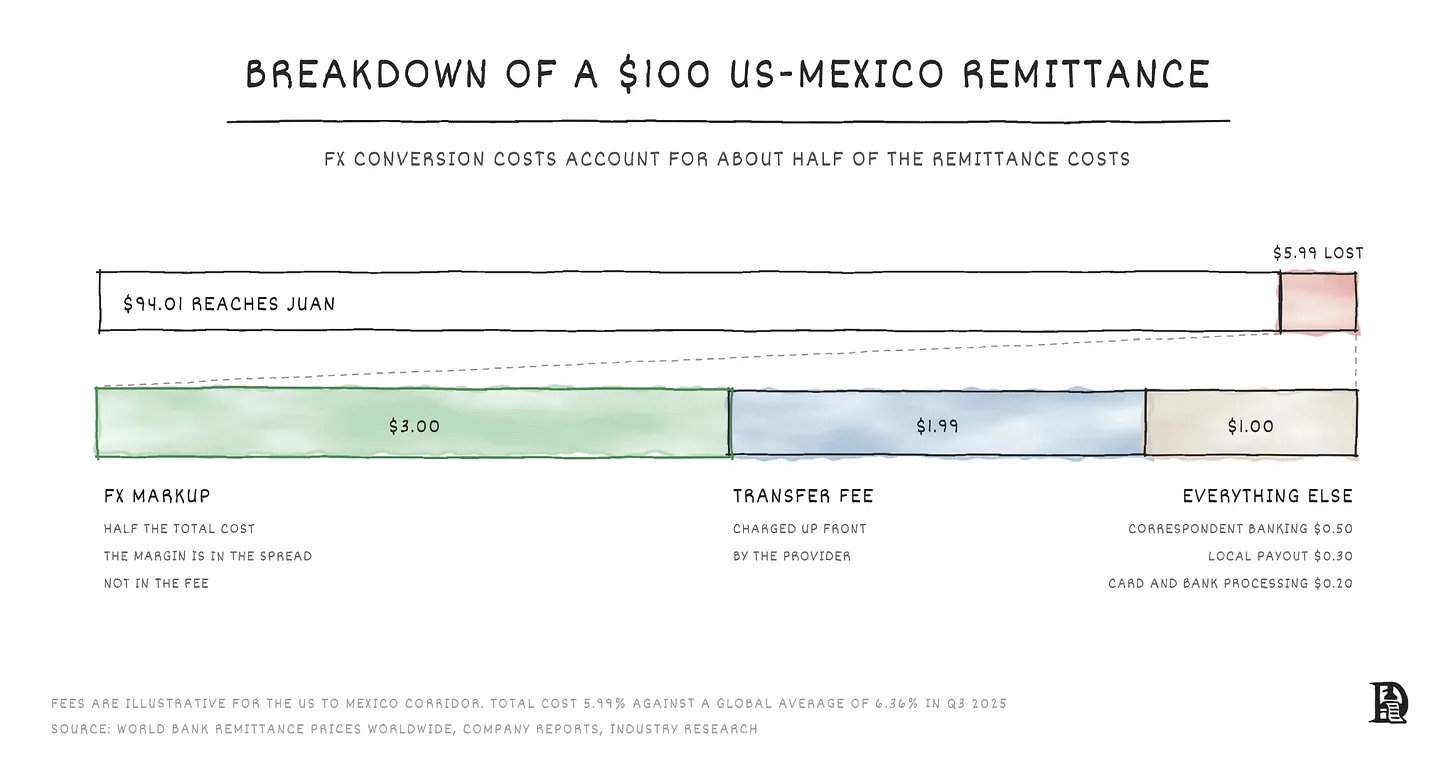
Cost breakdown of a $100 US-Mexico cross-border remittance
The advent and gradual adoption of stablecoins led us to believe it would completely rewrite the cross-border remittance model. But how will reality unfold? Blockchain is merely an entry ticket, not a competitive moat; it cannot create a single dominant industry giant.
The real value lies in off-chain operations: obtaining licenses, building banking relationships, and achieving last-mile payout. Different countries and regions have vastly different regulatory rules and banking system requirements. The remittance market will see a proliferation of regional leading players, each deeply cultivating their own remittance corridors, building advantages others cannot match. These advantages can stem from license resources, strong distribution channels, or cross-selling capabilities. This article will outline how this industry structure will evolve to this state.
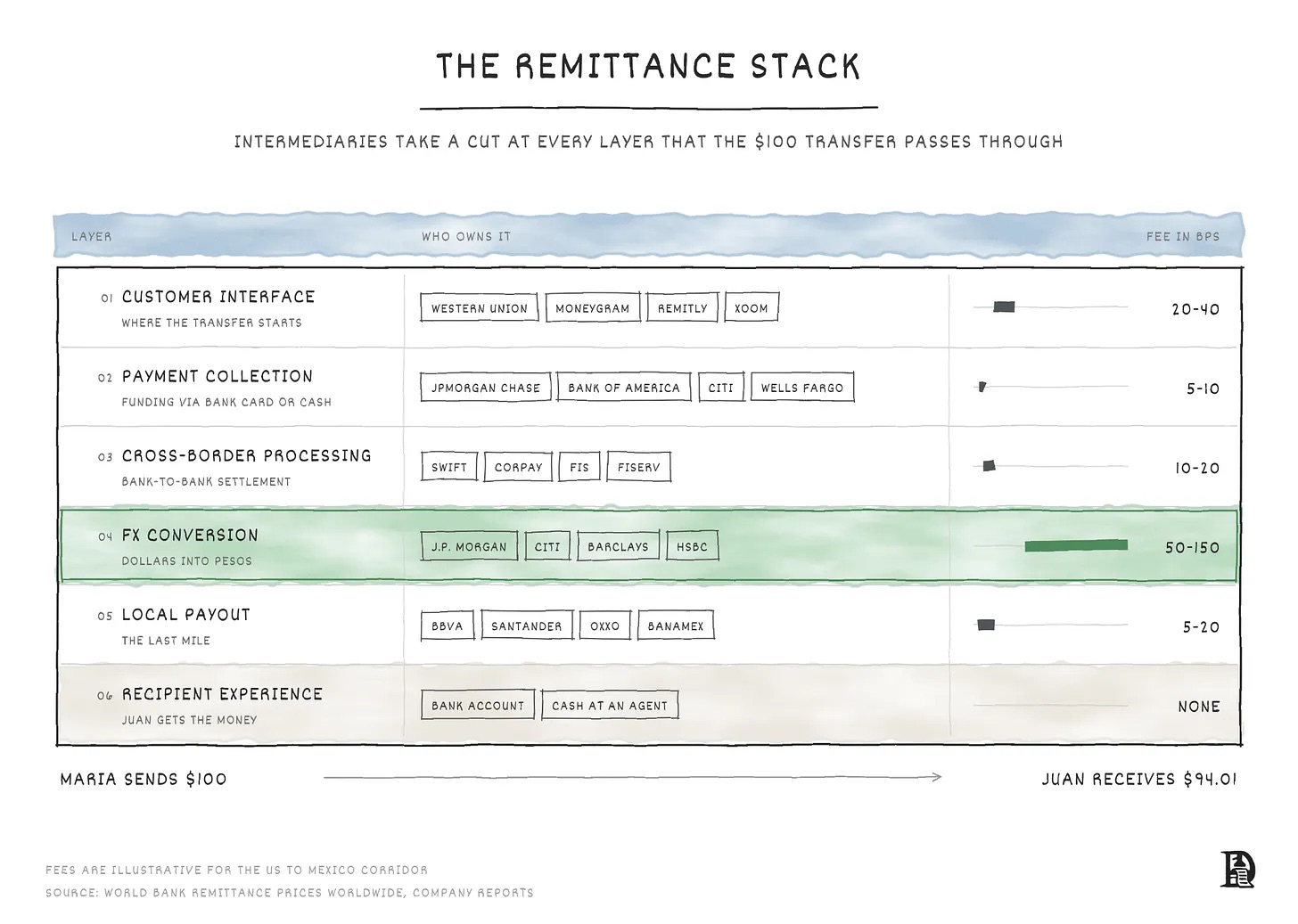
The diagram above illustrates only one transfer path: sending $100 from the US to Mexico. If we change to a Europe-Asia corridor, or differentiate between person-to-person (C2C) and business-to-business (B2B) transfers, the cost composition will change based on the specific challenges each faces. Each remittance corridor and each type of remittance scenario has unique bottlenecks. As these bottlenecks change, so do market opportunities and the distribution of value.
If Only Remittances Could Be Cheaper
The US-Mexico corridor is a relatively mature case study; it's the world's largest bilateral remittance route. With well-developed payment infrastructure on both ends, market competition has pushed the fee for sending dollars to Mexico down to 4.53%, making Mexico the market with the lowest receiving costs among G20 nations. Additionally, the Mexican peso has ample liquidity, and the country's real-time payment system, SPEI, can process transactions instantly, 24/7. If all remittance corridors reached this level, blockchain would have little room to play.
World Bank data shows the global average remittance fee is 6.36%, more than double the target set by the United Nations. The situation is particularly severe in Sub-Saharan Africa, where the average fee is 8.46%. Africa also has 13 remittance corridors with fees exceeding 20%, making it the region with the highest receiving costs globally. In contrast, the Middle East, North Africa, Afghanistan, and Pakistan region is the lowest-cost receiving region globally, averaging 5.11%.
Costs arise from friction. In recipient countries like Mexico with well-developed banking systems and reliable local payment rails, most problems are already solved, leaving limited scope for blockchain. But in regions with missing, expensive, or distrusted banking services, blockchain becomes the natural choice. There are roughly 20 remittance corridors globally with no low-cost services at all, the vast majority being intra-Africa transfers.
The biggest bottleneck for any remittance corridor is the foreign exchange spread. The size of this spread depends on how closely the two economies of the respective currencies trade with each other. Frequent trade leads countries to hold each other's currencies, ensuring liquidity. US-Mexico trade is robust, ensuring ample dollar-peso liquidity, leaving little room for banks to add significant spreads. When trade between two countries is sparse, there's little incentive to hold the counterparty's currency, leading to severely illiquid foreign exchange markets.
This relationship between trade and forex markets creates a paradox: precisely where the need for remittances is most urgent, transfer costs are often highest.
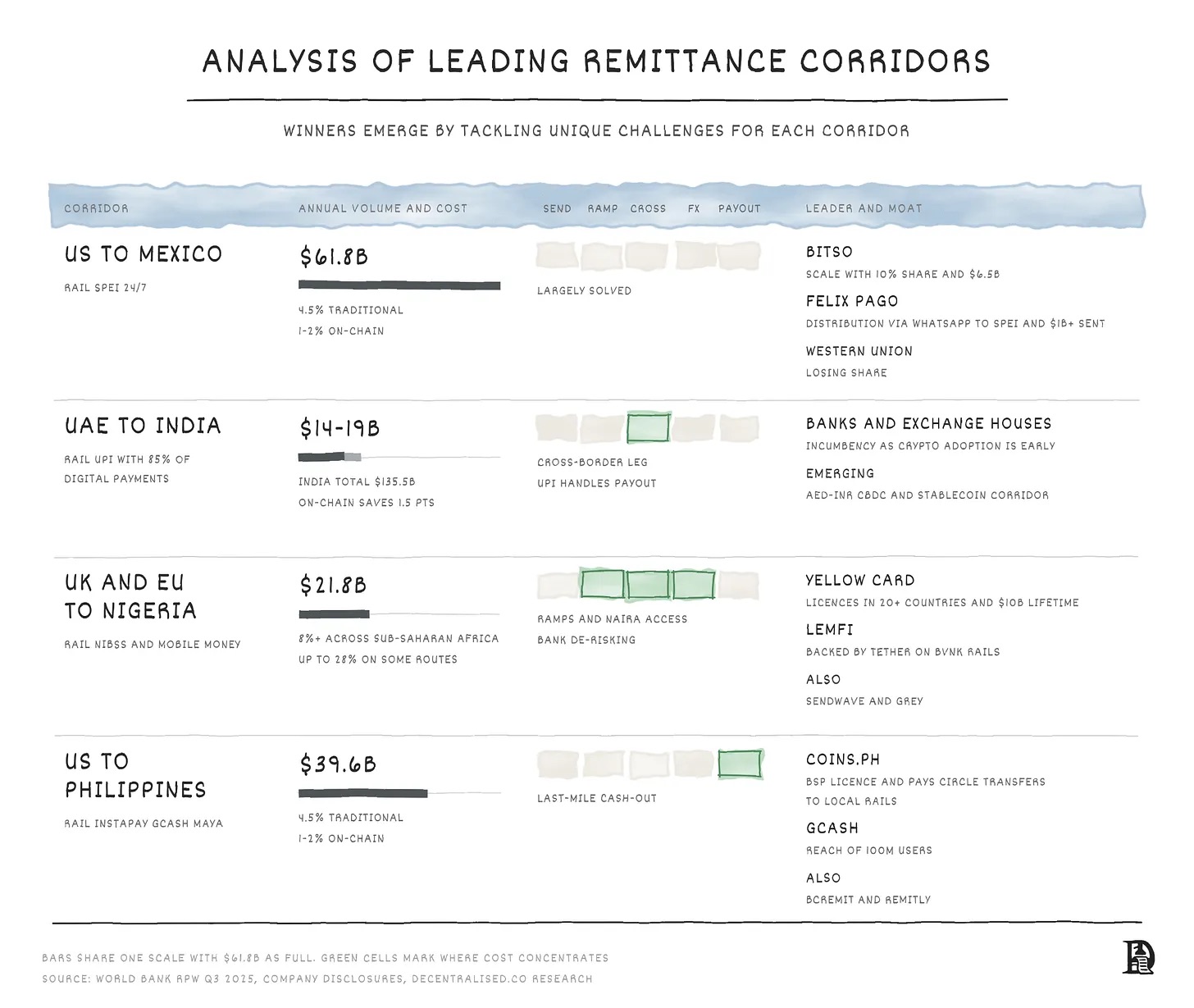
Analysis of Major Cross-Border Remittance Corridors
Different Transfer Scenarios, Different Challenges
Geography is just one factor; the type of transfer business is equally crucial.
The earlier $100 example is a consumer-to-consumer (C2C) transfer. In 2025, C2C remittances accounted for less than 5% of retail remittance transaction volume but contributed 14% of industry revenue, with an average fee of 3.1%—the highest among all business types. Business-to-business (B2B) transfers are the opposite: the largest by volume but with extremely low fee rates.
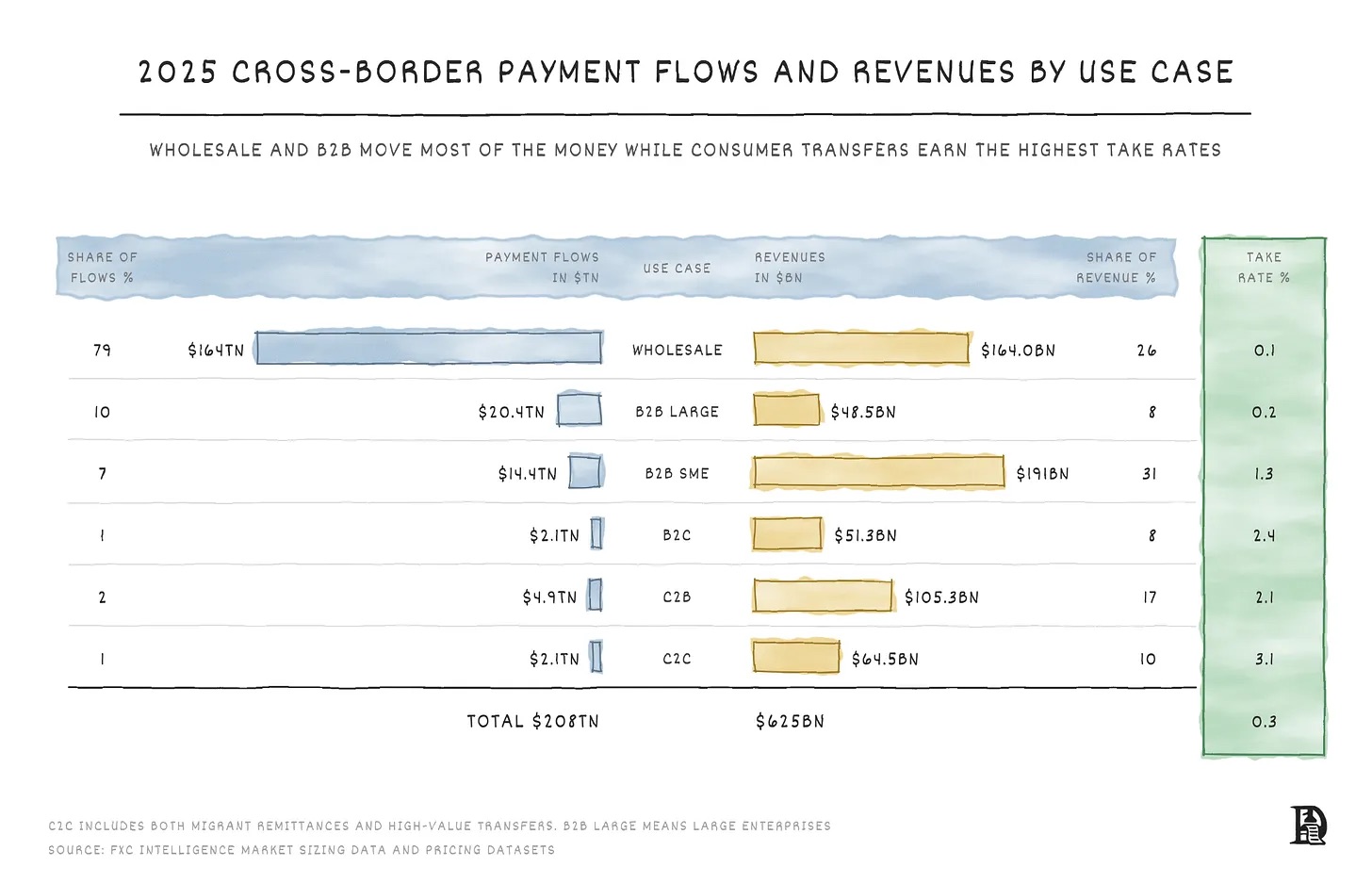
2025 Cross-Border Payment Volume and Revenue by Business Type
The obstacles to scaling these two types of businesses differ fundamentally. C2C transfers involve small, often one-off amounts. Customer verification (KYC), compliance checks, last-mile payout, and marketing all drive up customer acquisition costs. Therefore, competition in C2C remittances isn't about FX conversion but about channel distribution. The underlying payment rails have become increasingly commoditized; the key is acquiring and retaining remittance users at low cost to capture value.
In contrast, B2B transactions involve large individual amounts, high frequency, and razor-thin margins, with the scale of operations limited by working capital. To ensure same-day delivery to a recipient in Manila, a service provider must pre-fund an account in Manila with pesos—known as prefunding. If a provider serves multiple countries, the prefunding required across locations grows dramatically, becoming a burden for a single company.
Thus, different transfer scenarios require different solutions: C2C needs lower customer acquisition and distribution costs, while B2B requires reduced capital lockup to enable timely payouts across corridors with less prefunding. Many blockchain projects are now reconstructing the industry architecture around these two scenarios.
Who is Taking My Profit?
Today, infrastructure is gradually becoming complete; blockchain is arguably the easiest part to build. Blockchain can reduce settlement and FX conversion costs, but since everyone can use it, this cost compression doesn't create a unique competitive advantage. All participants using blockchain start from the same line. The contestable value flows off-chain. Local enterprises with exclusive licenses, banking relationships, and mature on/off-ramp networks have the opportunity to capture the largest share of value.
In the new-generation remittance architecture, the core functions of each layer haven't fundamentally changed; only the settlement asset is new. This reshuffles the value distribution landscape.
Every remittance starts at the Customer Interaction Layer. Applications with massive user traffic that build a transfer interface can solve the C2C pain point.
Felix Pago operates its remittance business via WhatsApp, allowing migrant communities to send money without downloading a new app. Sending $200 via Felix Pago yields 3,680 Mexican pesos, compared to only 3,604 pesos via Wise. Felix Pago settles using stablecoins on-chain, but the user only sees the messaging app they've used for years.
Distribution is its moat, and precisely on this basis, Felix Pago secured a $75 million Series B funding round, processing billions in annualized transaction volume.
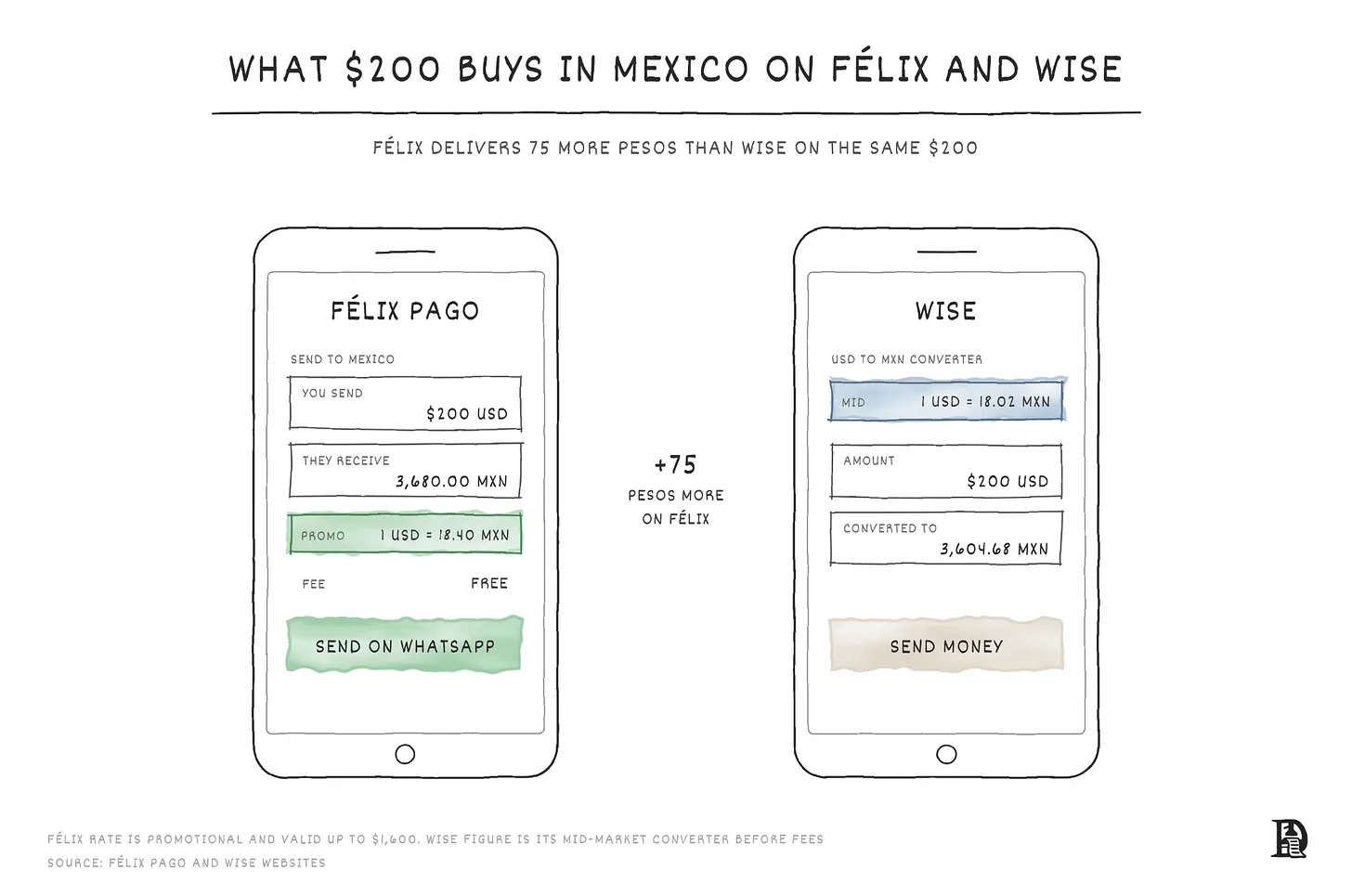
Felix vs Wise platform: How many pesos for $200 sent to Mexico
The On/Off-Ramp Layer is the hardest part of the entire system. Transferring stablecoins costs almost nothing, but converting cash to/from stablecoins is precisely the choke point for most crypto payment solutions. Each country has an independent banking system, regulatory license requirements, and cash usage habits. On/off-ramp facilities must be built market-by-market; only companies deeply focused on a single region can amortize the investment costs and achieve a commercial closed loop. This dictates that the winners in this segment will be regional specialists, not a single global on/off-ramp solution.
Yellow Card has obtained money transmission and virtual asset service provider (VASP) licenses in over 20 African countries, connecting to banking and mobile money networks to enable two-way conversion between fiat (like Naira, Cedi, Rand) and stablecoins. Acquiring a full suite of licenses is time-consuming and costly, so Yellow Card chooses to offer this infrastructure to others, generating revenue from on/off-ramp service fees and B2B transaction volume, rather than charging end consumers.
Kotani Pay connects stablecoins to mobile money via USSD, enabling feature phones without internet to receive funds—a difficult but necessary integration few companies are willing to do.
Coins.ph is a licensed on/off-ramp provider in the Philippines, connecting to the country's real-time payment system and cash agent networks, capturing value through license resources and payout reach.
Looking globally, the on/off-ramp segment is filled with localized challenges. This is why regional players can capture value here. Yellow Card and Coins.ph each focus on their respective corridors, not competing for each other's market share.
ZyntaFinance addresses similar pain points for businesses. Most African currencies lack direct trading pairs. Transferring money from Accra to Lagos typically routes through correspondent banks in New York or London, first converting Cedis to dollars, then to Naira. ZyntaFinance uses stablecoins for settlement, charging 0.5%-1% per transaction, and selects the optimal blockchain (Solana, Ethereum, Stellar) based on real-time costs.
The Orchestration Layer primarily serves B2B business. Orchestrators manage payment rails, stablecoin types, and remittance corridors, packaging on/off-ramp and settlement capabilities into an API. This layer didn't exist in the old architecture. Existing industry giants are now acquiring their way into this space.
Stripe acquired Bridge for approximately $1.1 billion. Developers can initiate cross-border transfers via API without worrying about wallets, blockchains, or license details. Stripe, leveraging its vast merchant base, charges a service fee per transfer, enabling rapid business scaling.
Mastercard spent $1.8 billion to acquire BVNK, offering multi-rail fiat and stablecoin settlement for large enterprises, coupled with local compliance licenses.
The Orchestration Layer is one of the few tiers where a global leader could emerge. Companies like Stripe and Mastercard can connect to all remittance corridors via a single API. However, even global orchestrators cannot control the Naira off-ramp, Philippine payout licenses, or local bank accounts in Manila; they must integrate with regional leaders. The global giants become customers of the local service providers, and value flows downwards to the regional leaders of each corridor, not aggregating entirely at the top.
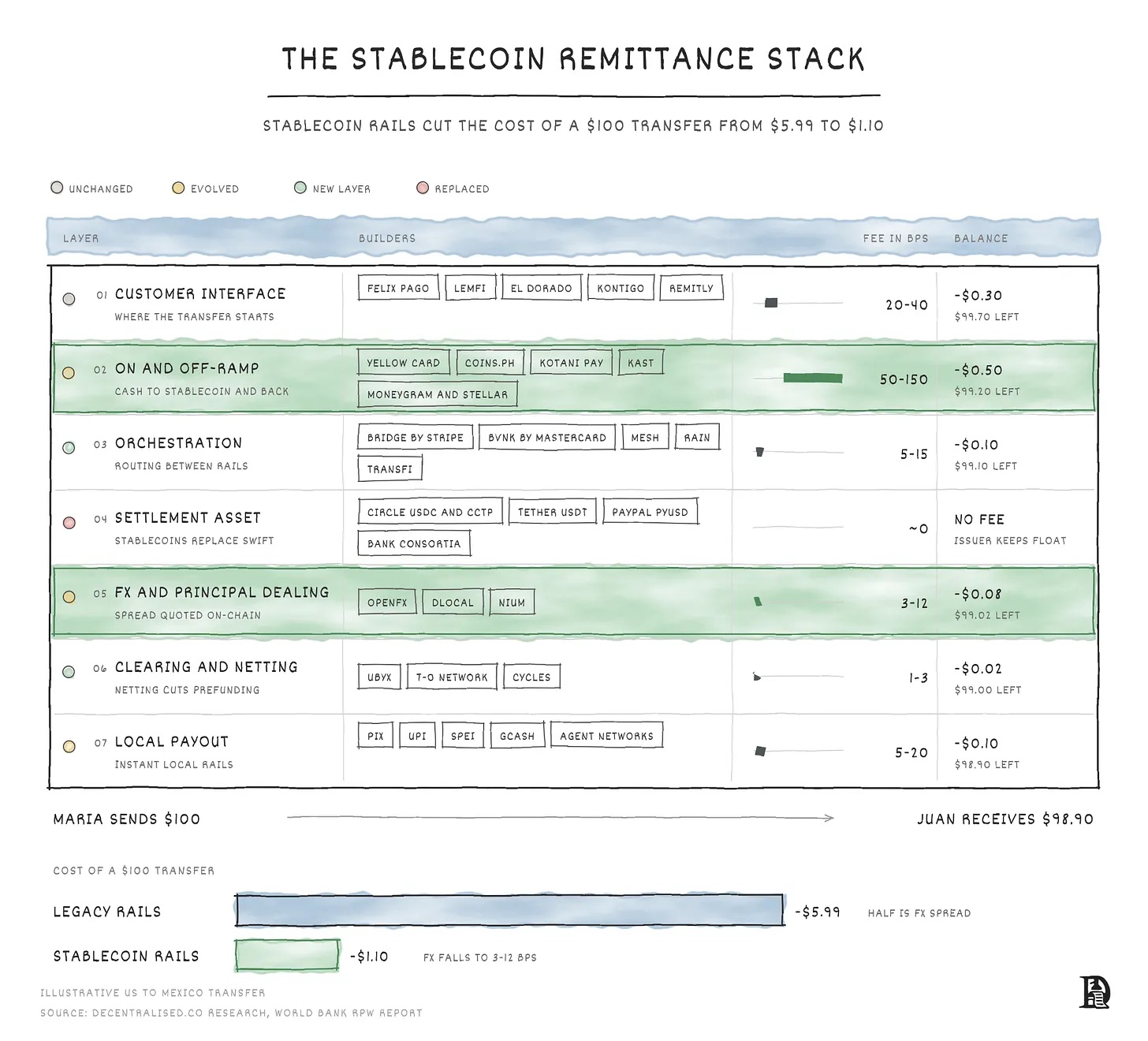
Stablecoins restructure the seven-layer remittance industry chain, reducing the cost of a $100 cross-border remittance from $5.99 to $1.10, with stablecoins replacing SWIFT in the settlement layer.
The Float Yield Circle
Settlement Asset Layer replaces the traditional cross-border messaging system. Stablecoins replace SWIFT messages and prefunded Nostro accounts, enabling 24/7 settlement.
The value in this layer comes from reserve assets. Circle holds tens of billions in US Treasuries as reserves for USDC, earning interest—a yield not available to regular holders. In 2025, Tether earned over $10 billion in profits from this model, with its stronghold being emerging markets where remittance problems are most acute. This is also why traditional giants like Western Union, Visa, and PayPal are keen to issue their own stablecoins rather than just using third-party ones.
Foreign Exchange Layer was the most profitable segment in the old architecture. In the new system, the bank's typical 50-150 basis point spread is compressed to single-digit costs.
OpenFX quotes spreads as low as 3-12 basis points, using stablecoins as the settlement rail for FX trades. It seeks to hedge FX exposure through matching reverse orders, and when unable to hedge, it takes on the position itself to provide a real-time, firm rate.
If market liquidity is poor or currency volatility is high, directly holding positions is risky. OpenFX then transfers the risk to local banks or OTC desks for a lower profit. Internal order matching reduces capital requirements, making fee-based revenue a larger profit contributor. dLocal employs this model in Africa, Latin America, and Asia, maintaining a fee rate around 0.7%, surviving on transaction volume rather than high margins.
Clearing & Netting Layer optimizes capital efficiency. Netting offsets transactions flowing in both directions, settling only the net remaining amount after mutual offset. The clearing layer handles the multilateral netting process for net settlement.
As mentioned earlier, service providers need to prefund in various countries. Companies like OpenFX and dLocal rely on clearing and netting to reduce the scale of idle capital dispersed and locked up across nations.
Institutions like Ubyx, t-0 Network, and Cycles enable two-way transaction hedging, so neither party needs prefunding. When someone sends dollars to Manila and someone else sends pesos back, the two transactions offset, eliminating the need for actual fund movement. Clearinghouses consolidate a series of bilateral obligations into a single net amount for settlement, charging a fee for netting services.
Although the current business volume is still small, this model can unlock hundreds of billions in tied-up capital. t-0 Network launched in early 2026 and already supports cross-border payments for 1,200 currency pairs. From January to August 2026, B2B stablecoin settlement volume reached $150 billion, a 40% year-over-year increase.
Comparing the old and new architectures clarifies what has changed and what remains the same.
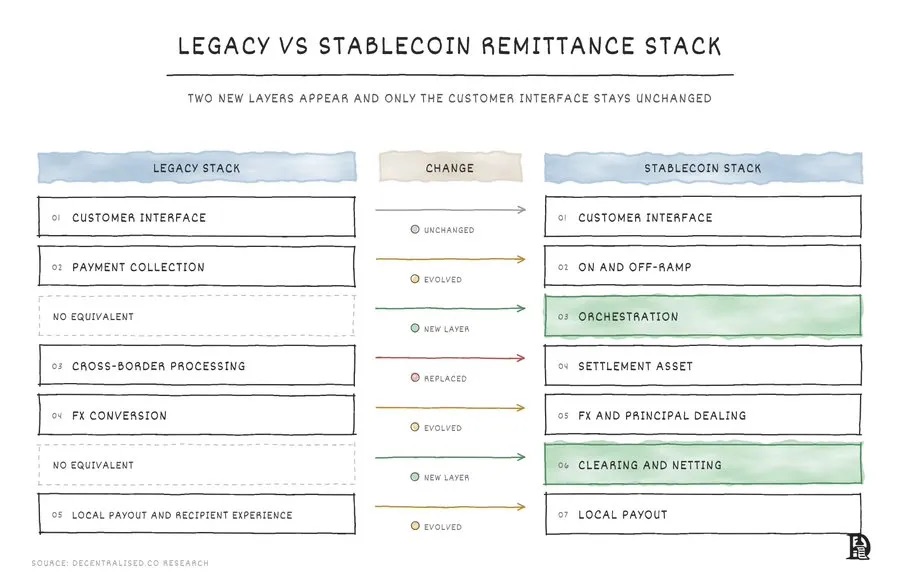
Traditional Remittance Architecture vs. Stablecoin Remittance Architecture
In the past, most profits were captured by the foreign exchange conversion layer. Now, profits are redistributed to three main blocks: the interaction layer with scarce user traffic, the orchestration layer where giants are acquiring, and the settlement asset issuers earning reserve interest.
Value flows to entities within each remittance corridor that control scarce resources: either user-trusted interaction points, compliance license conditions, or massive reserves generating passive yield. On-chain layers struggle to capture high value. Stablecoins can only accelerate the flow of dollars across borders, but ultimately, someone must hold pesos in Manila to complete the conversion of dollars.
The cross-border remittance case offers universal lessons. Blockchain reduces transfer costs but doesn't allow any single company to build a moat based solely on this efficiency. In the Web2.5 era, protocols handle the foundational work while applications own the users. Cross-border remittances add a geographic dimension on top: infrastructure goes global, but differentiated competitive barriers are firmly rooted locally.
The sender in the US still sends $100, and the family in Mexico receives a few more dollars on the same day. Yet, most of the profit generated in between ends up in the pockets of companies based in cities neither the sender nor the recipient has likely heard of or ever visited.