US judge asks for clarification on Do Kwon’s foreign charges

cointelegraphPublished on 2025-12-08Last updated on 2025-12-08

Abstract

US judge Paul Engelmayer is seeking clarification on the foreign legal charges against Terraform Labs co-founder Do Kwon, ahead of his sentencing on Thursday. Kwon pleaded guilty to two counts of wire fraud and conspiracy in the US. The judge inquired about potential sentences Kwon may face in South Korea, where he is expected to be extradited after possible US prison time, and whether his custody period in Montenegro would count toward a US sentence. Defense attorneys seek no more than five years, while prosecutors recommend at least 12. Kwon may also face up to 40 years in South Korea, where he holds citizenship.

With Do Kwon scheduled to be sentenced on Thursday after pleading guilty to two felony counts, a US federal judge is asking prosecutors and defense attorneys about the Terraform Labs co-founder’s legal troubles in his native country, South Korea, and Montenegro.

In a Monday filing in the US District Court for the Southern District of New York, Judge Paul Engelmayer asked Kwon’s lawyers and attorneys representing the US government about the charges and “maximum and minimum sentences” the Terraform co-founder could face in South Korea, where he is expected to be extradited after potentially serving prison time in the United States.

Kwon pleaded guilty to two counts of wire fraud and conspiracy to defraud in August and is scheduled to be sentenced by Engelmayer on Thursday.
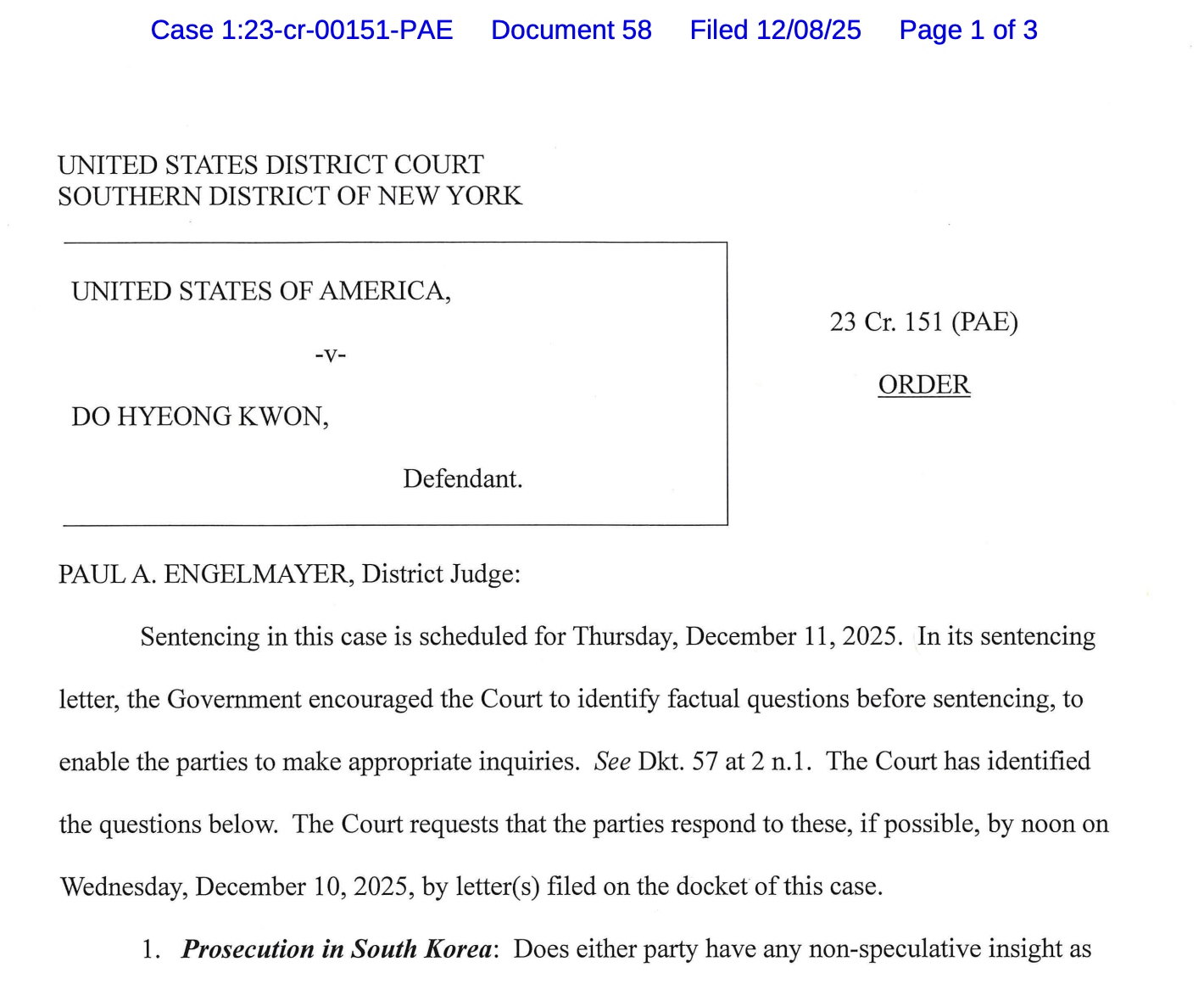
Source: Courtlistener

In addition to the judge’s questions on Kwon potentially serving time in South Korea, he asked whether there was agreement that “none of Mr. Kwon’s time in custody in Montenegro” — where he served a four-month sentence for using falsified travel documents and fought extradition to the US for more than a year — would be credited to any potential US sentence.

Judge Engelmayer’s questions signaled concerns that, should the US grant extradition to South Korea to serve “the back half of his sentence,” the country’s authorities could release him early.

Kwon was one of the most prominent figures in the crypto and blockchain industry in 2022 before the collapse of the Terra ecosystem, which many experts agree contributed to a market crash that resulted in several companies declaring bankruptcy and significant losses to investors.

Defense attorneys requested that Kwon serve no more than five years in the US, while prosecutors are pushing for at least 12 years.

Related: There’s more to crypto crime than meets the eye: What you need to know

The sentencing recommendation from the US government said that Kwon had “caused losses that eclipsed those caused” by former FTX CEO Sam Bankman-Fried, former Celsius CEO Alex Mashinsky and OneCoin’s Karl Sebastian Greenwood combined. All three men are serving multi-year sentences in federal prison.

Will Do Kwon serve time in South Korea?

The Terraform co-founder’s lawyers said that even if Engelmayer were to sentence Kwon to time served, he would “immediately reenter pretrial detention pending his criminal charges in South Korea,” and potentially face up to 40 years in the country, where he holds citizenship.

Thursday’s sentencing hearing could mark the beginning of the end of Kwon’s chapter in the 2022 collapse of Terraform. His whereabouts amid the crypto market downturn were not publicly known until he was arrested in Montenegro and held in custody to await extradition to the US, where he was indicted in March 2023 for his role at Terraform.

South Korean authorities issued an arrest warrant for Kwon in 2022, but have not had him in custody since the collapse of the Terra ecosystem. The country’s prosecutors applied to extradite Kwon from Montenegro simultaneously with the US, while they were pursuing similar cases against individuals tied to Terraform.

Magazine: When privacy and AML laws conflict: Crypto projects’ impossible choice

Related Reads

SociFi Dream Shattered? Farcaster Pivots to Bet on Wallet Track

Farcaster, a decentralized social network protocol, has announced a major strategic shift after 4.5 years, abandoning its "social-first" approach to adopt a "wallet-first" growth model. Co-founder Dan Romero acknowledged that despite initial success—such as a surge to 100,000 daily active users (DAU) in early 2024 driven by features like Frames and the DEGEN airdrop—user engagement and revenue sharply declined later that year. By October 2025, monthly revenue had dropped 99% from its peak. The platform will now prioritize building a high-quality wallet within its official app, Warpcast, focusing on the intersection of wallets and social interaction. The new user journey emphasizes wallet funding and utility as key activation points. Farcaster is also enhancing its financial infrastructure through the acquisition of token launch platform Clanker and offering incentives like a 10% reward on USDC deposits. Frames, interactive mini-apps within the social feed, enable "content as transaction" capabilities, allowing users to mint, trade, and pay directly in their feeds. Despite raising $150 million in a 2024 Series A round at a $1 billion valuation, the move has drawn criticism. Some argue it signals the end of the SocialFi dream and a return to a transaction-focused model reminiscent of the 2017 ICO era. Others note challenges in a competitive wallet market and potential feature bloat. Farcaster remains an open protocol, and users can choose alternative clients, but the shift underscores a broader industry reality: pure Web3 social networks may struggle without integrating high-value financial tools to drive user engagement and retention.

marsbit20m ago

SociFi Dream Shattered? Farcaster Pivots to Bet on Wallet Track

marsbit20m ago

12.9 Today's Market: Why the Drop? BTC\SOL\ETH\BNB\RDNT\STABLE\TRUMP\Horse to Success\bibi Trading Advice

The cryptocurrency market experienced significant volatility, with $212 million in liquidations over 24 hours, including a single $2.14 million Bitcoin liquidation on Hyperliquid. Market sentiment remains nervous, with high turnover reflecting short-term bearishness, though long-term holders remain steady. The Federal Reserve's upcoming meeting is a key focus, as interest rate decisions may influence market direction. Bitcoin’s support is near $88,100, with a potential dip to $85,200–85,900 offering a buying opportunity. Resistance is at $93,400. SOL may see support at $125.8 and $124, with potential accumulation near $120. ETH has supports at $2,955, $2,865, and $2,805, with resistance at $3,282. BNB’s key level is $898; holding above may lead to a bounce toward $939. Meme coins are highly risky, with many projects on BSC and SOL facing extreme volatility and potential scams. High-cap tokens like BIBI are relatively safer. Patience and strict stop-losses are advised. Specific tokens: - 马到成功 (Horse to Success): Accumulating near $2M market cap with strong community support. - ZEC: Showing strength, possibly entering a major upward trend if it holds key levels. - RDNT: Avoid chasing pumps—likely a temporary bounce. - TRUMP: Unlikely to rally this cycle due to locked supply; may perform in the next bull market if Trump remains politically relevant. - STABLE: Bearish due to high fully diluted valuation and lack of catalysts; consider shorting. Overall, December is to accumulate during consolidation while preserving capital for larger opportunities in Q1 2026.

金色财经30m ago

12.9 Today's Market: Why the Drop? BTC\SOL\ETH\BNB\RDNT\STABLE\TRUMP\Horse to Success\bibi Trading Advice

金色财经30m ago

Trading

Spot
Futures
活动图片