The Last High Wall in AI Mathematics Has Fallen: GPT-6 Astra Clears FrontierMath Tier 4

marsbitPublished on 2026-09-11Last updated on 2026-09-11

Abstract

GPT-6 Astra has solved the final unsolved problem in FrontierMath Tier 4, marking the "saturation" of this benchmark once considered an "AI math nightmare." According to Epoch AI's cumulative scoring method, every one of the 43 remaining research-level problems in Tier 4 has now been solved at least once by an AI model. FrontierMath was created in 2024 by Epoch AI and over 60 mathematicians, including Fields Medalists, to provide a more challenging benchmark beyond traditional tests. The hardest Tier 4 level was added in 2025 with problems designed by professors and postdocs, originally deemed potentially unsolvable by AI for decades. However, model performance accelerated rapidly, from under 2% initially to GPT-6 Astra's recent 97.6% score. Notably, the model's solution to the last problem was reportedly similar to the human-designed approach, avoiding numerical shortcuts. Despite this milestone, the article emphasizes that AI has not "solved math." FrontierMath is already evolving with new, even more difficult challenges: "Open Problems" featuring truly unsolved research questions and "FrontierMath Erdős," which requires formal, verifiable proofs. In this latest benchmark, Astra has solved only 2 out of 68 problems, indicating the journey continues.

Just now, the last unsolved problem in FrontierMath Tier 4 has been cracked by GPT-6 Astra.

With this, every question in this benchmark, once considered a nightmare for large models in mathematics, has been successfully solved by AI at least once.

Epoch AI has officially concluded: FrontierMath Tier 4 is saturated.
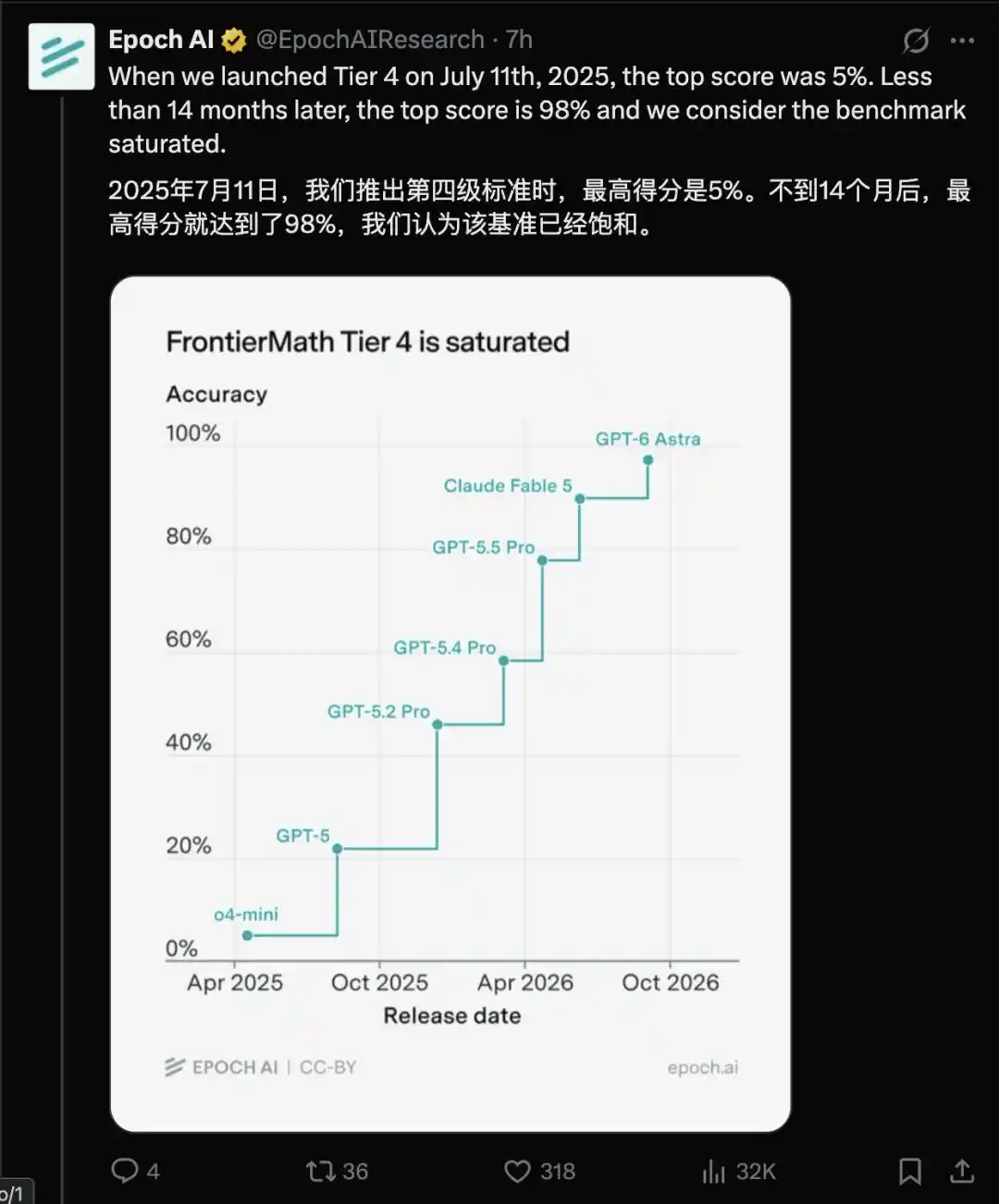
Although judging from the chart above, Astra hasn't directly reached 100%—OpenAI's own published score is 97.6%.

According to Epoch's algorithm, "fully solved" means that after accumulating attempts from different models at different times, every single problem in Tier 4 has had at least one successful solution.

And the one Astra solved was precisely the last remaining problem that had never been cracked by AI before.

(A simple way to understand this: Astra might have made an error in some tests, but the problem it got right was the one previously unsolved.)

To be honest, the speed of this development is still pretty insane.

If you follow model evaluations, you'll know that when Tier 4 was first launched on July 11, 2025, the top score on the leaderboard was only about 5%.

Now, just over a year and two months later, this former "high wall" has become a "step," and the final problem that was hard for AI to bypass has been overcome.

Jay Pantone, a math associate professor at Marquette University and one of the problem authors, also noted that while AI used to find numerical shortcuts, this time, the AI's solution approach was quite close to his own.

However, as GPT-6 Astra has been intensely attacking the mathematics world lately, frequently solving Millennium Prize Problems every few days, Pantone said he can hardly be surprised anymore!

It's safe to say that mathematics has become one of the areas where Astra has been flexing its muscles most prominently recently.

From Less Than 2% to Adding a Dedicated "Research-Level Defense"

FrontierMath was first released on November 7, 2024, and its very purpose was to prevent AI from breezing through math benchmarks too quickly.

At that time, traditional math benchmarks like GSM8K and MATH were finding it increasingly difficult to differentiate between top-tier models, so Epoch AI collaborated with over 60 mathematicians to design a new set of original problems that had never been publicly released before.

This group included Fields Medalists like Terence Tao, Timothy Gowers, and Richard Borcherds.

After reviewing some of the research-level problems, Terence Tao bluntly called them "extremely difficult," even predicting that the hardest Tier 3 might still stump AI for a few more years.
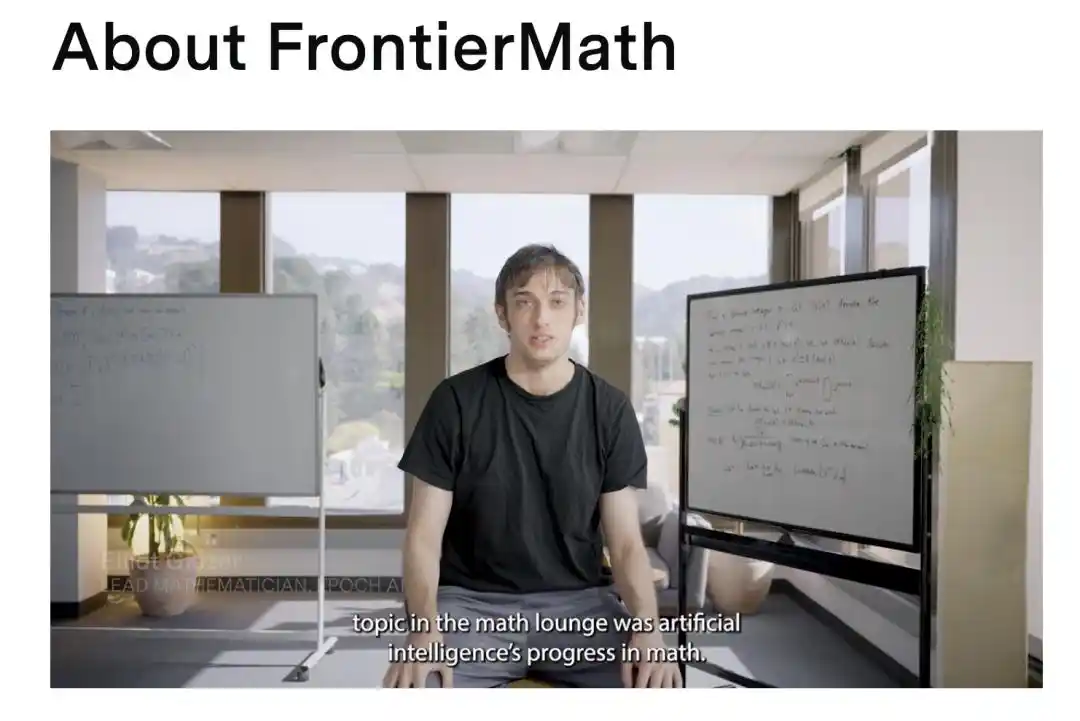
Sure enough, the first round of testing confirmed this, with the leading model's accuracy rate being less than 2%.

Specifically, initially, the core FrontierMath question bank had 300 problems, divided into three difficulty tiers: Tier 1, Tier 2, and Tier 3.
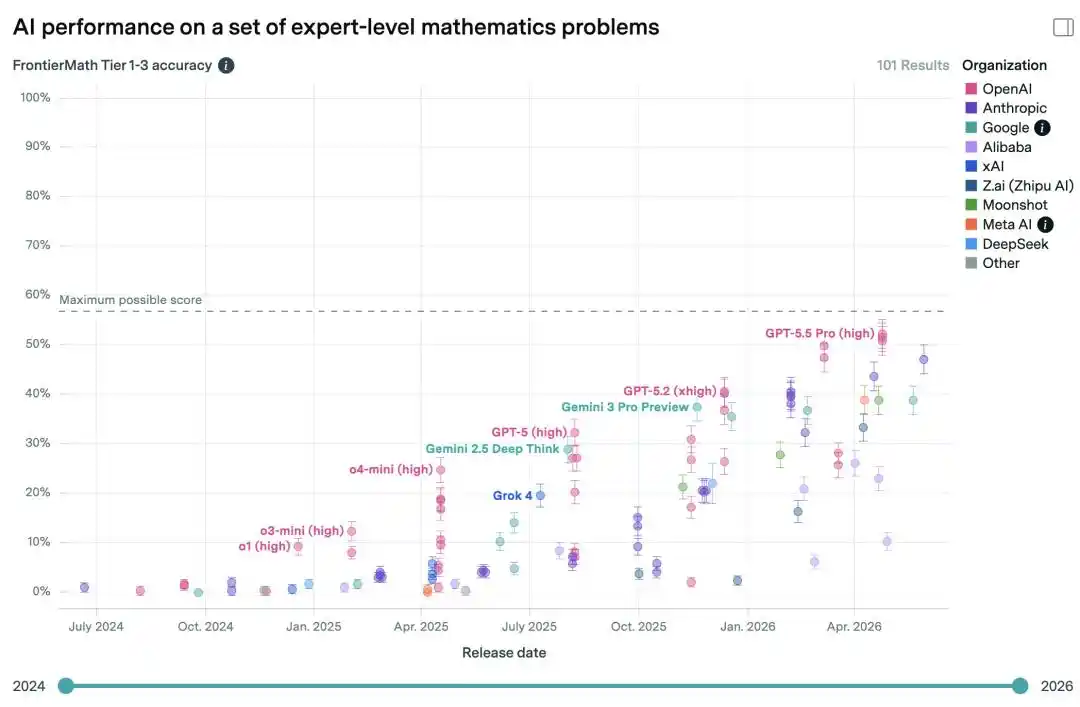
Tier 1 was roughly comparable to advanced undergraduate or math Olympiad problems, but allowed the use of more advanced tools; Tier 2 reached advanced graduate student difficulty; Tier 3 was closer to exploratory research problems early PhD students might encounter.

But with the emergence of reasoning models, these first three tiers also started to become insufficient. So in 2025, Epoch added another layer on top: Tier 4.

Tier 4 problems were mostly designed by mathematics professors and postdocs. Each would conduct a short-term research project lasting several weeks around their own research area, then compress the findings into a problem that could be automatically verified.
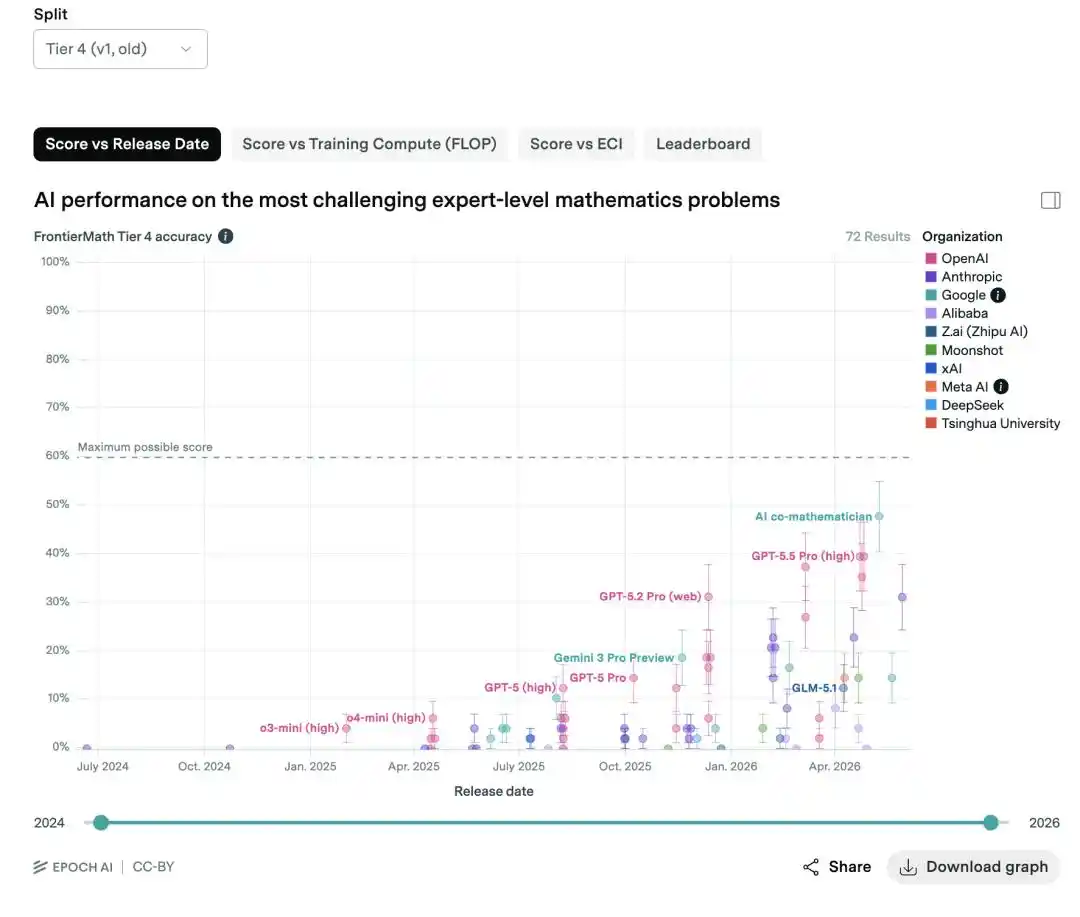
Initially, Tier 4 contained 50 problems. Their scope covered analysis, number theory, combinatorics, topology, algebraic geometry...

Upon release, across all models and all attempts combined, only 3 problems had ever been solved, and these solutions sometimes relied on correct but not fully justified assumptions.

Given this, on the official public sample problems page, Epoch once wrote: Some of these problems might not be solved by AI for decades.

(This statement is now being repeatedly mocked.)

However, as models grew stronger, another issue emerged: the question bank itself couldn't withstand AI's "grilling" anymore.

During testing, OpenAI found more errors in FrontierMath than anticipated.

Subsequently, Epoch launched an independent audit, first using GPT-5.5 and Claude Opus 4.7 to screen for suspicious points, then having mathematicians review each problem individually. Finally, in June 2026, version 2 was released, where Tier 4 had 12 problems corrected, 7 removed, leaving 43.

After the revision, model scores continued to climb.

GPT-5.6 Sol achieved 83.0%, Claude Fable 5 reached 90.2%, and with GPT-6 Astra, the score has now hit 97.6%.
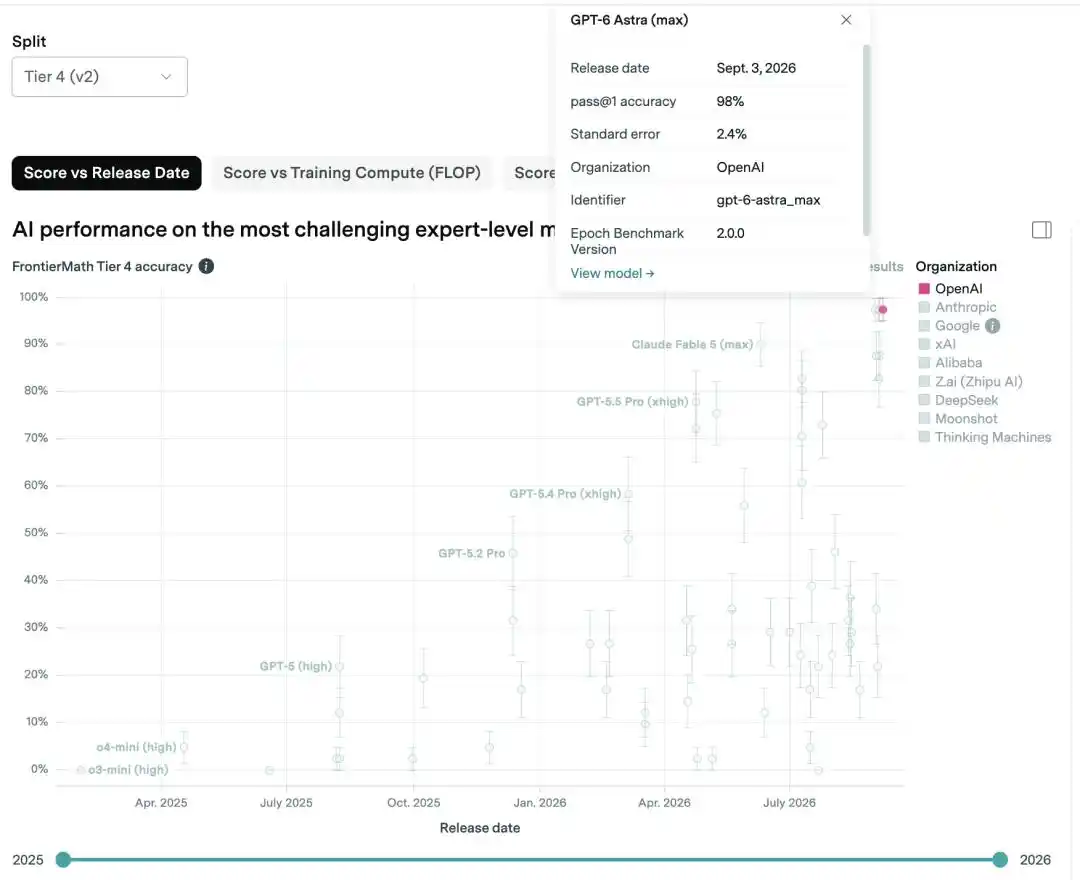
More crucially, Astra also filled the gap by solving the one problem that had never been cracked by AI before.

Thus, every single problem in Tier 4 has now been successfully solved by AI at least once. This research-level defense line, specifically added for the strongest models, has finally been cleared.

However, this doesn't mean "mathematics has been solved by AI." On the contrary, FrontierMath itself is already moving to the next phase.

Now, the entire project includes not only Tiers 1-4 but also genuine Open Problems, and FrontierMath Erdős, which formalizes Erdős open problems into Lean.
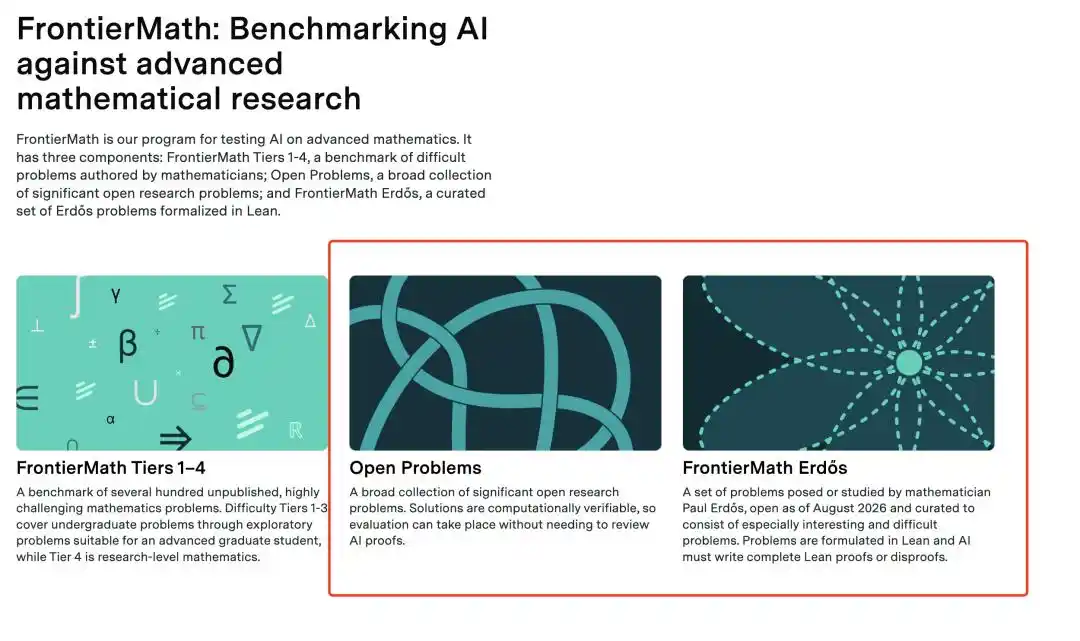
The former directly tests models on unsolved research problems from the mathematics community; the latter requires AI to produce complete proofs that can pass formal verification.

This time, Astra only solved 2 out of the 68 problems in FrontierMath Erdős.

The story continues~

This article is from the WeChat public account "QbitAI," author: henry

Related Questions

QWhat is FrontierMath Tier 4, and why was it created?

AFrontierMath Tier 4 is a collection of 43 (originally 50) highly difficult mathematical problems designed by mathematics professors and postdoctoral researchers as a benchmark to challenge advanced AI models. It was created by Epoch AI in 2025 to provide a 'research-level defense' because earlier difficulty tiers (Tiers 1-3) were becoming insufficient to differentiate top AI models, as traditional benchmarks like GSM8K and MATH were being solved too quickly.

QWhat significant milestone did GPT-6 Astra achieve regarding FrontierMath Tier 4?

AGPT-6 Astra achieved the milestone of solving the final remaining problem in FrontierMath Tier 4 that had never been solved by any AI before. This event, combined with all previous successful AI solutions for other problems, means that every single problem in the Tier 4 benchmark has now been solved at least once by an AI, leading Epoch AI to declare Tier 4 as 'saturated'.

QWhat was OpenAI's official reported score for GPT-6 Astra on Tier 4, and how does it relate to the 'saturation' claim?

AOpenAI's officially reported score for GPT-6 Astra on FrontierMath Tier 4 was 97.6%. The 'saturation' claim by Epoch AI refers to a different metric: it means that across all attempts by different AI models over time, each individual problem in the Tier 4 set has been successfully solved at least once. Astra contributed by solving the one last problem that had previously resisted all AI attempts, even though its single-attempt score was not 100%.

QHow did the author and mathematicians initially perceive the difficulty of FrontierMath's highest tiers?

AInitially, mathematicians like Terence Tao described some of the research-level problems as 'extremely difficult'. When Tier 3 was the highest level, Tao speculated it might stump AI for several more years. Upon the creation of Tier 4, Epoch AI's website even stated that some of its problems 'might not be solved by AI for decades,' a statement that has since been referenced humorously as progress accelerated rapidly.

QWhat are the next stages for the FrontierMath project after Tier 4 was saturated?

AAfter the saturation of Tier 4, the FrontierMath project has moved to even more challenging stages. These include 'Open Problems', which are genuine, unsolved research questions from mathematics, and 'FrontierMath Erdős', which involves formalizing unsolved problems from Paul Erdős into the Lean theorem prover and requires AI to produce complete, formally verified proofs. GPT-6 Astra, for example, has only solved 2 out of 68 problems in the FrontierMath Erdős set.

Related Reads

How to Understand the CFTC's Regulation of Prediction Markets?

On October 9, the U.S. Commodity Futures Trading Commission (CFTC) released two conflicting documents concerning event contracts in prediction markets. A proposal seeks to classify contracts on sports, politics, and other events as "swaps" under CFTC jurisdiction, while a separate interim rule explicitly excludes licensed sports betting and casino games from the swap definition. This creates a regulatory split where bets on the same NFL game could be regulated as state-level gambling if placed at a Las Vegas sportsbook, but as a federally regulated swap if traded on a CFTC-registered exchange like Kalshi. CFTC Chairman Michael Selig argues these event contracts are commodity derivatives for hedging, speculation, and price discovery. However, the move faces legal challenges. The NFL and 39 states oppose the CFTC's stance, arguing these contracts create new gambling risks rather than hedging existing ones. Federal appeals courts are divided: the Third Circuit ruled such contracts are swaps, while the Sixth and Ninth Circuits concluded they are not. This circuit split has prompted New Jersey to petition the Supreme Court for review. The proposed rules are not yet in effect, pending publication and a comment period. The ultimate outcome hinges on court decisions and the future composition of the CFTC commission. The core conflict remains whether event contracts on prediction markets fall under federal derivatives regulation or state gambling laws.

marsbit10m ago

How to Understand the CFTC's Regulation of Prediction Markets?

marsbit10m ago

BTC Daily Adjustment in Progress, HYPE Nears Short-term Directional Decision | Invited Analysis

This weekly analysis examines the recent price action of Bitcoin (BTC) and HYPE, focusing on key technical developments and outlining potential trading strategies. **Bitcoin (BTC) Analysis:** * **Market Trend Assessment:** The analysis applies a "52-week moving average confirmation method" to assess the broader trend. While BTC's weekly closing price has broken above this key average, the moving average itself remains in a downtrend, and a proper pullback confirmation is still lacking. The conclusion is that the rally from the July 1st low is still classified as a technical rebound, not yet confirming a new bull market. * **Daily Chart Structure:** The report argues that the five-wave rally (a-e) from the July low likely concluded at the September 21st high. The recent breakdown below the key support of $82,500, followed by a weak-volume rebound, supports this view. If the e-wave is complete, a larger corrective decline (potentially in three sub-waves) is anticipated. The first leg of this correction is underway, with an initial target around $78,000. * **Weekly Outlook & Strategy:** * **Outlook:** The focus is on the downside targets from the September 21st high. Key resistance is seen at $85,500 and the $87,500-$90,000 zone. Support levels are identified at $80,500-$82,500, $75,000-$78,000, and $69,100-$70,500. * **Strategy:** The medium-term posture is neutral/cautious, recommending watching for a potential pullback to a "channel" for confirmation. For short-term traders, two scenarios are outlined: (A) Selling into strength near the $85,500-$87,500 resistance if bearish signals appear, or (B) Selling a confirmed breakdown below the $80,500-$82,500 support zone. A 30% position size with strict stop-loss management is advised. **HYPE Analysis:** * **Daily Chart Structure:** HYPE broke below the lower boundary of its two-month ascending channel on October 8th. Price is currently in a "pullback confirmation" phase, testing this breached support-turned-resistance. A failure to reclaim this level would signal weakness and open the path towards the $75-$77 support area. The longer-term uptrend line, however, remains intact. * **Weekly Outlook & Strategy:** * **Outlook:** The critical watchpoint is the outcome of the current test of the former channel support. Resistance levels are noted at $88-$90, $94, and $102. Key support zones are $80-$82 and $75-$77. * **Strategy:** Two bullish scenarios are proposed for short-term trades: (1) A light long position if price convincingly reclaims and holds above the former channel support, or (2) A light long position if price falls to the $75-$77 support area and shows signs of stabilization. A 30% position size with strict stop-loss discipline is emphasized. **Risk Management Reminder:** The article includes a standard trailing stop-loss protocol (moving stop to breakeven at +1% profit, then locking in profits progressively). It strongly cautions that all analysis is for informational purposes only, not investment advice, and strategies must be adapted to changing market conditions.

marsbit1h ago

BTC Daily Adjustment in Progress, HYPE Nears Short-term Directional Decision | Invited Analysis

marsbit1h ago

U.S. Defense Procurement Seeks to Exclude Chinese PCBs, Stirring Domestic Disputes Among American Companies

A U.S. defense procurement rule set to take effect in January 2027, which aims to exclude printed circuit boards (PCBs) from China, Russia, Iran, and North Korea, has sparked debate within the American industry. While the policy, stemming from the 2021 National Defense Authorization Act, is intended to bolster U.S. domestic manufacturing and supply chain security, it faces conflicting pressures. The U.S. PCB industry association (PCBAA) urges swift implementation to redirect defense contracts to local manufacturers. In contrast, technology industry groups like the Information Technology Industry Council (ITI) seek a longer transition period, citing high costs and complexities for companies needing to establish new, certified supply lines and production facilities. The rule's direct impact on China's vast PCB industry is estimated to be minimal, affecting less than 1% of its total demand. However, it highlights a broader U.S. strategy to revive advanced electronics manufacturing through defense contracts, tax credits, and subsidies. Despite these efforts, rebuilding a competitive domestic PCB industry faces significant hurdles, including multi-year factory construction timelines, reliance on overseas materials and equipment, and the challenge of achieving commercial scale without sufficient non-defense orders. Notably, even U.S. defense contractors like TTM continue to expand production capacity in China to leverage its mature, cost-effective supply chain. Meanwhile, China's PCB sector is transitioning from scale to technological sophistication, making significant inroads in high-end areas like AI servers and advanced packaging. Leading Chinese firms are achieving breakthroughs in materials and complex multi-layer board production, supported by a deep industrial ecosystem of suppliers, manufacturers, and end-client collaboration. This entrenched system of scale, iterative development, and integrated supply chains represents a competitive advantage that U.S. policy alone cannot quickly replicate. The core challenge for the U.S. is not merely redirecting orders but rebuilding the comprehensive manufacturing capabilities and commercial viability that have shifted overseas.

marsbit1h ago

U.S. Defense Procurement Seeks to Exclude Chinese PCBs, Stirring Domestic Disputes Among American Companies

marsbit1h ago

Trading

Spot
活动图片