Tether, Kazakhstan cenbank mull tenge stablecoin and asset tokenization

cointelegraphPublished on 2026-10-08Last updated on 2026-10-08

Abstract

Tether has signed a memorandum of understanding with Kazakhstan's central bank and the Alatau City Authority to explore the issuance of a tenge-pegged stablecoin and the tokenization of real-world assets. The parties will study stablecoin models, identify use cases, and develop a pilot for a Kazakh tenge-backed stablecoin, while also creating a framework for asset tokenization potentially using Tether's Hadron platform. Workshops on stablecoin issuance and tokenization are also planned. Kazakhstan's central bank emphasized that financial stability and investor protection are priorities in this exploration. This move is part of Kazakhstan's broader push into digital assets, which includes a government-approved development plan covering tokenization, digital payments, and crypto mining. The country ranks seventh among governments for Bitcoin holdings, with its National Strategic Crypto Reserve valued at $700 million.

Tether has signed an agreement with Kazakhstan’s central bank and the Alatau City Authority to explore a tenge-pegged stablecoin and the tokenization of real-world assets.

Under the memorandum of understanding, the parties will study international stablecoin issuance models, identify potential use cases and develop a proposal for a tenge-backed stablecoin pilot, according to Tether.

The agreement also calls for the development of an asset tokenization framework, including identifying assets for potential tokenization and launching a pilot project in Alatau that could use Tether’s Hadron platform.

Tether, the National Bank of Kazakhstan and the Alatau City Authority will also hold workshops and training programs covering stablecoin issuance, reserve management and real-world asset tokenization.

National Bank of Kazakhstan Deputy Governor Binur Zhalenov said the central bank plans to study international approaches to stablecoin issuance and tokenization while prioritizing financial stability, transaction transparency and investor protection.

Related: Balaji’s Network School turns to Kazakhstan amid Malaysia setback

Kazakhstan expands digital asset push

Kazakhstan, the world’s largest landlocked country, has accelerated its push into digital assets this year, rolling out initiatives including stablecoins, tokenization, crypto payments and mining.

In September, the government approved a 65-measure plan across 10 areas aimed at developing the country’s digital asset industry. The plan includes measures to expand real-world asset tokenization, digital payments, international settlements and crypto mining.

The government also instructed the Energy and Digital ministries to develop a mechanism for using gas- and coal-fired power generation to supply mining centers. Kazakhstan ranked among the world’s top 10 countries for Bitcoin production in 2025, according to the government.

Kazakhstan’s National Strategic Crypto Reserve, meanwhile, has reached $700 million, while 34 digital asset projects have completed testing in the central bank’s regulatory sandbox, according to the announcement.

BitcoinTreasuries.net ranks Kazakhstan seventh among governments in its database for Bitcoin holdings, with an estimated 3,544 BTC worth about $294 million.
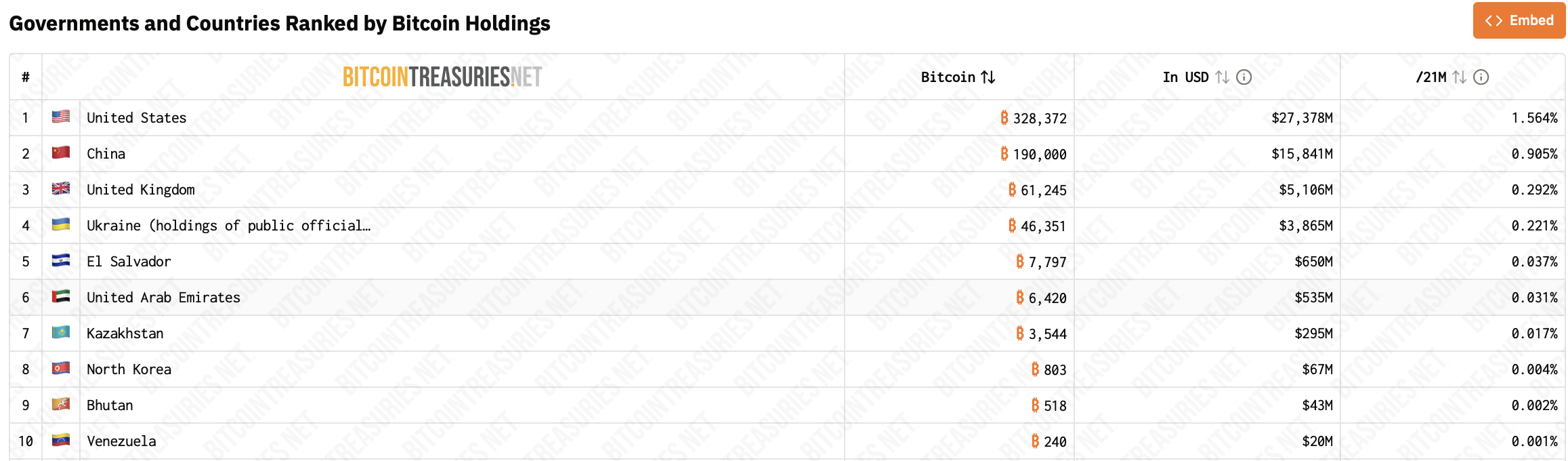
Source: BitcoinTreasuries.NET

Magazine: Capital starting to rotate back to crypto from AI: Raoul Pal

Related Questions

QWhat is the main purpose of the agreement signed between Tether and Kazakhstan's central bank?

AThe main purpose is to explore the development of a tenge-pegged stablecoin and the tokenization of real-world assets.

QBesides stablecoin issuance, what other key area will the partnership study and develop?

AThe partnership will also study and develop an asset tokenization framework, potentially using Tether's Hadron platform for a pilot project in Alatau.

QWhat are the National Bank of Kazakhstan's priorities in its study of stablecoins and tokenization?

AThe priorities are financial stability, transaction transparency, and investor protection.

QAccording to the article, how does Kazakhstan rank globally in Bitcoin production?

AKazakhstan ranks among the world's top 10 countries for Bitcoin production.

QWhat is the estimated value of Bitcoin held by the Kazakh government according to BitcoinTreasuries.net?

AThe Kazakh government is estimated to hold about 3,544 BTC worth approximately $294 million.

Related Reads

Leverage Flush, ETF Selling Pressure Not Yet Exhausted: The On-Chain Truth Behind the $64K Defense Line

After a month of range-bound trading, crypto markets suffered a brutal deleveraging washout last weekend, with Bitcoin falling roughly 13% in a week and briefly piercing $63,000, marking its sharpest single-day volatility in months. Glassnode's Week 47 Market Pulse report notes that while overheated derivatives leverage has largely been flushed out, continued outflows from spot ETFs are pushing the sector toward a critical threshold, with the aggregate ETF MVRV nearing the 1.0 break-even line. On-chain microdata shows loss pressure concentrated among recent entrants, with short-term holders now underwater overall. Bitcoin hovered near $64,000 on Monday after a weekly close down about 13%. The sell-off began Thursday and accelerated over the weekend, briefly breaking $63,000 on Saturday for the lowest level since late August. The concentrated selling rapidly cleared leveraged positions built up in derivatives over prior weeks. Perpetual futures open interest fell to the lower bound of its statistical range, and funding rates cooled sharply from warning levels back to neutral. Meanwhile, U.S. spot ETF investors extended net outflows, recording withdrawals every trading day last week, with aggregate ETF MVRV sliding to 1.06, extremely close to holders' break-even benchmark. On-chain activity remains relatively robust, with daily active addresses and large transfers holding up, but paper losses fall almost entirely on holders who entered in recent months. Short-term holders have turned fully underwater, and realized losses hit their highest level since July. In derivatives, spot momentum plunged 36.1% to 22.8, the weakest since August. Spot CVD deteriorated from -$51.5M to -$133.7M, with aggressive selling dominant Thursday through Saturday before slowing Sunday. Futures open interest fell 7.2% to $34.2B, also at the range's lower bound. Perpetual CVD widened from -$493M to -$1.4B, reflecting forced liquidations and stop-losses among speculative longs. The 25-delta skew jumped 30.9% to 13.7%, a new put-premium record since August, signaling strong demand for downside hedges. Spot ETF weekly net outflows narrowed slightly to -$995.4M but remain near the range bottom; weekly trading volume fell to $11.5B as institutions stayed defensive. On-chain, entity-adjusted daily transfer volume rose 3.6% to $5.4B near the upper bound, and daily active addresses totaled about 659,700, still healthy. However, realized cap monthly growth nearly stalled, dropping from 0.43% to 0.04%, indicating significantly slower external capital inflows. The STH-to-LTH supply ratio edged up to 15.1%, and hot capital share held at a high 22.0%, showing young coins bought within three months still carry heavy trading weight. The share of supply in profit fell from 60.4% to 55.3%, and STH-NUPL turned negative at -7.4%, historically a typical zone for capitulation-style turnover. Overall, the crash was driven by persistent ETF reduction, speculative long squeeze, and macro risk aversion. Open interest and funding rates have left dangerous overheated levels, clearing much pure leverage risk. Whether ETF net outflows turn positive and whether short-term holder capitulation spreads to long-term believers will determine if $64,000 becomes a solid bottom.

marsbit15m ago

Leverage Flush, ETF Selling Pressure Not Yet Exhausted: The On-Chain Truth Behind the $64K Defense Line

marsbit15m ago

US Stocks Trend (November 17): Nvidia Falls Another 4% to a 52-Week Low, Nasdaq Plunges 2.49%

Nvidia fell another 4.1% to $156.14, hitting a 52-week low, as the chipmaker's troubles deepened. Micron and Intel each dropped over 7%, and the Nasdaq tumbled 2.49%. The selloff spread to financials, industrials and energy, with all three major indexes closing lower. The Dow fell 739.38 points (-1.41%) to 51,608.17, the S&P 500 lost 145.08 points (-1.92%) to 7,416.59, and the Nasdaq dropped 626.52 points (-2.49%) to 24,509.76. The Russell 2000 fell 1.70%. It was the Nasdaq's biggest one-day decline since Nov. 5, and the S&P 500 and Nasdaq have now fallen for three straight sessions, erasing last week's gains. Nine of the S&P 500's 11 sectors declined, with tech and communication services down 2.98% and 2.82%, while consumer staples and utilities edged higher. The VIX jumped 18.7% to 22.91. Nvidia's board is focused on its investigation of Jensen Huang and has not discussed bringing him back as CEO, according to CNBC. The company has hired law firm Wachtell Lipton to investigate whether his conduct endangered national security or company secrets. Treasury Secretary Bessent called for a major overhaul and urged the board to look externally for a new CEO. The Commerce Department's BIS issued an interim final rule closing a loophole allowing Chinese firms to rent Nvidia compute through third-country data centers. Wall Street kept cutting targets: Mizuho lowered its to $220 from $250 and UBS to $240 from $300, both maintaining buy ratings. Mizuho's Vijay Rakesh said the roughly 32% drop from October's high, larger than the Philadelphia Semiconductor Index's 23% decline, reflects a lost "founder premium," with the CEO departure adding six to seven months of management uncertainty. Chip stocks fell broadly: Micron -7.62% to $719.02, Intel -7.07% to $55.47, Marvell and Arm each down over 7%, AMD about -6%, Broadcom about -4%, and the iShares Semiconductor ETF -5%. SanDisk and Lumentum fell over 8%, Dell about 7%, Oracle about 5%. Financials joined the afternoon selloff, with Morgan Stanley, Goldman Sachs and JPMorgan each down over 2%; Caterpillar fell 4.95% and Boeing 3.66% to a 52-week low. Defensive names outperformed: P&G rose 1.90% to a 52-week high, Molina Healthcare jumped 11.27% and Tyson Foods gained 8.72%. The November Empire State manufacturing index came in at 7.8, down 18 points from October and below the 16.7 expected; new orders fell to 3.0 while employment rose to 18.1, the highest since June 2022. The 10-year Treasury yield fell 2.2 basis points to 5.117% and the 2-year dropped 3.1 basis points to 4.821%, a bull steepener. Fed Chair Warsh's remarks focused on AI, warning it could disappoint, with little on monetary policy. WTI crude fell 3.21% to $85.72 a barrel and Brent dropped 3.55% to $92.44, as reports that the U.S. has no immediate plans to strike Iran outweighed support from an Iranian attack on a Bahrain air base and a tanker hitting a mine in the Strait of Hormuz. Gold fell 0.86% to $3,853 an ounce and silver plunged 4.60%. Bitcoin fell as low as $62,000 over the weekend, its lowest since August, and traded around $65,300 after the close. Looking ahead, Nvidia reports fiscal third-quarter results after the bell on Tuesday, with Bloomberg consensus at $2.47 EPS on about $109.15 billion in revenue; interim CEO Colette Kress will host the call, and options pricing implies an 8% move this week. Disney and Home Depot report before the open Tuesday, alongside October retail sales and import price data. Later in the week, Anthropic is expected to price Wednesday and list on Nasdaq Thursday at $70-78 per share, valuing it around $1.4 trillion, and Take-Two's GTA VI launches Thursday.

marsbit22m ago

US Stocks Trend (November 17): Nvidia Falls Another 4% to a 52-Week Low, Nasdaq Plunges 2.49%

marsbit22m ago

Altman Empathizes with Jensen Huang: 'Heroes Have Flaws,' But Does He Support His Return as NVIDIA CEO...

At the Semafor Silicon Valley Summit on November 16, OpenAI CEO Sam Altman publicly addressed Nvidia founder Jensen Huang's resignation as CEO after 33 years, expressing strong personal empathy. Altman called Huang "a hero of mine" and said it's hard to imagine the AI revolution without him, acknowledging that "heroes have flaws." Nvidia's stock fell about 15% within a week, wiping out over $570 billion in market value, and 180,000 people signed a petition urging his reinstatement—echoing Altman's own 2023 board ouster and dramatic return. Altman noted that Nvidia and OpenAI bet on each other early on. On business matters, he dismissed concerns that Nvidia's commitments—including a $105 billion financial guarantee for an OpenAI data center in Ohio—would lose credibility, saying the company is now a massive giant whose backing remains trusted. He also expressed optimism that the AI industry will keep advancing without Huang, given strong market demand and validated AI value. Altman identified scientific research as the next major AI breakthrough area, citing progress in math and physics, and predicted AI will take over repetitive, process-driven enterprise work. He also clarified his controversial memory chip remarks (saying he actually supports consumers upgrading their own PCs), explained that chip demand projections from multiple suppliers overlap even though real data center demand is solid, said OpenAI has not yet launched fully autonomous recursive self-improvement due to safety concerns, and stated OpenAI is in no rush to IPO despite Anthropic's filing, noting investor demand far exceeds quality supply.

marsbit26m ago

Altman Empathizes with Jensen Huang: 'Heroes Have Flaws,' But Does He Support His Return as NVIDIA CEO...

marsbit26m ago

If you lose money helping a friend trade cryptocurrency, will it be deemed fraud?

When friends entrust you with money to trade cryptocurrency on their behalf and the market turns against them, two distinct legal questions arise: whether you must compensate them, and whether your conduct constitutes fraud. These are separate issues. Civil liability depends on the nature of the relationship—whether it was a loan, a委托 investment, or a joint venture—and on the validity of any agreement. Under Chinese policy, virtual currency investment activities are treated as illegal financial activities, and civil acts involving them that violate public order and good morals are void, with losses generally borne by the parties themselves. Courts have reached different outcomes: in one case, an investor's claim for full repayment was rejected because the loss stemmed from market risk; in another, the operator was ordered to bear 20% of the loss for failing to recognize compliance risks, while the investor bore 80%. Fraud, by contrast, requires proof of deceptive conduct and intent to illegally possess the funds—mere trading losses or refusal to repay do not establish fraud. However, fabricating trade records, misappropriating funds, or secretly using leverage contrary to instructions can change the analysis. If a dispute escalates or police become involved, the priority is to preserve complete records of the agreement, fund flows, and trading history, avoid making unauthorized repayment promises, and cooperate truthfully with authorities while seeking professional legal advice.

marsbit26m ago

If you lose money helping a friend trade cryptocurrency, will it be deemed fraud?

marsbit26m ago

Stop Asking, I Just Love Money! The Naked-Quit Genius Researcher Backtracks, May Want to Return to Big Tech

Jacob Coxon, a 27-year-old Cambridge mathematics graduate and former pretraining researcher at both OpenAI and Anthropic, publicly reversed his stance just two months after a high-profile resignation. Speaking at a Stanford University event hosted by professor Rob Reich, Coxon admitted he is unsure whether leaving was the right decision and suggested he might return to a top AI lab. When pressed on why he still holds OpenAI stock options despite describing frontier labs as existential threats, he candidly replied, "I like money, brother. I admit it's blood money," and deflected further questions by blaming the host for raising the issue. He also said he remains anxious about no longer seeing frontier progress from the inside and feels he is "shouting into the void," questioning whether staying inside a lab would have been more influential. On technical matters, he argued that pretraining is not hitting a wall—compute efficiency is following a "super-exponential" curve—that recursive self-improvement requires only one narrow technical capability rather than broad mastery, and that deceptive or uncontrolled behavior in models originates solely from reinforcement learning during post-training, a loop labs cannot escape because RL remains the only effective tool for making models follow complex instructions. The episode, in which he clings to valuable equity while warning of AI risk, is seen as a candid portrait of Silicon Valley's AI culture.

marsbit30m ago

Stop Asking, I Just Love Money! The Naked-Quit Genius Researcher Backtracks, May Want to Return to Big Tech

marsbit30m ago

Trading

Spot
活动图片