Strategy Spent $16 Billion in Rescue Funds, Preferred Stock STRC Buyback Loop Faces Liquidity Test?

marsbitPublished on 2026-10-16Last updated on 2026-10-16

Abstract

MicroStrategy (now Strategy) launched a high-yield preferred stock, STRC, with a 12% annual dividend, designed to raise funds by issuing shares at or above their $100 face value to finance continuous Bitcoin purchases. However, since mid-May, STRC's price fell below par, dropping as low as $74.57 in late June, halting new issuances. To restore the $100 benchmark and restart this funding channel, Strategy initiated an aggressive weekly buyback program in late July, spending a cumulative $1.6 billion to repurchase STRC. Last week's buyback hit a record $192.4 million—approximately nine times its Bitcoin purchases for the same period. This massive effort has pushed STRC's price back to $99.90. The funding for these repurchases primarily comes from selling MSTR common stock in the open market. At the current spending rate, the authorized buyback budget could be exhausted in about two weeks, though the board may increase it again. The company's available liquidity could also be depleted in just over three weeks at this pace. This situation represents a significant shift in Strategy's capital strategy. Instead of using raised funds to leverage Bitcoin acquisitions, a substantial portion is now being diverted to support STRC's price. The company even sold some Bitcoin this summer to fund the repurchases. While financially accretive if MSTR trades above ~$131, this activity effectively reduces MSTR's leverage to Bitcoin's price. Market data shows Strategy's buybacks accounted for ...

Author: Jeff Albus, Unchained

Compiled by: Deep Tide TechFlow

Deep Tide Introduction: Deep Tide Introduction: MicroStrategy (Strategy) once designed the preferred stock STRC with an annual dividend as high as 12%, aiming to provide a continuous flow of U.S. dollar ammunition for ongoing Bitcoin purchases through premium public offerings. However, since STRC fell below its $100 face value in May, this fundraising channel has been completely paralyzed. To pull the stock price back to $100, the company initiated a large-scale buyback at the end of July, having cumulatively spent a staggering $16 billion. This buyback tug-of-war not only costs the company nine times more per week to buy preferred shares than its Bitcoin purchases but also forces the company to subsidize the effort by selling MSTR shares and even Bitcoin. With the buyback quota nearly depleted, how much longer can this self-recycling model hold up?

Featured Image: Michael Saylor's MicroStrategy (Strategy) is facing a balance in capital operations between preferred and common stock.

To raise funds for its continuous Bitcoin acquisition plan, MicroStrategy (now renamed Strategy) meticulously designed STRC: a high-yield preferred stock paying an annual dividend as high as 12%. According to the original design, when STRC trades at or above its $100 face value in the market, the company could continuously issue new shares, pay dividends to investors every half-month, and use all the raised cash to buy Bitcoin.

However, this fundraising machine has been completely stalled since mid-May.

In late June, STRC once fell to a historic low of $74.57, a deep discount of nearly 25% from its $100 benchmark face value. To rescue this core fundraising vehicle, Strategy launched a costly weekly buyback campaign at the end of July. According to statistics from the company's weekly regulatory disclosures, Strategy has so far spent a cumulative $16 billion in the secondary market to prop up and buy back shares. As of Tuesday's close, STRC traded at $99.90, just 10 cents away from its $100 target price.

Last week became the most intense week for Strategy's STRC buyback in history: the weekly buyback expenditure reached $192.4 million, approximately nine times its Bitcoin purchase expenditure during the same period (about $21 million). According to the company's established policy, it will not issue any new STRC shares in the market until STRC solidly stands above $100.

Where Does the Buyback Money Come From? How Long Can the Cash Pool Last?

So, is this expensive buyback loop depleting cash?

The answer is: Not yet depleted, but the time window is rapidly narrowing.

Currently, the preferred stock buyback budget approved by the company's board, if continued at last week's nearly $200 million procurement speed, will be completely exhausted in about two weeks. Of course, the board has full authority to, as it did in September, once again pass a resolution to double the buyback authorization to a higher scale (previously increased from $10 billion to $20 billion).

A more realistic constraint lies in cash reserves. At last week's cash consumption rate, the company's existing available liquidity can only last a little over three weeks. It is worth noting that Strategy's primary channel for paying this exorbitant buyback cost is through continuously issuing and selling MSTR common stock in the public market, or using the cash pool accumulated from previous MSTR sales. As long as MSTR's secondary market liquidity and stock price remain strong, the company can continue to raise funds by selling shares.
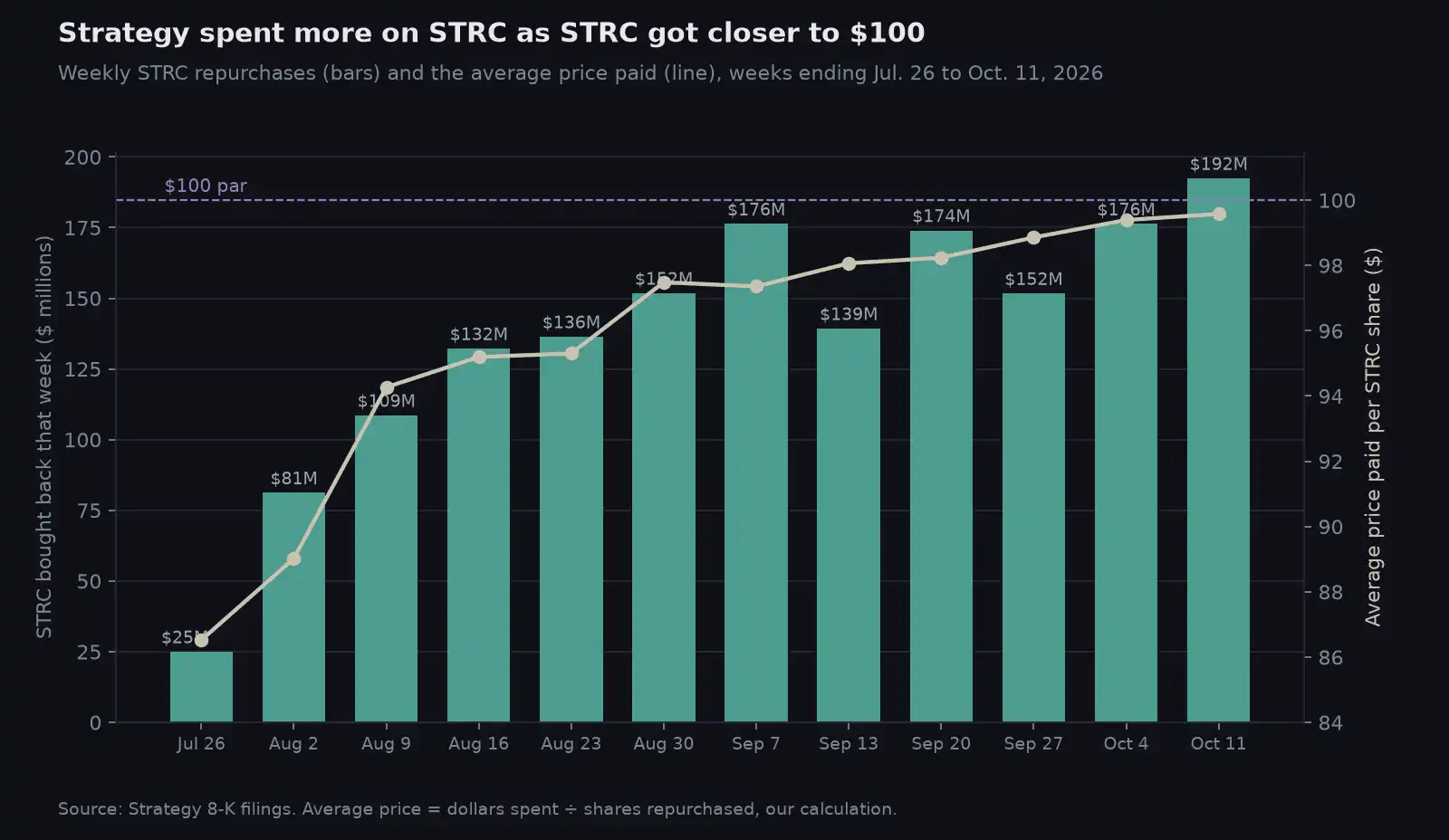
Chart: Comparison of Strategy's weekly STRC buyback amount and STRC market price climb since July.

From a Bitcoin Leverage Tool to a Burden Requiring Massive Funding

Strategy's growth into the world's largest corporate Bitcoin reserve is built on two pillars: First, the U.S. dollar will inevitably continue to depreciate over the long term; second, the global capital market is extremely eager for a compliant, high-leverage Bitcoin allocation tool. To this end, the company launched a series of preferred stock instruments, attempting to build a perpetual buying flywheel.

However, currently, STRC has evolved into a heavy burden that the company must spend huge sums to barely prop up.

Over the past few months, the vast majority of funds raised from selling MSTR shares have not flowed into the Bitcoin market but have been diverted to buy back and retire STRC. Even this summer, to raise enough buyback funds, the company was forced to sell part of its Bitcoin holdings.

From a pure financial calculation model, as long as MSTR common stock trades above approximately $131, issuing MSTR at a high price to buy back and retire STRC at a discount does not materially dilute the net asset value (NAV) per share for existing MSTR shareholders.

However, in terms of investment logic and capital structure, this operation brings an extremely subtle qualitative change: it is substantially reducing MSTR's leverage elasticity relative to Bitcoin. The capital engine originally used for aggressive Bitcoin purchases is now deeply mired in patching the financial hole of internal preferred stock discounts.

Details of the Buyback Operation and Market Dependency Risks

Strategy disclosed its strategy for supporting STRC in its Q2 earnings report: as long as the STRC price is below $100, the company will continuously intervene, "increasing purchases when the discount is large and gradually narrowing when the price approaches face value."

In the first week of late July, the company's entry was quite restrained, buying only about $25 million worth of STRC on the open market at an average price of about $87. But subsequently, as the price climbed, the weekly check amounts expanded exponentially. Last week, Strategy's average buyback price reached $99.58, fully entering the target resistance range of $99 to $100 defined by the company.

This sustained large-scale buying has made Strategy itself the largest absolute liquidity provider in the STRC market. On-chain and order book monitoring data from crypto market maker Keyrock indicates that in September, Strategy's proprietary buybacks accounted for one-fifth to one-quarter (20% to 25%) of STRC's overall weekly trading volume.

Keyrock bluntly pointed out that existing data cannot estimate how much genuine independent buy-side support would remain in the market once Strategy achieves its $100 target and withdraws its buyback support funds. If external buying power is weak, causing STRC to detach and fall below face value again, this multi-billion dollar self-rescue loop will be forced to restart.


Related Questions

QWhat is the primary purpose of MicroStrategy's (Strategy's) STRC preferred shares, and why has that mechanism stalled?

AThe primary purpose of MicroStrategy's (Strategy's) STRC preferred shares was to raise funds by issuing them at or above their $100 par value. The proceeds were then used to purchase Bitcoin, creating a continuous funding flywheel. This mechanism has stalled because since mid-May, STRC's market price has fallen below its $100 par value, preventing the company from issuing new shares for fundraising.

QHow much has Strategy spent on repurchasing STRC shares to prop up its price, and what was the spending ratio compared to its Bitcoin purchases in the most recent week mentioned?

AStrategy has spent a cumulative total of $1.6 billion repurchasing STRC shares. In the most recent week mentioned, the company spent approximately $192.4 million on STRC repurchases, which was about nine times the amount it spent on Bitcoin purchases (around $21 million) during the same period.

QWhat are the main sources of funding for Strategy's STRC repurchase program, and what are the constraints on these sources?

AThe main sources of funding for Strategy's STRC repurchase program are: 1) Proceeds from selling MSTR common stock in the public market, and 2) Utilizing cash reserves from previous MSTR stock sales. The constraints include the limited remaining board-approved repurchase budget, which could be exhausted in about two weeks at the recent spending rate, and the company's available cash liquidity, which could last just over three weeks at the current burn rate. Additionally, the strategy relies on maintaining strong market liquidity and price for MSTR stock to continue selling shares.

QAccording to the article, how has the role of STRC evolved from its original design, and what negative impact is this having on Strategy's core business strategy?

AOriginally designed as a leverage tool to fund continuous Bitcoin purchases, STRC has evolved into a significant financial burden that requires massive capital infusions to prop up its price. This negative impact diverts capital away from the company's core strategy of aggressive Bitcoin accumulation. Most funds raised from selling MSTR stock are now used to repurchase STRC instead of buying Bitcoin, and the company was even forced to sell some Bitcoin holdings to fund the repurchases. This operation is effectively reducing the leverage MSTR provides relative to Bitcoin.

QWhat does market data from Keyrock suggest about the sustainability of STRC's price once Strategy stops its repurchase program?

AMarket data from Keyrock suggests that Strategy has become the largest single liquidity provider for STRC, accounting for 20% to 25% of its weekly trading volume in September. The data indicates it is impossible to measure how much genuine independent buy-side demand would remain to support STRC's price once Strategy achieves its $100 target and withdraws its repurchase support. If external buying is insufficient and STRC's price falls below par again, the costly self-rescue cycle would likely have to restart.

Related Reads

Strategy stock sheds 5% amid MSCI index removal, Bitcoin sell-off

Strategy (Michael Saylor's Bitcoin treasury company) fell 6.49% on Thursday to close at $114.41, after MSCI confirmed the company's removal from its global equity indexes, compounded by a broader crypto market sell-off. The removal takes effect after the Nov. 30 market close and could trigger selling by index-tracking funds; JPMorgan previously estimated roughly $2.8 billion in potential selling pressure. Ryan Kirkley, CEO of Global Settlement Network, said the decision could distinguish Bitcoin treasury companies from traditional operating businesses and limit indirect crypto exposure for passive investors, noting that index inclusion had given ordinary passive investors leveraged Bitcoin exposure they never chose. He added it raises questions about whether such companies should be classified alongside traditional operating businesses, arguing that buying and holding an asset isn't an operating business but rather a fund that doesn't follow fund rules. In its Aug. 31 response to MSCI's proposed rules, Strategy called the changes a pretext for targeting digital asset treasury companies and downplayed the impact, saying MSCI-linked funds held about 13 million of its shares, just 3.1% of basic shares outstanding. The decline coincided with a broader crypto sell-off, with Bitcoin near $71,340, down 4.3% in 24 hours, and total crypto market capitalization down 3% to about $2.49 trillion.

cointelegraph1h ago

Strategy stock sheds 5% amid MSCI index removal, Bitcoin sell-off

cointelegraph1h ago

US Justice Department, business groups and DeFi firms challenge Illinois crypto tax

The US Department of Justice, business and financial industry groups, and a coalition of DeFi firms have backed a legal challenge to Illinois' 0.2% digital asset tax, arguing it unfairly targets crypto transactions and could impose taxes even without profit. The Justice Department filed a statement of interest, while the US Chamber of Commerce and SIFMA submitted an amicus filing. A coalition including Andreessen Horowitz, Paradigm, Uniswap and Aave Labs also filed a brief. The law, enacted in June, taxes the value of digital assets exchanged, transferred or stored regardless of profit. The Digital Chamber sued Illinois officials in July, followed by a separate challenge from the Blockchain Association and Crypto Council for Innovation in August. Originally set for Jan. 1, 2027, the tax was delayed to July 1, 2027. Illinois projected $60 million in fiscal year 2027 revenue. SIFMA and the Chamber warned the tax would affect banks, broker-dealers, custodians and asset managers nationwide, exposing them to compliance costs and burdening customers—someone who loses money owes the same tax as someone who profits, and moving assets between accounts could trigger tax without a sale or gain. They argued it discriminates against digital assets and may violate federal internet tax protections and constitutional interstate commerce requirements. The DOJ said the tax undermines federal efforts to promote crypto innovation, citing the Strategic Bitcoin Reserve and GENIUS Act. The DeFi coalition warned the rules could impose obligations on software developers and blockchain participants lacking customer information or control over funds.

cointelegraph2h ago

US Justice Department, business groups and DeFi firms challenge Illinois crypto tax

cointelegraph2h ago

DTCC Plans Solana Expansion as Wallet Rules Limit Access

DTCC plans to connect its tokenization service to Solana in the second half of 2027, allowing certain securities held by its DTC subsidiary to be converted into digital tokens on the network. Analysts say the move could attract more traditional financial institutions to Solana, which is known for fast transactions and low fees and had about $4.94 billion in total value locked as of Nov. 12. However, the impact may be limited by US regulatory rules. Alex Lin of Reforge noted that Solana's experience handling memecoin trading served as a public stress test, giving the network credibility to handle retail-scale volume reliably. Still, under a December 2025 SEC no-action letter, DTC participants must register wallets to hold tokenized securities, and tokens can only be transferred between registered wallets. Lin said the near-term impact is overstated because the tokens remain in a walled garden, inaccessible to permissionless retail and DeFi liquidity until regulators allow these assets to function as true onchain collateral. DTCC launched its tokenization service on the Canton Network and its private Besu network on Oct. 28, with 20 DTC participants signed on, though it has not said whether any plan to use Solana. Kha Nguyen of Birdeye said Solana has already seen growing demand for tokenized stocks, with trading volume reaching around $4.9 billion in H1 2026 and over 1 million accounts holding tokenized stocks by late September. However, broader Solana activity has slowed, with transactions down nearly 40%, DEX volume down 34.4%, and fees down 39%, while tokenized RWA value rose almost 7% to $4.76 billion. Nguyen said DTCC's integration would need banks, brokers, and issuers to actively issue, trade, and settle on Solana, with enough liquidity for large trades. He stressed that assets must be active rather than idle—traded around the clock, used as collateral, and earning yield. Lin agreed that long-term impact depends on where assets are used for secondary trading and collateral activity, not where they are issued.

cointelegraph3h ago

DTCC Plans Solana Expansion as Wallet Rules Limit Access

cointelegraph3h ago

Trading

Spot
活动图片