Security Storm Unresolved, Ledger Urgently Launches New Product Atom in Self-Rescue but Faces Widespread Ridicule

marsbitPublished on 2026-10-16Last updated on 2026-10-16

Abstract

Ledger faces ongoing security skepticism after a recent supply-chain attack, but has chosen this moment to launch a new product: the Ledger Atom, a smartphone-like hardware wallet priced starting at $849. The device features a dual-OS architecture separating daily Android apps from a secure enclave for private keys, advanced anti-tampering hardware, physical privacy switches, and an AI agent for market analysis (though final transaction approval remains with the user). However, the Atom lacks full phone capabilities like voice calls and SMS. Community reaction has been largely critical. Users question the timing of the launch while unresolved issues from a recent incident—where a distributor sold tampered devices leading to significant losses—remain unaddressed. Concerns also include the device's high price, its conspicuous branding potentially making users targets for physical "wrench attacks," and Ledger's lack of a clear compensation plan for past victims. The move is seen by many as an attempt to shift focus through a new product rather than directly restoring trust by handling the existing security crisis.

Author: Nancy, PANews

With the security alarm still not lifted, veteran hardware wallet manufacturer Ledger has chosen to high-profile launch its new product, Atom, at this time.

This smartphone-like hardware wallet promotes product design features such as a dual operating system, privacy protection, tamper-proof and anti-disassembly design, and an AI Agent as selling points, attempting to regain market trust and attract more attention. However, the market does not seem to be buying it.

Before its official launch, Atom has already sparked community controversy and even attracted considerable ridicule due to its launch timing and product design.

Launch of the Phone-Style Hardware Wallet Atom, with Tamper-Proof Design and AI Agent as Highlights

On October 16, Ledger announced the launch of the phone-style hardware wallet Ledger Atom. This product resembles a smartphone in appearance and user experience but is not a traditional mobile phone. It is a device that integrates daily applications, cryptocurrency asset management, and hardware security functions.
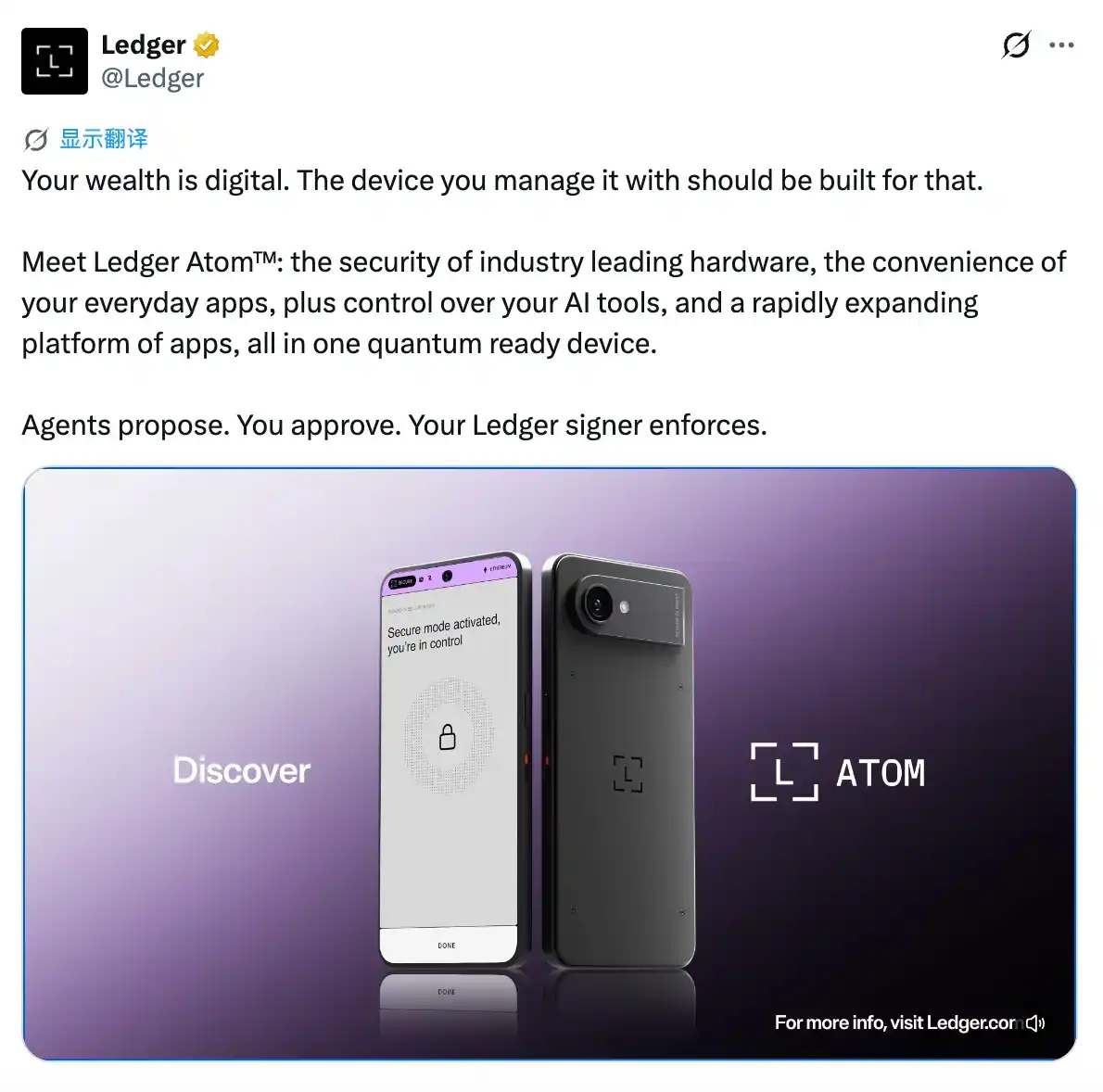
The Founder's Edition pre-order price is $849, and users can reserve it with a refundable $100 deposit; the regular version is expected to be priced at $899 and is planned for official release around mid-2027.

Ledger Atom does not support full mobile communication functions. According to official disclosure, the device only supports mobile data services and can connect to the internet via 4G/5G networks, but it does not support cellular voice calls, including VoLTE, VoNR, and VoWiFi, nor does it support SMS. Even with a SIM or eSIM card installed and within network coverage, users cannot make emergency service calls, such as 112 or 911, through this device.

In terms of security architecture, Ledger Atom adopts a dual operating system design, separating daily applications from sensitive operations involving asset security to reduce the risk of malicious software tampering with transaction information or inducing users to sign malicious transactions. Among them, the standard mode, based on the Android Open Source Project (AOSP), is responsible for running daily applications and networking services such as WhatsApp, Instagram, and TikTok; Ledger OS runs in an independent secure chip environment, specifically handling sensitive operations like private key storage, transaction signing, AI Agent authorization, and identity verification. When initiating a transaction, users can verify the transaction details through the secure screen and complete the signature after confirmation.

It is worth noting that, although the two operating systems share the same screen, Ledger still attempts to achieve isolation at the hardware level. Officially, the device controls access to the screen and touchscreen through an FPGA hardware multiplexer. When the device enters secure mode, the FPGA cuts off standard mode's access to the screen and touchscreen. Theoretically, even if the standard mode is completely controlled by malware, attackers cannot forge or tamper with the transaction approval interface seen by the user through this mode, nor can they use it to steal private keys or inject click operations.

Privacy protection is also a key design focus for Ledger Atom. The device is equipped with a physical privacy switch that can cut off power to the camera and microphone at the circuit level; when entering secure mode, these sensors are automatically turned off. The device also supports NIST-compliant post-quantum cryptography schemes, attempting to prepare in advance for potential future quantum computing threats.

In response to the recently exposed risks of hardware wallet devices being tampered with, Ledger has added multiple protective mechanisms to Atom, claiming it to be their most advanced anti-tampering and anti-disassembly solution to date. The device is equipped with protective shields around key sensitive components and features sensors to detect if the screen or back cover has been removed; the product packaging is also specially designed to identify if it has been opened. Meanwhile, the anti-tampering detection system is equipped with an independent battery, allowing it to operate continuously even when the device is powered off.

Beyond hardware security, Ledger has also introduced an AI Agent into the asset management process. Their Ledger Agent Intent allows AI Agents, including OpenClaw, to monitor the market, prepare transactions, and provide operational suggestions but does not grant them access to private keys. All requests involving fund transfers or other sensitive operations must ultimately be physically confirmed by the user through Ledger Atom's secure screen to be executed. In other words, users can use AI to assist in analysis and prepare operations, but the ultimate control over assets remains in the user's hands.

In terms of the application ecosystem, Ledger Atom will come pre-installed with Ledger Wallet, supporting cryptocurrency asset management and transaction signing. Additionally, Ledger announced a collaboration with Solana Mobile to introduce the Seeker app into the device; it is also collaborating with Cyber50 to explore using Ledger Atom and its hardware-level security technology to further enhance communication security and privacy protection.

Regarding sales channels, to reduce the risk of supply chain attacks exposed in recent incidents like the CryptoBilis event, Ledger plans to initially sell Atom only through its official website, bypassing third-party seller channels. As for the device upgrade issue for existing users, Ledger stated that there are currently no plans to offer a trade-in program for customers affected by this incident but did not rule out the possibility of future upgrade promotions.

Security Trust Not Yet Restored, Ledger's Hasty New Product Launch Raises Questions

However, even before its official market launch, Ledger Atom has already stirred community dissatisfaction.

On one hand, the trust crisis Ledger faces has not subsided. Previously, Ledger's authorized distributor in Southeast Asia, CryptoBilis, was exposed in a hardware wallet supply chain attack incident, where devices were implanted with malicious hardware, causing nearly a hundred million dollars in user losses.

In response, Ledger has suspended product sales through related authorized channels in Southeast Asia and Hong Kong, stating that the attack originated from a localized distribution channel rather than vulnerabilities in the company's chips, operating system, or servers. According to Ledger's disclosure, a highly organized criminal group spent months purchasing genuine devices, disassembling them to add custom hidden components in an attempt to steal the recovery seed phrases generated by users during the initialization process, and then reintroduced the tampered devices into the market through Southeast Asian distributors. The attackers were also said to have invested millions of dollars to build a logistics network, seed phrase collection servers, and infrastructure for stealing funds and money laundering, ultimately stealing user assets through coordinated actions.

Although Ledger has responded to the incident, the users' most pressing concern—how to address supply chain attacks—has not been clearly resolved. Meanwhile, regarding how to handle the asset losses of affected users, and whether clear compensation or replacement plans will be provided, the official has yet to give clear answers. At this point in time, instead of prioritizing responses to users' most urgent demands, Ledger is attempting to reshape the product's security image by launching Atom with hardware isolation and anti-tampering mechanisms, which naturally makes it difficult to dispel external doubts. For current users, properly handling the existing security incident and responding to victims' demands might be the key to restoring trust, rather than launching a new product.

On the other hand, while Ledger Atom offers stronger software isolation and protection against remote attacks, it still faces security risks from the physical world. Compared to traditional hardware wallets, Atom has an appearance and user experience close to that of a smartphone, but its prominent Ledger branding could also make it a target for potential criminals, with the community even joking it's a "walking ATM."

Such concerns are not unfounded. In recent years, wrench attacks targeting cryptocurrency holders have become increasingly frequent. Unlike remote hacking, this type of crime directly targets the victims themselves, using violent assault, kidnapping, torture, or threats to life to force them to hand over private keys or transfer assets on the spot. According to a previous disclosure by security agency CertiK, there were 52 verified wrench attack incidents in the first half of 2026, with recorded losses reaching $124.1 million; the number of incidents increased by 33.3% year-over-year, while the loss amount grew to 11.8 times that of the same period the previous year.
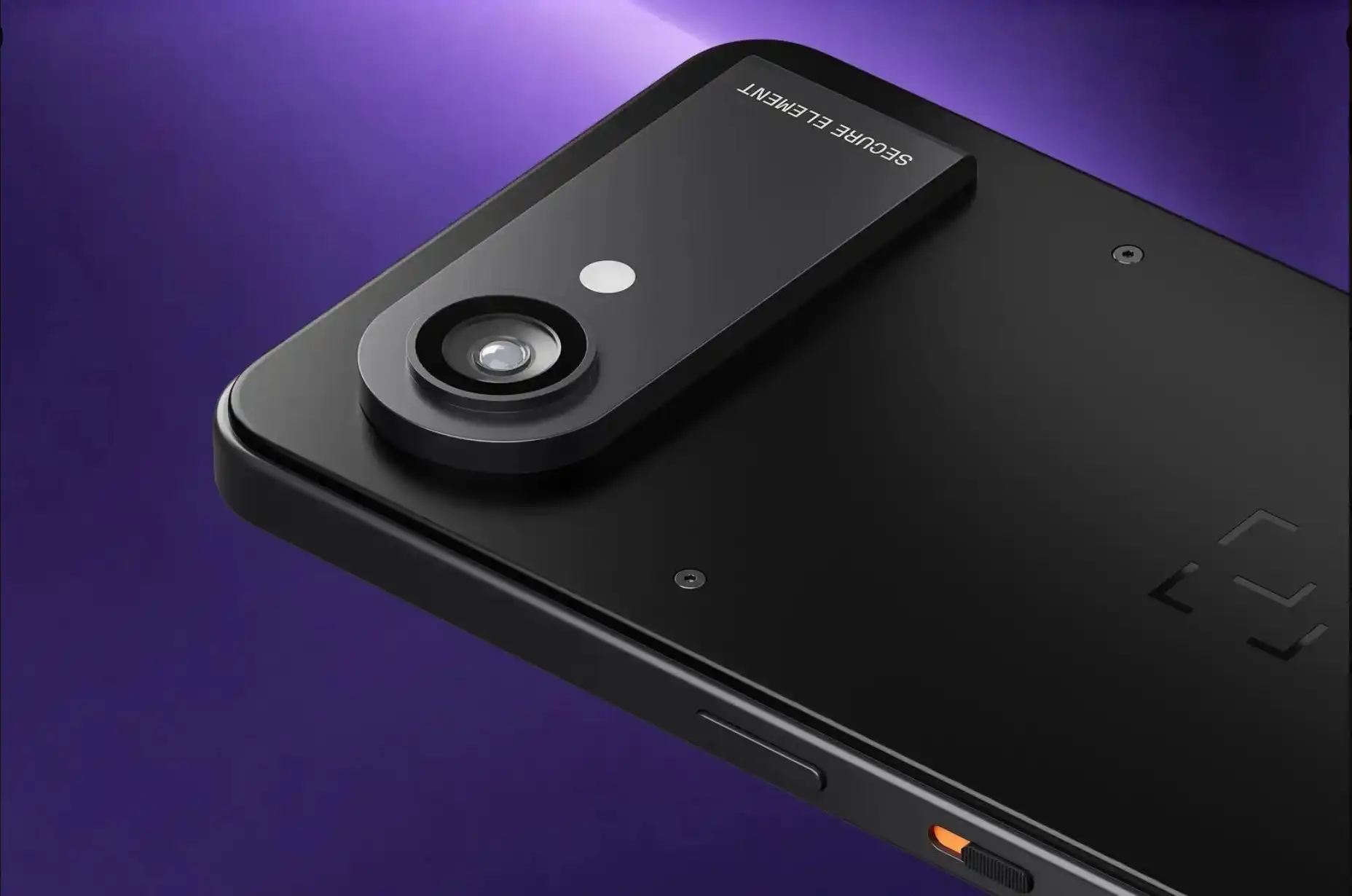
Additionally, the pricing of Ledger Atom has sparked controversy. Its price is considered significantly higher than most of Ledger's existing hardware wallet products, even approaching that of many mid-to-high-end smartphones. Given that the official explicitly states Atom is not a traditional smartphone, with its functional positioning clearly different from regular phones, many users have expressed unwillingness to pay this security premium.

Ultimately, in the cryptocurrency market, security is always the core value of hardware wallets. Relying solely on technological upgrades and product form innovation is not enough to win user trust. Especially at a time when Ledger's security incident remains controversial and user trust still needs repair, only by directly responding to user demands and effectively resolving security risks can market confidence be re-established.
Trending Cryptos

Related Questions

QWhat are the main security features of the new Ledger Atom hardware wallet?

AThe Ledger Atom features a dual-OS design separating daily apps from security-sensitive operations, a hardware FPGA multiplexer for screen/touchscreen isolation in secure mode, a physical privacy switch for the camera/microphone, post-quantum cryptography, advanced anti-tamper and anti-disassembly mechanisms with shields, sensors, and special packaging, and an independent battery for the tamper-detection system.

QWhy has the launch of the Ledger Atom sparked controversy and criticism within the community?

AThe launch has sparked controversy because it comes while a major supply chain attack involving Ledger's distributor, CryptoBilis, remains unresolved, with no clear solution or compensation for victims. The community views launching a new product before addressing the existing trust crisis as insensitive. Additionally, the device's high price, its potential to make users targets for physical 'wrench attacks', and its limited phone functionality have drawn criticism.

QHow does the AI Agent (Ledger Agent Intent) function in the Ledger Atom, and what are its security limitations?

AThe AI Agent, like OpenClaw, can monitor markets, prepare transactions, and offer suggestions. However, it does not have access to private keys. All sensitive operations, such as fund transfers, require the user's physical confirmation on the device's secure screen. The final control and authorization for any transaction remain solely with the user.

QWhat was the nature of the supply chain attack mentioned in the article that impacted Ledger's reputation?

AThe attack involved Ledger's authorized distributor in Southeast Asia, CryptoBilis. A criminal organization purchased genuine Ledger devices, disassembled them, installed custom hidden components designed to steal the recovery seed phrase generated during device setup, and then reintroduced the tampered devices into the market through the distributor. This sophisticated operation reportedly led to nearly $100 million in user losses.

QWhat are the key differences between the Ledger Atom and a traditional smartphone, according to the article?

AThe Ledger Atom resembles a smartphone but lacks key phone functionalities. It supports mobile data (4G/5G) for internet access but does not support cellular voice calls (including VoLTE, VoNR, VoWiFi), SMS, or emergency calls (e.g., 112 or 911), even with a SIM card. Its primary purpose is to combine daily applications with hardware-secured cryptocurrency management, not to replace a conventional phone.

Related Reads

Mercado Bitcoin begins post-hack reopening without a timeline for withdrawals

Mercado Bitcoin, one of Brazil's largest crypto exchanges, began restoring read-only access to customer accounts in phases on Monday, a week after attackers drained an estimated $49 million from the platform. Access started at 19:00 UTC, with all accounts expected to be viewable by 21:00 UTC, showing holdings as they stood on Nov. 2, the day of the hack. The exchange has yet to say when customers will be able to withdraw funds. Fabricio Tota, vice president of new business, said the exchange hoped read-only access would reassure customers that their assets were still recorded on the platform. He explained that the company opted for "a more conservative approach" to reactivating accounts "to ensure our return happens with the utmost security." The caution follows concerns from blockchain security analysts that attackers were able to access addresses, draining funds through standard transfers rather than a smart contract exploit. Blockchain analysts traced some of the stolen funds to customer deposit addresses, but Mercado Bitcoin says customers won't bear the losses. Tota said the vast majority of assets were never even touched by anyone and were not involved in the incident. On Nov. 4, Mercado Bitcoin pledged to cover all losses with company funds, bolstered by a $20 million investment from stablecoin issuer Tether in July. Tota highlighted that a portion of the stolen funds were also frozen in the hours after the company announced the attack. The next phase of recovery will require users to confirm their registration details before they can move funds. The exchange plans to restore withdrawals via Pix, Brazil's instant payment system, initially allowing customers to withdraw only to accounts in their own name. Tota gave no date for either step. Mercado Bitcoin has yet to explain how the attackers gained access to its wallets. Blockchain data company Bitquery found that as of Nov. 4, wallets linked to the attacker held most of the stolen funds that had escaped freezes, including 106.07 BTC.

cointelegraph5h ago

Mercado Bitcoin begins post-hack reopening without a timeline for withdrawals

cointelegraph5h ago

Avalanche’s AVAX leads crypto gains following NYSE tokenization deal

Avalanche's AVAX token rose as much as 10% on Monday, becoming the top gainer among the 100 largest cryptocurrencies, after the New York Stock Exchange announced plans to use Avalanche's blockchain to settle trades on a new platform for trading tokenized stocks around the clock. AVAX later eased to $8.86, still up over 8% on the day, with a market cap of around $3.95 billion and $439.7 million traded in the past 24 hours. Avalanche's total value locked stands at $633 million, up 4% over the past day. NYSE's head of digital issuance, Dennis Lee, said the exchange is examining how blockchain technology can expand its equities offerings and is picking the right technology for each job. The deal underscores Wall Street's growing effort to use blockchain to make stock trading faster and enable trading outside regular market hours; traditional US markets are open 9:30 am to 4:00 pm EST on weekdays, with trades often taking at least one business day to settle. The NYSE first announced plans for the platform in January, and Ava Labs revealed in September that the exchange had spent about a year testing Avalanche, though the final selection was not confirmed until Monday. Avalanche will record stock trades and help complete transactions on the platform, which will let investors buy and sell digital versions of stocks across different blockchains. Lee said the settlement ledger needs to be fast, reliable, permissioned, cost-predictable, and backed by a large developer community—all of which Avalanche meets. The platform could launch before the end of 2026 pending regulatory approval. Ava Labs chief business officer John Nahas said first conversations with the NYSE began nearly a year ago and called it an important step toward blockchain becoming foundational financial infrastructure. The news comes as other major firms invest in blockchain for faster, round-the-clock trading: Nasdaq plans to invest $100 million in Kraken's parent Payward to launch tokenized stocks by Q2 2027, and the DTCC launched a service in October allowing firms to turn traditional securities into digital tokens. The NYSE deal follows other efforts to bring traditional assets onto Avalanche, including Progmat moving over 452 billion yen in digital securities onto a dedicated Avalanche blockchain in July and Aave Labs' plans for a lending service using tokenized assets as collateral.

cointelegraph5h ago

Avalanche’s AVAX leads crypto gains following NYSE tokenization deal

cointelegraph5h ago

Trading

Spot

Hot Articles

How to Buy ATOM

Welcome to HTX.com! We've made purchasing Cosmos (ATOM) simple and convenient. Follow our step-by-step guide to embark on your crypto journey.Step 1: Create Your HTX AccountUse your email or phone number to sign up for a free account on HTX. Experience a hassle-free registration journey and unlock all features.Get My AccountStep 2: Go to Buy Crypto and Choose Your Payment MethodCredit/Debit Card: Use your Visa or Mastercard to buy Cosmos (ATOM) instantly.Balance: Use funds from your HTX account balance to trade seamlessly.Third Parties: We've added popular payment methods such as Google Pay and Apple Pay to enhance convenience.P2P: Trade directly with other users on HTX.Over-the-Counter (OTC): We offer tailor-made services and competitive exchange rates for traders.Step 3: Store Your Cosmos (ATOM)After purchasing your Cosmos (ATOM), store it in your HTX account. Alternatively, you can send it elsewhere via blockchain transfer or use it to trade other cryptocurrencies.Step 4: Trade Cosmos (ATOM)Easily trade Cosmos (ATOM) on HTX's spot market. Simply access your account, select your trading pair, execute your trades, and monitor in real-time. We offer a user-friendly experience for both beginners and seasoned traders.

7.1k Total ViewsPublished 2024.03.29Updated 2026.06.02

How to Buy ATOM

Discussions

Welcome to the HTX Community. Here, you can stay informed about the latest platform developments and gain access to professional market insights. Users' opinions on the price of ATOM (ATOM) are presented below.

活动图片