Satoshi-Era Bitcoin Wakes Up After 16 Years: 600 BTC Moved

cryptonews.ruPublished on 2026-09-06Last updated on 2026-09-06

Abstract

Bitcoins mined in 2010, totaling 600 BTC worth approximately $48 million, were moved from long-dormant addresses after over 16 years of inactivity, sparking speculation about a potential link to Bitcoin's pseudonymous creator, Satoshi Nakamoto. On-chain analysis tracked the coins to mining rewards from 12 blocks processed in March 2010, when the block subsidy was 50 BTC. Blockchain tracking platform Whale Alert stated its investigation found no connection between these specific blocks and Nakamoto, dampening the speculation. The movement is notable because the coins originate from the period when Nakamoto was still actively involved in Bitcoin's development. Whale Alert suggested one of the transfers may have been a test transaction before the bulk of the coins were moved.

Bitcoins mined in 2010 were moved from long-dormant addresses after more than 16 years, sparking renewed speculation about a potential connection to Satoshi Nakamoto.

According to on-chain analytics reviewed by Cointelegraph, on Saturday, coins were moved from 12 addresses that held a total of 600 Bitcoin ($BTC) worth approximately $48 million, after more than 16 years of inactivity.

Whale Alert, a blockchain transaction tracking platform, stated that the 600 $BTC were received as rewards for mining 12 Bitcoin blocks, and its investigation found no link to Nakamoto.

"According to our research, none of the blocks can be linked to Satoshi," a Whale Alert representative told Cointelegraph, tempering speculation about the origin of the coins mined during the period when Bitcoin's creator, known by the pseudonym, was still active.

Whale Alert Traced All 12 Bitcoin Block Rewards

Whale Alert traced all 12 rewards back to Bitcoin blocks mined in March 2010, when the subsidy per block was 50 $BTC. The subsidy size has been halved four times since; the last time was in April 2024, when it dropped from 6.25 $BTC to the current 3.125 $BTC per block.

These findings add to Whale Alert's previous analysis, which covered seven rewards. In a Sunday post on X, the service stated that those seven rewards originated from blocks that, by its definition, were not mined by Nakamoto.
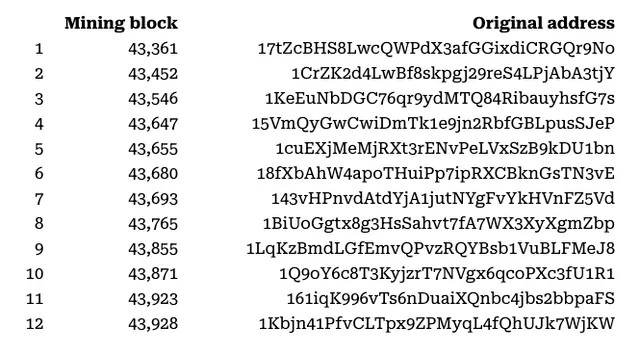
Mining blocks and addresses of the 12 dormant Bitcoin rewards. Source: Whale Alert

On-chain analytics platform Lookonchain also initially identified seven miner wallets that transferred 350 $BTC after 16.5 years of dormancy. According to the platform, these wallets received the coins from mining in March 2010.

Satoshi Era Doesn't Mean Bitcoin Belonged to Satoshi

The movement attracted attention partly because the coins date back to the period when Nakamoto was still actively involved in Bitcoin's development.

Nakamoto continued to participate in Bitcoin's development and communications throughout 2010 before gradually stepping away from the project; their last known message dates back to April 2011.
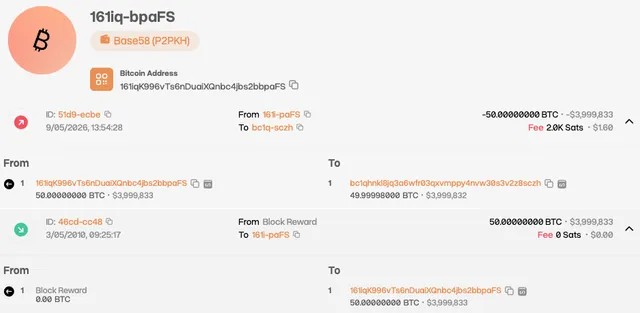
One of the 12 addresses received a 50 $BTC mining reward on March 5, 2010, and transferred the coins to a new address on September 5, 2026. Source: Blockchain.com

Whale Alert noted that one of the rewards was transferred several blocks earlier than most of the others, stating that this sequence fit with a test transaction prior to the remaining transfers.

Magazine: $BTC will reach $1 million by 2030... but Arthur Hayes is buying ETH instead

end-content

Trending Cryptos

Related Questions

QAccording to the article, what caused speculation regarding the 600 Bitcoin moved from inactive addresses?

AThe movement of 600 BTC that were mined in 2010 from addresses inactive for over 16 years caused speculation about a potential link to Bitcoin's creator, Satoshi Nakamoto.

QWhat did the blockchain analysis platform Whale Alert conclude about the origin of the 600 BTC?

AWhale Alert concluded that its research found no link between any of the 12 block rewards and Satoshi Nakamoto, dispelling the speculation that the coins belonged to the creator.

QIn which month and year were the Bitcoin blocks that generated these 600 BTC originally mined?

AThe 12 block rewards, each of 50 BTC, were originally mined in March 2010.

QHow many times has the Bitcoin block subsidy been halved since the blocks containing these 600 BTC were mined, and what is the current subsidy?

AThe block subsidy has been halved four times since March 2010. The current subsidy is 3.125 BTC per block, following the latest halving in April 2024.

QWhat reason did Whale Alert suggest for one of the 12 rewards being moved slightly earlier than the others?

AWhale Alert suggested that the earlier movement of one of the rewards likely served as a test transaction before the bulk of the transfers were executed.

Related Reads

Solana Cancels Major Shanghai Event As Attendance Surge Creates Problems

Solana's Accelerate event in Shanghai, scheduled for October 16, was abruptly postponed shortly before it began after registrations exceeded the venue's permitted capacity, according to Solana Foundation president Lily Liu. The event, called Solana Accelerate China, was intended to connect blockchain developers and businesses in the region. The postponement occurred in a country where commercial cryptocurrency activities face significant restrictions, prompting speculation about government intervention. However, organisers attributed the delay to attendance and venue compliance issues rather than a blanket ban by authorities. They noted the distinction between technical blockchain development and illegal cryptocurrency business activities, which are not necessarily treated the same under every regulatory framework. China remains an important source of software engineering talent, and international blockchain organisations continue trying to maintain relationships with developers there. No replacement date was announced at the time of postponement. For attendees who had travelled to Shanghai, the cancellation was an immediate inconvenience. For Solana, the impact is reputational and operational, as the foundation aims to show its ecosystem can develop internationally. The events illustrate how quickly such ambitions can encounter practical obstacles when regulatory expectations and a rapidly growing audience collide. Interest in Solana development may remain strong, but staging the next event will require more careful preparation.

bitcoinist6h ago

Solana Cancels Major Shanghai Event As Attendance Surge Creates Problems

bitcoinist6h ago

Trading

Spot

Hot Articles

What is $BITCOIN

DIGITAL GOLD ($BITCOIN): A Comprehensive Analysis Introduction to DIGITAL GOLD ($BITCOIN) DIGITAL GOLD ($BITCOIN) is a blockchain-based project operating on the Solana network, which aims to combine the characteristics of traditional precious metals with the innovation of decentralized technologies. While it shares a name with Bitcoin, often referred to as “digital gold” due to its perception as a store of value, DIGITAL GOLD is a separate token designed to create a unique ecosystem within the Web3 landscape. Its goal is to position itself as a viable alternative digital asset, although specifics regarding its applications and functionalities are still developing. What is DIGITAL GOLD ($BITCOIN)? DIGITAL GOLD ($BITCOIN) is a cryptocurrency token explicitly designed for use on the Solana blockchain. In contrast to Bitcoin, which provides a widely recognized value storage role, this token appears to focus on broader applications and characteristics. Notable aspects include: Blockchain Infrastructure: The token is built on the Solana blockchain, known for its capacity to handle high-speed and low-cost transactions. Supply Dynamics: DIGITAL GOLD has a maximum supply capped at 100 quadrillion tokens (100P $BITCOIN), although details regarding its circulating supply are currently undisclosed. Utility: While precise functionalities are not explicitly outlined, there are indications that the token could be utilized for various applications, potentially involving decentralized applications (dApps) or asset tokenization strategies. Who is the Creator of DIGITAL GOLD ($BITCOIN)? At present, the identity of the creators and development team behind DIGITAL GOLD ($BITCOIN) remains unknown. This situation is typical among many innovative projects within the blockchain space, particularly those aligning with decentralized finance and meme coin phenomena. While such anonymity may foster a community-driven culture, it intensifies concerns about governance and accountability. Who are the Investors of DIGITAL GOLD ($BITCOIN)? The available information indicates that DIGITAL GOLD ($BITCOIN) does not have any known institutional backers or prominent venture capital investments. The project seems to operate on a peer-to-peer model focused on community support and adoption rather than traditional funding routes. Its activity and liquidity are primarily situated on decentralized exchanges (DEXs), such as PumpSwap, rather than established centralized trading platforms, further highlighting its grassroots approach. How DIGITAL GOLD ($BITCOIN) Works The operational mechanics of DIGITAL GOLD ($BITCOIN) can be elaborated on based on its blockchain design and network attributes: Consensus Mechanism: By leveraging Solana’s unique proof-of-history (PoH) combined with a proof-of-stake (PoS) model, the project ensures efficient transaction validation contributing to the network's high performance. Tokenomics: While specific deflationary mechanisms have not been extensively detailed, the vast maximum token supply implies that it may cater to microtransactions or niche use cases that are still to be defined. Interoperability: There exists the potential for integration with Solana’s broader ecosystem, including various decentralized finance (DeFi) platforms. However, the details regarding specific integrations remain unspecified. Timeline of Key Events Here is a timeline that highlights significant milestones concerning DIGITAL GOLD ($BITCOIN): 2023: The initial deployment of the token occurs on the Solana blockchain, marked by its contract address. 2024: DIGITAL GOLD gains visibility as it becomes available for trading on decentralized exchanges like PumpSwap, allowing users to trade it against SOL. 2025: The project witnesses sporadic trading activity and potential interest in community-led engagements, although no noteworthy partnerships or technical advancements have been documented as of yet. Critical Analysis Strengths Scalability: The underlying Solana infrastructure supports high transaction volumes, which could enhance the utility of $BITCOIN in various transaction scenarios. Accessibility: The potential low trading price per token could attract retail investors, facilitating wider participation due to fractional ownership opportunities. Risks Lack of Transparency: The absence of publicly known backers, developers, or an audit process may yield skepticism regarding the project's sustainability and trustworthiness. Market Volatility: The trading activity is heavily reliant on speculative behavior, which can result in significant price volatility and uncertainty for investors. Conclusion DIGITAL GOLD ($BITCOIN) emerges as an intriguing yet ambiguous project within the rapidly evolving Solana ecosystem. While it attempts to leverage the “digital gold” narrative, its departure from Bitcoin's established role as a store of value underscores the need for a clearer differentiation of its intended utility and governance structure. Future acceptance and adoption will likely depend on addressing the current opacity and defining its operational and economic strategies more explicitly. Note: This report encompasses synthesised information available as of October 2023, and developments may have transpired beyond the research period.

3.7k Total ViewsPublished 2025.05.13Updated 2025.05.13

What is $BITCOIN

Discussions

Welcome to the HTX Community. Here, you can stay informed about the latest platform developments and gain access to professional market insights. Users' opinions on the price of BTC (BTC) are presented below.

活动图片