Polygon Open Money Stack expands to TRON, extending network access to regulated U.S. payment rails

cointelegraphPublished on 2026-10-08Last updated on 2026-10-08

Abstract

Polygon Labs has expanded its Open Money Stack to support the TRON network. This integration provides fintechs, remittance providers, and payment platforms a unified way to connect regulated U.S. banking rails directly to TRON, the largest network for USDT (TRC-20), which has over $94 billion in circulating supply. Businesses can now move dollars via bank transfers or cards into virtual accounts and settle on-chain without needing to independently assemble licensing, banking partners, and cross-chain infrastructure. The expansion enables three core functions: regulated fiat access across 48 U.S. states, programmable TRON wallet management, and seamless cross-chain movement of USDT between TRON and supported EVM networks like Polygon. This allows, for example, a remittance provider to accept dollars and send USDT to a TRON wallet—or facilitate cash-outs—through a single integration. Polygon CEO Marc Boiron stated the move brings deep USDT liquidity into their stack, while TRON founder Justin Sun noted it bridges on-chain liquidity with traditional finance. This marks the first phase of TRON support for the Open Money Stack, which was built following Polygon's acquisitions of Coinme and Sequence.

Dubai, UAE, October 7, 2026 – Polygon Labs today announced that Polygon Open Money Stack now supports the TRON network, giving fintechs, remittance providers and payment platforms a way to connect bank funds directly into the world’s largest network for USDT (TRC-20).

The expansion connects Polygon Open Money Stack to TRON’s stablecoin economy, which supports more than $94 billion in circulating USDT and over $30 trillion in total transfer volume. Businesses serving that economy have traditionally had to independently assemble licensing, sponsor banks, wallet providers, and cross-chain routing infrastructure before moving funds between banking rails and blockchain networks. Polygon Open Money Stack brings those components together through a single integration.

Dollars can enter through regulated on ramps via bank transfer, debit card, or cash at a retail counter, move into virtual accounts that hold real balances, and settle onchain under rules defined by the business. The same integration can then route funds across supported blockchains and facilitate payouts through supported payment rails.

TRON has established itself as one of the world’s most heavily used networks for moving digital dollars, particularly in markets where USDT is used for retail payments, savings, and cross-border transfers. With support for TRON, Polygon Open Money Stack enables businesses operating across TRON and EVM networks to serve customers across both ecosystems through a shared infrastructure layer.

Polygon has processed more than $3 trillion in payments volume as of September 21. By adding support for TRON, Polygon Open Money Stack connects major onchain payments ecosystems and gives businesses additional infrastructure for moving funds between blockchain networks and traditional financial rails.

“Polygon Open Money Stack was built so a payment company can plug in once and move money wherever it needs to go. Adding TRON brings one of the deepest pools of USDT liquidity into that same integration, so businesses can move those dollars onto U.S. banking rails or across chains with the licensing and orchestration already handled underneath,” said Marc Boiron, CEO of Polygon Labs.

“Stablecoins are becoming infrastructure for real-world financial activity, from payments and remittances to treasury management,” said Justin Sun, Founder of TRON. “By connecting TRON’s global ecosystem with Polygon Open Money Stack, we’re making it easier for businesses to build payment products that bridge onchain liquidity with traditional financial rails.”

The expansion extends three parts of Polygon Open Money Stack to TRON:

  • Regulated dollar access: Polygon Ramps connects TRON-based products to fiat on- and off-ramps supported by money-transmitter licenses and compliance infrastructure across 48 U.S. states.
  • Programmable accounts: Businesses can create and manage TRON wallets through the same Open Money Stack integration used across supported networks, removing the need to integrate a separate wallet provider or maintain different user experiences for each network.
  • Cross-chain movement: Businesses can route USDT between TRON and supported EVM networks, such as Polygon Chain, through a single transaction flow, with the bridging, conversion and execution handled underneath.

For a remittance provider, this means a customer can fund a payment in dollars and deliver USDT to a recipient’s TRON wallet without the provider integrating separate ramp, wallet and routing vendors. The same infrastructure can support the reverse flow, allowing users to move USDT from TRON and cash out through a bank account.

The integration can also support other payment workflows. A marketplace, for example, can accept USDT on TRON, hold funds in a programmable account, and settle with a seller through an EVM network or bank account. Payment applications can serve customers across both ecosystems without requiring users to move onto a preferred blockchain or businesses to build separate compliance and payment infrastructure for each network.

Polygon Labs began assembling Open Money Stack through its pending acquisition of Coinme and acquisition of Sequence, combining licensed U.S. fiat access with enterprise wallet infrastructure and cross-chain orchestration. The stack is designed to connect the networks, stablecoins, and banking rails customers already use rather than requiring businesses to select a single blockchain for every payment.

This marks the first phase of TRON support across Polygon Open Money Stack, with additional assets, markets and payment capabilities expected to become available over time.

About Polygon Labs

Polygon Labs is a global blockchain payments company building infrastructure to move money instantly, reliably and at internet scale, with the mission to move all money onchain. It is building the Polygon Open Money Stack, an integrated stack of stablecoin settlement, wallets, regulated fiat on- and off-ramps and cross-chain routing, so businesses can move money anywhere through one integration. Its infrastructure has facilitated trillions of dollars in onchain value transfer.

Media contact

Kurt Patat

kpatat@polygon.technology

About TRON DAO

TRON DAO is a community-governed DAO dedicated to accelerating the decentralization of the internet via blockchain technology and dApps.

Founded in September 2017, the TRON blockchain has experienced significant growth since its MainNet launch in May 2018. Today, TRON hosts the largest circulating supply of USD Tether (USDT) stablecoin, which currently exceeds $94 billion. As of October 2026, the TRON blockchain has recorded over 407 million in total user accounts, more than 15 billion in total transactions, and over $28 billion in total value locked (TVL), based on TRONSCAN. Recognized as the global settlement layer for stablecoin transactions and everyday purchases with proven success, TRON is “Moving Trillions, Empowering Billions.”

TRONNetwork | TRONDAO | X | YouTube | Telegram | Discord | Reddit | GitHub | Medium | Forum

Media contact

Yeweon Park

press@tron.network

Related Questions

QWhat is the main announcement made by Polygon Labs regarding the Polygon Open Money Stack?

APolygon Labs announced that the Polygon Open Money Stack now supports the TRON network, enabling fintechs, remittance providers, and payment platforms to connect bank funds directly into the TRON network, which is the world's largest network for USDT (TRC-20).

QAccording to the article, what key challenge for businesses does the Polygon Open Money Stack aim to solve with this expansion?

AThe Polygon Open Money Stack aims to solve the challenge where businesses traditionally had to independently assemble licensing, sponsor banks, wallet providers, and cross-chain routing infrastructure to move funds between banking rails and blockchain networks. It brings these components together through a single integration.

QWhich three specific parts of the Polygon Open Money Stack are being extended to TRON with this expansion?

AThe three parts being extended are: 1) Regulated dollar access via Polygon Ramps, 2) Programmable accounts for creating/managing TRON wallets, and 3) Cross-chain movement for routing USDT between TRON and supported EVM networks through a single transaction flow.

QHow does Marc Boiron, CEO of Polygon Labs, describe the benefit of adding TRON support to the Open Money Stack?

AMarc Boiron states that adding TRON brings one of the deepest pools of USDT liquidity into the same integration, allowing businesses to move those dollars onto U.S. banking rails or across chains with the licensing and orchestration already handled underneath the platform.

QWhat does the article cite as TRON's significance in the global stablecoin and payments ecosystem?

AThe article cites TRON as one of the world's most heavily used networks for moving digital dollars, particularly in markets where USDT is used for retail payments, savings, and cross-border transfers. It hosts the largest circulating supply of USDT (over $94 billion) and has processed over $30 trillion in total transfer volume.

Related Reads

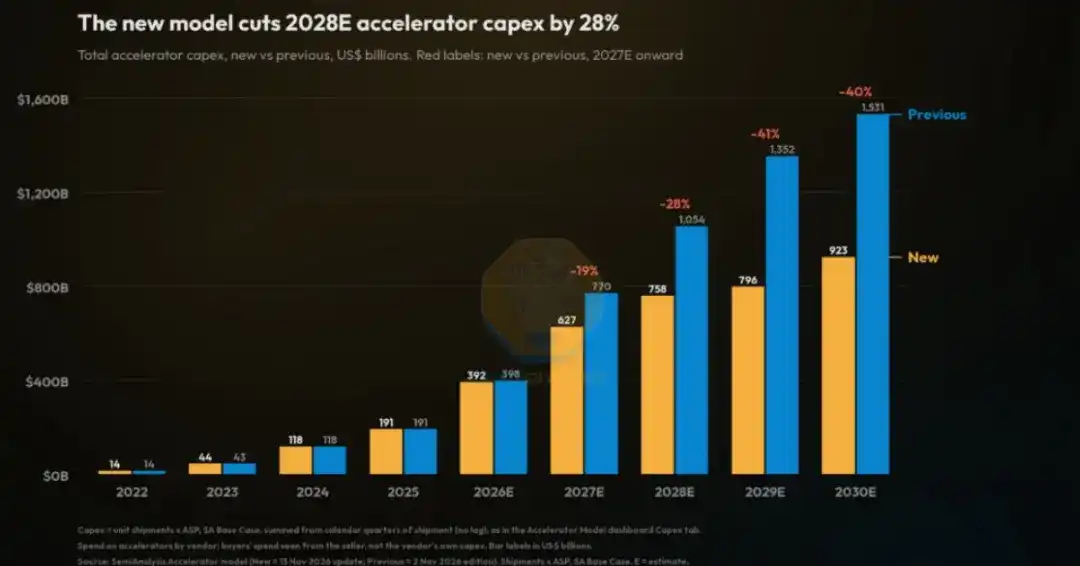
SemiAnalysis Slashes AI Compute Capex Forecast Again: 2029 Cut by 41%, 2030 Down to Only $923 Billion

Semiconductor research firm SemiAnalysis has sharply cut its forecasts for global AI accelerator capital expenditure, shipments, HBM demand, and power demand in its latest model update. The most significant revisions affect 2028–2030: capex forecasts are lowered by 28% for 2028 and by 41% and 40% for 2029 and 2030, respectively. Under the new model, global AI accelerator capex in 2030 falls to $923 billion from the previously projected $1.531 trillion—a reduction of $608 billion. Cumulative accelerator logic silicon wafer shipment area for 2026–2030 is cut by 17%, with Nvidia accounting for 66% of the reduction. The revisions stem from three factors: slowing AI revenue growth, as frontier AI labs saw declining growth in new annual recurring revenue in Q3, prompting reassessment of whether token revenue can cover high computing costs; tighter financing conditions, with debt and equity investors more cautious about projects lacking long-term procurement commitments from cloud providers; and intensifying U.S. regulatory and grid-connection constraints, with 5.8 GW of data centers expected to come online between H2 2027 and H1 2028 facing delays. The impact is uneven across the supply chain. Nvidia is hit hardest, with shipment forecasts cut substantially and average selling price assumptions for its next-generation Feynman series significantly lowered—Feynman from about $110,000 to $78,000, and Feynman Ultra from about $175,000 to $98,000—indicating competition is shifting from capacity to cost-effectiveness, with TPU, Trainium, and AMD GPUs eroding Nvidia's pricing power. Global HBM shipments for 2028 are cut 30%, and AI accelerator power demand for 2030 is cut 34%. This does not mean storage and power lose value; rather, the chain is shifting from grabbing capacity and power to allocating capacity based on returns. For the market, this correction looks like an early de-bubbling calibration. Previously, AI capex was seen as a one-way upward curve, but it is actually shaped by revenue validation, financing constraints, grid connections, chip efficiency, and competition. Key indicators to watch include cloud capex guidance, accelerator order visibility, HBM contract prices, data center grid-connection queues, and the share of inference workloads in total compute. If inference demand keeps growing, unit compute costs fall, and utilization improves, the chain will still find structural support; if long-term project returns prove hard to validate, further downward revisions remain possible. The global AI compute sector is undergoing a painful valuation correction. It is still unclear whether this phase is over—valuations may not look cheap if forecast parameters in valuation models have not been revised down in tandem. The best approach is to wait patiently for the market to clear itself. Market inertia often overshoots: if valuations are pushed to extreme lows and leveraged funds and sellers are cleared out while short positions sit at historic highs, a sharp rebound could follow. When that opportunity arrives is up to the market.

marsbit6m ago

SemiAnalysis Slashes AI Compute Capex Forecast Again: 2029 Cut by 41%, 2030 Down to Only $923 Billion

marsbit6m ago

Democrats Win Both Chambers, Trump's Business Alliance Begins to Crack

After Democrats won both chambers of Congress in the November 2026 midterms, the first shift was not in legislation but in how markets view business-government ties. Before the new Congress takes office on January 3, 2027, Democrats can prepare investigations and demand document preservation, though subpoena power comes later. Current pressure includes congressional oversight, board probes and civil suits—not criminal convictions. Trump retains veto power, and Democrats lack a two-thirds majority, so investigation becomes the key tool. Musk was asked by two Democratic senators to preserve Starlink and Starshield records, including communications with the White House and Pentagon; House Democrats also plan to examine DOGE cuts, SpaceX contracts and conflicts of interest. Nvidia announced on November 12, 2026 that Jensen Huang resigned as CEO and director, with CFO Colette Kress interim CEO and Harvey Jones as first board chair; reports of a possible return remain unconfirmed. Nvidia shares fell about 20% from October 30 to November 13. Democrats also plan to investigate the Trump family's crypto business, World Liberty Financial and related deals, while the CLARITY Act stalled in the Senate. Markets are starting to price the value of political protection that may not survive election cycles, with capital shifting toward AMD, Broadcom, custom chips and compliant financial institutions.

marsbit6m ago

Democrats Win Both Chambers, Trump's Business Alliance Begins to Crack

marsbit6m ago

Former Uniswap Engineering Director at the Helm, Metric Monthly Trading Volume Exceeds $8 Billion

Metric, a DEX led by former Uniswap Labs Engineering Director Christos Gkolias as CTO, surpassed $8 billion in trading volume in its first month, with over $600 million in daily volume, despite having only about $25 million in TVL. Metric focuses on tokenized stocks, major crypto assets, and stablecoins. Unlike traditional AMMs that derive prices from pool ratios, Metric separates pricing from liquidity provision, allowing pools to update quotes based on external references such as Chainlink and Pyth oracles or custom strategies, keeping liquidity near market prices. LP funds are placed in price ranges called Bins that automatically shift with the reference price, so capital stays active without manual redeployment, enabling small TVL to support large cumulative volume. Large trades still incur price impact as liquidity is consumed across bins. Metric also introduced Markout APR to compare execution prices against later reference prices, reminding LPs that more volume does not guarantee more profit. A points campaign launched October 15 distributes 1 million points weekly for trading, providing liquidity, managing pools, and referrals, with early users earning retroactive rewards. Users can earn points through spot trading via Metric's flagged routes or by providing liquidity in pools, though high APR must be weighed against trading losses and price changes. Referrals offer up to 10% point bonuses once bound.

marsbit9m ago

Former Uniswap Engineering Director at the Helm, Metric Monthly Trading Volume Exceeds $8 Billion

marsbit9m ago

Bridgewater's $23 Billion Portfolio Shake-Up: Embracing AI Hardware and Energy, Cutting Google and Amazon

Bridgewater Associates significantly reshaped its portfolio in the third quarter, concentrating on AI chip hardware and energy while cutting exposure to tech giants and traditional industrial stocks. According to Bloomberg's analysis of Bridgewater's 13F filing, the fund disclosed 974 positions worth $230 billion as of September 30. The firm substantially increased holdings in Qualcomm, AppLovin, and memory chip stocks Micron and SanDisk, while reducing stakes in Alphabet and Amazon and exiting industrial names such as Union Pacific. Healthcare saw the largest sector weight increase, while industrials saw the biggest decline. Among top holdings, State Street SPDR S&P 500 ETF Trust remained the largest at $2.595 billion (11% of the portfolio), followed by iShares Core S&P 500 ETF at $1.155 billion (about 5%). Nvidia ranked third at $614 million (about 2.7%), despite a reduction of about 1.178 million shares, remaining the most important single semiconductor holding. Broadcom followed at $462 million (about 2%), nearly unchanged, and Lam Research ranked fifth at $348 million (1.5%). On the buying side, Qualcomm saw the largest increase, up 716,000 shares to 878,000 shares, adding about $132 million in value. AppLovin Class A rose 536,000 shares to 683,000 shares, adding about $123 million. Micron gained 120,000 shares to 237,000 shares (about $118 million), and SanDisk added 66,000 shares to 66,800 shares (about $115 million). Qorvo was increased by over 1.037 million shares to 1.068 million shares, adding about $119 million. On the selling side, State Street SPDR S&P 500 ETF was cut by nearly 1.917 million shares (about $1.378 billion), and iShares Core S&P 500 ETF by 1.494 million shares (about $1.093 billion). Vanguard S&P 500 ETF fell 382,000 shares (about $261 million). Alphabet Class A was reduced by 862,000 shares to 460,000 shares (about $314 million), and Amazon by 1.055 million shares to 971,000 shares (about $241 million). Industrials saw the largest weight decline. Bridgewater fully exited Union Pacific, cutting 514,000 shares (about $140 million), the quarter's largest liquidation. Truck maker Paccar was also cleared, down 946,000 shares (about $114 million) amid an 8.6% price drop. Nutanix and S&P Global were fully exited as well. Healthcare received the biggest weight boost, with new positions in Medtronic and Jazz Pharmaceuticals (amounts not separately disclosed). In energy, Bridgewater opened a new 1.55 million-share position in Occidental Petroleum worth about $85.77 million and bought about 1.516 million shares of Dominion Energy worth about $91.76 million. New tech positions included Synaptics, Fortinet, and Cisco, valued at about $78.35 million, $75.41 million, and $71.2 million respectively.

marsbit9m ago

Bridgewater's $23 Billion Portfolio Shake-Up: Embracing AI Hardware and Energy, Cutting Google and Amazon

marsbit9m ago

Trading

Spot
活动图片