Opinion: Military Conflicts Accelerate Cryptocurrency Adoption in the Middle East

cryptonews.ruPublished on 2026-09-07Last updated on 2026-09-07

Abstract

Military conflicts and national currency instability have accelerated cryptocurrency adoption in the Middle East, according to an analysis for the Bitcoin Policy Institute. On-chain transaction volume in the region is estimated to have grown from around $100 billion in 2022 to $350 billion in 2025-2026, driven by macroeconomic pressure and government digitization programs, unlike global trends fueled by institutional investment. The market's initial reaction to the Israel-Iran escalation in June 2025 saw Bitcoin drop 2.3% and Ethereum 7.5%, with total crypto market cap falling 3.7%. However, Bitcoin later stabilized, with its market share rising to 64.8%, interpreted as a flight to safety from altcoins. Notably, crypto exchanges continued operating during regional conflicts while traditional stock exchanges halted. Adoption drivers vary across the region. In Egypt, Turkey, Lebanon, and Iran, demand for Bitcoin and dollar stablecoins stems from currency devaluation and traditional financial restrictions. In contrast, the UAE and Bahrain see growth supported by clear regulation, institutional players, and economic diversification programs. Data shows a surge in small everyday crypto payments in the UAE, while Turkey leads in transaction volume but with increased speculative trading. Iran's crypto market is becoming more isolated, requiring more intermediate transfers for international access. Analysts suggest these conflicts are pushing Bitcoin closer to becoming a genuine se...

Military conflicts and the instability of national currencies have increased interest in cryptocurrencies as a tool for preserving and transferring capital in the Middle East. This conclusion was reached by Zaid Belbagi, managing partner of London-based Hardcastle Advisory, in a report for the Bitcoin Policy Institute (BPI).

According to the organization's estimates, the annual volume of on-chain transactions in the region has grown from approximately $100 billion in 2022 to around $350 billion in 2025-2026.

Unlike the global market, where growth has been driven by institutional investments and regulatory changes, in the MENA region, the drivers are identified as macroeconomic pressure and government digitalization programs.

Digital Sands

Market's Initial Reaction

Belbagi examined the market's reaction to the escalation between Israel and Iran in June 2025. After the first strikes, Bitcoin fell by approximately 2.3% to $105,200, and Ethereum lost 7.5%. The total cryptocurrency market capitalization decreased by 3.7%.
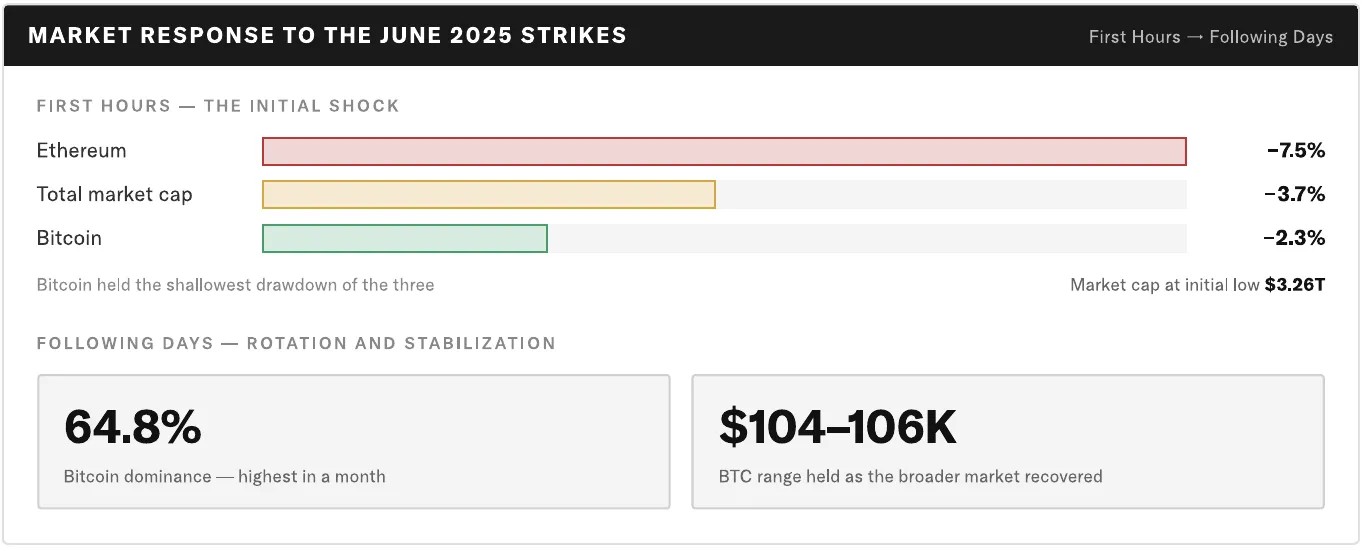
Initial market reaction to the escalation of the conflict between Israel and Iran. Source: Bitcoin Policy Institute.

Later, the price of the first cryptocurrency stabilized in the range of $104,000-106,000, and its share of the market capitalization reached 64.8%. The expert interpreted this dynamic as investors shifting from altcoins to Bitcoin to reduce risk.

Separately, he noted the continuous operation of crypto platforms. BPI cites Steven Coltman of 21Shares, who pointed out that during strikes on the UAE in 2026, local stock exchanges suspended trading, while platforms for trading digital assets continued operations.

Strait of Hormuz Paradox: Why the Oil Shock Didn't Break Bitcoin

Different Reasons for Adoption

Belbagi highlighted two scenarios for the region's development. In Egypt, Turkey, Lebanon, and Iran, the demand for Bitcoin and dollar-pegged stablecoins was linked to currency depreciation and restrictions of the traditional financial system.

In the UAE and Bahrain, growth is supported by regulation, institutional participants, and government economic diversification programs.
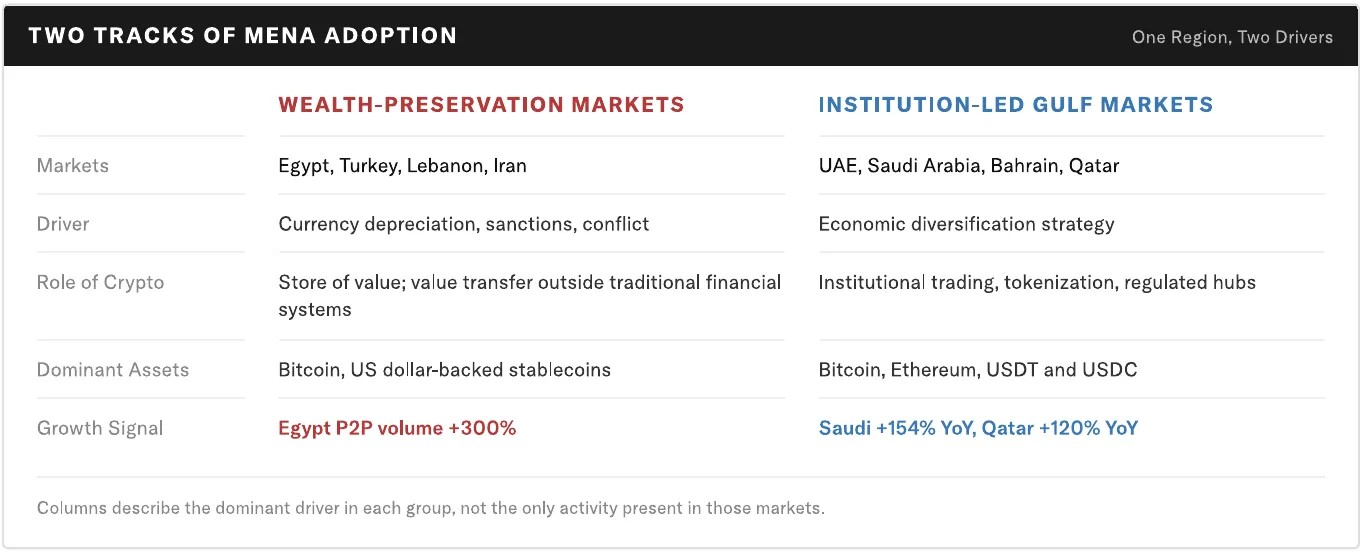
Two paths of cryptocurrency adoption in MENA. Source: Bitcoin Policy Institute.

Differences between markets were also noted by Chainalysis analysts in their 2025 report. In the UAE, the volume of small crypto payments through merchant services — less than $1000 — grew by 88.1% over the reporting period. Analysts linked this to the expansion of everyday use of digital assets.

In Turkey, the picture was different. The country led the region with an annual crypto transaction volume of around $200 billion, but researchers noted an increase in speculative trading.

By mid-2025, the 31-day smoothed average daily turnover of altcoins exceeded $240 million, compared to approximately $50 million at the end of 2024.
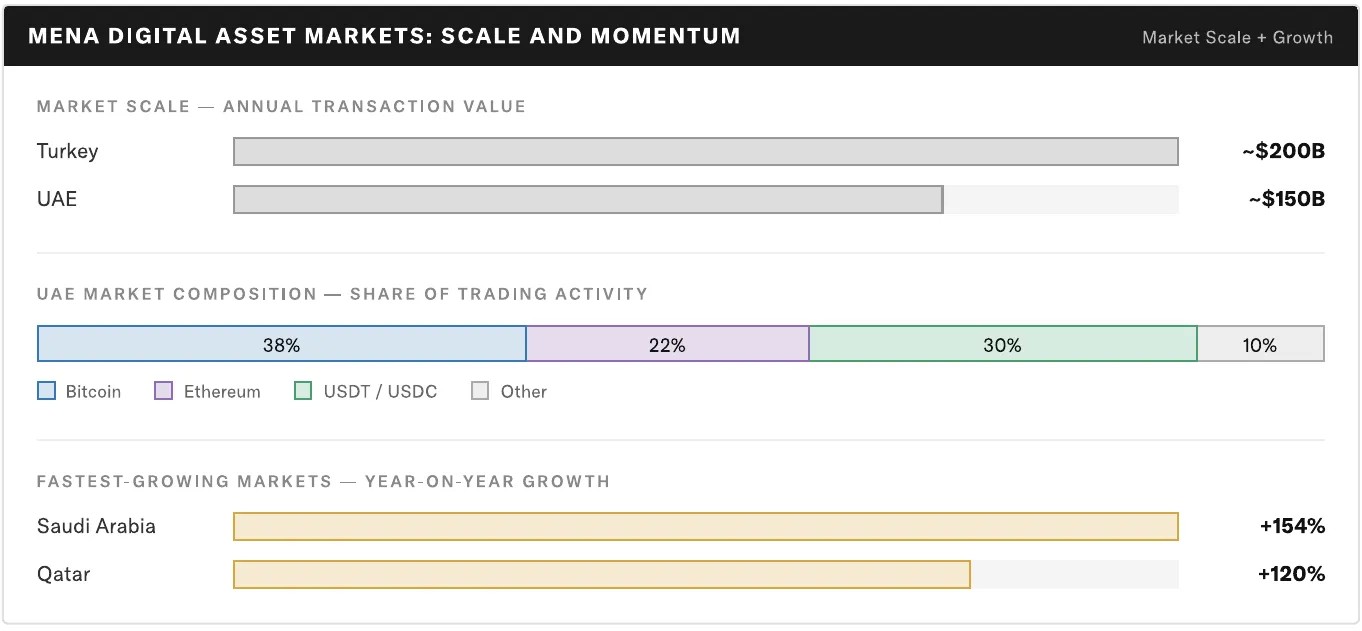
Source: Bitcoin Policy Institute.

According to Chainalysis, some participants, facing reduced purchasing power, began taking greater risks for returns. At the same time, the volume of transfers in the retail categories below $1000 and between $1000 and $10,000 decreased by 2.3% and 1.6%, respectively.

In Iran, analysts discovered growing isolation of the local crypto market: the average number of intermediate transfers between Iranian services and international exchanges increased from 1.6 in 2021 to 4.1 in 2025.

Recall that in April, Bitwise Chief Investment Officer Matt Hougan and Head of Research Ryan Rasmussen stated that the conflict in Iran has brought Bitcoin closer to the role of a real medium of exchange.

end-content

Related Questions

QAccording to the article, what are the main factors driving the adoption of cryptocurrencies in the MENA region?

AThe main drivers are macroeconomic pressure (such as military conflicts and instability of national currencies) and government-led digitalization programs. This differs from the global market, where growth is driven by institutional investment and regulatory changes.

QHow did the crypto market react to the initial escalation of the Israel-Iran conflict in June 2025, according to Zaid Belbagi?

AAfter the initial strikes, Bitcoin's price fell by approximately 2.3% to $105,200, and Ethereum lost 7.5%. The overall crypto market capitalization decreased by 3.7%. Later, Bitcoin stabilized between $104,000 and $106,000, with its market share reaching 64.8%, which was interpreted as investors shifting from altcoins to Bitcoin to reduce risk.

QWhat key difference in crypto adoption is highlighted between countries like Egypt/Turkey/Lebanon/Iran and countries like the UAE/Bahrain?

AIn Egypt, Turkey, Lebanon, and Iran, demand for Bitcoin and dollar-pegged stablecoins is driven by currency devaluation and restrictions in the traditional financial system. In the UAE and Bahrain, growth is supported by regulation, institutional participants, and state-led economic diversification programs.

QWhat contrasting trends in cryptocurrency usage were identified in Turkey compared to the UAE based on the Chainalysis 2025 report?

AIn the UAE, the volume of small crypto payments (under $1,000) via merchant services grew by 88.1%, indicating expanding everyday use. In Turkey, despite leading the region with around $200 billion in annual transaction volume, there was a noted increase in speculative trading, with a significant rise in altcoin trading volume, while retail transfers in smaller amounts declined slightly.

QWhat observation did the article make about the operational resilience of cryptocurrency platforms during regional conflicts?

ADuring strikes on the UAE in 2026, while local stock exchanges halted trading, platforms for trading digital assets continued their operations without interruption. This highlights the resilience and continuous operation of crypto exchanges compared to traditional financial markets in times of conflict.

Related Reads

Just now, Chen Danqi officially announced joining Noeri part-time, a new company betting on AI self-evolution

Princeton computer science associate professor Danqi Chen has revealed she joined AI startup Noeri on a part-time basis two months ago, expressing enthusiasm for its focus on applying AI to scientific discovery so scientists can tackle their hardest research problems. Noeri was co-founded by Stanford computer science professors Yejin Choi and Carlos Guestrin, who serve as co-CEOs. The company focuses on developing AI systems that can continuously learn and self-improve, helping enterprises build customized AI from their own data and business experience. It has raised $110 million led by Menlo Ventures, with participation from Madrona Venture Group, Kindred Ventures, Wing Venture Capital and NEA, plus strategic investors including NVIDIA, Cisco Investments and Snowflake. Choi is a leading researcher in commonsense reasoning, NLP, LLMs and AI alignment, formerly at the University of Washington and Ai2 and a senior research director at NVIDIA. Guestrin is a veteran ML scholar and entrepreneur who co-created XGBoost and co-founded Turi (acquired by Apple in 2016), later serving as Apple's senior director of ML and AI. Chen, an associate professor at Princeton, co-leads its NLP group, serves as deputy director of the Princeton Language and Intelligence initiative, and is a co-author of RoBERTa. Noeri's core idea is "Plural Intelligence" — the belief that future AI should comprise many systems of different scales and specialties, each organization building and continuously improving its own AI, rather than depending on a single corporate superintelligence. Its product acts like a persistent AI engineer: it studies a company's data and workflows and optimizes instructions and skills, tool configuration and orchestration, model selection, and even underlying model parameters. Every change comes with an explanation and requires human review, akin to code review. The system supports both closed and open-weight models and learns from each task's interactions and corrections. Chen said she looks forward to working with Choi, a longtime role model and friend, and is especially excited about plural intelligence in scientific discovery, where specialized AI agents could continuously learn around a specific research question, remember past attempts, and collaborate on hypotheses and validation.

marsbit25m ago

Just now, Chen Danqi officially announced joining Noeri part-time, a new company betting on AI self-evolution

marsbit25m ago

40 Kilometers: Shenzhen Fits an Entire Chip Supply Chain Into a One-Hour Drive

Shenzhen is compressing an entire chip supply chain into a one-hour drive, roughly 40 kilometers. Design firms cluster within 10 km of the Futian APEC venue, while fabs sit 20–40 km away in Pingshan, Pinghu, and Yanluo. The article argues this is not just local ambition but a response to a hard rule: the more mature a process, the easier design and manufacturing can be separated; the more immature, the closer they must be. TSMC's PDK model let California design and Taiwan manufacturing run for 30 years, but only because mature processes could be codified. Shenzhen's outer ring, however, hosts immature work—Huawei's "Tau Law" and stacked "logic folding" chips—where tacit knowledge lives in engineers' heads and demands face-to-face iteration. With回路B (design-process feedback) and回路C (fab-equipment feedback) cut by export controls after 2020, both loops had to return home. Shenzhen lacks an integrated giant like Samsung or Intel, so it uses city governance: a state platform invests across fabs and equipment makers, plus tape-out subsidies up to 10 million yuan. The geography forms a slope—Nanshan offices, Bantian R&D, Guanlan/Pinghu pilot lines, Pingshan fabs—connected by Metro Line 14 (40 minutes Futian to Pingshan). The lesson for planners: zone land by process maturity, not by industry category, and keep the most immature, iteration-hungry steps within an hour's drive rather than chasing a full chain.

marsbit25m ago

40 Kilometers: Shenzhen Fits an Entire Chip Supply Chain Into a One-Hour Drive

marsbit25m ago

German lawmakers back crypto freezes outside criminal cases

Germany’s Bundestag passed a customs reform bill allowing authorities to temporarily freeze cryptocurrency and other high-value assets suspected of unlawful origins without first opening a criminal investigation. The measure targets assets worth over 100,000 euros and explicitly names cryptocurrencies. Authorities could hold assets for up to 30 days given factual indications of unlawful origin, with confiscation applications suspending deadlines pending court decisions; in contested cases courts must be satisfied assets are illicit, effectively placing the burden of proof on the holder. SPD lawmaker Ingo Vogel said the powers let authorities pursue suspicious assets absent grounds for a criminal case. The bill needs Bundesrat consent and is intended to take effect Jan. 1, 2027. The Federal Bar Association (BRAK) opposed the draft, warning “unlawful origin” is too vague and risks treating missing records as evidence of illicit wealth, citing inherited assets as an example, and questioned what the administrative process adds to existing criminal confiscation rules. Bundesblock warned blockchain analysis should not automatically be treated as proof of ownership or control, and incorrect wallet attribution could infringe fundamental rights. Germany has already made large seizures: Saxony sold 49,858 BTC linked to the Movie2k piracy probe in 2024 for about 2.6 billion euros. A Leipzig judge recently proposed ending proceedings against the main defendant for 40,000 BTC and 38 million euros for potential victims; the proposal remains under consideration.

cointelegraph2h ago

German lawmakers back crypto freezes outside criminal cases

cointelegraph2h ago

Trading

Spot
活动图片