Opinion: A Week of Two Reversals in Financial Markets

cryptonews.ruPublished on 2026-09-07Last updated on 2026-09-07

Abstract

**Summary: A Week of Two Shifts on Financial Markets (Aug 31 – Sep 4, 2026)** Financial markets experienced a week of dual reversals amid shifting expectations. Major stock indices (S&P 500, Nasdaq, Dow) ended nearly flat, masking internal volatility. The probability of a September Fed rate hike fluctuated, starting the week at 65%, dropping to ~50% mid-week after dovish Fed commentary, and rebounding to 63% following a strong U.S. jobs report (+162k jobs). Bond yields rose globally (U.S. 10-year ~4.75-4.80%), but the U.S. Dollar Index remained subdued below 100. Oil prices surged (Brent +7.6% to $92.68), driven by refinery capacity constraints and critically low diesel inventories rather than crude supply shortages, creating a persistent inflationary risk. Gold fell 3.5% as rising real yields from higher rates outweighed its safe-haven appeal. The equity market saw rotation: semiconductor stocks outperformed while some software and growth stocks weakened. Capital continued flowing out of U.S. equity funds into cash and short-term bonds. Bitcoin traded between $76,200 and $82,200, closing at $79,766. The crypto market was supported by a sharp $1.24 billion weekly inflow into exchange-traded crypto funds, with Bitcoin receiving the majority. Market structure favors large-cap assets (Bitcoin dominance 59.4%), with the Altseason Index at 40/100 indicating limited rotation into altcoins. Key drivers of the week's relative stability were defensive positioning and short-coveri...

Disclaimer

ForkLog is not responsible for readers' investment decisions. Financial market forecasts represent the author's personal opinion and do not necessarily reflect the editorial position.

In an author's column for ForkLog, trader and Coen+ Telegram channel author Vladimir Coen analyzed how a shift in Fed rate expectations, rising yields, and fuel prices impacted markets, while inflows into crypto funds supported bitcoin after an intraweek reversal.

Financial Markets: August 31 — September 4, 2026.

Indices closed almost unchanged: the S&P 500 gained 0.1%, the Nasdaq Composite rose 0.4%, while the Dow Jones Industrial Average fell 0.3%. Behind this flat picture lie two shifts in direction and a noticeably changed market internal structure.
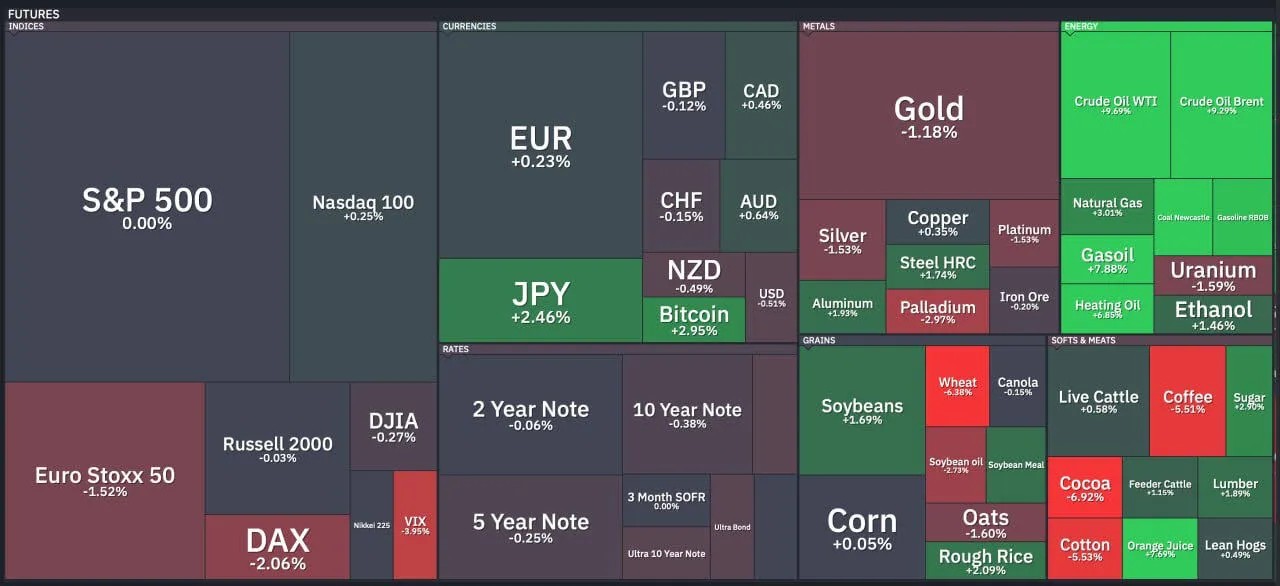
Futures market heatmap. Source: Finviz.

The Pendulum of Rate Expectations

The week began in a sentiment typical for September: a historically weak month for markets, escalation in the Middle East, expensive oil, and inflation risks. The reaction was predictable: defensive positioning, growth in short positions, and heightened sensitivity to data.

The trajectory of probability for a September rate hike:

  • Hawkish impulse after Fed Chair Kevin Warsh's speech in Jackson Hole — 65%;
  • Verbal interventions by Fed Governor Christopher Waller and New York Fed President John Williams — a drop to around 50% and a short squeeze on Thursday;
  • Strong employment report on September 4 — return to 63%.

Employment grew by 162,000 against expectations of 45,000-55,000. Unemployment was 4.1%. The July figure was revised from negative territory to positive.

A key nuance: the report removed the argument for easing but did not show a new wage overheat. This was not a hawkish shock, but rather a cancellation of dovish hope.

The reaction was appropriate: on Friday, the S&P 500 fell 0.38%, Nasdaq — 0.29%.

The probability of at least one rate hike by year-end reached 71.5%.

How Does the Fed Rate Affect Cryptocurrency Prices?

Rates: Pressure Became Global

The yield on 10-year U.S. Treasury bonds ranged between 4.75-4.80%, for 30-year bonds — above 5.2%.

Simultaneously, yields on German, British, and especially Japanese bonds rose. Therefore, this can no longer be considered solely an American story.

The market is globally re-evaluating three factors: the term premium, the volume of government borrowing, and the neutral rate level.

The main divergence of the week: the probability of a rate hike is rising, yields are rising, but the dollar index remains below 100.

The dollar does not confirm the scale of the move in the bond market. In my opinion, participants are pricing in a targeted tightening but are not yet pricing in the start of a new rate hike cycle. These are different scenarios.

Oil: The Shortage Isn't in Crude

Brent closed the week at $92.68 (+7.6%), WTI — at $91.48 (+10%).

But the barrel price itself doesn't show the main thing. According to U.S. Energy Department data:

  • Crude oil inventories fell by 4.5 million barrels;
  • Gasoline inventories decreased by 1.2 million barrels;
  • Distillate inventories were 104.2 million barrels, which is 14% below the five-year average;
  • Refinery utilization reached 98%;
  • Petroleum product deliveries over four weeks fell 4% year-over-year.

The combination is atypical: demand is not overheated, but plants are operating near physical capacity, and fuel inventories remain low. So, the bottleneck now is not in crude oil, but in refining capacity and diesel fuel availability.

American diesel reached a record $5.85 per gallon. European crack spreads exceeded $100 per barrel.

This is an inflationary impulse with a lag. It penetrates core inflation through transportation costs and production costs and may persist even after oil prices stabilize.

Gold: Rates Proved Stronger Than Fear

Gold fell 3.5% over the week — from $4601 to $4438. This happened against the backdrop of military escalation.

The mechanics look like this: rising tensions push oil up, expensive oil supports real yields, and rising yields put pressure on gold.

As a result, the rate effect proved stronger than safe-haven demand. As long as real yields are rising, international tension alone is not a sufficient driver for gold.

Stocks: The Index Held, Structure Changed

The semiconductor sector outperformed the market. Part of the software companies and growth stocks from the consumer segment came under pressure.
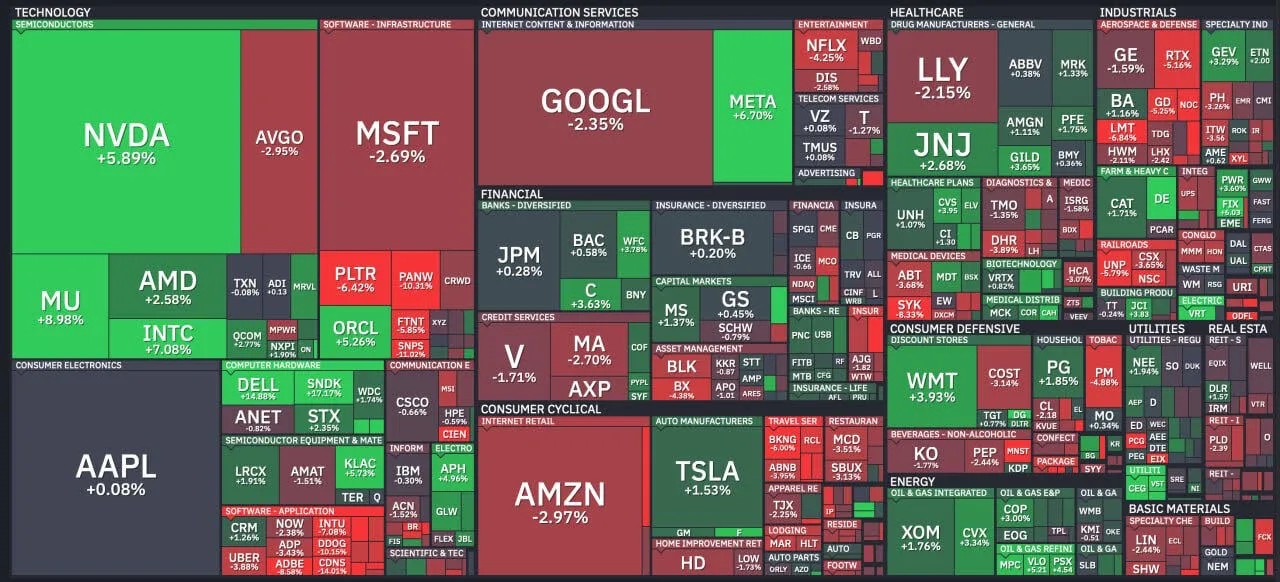
Futures market heatmap. Source: Finviz.

On Friday, the SOX index gained 3.4% against a decline in broad indices. This already looks more like market stratification than ordinary rotation.

Simultaneously, capital outflow continues:

  • U.S. equity funds saw outflows of $11.1 billion for the week to September 2, compared to $22.7 billion the previous week.
  • Money market funds received $48.8 billion;
  • Short- and medium-term government bonds saw inflows of $4.5 billion.

Old capital maintains positions, while new money is mainly going into cash and short-term debt.

Cryptocurrencies: Inflow Returned Sharply

Bitcoin traversed a route from $76,200 through $82,200 to $79,766 over the week.

Closing prices for the week:

  • Bitcoin — $79,766 (+0.44%).
  • Ethereum — $2461 (+0.34%).
  • BNB — $766.30 (+6.99%).
  • Solana — $103.27 (+1.68%).
  • $XRP — $1.4176 (+0.44%).

Total market capitalization was $2.7 trillion with a trading volume of $67.4 billion.

Is a Bitcoin Price "Golden Cross" Expected in 2026?

Bitcoin dominance reached 59.4%, Ethereum — 11.1%, with other assets accounting for 29.5%.

The Fear and Greed Index stood at 75, in the greed zone. The Altseason Index — 40 out of 100. A full altcoin season is still far away: major capital remains in the first tier.

Open interest in perpetual contracts was $408.59 billion, in futures — $2.37 billion.

Implied volatility Volmex for Bitcoin reached 39.32, for Ethereum — 52.84. The leading altcoin is trading at a volatility premium against the comparative weakness of its price. This indicates higher demand for hedging specifically in this asset.

The main change of the week occurred in exchange-traded crypto fund flows:

  • August 27 — +$540 million.
  • August 31 — +$310 million.
  • September 1 — −$194.4 million.
  • September 2 — +$60 million.
  • September 3 — +$820 million.
  • September 4 — +$205.8 million.

On September 4, Bitcoin saw inflows of +$174.6 million, Ethereum — +$25.9 million, HYPE — +$10.5 million. Solana recorded an outflow of $5.2 million, $XRP — a zero result.

Final flows were +$1.238 billion for the week, +$5.745 billion for the month, and +$4.164 billion for the quarter. Combined crypto fund assets reached $122.57 billion across 32 products from 11 issuers.
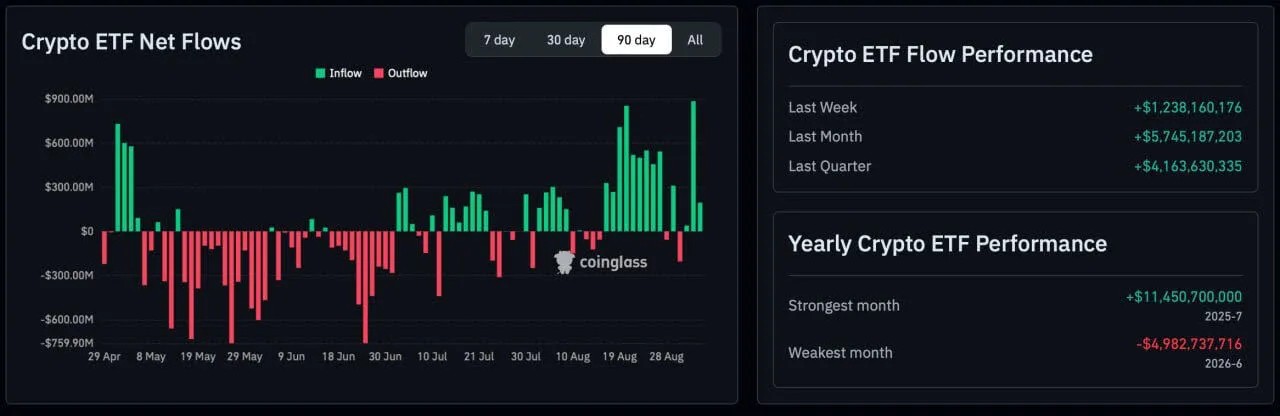
Source: CoinGlass.

The intraweek reversal here mirrors the stock market: selling on Tuesday, a strong reversal on Thursday, and consolidation on Friday.

Why the Decline Was Mild

For me, this is the key to the entire week:

  1. The market entered the week with a defensive skew: accumulated short positions, purchased hedges, and heightened sensitivity to news.
  2. A series of verbal interventions on Wednesday and Thursday lowered the probability of a rate hike from about 65% to 50%. Short positions began to close, amplifying the rise on Thursday.
  3. By Friday, a significant portion of shorts had already been closed, but hedges remained ahead of the employment data release.
  4. The report was strong. However, a significant part of the speculative overhang had disappeared the day before, and the remaining hedges softened the move.

As a result, the market declined, but from higher levels and with relatively restrained volatility. Positioning and defensive structures partially absorbed the blow in advance.

The Timing Puzzle

On the eve of the September 4 data release, an unusually dense series of public statements was heard: from Fed representatives, Secretary of Commerce Howard Latnik, the Treasury Secretary, and U.S. President Donald Trump himself.

This was not one speech, but a whole series immediately before the report.

In my view, such a sequence looks deliberate. Administration representatives might have understood the direction of the data in advance and prepared the market, softening rate expectations before the publication.

The result was a strong short squeeze against the backdrop of general September pessimism. By the time negative stock data was released, the market was already much less vulnerable in terms of positioning.

The link looks consistent: a series of interventions → a reversal of expectations → closing of short positions → a milder reaction to strong data.

The closer the elections get, the more such interventions we are likely to see. The battle for managing expectations is already intensifying.

Week's Summary

The week ended almost unchanged for major indices, but with increased sensitivity to rates and record diesel prices as one source of inflation risk.

The crypto market closed the week on the return of institutional demand: net inflows into exchange-traded products amounted to $1.238 billion after a reversal of flows within the week.

Main trends:

  1. The divergence between the dollar and yields remains unresolved: the market prices in targeted tightening but not the start of a new rate hike cycle.
  2. A shortage of refining capacity and low distillate inventories create an inflation channel with a lag that is not fully dependent on oil prices.
  3. Outflows from U.S. stocks continue against the backdrop of index resilience: the direction of capital movement diverges from price dynamics.
  4. The crypto market remains in a Bitcoin dominance phase. The Altseason Index is 40 out of 100, a noticeable rotation into altcoins has not yet begun.

Triggers for the next week:

  • Fed meeting on September 15-16. The current probability of a rate hike is 63%;
  • CPI publication before the meeting, which will determine the final trajectory of expectations;
  • Continued verbal interventions before the rate decision;
  • Dynamics of distillate inventories and refinery utilization as a signal of the persistence or weakening of inflation risk from fuel.

The market closes the week in a state of a compressed spring: indices are near highs, rates are at multi-year peaks, and the dollar does not confirm the move. Next week will show which of these forces changes direction first.


Related Questions

QWhat were the key reasons for the 'two reversals' experienced in the financial markets during the week of August 31 - September 4, 2026?

AThe first reversal occurred mid-week when dovish remarks from Fed officials Waller and Williams lowered the perceived probability of a September rate hike from 65% to around 50%, triggering a short squeeze. The second reversal came on Friday after a strong employment report, which dashed those dovish hopes and pushed the probability of a hike back to 63%, causing a market decline.

QAccording to the author, what was the most significant discrepancy in market behavior during the reported week?

AThe most significant discrepancy was that while the probability of a Fed rate hike and Treasury bond yields were rising, the US Dollar Index remained below the 100 mark. The author interprets this to mean the market is pricing in a potential spot-tightening but not the start of a new cycle of rate hikes.

QWhy does the author argue that the current oil market situation presents an inflationary risk with a lag, even if crude oil prices stabilize?

AThe author points out that the bottleneck is not crude oil supply, but refining capacity and low inventories of distillates (like diesel). With refineries operating near physical limits and diesel prices hitting record highs, this creates an inflationary impulse through increased transportation and production costs that can persist after crude prices stabilize.

QWhat was the main factor that prevented a more severe market drop following the strong US employment report on September 4th?

AThe main factor was the market's defensive positioning. Entering the week, many participants held short positions and hedges. The mid-week dovish comments triggered a short squeeze, closing many of those shorts. By Friday, the speculative overhang was reduced, and remaining hedges softened the impact of the negative news.

QWhat does the significant weekly inflow of $1.238 billion into crypto exchange-traded products indicate about the cryptocurrency market's condition?

AIt indicates a strong return of institutional demand and support for major cryptocurrencies like Bitcoin, which received the majority of the inflows. This institutional flow helped Bitcoin recover from an intra-week decline and close the week slightly higher, mirroring the reversal pattern seen in traditional stock markets.

Related Reads

Leverage Flush, ETF Selling Pressure Not Yet Exhausted: The On-Chain Truth Behind the $64K Defense Line

After a month of range-bound trading, crypto markets suffered a brutal deleveraging washout last weekend, with Bitcoin falling roughly 13% in a week and briefly piercing $63,000, marking its sharpest single-day volatility in months. Glassnode's Week 47 Market Pulse report notes that while overheated derivatives leverage has largely been flushed out, continued outflows from spot ETFs are pushing the sector toward a critical threshold, with the aggregate ETF MVRV nearing the 1.0 break-even line. On-chain microdata shows loss pressure concentrated among recent entrants, with short-term holders now underwater overall. Bitcoin hovered near $64,000 on Monday after a weekly close down about 13%. The sell-off began Thursday and accelerated over the weekend, briefly breaking $63,000 on Saturday for the lowest level since late August. The concentrated selling rapidly cleared leveraged positions built up in derivatives over prior weeks. Perpetual futures open interest fell to the lower bound of its statistical range, and funding rates cooled sharply from warning levels back to neutral. Meanwhile, U.S. spot ETF investors extended net outflows, recording withdrawals every trading day last week, with aggregate ETF MVRV sliding to 1.06, extremely close to holders' break-even benchmark. On-chain activity remains relatively robust, with daily active addresses and large transfers holding up, but paper losses fall almost entirely on holders who entered in recent months. Short-term holders have turned fully underwater, and realized losses hit their highest level since July. In derivatives, spot momentum plunged 36.1% to 22.8, the weakest since August. Spot CVD deteriorated from -$51.5M to -$133.7M, with aggressive selling dominant Thursday through Saturday before slowing Sunday. Futures open interest fell 7.2% to $34.2B, also at the range's lower bound. Perpetual CVD widened from -$493M to -$1.4B, reflecting forced liquidations and stop-losses among speculative longs. The 25-delta skew jumped 30.9% to 13.7%, a new put-premium record since August, signaling strong demand for downside hedges. Spot ETF weekly net outflows narrowed slightly to -$995.4M but remain near the range bottom; weekly trading volume fell to $11.5B as institutions stayed defensive. On-chain, entity-adjusted daily transfer volume rose 3.6% to $5.4B near the upper bound, and daily active addresses totaled about 659,700, still healthy. However, realized cap monthly growth nearly stalled, dropping from 0.43% to 0.04%, indicating significantly slower external capital inflows. The STH-to-LTH supply ratio edged up to 15.1%, and hot capital share held at a high 22.0%, showing young coins bought within three months still carry heavy trading weight. The share of supply in profit fell from 60.4% to 55.3%, and STH-NUPL turned negative at -7.4%, historically a typical zone for capitulation-style turnover. Overall, the crash was driven by persistent ETF reduction, speculative long squeeze, and macro risk aversion. Open interest and funding rates have left dangerous overheated levels, clearing much pure leverage risk. Whether ETF net outflows turn positive and whether short-term holder capitulation spreads to long-term believers will determine if $64,000 becomes a solid bottom.

marsbit17m ago

Leverage Flush, ETF Selling Pressure Not Yet Exhausted: The On-Chain Truth Behind the $64K Defense Line

marsbit17m ago

US Stocks Trend (November 17): Nvidia Falls Another 4% to a 52-Week Low, Nasdaq Plunges 2.49%

Nvidia fell another 4.1% to $156.14, hitting a 52-week low, as the chipmaker's troubles deepened. Micron and Intel each dropped over 7%, and the Nasdaq tumbled 2.49%. The selloff spread to financials, industrials and energy, with all three major indexes closing lower. The Dow fell 739.38 points (-1.41%) to 51,608.17, the S&P 500 lost 145.08 points (-1.92%) to 7,416.59, and the Nasdaq dropped 626.52 points (-2.49%) to 24,509.76. The Russell 2000 fell 1.70%. It was the Nasdaq's biggest one-day decline since Nov. 5, and the S&P 500 and Nasdaq have now fallen for three straight sessions, erasing last week's gains. Nine of the S&P 500's 11 sectors declined, with tech and communication services down 2.98% and 2.82%, while consumer staples and utilities edged higher. The VIX jumped 18.7% to 22.91. Nvidia's board is focused on its investigation of Jensen Huang and has not discussed bringing him back as CEO, according to CNBC. The company has hired law firm Wachtell Lipton to investigate whether his conduct endangered national security or company secrets. Treasury Secretary Bessent called for a major overhaul and urged the board to look externally for a new CEO. The Commerce Department's BIS issued an interim final rule closing a loophole allowing Chinese firms to rent Nvidia compute through third-country data centers. Wall Street kept cutting targets: Mizuho lowered its to $220 from $250 and UBS to $240 from $300, both maintaining buy ratings. Mizuho's Vijay Rakesh said the roughly 32% drop from October's high, larger than the Philadelphia Semiconductor Index's 23% decline, reflects a lost "founder premium," with the CEO departure adding six to seven months of management uncertainty. Chip stocks fell broadly: Micron -7.62% to $719.02, Intel -7.07% to $55.47, Marvell and Arm each down over 7%, AMD about -6%, Broadcom about -4%, and the iShares Semiconductor ETF -5%. SanDisk and Lumentum fell over 8%, Dell about 7%, Oracle about 5%. Financials joined the afternoon selloff, with Morgan Stanley, Goldman Sachs and JPMorgan each down over 2%; Caterpillar fell 4.95% and Boeing 3.66% to a 52-week low. Defensive names outperformed: P&G rose 1.90% to a 52-week high, Molina Healthcare jumped 11.27% and Tyson Foods gained 8.72%. The November Empire State manufacturing index came in at 7.8, down 18 points from October and below the 16.7 expected; new orders fell to 3.0 while employment rose to 18.1, the highest since June 2022. The 10-year Treasury yield fell 2.2 basis points to 5.117% and the 2-year dropped 3.1 basis points to 4.821%, a bull steepener. Fed Chair Warsh's remarks focused on AI, warning it could disappoint, with little on monetary policy. WTI crude fell 3.21% to $85.72 a barrel and Brent dropped 3.55% to $92.44, as reports that the U.S. has no immediate plans to strike Iran outweighed support from an Iranian attack on a Bahrain air base and a tanker hitting a mine in the Strait of Hormuz. Gold fell 0.86% to $3,853 an ounce and silver plunged 4.60%. Bitcoin fell as low as $62,000 over the weekend, its lowest since August, and traded around $65,300 after the close. Looking ahead, Nvidia reports fiscal third-quarter results after the bell on Tuesday, with Bloomberg consensus at $2.47 EPS on about $109.15 billion in revenue; interim CEO Colette Kress will host the call, and options pricing implies an 8% move this week. Disney and Home Depot report before the open Tuesday, alongside October retail sales and import price data. Later in the week, Anthropic is expected to price Wednesday and list on Nasdaq Thursday at $70-78 per share, valuing it around $1.4 trillion, and Take-Two's GTA VI launches Thursday.

marsbit24m ago

US Stocks Trend (November 17): Nvidia Falls Another 4% to a 52-Week Low, Nasdaq Plunges 2.49%

marsbit24m ago

Altman Empathizes with Jensen Huang: 'Heroes Have Flaws,' But Does He Support His Return as NVIDIA CEO...

At the Semafor Silicon Valley Summit on November 16, OpenAI CEO Sam Altman publicly addressed Nvidia founder Jensen Huang's resignation as CEO after 33 years, expressing strong personal empathy. Altman called Huang "a hero of mine" and said it's hard to imagine the AI revolution without him, acknowledging that "heroes have flaws." Nvidia's stock fell about 15% within a week, wiping out over $570 billion in market value, and 180,000 people signed a petition urging his reinstatement—echoing Altman's own 2023 board ouster and dramatic return. Altman noted that Nvidia and OpenAI bet on each other early on. On business matters, he dismissed concerns that Nvidia's commitments—including a $105 billion financial guarantee for an OpenAI data center in Ohio—would lose credibility, saying the company is now a massive giant whose backing remains trusted. He also expressed optimism that the AI industry will keep advancing without Huang, given strong market demand and validated AI value. Altman identified scientific research as the next major AI breakthrough area, citing progress in math and physics, and predicted AI will take over repetitive, process-driven enterprise work. He also clarified his controversial memory chip remarks (saying he actually supports consumers upgrading their own PCs), explained that chip demand projections from multiple suppliers overlap even though real data center demand is solid, said OpenAI has not yet launched fully autonomous recursive self-improvement due to safety concerns, and stated OpenAI is in no rush to IPO despite Anthropic's filing, noting investor demand far exceeds quality supply.

marsbit28m ago

Altman Empathizes with Jensen Huang: 'Heroes Have Flaws,' But Does He Support His Return as NVIDIA CEO...

marsbit28m ago

If you lose money helping a friend trade cryptocurrency, will it be deemed fraud?

When friends entrust you with money to trade cryptocurrency on their behalf and the market turns against them, two distinct legal questions arise: whether you must compensate them, and whether your conduct constitutes fraud. These are separate issues. Civil liability depends on the nature of the relationship—whether it was a loan, a委托 investment, or a joint venture—and on the validity of any agreement. Under Chinese policy, virtual currency investment activities are treated as illegal financial activities, and civil acts involving them that violate public order and good morals are void, with losses generally borne by the parties themselves. Courts have reached different outcomes: in one case, an investor's claim for full repayment was rejected because the loss stemmed from market risk; in another, the operator was ordered to bear 20% of the loss for failing to recognize compliance risks, while the investor bore 80%. Fraud, by contrast, requires proof of deceptive conduct and intent to illegally possess the funds—mere trading losses or refusal to repay do not establish fraud. However, fabricating trade records, misappropriating funds, or secretly using leverage contrary to instructions can change the analysis. If a dispute escalates or police become involved, the priority is to preserve complete records of the agreement, fund flows, and trading history, avoid making unauthorized repayment promises, and cooperate truthfully with authorities while seeking professional legal advice.

marsbit28m ago

If you lose money helping a friend trade cryptocurrency, will it be deemed fraud?

marsbit28m ago

Stop Asking, I Just Love Money! The Naked-Quit Genius Researcher Backtracks, May Want to Return to Big Tech

Jacob Coxon, a 27-year-old Cambridge mathematics graduate and former pretraining researcher at both OpenAI and Anthropic, publicly reversed his stance just two months after a high-profile resignation. Speaking at a Stanford University event hosted by professor Rob Reich, Coxon admitted he is unsure whether leaving was the right decision and suggested he might return to a top AI lab. When pressed on why he still holds OpenAI stock options despite describing frontier labs as existential threats, he candidly replied, "I like money, brother. I admit it's blood money," and deflected further questions by blaming the host for raising the issue. He also said he remains anxious about no longer seeing frontier progress from the inside and feels he is "shouting into the void," questioning whether staying inside a lab would have been more influential. On technical matters, he argued that pretraining is not hitting a wall—compute efficiency is following a "super-exponential" curve—that recursive self-improvement requires only one narrow technical capability rather than broad mastery, and that deceptive or uncontrolled behavior in models originates solely from reinforcement learning during post-training, a loop labs cannot escape because RL remains the only effective tool for making models follow complex instructions. The episode, in which he clings to valuable equity while warning of AI risk, is seen as a candid portrait of Silicon Valley's AI culture.

marsbit32m ago

Stop Asking, I Just Love Money! The Naked-Quit Genius Researcher Backtracks, May Want to Return to Big Tech

marsbit32m ago

Trading

Spot
活动图片