Morpho Stablecoin Yield Strategy: Same Curator, 3.96% vs. 7.7% Return Gap

marsbitPublished on 2026-09-09Last updated on 2026-09-09

Abstract

**Summary of "Morpho Stablecoin Yield Strategy: 3.96% vs 7.7% from the Same Curator"** This article analyzes a yield opportunity on Morpho, a permissionless lending protocol, where depositors can bypass curated vaults to directly supply stablecoins to individual lending pools for higher returns. The core observation is a significant yield gap: a conservative vault managed by "Steakhouse Financial" offers a 7-day average APY of 3.96%, while its higher-risk vault offers 5.09%. Meanwhile, directly depositing into a specific pool (USDC / PT-reUSD-10DEC2026), which several professional vaults like Steakhouse also invest in, yields approximately 7.7%. This ~3.7 percentage point premium compensates depositors for assuming the specific collateral risk (a structured asset expiring Dec 10, 2026) and forgoing the diversification, monitoring, and emergency actions provided by vault managers. The article details the risks: 1) Concentrated exposure to a single collateral type with potential de-pegging or expiry risks. 2) Low immediately withdrawable liquidity (only 5% of the pool's supply), meaning exits may require queuing. 3) No professional oversight for the pool. Key operational advice includes: * Using the number of reputable vaults invested in a pool as a primary filter (for exclusion, not endorsement). * Always calculating the "landed" APY based on one's deposit size and the pool's utilization rate, rather than trusting the listed rate. * Pre-defining strict exit signals (...

Written by: Daii

A stablecoin curator managing $2.2 billion. Its most conservative vault has provided depositors with an average 7-day APY of 3.96%; another vault under the same curator's name has a 7-day average of 5.09%, while the pool into which it has placed nearly $10 million yields around 7.7% on a 7-day average.

The few percentage points of difference aren't pocketed by anyone; they are the price you pay for "not having to make decisions yourself" and "not having to bear the collateral risk yourself"; the door to that pool is closed by default in the main interface.

This mismatch won't disappear because subsidies run out; it will gradually be arbitraged away as more and more people push that door open.
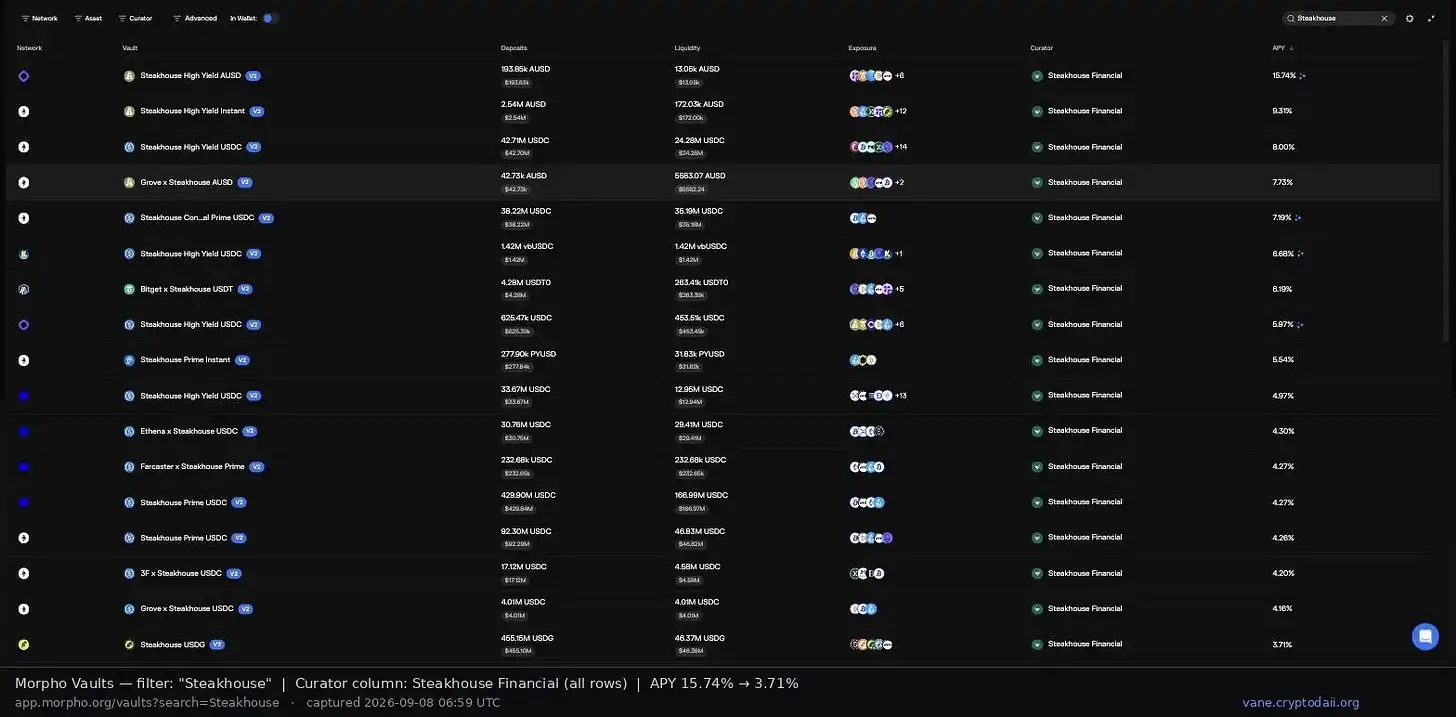
Figure 1: Morpho's official vault list, searching for Steakhouse. The entire Curator column is the same entity. The APY column ranges from 15.74% down to 3.71%.

1. Where Does This Extra Yield Actually Come From?

Let's be absolutely clear: There are no token emissions, no points, no airdrop expectations here. All the numbers above are real interest paid by borrowers—the cleanest type of yield in this system. Precisely because it's clean, it won't suddenly drop to zero like subsidies; but also because it's clean, it won't be given to you for free.

In these permissionless lending systems, depositors actually have three paths, not two.

The first is the default path: entrust your funds to a conservative vault managed by a professional team. The team selects pools for you, diversifies, monitors, and repositions during crises. What you receive is a blended average return, after deducting the team's performance fee and the drag from idle funds held for redemption readiness.

The second path, many don't know exists: The same team often also operates a vault with a higher risk tolerance. It's still monitored and diversified, but the list of eligible pools is broader. In Figure 1, that entire Curator column belongs to the same entity, yet yields range from 3.71% up to 15.74%—the difference isn't about who manages money better, but about what each vault is allowed to touch.

The third is depositing directly into a specific pool. No middleman, no performance fee, no cash drag; you get the full interest rate of that pool at that moment. The problem is, the default interface usually doesn't give you an entry point for this path—not due to technical limitations, but by deliberate design choice. This design objectively protects the vast majority, at the cost of also taking away the right to "choose your risk level."

Therefore, the essence of this yield spread is not that someone is hiding your money, but this: You are bearing the collateral risk that the professional team is unwilling to expose their conservative vault to, and the market pays you a premium for it. This sentence is the only thing you need to remember from this article.

2. The Surface Number Is Not What You'll Get

This is the easiest place to lose money on details, worth its own section. And this time, I don't even need to explain it—the official interface says it all.
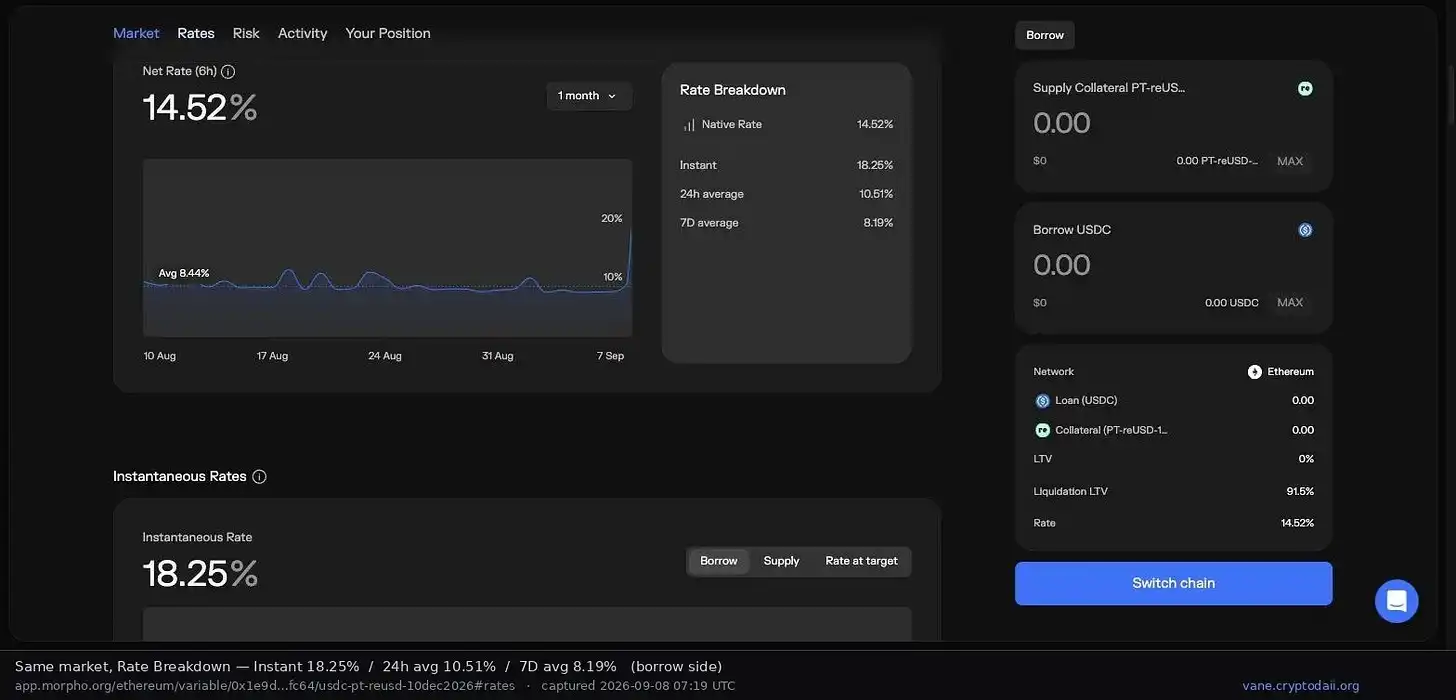
Figure 2: For the same pool, at the same moment, the official page displays three metrics side-by-side—Instantaneous 18.25%, 24h Average 10.51%, 7-Day Average 8.19%.

These three numbers are different representations of the same pool at the same second. If you see someone elsewhere touting 18.25%, they aren't fabricating data; they're just picking the metric most favorable to their story. From the title to net yield breakdowns, this article exclusively uses the 7-day average, because only this metric allows for post-fact verification.

Why is there more than a twofold difference? Rates in these pools are determined by utilization: the higher the proportion lent out, the higher the rate, and it rises steeply past a target line. Simultaneously, the moment your funds are deposited, the denominator increases, utilization is immediately depressed, and the rate drops accordingly. In other words, the enticing number you see on the list is from before you enter; the moment you enter, it's no longer that number. Larger positions depress it more.

The most typical pitfall I've seen looks like this: a pool shows an APY in the thousands, but upon inspection, the withdrawable liquidity is less than one dollar. The sign isn't lying; it's just that sign never belonged to those who enter later.

Therefore, what you must do before entering isn't to look at the sign, but to plug your intended capital size into the rate curve and calculate the realized rate. This was the original reason I built that tool; Section 6.2 will give the specific methodology.

3. When Will This Door Close?

Structural arbitrage doesn't have a hard expiry date, but it will be arbitraged away. Three paths, in my estimated order:

First, crowding. More people depositing directly into the pool dilutes utilization, naturally bringing the high-yield pool's rate closer to that of the vaults. This is the gentlest and most certain path.

Second, productization. The day the default interface opens a direct entry, or a better third-party interface appears, friction costs drop, and the spread will be rapidly eaten away.

Third, fee reduction. Custodians, to retain capital, proactively lower performance fees; the service fee segment will disappear first.

Thus, the window I suggest is to review weekly, not chase daily. The real risk isn't that it disappears tomorrow, but that you continue bearing the risk corresponding to the original risk premium after the spread has already been arbitraged away.

Three Risks You Must Accept First

First, you lose diversification and oversight. The diversification, daily monitoring, and emergency repositioning during crises performed by the professional team are gone once you take this path. You are taking a concentrated exposure to a single pool. This is the primary consideration for this premium.

Second, you might not be able to exit. For the pool in this example, the total size is about $83 million, but the immediately withdrawable liquidity is only $4.16 million, about 5% of total supply. If you want to exit and borrowers haven't repaid, and others are also rushing to exit, you'll have to queue. This isn't a bug; it's inherent to the nature of lending.

Third, the collateral itself might go bad. Structured assets with maturity dates, yield-bearing stablecoins, cross-chain wrapped assets each have their own depeg and maturity risks; oracles can also fail during extreme market conditions. Once bad debt occurs, losses are shared among all suppliers; you may never get your full principal back.

Only if you accept all three, read on. This article does not constitute investment advice, does not provide safety endorsements, and does not promise any returns.

4. Laying It Out: Which Protocol, and What Did I Do?

A necessary disclosure upfront: The tool Vane mentioned below is something I built and deployed myself (https://vane.cryptodaii.org/). I am its author, and it charges a small fee per transaction. This constitutes a conflict of interest. Therefore, in this section, I will try to explain things to the point where you can complete the process yourself even if you never touch this tool.

The protocol is Morpho. Its markets are permissionlessly created; anyone can create a pool, so pool quality varies greatly. Its official interface guides depositors to curator vaults; the path of directly supplying to individual markets has no entry point in the default interface, though it's fully open at the protocol level.

All data in this article is from the Morpho official interface on 2026-09-08. Each screenshot includes the original URL and capture time; you can click back to verify each one. If you are reading this days later, please treat these numbers as a demonstration of the method, not as current quotes.

Three tiers, using the 7-day average metric.
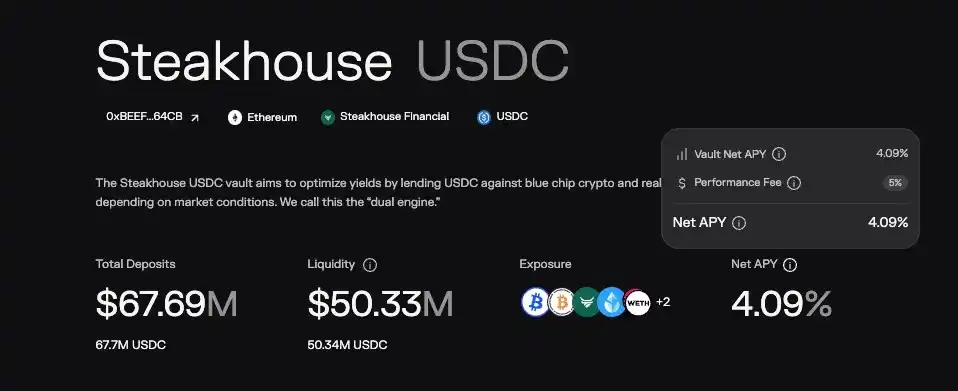
Figure 3: Steakhouse USDC, Curator Steakhouse Financial, total deposits $67.69 million, performance fee 5%. The 7-day average APY in the Returns column is 3.96% (large number in image is instantaneous).
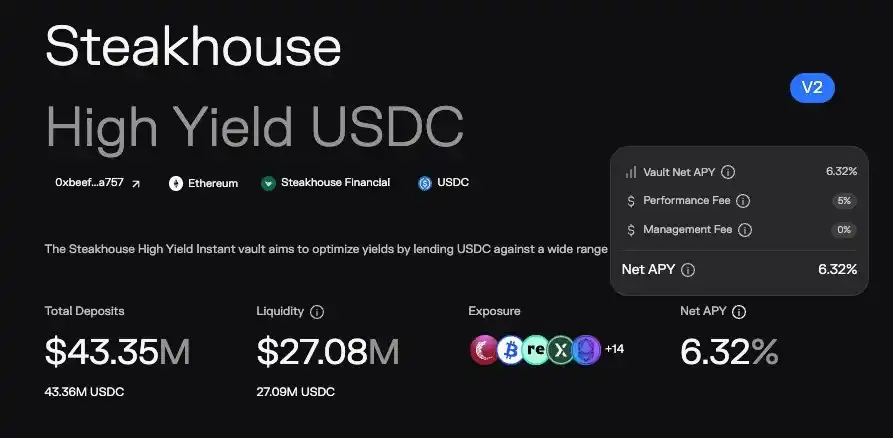
Figure 4: Steakhouse High Yield USDC (Ethereum, deposits $43.35 million) under the same curator, 7-day average APY 5.09% (large number in image is instantaneous).

The third tier is direct pool deposit. The target pool is USDC / PT-reUSD-10DEC2026 on Ethereum.
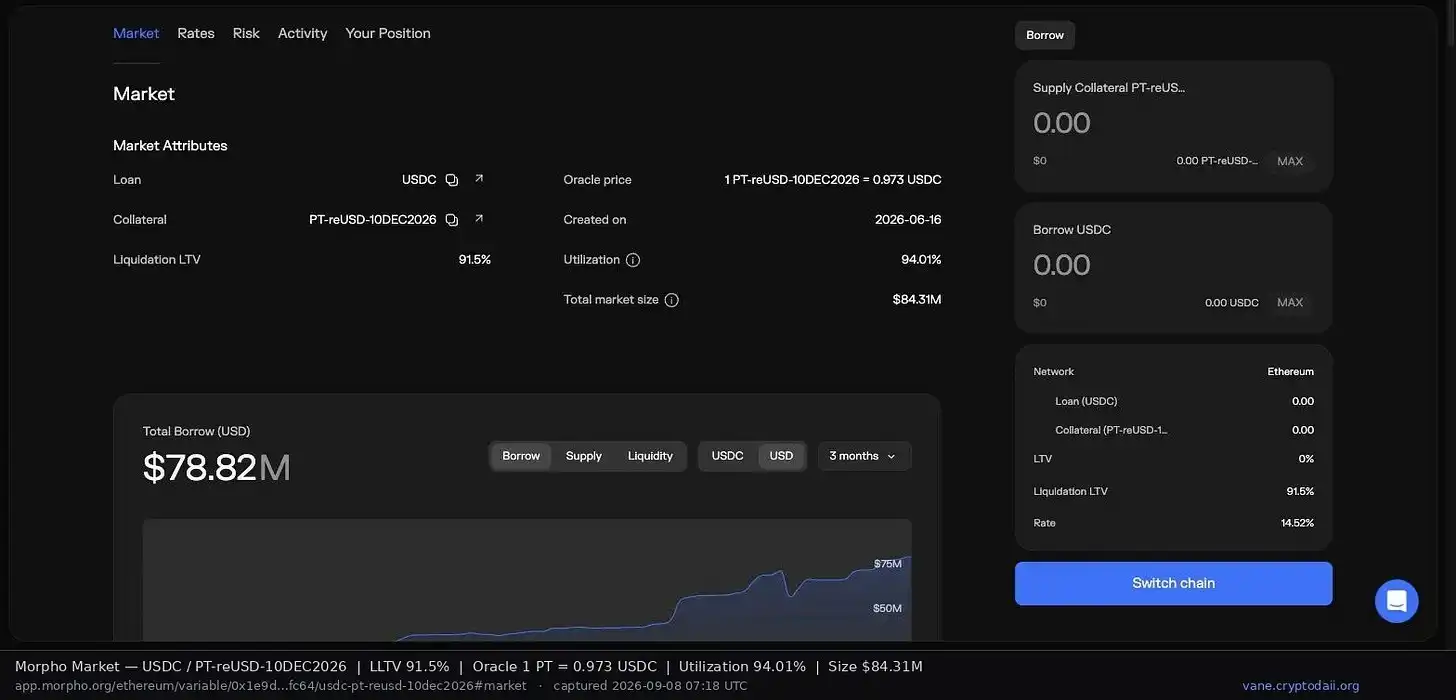
Figure 5: Liquidation threshold 91.5%, oracle quote 1 collateral token = 0.973 USDC, creation date 2026-06-16, utilization 94.01%, total size $84.31 million.

The supply-side 7-day average is not directly printed on the page, so I'll lay out the calculation: Borrower-side 7-day average is 8.19% (Figure 2), multiplied by utilization 94.01%. The market itself doesn't take a cut, yielding a supply-side 7-day average of approximately 7.7%. You can verify this yourself; no need to trust me.

Putting the three tiers together: conservative vault 3.96%, the same curator's aggressive vault 5.09%, direct deposit into that pool ~7.7%. Each step up is not free.

5. My Own Exclusion Method: First, See How Many Are Willing to Touch It

Not screening is a premise of this approach, but not screening doesn't mean entering blindly. I don't use a scoring system; I use exclusion—only to veto, not to endorse. The most useful signal is: How many verified curator vaults have actually allocated real capital to this pool?
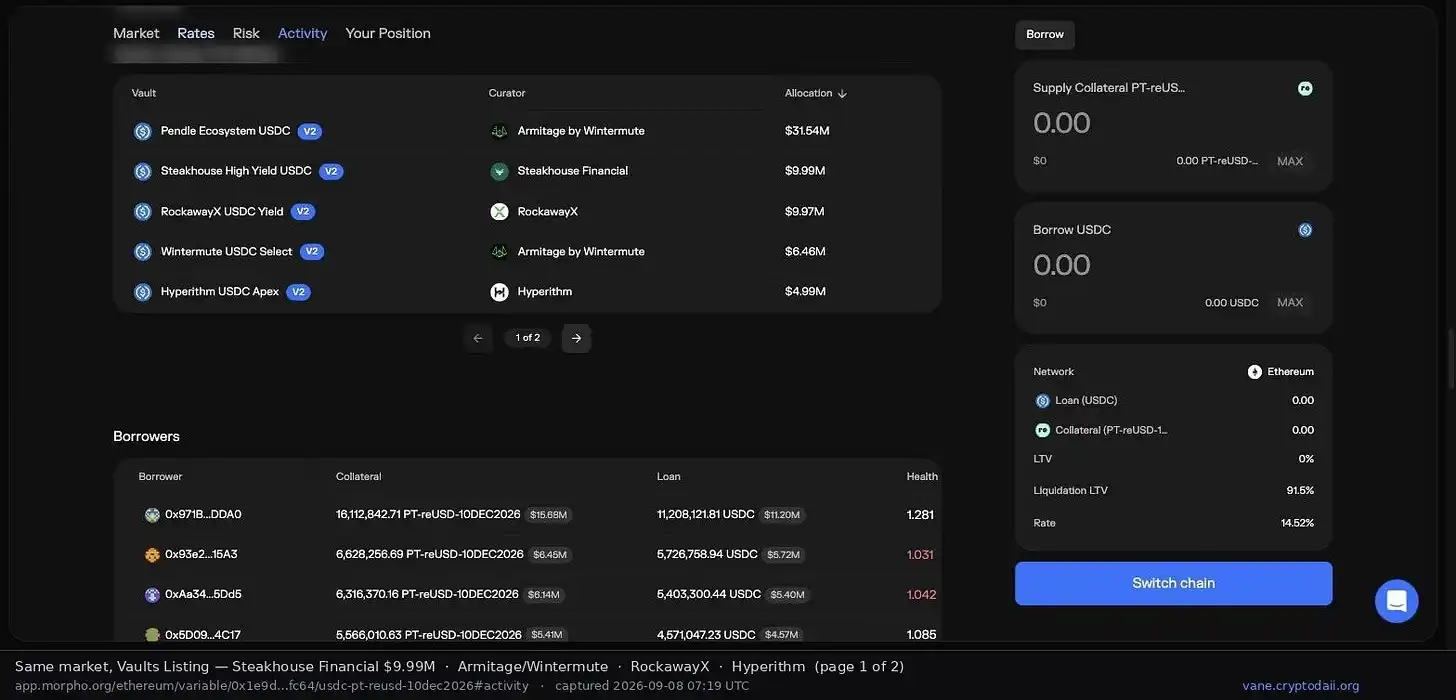
Figure 6: First page of the list of vaults supplying to this pool. Armitage by Wintermute two vaults total $38 million, Steakhouse Financial $9.99 million, RockawayX $9.97 million, Hyperithm $4.99 million.

This chart answers two things simultaneously. First, this pool has been independently evaluated and deemed worthy of capital allocation by at least six verified curators. Second—note the second row—the conservative vault offering you 3.96% and the vault that placed $9.99 million into this ~7.7% pool belong to the same curator. The title is not rhetorical.

Now contrast with the opposite. On the same market list, some other pools show four-digit APYs, the "Trusted By" column has only one icon, withdrawable liquidity is less than a dollar, and total borrows are only a few tens of dollars. Those extra percentage points often correspond to the absence of five professional teams willing to vouch for it. This is the most practical criterion I believe is worth taking away. Note it can only be used to veto: endorsement by six doesn't guarantee safety, it only indicates the pool has been evaluated by six teams independently. A pool with no endorsements but a high rate can basically be crossed off.

Another subtler but more informative signal: Look at the allocation cap the curator sets for this pool. The aggressive vault in Figure 4 has an absolute cap of $10 million for this pool; it's already allocated $9.99 million, maxed out. Simultaneously, this pool only constitutes 23% of its total portfolio. A professional team willing to allocate capital but explicitly unwilling to allocate more is more valuable to reference than a team going all-in—you want to copy their upper limit, not their lower limit.

Beyond this, I also hard-veto these types: single-source or upgradable oracles; collateral lacking sufficient on-chain depth to be liquidated; pool borrow amounts so small they indicate no real demand; and pools with excessively low withdrawable liquidity as a percentage of total supply. This last point itself is a drawback for the pool in this article—5% is not ample.

A technical detail for checking data: Morpho now has two vault generations; newer chains mostly have V2, with curators listed in a different field. Checking only the old field might show a misleading "No Curator"—my own tool missed a clearly endorsed pool this way a few days ago, now fixed. If you're writing your own script, check both generations.

6. Step-by-Step Operation

6.1 Select a Pool and Verify Parameters On-Chain

First, decide on the asset (suggest starting with a familiar mainstream stablecoin for your first time), then filter candidate pools using the exclusion method from the previous section. Once selected, before sending any transaction, you must read five parameters of this pool (loan asset, collateral asset, oracle, rate model, liquidation threshold) directly from the blockchain and cross-check them with what the interface displays.

New risk: Any interface data can be stale or mismatched. Skipping this step could lead you to deposit into a different pool than you think. My tool forces an on-chain parameter read and cross-check before every approval and deposit, refusing execution on mismatch; if you're doing it manually, you must do this step yourself.

6.2 Calculate the Realized Rate, Don't Just Look at the Sign

Plug in the amount you intend to deposit, calculate the pool's utilization and corresponding rate after your deposit, and compare that with the number you see now.
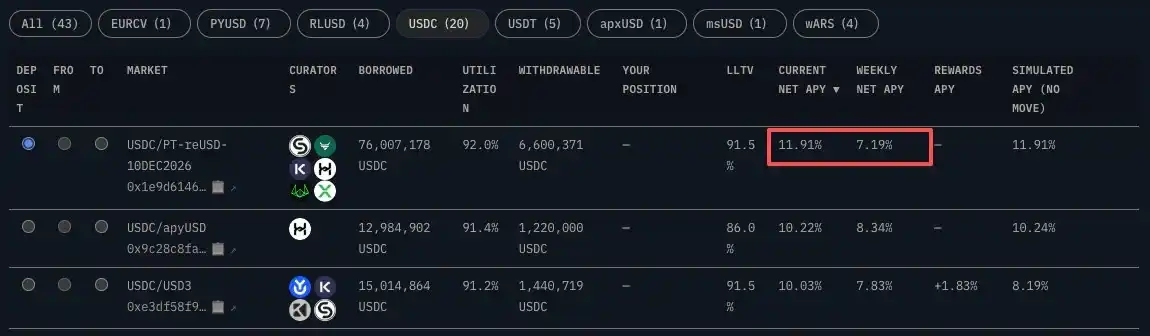
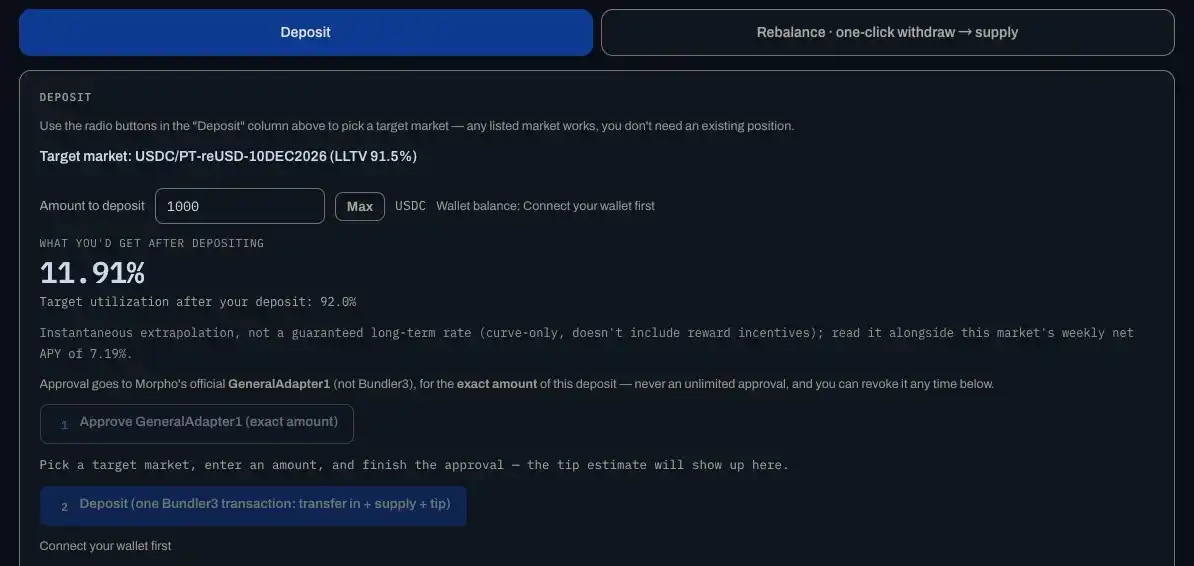
Figure 7: Vane calculates the realized APY before deposit, displaying it side-by-side with the sign's weekly average APY, and gives an explicit warning if the difference is extreme.

For my own judgment criteria: Using the 7-day average metric, if the realized rate improvement over your current vault is not more than two percentage points, I don't act. Below that, the transaction fees and extra risk undertaken aren't worth the move. In this article's example, 7.7% vs. 3.96% is a 3.7 percentage point improvement, barely qualifying; but as you'll see next section, qualifying doesn't automatically mean it's worthwhile.

New risk: This realized number is an instantaneous extrapolation based on the public rate curve; it does not simulate rate adaption over time, nor is it an official protocol number. It only addresses the "sign is deceiving you" problem; it does not guarantee your long-term yield.

6.3 Execute, and Write Down Your Exit Conditions Immediately

Depositing involves one approval transaction and one deposit transaction. Key point: The approval should be granted to the protocol's official adapter contract, not something else, and should be for the precise amount of this transaction—do not give infinite approvals. This way, even if the frontend is compromised, the single loss is capped at that amount.

If you later want to move between pools, note that swapping requires a one-time approval covering your entire position on that chain, with much broader permissions than a simple deposit. Be absolutely sure before signing. My tool hardcodes this approval object to the protocol's official adapter and lists all the official contract addresses for that chain on the page, along with a link to the official address list for character-by-character comparison—this is the strongest evidence of trust I can provide; you shouldn't trust me just because I say it's safe.

New risk: Approvals themselves are an attack vector. Infinite approvals, approvals to unknown contracts, and signing on the wrong chain are the three most common ways to lose money on this path.

7. Net Yield Breakdown: The Threshold Is Much Lower Than You Think

Using that pool, $10,000 principal as an example. First, lock in the holding period: Collateral maturity is December 10, 2026. According to the rules in the trigger points section, you must exit at least 2 weeks early, so the usable window is about 2.5 months; I'll calculate based on 2 months, leaving a buffer. This order cannot be reversed—first, determine how long you can hold based on the trigger point, then calculate if it's worthwhile, not the other way around.

Nominal side, using the 7-day average metric: Direct pool deposit ~7.7% APY, for 2 months ~$128.3; leaving the same $10,000 in the conservative vault at 3.96% APY for 2 months yields ~$66.0. The gross difference is $62.3. There are no emission tokens to liquidate here, so there's no issue of "whether the tokens you receive can be sold without slippage." This is one of the most comfortable aspects of this opportunity compared to airdrop-type opportunities.

Deductions consist of 4 items. I'll state all assumptions; you can recalculate with your numbers on the day.

1. Gas. The whole journey requires 3 on-chain transactions: approval for entry, deposit for entry, withdrawal for exit. On Ethereum mainnet on September 8, 2026, Etherscan showed a gas price of 0.051 gwei, with ETH price around $2,470. Based on actual transaction experience, each transaction costs about $0.3, totaling ~$0.9 for 3 transactions.

2. Tool fee, charged as a fixed percentage of gas cost, with a minimum amount. At the gas level above, the entire journey is on the order of less than $0.3 per transaction.

3. Slippage. This type of operation has no swap component, so it's 0.

4. Opportunity cost, already accounted for in the "compared to the vault" metric, not double-counted.

Thus, total journey cost ~$1.5, net excess ~$61.

So, what is the minimum viable position size? The excess APY is 3.74 percentage points, which over 2 months equals 0.62% of principal. Divide the cost by this to get the break-even principal:

At today's actual fee (journey ~$1), the threshold is around $160. If gas returns to 10 gwei, the threshold rises to ~$1,800; if it returns to 30 gwei, it rises to ~$5,400—which was precisely the number I estimated in my previous version, corresponding to a gas environment that doesn't exist today.

In other words, the threshold is entirely determined by the gas price on the day, not by the chain. "Mainnet is too expensive, must do it on cheaper chains" is wrong as of September 8, 2026—today's mainnet itself is cheap. But it can change back at any time: what you should monitor is the gas at the moment you send the transaction, not remember a fixed dollar threshold. This is the real takeaway from this section, and what I missed when I made that previous rough estimate.

Conclusion: At current fee levels, cost is no longer the barrier; risk is.

A $10,000 position is arithmetically valid. What should give you pause are the 3 points in Section 3.1—only 5% withdrawable liquidity, single collateral exposure, and no one watching for you.

Ask yourself first if you can tolerate queuing and bad debt, then ask if it's worthwhile. Reverse the order, and cheap gas might lead you into pools you shouldn't have entered.

8. Every Trigger Point

8.1 Collateral Maturity (Structured Assets with Maturity)

The collateral in this pool is a principal token with a clear maturity date, written in its name: December 10, 2026. Its price behavior changes as maturity approaches, discounts may widen, and the pool's risk profile shifts accordingly. Action: Exit at least two weeks before maturity; don't gamble on the final stretch.

8.2 Collateral Depegging

The oracle's current quote is 1 collateral token = 0.973 USDC, already at a discount, while the liquidation threshold is 91.5%. Depegging for such assets is not theoretical—a batch of real liquidations occurred in this pool on August 25.
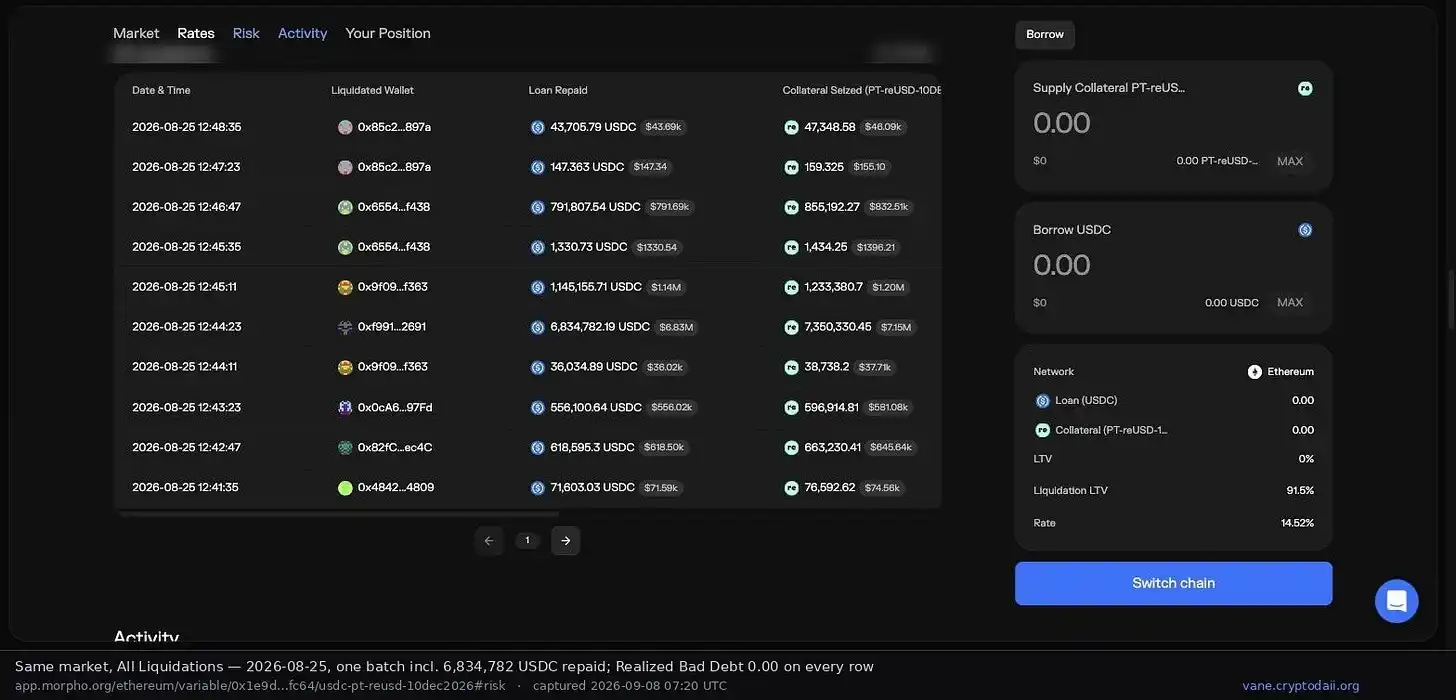
Figure 8: The pool's liquidation records from August 25. One entry repays $6.83 million; each row shows realized bad debt as 0.00.

This chart should be viewed both ways. The good side: The liquidation mechanism indeed worked, cleaning out positions in the millions without leaving bad debt. The bad side: It proves this collateral can indeed fall to the liquidation threshold, and in batches. Action: Treat the oracle quote as a monitoring metric; exit first if the discount widens significantly.

8.3 Utilization Hits Max, Unable to Withdraw

Current utilization is 94%, already past the 90% target line. Withdrawable liquidity is only 5% of total supply. Higher utilization means higher rates, which is precisely why the sign looks good, and also precisely why you might get stuck—these are two sides of the same coin. Action: Treat the percentage of withdrawable liquidity as a hard metric. Start queuing for exit when it falls below your acceptable line, don't wait until you want to leave to find others ahead of you.

8.4 Oracle Failure or Manipulation

Single price source, upgradable oracle contracts, ambiguous control ownership are all hard veto criteria. If this occurs, it's likely a total loss scenario, no middle ground. Action: Filter these out in the exclusion method of step 6.1 when selecting the pool; don't try to fix it afterwards.

9. Exit Signals Written Before Entry

First, unconditionally exit two weeks before the collateral maturity date.

Second, when the withdrawable liquidity as a percentage of total supply falls below your predetermined line (I use 5%; this pool is already at this line), start queuing for withdrawal.

Third, using the 7-day average metric, when your realized yield improvement over the conservative vault narrows to within two percentage points—the premium is gone, but the risk remains. Staying at this point is a pure loss.

Fourth, the number of verified curator vaults supplying to this pool decreases, or large amounts of capital withdraw. Others know something before you do.

Fifth, your own position size has grown to the point where it depresses the realized rate close to that of the vault—at this point, you're bearing all the extra risk without getting extra yield.

Discipline as always: Plan your exit before entry. Take the first 80%; leave the last bite for others.

Data & Sources

All data and screenshots are taken from the Morpho official application app.morpho.org, capture time 06:59 to 07:20 UTC on 2026-09-08. The bottom of each image includes the original URL and capture time for verification. All yield metrics in the article use the 7-day average; instantaneous values appear only in Section 2 for contrast.

  • Vaults: Steakhouse USDC, contract 0xBEEF01735c132Ada46AA9aA4c54623cAA92A64CB, Ethereum, v1, total deposits $67.79 million, performance fee 5%, 7-day avg APY 3.96%, 30-day 3.93%, curator Steakhouse Financial. Steakhouse High Yield USDC, contract 0xbeeff2C5bF38f90e3482a8b19F12E5a6D2FCa757, Ethereum, v2, total deposits $43.21 million, performance fee 5%, management fee 0%, 7-day avg APY 5.09%, 30-day 5.29%, curator same Steakhouse Financial.
  • Market: Ethereum USDC / PT-reUSD-10DEC2026, market ID 0x1e9d614631a7df0ec07fb05b2c8cb2491575fd1a63a33bf187a6afb295a4fc64, liquidation threshold 91.5%, creation date 2026-06-16, oracle 0x217d6DdCDB95112C51657F6270e8C079CFDB51f0, oracle quote 1 collateral token = 0.973 USDC (consistent with DefiLlama quote), rate model 0x870aC11D48B15DB9a138Cf899d20F13F79Ba00BC, target utilization 90%, current utilization 94.01%, total size $84.31 million, total borrows $78.82 million, withdrawable liquidity $4.16 million, liquidation penalty 2.61%, realized bad debt 0.00. Borrower-side rates: instantaneous 18.25%, 24h avg 10.51%, 7-day avg 8.19%. Supply-side 7-day avg derived from 8.19% multiplied by utilization ~7.7%.
  • Supplying vaults for this market (sorted by allocation, first page): Pendle Ecosystem USDC $31.45 million (curator Armitage by Wintermute), Steakhouse High Yield USDC $9.99 million (Steakhouse Financial), RockawayX USDC Yield $9.97 million (RockawayX), Wintermute USDC Select $6.46 million (Armitage by Wintermute), Hyperithm USDC Apex $4.99 million (Hyperithm); subsequent pages include Re Ecosystem Vault, Smokehouse USDC, Keyrock USDC, etc.
  • Morpho official contract address list docs.morpho.org/get-started/resources/addresses. Tool developed by myself: vane.cryptodaii.org.

Trending Cryptos

Related Questions

QAccording to the article, what is the main reason for the yield difference between the 3.96% and 7.7% strategies offered by the same curator?

AThe yield difference represents a risk premium. Investors in the direct pool strategy (yielding ~7.7%) are paid more because they are taking on the specific collateral risk and concentration risk that the professional curator's conservative vault (yielding 3.96%) is unwilling to bear. The extra yield is compensation for 'not having decisions made for you' and 'not having someone else monitor and manage that collateral risk'.

QWhy does the article emphasize using the 7-Day Average APY instead of the instantaneous rate when evaluating a pool?

AThe article emphasizes the 7-Day Average APY because it is the only verifiable figure post-facto. The instantaneous rate is highly misleading as it is based on the pool's utilization *before* a new deposit. Adding funds increases the pool's total supply, lowers the utilization, and immediately causes the interest rate to drop. Therefore, the attractive rate displayed is not the rate an investor will actually earn upon entering.

QWhat is one of the key 'exclusion' criteria the author uses to filter potentially unsafe pools before investing?

AA key exclusion criterion is to check how many verified curator vaults have allocated real funds to the pool. The presence of several independent, professional teams investing in a pool serves as a strong negative filter. A pool with a very high APY but only one or no trusted curator backing it, especially if it has minimal available liquidity, can often be safely ruled out.

QWhat are the three primary risks an investor accepts when choosing the direct pool strategy over a curated vault?

A1. Loss of Diversification & Monitoring: The investor takes on a concentrated exposure to a single pool's collateral without the professional team's diversification, daily oversight, or emergency rebalancing. 2. Potential Illiquidity: The investor may not be able to withdraw immediately if borrowers haven't repaid and others are also trying to exit, as they must queue for the available liquidity. 3. Collateral Failure Risk: The underlying collateral (e.g., structured assets, yield-bearing stablecoins) carries risks like de-pegging, maturity issues, or oracle failure, which could lead to bad debt and loss of principal.

QBased on the net profit breakdown for a $10,000 investment, what does the author conclude is the real barrier to entry for this strategy in the current market environment?

AIn the current low-gas environment (demonstrated on 2026-09-08), transaction costs are minimal, making the strategy viable even for smaller positions (~$160 break-even). Therefore, the author concludes that cost is no longer the primary barrier. The real barrier is the investor's ability to understand and accept the fundamental risks outlined in the article—specifically illiquidity risk, collateral risk, and lack of professional oversight—before considering if the potential profit is worthwhile.

Related Reads

Trading

Spot

Hot Articles

What is LINON

Linde plc Tokenized Stock (Ondo): Revolutionizing Traditional Equity Access Through Blockchain Innovation The emergence of Linde plc Tokenized Stock (Ondo), represented by the ticker $LINON, signifies a monumental shift in the fusion of traditional financial structures and decentralized finance (DeFi). This innovative financial instrument showcases the tremendous potential of blockchain technology to democratize access to traditional equity markets while ensuring the security and regulatory compliance necessary for institutional-grade financial products. Through Ondo Finance's pioneering tokenization platform, $LINON provides a seamless pathway for global investors to engage with one of the world's leading industrial gas companies, Linde plc, creating a blockchain-native representation of the underlying equity. Introduction to Linde plc Tokenized Stock The landscape of financial markets is witnessing a groundbreaking transformation through the tokenization of real-world assets. Linde plc Tokenized Stock (Ondo) epitomizes this revolutionary approach by bridging the gap between conventional stock ownership and blockchain-enabled financial infrastructure. The $LINON token allows investors to gain exposure to one of the prominent industrial companies worldwide through decentralized technology. Operating within Ondo Finance's comprehensive ecosystem, $LINON symbolizes a practical application of tokenization technology that enhances accessibility, efficiency, and global connectivity in traditional financial markets. By leveraging blockchain infrastructure, this tokenized stock enables international investors to participate in U.S. equity markets, overcoming traditional barriers associated with cross-border investing. The significance of $LINON goes beyond technological innovation; it represents a fundamental shift in asset structuring, distribution, and trading in the digital age. This tokenized stock maintains all the economic benefits associated with traditional Linde plc shares while offering improved liquidity, programmable compliance features, and seamless integration with decentralized finance protocols. The development of $LINON indicates a growing acceptance of blockchain technology as a viable means for traditional finance, exemplifying how even well-established assets like Linde plc can integrate into blockchain systems. This approach preserves the core attributes that appeal to investors while introducing advanced capabilities that enhance the overall investment proposition. Project Overview and Objectives Linde plc Tokenized Stock (Ondo) encapsulates a strategic effort to democratize access to traditional equity markets through advanced blockchain technologies. The primary objective of $LINON is to provide approved global investors seamless access to the economic exposure associated with Linde plc shares, furthering an effort to create a more inclusive financial ecosystem. Beyond the digital representation of traditional assets, $LINON endeavors to eliminate barriers of geography and time zones that limit investor participation. Its design ensures that blockchain technology can elevate traditional investment vehicles without undermining the security or compliance requirements expected by investors. Key goals of the project include enhanced liquidity provision, programmable compliance mechanisms, and interoperability with other blockchain networks. Each $LINON token is fortified by actual Linde plc securities housed at U.S.-registered broker-dealers, allowing holders to reap economic advantages akin to traditional stockholders, such as dividend reinvestment. Furthermore, $LINON aims to establish new industry standards for institutional-grade tokenized securities, paving the way for traditional assets to embrace blockchain technology while remaining compliant with regulatory frameworks. By associating itself with a company as reputable as Linde plc, the project opens avenues for exploring tokenized equities catering to both conservative institutional players and daring retail investors. Project Creator and Development Team The vision for Linde plc Tokenized Stock (Ondo) comes from Nathan Allman, founder and CEO of Ondo Finance. His background in traditional finance coupled with expertise in blockchain technology positions him uniquely to navigate the complexities of asset tokenization. Allman's academic journey began at Brown University, focusing on Economics and Biology, equipping him with valuable analytical skills. His time at Goldman Sachs in the Digital Assets division strengthened his understanding of the interplay between financial institutions and emerging technologies, laying the groundwork for his later endeavors in alternative investment strategies. Under Allman's guidance, Ondo Finance has emerged as a leader in asset tokenization, launching $LINON as a flagship example of the company's larger mission towards revolutionizing traditional financial systems using blockchain technology. His commitment to leveraging blockchain for creating institutional-grade financial products has shaped the landscape of real-world asset tokenization. Investment and Funding Structure The growth of Ondo Finance, the platform powering Linde plc Tokenized Stock (Ondo), is bolstered by robust financial backing from prestigious venture capital firms and strategic investors. This strong investment foundation underpins the development of the key infrastructure essential for compliant tokenized securities like $LINON. In August 2021, Ondo Finance secured $4 million in seed funding led by a major venture capital firm, which enabled the company to commence platform development and establish the necessary regulatory processes for tokenizing real-world assets. This early investment cemented Ondo Finance's credibility within the industry. The Series A funding round followed, garnering $20 million with participation from renowned firms committed to transformative technology companies. This backing demonstrated substantial institutional confidence in Ondo Finance's vision, allowing it to hone its approach to asset tokenization through mechanisms that ensure compliance and accessibility. Noteworthy contributors, including institutional investors and experienced partners, have added significant value to Ondo Finance’s development efforts. Their involvement underscores the confidence across sectors in Ondo Finance's approach to bridging traditional finance with blockchain innovations. Technical Infrastructure and Innovation The technical architecture that underpins Linde plc Tokenized Stock (Ondo) represents a sophisticated melding of traditional finance systems and cutting-edge blockchain technology. The architecture's foundation is built on the Ethereum network, renowned for its security and programmability—both critical for intricate financial instruments. The $LINON tokenization process comprises creating a blockchain-native representation of Linde plc shares that preserves economic benefits while augmenting investor capabilities. Each token corresponds to actual shares held at U.S.-registered broker-dealers, creating a compliant custody structure that legitimizes the asset's existence and value. Automated compliance systems are integrated into the tokenization process, managing critical components such as know-your-customer (KYC) verification and anti-money laundering (AML) protocols. This incorporation of programmable compliance empowers $LINON to uphold regulatory standards essential for institutional proliferation. Cross-chain interoperability characterizes the advanced technical features of $LINON. While initially deployed on Ethereum, the framework is designed for expansion to other networks such as Solana and BNB Chain. This adaptability enhances liquidity and accessibility, allowing investors to select their preferred blockchain ecosystems. Historical Timeline and Development Crafting the history of Linde plc Tokenized Stock (Ondo) unfolds in parallel with the evolution of Ondo Finance's tokenization platform. The timeline's inception dates back to March 2021 when Nathan Allman laid the foundations for creating institutional-grade financial products on blockchain infrastructure. The initial funding round in August 2021 provided crucial resources for developing the platform and establishing partnerships necessary for effective tokenization. By January 2023, Ondo Finance launched its tokenized treasury products, establishing mechanisms that would facilitate future tokenized equities such as $LINON. A pivotal milestone arose in February 2025 when Ondo Chain—a Layer 1 blockchain designed specifically for asset tokenization—was introduced. This infrastructure enhances capabilities vital for institutional markets, demonstrating Ondo Finance's long-term commitment to tokenization. Subsequently, the launch of Ondo Global Markets in September 2025 marked the official debut of $LINON. This milestone showcased the successful transition from development to active trading, enabling investors around the world to access American financial markets seamlessly. Ongoing development plans include a targeted expansion of available tokenized assets to over 1,000 by the end of 2025, pointing to a bright future for Ondo Finance's ecosystem and its mission to broaden tokenized equity accessibility. Regulatory Compliance and Legal Framework The legal architecture governing Linde plc Tokenized Stock (Ondo) emphasizes a sophisticated approach to regulatory compliance, allowing tokenized securities to be implemented within a blockchain-based framework. The legal structure governing $LINON spans multiple jurisdictions while maintaining a robust legal footing. Compliance systems ensure that only eligible investors can access the token, enforced through automated verification that aligns with international regulations. This innovative regulatory technology promises real-time enforcement of complex requirements, considerably enhancing efficiency in operating within the regulatory landscape. The custody framework undergirding $LINON ensures that the underlying shares are securely held at U.S.-registered broker-dealers, complying with necessary regulations while delivering blockchain-driven access to investors. The token maintains its economic equivalency and security through this carefully structured custody arrangement. KYC and AML compliance systems are embedded within the smart contract architecture, ensuring integrity and adherence to regulatory practices while fostering transparency for investors. The jurisdictional restrictions mark a commitment to navigating the evolving landscape of international securities laws. Market Impact and Industry Significance The advent of Linde plc Tokenized Stock (Ondo) holds profound implications for the broader financial landscape, symbolizing a clear shift towards blockchain-enabled markets. $LINON serves as a proof-of-concept for integrating traditional companies into blockchain ecosystems, showcasing the potential benefits such as broader accessibility and improved efficiency. The market's response to $LINON indicates a growing acceptance of tokenization among institutional investors, contributing to the emergence of an expanding sector wherein traditional assets can be interconnected with blockchain innovations. The success of $LINON further solidifies market confidence, indicating an overarching shift towards recognizing asset tokenization as a transformative force in finance. Future Development and Expansion Plans The future trajectory for Linde plc Tokenized Stock (Ondo) centers around the expansion of the tokenization ecosystem and enhanced infrastructure supporting blockchain-enabled financial services. Plans for cross-chain integration usher in new opportunities for liquidity and flexibility within the investment framework, with existing capabilities poised for continuous enhancement. With the introduction of Ondo Chain, Ondo Finance aims to transition $LINON to an optimized blockchain environment specifically designed for asset tokenization. This new infrastructure heralds exciting prospects for the development of institutional-grade financial products, ensuring ongoing compatibility with contemporary investment strategies. Further integration with decentralized finance protocols signifies a commitment to empowering $LINON holders through advanced financial strategies. The anticipated expansion of available tokenized assets promises to broaden investor access, enhancing the utility and appeal of the platform. In alignment with ambitions for regulatory expansion, ongoing efforts to secure approvals for new jurisdictions will enhance investor access, further positioning $LINON at the forefront of the burgeoning tokenization market. Conclusion Linde plc Tokenized Stock (Ondo), as represented by the $LINON token, stands at the intersection of traditional finance and blockchain innovation. It embodies a transformative milestone in how financial assets are structured, distributed, and engaged within modern investment ecosystems. The technical sophistication behind $LINON, combined with its regulatory compliance framework, illustrates that asset tokenization can improve financial infrastructure rather than simply digitizing existing products. This pioneering effort not only enhances investor access to U.S. equity markets but also signifies an evolution of how traditional financial services can integrate blockchain technology. As the asset tokenization market grows exponentially, with prospects suggesting significant valuation increases, $LINON paves the way for a future where tokenized securities become standard fixtures in the financial landscape. The trajectory of $LINON will undoubtedly influence how traditional finance adapts to a transformed, blockchain-powered world.

5.3k Total ViewsPublished 2025.12.05Updated 2025.12.05

What is LINON

What is CRMON

Salesforce Tokenized Stock (Ondo): Revolutionising Traditional Equity Access Through Blockchain Innovation The emergence of Salesforce Tokenized Stock (CRMON) marks a pivotal advancement in integrating traditional financial markets with blockchain technology. This innovative approach offers investors unprecedented access to equity exposure through tokenisation. Developed by Ondo Finance, CRMON provides tokenholders with economic exposure equivalent to holding Salesforce stock (CRM) while automatically reinvesting dividends. This effectively bridges the gap between conventional equity markets and decentralised finance (DeFi). Introduction and Comprehensive Overview of Salesforce Tokenized Stock In recent years, the financial landscape has dramatically transformed due to blockchain technology, fundamentally altering how investors access and interact with traditional assets. The development of Salesforce Tokenized Stock (CRMON) is a prime example of this evolution, representing a sophisticated fusion of conventional equity markets with cutting-edge distributed ledger technology. CRMON is a tokenised version of Salesforce stock, emerging from the innovative work of Ondo Finance, a leading platform in the real-world asset tokenisation sector that positions itself as a bridge between traditional finance and decentralised systems. Designed to provide tokenholders with economic exposure that mirrors the performance of the underlying Salesforce stock, CRMON incorporates automatic dividend reinvestment mechanisms. This eliminates many traditional barriers associated with international equity investment, such as complex brokerage relationships, currency conversion challenges, and restricted trading hours. The tokenisation process reimagines stock ownership as a blockchain-native asset while maintaining its economic equivalence with the underlying security, offering enhanced portability and integration capabilities within decentralised finance ecosystems. CRMON transcends its individual utility as an investment instrument to represent a fundamental shift in how financial markets can operate in an increasingly digital world. By maintaining full backing through U.S.-registered broker-dealers and implementing robust compliance frameworks, CRMON demonstrates that tokenised securities can achieve the regulatory standards necessary for institutional adoption while delivering the technological advantages of blockchain infrastructure. Understanding Tokenized Real-World Assets and CRMON's Strategic Position Tokenised real-world assets signify one of the most significant innovations in modern finance, fundamentally reimagining how traditional securities are represented, traded, and utilised within digital ecosystems. CRMON operates as a tokenised equity instrument correlating directly with Salesforce stock while optimising accessibility and efficiency. This aligns with Ondo Finance's broader mission to democratise access to institutional-grade financial products through innovative tokenisation strategies. The tokenisation process guarantees complete economic equivalence with the underlying Salesforce equity. Each CRMON token represents a proportional claim on Salesforce stock held by qualified custodians, with dividend payments automatically reinvested to maintain continuous exposure to total return performance. This structure simplifies dividend management and ensures that tokenholders receive the full economic benefit of their equity exposure, encompassing both capital appreciation and income generation. Ondo Finance's strategy in tokenising Salesforce stock demonstrates its expertise in creating compliant, institutional-grade products that meet traditional financial markets' stringent requirements. The platform’s focus on merging regulatory compliance with blockchain benefits positions it at the forefront of decentralised finance, captivating both institutional and retail investors seeking blockchain-native solutions. The Technology and Innovation Framework Behind CRMON The technological infrastructure supporting CRMON integrates blockchain technology with traditional financial mechanisms, delivering institutional-grade security and compliance while maintaining the operational advantages of decentralised systems. Built on the Ethereum blockchain, CRMON utilises robust smart contract capabilities to ensure transparent, secure operations. The smart contract architecture incorporates layered security and compliance mechanisms, enabling automated compliance checks and real-time asset backing verification. Integration with oracle services maintains accurate pricing and dividend information, ensuring CRMON reflects the underlying Salesforce stock's accurate performance. This architecture delivers automated dividend reinvestments and other corporate actions, eliminating manual processing requirements and directly enhancing tokenholder benefits. Ondo Finance ensures CRMON's security structure includes daily third-party verification of holdings, independent collateral agents, and a multiple-layer custody system through partnerships with established financial institutions. This framework safeguards tokenholder interests against operational risks while providing robust asset backing. The user interface enhances integration capabilities, allowing seamless interaction between CRMON and various decentralised finance protocols, as well as cryptocurrency exchanges. This interoperability enables users to leverage their tokenised equity across multiple platforms, creating sophisticated investment strategies that marry traditional equity characteristics with blockchain-native innovation. Leadership and Corporate Structure of Ondo Finance The leadership team behind CRMON and Ondo Finance blends expertise from traditional finance and blockchain technology, presenting a robust combination of skills essential for successfully bridging conventional markets with decentralised finance. Nathan Allman, the founder and CEO, emerged from a distinguished financial background before establishing Ondo Finance in 2021. Allman's experience includes notable roles at major financial institutions, including significant contributions to developing cryptocurrency market services. His insights into regulatory compliance were paramount in developing products like CRMON that successfully unify traditional securities with blockchain technology. With a team of professionals boasting substantial experience in both conventional finance and blockchain sectors, Ondo Finance's leadership comprises diverse expertise that covers every aspect of tokenised asset development. Justin Schmidt serves as President and COO, contributing unique operational expertise, while Chris Tyrell brings essential compliance knowledge. Investment Landscape and Funding History The investment landscape surrounding Ondo Finance reflects significant institutional confidence in its mission to tokenise real-world assets. The company has raised substantial funds through various investment rounds, attracting leading venture capital firms and strategic investors that recognise the transformative potential of tokenised securities like CRMON. Notably, Ondo Finance completed a successful Series A funding round in 2022, led by well-known venture capital firms. This funding success validates Ondo Finance's innovative approach to creating compliant, institutional-grade tokenised products. In total, Ondo Finance has successfully secured substantial funding, raising significant capital for product development and market expansion, including a noteworthy token sale that reinforced its governance structure through the establishment of the ONDO token. The diverse composition of investors reflects broad market confidence in Ondo Finance's business model, demonstrating support from both traditional and blockchain-native organisations. Operational Mechanics and Technical Implementation The operational framework supporting CRMON exemplifies sophisticated integration of traditional financial mechanisms with blockchain technology. The technical implementation introduces multiple layers of security, compliance, and operational efficiency to meet institutional standards while enhancing accessibility. The tokenisation process begins by acquiring actual Salesforce stock through U.S.-registered broker-dealers, ensuring each CRMON token maintains direct correlation with the underlying equity performance. Smart contracts automate operational processes, including dividend reinvestment and corporate action processing, facilitating a streamlined user experience. The Minting and redemption processes allow authorised participants to manage CRMON tokens effectively. During U.S. trading hours, institutions can mint new tokens by depositing stablecoins that are used to purchase corresponding Salesforce equity. This structure maintains a tight correlation with underlying assets, enhancing liquidity and price discovery. Additionally, the infrastructure supports twenty-four-hour token transfer capabilities, providing CRMON holders with operations outside traditional market hours. This represents a significant advantage over conventional securities ownership, thus promoting integration with decentralised finance applications. Plans for cross-chain compatibility through partnerships signal further ambitions for CRMON's market reach. By expanding to other blockchain networks, Ondo Finance aims to enhance accessibility and user engagement with tokenised equity products. Timeline and Historical Development of Tokenized Equity Innovation The timeline of CRMON's development and Ondo Finance's broader tokenised capabilities demonstrates a systematic innovation process beginning with the company's founding in 2021. 2021: Ondo Finance is founded by Nathan Allman and co-founders, launching initial products focused on structured vault offerings on the Ethereum blockchain. 2022: The company completes substantial funding rounds—both equity and token sales—totaling significant capital and launching initial tokenised U.S. Treasury products. 2023-2024: Ondo Finance experiences substantial growth, establishing partnerships with major financial institutions while expanding its product offerings beyond fixed-income securities. February 2025: Ondo Global Markets is announced, marking the transition into equity tokenisation with plans for accessing over one hundred U.S. stocks and ETFs. September 2025: The official launch of Ondo Global Markets includes CRMON alongside other tokenised equity offerings, marking a significant evolution in Ondo Finance's product ecosystem. This timeline highlights the organisation's rapid growth and its capability to adapt its technological and compliance frameworks to accommodate different asset classes effectively while maintaining security and regulatory integrity. Regulatory Framework and Compliance Approach Ondo Finance's regulatory framework showcases a sophisticated compliance strategy, essential for achieving institutional adoption in the tokenised securities market. The company's strong partnerships with U.S.-registered broker-dealers promote adherence to Securities and Exchange Commission regulations and apply robust investor protections. Acquisitions, such as Oasis Pro—a registered broker-dealer—significantly enhance Ondo Finance's compliance capabilities, ensuring thorough alignment with existing regulatory structures. The company employs independent verification procedures that foster transparency, aiming for a solid performance standards reputation. Furthermore, Ondo Finance's commitment extends to international regulatory compliance, ensuring token access remains restricted to eligible investors while adhering to pertinent cross-border securities regulations. Comprehensive attention to tax implications and reporting requirements fortifies the security and compliance landscape of CRMON, ensuring that investor obligations remain manageable. Future Prospects and Market Positioning The forward-looking landscape for CRMON and Ondo Finance illustrates substantial growth opportunities driven by institutional adoption of blockchain technology and escalating demand for efficient alternatives to conventional securities ownership. Market projections indicate the tokenised asset sector could value multiple trillion dollars by 2030. With plans to scale CRMON offerings significantly and integrate it with a dedicated blockchain infrastructure—Ondo Chain—Ondo Finance aims to elevate its institutional-grade tokenised asset operations. Additionally, the development of strategic partnerships enhances distribution capabilities while establishing the company's credibility in the financial market. Furthermore, the integration of tokenised equity with decentralised finance protocols offers new potential for innovative financial products and strategies previously impossible with traditional securities. These factors underscore CRMON's positioning to effectively capture increased market share and deliver innovative solutions for international investment exposure. Conclusion Salesforce Tokenized Stock (CRMON) symbolises a transformative development within financial markets, successfully bridging traditional equity ownership with blockchain technology to create unprecedented accessibility for global investors. Through Ondo Finance's sophisticated tokenisation framework, CRMON provides complete economic exposure to Salesforce equity performance while enhancing operational advantages that exceed traditional ownership. The launch of CRMON reflects the broader evolution of financial markets towards blockchain infrastructures that maintain regulatory compliance while delivering increased efficiency. Ondo Finance's extensive approach to regulatory adherence, institutional-grade security, and technological innovation solidifies CRMON as a model for future tokenised securities, delivering access previously unattainable in conventional brokerage structures. As the tokenised asset sector continues to develop, CRMON is well-positioned to address historical inefficiencies in capital markets while providing investors with innovative solutions for accessing traditional securities. The outlook for CRMON looks exceptionally promising, supported by ambitious expansion plans, technological innovations, and strategic partnerships, thereby representing a pioneering model of modern financial infrastructure evolving through blockchain integration.

5.5k Total ViewsPublished 2025.12.05Updated 2025.12.05

What is CRMON

What is SHOPON

Shopify Tokenized Stock (Ondo): A Comprehensive Analysis of Real-World Asset Tokenization in Web3 This article delves into the Shopify Tokenized Stock (Ondo), recognised by its ticker symbol $SHOPON, exploring its implications at the intersection of traditional finance and blockchain technology. As a part of Ondo Finance's tokenized securities platform, Shopify’s tokenized stock exemplifies advancements in democratizing access to global capital markets through innovative digital assets. Introduction and Overview of Shopify Tokenized Stock (Ondo) Shopify Tokenized Stock (Ondo), or $SHOPON, portrays a pivotal innovation in the realm of tokenized securities, allowing investors to gain economic exposure akin to directly owning shares of Shopify Inc. This token, developed under the umbrella of Ondo Finance, not only provides investors with the ability to hold digital representations of the company’s stock but also integrates features such as automatic reinvestment of dividends. This advancement represents a substantial shift in the landscape of decentralized finance (DeFi), linking conventional equity markets with blockchain solutions designed to enhance accessibility, transparency, and liquidity. By eliminating geographical barriers and enabling 24/7 trading capabilities, $SHOPON is positioned as a bridge connecting traditional financial instruments and the emerging Web3 ecosystem. What is Shopify Tokenized Stock (Ondo), $SHOPON? The $SHOPON token serves as a digital manifestation of Shopify Inc.'s shares, engineered to provide a direct correlation to the underlying asset's performance. Through the utilization of blockchain technology, the token gives holders a mechanism to participate in the economic benefits associated with equity ownership, including capital appreciation and dividend distribution. The unique aspect of $SHOPON lies in its automatic dividend reinvestment mechanism, which allows returns to compound without necessitating active management by the investor. This feature inherently enhances its attractiveness as an investment vehicle, particularly for individuals seeking passive income growth alongside exposure to high-performing equities. The tokenization process is facilitated by the custody of actual Shopify shares through regulated intermediaries, ensuring that every $SHOPON token is verifiably backed by real equity. This structure empowers investors with the dual advantages of both traditional financial characteristics and the innovative benefits tied to blockchain technology. Who is the Creator of Shopify Tokenized Stock (Ondo)? The creator of Shopify Tokenized Stock (Ondo), Nathan Allman, is an experienced figure in the finance sector, formerly associated with Goldman Sachs. His rich background includes significant expertise in digital asset development, bridging the gap between traditional finance and cryptocurrencies. Allman’s educational journey, marked by studies at Brown University, provided him with a deep understanding of economics and biology, equipping him with analytical skills that inform his strategic vision. In 2021, he founded Ondo Finance, committing to developing tokenized securities that meet institutional-grade standards while leveraging blockchain's transformative capabilities. Under Allman's leadership, Ondo Finance has focused on creating compliant and innovative financial products that empower a diverse investor base. Who are the Investors of Shopify Tokenized Stock (Ondo)? The investment landscape surrounding Shopify Tokenized Stock (Ondo) is notably robust, underpinned by significant institutional support. Primarily, Pantera Capital stands out as a strategic partner through the Ondo Catalyst initiative, a $250 million commitment aimed at accelerating the development of on-chain capital markets. This partnership not only signifies institutional confidence in the potential of tokenized assets but also reinforces Ondo Finance's operational capabilities and market positioning. The funding pathways have included earlier rounds that amassed millions in seed funding and further structural investments, solidifying relationships with both venture capital firms and private investors. Moreover, the financial framework is complemented by strategic partnerships with established financial institutions and technology companies, enhancing Ondo’s infrastructure and operational expertise. How Does Shopify Tokenized Stock (Ondo), $SHOPON Work? At the core of $SHOPON's operational framework is a sophisticated system integrating traditional finance mechanisms with blockchain technology. The custody of actual Shopify shares ensures that token holders retain authentic economic exposure, safeguarding their investments in line with recognized legal structures. The smart contracts employed in managing $SHOPON handle various functions, including automatic dividend reinvestment and ownership transfer, offering instant settlement and increased liquidity, marking a significant departure from conventional trading systems plagued by multi-day settlement delays. By providing interoperability with other decentralized finance applications, $SHOPON empowers holders with potentially lucrative opportunities for advanced investment strategies, including lending and automated market making. This complex integration presents a unique value proposition, catering to both traditional and crypto-native investors. The innovative structure of $SHOPON also allows for real-time settlements and transactions documented on the blockchain, delivering unparalleled transparency and security—a major advancement over standard equity trading practices. Timeline of Shopify Tokenized Stock (Ondo) March 2021: Nathan Allman establishes Ondo Finance, initially focusing on decentralized finance yield optimization. August 2021: Completion of a $4 million seed funding round led by Pantera Capital. January 2023: Launch of initial tokenized treasury security products, laying the groundwork for future equity tokenization. July 2025: Announcement of the Ondo Catalyst initiative, a strategic investment program valued at $250 million, aimed at propelling the development of tokenization in capital markets. September 3, 2025: Launch of Ondo Global Markets featuring over 100 tokenized U.S. stocks and ETFs, including $SHOPON. Technical Implementation and Blockchain Infrastructure Shopify Tokenized Stock (Ondo) operates on a technical architectural framework that marries blockchain protocols with traditional financial custody arrangements. The ecosystem leverages Ethereum's smart contract capabilities, providing seamless transaction management while ensuring compliance with regulatory standards through established financial custodians. Central to this architecture are security measures and transparent transaction records that affirm the legitimacy of each tokenholder's economic stake. With automated features managed by intricate smart contracts, $SHOPON not only streamlines ownership transfers but also allows for the tactical reinvestment of dividends—a hallmark of modern investment strategies. Moreover, the incorporation of LayerZero technology facilitates cross-chain interoperability, making $SHOPON accessible across multiple blockchain environments while preserving its functional robustness. This forward-thinking technical design positions $SHOPON as an adaptable asset within the larger DeFi milieu. Regulatory Framework and Compliance Architecture $SHOPON's regulatory framework is built upon the meticulous navigation of existing financial regulations that govern securities. The custody arrangements for the underlying Shopify shares are managed by U.S.-regulated broker-dealers, ensuring compliance and protection for investors. By maintaining a separation between the blockchain tokenization process and traditional custody, $SHOPON adheres to legal requirements while offering innovative functionalities that challenge conventional constraints. This dual-layered compliance approach enhances investor confidence and underscores Ondo Finance's commitment to regulatory integrity. Notably, the availability of $SHOPON is tailored to international investors from regions such as Asia-Pacific, Europe, and Africa, as regulatory parameters in the U.S. and U.K. present challenges in accessing tokenized securities. Market Access and Global Distribution Strategy The distribution strategy of $SHOPON is keenly designed to optimize global access while conforming to regulatory standards. The platform aims to establish comprehensive coverage for eligible investors across multiple regions, effectively dismantling traditional barriers through the implementation of blockchain technology. Integration with various cryptocurrency wallets and exchanges also promotes user-friendliness and accessibility, establishing a streamlined experience for investors to manage their holdings. Moreover, the 24/7 trading capabilities afforded by the tokenized model allow participants to react promptly to market shifts, fundamentally transforming how global equities are accessed and traded. Technology Integration and Cross-Chain Functionality The remarkable technological underpinnings of $SHOPON propagate its multi-chain functionality, set to expand its reach beyond Ethereum to networks such as Solana and BNB Chain. Such cross-chain capabilities allow users flexibility when navigating between blockchains, concurrently leveraging distinct network attributes to optimize their trading experience. LayerZero serves as the backbone for ensuring decentralized transfers between networks while providing the requisite security and speed, quintessential for maintaining investor trust. This comprehensive interoperability illustrates $SHOPON's commitment to being a versatile, user-centric asset in the evolving investment landscape. Ecosystem Integration and DeFi Compatibility Incorporating $SHOPON into broader DeFi protocols signifies its potential beyond traditional stock ownership. Token holders can leverage their holdings for various sophisticated strategies and applications, enhancing investment returns and liquidity management. By establishing a presence in lending protocols and automated trading systems, $SHOPON effectively democratizes access to advanced financial strategies previously limited to institutional investors. Such integration contributes to a more competitive and dynamic financial landscape, where individual investors can capitalize on tools typically reserved for larger entities. Risk Management and Security Framework Security remains paramount in the operational infrastructure of $SHOPON. The tokenization framework employs multiple layers of protection—beginning with regulated custody of the underlying Shopify shares. The operational protocols establish rigorous auditing, key management, and transaction monitoring standards, thus safeguarding against potential vulnerabilities. Moreover, meticulous adherence to evolving regulatory requirements provides an extra layer of security, fortifying investor protections and institutional compliance. Market Impact and Industry Implications The introduction of Shopify Tokenized Stock (Ondo) heralds a transformative shift in how financial markets operate, emphasizing the potential of tokenized securities to reshape traditional investment paradigms. The successful integration of $SHOPON encapsulates the efficiencies inherent in blockchain technology and opens avenues for new user demographics previously barred from extensive market participation. The impact extends beyond the immediate benefits to token holders, indicating broader trends that may challenge the status quo of investment services, particularly in addressing geographic restrictions and operational costs typically associated with traditional brokerage platforms. Undeniably, $SHOPON encapsulates the potential for traditional institutions to innovate further, leveraging the increasing demand for seamless blockchain access to complement existing financial infrastructure. Future Development Roadmap and Strategic Vision As Ondo Finance looks forward, the trajectory of $SHOPON rests on ambitious goals aimed at broadening the spectrum of available tokenized assets significantly. Over the next few years, plans are in place to expand to more than 1,000 tokenized securities, further enhancing market participation and investment options for individuals worldwide. Continued integration with traditional financial actors, development of specialized institutional products, and enhancements in automated trading capabilities will ensure that $SHOPON maintains its position at the forefront of financial innovation. Regulatory collaboration will also remain a focal point, establishing a framework that not only supports the compliance requirements but also promotes a healthy environment for tokenized asset proliferation. Conclusion and Market Significance In summary, Shopify Tokenized Stock (Ondo), represented by the ticker $SHOPON, is more than merely a tokenized equity offering; it embodies the innovation possible when traditional finance collides with modern blockchain applications. With a robust technical architecture, a commitment to compliance, and a clear strategic vision, $SHOPON exemplifies the potential for tokenized assets to enhance liquidity, accessibility, and functionality in capital markets. As the global investment landscape evolves, the transformative implications of $SHOPON extend beyond individual investors to revolutionize how financial instruments are perceived, traded, and utilized within both traditional and decentralized frameworks.

5.4k Total ViewsPublished 2025.12.05Updated 2025.12.05

What is SHOPON

Discussions

Welcome to the HTX Community. Here, you can stay informed about the latest platform developments and gain access to professional market insights. Users' opinions on the price of MORPHO (MORPHO) are presented below.

活动图片