Grayscale Claims Zcash Mining is 2-4 Times More Profitable Than Struggling BTC Mining

cryptonews.ruPublished on 2026-09-11Last updated on 2026-09-11

Abstract

Grayscale's launch of the first U.S. spot ETF for a privacy-focused cryptocurrency, ZCSH, has ignited a major shift in crypto mining. The ETF fueled a surge in Zcash ($ZEC) price, pushing it past $1000 and into the top 10 by market cap. This price appreciation has made Zcash mining significantly more profitable than Bitcoin mining. According to data, the top Zcash mining rig (Bitmain Z15 Pro) earned approximately $727 per megawatt-hour in August, roughly four times more than the top Bitcoin ASIC. This profit potential is attracting miners, especially those facing squeezed Bitcoin margins post-halving. Companies like Cypherpunk Technologies and Foundry USA are rapidly expanding their Zcash mining operations. Consequently, while mining profitability for individuals may decrease as network hash rate grows, the trend marks a clear capital migration from struggling Bitcoin miners towards Zcash and, in some cases, entirely away from crypto to AI computational services.

Miners using the block reward system are switching from Bitcoin to Zcash, where the best mining rig now earns about four times more per megawatt-hour than the best Bitcoin machine, after the rising price of $ZEC propelled this privacy-focused cryptocurrency into the top 10 by market capitalization.

For miners whose mining profits have declined in recent years, especially following the latest halving, among other factors, the potential profit from Zcash mining makes the decision of where to direct electricity an easy one.

Why Did the Z15 Pro Suddenly Start Earning More Than the Best Bitcoin ASIC?

The math has flipped in favor of privacy. According to data from The Energy Mag, mining Zcash on the Bitmain Z15 Pro brought in about $727.30 per megawatt-hour (MWh) of electricity by August. As of June 30, that price was $585.61.
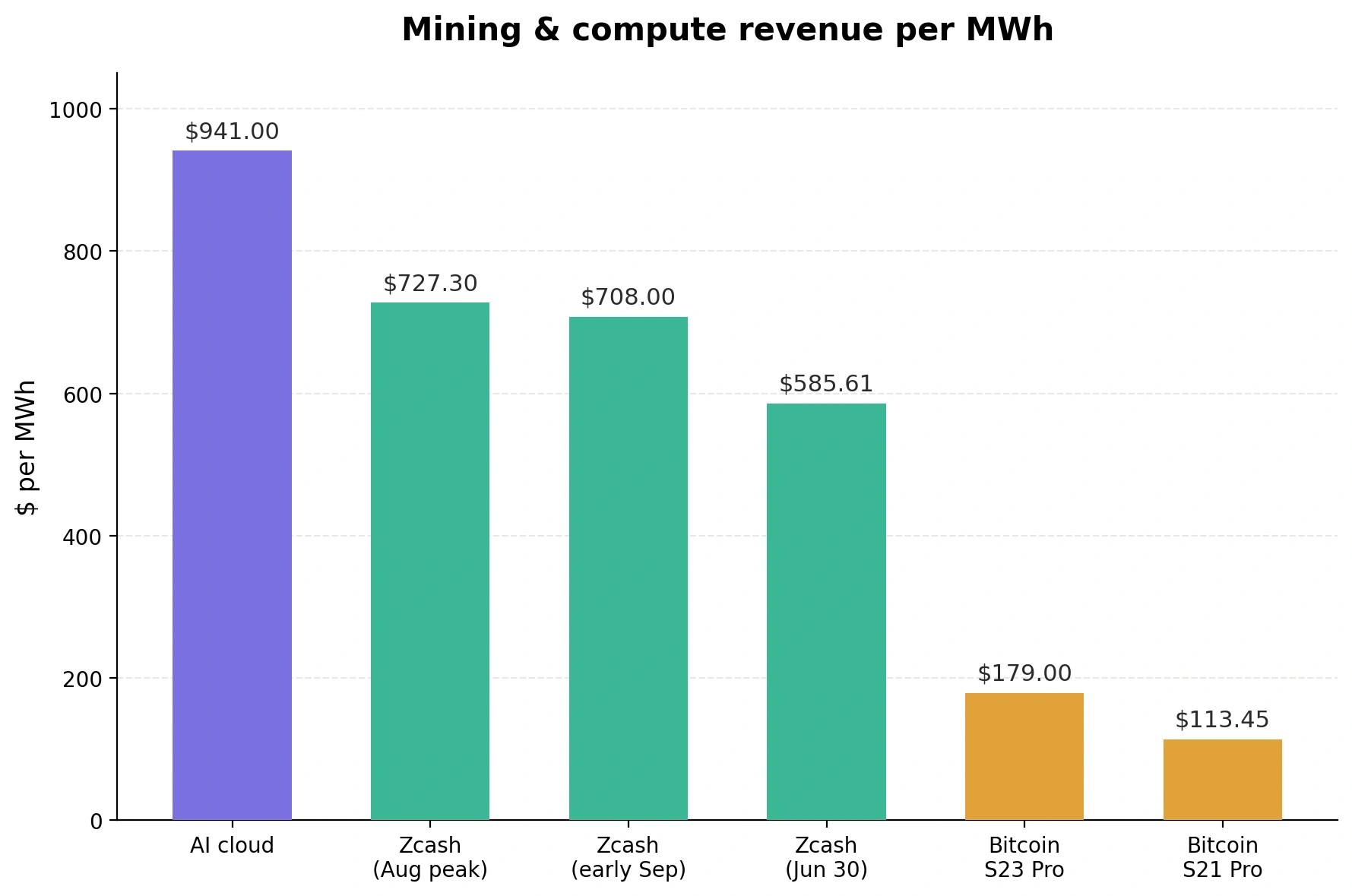
The modern Bitmain S23 Pro Bitcoin mining machine brought in only $179 over the same period, while the older S21 Pro managed a mere $113.45. Only cloud-based AI tasks, bringing in about $941 per MWh, outperformed the Zcash rig.

As of early September, the Z15 Pro's profitability is about $708 per MWh, roughly 3% below the August peak, as more devices have come online. The profit tracks the price of $ZEC, which peaked at a record $890 in August.

Zcash from ETFs That Lit the Fuse

The project's economic viability is based on the rising token price, which Grayscale helped kickstart. The firm converted its Zcash Trust into an exchange-traded fund and listed ZCSH on NYSE Arca on August 25, becoming the first U.S. product to offer spot investing in a privacy-focused cryptocurrency.

The fund's assets under management exceeded $500 million. This amount also includes about $100 million from DCG International Investments, a subsidiary of Grayscale's parent company, Digital Currency Group, which contributed 85,705.32563297 $ZEC for shares.

$ZEC rose along with the capital influx. On September 4, the token surpassed $1,000 for the first time, and CoinMarketCap now values it at approximately $1,180 , with a market capitalization of around $20 billion. On September 3, Grayscale attributed the rise to "an investment-based 'hard money' scenario and growing attention to digital privacy."

Capturing Territory for Zcash Hashrate

Profitability attracted a crowd of investors, and that crowd reduces profitability. Company Cypherpunk Technologies (Nasdaq: CYPH), backed by Cameron and Tyler Winklevoss, paid $33.33 million in August to fund what it calls the world's largest Zcash mining operation, running at about 4.2 Gsol/s, or roughly 18% of the network. The company owns nearly 2% of the $ZEC supply and aims for 5%.

The company has competitors. Foundry USA launched an "institutional-grade" Zcash pool in March and within a month captured nearly 30% of the mining market share. Fortitude Mining Holdings, another DCG subsidiary, purchased a 12.5-megawatt power plant in Nebraska to expand operations.

As the network's hashrate rises faster than the price, each participant's share of the approximately 43,800 $ZEC in monthly rewards shrinks.

Bitcoin Miners Are Leaving Anyway

The shift to Zcash is happening against the backdrop of a stalling Bitcoin rally. The BTC rally stalled after hitting $82,000 on September 3. It is now trading around $77,000, and reports indicate network difficulty is set to increase again on September 19.

Canaan reported Q2 mining revenue of $17.7 million and a net loss of $97.6 million, with projected Q3 revenue potentially as low as $11 million.

Many miners are abandoning cryptocurrency entirely in favor of AI. On August 25, it was reported that Riot Platforms signed a 20-year agreement with Anthropic worth $9 billion for computing capacity, and Bitdeer one for 16 years.

Trending Cryptos

Related Questions

QAccording to the article, how much more profitable is Zcash mining compared to Bitcoin mining for the best setups?

AAccording to the article, the best Zcash mining setup (Bitmain Z15 Pro) now earns approximately four times more per megawatt-hour than the best Bitcoin machine (Bitmain S23 Pro).

QWhat event, mentioned in the article, significantly contributed to the rise in ZEC's value and miner profitability?

AThe key event was Grayscale converting its Zcash Trust into a spot ETF and listing it on NYSE Arca on August 25, which initiated significant capital inflow and increased the token's price.

QWhat specific company, backed by the Winklevoss twins, made a major investment to become a leading Zcash miner?

ACypherpunk Technologies (Nasdaq: CYPH), backed by Cameron and Tyler Winklevoss, invested $33.33 million to fund what it calls the world's largest Zcash mining operation, aiming for 5% of the ZEC supply.

QAside from mining, what other application is mentioned as being even more profitable per megawatt-hour than Zcash mining?

AThe article states that only cloud-based AI tasks, which bring in about $941 per MWh, outperformed the Zcash mining setup's profitability.

QWhat is one reason given for the recent decline in profitability for Bitcoin miners, making Zcash more attractive?

AOne major reason is the Bitcoin network's halving event, which reduced block rewards. Additionally, the article mentions that Bitcoin's price growth has stalled after reaching $82,000, and network difficulty is set to increase again.

Related Reads

Trading

Spot

Hot Articles

What is $BITCOIN

DIGITAL GOLD ($BITCOIN): A Comprehensive Analysis Introduction to DIGITAL GOLD ($BITCOIN) DIGITAL GOLD ($BITCOIN) is a blockchain-based project operating on the Solana network, which aims to combine the characteristics of traditional precious metals with the innovation of decentralized technologies. While it shares a name with Bitcoin, often referred to as “digital gold” due to its perception as a store of value, DIGITAL GOLD is a separate token designed to create a unique ecosystem within the Web3 landscape. Its goal is to position itself as a viable alternative digital asset, although specifics regarding its applications and functionalities are still developing. What is DIGITAL GOLD ($BITCOIN)? DIGITAL GOLD ($BITCOIN) is a cryptocurrency token explicitly designed for use on the Solana blockchain. In contrast to Bitcoin, which provides a widely recognized value storage role, this token appears to focus on broader applications and characteristics. Notable aspects include: Blockchain Infrastructure: The token is built on the Solana blockchain, known for its capacity to handle high-speed and low-cost transactions. Supply Dynamics: DIGITAL GOLD has a maximum supply capped at 100 quadrillion tokens (100P $BITCOIN), although details regarding its circulating supply are currently undisclosed. Utility: While precise functionalities are not explicitly outlined, there are indications that the token could be utilized for various applications, potentially involving decentralized applications (dApps) or asset tokenization strategies. Who is the Creator of DIGITAL GOLD ($BITCOIN)? At present, the identity of the creators and development team behind DIGITAL GOLD ($BITCOIN) remains unknown. This situation is typical among many innovative projects within the blockchain space, particularly those aligning with decentralized finance and meme coin phenomena. While such anonymity may foster a community-driven culture, it intensifies concerns about governance and accountability. Who are the Investors of DIGITAL GOLD ($BITCOIN)? The available information indicates that DIGITAL GOLD ($BITCOIN) does not have any known institutional backers or prominent venture capital investments. The project seems to operate on a peer-to-peer model focused on community support and adoption rather than traditional funding routes. Its activity and liquidity are primarily situated on decentralized exchanges (DEXs), such as PumpSwap, rather than established centralized trading platforms, further highlighting its grassroots approach. How DIGITAL GOLD ($BITCOIN) Works The operational mechanics of DIGITAL GOLD ($BITCOIN) can be elaborated on based on its blockchain design and network attributes: Consensus Mechanism: By leveraging Solana’s unique proof-of-history (PoH) combined with a proof-of-stake (PoS) model, the project ensures efficient transaction validation contributing to the network's high performance. Tokenomics: While specific deflationary mechanisms have not been extensively detailed, the vast maximum token supply implies that it may cater to microtransactions or niche use cases that are still to be defined. Interoperability: There exists the potential for integration with Solana’s broader ecosystem, including various decentralized finance (DeFi) platforms. However, the details regarding specific integrations remain unspecified. Timeline of Key Events Here is a timeline that highlights significant milestones concerning DIGITAL GOLD ($BITCOIN): 2023: The initial deployment of the token occurs on the Solana blockchain, marked by its contract address. 2024: DIGITAL GOLD gains visibility as it becomes available for trading on decentralized exchanges like PumpSwap, allowing users to trade it against SOL. 2025: The project witnesses sporadic trading activity and potential interest in community-led engagements, although no noteworthy partnerships or technical advancements have been documented as of yet. Critical Analysis Strengths Scalability: The underlying Solana infrastructure supports high transaction volumes, which could enhance the utility of $BITCOIN in various transaction scenarios. Accessibility: The potential low trading price per token could attract retail investors, facilitating wider participation due to fractional ownership opportunities. Risks Lack of Transparency: The absence of publicly known backers, developers, or an audit process may yield skepticism regarding the project's sustainability and trustworthiness. Market Volatility: The trading activity is heavily reliant on speculative behavior, which can result in significant price volatility and uncertainty for investors. Conclusion DIGITAL GOLD ($BITCOIN) emerges as an intriguing yet ambiguous project within the rapidly evolving Solana ecosystem. While it attempts to leverage the “digital gold” narrative, its departure from Bitcoin's established role as a store of value underscores the need for a clearer differentiation of its intended utility and governance structure. Future acceptance and adoption will likely depend on addressing the current opacity and defining its operational and economic strategies more explicitly. Note: This report encompasses synthesised information available as of October 2023, and developments may have transpired beyond the research period.

3.6k Total ViewsPublished 2025.05.13Updated 2025.05.13

What is $BITCOIN

Discussions

Welcome to the HTX Community. Here, you can stay informed about the latest platform developments and gain access to professional market insights. Users' opinions on the price of BTC (BTC) are presented below.

活动图片