Author:Zack Pokorny
Compiled by: Deep Chao TechFlow
Deep Chao Introduction: Polymarket and Kalshi have proven that there is demand for 'pricing events.' This Galaxy report asks what's next: not just betting on whether an event will occur, but trading on 'what an asset will be worth after the event happens.' Decision markets have expanded from MetaDAO alone to two fronts on Solana and EVM, while impact markets have projects like Proof and If Market launching on mainnet this year. The scale is still small, with most products still in testing, but the recovery in on-chain options volume and transaction cases of customized 'hedge anything' suggest that the next round of demand for derivatives may not solely be in perpetual contracts.
Decision markets are expanding, impact markets are about to launch on mainnet, and new infrastructure is pushing event-driven finance beyond prediction markets.
Introduction
Over the past 18 months, Galaxy Research has conducted extensive research on prediction markets and their derivative forms: decision markets and impact markets. We have discussed the applicability of decision markets in decentralized autonomous organization (DAO) governance, their potential as a cold-start mechanism for early-stage crypto projects, the use of prediction and impact markets as hedging tools, and studied Hyperliquid's HIP-4 outcome markets.
A common thread throughout this research is: prediction markets are merely a 'version 0' of event-driven markets and hedging tools, while broader experiments, represented by decision markets and impact markets, are thriving behind the scenes. At the time, except for a few cases like MetaDAO, most of this field existed only as ideas in X posts and whitepapers. Now things are starting to change: multiple projects are entering testing phases, and a new generation of experiments is unfolding.
The following will sort out the current progress in this track, who is building, and where the ideological discussions and experiments sparked by this movement are headed.
Why Conditional Markets?
Previously, we discussed impact markets and decision markets as two distinct concepts. Today, it is more appropriate to view them as subsets under a broader category we call 'conditional markets.' Their market mechanisms are functionally the same: conditional trades are placed in the market and settle only when specific outcomes occur. The main difference is that decision markets also settle with an explicitly binding outcome (e.g., if the price in the conditional market is more than 5% higher than spot, the management team adds a certain protocol feature). Given the identical mechanisms and the impending expansion of event-driven market and hedging tool varieties, grouping them together is most reasonable.
Definitions aside, conditional markets, as event-driven markets and hedging tools, have some characteristics that distinguish them from prediction markets. We have discussed these in more detail in previous reports. Key differences include:
Moving beyond the binary 'all-or-nothing' nature of prediction markets.
Allowing participants to trade real assets and their prices, rather than synthetic instruments based on probability.
As an informational byproduct, they output the impact of future events on asset value, not the probability of whether an event will occur.
These characteristics (and others mentioned in the linked report) open up possibilities from hedging, payoff structure, and market signaling angles that prediction markets fundamentally cannot provide.
What's the Current State of Conditional Markets?
Since our last research, both decision markets and impact markets have made tangible progress. The following sections outline their current status, the projects building at the market and infrastructure layers, and the experiments forming around them.
Decision Markets
In September, Umia, an ownership token issuance platform for Ethereum Virtual Machine (EVM) compatible chains, went live, expanding the design space for decision markets. Previously, decision markets were largely confined to MetaDAO on Solana, which pioneered the concept and was the first to achieve scale.
Until now, decision markets have been binary: the decision being traded is either passed or rejected. Proposal drafters first solicit community input, draft the proposal, and then launch the market. This approach allows decisions to be traded via markets, but the social factors in the drafting process and the fact that all variables in the proposal are fixed (e.g., increasing monthly burn from $50k to $65k, or converting 50% of the DAO treasury to yield-bearing stablecoins) create friction. Traders can only judge based on the proposal's fixed parameters, even if they agree in direction but disagree on details. (For instance, a trader might think monthly spending should increase, but only to $60k; or that the DAO should mobilize treasury funds, but not exceed 30%.) This means the optimal outcome can only emerge through social filtering, possibly requiring repeated proposals, or may never be priced and traded at all.
The diagram below shows what this type of market looks like at a macro level.
With Umia's launch, we now have multi-outcome decision markets: traders can make decisions on the specific parameters of a proposal (e.g., should spending increase to $55k, $60k, or higher?). This allows traders who agree with the proposal's direction to express views on its specific details. The result is that traders price each parameter of the proposal, while the proposal itself can remain broader in scope. Because traders can price individual parameters rather than a fixed proposal, this design can reduce reliance on the social factors inherent in binary 'pass/fail' decision markets, converging towards the 'optimal' outcome even before launch. Multi-outcome markets no longer rely on drafters to socially filter out the 'correct' version before a proposal becomes a market; instead, this filtering happens through price discovery. The practical effect is that decisions can be priced more accurately and efficiently. The market surfaces the specific parameters the community actually supports, rather than forcing everyone to judge and price whether the market agrees with the specific parameters written into the proposal.
The diagram below shows what this type of market looks like at a macro level. They are essentially almost identical to binary decision markets, just with multiple tradable markets.
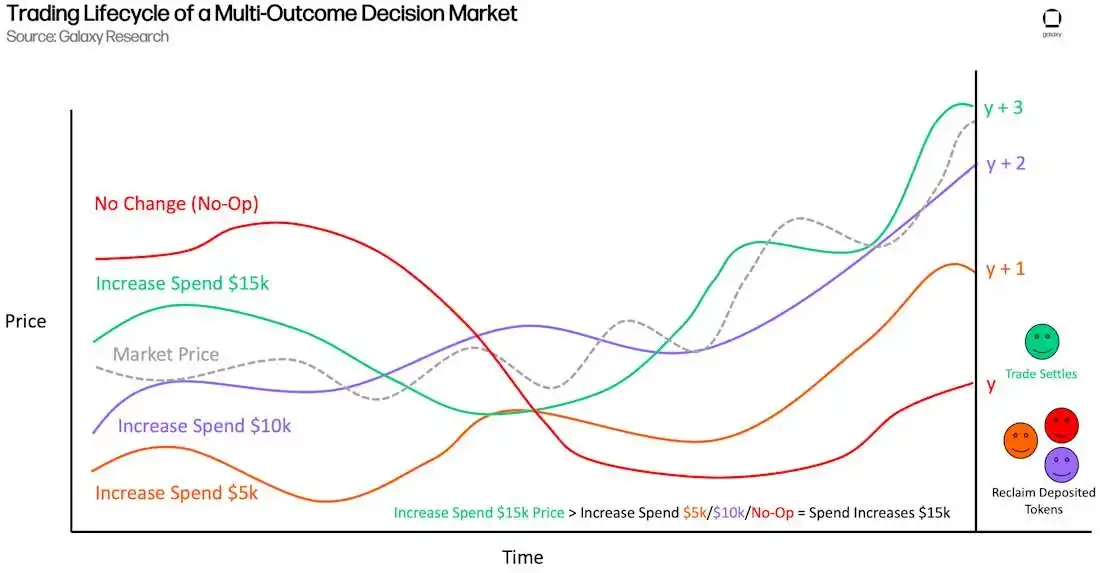
A challenge for multi-outcome markets is potential liquidity fragmentation, as the number of tradable markets increases linearly with the number of possible proposal outcomes. Umia's design doesn't require traders to split funds across each market. Instead, it allows a single deposit (stablecoin or DAO token) to be simultaneously converted into corresponding positions across all outcomes (e.g., a 5 USDC deposit can be used to trade in the 'increase spending by $5k,' 'increase by $10k,' 'increase by $15k,' and 'keep unchanged' markets). This is possible because these markets are conditional on each other; ultimately, only trades in the winning market settle. Therefore, a trader's funds can be present everywhere at once but never face loss risk in more than one place. Effectively, a single deposit covers the full outcome space, allowing traders to build positions on every possible proposal parameter without having to bet upfront on which one will pass. This is key to maintaining liquidity in multi-outcome markets. Since a single deposit can trade in each market, adding more outcomes doesn't split the funds, and market depth doesn't thin as the number of markets increases.
Currently, 22 DAOs have a total of $50.5 million in total value governed by decision markets. This figure includes all stablecoins and tokens held in the treasuries of DAOs that rely entirely on decision markets for governance (e.g., DAO tokens held on the balance sheet, liquidity provider positions, and all other tokens held by the DAO). The MetaDAO ecosystem controls most assets in market-governed treasuries: 21 out of the 22 DAOs using decision markets, accounting for 78% of total assets in market-governed treasuries. $50 million may sound small, but MetaDAO's market-governed DAO launch platform completed its first fundraising only 11 months ago.
Looking only at the stablecoin portion of these DAOs' balance sheets, the value governed by decision markets is $35.8 million. This is an important figure to track because it represents the value that could be liquidated if investors choose to withdraw funds. Similar to the total assets in market-governed treasuries, the MetaDAO ecosystem controls the majority (82%) of the stablecoin value governed by decision markets.
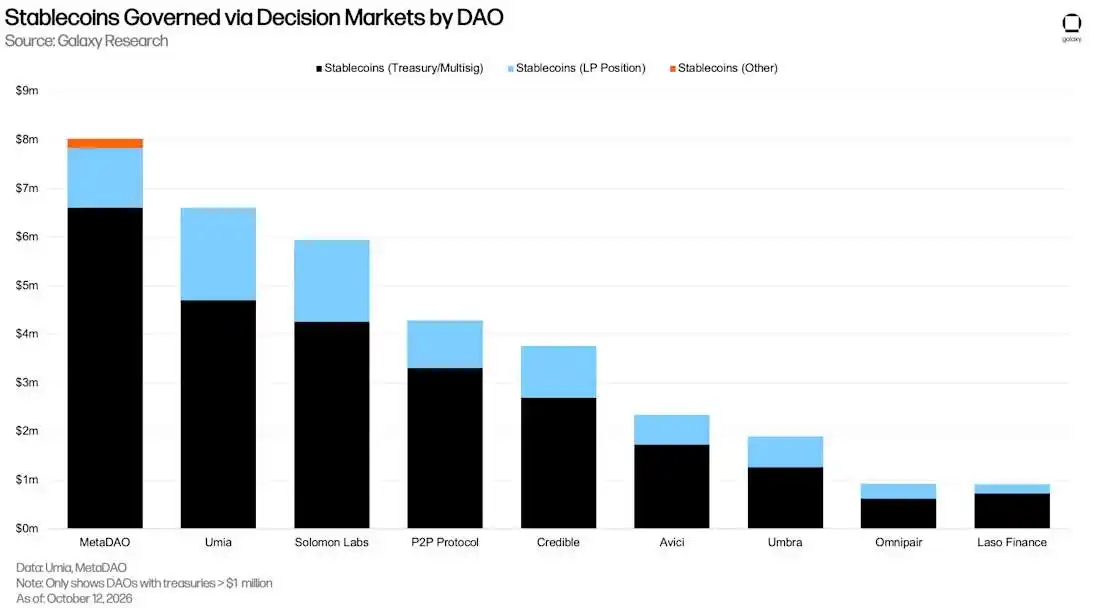
Umia's launch introduces previously unseen competition into the decision markets track. This is important for the growth and proliferation of decision markets for two reasons: it helps expand the asset size of market-governed treasuries and broadens the chain choices for organizations based on decision markets.
Expanding the asset size of market-governed treasuries is arguably the most important Key Performance Indicator (KPI) for this track, because the dollar value of assets governed by decision markets determines the economic stakes involved in any proposal, and the size of the stakes is what attracts volume into the markets. A proposal built on a small treasury or low-market-cap token has little dollar impact even if passed, giving traders little incentive, or even no capacity, to deploy significant capital to price it correctly. As the scale of assets governed by markets grows, similar decisions carry greater value impact, markets can support larger positions, attracting more capital and sophisticated traders to compete in correct pricing. With multiple projects able to launch decision market DAOs, no longer reliant on a single incumbent, the number of organizations running proposals through this mechanism at any given time will increase, boosting total volume even if individual markets aren't larger yet.
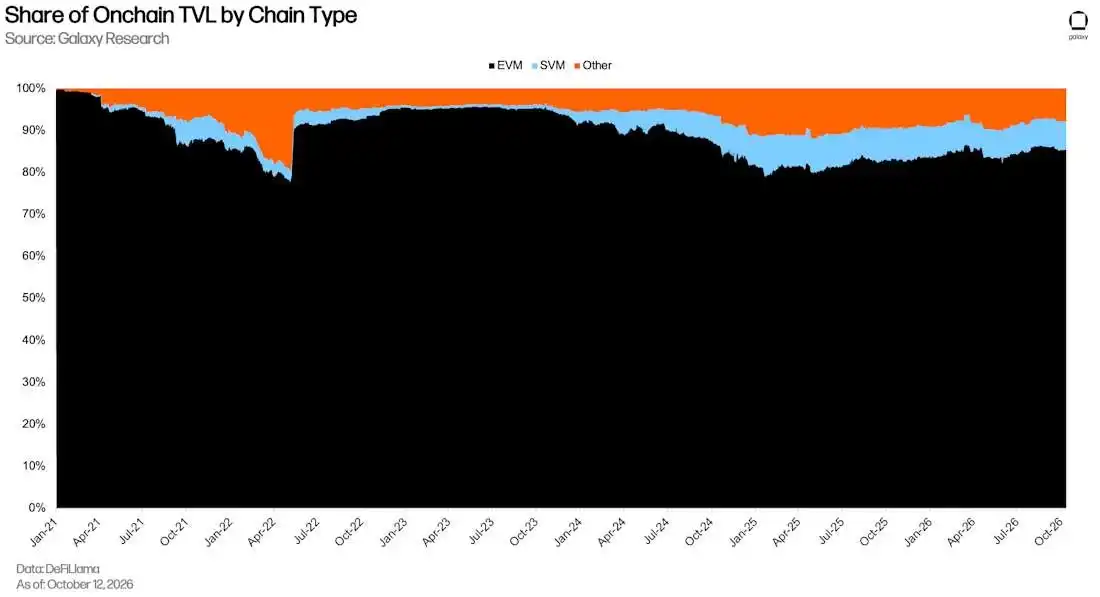
Competition also broadens the chain choices for these organizations. Previously, decision markets were effectively confined to Solana, because MetaDAO was the only project that had issued tokens most suitable for decision markets, a problem of 'objective function effectiveness' we've discussed before. With Umia's launch, projects can now choose to launch decision market DAOs with effective tokens on either Solana or EVM, which together account for about 92% of Total Value Locked (TVL) by chain type, significantly expanding the potential market for this design.
Impact Markets
Since our earlier research, impact markets have made tangible progress: several projects are finishing testing and moving towards mainnet, and new projects are entering at both the market and infrastructure layers. The design approaches taken by various teams are noticeably different, operating at different layers of the tech stack, from standalone markets to underlying infrastructure supporting them. Soon, we should see tradable products launching on mainnet applications.
It is increasingly clear that competition in this sub-sector will intensify over the coming year. Understanding what each project needs to succeed as competition heats up clarifies the fundamental reasons why these markets are useful, starting with traders. The information these markets generate is valuable, but it's a byproduct of a healthy market, not the product itself. What's sold to traders is exposure; exchanges must be built around 'giving users a real reason to take, hold, and hedge risk,' because these actions generate the volume upon which information depends. This means judging who will succeed must be trader-centric: liquidity must be high enough for odds in these markets to be authoritative, much like mainstream media now cites Polymarket and Kalshi odds; exposure must be potent enough; leverage must be competitive with perpetual contracts. Conditional markets also don't exist in isolation. Their relationship with underlying perpetual contract markets and prediction markets is crucial to their overall health, so hedging and arbitrage between them must be practical and cost-effective. Finally, market durations need to be short and turnover fast, closer to the rapid pace of prediction markets, to match traders' attention cycles.
Below are several projects building impact markets.
Lightcone was the first team to publicly articulate what is now known as impact market products, announcing the project in October 2025, with other teams following. Lightcone also coined the term 'impact market,' effectively naming the category. The project is currently in testing, aiming for a public launch by year-end.
Proof takes a vertically integrated route, building a full-stack exchange on its own infrastructure. The team has experience building and operating derivatives exchanges, is highly trader-centric, and design decisions revolve around supporting liquidity and providing attractive exposure for traders. The diagram below shows Proof's vertically integrated design linking conditional markets, perpetual contracts, and prediction markets (which it calls 'binaries').
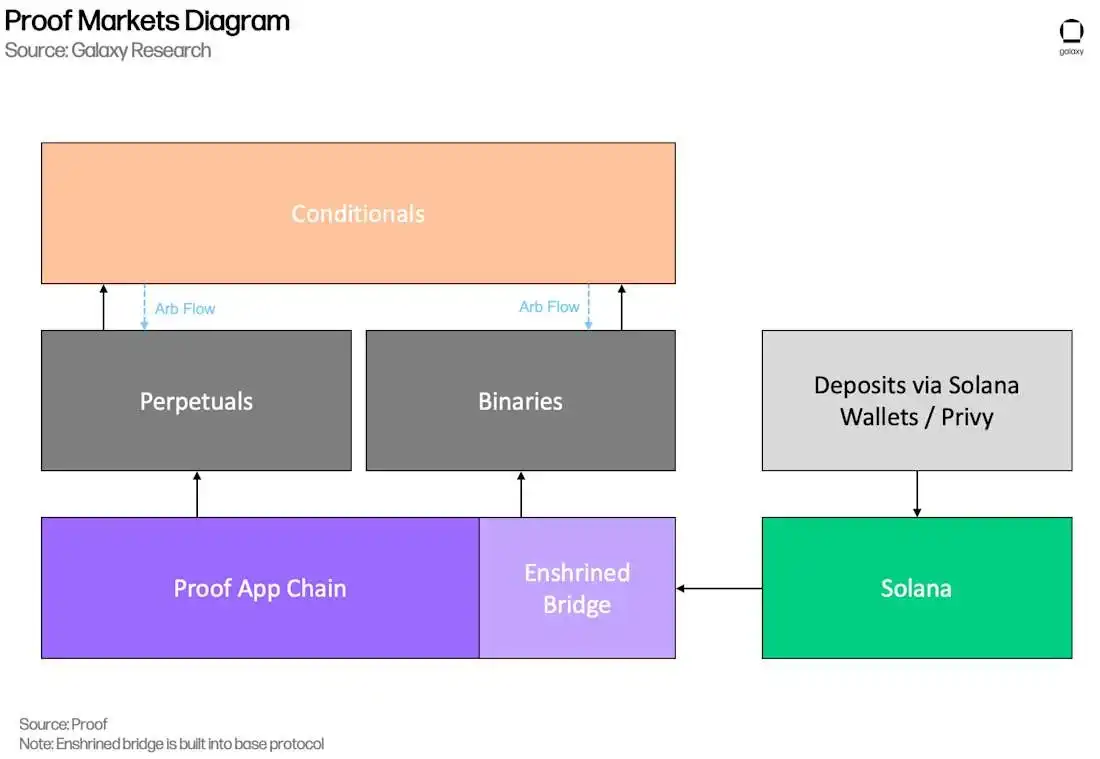
Proof was founded this year, has launched its application chain testnet and a v0 exchange, and ran a trading competition attracting about 500 traders to test the market design. The team aims to launch on mainnet in an invite-only manner within the next month or two (around November 2026). Capital efficiency and the relationship between primitives are core to Proof's design. Its margin framework supports leverage and netting between perpetual and conditional markets. This serves three purposes:
Giving traders more efficient exposure on single positions;
Allowing market makers to hedge conditional exposure efficiently using underlying perpetual contracts;
Enabling capital-efficient direct arbitrage between conditional markets, perpetual contracts, and prediction markets (important for pricing and market health, and potentially an accelerator by connecting traffic between two previously separate market types).
Proof is also building its own perpetual exchange rather than layering conditional markets on third-party infrastructure. This is necessary to achieve margin netting between conditional markets and underlying assets. Because conditional markets are built atop this underlying exchange, the execution quality at the base directly determines how much liquidity and pricing quality the conditional market layer can support.
Proof's broader view is that an exchange with excellent execution can simultaneously capture arbitrage flows from both prediction markets and perpetual contracts against the same underlying liquidity. This is important because shared liquidity increases market depth and tightens spreads, making the resulting exposure more attractive to traders. Proof also believes this integrated design can address some liquidity constraints that have historically limited event market development, potentially enabling deeper prediction market exposure in categories beyond sports and elections.
Proof's rationale for vertically integrating these primitives is that markets don't exist in isolation. For conditional markets to be attractive products, surrounding components—underlying perpetual liquidity, margin, execution, settlement, and arbitrage paths—need to work together as a unified system.
If Market employs a different design from Proof. Instead of an on-chain approach, it offers exposure in the form of synthetic, cash-settled positions. Users deposit stablecoins, and positions are cash-settled at the spot price of the underlying asset upon market settlement. Nothing is tokenized or custodied throughout the process. The team cites two reasons for this, related to product demand and user experience (UX): natural interest in holding tokenized versions of the market's underlying assets may be limited; and a purely cash-settled design offers a simpler UX for a product intended to price event impact rather than custody assets.
Each market on the platform is organized around a common event (e.g., 'Will the Fed cut rates at the next FOMC meeting?'). The sub-markets represent different framings of this event's impact (e.g., the price of Brent crude, gold, or Microsoft stock if the event happens vs. if it doesn't). Each market splits into YES and NO 'universes,' each with its own full set of order books per asset, while all assets in that market share a single prediction market order book. This prediction market serves two purposes: the obvious one of pricing the event's probability; and, when traders close impact market positions before settlement, absorbing the locked-in profit & loss (P&L), converting it into prediction market tokens that traders can immediately sell or hold until settlement. At settlement, positions in the losing universe have their committed margin fully returned.
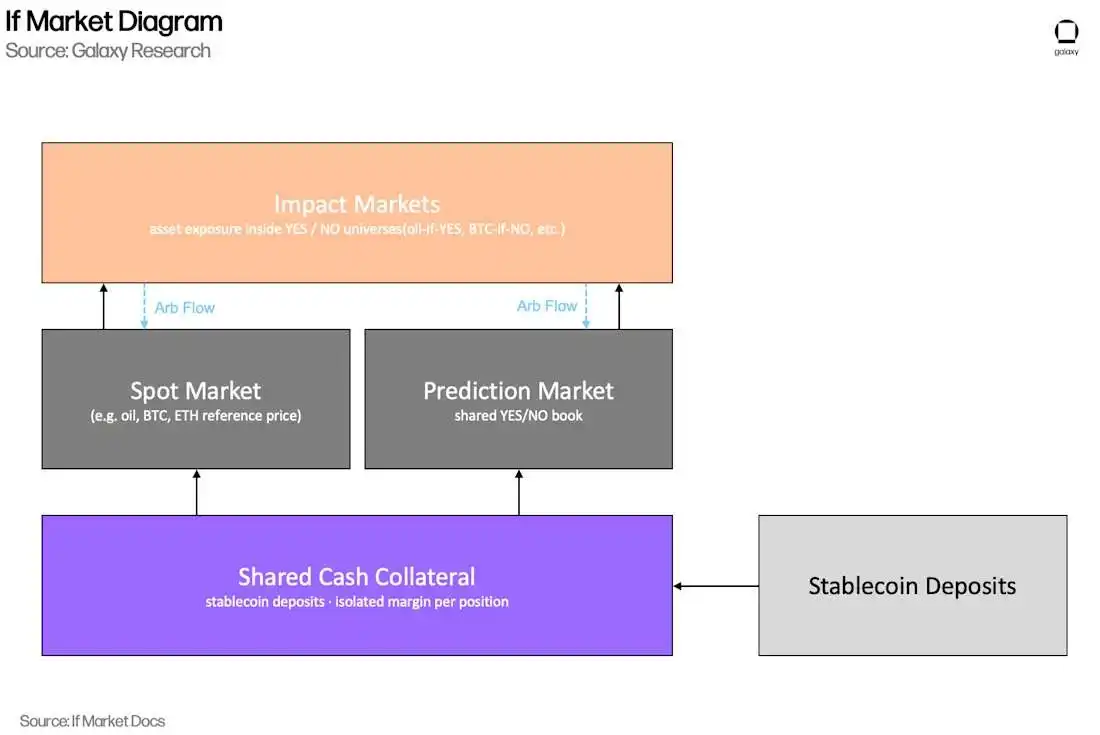
Leverage on the platform went live in September. Positions use isolated margin per position, with position caps set by tier based on notional value. Some markets allow up to 10x leverage. Unlike a perpetual-style design, If Market has no funding rate; instead, arbitrage anchors conditional prices near spot, and this risk is managed via position caps rather than pulling price towards an oracle. Liquidation mark prices use the order book's Time-Weighted Average Price, not a single fill price. Settlement prices come from external data sources with outliers removed, and if a market's rules specify, a short time-weighted window is used, making it harder to manipulate settlement around the expected settlement time.
The product is still in testing, but the platform's first trading competition concluded on September 30, attracting over 2,000 traders and executing over 6 million trades.
Beyond exchange and market-layer developments, activity is also beginning at the infrastructure layer for impact markets.
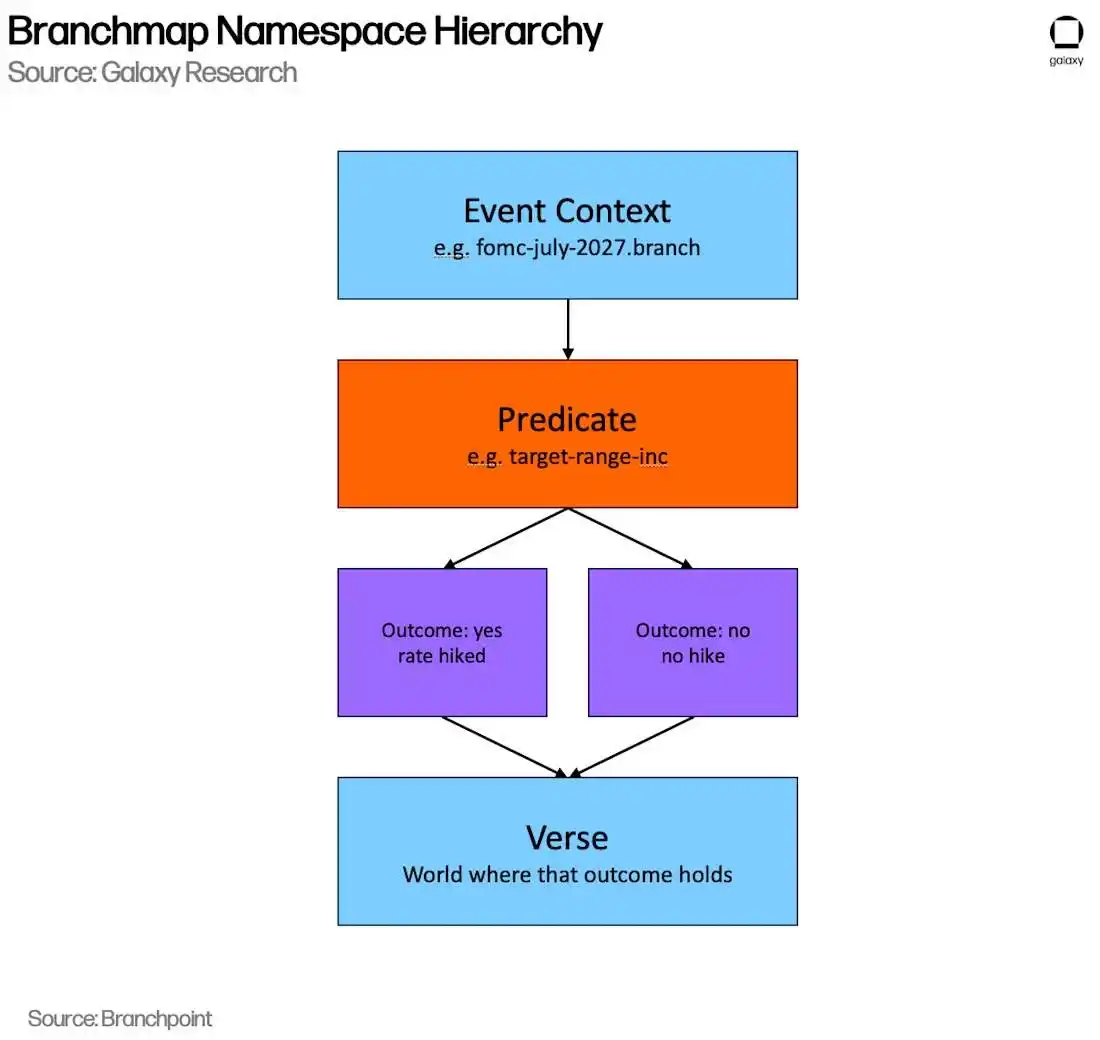
Branchpoint is building Branchmap, a semantic namespace layer for 'multiverse finance' (a term first introduced by Dave White, Research Partner at venture firm Paradigm), with impact markets being just one of many applications it supports. Rather than building an exchange first, Branchmap positions itself as shared infrastructure, giving events, predicates, and outcomes stable, machine-readable identities on-chain. This allows prediction markets, DEXs, lending protocols, and any other on-chain application to reference the same underlying event data and compose around it. For example, the same registered event, like whether the Fed will hike rates at a certain FOMC meeting, could be referenced simultaneously by a prediction market pricing the hike probability, a DEX listing BTC conditional on that outcome, and a lending protocol accepting such conditional BTC as collateral, all without each protocol needing to define or verify what the event is or how it settles.
The diagram below shows the structure of this namespace. It provides an event context (e.g., Fed Rate Decision), containing a predicate (e.g., Is the target rate raised?), which then generates named outcome entries for each possible result. Selected outcome combinations across one or more predicates define a 'verse'—the financial world in which conditional assets exist, though the verse itself is not a stored namespace entry.
The core idea is that prediction markets already act as a unit of account for an outcome: a binary contract paying $1 if an event settles a certain way is economically equivalent to holding $1 in the universe where that outcome occurs. Branchmap builds on this further, allowing any asset to be split into conditional versions for each possible outcome of an event, and recombined after the event settles. The diagram below illustrates this mechanism: a root asset splits into universe-conditional copies for each outcome of a predicate, and after the predicate settles, the surviving branches merge back into ordinary unconditional assets.
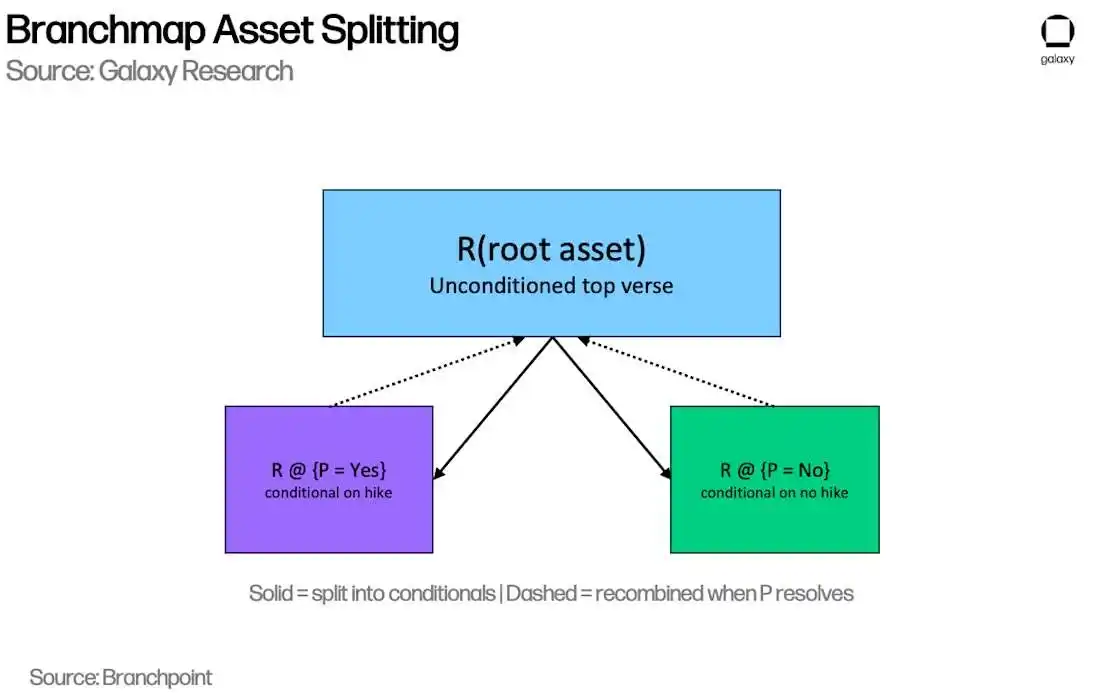
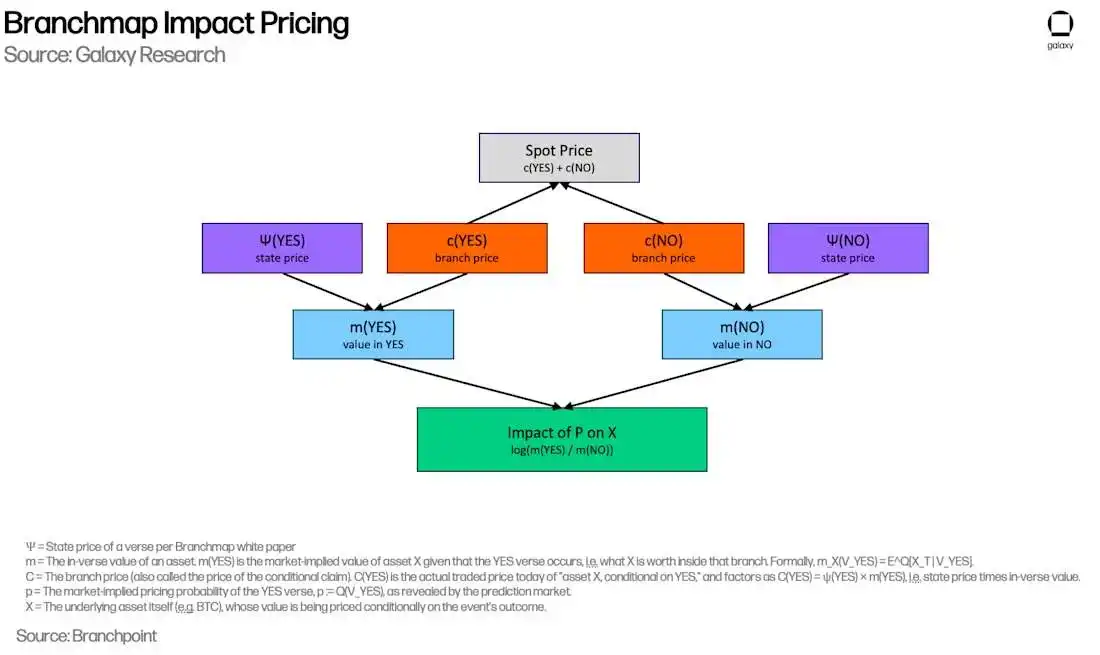
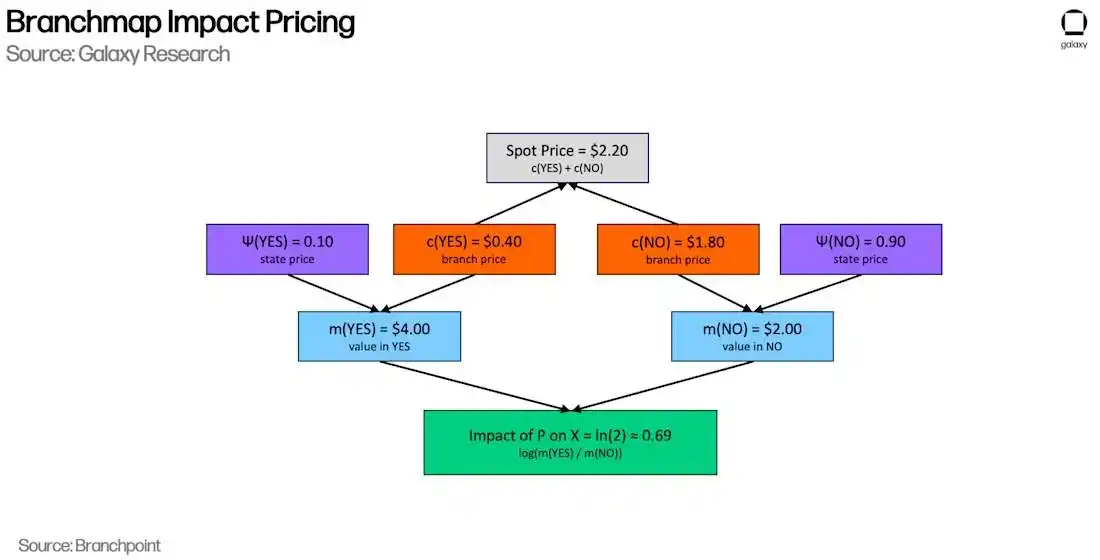
This splitting mechanism establishes a direct link between the probability a prediction market assigns to an outcome and the price of an asset conditional on that outcome—precisely the decomposition impact markets aim to price. Branchpoint explicitly lists this connection as one of its applications: the price of a claim on an asset in a given universe (its 'branch price') can be decomposed into the state price provided by the prediction market and the market-implied value of the asset within that universe ('in-verse value'). The state price is the price of that outcome's token in the prediction market, approximating the market-implied probability when discounting is negligible. In practice, conditional asset markets reveal branch prices; dividing by the state price recovers the in-verse value. Within Branchpoint's framework, the logarithm of the ratio of an asset's in-verse values in the 'Yes' and 'No' branches of an event is a measurable 'impact' statistic (see diagram below). Because the namespace gives both sets of prices the same event, outcome, and settlement identity, impact markets could in principle be built on top without needing custom infrastructure for each market.
Suppose the predicate is 'Will Florida temperatures remain below 28°F for three consecutive hours in December?', and the prediction market prices frost at 10%. If a Frozen Concentrated Orange Juice (FCOJ) claim that pays only in the 'Yes' universe trades at $0.40 per pound, and the corresponding 'No' universe claim trades at $1.80, then dividing each branch price by its state price yields the in-verse values: $4.00 in the 'Yes' universe and $2.00 in the 'No' universe. Therefore, the market expects orange juice to double in value should frost occur. The impact value is the natural log of this ratio: ln($4/$2) ≈ 0.69. The sum of the two branch prices also equals the unconditional orange juice price of $2.20.
Branchpoint's pilot deployment is expected to be a single-chain EVM namespace, initially controlled by the team, with a long-term roadmap towards a decentralized, cross-chain namespace where other trading venues and protocols can independently claim and govern. Like other infrastructure-layer projects, Branchpoint's utility to the impact markets track depends on whether trading venues and market operators adopt Branchmap as a shared underlying layer for their events and conditional assets, rather than building isolated event definitions and settlement logic.
Progress Behind the Scenes
The world is growing more complex. The downstream impact of individual events, whether political, regulatory, technological, or environmental, on asset prices and corporate balance sheets is increasing. Risks that investors and companies may now wish to hedge more actively were either milder or non-existent in the past; or tools to hedge certain risks or achieve certain payoff structures didn't exist. A natural conclusion is that market participants and firms should be able to hedge any event, not just the narrow set of risks traditional financial instruments were originally designed for, and obtain customized payoff structures on demand. Conditional markets are one manifestation of this idea, but they are likely just a step on a broader path towards more flexible, event-based financial instruments.
Perpetual contracts, the dominant hedging tool on-chain today, also have limitations that may push demand towards alternatives. Their payoff structure is linear (i.e., exposure changes proportionally with the underlying price, regardless of price level), which isn't suitable for all use cases. Some risks are better expressed with nonlinear or event-conditional payoff structures rather than constant 1:1 exposure. Perpetuals also carry liquidation risk (see the '10/10' event), which not all traders are willing to bear.
Several projects are working along these lines, and related thinking is increasing.
Options Protocols
Since January 1, Derive's options business has grown significantly. Monthly options notional volume dropped from $1.47 billion in January to a low of $629 million in February, then steadily recovered through the summer, accelerating sharply to $3.82 billion in September, about 2.6 times the January level; the pace over the past 30 days (September 13 – October 12) is about 195% higher than January. Open interest movement has been more volatile: starting at $590 million at the beginning of the year, sliding to a low of $359 million in late June, then recovering to a peak of $2.49 billion on September 21, and falling back to $1.66 billion by October 12. This is about 181% higher than January 1, over 4.6 times the June low, and about 34% lower than the September peak.
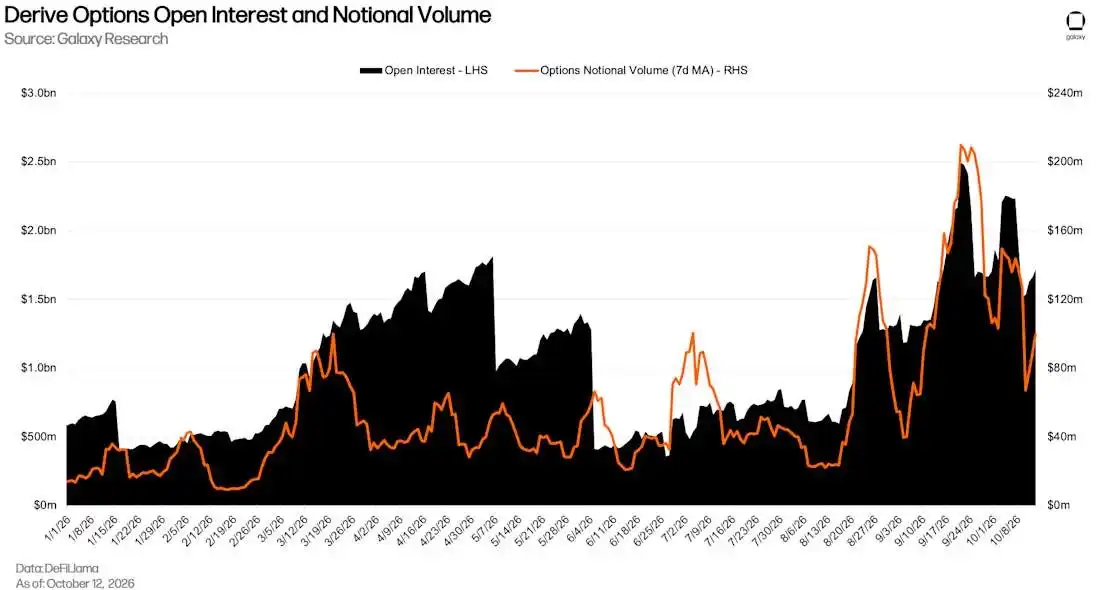
Compared to their off-chain counterparts, on-chain options have historically been significantly constrained because their capital requirements make them structurally more expensive, especially for sellers: sellers must pre-fund 100% margin on-chain, while off-chain they can hold positions with less capital via dynamic margining. Nonetheless, the recent trend is a meaningful signal that on-chain traders appear to be actively seeking hedging tools beyond perpetuals, a good omen for adoption of the more exotic conditional and event-driven tools discussed elsewhere in this report.
Castle Tech
Castle Technologies is a New York-based startup founded this year. Its value proposition is turning event risks not priced by traditional insurance and derivatives markets (e.g., tariffs, geopolitical disruptions, or specific legislation) into structured, tradable hedging instruments.
A recent Castle deal with a California goat-grazing company illustrates what a hedging contract looks like when a risk is too narrow and specific for an insurer to price and no ready market exists to match it.

Conditional markets are getting 'real' with goats this time.
The expiration of California's sheepherder wage exemption could increase Western Grazers' labor costs by about three to fourfold, up to $240,000 annually. The company operates about 4,000 goats used to clear vegetation that could fuel wildfires. No insurance company would write a policy on the outcome of specific legislation; before Castle stepped in, there was no options market, no perpetuals, no prediction market on this issue; and such events don't naturally generate two-sided retail interest.
Castle's job was to build the pipeline for this exposure from scratch: turning an ongoing legislative situation into a precise, self-certifying settlement condition, then finding a counterparty willing to price and hold this risk that traditional underwriters won't touch. Western Grazers entered a swap agreement with Castle structured to pay the company about $500,000 if the California legislature failed to resolve the wage issue by the October 1 deadline, with no payout if legislators resolved it. Castle transferred this risk via a back-to-back swap with quant trading firm Susquehanna, which priced and took on the exposure, with the trade ultimately matched and settled through a Kalshi prediction market.
The result is a custom underwriting policy executed via a prediction market exchange conduit: one fill, one counterparty, a settlement condition drafted specifically for this trade rather than off-the-shelf. Castle end-to-end manufactured a hedging contract for which there was previously no instrument, no market, and no insurer willing to provide, enabled by prediction market infrastructure. This trade suggests demand exists for 'hedge anything' products. Companies increasingly face risks outside the coverage of traditional insurance and derivatives markets (regulatory, legislative, highly localized) and are willing to pay real premiums for on-demand, custom-designed solutions.
Statebook
Statebook is more a theoretical concept than a ready product, but it provides a useful new framework for organizing event-based hedging tools. The idea comes from a working paper titled 'Markets for All States of the World.' The approach is to design financial markets first around a payoff structure (i.e., the exposure a trader wants) and then work backwards to see which existing contracts or combinations achieve it, rather than starting with the tools that happen to be listed and forcing traders to make do.
The mathematics underpinning this idea echoes the state price theory discussed in the Branchmap section earlier, but the definitions of 'state' come from different starting points. Branchmap's state prices come from an Arrow-Debreu-style partition: a predicate (e.g., 'Did the Fed hike rates?') settles via an oracle, and the resulting outcome directly defines a universe; the universe's existence doesn't require an options chain. Statebook's state prices come from a narrower but more concrete model, the Breeden-Litzenberger model. Taking the derivative of European call option prices with respect to strike price recovers the market's implied price for the underlying asset finishing above (or within) any given level or interval, turning an options curve into a ladder of boundary claims and range claims. While Branchmap uses its state definitions to give conditional assets shared semantic identity, allowing on-chain protocols to reference the same event and compose around it, statebook implements the state definition as an execution layer: treating plain options, boundary or threshold claims (e.g., 'pay $1 if the index closes above 100'), and range claims (e.g., 'pay $1 if the index closes between 100 and 110') as different views of the same set of options-implied state price data. Thus, a claim without its own order book, like a narrow range bet, can still be assembled for execution via two more liquid boundary claims or a matched pair of options, with statebook responsible for finding the cheapest available path and disclosing it at a firm, executable price.
Effectively, this aligns with the ambition driving the entire conditional market space: building infrastructure to hedge any well-defined event or price outcome, not just the few payoff structures that happen to have deep, dedicated markets today. Statebook achieves this through execution and routing, rather than Branchmap's on-chain semantic namespace approach; and its foundation overwhelmingly lies in traditional finance and US-regulated market structure, not DeFi. On-chain venues like Hyperliquid and Polymarket appear only as points of contrast, not the paper's primary focus. Nonetheless, the common thread is the same. Conditional markets, impact markets, and statebook are different variations of the same idea: markets should be organized around the states of the world traders want exposure to, not around the contracts that happen to exist. Notably, the statebook paper also points out that today's dominant on-chain hedging tool, perpetual contracts, cannot fit into this framework at all because they lack a fixed expiry and thus a terminal payoff against which states can be defined. This suggests perpetuals and statebook-style claims likely serve different, complementary hedging needs rather than competing for the same demand.
Conclusion
The design space for conditional markets is beginning to expand as impact market projects approach mainnet and multiple teams build around the decision market concept. Prediction markets were merely a 'version 0' of event-driven finance but have sparked a Cambrian explosion of experiments over the past 18 months. Decision markets layered a binding governance outcome on this mechanism; impact markets isolated the effect of events on asset prices rather than just the probability of the event itself. Now, infrastructure and downstream concepts like Branchmap and statebook are pushing the underlying idea—that markets should be organized around the states of the world traders actually want exposure to—into entirely new territory. With Umia introducing competition to decision markets for the first time and multiple teams simultaneously building impact markets at both the market and infrastructure layers, competition across the tech stack should intensify noticeably over the coming year.
That said, this is all still early. The learning curve for traders and builders is steep; every impact market project mentioned here is either still in testing or, like statebook, remains a working paper rather than a shipped product. Liquidity for these new instruments must be built essentially from scratch; demand for some may be more niche than proponents expect; and the entire track is still figuring out which underlying design is best—Proof's vertically integrated stack or If Market's cash-settled, non-tokenized route. In contrast, decision markets are further along: DAOs are already using MetaDAO's and Umia's designs in practice, and organizations governed by decision markets are proliferating. The coming year should bring more clarity on how these open questions for impact markets resolve and how much further decision market adoption can expand from here.