Author: Nick_Researcher
Compiled by: AididiaoJP, Foresight News
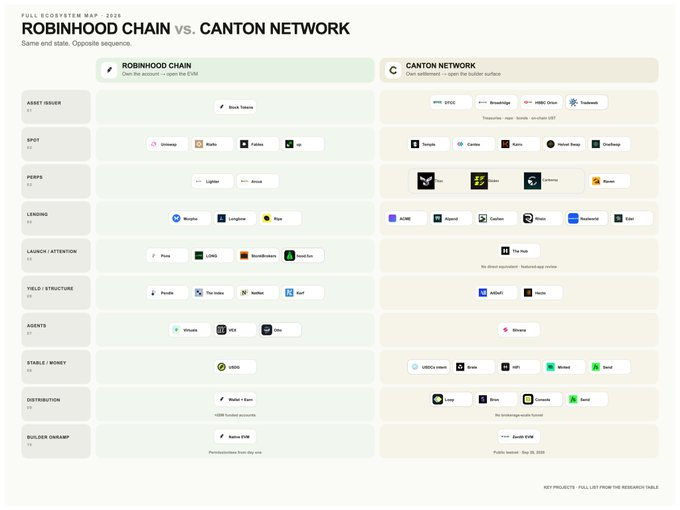
I've spent a lot of time tracking Robinhood and Canton Network. They are heading toward the same destination: placing real-world assets onto programmable infrastructure that people can use, but they are starting from opposite ends of the market.
Robinhood started from distribution. It first had millions of funded accounts, then launched tokenized assets and opened its chain to developers. Canton started from institutional settlement, privacy, and regulated financial infrastructure. Only now is it beginning to open up a more accessible environment for developers. I think this difference explains both their current positions and what Canton must do next.
One Starts from Users, the Other from Institutions
Robinhood Chain is an L2 based on Arbitrum Orbit, which launched its public mainnet on July 1, 2026. It uses ETH to pay for gas and supports permissionless deployment.
The core product is Stock Tokens, tokenized debt securities issued by Robinhood Assets (Jersey) Limited. They track the economic performance of U.S. stocks and ETFs but do not represent legal ownership of the underlying stocks. These products are available in over 120 countries, excluding U.S. users.
The main advantage lies in distribution. Robinhood already has approximately 28 million funded accounts, backed by Robinhood Wallet and Robinhood Earn. Uniswap, Chainlink, BitGo, Morpho, Lighter, etc., are the first batch of partners, and independent teams can also deploy products without permission.
Canton took a different path. It is a privacy-focused L1 developed by Digital Asset over about a decade. The Daml architecture allows participants to selectively share transaction data rather than exposing the entire network state. Its initial clients were not retail investors but financial institutions.
Broadridge's DLR repo platform runs on Canton. DTCC is promoting the tokenization of U.S. Treasuries custodied by DTC, aiming to launch commercial services in October 2026. Euroclear serves as Co-Chair of the Canton Foundation alongside DTCC. LSEG, Visa, and a16z crypto are members of the super validator set.
Digital Asset also completed a $355 million funding round in June 2026, led by a16z crypto, with participation from BNP Paribas, Citadel Securities, HSBC, Tradeweb, and ADIA. In late September, Hong Kong's record HKD 20 billion digital green bonds were settled on Canton through HSBC Orion.
In my view, the contrast is clear: Robinhood controls user relationships, lowers barriers, and allows applications to develop on a public EVM; Canton controls institutional settlement and collateral processes, protects sensitive transaction data, and is only now beginning to invite more developers. Robinhood is bottom-up; Canton is top-down.
Two Ecosystems: Where Each Stands Now
Robinhood's open ecosystem gained traction quickly. By late September, different tracking platforms estimated DeFi TVL to be between $0.9 billion and $1.6 billion, stablecoin liquidity close to $1 billion, and active RWA market capitalization around $150 million to $260 million. The specific numbers vary, but the direction is clear: capital entered rapidly and found multiple uses.
Uniswap became the primary liquidity venue; Morpho became the credit layer, now supporting Robinhood Earn markets around USDG; Lighter and Arcus launched stock and crypto perpetual contracts. Pons captured most launchpad activity, with Long, ClutchMarkets, and several smaller platforms following closely.
Meme coins and stock-paired tokens generated the initial trading activity. Subsequently, Stock Tokens gave users a reason to keep funds on-chain because they could serve as collateral, trading pairs, and underlying assets for derivatives.
What catches my attention is that Robinhood's most core distribution channel hasn't been fully connected. Johann Kerbrat mentioned that integration with Robinhood's core application is still in its early stages. The chain itself is operational, but the complete user journey from a brokerage account to on-chain hasn't materialized.
Canton is almost the opposite. Its institutional infrastructure is already in production. The network reports monthly tokenized RWA activity around $9 to $10 trillion, primarily driven by repo transactions. RWA.xyz shows represented asset value of about $326 billion, mostly from Broadridge DLR. This is institutional collateral activity, not widely distributed retail liquidity. According to different sources and definitions, network participants range between 500 and 780.
What Canton lacks is a mature public application layer. Wallets exist, several DEXs and lending protocols are in development, and curated application rewards are going through governance processes, but the cycle of users and liquidity remains limited. Zenith opened a public EVM testnet on September 28, 2026; Kaiko deployed an institutional-grade oracle two days later. I view Zenith as Canton's first credible Solidity developer entry point, but it is still a testnet, not an active application economy.
What Robinhood Still Lacks
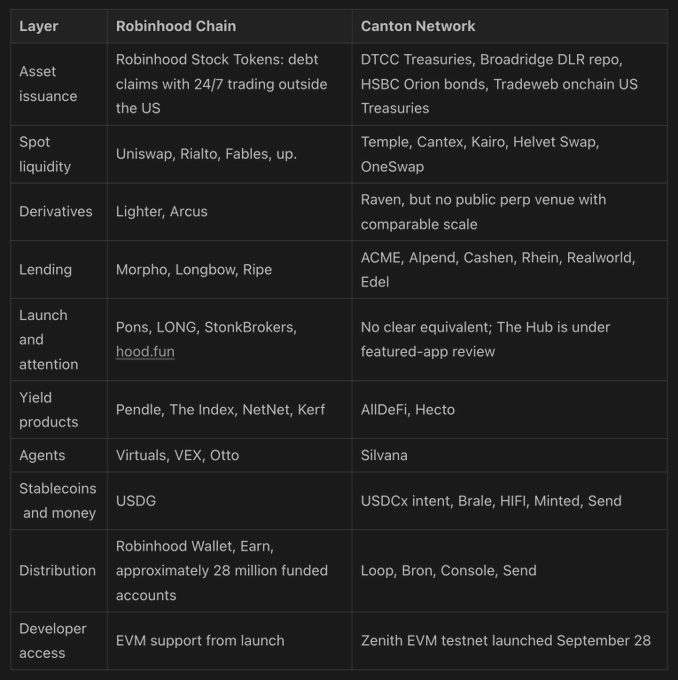
Robinhood has users and applications but lacks the institutional assets that Canton already supports.
Stock Tokens provide economic exposure; they are not stocks directly held in DTC infrastructure. U.S. users are still excluded. This chain is also not designed for banks managing bilateral repo positions, intraday margin, or private trading books. These institutions require controlled access and selective disclosure. Private equity, real estate, and art remain future product categories, not established on-chain markets.
In my opinion, Robinhood's speculative and trading layers have developed faster than its long-term allocation layer. This helps attract liquidity but also exposes the limitations of the current asset base.
What Canton Still Lacks
Canton already has high-quality institutional assets and settlement activity but lacks distribution and open, composable cycles.
There is no simple 24/7 stock product that non-institutional users can buy, lend, or use as a trading pair. There is no role like Pons to create new issuance and attention. There is no market of Morpho's scale where tokenized Treasuries become standard collateral for open lending. Public DEX liquidity remains limited compared to Uniswap on Robinhood Chain. Most importantly, Canton lacks a large consumer platform that can direct funded users to these products. Zenith might solve developer access but alone cannot solve distribution.
How Canton Can Replicate Robinhood's Success
I don't think Robinhood succeeded because its chain technology is fundamentally better. It succeeded because Robinhood already controlled user distribution, launched an easily understood asset class, and allowed developers to build around it.
Meme coins and launchpads brought attention; Stock Tokens retained capital; Morpho enabled assets to be used as collateral; Lighter and Arcus allowed traders to hedge and speculate on these assets. Canton shouldn't copy every product but should leverage its own institutional strengths to reproduce this sequence. I see three priorities.
First, Build a Morpho Around Institutional Collateral
To me, this is the highest conviction opportunity. Canton already has DTCC Treasuries, Broadridge repo collateral, and regulated bond infrastructure but lacks an open credit market that turns these assets into widely usable collateral.
Robinhood showed how quickly lending can aggregate liquidity. Within weeks, Morpho became one of the primary destinations for USDG and Stock Token-related capital. Canton could build a stronger version because the underlying collateral can have clearer legal and institutional claims.
I would watch for a structure like this: a permissioned primary market for regulated institutions; a more open secondary market for developers and qualified users; privacy maintained on the institutional side; and transparent collateral, interest rate, and liquidation rules at the application layer. This structure could meet institutional requirements while giving external developers an asset base to build around. Without an open credit layer, Canton's tokenized assets will continue circulating only among approved institutions and cannot foster a larger ecosystem.
Second, Secure a Large Retail Distributor
Canton doesn't need another hundred wallets. It needs a brokerage, neobank, or consumer finance application with funded users, fiat on/off ramps, and a clear product interface.
Robinhood's main advantage is not its AMM or EVM, but the account users already use to hold and move funds. Canton needs an equally simple product: hold tokenized Treasuries to earn transparent yield, trade stock tokens backed by actual DTC-custodied inventory, and access them 24/7 through an existing financial account.
Send, Loop, and Bron can provide important infrastructure, but infrastructure alone doesn't create demand. Curated application incentives might attract developers and short-term capital but are no substitute for a genuine consumer distribution channel. Without this channel, rewards will likely attract airdrop farmers, not long-term users.
Third, Focus on Derivatives and Issuance Only After Collateral Flows
I wouldn't prioritize large perpetual contracts or launchpads before the underlying assets and lending markets are functioning. Arcus and Lighter make sense on Robinhood Chain because users are already trading the underlying assets. A perpetuals market on Canton or Zenith, without liquid retail targets, would remain a limited product. The same goes for launchpads.
Robinhood Chain benefited from stock-paired tokens and active retail issuance because the environment already had attention, liquidity, and familiar assets. Canton could adopt a more focused model. Instead of a general meme coin platform, support issuances related to tokenized companies, funds, private market exposures, or regulated assets. This would maintain Canton's financial positioning while creating new products for traders and developers.
Sequence matters: Collateral → Credit → Distribution → Derivatives and Issuance. If Canton prioritizes speculation before this foundation is laid, liquidity will only be temporary.
Summary
I don't expect Canton to match Robinhood's retail holder count in the short term. That's not the comparison I care about. I want to see if Canton can create the same composable cycle while offering stronger assets, better privacy, and clearer legal claims.
Robinhood has proven that when a familiar asset is connected to lending, liquidity, derivatives, and distribution, users enter the ecosystem. Canton already has assets with significant institutional demand. Its challenge is making these assets accessible and usable outside closed settlement processes.
The October DTCC service and the future Zenith mainnet create an important window. If, after both are live, Canton still lacks a major lending market or a product oriented toward retail in the following quarter, I would assume most institutional activity remains closed to the broader ecosystem. The network would continue handling large volumes of financial transactions, but the open application layer would still rely on grants and incentives.
If Canton launches a serious collateral market and secures an effective retail distributor, my view would change rapidly. This is the gap I'm willing to bet on.