Author: KarenZ, Foresight News
The Glamsterdam upgrade for Ethereum is most easily misunderstood as yet another purely technical iteration to increase throughput. A more accurate description is: it is reorganizing Ethereum's block proposal process, validation process, resource pricing methods, and more, laying the groundwork for higher gas limits, larger blob capacities, and future parallel execution.
As of June 23, 2026, ethereum.org labels Glamsterdam as an upgrade planned for the second half of 2026. The name Glamsterdam comes from the combination of the execution layer upgrade "Amsterdam" and the consensus layer upgrade "Gloas." The official roadmap places it after Fusaka in December 2025 and before Hegotá, clearly listing two main features: enshrined proposer-builder separation (ePBS) and block-level access lists (BAL).
Who Proposes, Who Builds: ePBS Codifies Block Creation Roles into the Protocol
Today's Ethereum block production is like a very tight shift change: someone is responsible for proposing a block, someone else for building the transaction content, with dependencies on off-protocol infrastructure like MEV-Boost and third-party relays.
This system has been running for years, but it places some trust relationships off-protocol and also forces validators to handle consensus, execution, data availability, and other tasks within a very short time window.
One of Glamsterdam's headline changes, EIP-7732, or ePBS (Enshrined Proposer-Builder Separation), codifies the division of labor between proposers and builders into the protocol.
Simply put, the proposer is responsible for selecting the consensus block, and the builder is responsible for preparing the transaction content inside it. A builder cannot just make verbal promises; it must first "post a bond" within the protocol: specify exactly which execution payload it will deliver and how much it is willing to pay the proposer. Subsequently, a Payload Timeliness Committee (PTC) will check whether it delivers on time.
The key to this change is not just reducing reliance on third-party relays but also buying time for block propagation and validation.
Today, validators need to handle both consensus and execution simultaneously within a very short critical window; ePBS separates these two tasks, allowing the execution payload to be revealed and verified later. According to the design of EIP-7732, the propagation window for the execution payload—the available time for data to spread through the network and be received by nodes—can be extended from about 2 seconds to about 9 seconds. With a longer window, Ethereum can more safely handle larger payloads when increasing block capacity, reducing the risk of missed votes or reorgs due to nodes not having enough time to download, verify, and vote.
This change may not be directly perceptible to ordinary users, but it is crucial for Ethereum scaling. A longer propagation and validation window means the network can more securely handle larger loads. CoinDesk reported on June 16, 2026, citing Ethereum Foundation DevOps engineer Parithosh Jayanthi, that Glamsterdam could be one of the biggest forks since the Merge, changing many assumptions about Ethereum and preparing for larger-scale scaling in the future.
BAL and Repricing: Scaling Isn't Just About Stepping on the Gas, It's Also About Managing the Database
Another core change in Glamsterdam is EIP-7928, Block-Level Access Lists.
It can be understood as providing each block with an "access record": which accounts and which storage locations were touched during the block's execution, and what the related state became after execution, are all recorded. This way, nodes no longer process blocks completely like opening a blind box; they can know earlier which data needs to be read and which computations can be advanced in parallel.
The earlier EIP-2930 introduced transaction-level access lists, but they were optional and saw limited practical use. The change with EIP-7928 is that it elevates access lists to the block level: the block header contains a "fingerprint" (hash) of this list, while the execution payload stores the complete list. Nodes executing the block will verify whether the access records written in the list actually match the block's execution process; if they don't match, the block is invalid.
Why is this important? Today, when Ethereum executes transactions, many data accesses are only known when that specific step is reached. Nodes don't know if a batch of transactions will read/write the same account or storage slot simultaneously, making it hard to confidently process them in parallel. BAL explicitly writes out the access trajectory during block execution, allowing clients to perform parallel disk reads, parallel transaction validation, parallel state root computation, and also update the state in some scenarios without fully replaying transactions. It's not a direct button to lower user fees but opens up engineering space for client-side parallelization.
But Glamsterdam's scaling logic isn't just about "widening the road." It also needs to manage the long-term bloat of Ethereum's database. EIP-8037 increases state creation costs and introduces a cost per state byte (CPSB). State can be understood as the database content that Ethereum must preserve long-term, such as new accounts, new contracts, and new storage slots. Transactions end after execution, but state remains in the ledger that all nodes must maintain; if state grows too fast, running a node becomes increasingly expensive, and decentralization is gradually eroded.
The background numbers provided by EIP-8037 are straightforward: As of January 2026, a Geth node database dedicated to state is about 390 GiB; after the mainnet gas limit increased from 30 million to 60 million, daily new state growth rose from about 105 MiB to about 326 MiB, translating to an annual growth of about 116 GiB. Extrapolating proportionally under a 200 million gas limit, state growth could reach about 387 GiB per year and exceed the 650 GiB performance degradation threshold in less than a year.
Therefore, what EIP-8037 aims to do is separate the pricing of "temporary computation" from "permanently occupying the database." Creating new state will be more expensive because it imposes not a one-time computation cost on the network but a long-term storage burden.
Vitalik Buterin also mentioned, while explaining the Glamsterdam scaling roadmap, that Glamsterdam will separate state creation costs from execution and calldata costs: the goal is to allow execution capacity to expand more significantly while preventing state size from膨胀 at the same rate.
Looking at them together, BAL makes it easier for nodes to process blocks in parallel, addressing "running faster"; state creation repricing makes operations that long-term occupy the database pay a higher cost, addressing "don't let the ledger get fatter and fatter." Glamsterdam's scaling isn't simply raising the gas limit; it's asking a more realistic question: can Ethereum accommodate more transactions while preventing block propagation, transaction validation, and state storage pressures from spiraling out of control.
The Glamsterdam EIP List Takes Shape: Which Are Set, Which Are Still Waiting?
As of June 23, 2026, according to tracking content on Forkcast regarding Ethereum upgrades, Ethereum developers are currently testing the Glamsterdam upgrade in devnets environments, with deployment scheduled for Sepolia on August 3 and for the mainnet on September 16 (specific deployment dates are subject to change).
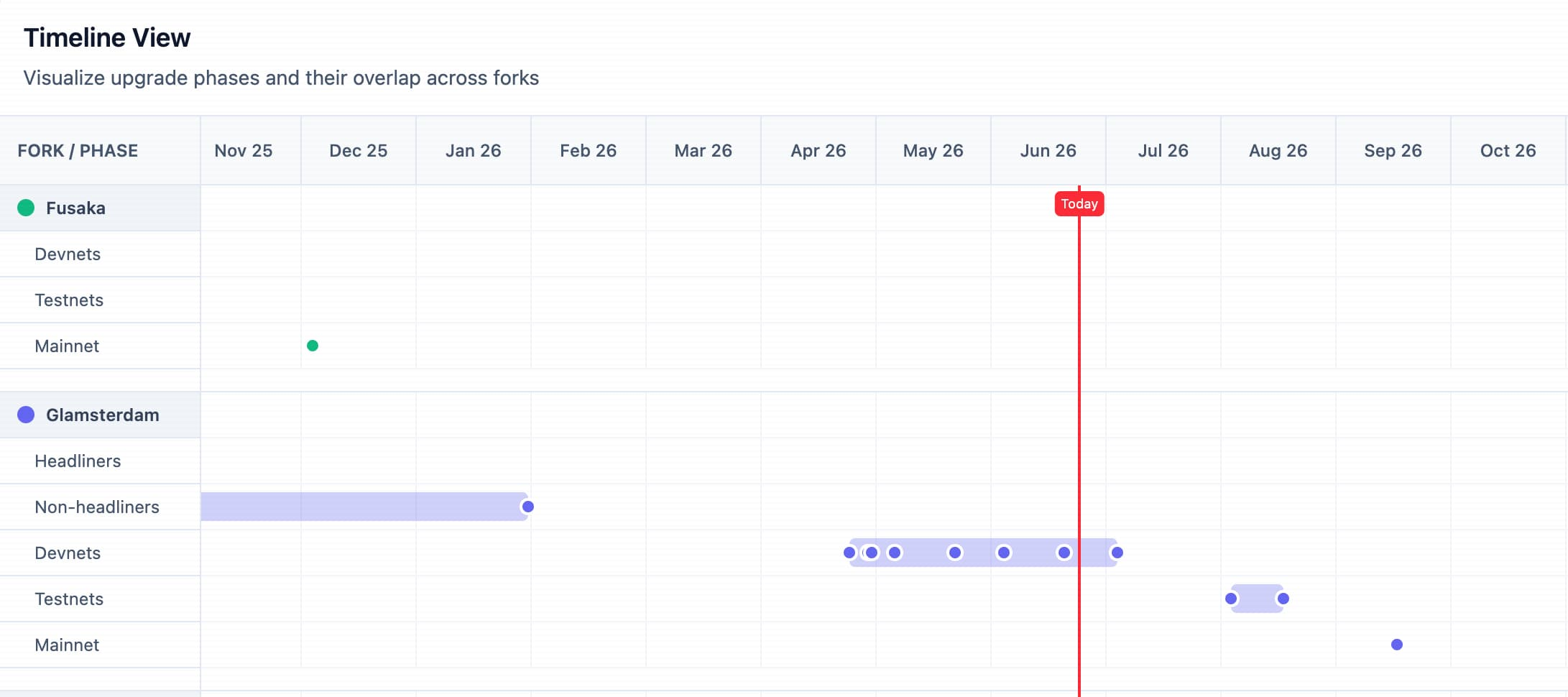
Currently, 10 EIPs are planned for inclusion in the Glamsterdam list:
- EIP-7708 (ETH transfers will also trigger logs, facilitating indexing and tracking of native ETH transfers)
- EIP-7732 (ePBS, codifying proposer-builder separation into the protocol, reducing reliance on off-protocol relays)
- EIP-7778 (Removes block gas accounting related to gas refunds, simplifying block gas calculation)
- EIP-7843 (Adds SLOTNUM opcode, allowing contracts to read the current slot number)
- EIP-7928 (Block-level access lists BAL, recording accounts and storage locations accessed during block execution, paving the way for parallel verification)
- EIP-7954 (Increases the maximum contract size limit, allowing larger contract bytecode)
- EIP-7976 (Increases calldata floor cost, adjusting the minimum cost for calldata)
- EIP-7981 (Increases access list cost, recalibrating gas pricing for access lists)
- EIP-8024 (Backward-compatible SWAPN, DUPN, EXCHANGE opcodes, enhancing EVM stack operation capabilities)
- EIP-8037 (Increases state creation gas cost,抑制 state database过快膨胀)
These EIPs can be roughly categorized into several groups: The first is the restructuring of block proposal and validation processes, with EIP-7732 and EIP-7928 at the core; the second is resource pricing adjustments, including EIP-7778, EIP-7976, EIP-7981, and EIP-8037; the third is EVM and developer experience changes, including EIP-7708, EIP-7843, EIP-7954, and EIP-8024.
In other words, Glamsterdam isn't changing just one feature point; it's simultaneously upgrading block creation roles, parallel validation, gas pricing, and EVM usability.
Another batch of EIPs remains on the "Considered for Inclusion" list:
- EIP-2780 (Splits transaction intrinsic gas by resource)
- EIP-7610 (Contract creation reverts when using a non-empty storage account)
- EIP-7688 (Future-compatible consensus layer data structure)
- EIP-7904 (Computational gas cost analysis, potentially to be removed from Glamsterdam)
- EIP-7975 (eth/70, partial block receipt lists)
- EIP-7997 (Deterministic factory contracts)
- EIP-8038 (State access gas cost updates)
- EIP-8045 (Excludes slashed validators from continuing to propose blocks)
- EIP-8061 (Increases exit and merge churn)
- EIP-8070 (eth/72, Sparse Blobpool)
- EIP-8080 (Allows exits to use the consolidation queue)
- EIP-8136 (Cell-level deltas for data column broadcasts)
- EIP-8159 (eth/71, block access list exchange)
- EIP-8246 (Removes SELFDESTRUCT burn)
- EIP-8282 (Builder Execution Requests, provides dedicated registration and exit requests for ePBS builders)
Additionally, Forkcast currently lists EIP-8254 (Limits the number of deposit requests per execution layer block to 8192) on the "Proposed for Inclusion" list.
From a staker's perspective, EIP-8061 and EIP-8080 on the considered list are particularly noteworthy. For stakers, this could mean improved exit liquidity. Figment stated in an article on May 5, 2026, that institutional stakers should pay most attention to ePBS, EIP-8061, and EIP-8080, estimating that under the ~38.9 million ETH staked规模 as of April 2026, EIP-8061 could increase the exit churn limit from 256 ETH/epoch to ~1187 ETH/epoch, while EIP-8080 allows regular exits to utilize spare capacity in the merge queue. Figment also cautions that all pre-mainnet numbers should be considered speculative.
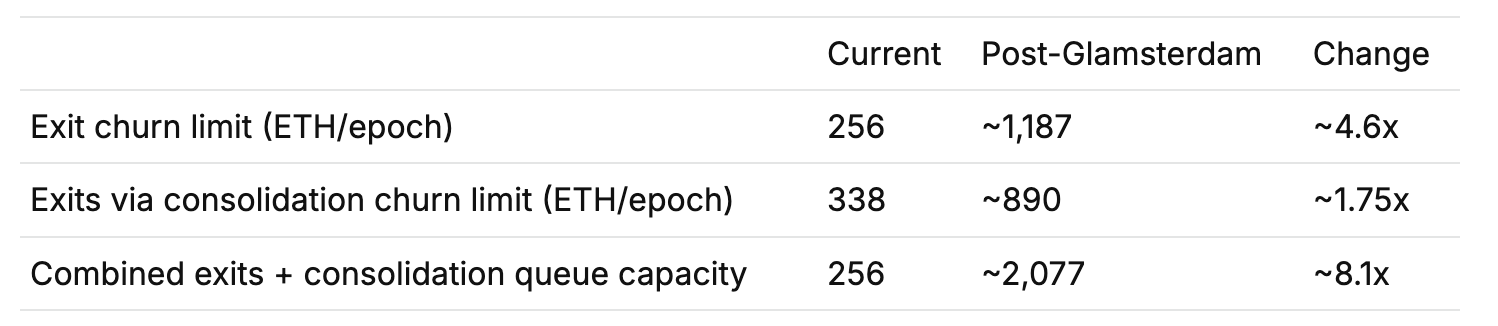
Source: Figment
The Protocol is Upgrading, and Foundation Members Are Also Changing
The technical preparation for Glamsterdam coincides almost simultaneously with personnel changes in the Ethereum Foundation's Protocol cluster. An Ethereum Foundation blog post on May 11, 2026, stated that Glamsterdam had reached several milestones: a 200 million gas limit floor had been established as a credible post-Glamsterdam target, ePBS was running stably on multi-client Glamsterdam devnets, and EIP-8037 was finalized.
The same article announced a leadership transition for the Protocol cluster: Will Corcoran, Kev Wedderburn, and Fredrik would become the new Protocol cluster coordinators. Original coordinators Barnabé Monnot and Tim Beiko left the Ethereum Foundation, and Alex Stokes is on leave.
The Foundation's description of the分工 for the three new coordinators is: Will Corcoran has cross-team coordination experience; Kev Wedderburn leads the zkEVM team; Fredrik leads the Protocol Security and Trillion Dollar Security project.
These changes didn't stop at the protocol team. On June 18, 2026, Hsiao-Wei Wang posted that after a leave of absence, they had decided to resign from their positions as Co-Executive Director and Board Member of the Ethereum Foundation.
Former Ethereum Foundation researcher Dankrad Feist stated on June 19, 2026, that those leaving the EF are believers in CROPS (Censorship & Capture Resistance, Open Source, Privacy, Security), that the issue isn't with strategy but with management, and called this wave of talent outflow slightly bearish for Ethereum. Miden co-founder Azeem interpreted it from the opposite direction, believing the EF struggles to change itself, and that the talent outflow might lead to the formation of new organizations better able to execute the Ethereum roadmap, ultimately a net positive for the ecosystem long-term.
The narrative from within the Ethereum Foundation sounds more like setting boundaries. Ethereum Foundation Interim Co-Executive Director Bastian Aue (Aerugo) responded that reasons for EF members leaving include strategic disagreements, role fit, normal institutional turnover, or personal choice, that the EF wouldn't discuss individual personnel matters on social media, but stated that those leaving should have a dignified way to depart.
The Ethereum Foundation later provided a clearer organizational narrative via an official Twitter thread: realizing Ethereum's potential requires a coalition of multiple organizations, and over the past year, several organizations have jointly enhanced the ecosystem's resilience and capabilities. Examples listed by the EF include: ethlabs announced on June 23 (a non-profit R&D lab focused on the next stage of Ethereum and ETH adoption), the Eth Apps Guild launched in April 2026 (focused on real adoption of Ethereum-native apps, especially in emerging markets), the Ethereum Economic Zone launched in 2026 (aiming to reduce ecosystem fragmentation through synchronous composability and zero-knowledge real-time proofs), and Argot established in 2025 (an autonomous collective of engineers and researchers maintaining Solidity and open-source compiler tools).
This official thread makes the recent changes at the Ethereum Foundation easier to understand: the Foundation isn't simply pushing people and projects out, nor is it abandoning central coordination; rather, it might be distributing the Ethereum roadmap across more organizations to shoulder together.
Summary
Therefore, Glamsterdam shouldn't be seen merely as a set of EIPs. It is a significant engineering reorganization by Ethereum before achieving higher throughput: who builds blocks, who proposes them, who validates them, which data must be stored long-term, and which resources should be more expensive are all being re-examined.
The keywords for the technical route are ePBS, BAL, and the beginning of multi-dimensional gas; the keywords for the organizational route are more pragmatic: can the Ethereum Foundation maintain its coordinating power, and can new organizations outside the Foundation turn this coordinating power into sustained delivery.
References:
https://forkcast.org/upgrade/glamsterdam/
https://ethereum.org/roadmap/glamsterdam/
https://blog.ethereum.org/2026/05/11/protocol-update-may-26
https://x.com/VitalikButerin/status/2027403360484430122