Ethereum’s first ZK-rollup, ZKsync Lite, to be retired in 2026

cointelegraphPublished on 2025-12-08Last updated on 2025-12-08

Abstract

ZKsync Lite, the first zero-knowledge rollup on Ethereum, will be retired in 2026 as part of a planned phase-out. Launched in 2020 by Matter Labs, it served as a proof-of-concept for fast transfers and NFT minting but did not support smart contracts. The team confirmed that user funds remain safe and withdrawals will continue uninterrupted. Development shifted to ZKsync Era, a zkEVM with smart contract support, in early 2023. ZKsync Lite currently holds nearly $50 million in assets but has seen minimal recent activity. The deprecation does not affect other ZKsync products, and migration details will be shared soon.

ZKsync Lite, the first-ever zero-knowledge (ZK) rollup network to launch on Ethereum, will be deprecated next year, its team says, as it has fulfilled its purpose.

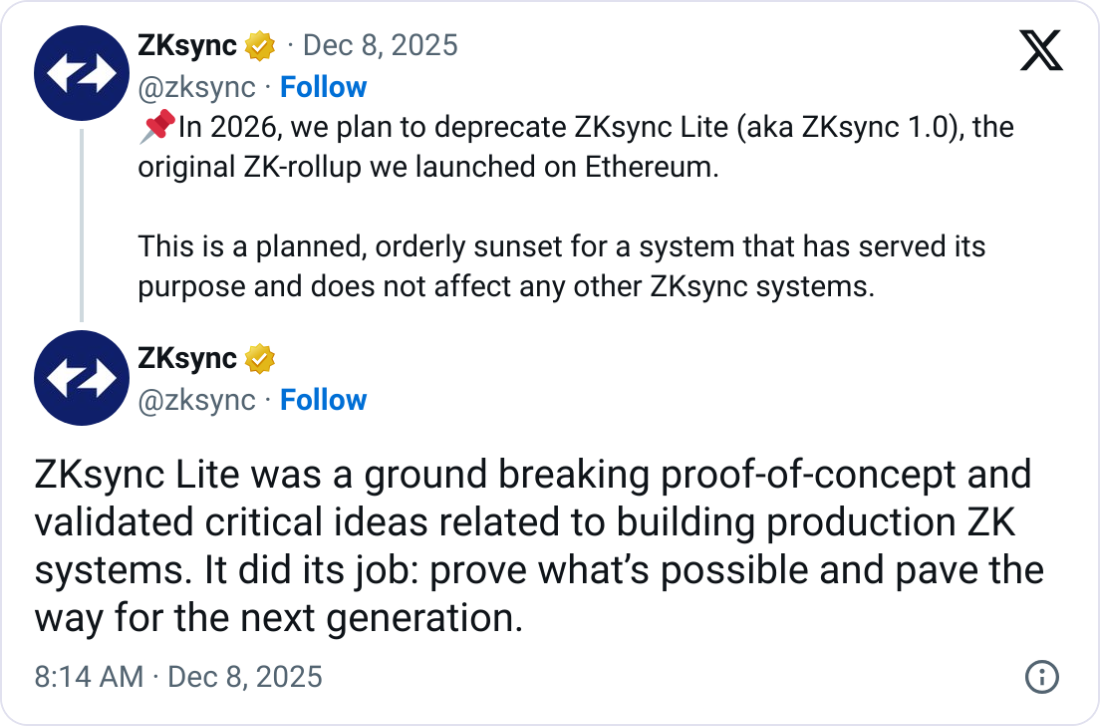
“In 2026, we plan to deprecate ZKsync Lite (aka ZKsync 1.0), the original ZK-rollup we launched on Ethereum,” ZKsync wrote to X on Sunday. “This is a planned, orderly sunset for a system that has served its purpose and does not affect any other ZKsync systems.”

It added that ZKsync Lite “was a groundbreaking proof-of-concept and validated critical ideas related to building production ZK systems.”

“It did its job: prove what’s possible and pave the way for the next generation.”

Technology company Matter Labs launched ZKsync Lite in 2020, designed for fast transfers and minting non-fungible tokens (NFTs). However, it didn’t support smart contracts, which limited its use.
Source: ZKsync

The network was the first to use validity proofs that instantly proved if a transaction was valid, before transactions were bundled up and sent to the Ethereum mainnet for final validation.

Matter Labs stopped development on ZKsync Lite in early 2023 after launching its zero-knowledge Ethereum Virtual Machine (zkEVM) that supported smart contracts, ZKsync Era.

ZKsync said that no immediate action was required from ZKsync Lite users, and the network is operating as usual. “Funds remain safe, and withdrawals to L1 will keep working through the process,” it added.

Its other products are similarly unaffected, and the team said it would share “concrete details, dates, and migration guidance soon” for ZKsync Lite.

Related: Privacy tools are rising behind institutional adoption, says ZKsync dev

Just under $50 million is currently bridged to the network, according to DefiLlama, but L2BEAT data shows it has only seen just over 330 user operations in the past day.

By comparison, ZKsync Era has a total value locked of $36.4 million and has seen over 22,000 user operations over the past day.

It comes as the blockchain could be undergoing more changes. Last month, ZKsync co-creator Alex Gluchowski proposed overhauling its ZKsync (ZK) governance token to prioritize “economic utility,” tying the token to the network’s fees.

Magazine: What are native rollups? Full guide to Ethereum’s latest innovation

Related Reads

Bull vs. Bear Debate: Is the Profit Moat of Stablecoin Leader CRCL Solid?

The article presents a heated debate surrounding Circle (NYSE: CRCL), the issuer of the stablecoin USDC, focusing on the sustainability of its business model following its IPO and Q3 2025 earnings report. Key bearish points, led by figures like Jiang Zhuo'er, argue that CRCL's profits are unsustainable. They compare it to a bank reliant on an interest rate spread, which is highly vulnerable to Federal Reserve rate cuts. Critics highlight that over 60% of profits are paid to distributor Coinbase, leaving CRCL with a thin margin. They warn that competition from traditional financial giants like JPMorgan could easily disrupt its model, and that its regulatory advantage is a temporary benefit, not a permanent moat. Bullish commentators, including @BTCdayu and @qinbafrank, counter that CRCL is a long-term infrastructure play, not a simple bank. They believe current profit-sharing is a strategic cost to achieve market dominance and network effects, similar to companies like Amazon in their early days. They argue that future growth from massive USDC adoption (potentially reaching trillions) will far outweigh the impact of falling interest rates. They see compliance as a powerful, long-term moat that will eliminate smaller competitors. Additional short-term concerns include a significant sell-off pressure from the post-IPO lockup expiration and a structural barrier to USDC's use in U.S. retail payments due to its classification as a taxable asset. In summary, the debate pits short-term cyclical risks (interest rates, high costs, sell pressure) against a long-term structural opportunity (market growth, network effects, compliance as a barrier to entry). The core question remains whether CRCL's current model is a fragile interest-rate play or a foundational bet on the future of digital currency.

比推23m ago

Bull vs. Bear Debate: Is the Profit Moat of Stablecoin Leader CRCL Solid?

比推23m ago

Trading

Spot
Futures
活动图片