CFTC joins SEC in proposing crypto framework after failed CLARITY vote

cointelegraphPublished on 2026-10-06Last updated on 2026-10-06

Abstract

CFTC Chair Michael Selig announced that the agency is moving forward with a proposed crypto regulatory framework, named 'CTX,' following President Donald Trump's direction to act "with or without legislation." The proposal, presented at a Fordham Law symposium, would allow crypto companies to operate under uniform CFTC oversight instead of a state-by-state patchwork. Key elements include a new "crypto asset market" (CAM) category for exchanges and rules for retail trading on a margined or leveraged basis. Ordinary spot exchanges remain under state laws, though the CFTC retains anti-fraud authority. This action comes after the Senate failed to pass the CLARITY Act, which would have expanded the CFTC's regulatory role. The SEC also recently proposed its own crypto securities regime. Both agencies are currently understaffed, with the SEC down to two commissioners after Hester Peirce's departure and the CFTC led solely by Selig. The White House has indicated plans to nominate new commissioners soon.

US Commodity Futures Trading Commission (CFTC) Chair Michael Selig said that the agency will move forward on crypto regulation at the direction of President Donald Trump “with or without legislation” from Congress.

Speaking at the Fordham Law Blockchain Regulatory Symposium on Monday, Selig announced proposals giving crypto companies the option to operate under the CFTC’s umbrella rather than dealing with the patchwork of regulations offered by individual US states.

According to written remarks from the event, the CFTC chair said that it had issued an advanced notice of proposed rulemarking for companies “offering retail customers the ability to trade crypto assets on a margined, leveraged, or financed basis,” calling the regulation ‘CTX.’

Selig said that the agency planned to establish a new category of designated contract market (DCM) called a “crypto asset market,” or CAM, giving certain exchanges the option to register as either.

“These rules would codify a pathway for crypto asset exchanges to operate under uniform national oversight by the CFTC pursuant to the same statutory authorities that the prior administration instead utilized to regulate by enforcement,” said Selig.
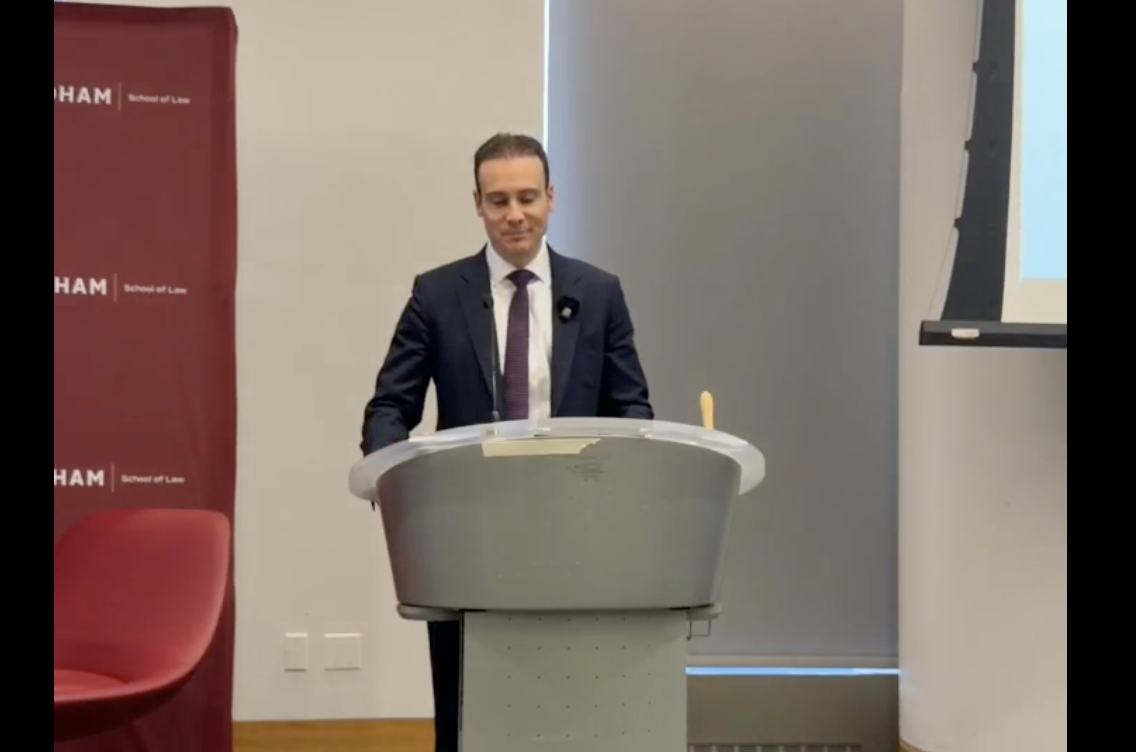
CFTC Chair Michael Selig on Monday.
Source: Fordham Law Blockchain Regulatory Symposium

The proposed rules would not extend to what the chair called “ordinary spot crypto exchanges” that are “generally regulated under state money transmission laws.” For companies offering spot trading on crypto assets like Bitcoin (BTC), the CFTC would still have the authority to enforce anti-fraud and anti-manipulation regulations.

Selig’s proposed regulatory framework for crypto companies came a few weeks after lawmakers in the US Senate failed to approve passage of the Digital Asset Market Clarity (CLARITY) Act, a bill that had been expected to give the CFTC more authority in overseeing and enforcing crypto regulations.

The Securities and Exchange Commission already announced its own version of a proposed “tailored securities offering regime” for crypto assets in August before the failed CLARITY vote, setting the expectation that both agencies would move forward with regulation without legislation codifying such rules from Congress.

Selig said that Trump promised to deliver a crypto asset regulatory market structure with or without legislation, and the regulators will help him deliver it using existing statutory authorities.

“The opponents to CLARITY may have not bargained for the seeming readiness of the executive branch to act in the absence of any constraint from the legislative branch,” said ProChain Capital’s David Tawil, in a post on Monday.

Both regulators still understaffed as they advance crypto proposals

Friday was SEC Commissioner Hester Peirce’s last day at the agency, wrapping up eight years of service, just ahead of the 18-month extension for her second term. Her planned departure leaves just two commissioners leading the SEC and Selig heading the CFTC as its sole commissioner and chair.

A White House official told Cointelegraph last week that Trump intended to nominate commissioners to both agencies “in the near future.” As of Monday, the administration had not announced any replacements for Peirce or the other six commissioner seats.

Magazine: Former SEC boss made AI Czar, Bitcoin may hit $600K this cycle: Hodler’s Digest

Related Questions

QWhat is the main purpose of the regulatory framework proposed by CFTC Chair Michael Selig?

AThe main purpose is to give crypto companies the option to operate under the CFTC's uniform national oversight, as an alternative to dealing with the patchwork of regulations from individual US states. This includes a proposal for a new category of designated contract market called a 'crypto asset market' (CAM).

QHow does the proposed 'CTX' regulation relate to crypto asset trading?

AThe proposed 'CTX' regulation is an advanced notice of proposed rulemaking for companies that offer retail customers the ability to trade crypto assets on a margined, leveraged, or financed basis.

QWhy are the CFTC and SEC moving forward with their own regulatory proposals for crypto?

AThey are moving forward because the US Senate failed to pass the Digital Asset Market Clarity (CLARITY) Act, which was expected to give the CFTC more authority. President Trump has directed the agencies to proceed 'with or without legislation' from Congress, leading them to use their existing statutory authorities.

QAccording to the article, what type of crypto exchanges would not be covered under the CFTC's new proposed rules?

AThe proposed rules would not extend to 'ordinary spot crypto exchanges' that are generally regulated under state money transmission laws. However, the CFTC would still have authority to enforce anti-fraud and anti-manipulation regulations for these spot trading platforms.

QWhat staffing challenge is mentioned for both the SEC and CFTC as they advance their crypto proposals?

ABoth agencies are understaffed. SEC Commissioner Hester Peirce has left, leaving just two commissioners at the SEC. The CFTC has Michael Selig as its sole commissioner and chair. The White House intends to nominate new commissioners, but no replacements had been announced as of the article's publication.

Related Reads

Arthur Hayes ‘flattered’ as Coinbase backs US stock perps

Arthur Hayes, co-founder of BitMEX, said he was "flattered" by Coinbase's support for the CFTC in a US legal dispute over stock perpetual futures. Hayes noted that when BitMEX launched the perpetual swap in 2016, Washington's reaction was "less than warm," and remarked that "imitation is the sincerest form of regulation." Coinbase and five other companies submitted a brief opposing the Capital Markets Alliance Association's (CMAA) request to block trading in perpetual futures tied to individual stocks. The CMAA argues these contracts should be treated as security-based swaps, which face tighter retail trading restrictions. The SEC reportedly submitted a proposed brief opposing the alliance's request to temporarily halt trading, saying it is reviewing the exchanges' rules for listing the contracts. The CMAA said the CFTC approved the contracts without adequately explaining its decision or addressing unresolved regulatory questions, citing about $375 million in reported 24-hour notional trading volume for Kalshi's stock perpetuals shortly after launch. US District Judge Valerie Caproni denied the group's request for a temporary restraining order, finding the alliance was likely to succeed on its claim that the CFTC exceeded its authority. Stock perpetuals let traders speculate on share prices without owning the underlying stocks and have no fixed expiration date. Wojciech Kaszycki, strategy adviser to BTCS SA, said the lack of a fixed expiration or delivery date could complicate treating perpetual contracts as futures, but warned that a ruling against the CFTC could push trading toward offshore and decentralized platforms: "The product doesn't die; it just changes address."

cointelegraph32m ago

Arthur Hayes ‘flattered’ as Coinbase backs US stock perps

cointelegraph32m ago

TechFlow Intelligence: Jensen Huang Resigns as Nvidia CEO Amid Multiple Extramarital Affair Scandals; Microsoft Global Outage Still Unresolved After 12 Hours

TechFlow Intelligence Brief: Nvidia CEO Jensen Huang has resigned amid multiple extramarital affair scandals (one individual suspected of being a Chinese spy); CFO Colette Kress takes over as interim CEO, with shares falling to $156 and nearly $500 billion in market value wiped out. Anthropic launched its IPO page, claiming it has reached the threshold of "AI accelerating AI research," drawing intense Hacker News discussion. Google released Gemini 4 Hydrogen on its Antigravity platform, praised for multimodal and code-generation capabilities. Claude suffered major outages affecting claude.ai and Claude Code, sparking developer complaints about AI tool reliability. Claude also added Google Meet integration for automatic meeting notes. Crypto/Web3: Bitcoin fell below $70,000, dropping from $73,866 to $68,943 (6.11% in 24 hours), with $622 million liquidated in 4 hours, mostly longs. Spot Bitcoin ETFs saw five consecutive days of outflows totaling about $1.44 billion, turning yearly flows negative. DTCC plans to bring tokenized securities to Solana. Frax launched its Burn Engine to buy back and burn FRAX using protocol revenue. Chips/Hardware: Nvidia employees petitioned for Huang's return. Reuters reported a second employee relationship involving Huang. TSMC confirmed a cyberattack in an SEC filing. AMD detailed its Zen 6 architecture in a deep interview. Tech Companies: Microsoft suffered a global outage lasting over 12 hours, crippling Outlook and Teams. Microsoft researchers demonstrated implanting backdoors in AI agents by editing fewer than 10 neurons without retraining. Nebius announced a $40 billion neocloud spending plan. Markets/Finance: Former US AI czar David Sacks said there is no evidence that Alice Huang is a Chinese spy. Cerebras posted record Q3 revenue and raised guidance. Applied Materials issued strong Q1 guidance on AI demand. NY Fed's Williams warned inflation remains too high, with markets pricing consecutive rate hikes. New Products/Trends: The first NS2 emulator reportedly runs exclusive games on PC. AI tool Fable 5.2 produced an FPS game, "Saltline," for just $550. The takeaway: Huang's resignation, Bitcoin's plunge, Microsoft's outage, and Strait of Hormuz tensions all point to 2026 markets being exposed to both key-person risk and critical-infrastructure risk. As AI and crypto are priced as risk assets, their ties to geopolitics, corporate governance, and even CEO personal lives will only deepen.

marsbit1h ago

TechFlow Intelligence: Jensen Huang Resigns as Nvidia CEO Amid Multiple Extramarital Affair Scandals; Microsoft Global Outage Still Unresolved After 12 Hours

marsbit1h ago

Racing to Secure Seats Before the Senate Flips: Trump Nominates Four SEC and CFTC Commissioners, Ushering in a New Era for Crypto Regulation

On November 12, Trump submitted four nominations for SEC and CFTC commissioner positions—one Republican and one Democrat for each agency—as time runs short before Republicans lose their Senate majority in January. The seats have been vacant for months: SEC has only Chair Paul Atkins and Commissioner Mark Uyeda since Hester Peirce departed in October, while CFTC has only Chair Michael Selig. Even if all four are confirmed, SEC would have four commissioners and CFTC three—still short of full five-member slates—so the significance lies in adding voting participants rather than announcing new policy. Both CFTC nominees, Nathan Anonick and Matthew Rowland, worked on the CLARITY Act, which would authorize CFTC oversight of digital commodity spot intermediaries, platform registration, customer fund segregation and conflict-of-interest rules; it failed a procedural Senate vote in September. If confirmed, they would join Selig in voting on rules such as the event-contract draft proposed in June. SEC nominee Kristin Johnson, a former CFTC commissioner and law professor, publicly supported CFTC enforcement against three DeFi operators in 2023, arguing regulators should examine whether platforms concentrating clearing or settlement off-chain effectively act as intermediaries. The other SEC nominee, Levine, served as deputy chief of staff to acting Chair Uyeda during the agency's early crypto framework overhaul and would fill Peirce's seat. The bipartisan list responds to calls for restoring two-party representation and seeks broader support for confirmation. Senate hearings will be the first key window into the nominees' regulatory intentions.

marsbit2h ago

Racing to Secure Seats Before the Senate Flips: Trump Nominates Four SEC and CFTC Commissioners, Ushering in a New Era for Crypto Regulation

marsbit2h ago

Revenue Becomes This Year's Hardest Crypto Narrative

The article argues that "revenue" is becoming crypto's most durable narrative in 2026, as the industry matures and institutional allocators shift from speculation toward sustainable business models. Crypto protocols generated $11.68B year-to-date, on pace for ~$13.9B by year-end—only slightly below 2025 despite a much weaker market. The author contends the real opportunity lies not just in profitable protocols but in those with mechanisms converting business success into tokenholder value, primarily token buybacks backed by real revenue. Four criteria define a "good" buyback: revenue-funded, established product-market fit, transparent execution, and sustainable capital allocation. Context matters: Jupiter's $70M+ buyback failed amid a Solana-wide downturn, and buybacks can be swamped by new token emissions. Still, 2026 data is compelling—among the 16 top-revenue protocols with tradeable tokens, the 12 with active buybacks averaged +62.2% YTD (median +32.6%) versus −31.6% for those without, a 93.8-point gap, achieved despite crypto's total market cap falling ~19%. Buyback tokens also outperformed direct revenue-distribution tokens (190% vs 29% market-cap-weighted). The author highlights opportunities in stablecoins/RWA lending, World Liberty Financial's USD1 buyback linking stablecoin economics to WLFI, Venice's AI platform ($100M+ annualized revenue, VVV up 1,200%), Bittensor subnets using revenue for alpha-token buybacks, and Robinhood Chain's LONG 500 model combining buybacks with tokenized stock accumulation. The piece concludes the revenue narrative is still early, and in a true bull market, revenue-funded buybacks could act as accelerant rather than life raft.

marsbit2h ago

Revenue Becomes This Year's Hardest Crypto Narrative

marsbit2h ago

Trading

Spot
活动图片