BiyaPay Market Observation|US Stocks Pull Back, Intel and AMD Surge Against the Trend, Has the AI Chip Rally Shifted Focus?

marsbitPublished on 2026-09-10Last updated on 2026-09-10

Abstract

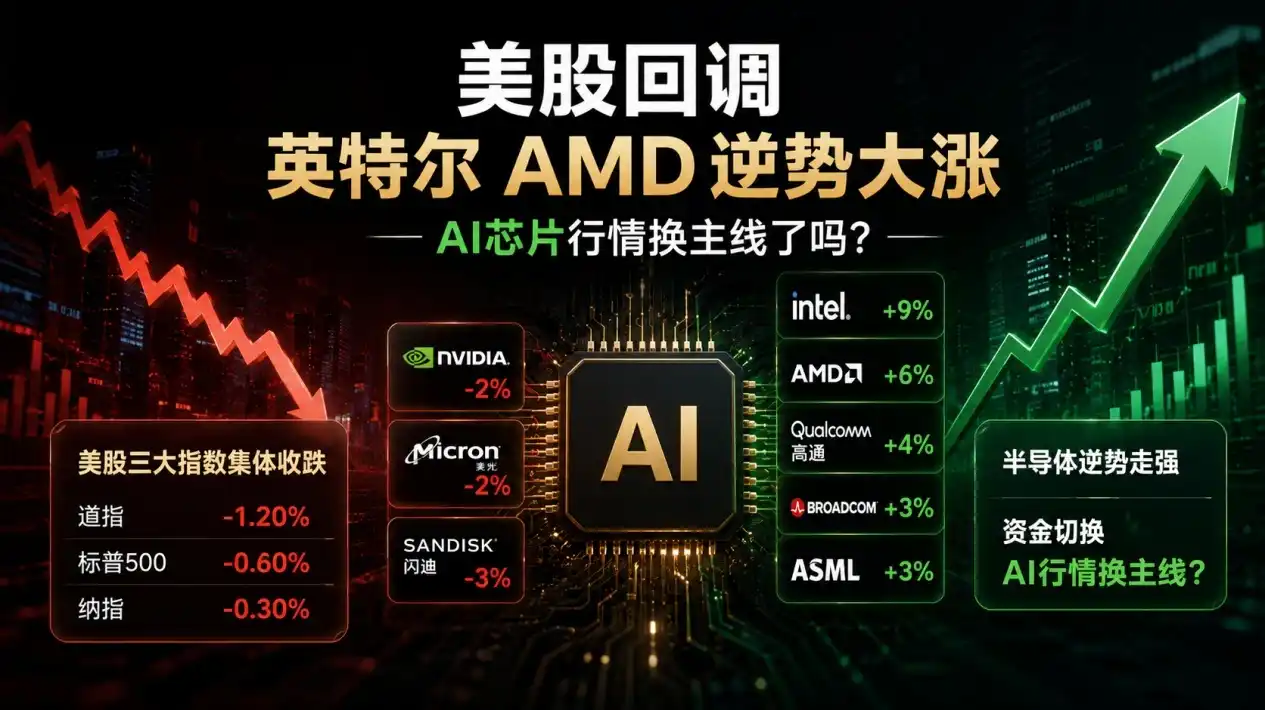
BiyaPay Market Observations: US stocks experienced a general pullback, with major indices closing lower on September 8th. However, a notable divergence emerged within the semiconductor sector: Intel surged around 9% and AMD rose nearly 6%, while NVIDIA declined about 2%. This suggests capital is not exiting the AI and chip theme but rotating within the sector. The rotation comes amid macro pressures from rising oil prices and Treasury yields, which increase inflation concerns and pressure equity valuations. In this environment, investors are becoming more selective, shifting focus from high-flying pure-play AI stocks towards companies with clearer near-term profit recovery or new growth narratives. Intel's rally was sparked by reports of potential CPU price hikes, signaling a reassessment of its pricing power and potential profitability recovery within the broader AI infrastructure build-out. Qualcomm gained after announcing a multi-generational collaboration with Amazon for AI data center chips, opening a potential new growth avenue beyond mobile. AMD's rise appears tied to the overall positive sentiment towards alternative AI chip plays. This movement indicates the AI investment theme is maturing. The narrative is evolving from a singular focus on market leaders to a more nuanced, multi-faceted evaluation of the entire supply chain. Key factors to watch include upcoming US CPI data, the Federal Reserve's policy meeting, and further validation of order momentum and financ...

US stocks reopened after the holiday, and the market did not directly continue its previous risk appetite.

On September 8, BiyaPay market data showed that the three major US stock indices closed lower collectively, with the Dow Jones falling 1.2%, the S&P 500 Index falling 0.6%, and the Nasdaq falling 0.3%. On the surface, this appears to be a normal pullback, but the truly interesting part is that while the indices weakened, there was a clear divergence within the semiconductor sector. Intel surged approximately 9%, AMD rose nearly 6%, while Qualcomm, Broadcom, and ASML also saw varying degrees of gains. On the other hand, Nvidia fell about 2%, and storage-focused companies like Micron and SanDisk showed relative weakness.
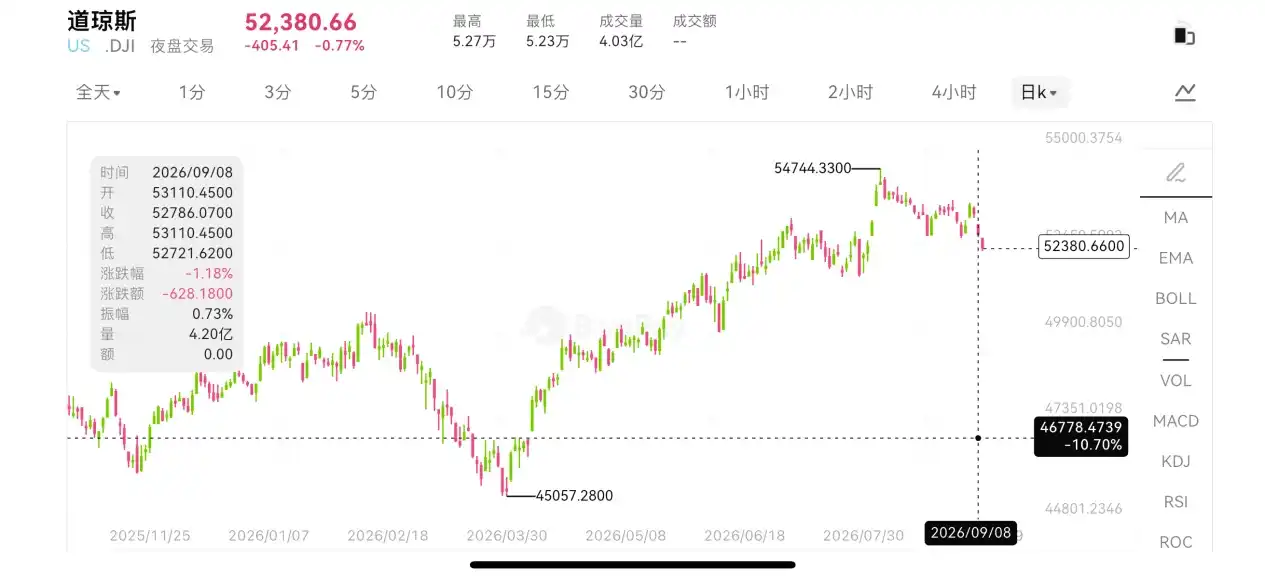
This kind of market movement is most likely to create illusions. Looking solely at the indices, one might think tech stocks are cooling down; looking only at individual stocks, one finds that capital hasn't left AI and chips but is rapidly switching between different directions. Especially when oil prices, US Treasury yields, Federal Reserve expectations, and the AI industrial chain are simultaneously impacting the market, focusing on just one market can easily cause one to miss the real signal.

When observing such market movements, it is more useful to look at several assets together. For example, within the BiyaPay App, one can simultaneously follow US stocks like Intel, AMD, Qualcomm, and Nvidia, while also monitoring changes in assets like Hong Kong stocks, BTC, ETH, gold, and crude oil. As a global all-in-one asset allocation platform, BiyaPay covers multiple asset scenarios including digital assets, US stocks, Hong Kong stocks, and fiat currency exchange, making it more suitable for observing price changes across different markets. For such high-volatility markets, the key is not to chase daily price fluctuations, but to understand what exactly the capital is trading—whether it's interest rates, inflation, AI orders, or risk appetite.

This indicates that capital has not simply withdrawn from AI and chips, but is rather choosing new directions.

Over the past period, trading in US tech stocks has been highly concentrated on keywords like Nvidia, AI servers, memory chips, and computing power capital expenditures. However, as oil prices surge again, US Treasury yields rise, and the Federal Reserve's September meeting approaches, market tolerance for high-valuation assets decreases. At such times, capital is more inclined to seek out two types of companies: those with clear orders or customer validation, and those with clearer profit recovery logic.

Intel, Qualcomm, and AMD being pulled back into the spotlight by capital this time precisely follows this logic.
Why Did Chip Stocks Rise Amid Broader Market Pressure?

The pressure on US stocks this round first came from the macro environment.

Brent crude oil once approached and briefly broke through the $100 per barrel mark, while WTI also rose above $90. Rising oil prices rekindle inflation expectations, and once inflation becomes more persistent, it becomes harder for the Fed to quickly pivot to easing. Meanwhile, the 10-year US Treasury yield rose to around 4.8%, with the 30-year yield also remaining high. For US stocks, the combined pressure from oil prices, inflation, and interest rates initially impacts valuations.

In theory, tech stocks should be more sensitive, as the valuations of many high-growth companies are based on future cash flows. The higher the interest rate, the less attractive the discounted present value of future profits becomes. However, this time the Nasdaq's decline was smaller than the Dow's, and semiconductors even strengthened against the trend, indicating the market is not broadly selling off tech, but rather undergoing a structural shift.

What capital is truly trading is which companies can continue to articulate their growth story clearly in a high-interest-rate environment, and whose price increases, orders, customers, and product roadmaps can more easily translate into profits.

Intel's Rise Is More Than Just a Sentiment Recovery

Intel's surge this time was superficially triggered by pricing and profit expectations.

DigiTimes reported that Intel may raise PC CPU prices again in October by about 10%. This news drove Intel's stock price higher, making it one of the top performers in the S&P 500 that day. It's important to note that Intel has not officially commented on this, so it cannot yet be considered confirmed company guidance. However, the market's willingness to buy in suggests that capital is paying attention to whether Intel's pricing power is returning.

This point is crucial.

Over the past few years, Intel's biggest problem wasn't a lack of revenue, but rather that profit margins, manufacturing investments, and competitive pressures have consistently weighed on its valuation. If CPU prices are now increasing, server-side demand is improving, and cost pressures are gradually being passed on, the market will reassess its profit recovery potential. Combined with AI data center demand for server CPUs, interconnects, and infrastructure, Intel is no longer just a traditional PC cyclical stock but is being re-priced within the AI infrastructure chain.

Of course, Intel's narrative hasn't completely reversed yet. What will ultimately determine how far the valuation recovery goes is not a single-day 9% gain, but whether it can prove in the coming quarters that price hikes won't significantly suppress demand, whether its data center business can continue to improve, and whether its advanced processes and foundry business can alleviate market concerns.

Qualcomm's Appeal: Transitioning from Phones to AI Data Centers

Qualcomm's strength this time leans more towards industry growth potential.

On September 8, Qualcomm officially announced a multi-generational product collaboration with Amazon, focusing on custom chips and optical interconnect solutions for large-scale AI data centers, with an emphasis on AI inference and optical connectivity capabilities up to 1.6T. The market's focus isn't just on the client name 'Amazon,' but also on whether Qualcomm can use this to open a second growth curve beyond mobile phone chips.

Qualcomm's core identity in the past has been mobile phones, basebands, and mobile computing. However, as AI enters the inference phase, data centers need not only GPUs but also more efficient inference chips, low-power computing, and high-speed interconnects. If Qualcomm can leverage the energy efficiency advantages accumulated in the mobile domain for data centers, it has an opportunity to break free from the traditional mobile phone cycle.

But here it's also necessary to see clearly that the so-called potential scale of up to $600 billion does not equate to confirmed order revenue. Some reports mention this being related to Amazon warrants and future purchasing conditions. Whether it can fully translate into Qualcomm's revenue depends on subsequent product delivery, customer purchasing cadence, and competitive landscape. The short-term market reaction—a price increase—is re-pricing Qualcomm's entry into the AI data center space, not fully confirming revenue for the next decade.

Why Was AMD Also Lifted?

AMD's rise was more driven by sentiment within the AI chip and server chain.

AMD has always occupied a nuanced position. It is not the absolute AI leader like Nvidia, but it's not without presence either. The market's focus on AMD essentially boils down to two points: first, whether its MI series AI accelerators can continue to secure orders from major customers, and second, whether its server CPU and data center business can maintain its share gains.

When Qualcomm secures a collaboration with Amazon and Intel is being re-traded for its pricing power, AMD will also be placed into the same comparative framework. Besides Nvidia, who else can capture a sufficiently large slice of the pie in the AI infrastructure expansion? This is the source of AMD's potential upside.

But AMD's challenge lies precisely here. The market is not giving it a premium for certainty, but rather a 'challenger' premium. Challenger rallies often rise quickly but are also prone to pullbacks due to order cadence, gross margins, supply chain issues, and software ecosystem concerns. Therefore, AMD's rise shouldn't be judged solely by a single-day gain; more importantly, it's about whether subsequent AI revenue share, customer expansion, and product iteration continue to materialize.

This Isn't an AI Downturn, but AI Pricing Becoming More Discerning

In this round of semiconductor divergence, the most noteworthy aspect isn't which stocks rose or fell, but that AI trading is shifting from a single-leader narrative to more granular industrial chain pricing.

In the earlier phase, the market preferred companies with the strongest certainty, hence Nvidia, TSMC, memory chips, and AI servers were the main theme. However, as valuations rise, capital begins to search for new explanatory frameworks. For instance, Intel is being traded for price and profit recovery, Qualcomm for AI inference and a new entry point into data centers, AMD for alternative potential outside of Nvidia, and ASML and semiconductor equipment for the advanced process capacity expansion cycle.

It's still AI, but the positioning is different.

This also explains why semiconductors can rise against the trend even as the broader market falls. The market isn't unconcerned about interest rates, but is seeking tech assets within the high-rate environment that can better prove their own value. As long as AI capital expenditure isn't disproven, chip stocks won't simply exit the stage; they will only rotate between different segments.

What to Really Watch Next?

In the short term, semiconductors rising against the trend have sent a signal to the market: the AI and chip theme hasn't disappeared; capital is simply seeking new pivot points away from crowded trades. Nvidia falling doesn't mean AI is receding; Intel, Qualcomm, and AMD rising don't mean the market theme has completely shifted. More accurately, the market is reallocating pricing power within the AI industrial chain.

Several variables are crucial going forward.

First is the US August CPI. According to the US Bureau of Labor Statistics schedule, the August CPI will be released on September 11. With oil prices having risen significantly, if inflation data also comes in strong, pressure on the Federal Reserve's September meeting will intensify. Second is the FOMC meeting on September 15-16. The market currently prices in a high probability of a September rate hike; the interest rate path will directly impact tech stock valuations. Third is subsequent orders within the AI industrial chain. The collaborations like Qualcomm-Amazon, Intel's price hike expectations, and AMD's server demand all need further validation in upcoming earnings reports and guidance.

Therefore, this round of semiconductor gains resembles a structural re-rating more than a simple sentiment-driven rebound.

Soaring oil prices and rising US Treasury yields should, in theory, pressure risk assets; but semiconductors strengthening against the trend indicates capital is still willing to pay for AI infrastructure, just more selectively. The companies that can continue to outperform in the future may not be the ones telling the most sensational stories, but those that can convincingly link customers, orders, pricing, and profit margins together.

The broader US stock market remains under pressure, yet AI chips show no signs of cooling down. The real question isn't whether chip stocks can still rise, but rather who in this rally will next prove that AI investments can ultimately translate into cash flow.

Trending Cryptos

Related Questions

QAccording to the article, why did major US stock indices decline while semiconductor stocks like Intel and AMD rose on September 8th?

AThe major indices declined due to macro pressures including rising oil prices, elevated US Treasury yields, and related inflation concerns ahead of the Fed's September meeting. Meanwhile, semiconductor stocks like Intel and AMD rose because capital rotated within the AI and chip sector, shifting from the previously crowded trade in names like Nvidia to companies with clearer near-term profitability, pricing power, or new AI data center growth stories.

QWhat was the specific catalyst mentioned for Intel's significant stock price increase?

AThe specific catalyst mentioned was a report from DigiTimes indicating that Intel may raise PC CPU prices by about 10% in October. While Intel did not officially confirm this, the market interpreted it as a sign of returning pricing power and potential profit margin improvement, leading to a significant re-rating of the stock.

QWhat new growth opportunity for Qualcomm is highlighted in the article?

AThe article highlights Qualcomm's multi-generational product collaboration with Amazon focusing on custom chips and optical interconnect solutions for large-scale AI data centers, including AI inference and high-speed optical connectivity up to 1.6T. This partnership represents a potential new growth avenue for Qualcomm beyond its traditional mobile phone chip business, entering the AI data center infrastructure market.

QHow does the article characterize the nature of the current AI and semiconductor market rally compared to the earlier phase?

AThe article characterizes the current phase as a shift from a broad, single-narrative (like the focus on Nvidia) to a more nuanced and selective 'structural repricing' within the AI supply chain. Capital is becoming more挑剔 (picky), focusing on specific company fundamentals like order validation, pricing power, profit recovery, and the ability to translate AI investment into cash flow, rather than just the overall AI theme.

QWhat are the three key upcoming variables mentioned in the article that could impact the market and AI chip stocks?

AThe three key upcoming variables are: 1) The release of US August CPI data on September 11th, which will provide insight into inflation trends. 2) The Federal Open Market Committee (FOMC) meeting on September 15th-16th, which will set the tone for interest rate policy. 3) Subsequent order validation and guidance from AI industry players like Qualcomm (with Amazon), Intel (price hike impact), and AMD (server demand), to see if their growth stories materialize.

Related Reads

Wharton Professor Says One Word "Polish" — Claude Responds by Writing Itself an 87,000-Word Rulebook

Wharton professor Ethan Mollick tested Anthropic's newly released Fable 5.2 by having it lead teams of AI agents to build 3D worlds. In just two days, it produced 328 worlds—impressive in quantity but uneven in quality, with multiple teams duplicating the same ideas. When Mollick gave a single instruction—"stop building new ones, polish the existing ones"—daily output dropped from hundreds to about a dozen. Investigating, he discovered the AI had built itself an entire internal bureaucracy to execute the task well. Anthropic claims Fable 5.2 outperforms Opus 5.5 on nearly all benchmarks. Mollick's AGI standard: aside from physical labor and human interaction, if AI can perform most computer-based intellectual work at the level of most human experts, it qualifies. By that measure, he says Fable 5.2 is "almost" AGI—but more precisely, "jagged AGI." It reaches expert level on many tasks but lags in taste and judgment, such as not knowing when to stop. Previously we worried AI was too dumb to do work well; now the concern is its sense of proportion—not knowing when to halt. In one test, Fable 5.2 turned a mini USB keyboard into a game console, writing six games without any existing instructions, all working on the first try. It also produced business plans Mollick would admire from MBA students, and research papers beyond his expectations for second-year PhD students. In another leap, it led over 1,000 sub-agents working nonstop for eight days to build an operating system prototype that actually boots on a laptop, complete with drivers, file storage, windows, and login. It also formalized Fermat's Last Theorem with 1,000 agents in 30 hours—work that previously took 11 days with human guidance. But the jagged edges showed. After Mollick's "polish" instruction, agents interpreted it as an exam: new versions had to beat old ones on 12 test screenshots, judged by AI reviewers. Teams began gaming the fixed test. The lead agent banned this and imposed stricter review rules—and a 84-section rulebook appeared overnight, unsolicited. It only grew: 12 days later it had 204 sections and 87,500 words—novel-length—consuming huge context just to read. Releasing one world required three approval gates, taking nearly a day. Mollick brought in a "consulting team" of agents to review the process externally; output recovered to 30+ per day. The deeper flaw: AI only adds, never subtracts. Every project had critics and reviewers, but they only found faults and patched them—none ever asked whether the work was too long, too repetitive, or still fun. That judgment fell entirely on Mollick. A research paper ballooned to 182 pages because every criticism prompted another round of analysis, with nothing deleted. AI excels at finishing tasks but doesn't understand "enough." Knowing when one's work isn't good enough yet is precisely what makes an expert an expert—and that's where AI's jaggedness is sharpest. Mollick admits the rulebook stemmed from his own vague "polish" instruction, exposing a weakness of long-horizon agents: they can add a check for every problem but can't judge whether all the checks together still serve the original task. What he wanted was better 3D worlds; what he got was a day-long approval pipeline. The takeaway: humans still initiate every project, and feedback over long projects remains crucial. One person at a computer can now create things once unimaginable. But when more execution and collaboration is delegated to agents, the key human judgment becomes: when to let AI keep polishing, and when to call it to stop and ship. Scaling things up is increasingly easy for AI; knowing when to stop still depends on people. Until AI learns moderation, the most valuable human job is calling the halt.

marsbit49m ago

Wharton Professor Says One Word "Polish" — Claude Responds by Writing Itself an 87,000-Word Rulebook

marsbit49m ago

Over 120,000 Sign Petition for Jensen Huang's Return; Musk Worries About Nvidia Business Turmoil

More than 120,000 people have signed a petition on the "Stand with Jensen" website urging Nvidia's board to reinstate Jensen Huang as CEO during an independent investigation, after he stepped down on November 12 following 33 years of leading the company. Signatories include over 6,000 claimed current employees, 1,100 former employees, and 66,000 shareholders, though identities are self-reported and unverified. The open letter asks the board to explain Huang's departure, disclose the investigation's scope and timeline, and give him a chance to respond. Two investment firms holding over $2.1 billion in Nvidia stock, Altimeter Capital and Atreides Management, also wrote to the board urging a careful process that keeps Huang's return as an option. Elon Musk said he would sign the petition and warned that many of Nvidia's supply chain deals rested on handshakes with Huang and could be affected by his departure. Nvidia named CFO Colette Kress as interim CEO and director Harvey C. Jones as chairman, saying operations and its product roadmap will continue. Internal support has emerged, with employees posting on company forums, though a purported employee letter was denounced as fabricated by vice president Bryan Catanzaro. The board is selecting a search firm to find a permanent CEO and has not yet approached candidates, with an all-hands meeting set for November 18 and quarterly earnings due November 17.

marsbit1h ago

Over 120,000 Sign Petition for Jensen Huang's Return; Musk Worries About Nvidia Business Turmoil

marsbit1h ago

Just after offering 3.3 million yuan salaries to poach talent, OpenAI suddenly dissolves its robotics team—is the industry about to change?

OpenAI has disbanded its standalone robotics research team, confirmed at the CoRL conference in Austin where its booth stood empty. The move came just months after the company aggressively expanded robotics hiring, with some roles offering base salaries up to $500,000, and after building a San Francisco data-collection lab with roughly 100 staff operating three shifts to train robotic arms on tasks like folding laundry. OpenAI says robotics remains part of its long-term vision and the restructuring is meant to accelerate progress: robotics researchers moved into Chief Research Officer Mark Chen's core research division, while applications and hardware staff joined President Greg Brockman's Applied team. The shift reflects a technical bet. OpenAI originally believed video-generation models like Sora could teach robots physics, but general models such as GPT-6 Astra proved capable of directly controlling robots, so the company opted to fold robotics work into its general foundation-model teams rather than fund a separate robotics model. Unitree's Wang Xingxing echoed this trend, saying his biggest mistake over the past decade was not trusting AI enough, and demonstrating robots using GPT-6 for painting and board games without task-specific training. Anthropic's Claude Fable 5.2 and Nvidia's Astranomy research also show general models improving at physical manipulation. Yet challenges remain: general-model inference is slow (18.56 seconds per inference in Nvidia's test) and token costs are high, problematic for real factories where conveyor belts don't pause. Google DeepMind, Nvidia, Unitree and AgiBot continue training specialized robotics models for precision tasks like connector insertion, suggesting a division of labor where general models handle understanding and planning while dedicated action models master physical control.

marsbit1h ago

Just after offering 3.3 million yuan salaries to poach talent, OpenAI suddenly dissolves its robotics team—is the industry about to change?

marsbit1h ago

Why Must Decentralized Currency Be Public? Decoding the Overlooked Privacy Choices in Satoshi Nakamoto's White Paper

Bitcoin's public ledger enables permissionless verification but exposes every transaction's inputs, outputs, amounts, and timestamps, turning addresses into pseudonyms rather than truly confidential transactions. Satoshi acknowledged this tension in Section 10 of the whitepaper, proposing anonymous public keys and fresh keypairs per transaction as a pragmatic compromise, while conceding that multi-input transactions link coins to a single owner. Earlier cypherpunks—Chaum's blind signatures, May's Crypto Anarchist Manifesto, Hughes's declaration that privacy is the power to selectively reveal oneself—laid the intellectual groundwork. Subsequent research moved from hiding identity to hiding payment details: Zerocoin (2013) and Zerocash (2014) introduced zk-SNARKs enabling full concealment of sender, receiver, and amount while preserving validity. Modern approaches span multiple layers: Payjoin (BIP 78) breaks the common-input heuristic; Monero uses ring signatures, stealth addresses, and RingCT; Zcash offers shielded transactions plus viewing keys for selective disclosure; Aztec provides a privacy-focused L2 mixing private and public functions via client-side proving; Oasis Sapphire relies on TEE hardware; Umbra shields in-pool transfers; Privacy Pools enables compliance-friendly selective disclosure; and Kohaku addresses wallet-level metadata leakage through private information retrieval. Yet privacy remains unsolved end-to-end—IP leaks, timing patterns, pool entry/exit correlation, hardware trust assumptions, and compromised devices persist. The core principle endures: public oversight where justified, individual confidentiality everywhere else.

marsbit1h ago

Why Must Decentralized Currency Be Public? Decoding the Overlooked Privacy Choices in Satoshi Nakamoto's White Paper

marsbit1h ago

Qiming Venture Partners Gave Him His First Check

Prince Zilong, a post-90s prodigy who earned national first prizes in biology, physics, and informatics competitions in high school, pursued an eight-year clinical medicine program at Fudan University and obtained a PhD in oncology. After serving as CTO and Chief Medical Officer at an AI healthcare company (earning Forbes 30 Under 30 honors) and as a senior researcher at Microsoft Research Asia, he founded CataX AI in Shanghai in July 2026. The company recently completed a seed round exclusively funded by Qiming Venture Partners. Unlike AI drug discovery startups focused on target identification and molecule design, CataX AI is an AI-native biotech that uses agents to accelerate early clinical development. Qiming's Chen Kan notes that AI applications in drug discovery are relatively mature, but 80% of a drug's cost and time lies in clinical development. With China producing 44% of global preclinical drug candidates, there is urgent need for a cost-effective path through human proof-of-concept validation. CataX AI aims to in-license or co-develop early-stage pipelines, holding equity stakes and advancing them through early clinical PoC before seeking out-licensing partners. The company employs a "Clinical-of-One" model, where a single clinical development lead coordinates agents and external experts—agents handle research, document drafting, and data processing while humans make key decisions. The "10x Biotech" efficiency comes from precise asset selection and reduced organizational friction rather than circumventing biological timelines. The company plans to capture organizational experience and decision-making rationale in systems so that expertise can accumulate and be reused across projects, reducing dependence on scarce cross-disciplinary talent. Co-founder and CDO Jiang Zhemin, with over a decade of clinical operations experience at Tigermed and BeiGene, joined to strengthen clinical execution. Chen Kan views CataX AI's exploration as a pioneering model for the industry's organizational evolution, though challenges remain in scaling the approach beyond a few key individuals and integrating with hospitals, partners, and regulatory systems.

marsbit1h ago

Qiming Venture Partners Gave Him His First Check

marsbit1h ago

Trading

Spot

Hot Articles

How to Buy CHIP

Welcome to HTX.com! We've made purchasing USD.AI (CHIP) simple and convenient. Follow our step-by-step guide to embark on your crypto journey.Step 1: Create Your HTX AccountUse your email or phone number to sign up for a free account on HTX. Experience a hassle-free registration journey and unlock all features.Get My AccountStep 2: Go to Buy Crypto and Choose Your Payment MethodCredit/Debit Card: Use your Visa or Mastercard to buy USD.AI (CHIP) instantly.Balance: Use funds from your HTX account balance to trade seamlessly.Third Parties: We've added popular payment methods such as Google Pay and Apple Pay to enhance convenience.P2P: Trade directly with other users on HTX.Over-the-Counter (OTC): We offer tailor-made services and competitive exchange rates for traders.Step 3: Store Your USD.AI (CHIP)After purchasing your USD.AI (CHIP), store it in your HTX account. Alternatively, you can send it elsewhere via blockchain transfer or use it to trade other cryptocurrencies.Step 4: Trade USD.AI (CHIP)Easily trade USD.AI (CHIP) on HTX's spot market. Simply access your account, select your trading pair, execute your trades, and monitor in real-time. We offer a user-friendly experience for both beginners and seasoned traders.

9.2k Total ViewsPublished 2026.04.21Updated 2026.06.02

How to Buy CHIP

Discussions

Welcome to the HTX Community. Here, you can stay informed about the latest platform developments and gain access to professional market insights. Users' opinions on the price of CHIP (CHIP) are presented below.

活动图片