Bitwise crypto index fund moves from over-the-counter to NYSE Arca for trading

cointelegraphPublished on 2025-12-09Last updated on 2025-12-09

Abstract

Bitwise Asset Management's 10 Crypto Index Fund (BITW) is transitioning from the over-the-counter market to NYSE Arca, marking a significant step toward mainstream adoption. The fund, which offers diversified exposure to the top 10 cryptocurrencies like Bitcoin and Ethereum, will now trade as an exchange-traded product on a major regulated securities exchange. This move is expected to reduce investment friction and provide a safer, more accessible entry point for investors hesitant about direct crypto exposure. Bitwise, an early issuer of a spot Bitcoin ETF, has seen growing institutional interest amid regulatory developments and market volatility, including recent large liquidations and subsequent inflows into crypto ETPs.

Bitwise Asset Management’s 10 Crypto Index Fund (BITW) is moving from the over-the-counter market to NYSE Arca, a shift that brings crypto exposure further into mainstream trading infrastructure.

Beginning Tuesday, BITW is officially uplisted to NYSE Arca — one of the New York Stock Exchange’s electronic markets for exchange-traded products — where it will trade as an exchange-traded product, the company announced.

Launched in 2017, BITW offers diversified exposure to the 10 largest cryptocurrencies by market capitalization, including Bitcoin (BTC), Ether (ETH), Solana (SOL) and XRP (XRP). The fund rebalances monthly to reflect changes in the broader crypto market.

Listing on NYSE Arca places a crypto-linked product on a major regulated securities exchange, the same type of venue where traditional exchange-traded funds (ETFs) trade. The move is expected to reduce friction for investors who may be hesitant to navigate crypto exchanges.

“Most investors we meet are convinced crypto is here to stay, but they don't know who the winners will be or how many will succeed," said Bitwise CIO Matt Hougan. “The index approach is a way for people to invest in the thesis without having to predict the future.”

Source: Matt Hougan

Bitwise was among the first issuers to receive approval for a spot Bitcoin ETF in January 2024. Its Bitwise Bitcoin ETF Trust (BITB) was one of the fastest 25 exchange-traded products to reach $1 billion in assets, hitting the milestone roughly a month after launch.

Related: Bitwise files for stablecoin, tokenization ETF with US SEC

Institutional adoption and market volatility

Institutional interest in digital assets has expanded rapidly since the approval of US spot Bitcoin ETFs in early 2024. The arrival of the more crypto-friendly Trump administration has further accelerated adoption through increased regulatory attention, new legislation and a federal mandate to support the industry’s development.

At the same time, institutional investors have been reminded of the sector’s inherent volatility, which remains elevated even as larger and more established participants enter the market.

Crypto markets saw their largest-ever liquidation event on Oct. 10, when roughly $19 billion in positions were wiped out. The resulting turbulence over the following month triggered sharp withdrawals and significant outflows from crypto exchange-traded products.

However, inflows have resumed in the last two weeks, with ETP inflows exceeding $1.7 billion over that period, according to CoinShares data.
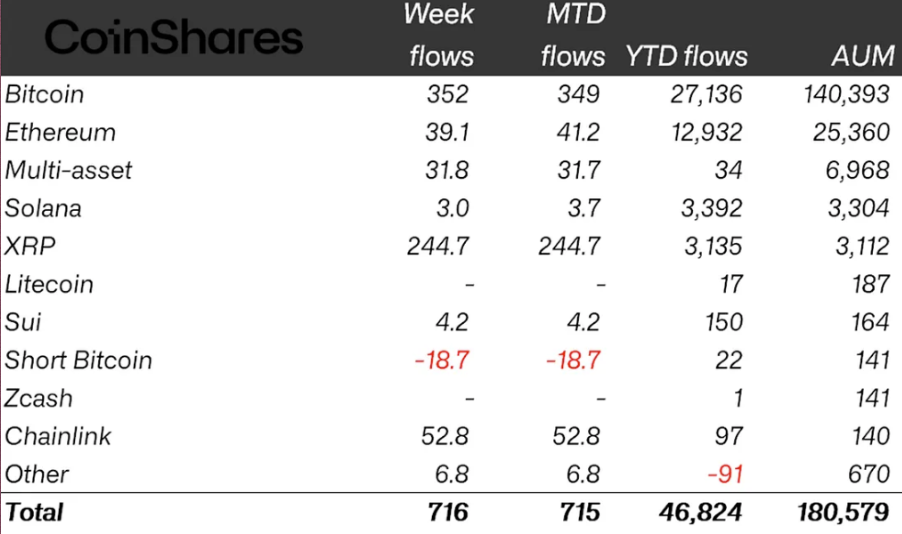
Inflows into crypto ETPs flip positive for two consecutive weeks. Source: CoinShares


Magazine: Decade after Ethereum ICO: Blockchain forensics end double-spending debate

Related Reads

Bull vs. Bear Debate: Is the Profit Moat of Stablecoin Leader CRCL Solid?

The article presents a heated debate surrounding Circle (NYSE: CRCL), the issuer of the stablecoin USDC, focusing on the sustainability of its business model following its IPO and Q3 2025 earnings report. Key bearish points, led by figures like Jiang Zhuo'er, argue that CRCL's profits are unsustainable. They compare it to a bank reliant on an interest rate spread, which is highly vulnerable to Federal Reserve rate cuts. Critics highlight that over 60% of profits are paid to distributor Coinbase, leaving CRCL with a thin margin. They warn that competition from traditional financial giants like JPMorgan could easily disrupt its model, and that its regulatory advantage is a temporary benefit, not a permanent moat. Bullish commentators, including @BTCdayu and @qinbafrank, counter that CRCL is a long-term infrastructure play, not a simple bank. They believe current profit-sharing is a strategic cost to achieve market dominance and network effects, similar to companies like Amazon in their early days. They argue that future growth from massive USDC adoption (potentially reaching trillions) will far outweigh the impact of falling interest rates. They see compliance as a powerful, long-term moat that will eliminate smaller competitors. Additional short-term concerns include a significant sell-off pressure from the post-IPO lockup expiration and a structural barrier to USDC's use in U.S. retail payments due to its classification as a taxable asset. In summary, the debate pits short-term cyclical risks (interest rates, high costs, sell pressure) against a long-term structural opportunity (market growth, network effects, compliance as a barrier to entry). The core question remains whether CRCL's current model is a fragile interest-rate play or a foundational bet on the future of digital currency.

比推28m ago

Bull vs. Bear Debate: Is the Profit Moat of Stablecoin Leader CRCL Solid?

比推28m ago

Trading

Spot
Futures
活动图片