An IT Empire Built on a Toothpick: Everyone Keeps Adding Bricks, No One Glances at the Foundation

marsbitPublished on 2026-09-10Last updated on 2026-09-10

Abstract

An IT Empire Built on a Toothpick: Everyone Piles Bricks, No One Looks at the Foundation This article uses a vivid metaphorical illustration to critique the increasingly fragile state of modern digital infrastructure. The core argument is that the entire edifice of information technology is built atop an unresolved, fundamental flaw: the von Neumann bottleneck. The author describes a precarious tower of technology stacks—from mobile operating systems and browsers down to CPUs and silicon wafers—each layer individually robust and well-documented. However, the entire structure rests on a single, thin, red pillar representing the von Neumann architecture. This 1945 design, where a CPU fetches data from memory over a bus, creates a critical bottleneck. As CPUs get faster and programs more complex, this data transfer becomes the system's primary constraint. Despite this, the tech industry largely ignores solving this hard, foundational problem in favor of adding more lucrative layers on top. The piece satirizes various actors contributing to the instability: * **Big Tech** acts like an "angry bird," periodically launching disruptive new frameworks and standards that break existing ecosystems for their own growth, rather than strengthening the core structure. * **The AI boom** is portrayed not as a savior but as a final lever accelerating collapse. AI models massively strain the already-bottlenecked compute and data infrastructure, while generating vast amounts of low-qualit...

Author: The Assembly Monk
Have you ever considered how many layers of the tech stack this article you're currently reading has passed through?

Mobile OS, browser kernel, JavaScript engine, WebAssembly, CDN, DNS, cloud servers, Linux kernel, C runtime library, CPU instruction set, semiconductor wafer... all ultimately resting on a piece of silicon consuming electricity.

Each layer sounds rock-solid. Each layer has whitepapers, certifications, and backing from big corporations.

But when you stack them all together, you get a disconcerting picture—a teetering tower of Babel, supported at the very bottom by a ridiculously thin red pillar.

Its name is: the Von Neumann Bottleneck.

And you, standing at the top of the tower, are holding your phone, thinking everything is just fine.

01 That Red Pillar Nobody Wants to Look At

John von Neumann, father of the modern computer. The Von Neumann architecture is the underlying design of almost all modern computers. The CPU handles calculation, memory handles storage, and a bus shuttles data between them. This design has been used from 1945 to today, supporting mainframes, PCs, the internet, the mobile era, and now artificial intelligence.

But it has two inherent flaws: 1) CPUs are getting faster and faster, but memory and the bus can't keep up. Data movement becomes the system's ceiling—the CPU spends most of its time waiting for data, not calculating. 2) The CPU's high processing depends on cache capacity, but caches have inherent physical limitations and cannot be scaled horizontally like memory. Driven by modern high-level programming languages emphasizing human readability, increasingly bloated programs and complex heterogeneous data have long exceeded cache capacity limits, further increasing the frequency and volume of data traffic between memory and CPU, making computers run slower, lag more, and crash more easily. This is the "Von Neumann Bottleneck."

The irony is that this bottleneck is the IT industry's most fundamental, core, and unavoidable problem, yet also the most neglected one.

Why? Because solving it is too hard and not lucrative.

Big companies prefer to add more layers on top—faster GPUs, larger VRAM, more complex cache hierarchies, smarter scheduling algorithms. Each layer can be written into a PPT, each layer can be sold, each layer is a workaround for that red pillar, rather than confronting and solving the problem itself.

It's like constantly adding floors to a building while covering cracks in the foundation with thicker wallpaper.

Ask the people living inside if it's safe? They'll say: Don't worry, we just installed the latest smart lock and bought the most expensive disaster insurance.

02 Every Brick Is Square, But the Stack Slants

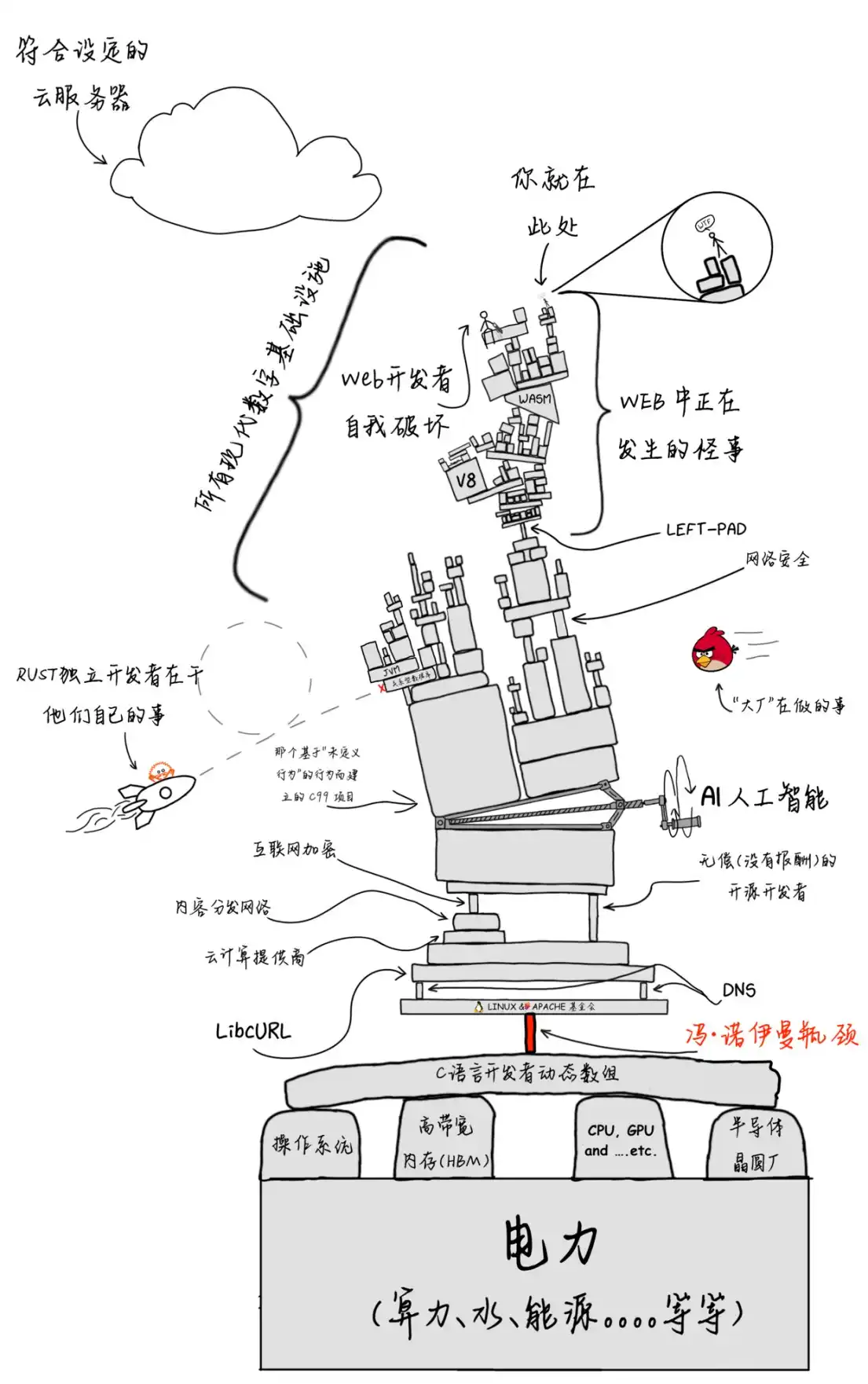
Look at this picture, and you'll notice an interesting phenomenon: each layer, taken individually, looks like a carefully designed block.

The OS has a rigorous kernel architecture. High Bandwidth Memory (HBM) uses sophisticated stacking technology. CPUs and GPUs have intricate designs with billions of transistors. Semiconductor fabs are the crown jewel of human industry.

The Linux & Apache Foundation maintains the world's most reliable open-source infrastructure. LibcURL is called by almost every program needing network access. The DNS system allows the global internet to find itself. Cloud providers promise 99.99% availability.

Every piece is square, every piece has papers, standards, and audits.

But stack them from bottom to top, and the picture changes.

This is the truth of modern digital infrastructure: not a carefully designed whole, but a miracle stacked from countless temporary solutions.

It runs not because it's well-designed, but because enough people have patched enough holes on enough late nights.

You think you're in a grand edifice. Actually, you're standing on a Jenga tower of patches.

03 AI Is Not the Savior, It's the Last Lever That Breaks the Camel's Back

Look at the mechanical arm extending from the side of the picture, labeled "AI Artificial Intelligence."

It's not supporting this tower; it's acting as a lever accelerating the collapse of the patched-together facility.

This is the most precise satire of the current AI frenzy.

Everyone says AI is a productivity revolution, the next era, the silver bullet that will save everything. But from an infrastructure perspective, the first thing AI does is push the already teetering system closer to the edge.

Why? Because 1) AI is a compute monster. Training a large model once consumes electricity equivalent to a small city's annual usage. Inference deployment requires massive GPUs, and GPUs' underlying architecture still runs on Von Neumann—that red pillar bears more pressure than ever before. 2) The pressure from AI's brute-force data retrieval on infrastructure is tens of thousands of times greater than from human users, and the currently hyped loop solutions will only geometrically increase the frequency of data retrieval, queries, and computations in AI tasks.

Even more ironic is AI's output.

Massive amounts of AI-generated code are submitted to open-source projects, with varying quality and endless vulnerabilities. Massive amounts of AI-generated content flood the internet, burying search engine results in garbage. Massive amounts of AI-generated "solutions" are packaged and sold to customers, only to reveal hallucinations at their core when problems arise.

AI hasn't fixed the red pillar. It's just added another layer on top of the tower, then told everyone: Look, we're higher now.

Will it collapse? That's a problem for next quarter.

A joke sums it up well: Humanity spent 70 years evolving computers from "calculating fast" to "being able to talk nonsense," and called it progress.

04 Big Tech's Angry Birds: Not Fixing the Building, But Demolishing It

On the right side of the picture, an angry bird is flying towards the tower. The label reads: What "Big Tech" is doing.

The metaphor is harsh, but precise.

Every so often, big tech companies launch a "revolutionary" new product, framework, or standard. The launch events are grand, the PPTs exquisite, KOLs sing praises in unison.

But these products often don't repair or strengthen the existing industry structure; they disrupt it.

A new framework emerges, and the ecosystem of the old one dies. A new standard arrives, and all devices compatible with the old one become "obsolete." Big tech isn't unaware of the cost. But for them, the cost of ecosystem destruction is borne by developers and users, while the growth and valuation from the new product are theirs.

05 Independent Developers: Rockets Flying Away and Scattered Fragments

On the left side of the picture, a Rust independent developer flies away on a rocket, with the label: "RUST INDEPENDENT DEVELOPERS DOING THEIR OWN THING."

This is another form of satire.

Independent developers are the most dynamic group in the IT ecosystem. Unbound by big tech KPIs, they can experiment rapidly and create polished applications big companies can't.

But the output of independent developers has another side:

- Clutter. For the same function, ten independent developers make ten versions, all different, each with its own design philosophy, each maintained only until the author loses interest.

- Chaos. No unified standards, no compatibility promises, no upgrade roadmaps. Works today, the author might delete the repo tomorrow.

- Lack of rigor. Many independent projects have no tests, no documentation, no security audits. The author thinks "it runs, good enough," and then this project gets depended on by ten thousand others.

Individually, these issues aren't huge, but combined, they become another form of market disruption. Users pick through countless half-finished products, developers stumble through countless abandoned frameworks, and the ecosystem's trust cost keeps rising.

And those truly excellent independent developers, like the Rust developer flying away on the rocket—they're doing their own thing, doing it well, but it has nothing to do with this teetering tower.

The tower won't become more stable because of them, and they won't stop for the tower's sake.

Everyone's busy with their own thing, heading for their own kind of collapse.

06 One Picture, One Absurd History of the IT Industry

Let's look at this picture from top to bottom, completely.

At the very bottom is a large gray square: "Electricity (Compute, Water, Energy... etc.)". This is the starting point of everything—without electricity, no computing. But in the IT industry's narrative, electricity is the most neglected layer. Everyone discusses cloud-native, microservices, large models, but rarely: where does the electricity for these things come from? How much does it cost? What's the environmental impact?

Above electricity are four foundation stones: Operating System, High Bandwidth Memory (HBM), CPU/GPU, Semiconductor Fab. This is the hardware layer, the truly "square" part. Each represents the pinnacle of human industry. But note, they are four separate stones, not a single foundation—the connections between them inherently have gaps.

Above that is a wobbly long plank labeled "C Developer Dynamic Array." This plank spans the four foundation stones and is inherently unstable. And right in its middle, a thin red pillar supports all the weight above—the Von Neumann Bottleneck. The weight of the entire IT world ultimately rests on this pillar.

Further up, the style starts to unravel. A "C99 Project Based on Undefined Behavior" handles critical functions. Under the JVM, Relational Database is crossed out. A mechanical arm extends from the side, labeled "AI Artificial Intelligence," pushing the tower.

Continuing up are the V8 Engine, left-pad, Cybersecurity, WebAssembly—this is the web layer. Large text nearby reads "WEB DEVS SELF-SABOTAGE" and "WEIRD THINGS HAPPENING IN WEB."

At the very top, a tiny stick figure representing the user stands on the teetering pinnacle, with the label "YOU ARE HERE." Zoom in, and this little figure is holding a phone—he's using this tower, which could collapse at any moment.

To the tower's left, the Rust independent developer flies away on a rocket, doing his own thing. To the tower's right, the angry bird (Big Tech) is crashing into it. Above the tower, a cloud drifts alone, labeled "Cloud Server That Matches the Setting"—it has no connection to the tower, seemingly just a concept.

The entire picture has no extra words. Every label is a jab at the IT industry's most sensitive spots.

It's not predicting anything. It's describing the present.

Final Thoughts

Writing this article up to here, some might say: You're too pessimistic. Isn't the IT industry running just fine?

Yes, it's running.

But "running" and "stable" are two different things. A person can walk doesn't mean their bones aren't cracked. A bridge can carry traffic doesn't mean it isn't overloaded.

The terrifying aspect of the IT industry is that every layer iterates at high speed, but the most fundamental problems have never truly been solved. The Von Neumann Bottleneck remains, big tech demolition remains, AI-generated garbage remains, independent developers working in silos remains.

Everyone keeps building upwards. No one is willing to glance downwards.

Because looking down, you'd find the foundation is a toothpick. And toothpicks, eventually, have a day when they can no longer hold.

Perhaps only on that day, we standing at the top holding our phones, might finally ask that question for the first time: How exactly was this building's foundation built?

Trending Cryptos

Related Questions

QWhat is the core technical problem identified in the article as the 'weakest link' in modern computing?

AThe core technical problem is the 'Von Neumann bottleneck.' It refers to the inherent limitation of the classic Von Neumann computer architecture, where the CPU must wait to fetch data and instructions from memory over a bus. This data transfer speed cannot keep up with the increasing processing speed of modern CPUs, creating a fundamental performance ceiling for entire systems.

QAccording to the article, how does the proliferation of Artificial Intelligence (AI) exacerbate existing infrastructure issues?

AThe article argues that AI acts as a destabilizing force, not a solution. First, AI models, especially large ones, are 'computing monsters' that place immense new pressure on the already-strained Von Neumann architecture through massive power consumption and GPU demands. Second, AI-driven data retrieval and processing, especially with automated 'loop' systems, increases query frequency and traffic by orders of magnitude, pushing data infrastructure to its limits.

QWhat metaphor is used to describe the behavior of major technology companies ('Big Tech') in the context of this fragile system?

AThe article uses the metaphor of the 'Angry Bird' from the popular game. It depicts Big Tech as an Angry Bird that repeatedly crashes into the unstable tower. This symbolizes how big companies often launch disruptive new products, frameworks, or standards that break existing ecosystems rather than fixing foundational problems. The cost of this disruption is borne by developers and users, while the companies benefit from the growth and market valuation of their new offerings.

QWhat is the contradictory nature of the 'independent developer' as portrayed in the article's critique?

AIndependent developers are portrayed with a dual nature. On one hand, they are the 'most vibrant' part of the ecosystem, free from corporate constraints and capable of creating innovative applications. On the other hand, their output contributes to systemic chaos through proliferation of disparate, often poorly maintained projects ('disorder'), lack of standards ('messiness'), and a focus on 'it works for me' over rigorous testing and documentation ('lack of rigor'). This increases the overall 'trust cost' and fragmentation within the software ecosystem.

QWhat is the final, unsettling conclusion the article draws about the state of the modern IT industry?

AThe article's unsettling conclusion is that the entire modern IT edifice is fundamentally fragile and unstable. It is not a well-designed structure but a precarious tower of 'temporary solutions' and 'patches' stacked on top of an unresolved, ancient bottleneck (Von Neumann). The industry's focus is solely on adding new layers on top for profit and novelty, while willfully ignoring the crumbling foundation. The system 'works' not because it is solid, but through sheer momentum and countless fixes, and it is only a matter of time before this 'toothpick' foundation can no longer support the weight.

Related Reads

Bitcoin carry trades could beat Treasury bills in 2027, Sygnum predicts

Bitcoin carry trades could regain their edge over US Treasury bills in 2027 as demand for leverage recovers, according to digital asset bank Sygnum. In its 2027 Sygnal Outlook report, Sygnum forecasts that the annualized premium on three-month Bitcoin futures at the Chicago Mercantile Exchange would average more than 2% above three-month US Treasury bill yields next year. A crypto carry trade involves buying Bitcoin while betting against its price through futures contracts, limiting exposure to price swings while collecting funding payments or futures premiums. Fabian Dori, Sygnum's chief investment officer, said returns could recover as investors become more willing to take risks and fewer hedge funds compete for the same profits. The basis trade had become very crowded, with many hedge funds running it through spot ETFs against short CME futures, but positioning data indicates those funds have now unwound much of their CME short positions. Sygnum cited a 67-day stretch of negative Bitcoin funding rates in 2026, and Talos research shows funding rates and futures premiums that peaked at 20%-40% annualized in early 2024 dropped to just 3%-5% this year, roughly matching the current three-month Treasury bill yield of around 4.25%. Bitcoin carry trades became popular after the launch of US spot Bitcoin ETFs in 2024, but as more investors entered, returns fell. Dori noted a more mature market pays less for the same trade but also attracts additional investors, potentially increasing demand for leverage. Talos found funding rates have started rising again since August, and Coinbase reported Bitcoin funding rates rose from around 4% annualized at the start of October to an average of 8.9% in the last week of the month, though Coinbase questioned whether this reflected meaningful demand given weaker spot buying. Sygnum expects wider institutional adoption, tokenization growth and rising AI demand to support leveraged Bitcoin exposure in 2027. Dori warned that a sharp market downturn, liquidity shortage, or interest rates staying higher for longer could prevent carry trade returns from recovering, and that even hedged positions can face margin calls. Carry can pay steadily for long periods and then turn quickly, he said, and when positioning gets crowded and funding reverses, the unwind is typically fast.

cointelegraph2m ago

Bitcoin carry trades could beat Treasury bills in 2027, Sygnum predicts

cointelegraph2m ago

Bernstein Research Report Interpretation: Fiscal 2028 Revenue to Top $740 Billion, Yet Only a Neutral Rating for Nvidia

Nvidia reported Q3 FY2027 revenue of $115.844 billion, beating consensus of $109.330 billion, with adjusted EPS of $2.68 versus $2.47 expected. Data Center revenue reached $107.610 billion, up 21% QoQ and 110% YoY, driven by the Vera Rubin architecture, which contributed about $20 billion in its first quarter, alongside continued Blackwell Ultra shipments. Hyperscale cloud revenue was $60.136 billion, while AI cloud and enterprise customers reached $47.474 billion, up 195% YoY. Networking contributed about $21 billion, and adjusted gross margin came in at 74.9%. Q4 FY2027 guidance stands at $130 billion, above the $125.1 billion consensus, but Bernstein notes this includes an extra accounting week worth roughly $5-10 billion; excluding it, the normalized outlook is slightly below consensus. Q3 also benefited from about $2.4 billion in Hopper sales to China, which are excluded from Q4 guidance. Q4 gross margin is guided at 71.5%, expected to be the cycle trough before price increases lift margins to 72-73% in FY2028. Management raised FY2028 revenue growth guidance to about 75% from 70%, implying revenue above $740 billion, saying strong global demand offsets new export controls. Supply commitments rose to $390 billion, or $518 billion including cloud, leasing, and equity commitments. Inventory climbed to $39.7 billion. Free cash flow was $43.8 billion, with $22.1 billion in buybacks and a new $150 billion authorization. Bernstein raised its FY2028 revenue forecast to $742.4 billion and EPS to $17.18. Despite strong fundamentals, Bernstein maintains a Market-Perform rating and $200 target price, citing governance and long-term execution risks following management changes. The board has said it does not intend to bring back Jensen Huang and is searching for a new leader, raising questions about supplier negotiations, product roadmap, decision speed, and talent retention, plus potential investigation risks. At around $155.46, the stock trades at just 9.0x FY2028 EPS, or about 10x the $200 target based on average FY2028-29 EPS of $20.59. Bernstein remains on the sidelines pending clarity.

marsbit1h ago

Bernstein Research Report Interpretation: Fiscal 2028 Revenue to Top $740 Billion, Yet Only a Neutral Rating for Nvidia

marsbit1h ago

Bitcoin Volatility Falls to 43%, Below Nearly One-Fifth of S&P 500 Constituents: Is the Crypto Asset Risk Narrative Being Rewritten?

Grayscale Research argues that Bitcoin's risk profile has structurally changed and that investors' framework for assessing crypto risk needs a fundamental reset. Bitcoin's one-year realized volatility has fallen from roughly 64% a decade ago and 81% five years ago to about 43% today, placing it within the normal range of S&P 500 large-cap stocks and below roughly 19% of S&P 500 constituents. This decline reflects deeper institutional market-making, spot ETP launches, and established regulatory boundaries. The report cautions against judging Bitcoin by volatility alone. Its returns exhibit fat tails and momentum clustering, with the bulk of long-term compound gains concentrated in a handful of best trading days; missing the top 10 days would erase most cumulative returns. Downside-only measures such as the Sortino ratio therefore flatter Bitcoin more than the Sharpe ratio does. Although drawdowns exceeding 50% have occurred, risk-parity-adjusted drawdowns look less exceptional versus traditional assets. Crucially, Bitcoin's returns are poorly explained by traditional macro factors, giving it low correlation with equities, bonds, and commodities. Backtests show that adding a 1–5% Bitcoin allocation to a classic 60/40 portfolio improves risk-adjusted returns without proportionally worsening maximum drawdown. Beyond Bitcoin, crypto sub-sectors are structurally decoupling: Bitcoin now explains only about 50% of overall crypto return variance. Smart contract platforms show roughly 58% volatility driven by on-chain fundamentals, while consumer and AI sectors show 76% and 85% respectively, driven by distinct narratives. This rotation creates room for bottom-up alpha. Institutions should adopt a two-layer approach: Bitcoin as a macro diversifier, plus selective exposure to vertical-sector infrastructure, managed through volatility budgeting and disciplined rebalancing.

marsbit1h ago

Bitcoin Volatility Falls to 43%, Below Nearly One-Fifth of S&P 500 Constituents: Is the Crypto Asset Risk Narrative Being Rewritten?

marsbit1h ago

Strategy Removed from MSCI: Will BlackRock's 123,000 Shares Really Hit the Market?

After Nov 30, MSCI will remove Strategy (Michael Saylor's bitcoin-holding company) from several indices, effective Dec 1, under new eligibility rules for "non-operating" companies. Investors expect selling pressure, since index-tracking funds that bought Strategy solely to mirror the index no longer have a reason to hold it. But two BlackRock funds tracking the same MSCI USA Index illustrate why holdings can't simply be summed into one sell order: iShares MSCI USA ETF (MLRG) holds Strategy shares directly (5,227 shares as of Nov 13), while iShares MSCI USA Swap UCITS ETF (MUSD) gets index exposure via total return swaps, so its counterparties may adjust their own positions without disclosure. BlackRock's URTH (29,300 shares) and ACWI (88,500 shares) also hold Strategy, bringing the three identified funds to 123,000 shares worth about $13.74 million — a specific snapshot, not the full universe of affected funds. USXF holds 16,100 shares but its specialized index adjustment is pending. Strategy says index funds collectively hold about 13 million shares, or 3.1% of free float. Crucially, shrinking holdings don't prove selling: ETFs grow and shrink with creations and redemptions, and shares can leave a fund via in-kind redemptions without exchange sales. Index removal may weaken demand for Strategy's stock and complicate its bitcoin-funding model, but it does not require Strategy to sell any bitcoin.

marsbit1h ago

Strategy Removed from MSCI: Will BlackRock's 123,000 Shares Really Hit the Market?

marsbit1h ago

Trading

Spot

Hot Articles

How to Buy ONE

Welcome to HTX.com! We've made purchasing Harmony (ONE) simple and convenient. Follow our step-by-step guide to embark on your crypto journey.Step 1: Create Your HTX AccountUse your email or phone number to sign up for a free account on HTX. Experience a hassle-free registration journey and unlock all features.Get My AccountStep 2: Go to Buy Crypto and Choose Your Payment MethodCredit/Debit Card: Use your Visa or Mastercard to buy Harmony (ONE) instantly.Balance: Use funds from your HTX account balance to trade seamlessly.Third Parties: We've added popular payment methods such as Google Pay and Apple Pay to enhance convenience.P2P: Trade directly with other users on HTX.Over-the-Counter (OTC): We offer tailor-made services and competitive exchange rates for traders.Step 3: Store Your Harmony (ONE)After purchasing your Harmony (ONE), store it in your HTX account. Alternatively, you can send it elsewhere via blockchain transfer or use it to trade other cryptocurrencies.Step 4: Trade Harmony (ONE)Easily trade Harmony (ONE) on HTX's spot market. Simply access your account, select your trading pair, execute your trades, and monitor in real-time. We offer a user-friendly experience for both beginners and seasoned traders.

8.2k Total ViewsPublished 2024.03.29Updated 2026.09.28

How to Buy ONE

Discussions

Welcome to the HTX Community. Here, you can stay informed about the latest platform developments and gain access to professional market insights. Users' opinions on the price of ONE (ONE) are presented below.

活动图片