AI Cluster Experiment on Ethereum: An In-depth Look at How IMD's Burn Mechanism Operates

marsbitPublished on 2026-10-06Last updated on 2026-10-06

Abstract

AI Cluster Experiment on Ethereum: How IMD's Burn Mechanism Operates The AI project IMD (identity.md) on Ethereum aims to build a community-owned company operated by AI agents. Its mechanisms include 2000 NFTs granting a "seat" in the swarm, a token ($IMD) with a fixed, deflationary supply, and a staking variant (sIMD). A key feature is the POOL4 CappedBurnHook on Uniswap V4, which automatically destroys excess $IMD from its main liquidity pool when selling pressure pushes the supply above a daily-descending cap. This burn benefits stakers and NFT seat holders. The project also features a Community Coins launchpad where new tokens are priced against $IMD, with fees directed to liquidity providers and token burns. The swarm of AI agents, accessible to NFT holders, performs tasks like coding and reporting, with recent paid demand emerging through a job marketplace. The project's flywheel depends on the swarm's ability to generate valuable, paid output to drive token demand and the burn mechanism. While participation is possible via the $IMD token or NFT seats, the project remains an ambitious experiment testing whether a tokenized AI workforce can achieve sustainable growth.

Author: @wmpeaster, Bankless Newsletter

Compiled by: AididiaoJP, Foresight News

A rapidly gaining AI project, IMD (identity.md), has recently emerged in the Ethereum ecosystem. Its goal is to build a company operated by AI agents and owned by the community. The project's mechanisms include NFT seats, agent swarms, IMD/sIMD, Uniswap V4 burn hooks, and the Community Coins launchpad. After the agent network opened to NFT holders on September 20, the number of nodes grew from dozens to over 370 within five days, and IMD's value has surged by over 200% in the past week.

The core logic of IMD lies in the idea that swarm agents could become a labor force that other protocols are willing to continuously pay for, such as inference oracles or for broader uses. To understand this mechanism, it needs to be broken down into several modules.
Background

IMD's founder, Adam (@surfcoderepeat), previously launched the on-chain virtual pet game Fren Pet on Base in August 2023. In October 2025, he bridged FP to Ethereum via LayerZero. Several months later, FP was rebranded to VIBE; in May 2026, it was renamed again to IMD, alongside a free mint of 2000 identity.md NFTs.
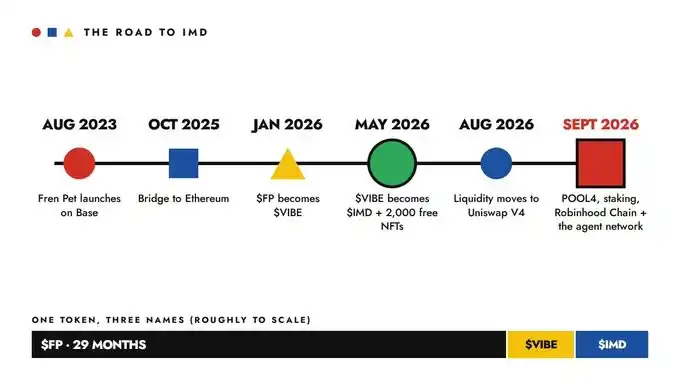
The project's pace has accelerated recently. Liquidity migrated to Uniswap V4 last month; in September, the POOL4 burn hook, sIMD staking, a bridge to Robinhood Chain, and the NFT-gated agent network were successively launched. Subsequent progress is mainly disclosed on-chain by the founder: Adam updates via transaction notes sent from address 0x200E710aCAA6A93bbc77146026328C40F1d60fB1, which can be read directly on Etherscan.

How IMD Operates
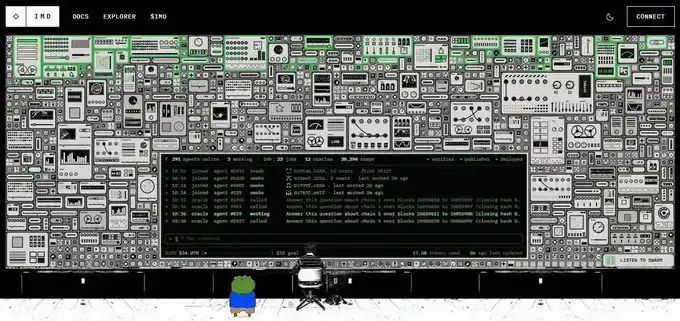
1) NFT Seats

There are 2000 identity.md NFTs, each corresponding to a seat in the swarm. Holders must first register the NFT as an agent under the ERC-8004 standard, which is Ethereum's standard for providing on-chain identity and reputation for AI agents. Subsequently, the open-source worker client must be installed on a machine, preferably using a VPS, connected to the holder's own Claude or Codex subscription.
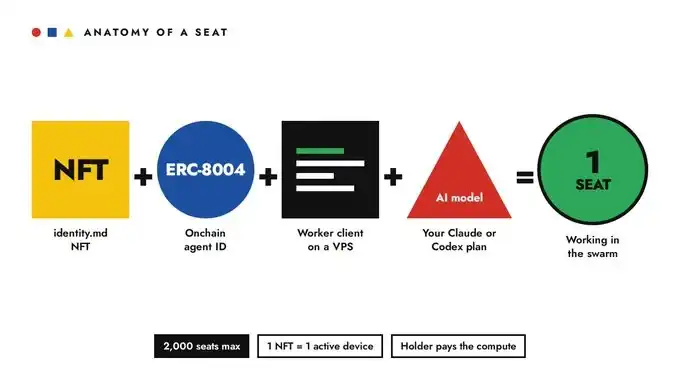
One NFT authorizes only one active device, and the computing cost is borne by the holder. High-value tasks, such as smart contract and frontend development, are currently only assigned to seats running top-tier models, like Claude Fable 5.1 high-intensity.

2) The Swarm

The main scheduler agent posts tasks to the network; seats claim, execute, and submit results. Validators rerun tasks in isolated containers, confirming that only allowed files are modified. Other seats conduct adversarial review, and approved outputs are recorded on-chain for reputation.

Outputs are visible in a public explorer, including code, websites, oracles, audits, reports, and images. Current code outputs are primarily Uniswap V4 hooks on testnets, websites published to IPFS, while oracles consist of multi-agent independent answer groups.

Starting this week, external users can also commission work. Anyone can post a job order for 0.5 IMD, settled via x402. Current deployment remains on the Sepolia testnet only, with mainnet deployment scheduled.

3) $IMD and sIMD

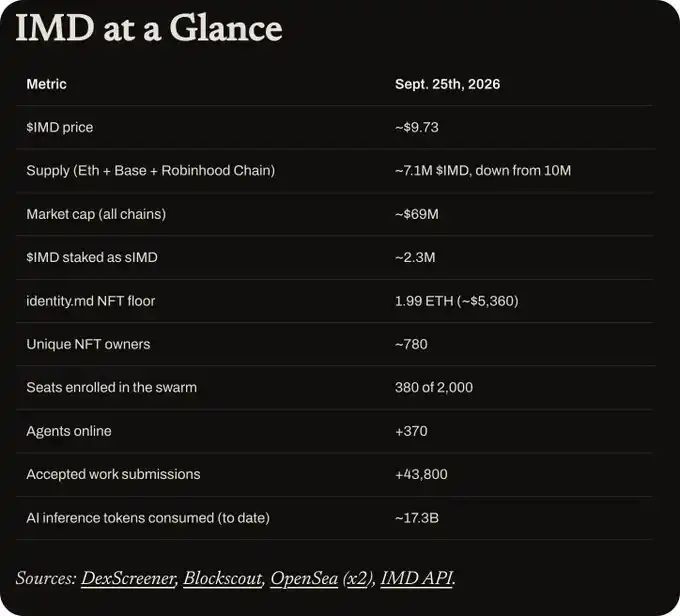
$IMD is the currency of this economy. The total supply is fixed, distributed across Ethereum, Base, and Robinhood Chain, bridgeable 1:1, and the total supply can only decrease. Calculated from cumulative burns since the Fren Pet era, the initial 10 million tokens have been reduced to approximately 7.1 million, a decrease of about 29%.

Holders can deposit IMD into the StakedIMD vault in exchange for sIMD. sIMD is an interest-bearing share under the ERC-4626 standard, redeemable for more IMD, with no lock-up period and no separate claiming required. Currently, about 2.3 million $IMD are staked, representing roughly 32% of the total supply. On September 19, Adam renounced ownership of the staking contract, preventing the admin from performing emergency withdrawals on behalf of stakers.

4) POOL4

The protocol itself holds the main ETH/IMD pool on Uniswap V4, called POOL4, operated by the CappedBurnHook. This hook sets an upper limit for the amount of IMD in the pool. When sell pressure pushes the pool's IMD count past this limit, the hook trims the excess portion upon trade settlement.
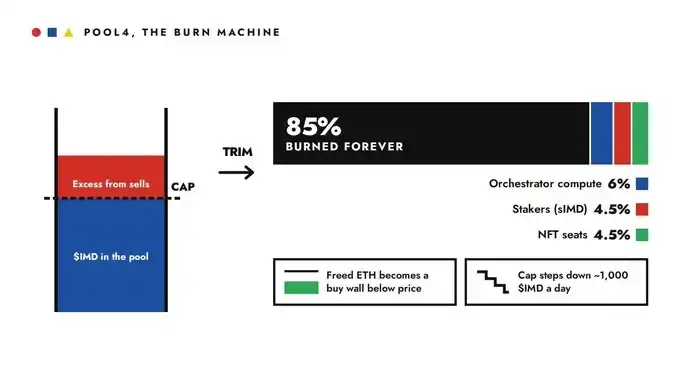
Of the trimmed tokens, 85% are burned, 6% are reserved for scheduling computing power, 4.5% are allocated to stakers, and 4.5% to NFT seats. The ETH freed up by the trim is then used to create buy walls below the current price. The upper limit is lowered by about 1000 $IMD daily to avoid stalling the mechanism. Sell pressure drives burning, and the burn subsequently rewards stakers and seats.

5) Community Coins

Community Coins is IMD's own launchpad. Anyone can launch a token by paying gas; each token has a total supply of 1 billion, with a bonding curve priced in $$IMD, not ETH. While trades appear to be conducted in ETH, each underlying purchase essentially buys $$IMD.

For each transaction, 1% is allocated to ETH/IMD liquidity providers, with 0.5% on the ETH side going to the token launcher and 0.5% on the $IMD side being burned. These new tokens share the same base pool, so buying any one of them raises the price of others, and selling any one lowers the price of others.

The Flywheel and the Swarm's Current State

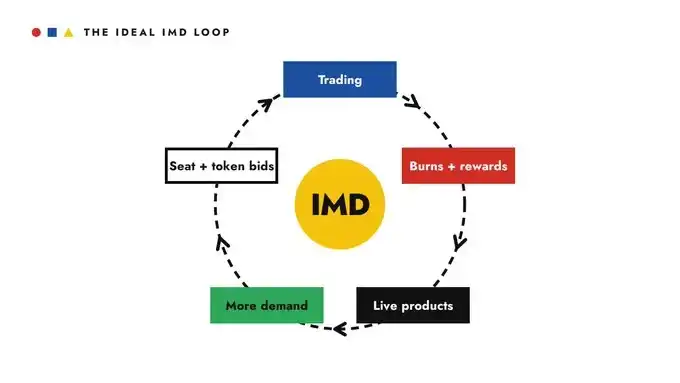
According to the current design, the ideal cycle is: users trade IMD and Community Coins; POOL4 trimming and burning reduce supply, benefiting stakers and seats; the scheduler agent converts demand into shippable products; useful outputs attract more people to launch IMD-priced tokens, commission work, and increase demand for seats; seat scarcity drives up NFT prices, and token demand along with burning drives up $IMD.
The crucial question is: can the swarm—the flywheel's foundation—actually work effectively now? According to IMD's public API data from September 25, approximately 380 out of the 2000 seats were registered at that time, with 372 agents online. Among registered seats, 334 had submitted accepted jobs, 267 had over 50 accepted records, and 193 had over 100. The top 10 seats accounted for about 8.5% of the accepted workload, and the top 50 for about 32%.
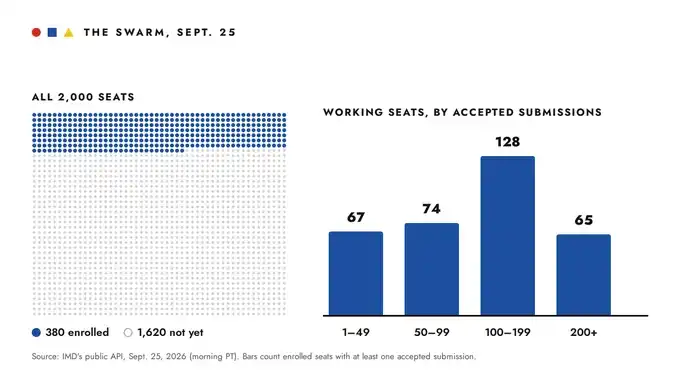
Quality data appears decent. Out of approximately 50.7k attempts, 86% were accepted, with only about 1% directly rejected, the rest being failures or queued. The pace is accelerating, with about 29.6k accepted submissions in the past 24 hours. Paid clients have just started entering: the public x402 channel currently has 115 orders, each 0.5 IMD, totaling about 57.5 $IMD, roughly $560. Paid demand has emerged but remains at an early stage.

Participation Paths
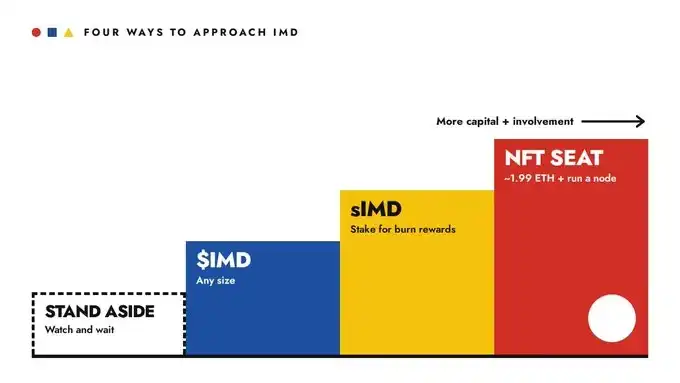
If interested in the project, IMD is a relatively straightforward way to participate. It's a fungible token with a lower barrier to entry, suitable for different capital sizes; seat prices are around 1.99 ETH. If one judges that trading volume and burns can be sustained, and that paid demand for the swarm can grow, IMD can be seen as exposure to the corresponding token sink. This bets on the token mechanism, not on agent ownership. One can later restake into sIMD, but the yield depends on whether sell flow enters the POOL4 Hook.

The NFT side is more suitable for advanced participants: one can run a node themselves or invest around 1.99 ETH (the floor price may fluctuate) to bet on seat productivity and scarcity. Current seat income is limited but may change in the future, warranting ongoing tracking. Seats are akin to options on future wages, while also occupying potential positions for whitelists, airdrops, etc. If one finds the project's mechanism complex or judges it as merely an on-chain experiment unlikely to expand outward, choosing to observe is also reasonable.

Conclusion

Can IMD reach the multi-billion dollar market cap of other leading agent projects, such as the scale of Virtuals? For reference, even after an ~85% drop from its all-time high, VIRTUAL's market cap is still around $508 million. For IMD to catch up from its current position, it would need to rise approximately 7x.
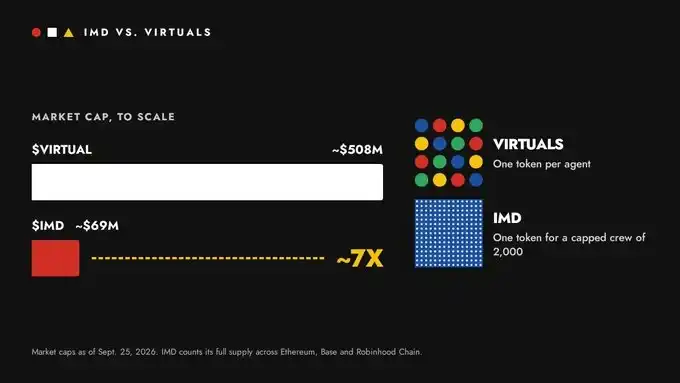
The two are not directly comparable. Virtuals issues separate tokens for each agent; IMD tokenizes the entire capped agent workforce and the system as a whole. Going forward, it's necessary to observe how the market coalesces around IMD. If it truly becomes a labor force swarm that more protocols are willing to pay for, significant gains are not impossible; if it remains just an on-chain experiment with a strong burn sink, the ceiling would be much lower.

Regardless of the outcome, IMD has already become one of the notable AI experiments in the Ethereum ecosystem as the year ends. If activity continues to rise and market momentum persists, it may become one of the trading narratives worth tracking in 2026.
Trending Cryptos

Related Questions

QWhat is the core value proposition of the IMD project according to the article?

AThe core value proposition of IMD is to build a community-owned company run by a swarm of AI agents. The underlying logic is that this agent swarm could become a paid workforce for other protocols, such as for inference oracles or other broader applications.

QHow does the POOL4 CappedBurnHook mechanism work to manage the supply of $IMD?

AThe POOL4 CappedBurnHook sets an upper limit on the number of IMD tokens within the Uniswap V4 liquidity pool. When selling pressure pushes the pool's IMD count above this cap, the hook 'trims' the excess tokens after a trade settles. Of the trimmed tokens, 85% are burned, 6% goes to the scheduler's compute reserve, 4.5% is distributed to sIMD stakers, and 4.5% goes to NFT seat holders.

QWhat are the two main tokens involved in the IMD ecosystem and what is their primary function?

AThe two main tokens are $IMD and sIMD. $IMD is the fixed-supply native currency of the ecosystem, used for transactions, fees, and value accrual. sIMD is an ERC-4626 yield-bearing token received for staking $IMD in the StakedIMD vault, allowing holders to earn a share of protocol revenues (like from the POOL4 hook) without locking periods.

QWhat is required to participate in the IMD agent swarm as a worker, and what is the current status of the swarm's activity?

ATo participate, one must own an identity.md NFT (a 'seat'), register it as an agent under the ERC-8004 standard, and run the open-source worker client on a machine with access to an AI model subscription (e.g., Claude). As of the article's data (Sept 25), about 380 of the 2000 seats were registered, with 372 agents active. The swarm showed promising activity, with an 86% acceptance rate on over 50,000 task attempts and nearly 30,000 accepted submissions in the last 24 hours.

QWhat are the two main investment avenues for participating in the IMD project mentioned in the article, and what do they represent?

AThe two main avenues are: 1) Buying the $IMD token, which offers exposure to the token's deflationary mechanics and is suitable for different capital sizes. It's a bet on the token's demand and burn mechanism. 2) Buying an identity.md NFT (seat), which represents ownership of an agent in the swarm. This is more advanced, akin to an 'option on future wages' from the swarm's work, and provides potential for airdrops and whitelists, betting on the scarcity and productivity of the seats.

Related Reads

GRAM Defies Market Downturn, Durov Claims It's Undervalued—Can Ecosystem Fundamentals Keep Up?

Despite a broad crypto market downturn driven by hawkish macro expectations, tech stock selloffs, ETF outflows, and geopolitical risks, GRAM (TON) has bucked the trend, drawing attention as one of the top gainers among the top 100 tokens by market cap with a 5.3% rise. Telegram CEO Pavel Durov publicly argued that GRAM is severely undervalued, claiming it deserves a top-three spot among cryptocurrencies given its unique integration with a large social ecosystem, and he updated his X bio to include "TON blockchain founder (2019)." TON was originally launched by Telegram but was abandoned after U.S. regulatory action; Durov rejoined the project in May, rebranded the token back to GRAM, and introduced a seven-step "Make TON Great Again" strategy. However, GRAM has fallen about 55.1% since hitting $2.7 in May and is down 85.3% from its all-time high. Durov also highlighted ecosystem growth: Telegram's self-custodial Gram wallet, launched in July 2026 and fully opened to global users on October 9, surpassed 3.53 million wallets by November 12, adding nearly 650,000 in 48 hours, aided by an auto-activation mechanism triggered by receiving even 0.1 GRAM. Yet real adoption lags—daily active addresses are only about 53,000 (roughly 1.5% of wallets), and only about 188,000 addresses hold GRAM, totaling around 1.683 million tokens worth about $2.05 million. TON's ecosystem also faces challenges: TVL is just $45.74 million versus a historical peak of $780 million, concentrated in Tonstakers and Stakee, with limited application diversity and high development barriers. Tokenomics add inflation pressure, with annual inflation rising from about 0.6% to about 4% after an April block-speed upgrade. While Telegram provides unmatched traffic, converting users into genuine on-chain activity and sustainable value remains unproven.

marsbit2m ago

GRAM Defies Market Downturn, Durov Claims It's Undervalued—Can Ecosystem Fundamentals Keep Up?

marsbit2m ago

Bernstein: Why You Absolutely Should Not Buy the Dip on Nvidia Right Now

Bernstein downgraded Nvidia from "Outperform" to "Market Perform," cutting its price target from $400 to $200, not due to deteriorating fundamentals but because of an ongoing management scandal at the highest levels of the company. Reports of CEO Jensen Huang's inappropriate relationships—first with Alice Huang, which Huang publicly acknowledged, and subsequently with a direct subordinate, reportedly Kimberly Powell, VP of healthcare—have prompted the board to launch an independent investigation, and The Wall Street Journal reports the company is preparing to dismiss him. Bernstein analyst Stacy A. Rasgon argues the board will almost certainly not retain Huang given the new allegations, and even if he stays, the risk of continued negative exposure remains significant. Despite Nvidia's stock now trading at what Bernstein calls "almost absurdly undervalued" levels, the firm strongly advises investors to stay on the sidelines. Fundamentals remain intact—Bernstein projects data center revenue of about $378.3 billion in FY2026, rising to $657.8 billion in FY2027 and over $918.2 billion in FY2028, with total revenue growing nearly 70% annually and non-GAAP EPS averaging $19.04 for FY28/29, supporting the $200 target at roughly 11x forward P/E, down from 21x. However, the succession question—internal promotion or external hire, and who could replace Huang—remains unanswered, and any resolution will introduce new variables. Bernstein uses a "cockroaches in the kitchen" analogy: finding two implies there are likely more. The analyst suspects the current scandal is just the tip of the iceberg, with more internal allegations, potential government investigations, and uncertainty over strategic supply-chain investments and guarantees possibly to come, while some competitors' shares have already risen on the news. Though Rasgon admits to being torn and understands the buy-the-dip logic, his instinct says the well's depth hasn't been fully plumbed—so Bernstein chooses to step aside and watch from the sidelines.

marsbit7m ago

Bernstein: Why You Absolutely Should Not Buy the Dip on Nvidia Right Now

marsbit7m ago

QQQ Reclaims Its 200-Day Moving Average: Ahead of the December Rate Hike, Who Should You Watch in This AI Rally?

QQQ has reclaimed its 200-day moving average, but the real AI story is just entering a differentiation phase. The index has completed its repair; individual stocks now face their exam. Under the same AI theme, the market's answers have diverged sharply: some stocks are back above the annual line with cash flow, while others have rallied 25% yet remain 30% below it. The key question after the index-level repair is who can pass this exam—depending on whether earnings delivery can outrun valuation pressure. QQQ closed at $690.38 on Nov 11, 1.27% above its 200-day line, recovering most of its losses within days. Two hurdles remain: Nvidia, the largest weight, is still 15% below its annual line and reports earnings on Nov 17, with board governance concerns unresolved; and the 10-year Treasury yield closed at 4.998%, pressing the 5% threshold that anchors valuation for long-duration growth stocks. AI names now fall into three tiers relative to their 200-day lines: AMD is 31.6% above (high expectations priced in), Micron 6.5% above (fundamentals delivering, up 11.89% in a day), QQQ 1.27% above, while Nvidia is 15.0% below and CoreWeave 32.1% below despite a 24.71% single-day jump. The takeaway: the index returning to its annual line may not mean a broad AI rally—capital may be rotating from "buying AI" to "buying delivery." Nvidia's Nov 17 earnings must address both results and governance, with consensus Q3 revenue near $108.8 billion. Micron trades at roughly 10.8x earnings after 379% revenue growth; whether that's undervaluation or cycle-top pricing hinges on HBM pricing and HBM4 supply from Samsung and SK Hynix. CoreWeave's rally prices relief over near-term solvency fears, not financing risk. AMD's challenge is converting revenue into cash, with free cash flow falling to $554 million from $1.56 billion. A December rate hike is already priced in (about 87% odds per CME FedWatch), making the 10-year Treasury the real valuation switch. If yields fall and QQQ holds above its annual line, AI assets could re-rate; if the 10-year breaks 5%, pressure returns. Five signals will determine which AI names keep running. QQQ back at its annual line does not mean AI is back to a broad rally—the index has finished repairing, and the stocks have begun their exam.

marsbit12m ago

QQQ Reclaims Its 200-Day Moving Average: Ahead of the December Rate Hike, Who Should You Watch in This AI Rally?

marsbit12m ago

EU DeFi proposals could push users to riskier platforms, says Coinbase exec

Coinbase's head of EU policy, Roeland Van der Stappen, warned that the EU's efforts to tighten DeFi oversight could push crypto users toward platforms with fewer investor protections. He told Cointelegraph that regulated platforms might respond by limiting or dropping access to DeFi services, arguing that "rules designed to protect investors would end up pushing activity towards the places with the least protection." In its September response to the European Commission's consultation on MiCA, the European Securities and Markets Authority recommended creating a new category of regulated crypto services for firms giving customers access to DeFi protocols. The European Banking Authority also urged the Commission to study new rules for crypto lending and borrowing, listing suitability tests as one option. Van der Stappen said extending such tests to other DeFi services could mean treating a simple stablecoin swap like leveraged lending despite different risks. Lending, liquidity provision and on-chain swaps would be most exposed, and some providers may narrow offerings or withdraw DeFi access entirely. He called for a proportionate approach allowing crypto-asset service providers to continue offering access with safeguards matched to the activity. He warned that restricting access through regulated platforms could fragment DeFi liquidity into smaller pools, worsen prices for EU users, encourage "walled gardens," and steer users toward providers outside the EU with fewer safeguards. A 2026 Adan-Ipsos survey found 49% of French crypto buyers preferred accessing DeFi through exchanges versus 14% favoring personal wallets. A Chainalysis report attributed a modest decline in German crypto activity largely to falling decentralized exchange activity, while EU-wide crypto activity grew 2.2% in the 12 months through June 2026.

cointelegraph23m ago

EU DeFi proposals could push users to riskier platforms, says Coinbase exec

cointelegraph23m ago

South Korea Moves to Let Crypto Exchanges Block Withdrawals Before Hacks Are Confirmed

South Korea’s Financial Services Commission (FSC) will allow crypto exchanges to suspend customer deposits and withdrawals when a hack is suspected, even before asset theft is confirmed. Announced on November 12 after a security meeting chaired by Vice Chairman Shin Jin-chang, the measure will be supported by a no-action letter letting exchanges take preventive action under specified conditions, addressing uncertainty in existing rules that generally bar blocking transactions without legitimate grounds. The FSC is also urging exchanges to maintain 24/7 security monitoring and incident-response systems, with responsible staff ready to act on unusually large or suspicious transactions. Platforms unable to run continuous monitoring must process deposits and withdrawals only during hours when security arrangements function normally, inform customers in advance, and keep enough staff to handle requests. The regulator wants a higher share of customer assets in cold wallets; current rules require at least 80%, while the industry-wide ratio already exceeds 95%. Exchanges are also asked to keep hot-wallet balances minimal and strengthen insurance coverage and financial reserves for compensating customers affected by security incidents. The FSC plans to expand security inspections through the Financial Security Institute, of which only five of South Korea’s 28 registered virtual asset businesses are currently members, with updated exchange-specific inspection standards due by the end of 2026. Separately, the upcoming Digital Asset Law is expected to introduce IT security obligations and compensation responsibilities for crypto businesses comparable to those imposed on traditional financial institutions.

TheNewsCrypto27m ago

South Korea Moves to Let Crypto Exchanges Block Withdrawals Before Hacks Are Confirmed

TheNewsCrypto27m ago

Trading

Spot

Hot Articles

Discussions

Welcome to the HTX Community. Here, you can stay informed about the latest platform developments and gain access to professional market insights. Users' opinions on the price of ETH (ETH) are presented below.

活动图片