A Giant Loophole in the Global Cryptocurrency Taxation System; China's Taxable Cryptocurrency Volume is Only 1/5 of the US Figure

cryptonews.ruPublished on 2026-08-27Last updated on 2026-08-27

Abstract

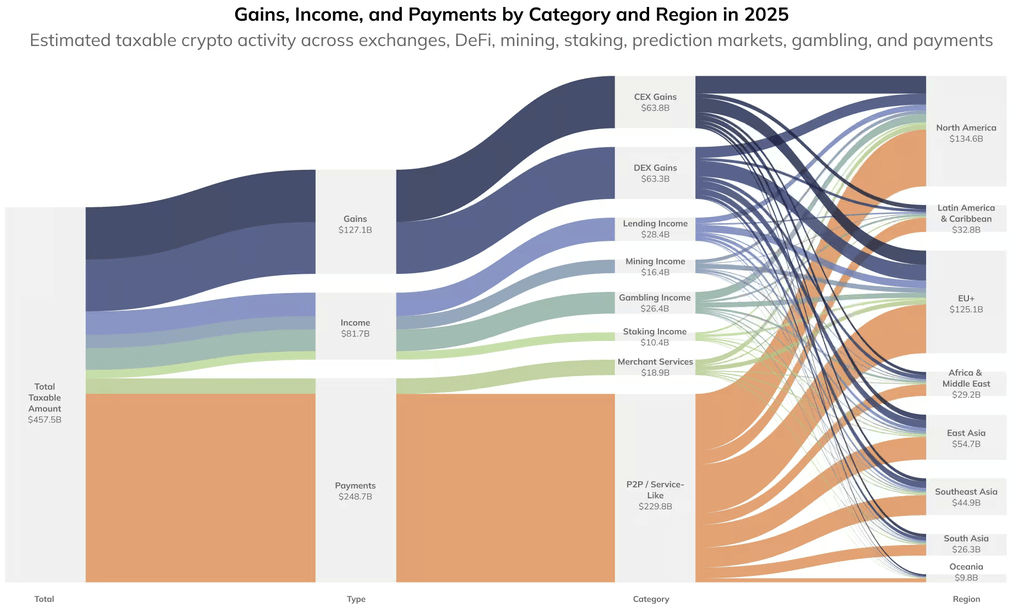
According to a report by Chainalysis, the global volume of potentially taxable crypto activity in the past year exceeded $457 billion, with Europe accounting for $125.1bn, the US for $112.6bn, and China for $21bn. A significant 86% of this global activity—including peer-to-peer transfers, decentralized exchange (DEX) trading, income from staking, mining, lending, and crypto payments—falls outside the scope of the OECD's Crypto-Asset Reporting Framework (CARF), which is set to begin implementation in 2027. CARF only covers activity on centralized exchanges and some wallet providers. While frameworks like CARF and the EU's DAC8 directive aim to improve tax reporting, they face challenges like a lack of comprehensive user data and non-universal adoption. Furthermore, mandatory data collection raises serious privacy and security concerns. The article cites France, where data leaks from tax authorities have been linked to a sharp increase in physical attacks on crypto asset holders.

Last year, the volume of potentially taxable global cryptocurrency activity on-chain exceeded $457 billion, according to a new report by blockchain data analytics firm Chainalysis. Of this amount, $125.1 billion was attributable to European countries, $112.6 billion to the United States, and $21 billion to China, where onshore cryptocurrency trading is banned.

These figures, estimated to represent a lower bound, include income from centralized and decentralized exchanges; revenue from mining, staking, lending, and gambling; as well as cryptocurrency-denominated payments. Regarding China, due to the trading ban, it is difficult to assess the total activity of Chinese users as transactions move offshore.

The 86% Gap

In any case, analysts believe that CARF (Crypto-Asset Reporting Framework) — the crypto asset reporting system developed by the OECD and set to take effect next year — covers only 14% of the global volume.

"The remaining 86% — including activity on decentralized exchanges (DEX), peer-to-peer transfers, on-chain revenue flows, and payments — falls outside the practical scope of this system," stated Chainalysis, which sells blockchain tracking tools to governments and companies.
Source: Chainalysis

CARF, designed to identify tax-related risks, applies only to centralized exchanges, brokers, retailers, and some wallet providers. At least 46 countries have already committed to implementing this system in 2027 and starting to collect and exchange information about crypto asset users with other jurisdictions. Another 29 countries are expected to join this group in 2028, and the United States in 2029.

What Remains Out of Sight for Now

Blockchain analysts argue that CARF will fail to capture the vast majority of taxable crypto-related income, as it does not account for activity on decentralized exchanges, peer-to-peer transfers, self-custody, mining rewards, staking income, lending income, and many payments for goods and services.
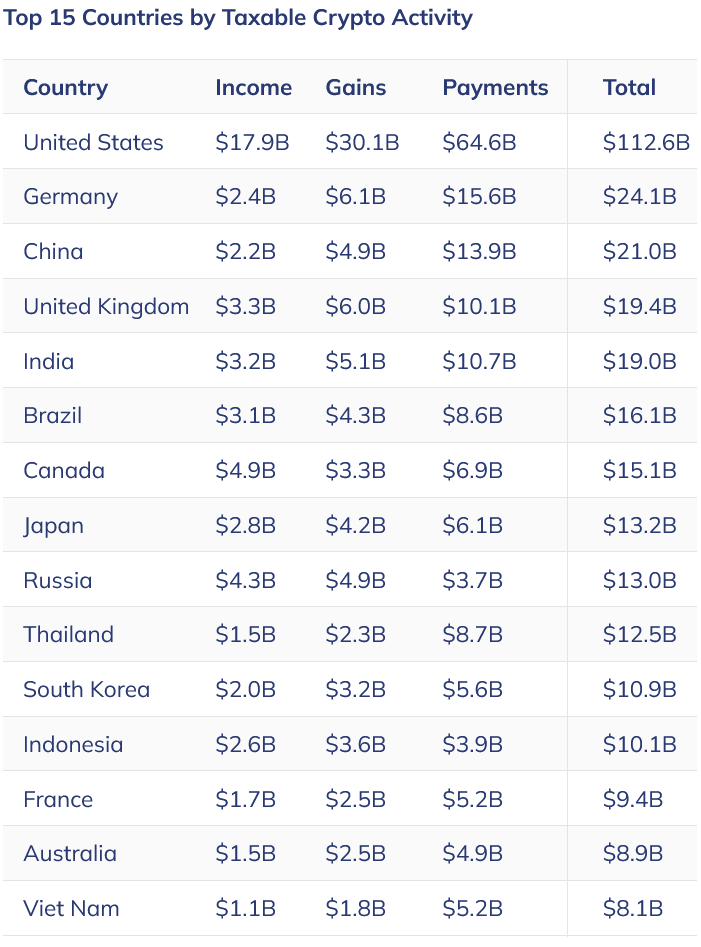
Profit — realized capital gains from trading on centralized (CEX) and decentralized (DEX) exchanges; Income — revenue from mining, staking, lending, and gambling; Payments — cryptocurrency payments. Source: Chainalysis

Furthermore, exchanges lack information about crypto assets acquired elsewhere, making accurate profit and loss calculations difficult, and not all countries will participate in CARF. Additionally, the system can report to the tax authority for how much a person sold their crypto assets, but not for how much they acquired them, complicating profit calculation.

Nevertheless, CARF is not the only recent effort to improve tax collection related to crypto assets. In the EU, where the DAC8 directive came into force this January, cryptocurrency exchanges are already collecting sensitive personal data of their clients and will start sharing it with national tax authorities in 2027.

Life-Threatening Dangers of Tax Data Leaks

Cracking down on tax evasion is a double-edged sword, as it also puts crypto asset owners at risk.

This summer, Bull Bitcoin, an exchange dedicated solely to Bitcoin, began a legal battle in France in an attempt to overturn a decree implementing the DAC8 directive into local law. According to the exchange, which also develops the popular multi-feature, privacy-enhancing Bitcoin wallet Bull, the EU directive creates a "massive international 'honey pot' of financial data, linking individuals' legal identities, their home addresses, and cryptocurrency activity, including information absolutely unrelated to taxation."

France has gained notoriety as the country with the highest number of physical attacks against Bitcoin and other crypto asset owners, a situation also fueled by personal data leaks from the national tax authority. According to an open database of recorded physical attacks on crypto asset owners, 36 incidents occurred in the first eight months of this year, a 64% increase compared to the entire year of 2025. The actual number is likely higher, as not all attacks are reported to the police and/or become public knowledge.


Related Questions

QAccording to the Chainalysis report, what was the total global volume of potentially taxable crypto activity last year and what were the figures for the US, Europe, and China?

AThe total global volume of potentially taxable crypto activity last year exceeded $457 billion. The volume for Europe was $125.1 billion, for the US it was $112.6 billion, and for China it was $21 billion.

QWhat is the CARF and what significant limitation does the Chainalysis report highlight about its coverage of global crypto activity?

ACARF is the Crypto-Asset Reporting Framework developed by the OECD, set to take effect next year. According to Chainalysis, CARF will cover only 14% of the global crypto volume, leaving 86% (including activity on DEXs, peer-to-peer transfers, on-chain income flows, and payments) outside its practical scope.

QWhat types of crypto-asset activities are currently NOT covered by the CARF reporting framework?

ACARF does not cover activity on decentralized exchanges (DEXs), peer-to-peer transfers, self-custody, mining rewards, staking income, lending income, and many payments for goods and services.

QWhat is one specific challenge mentioned regarding CARF's ability to accurately calculate profits and losses for users?

AOne challenge is that exchanges lack information about crypto-assets acquired elsewhere, making it difficult to accurately calculate profits and losses. Furthermore, CARF may report the amount for which a person sold their crypto-assets but not the purchase price, complicating profit calculations.

QWhat risk associated with tax data collection for crypto assets is highlighted in the article, specifically referencing France?

AThe article highlights the risk of physical attacks on crypto-asset owners linked to data leaks from tax authorities. France is cited as having the highest number of such attacks, a situation exacerbated by personal data leaks from its national tax agency. There were 36 recorded incidents in the first eight months of the year, a 64% increase from all of 2025.

Related Reads

Why Ethereum Staking Will Change in 2026

The article discusses the evolving role of Ethereum (ETH) staking, shifting from a niche crypto enthusiast topic to a mainstream portfolio management tool for financial advisors and institutional investors. It explains how staking works in Ethereum's Proof-of-Stake network, detailing validator requirements and methods like solo staking, pools, exchanges, and liquid staking protocols, each with its own risk-reward profile (e.g., liquidity, control, technical requirements). A key point is staking's growing importance for corporate treasuries, where staking rewards represent a significant income stream, unlike non-yielding Bitcoin holdings. Looking ahead, the article highlights the anticipated 'Glamsterdam' upgrade in late 2026 as a pivotal development expected to enhance scalability, decentralization, and post-quantum resistance, further solidifying Ethereum's institutional appeal. It also emphasizes that while staking offers passive income and network participation, risks include technical failures, slashing penalties, platform/custodial risks, and regulatory uncertainty. For advisors, the conclusion stresses the need to evaluate staking providers beyond just promised yields, focusing on reliability, fees, withdrawal terms, security, and the specifics of reward structures (protocol vs. MEV-based). The regulatory landscape and infrastructure maturity around digital asset custody are noted as critical adjacent topics to monitor.

cryptonews.ru51m ago

Why Ethereum Staking Will Change in 2026

cryptonews.ru51m ago

Scott Bessent's Risky Bond Buyback Operation Could Fuel Bitcoin Price Surge

Bitcoin returned to the $80,000 level on Thursday, breaking past a key $79,000 resistance point, on news of an upcoming $92 billion U.S. Treasury bill auction scheduled for August 31st. The price recovery saw Bitcoin reach a daily high of $80,808, though it faced brief selling pressure. The cryptocurrency was trading around $80,400 by late morning EST, marking a roughly 3% daily increase and pushing its market cap back to $1.61 trillion. This surge positions Bitcoin for a monthly gain of over 20%, a sharp reversal from July's flat performance. The volatility led to $105 million in leveraged Bitcoin positions being liquidated in 24 hours, with short positions accounting for the majority of losses. Analysts note the large-scale Treasury auction could drain short-term market liquidity, potentially pushing yields higher and pressuring risk assets like stocks and crypto. Furthermore, a recent article in The Economist warns that U.S. Treasury Secretary Scott Bessent's policies risk undermining confidence in the American financial system. The report criticizes measures to artificially cap long-term bond yields and a shift towards issuing more short-term T-bills, which shortens the overall debt duration and increases vulnerability to future rate hikes. This approach, along with distorting market pricing mechanisms, could jeopardize long-term investor trust in U.S. sovereign debt. Prominent figures like Ray Dalio suggest such policies are reducing the inflation-adjusted yield of traditional fixed-income assets, potentially driving capital seeking a store of value towards alternatives like gold and Bitcoin, whose prices have risen since the Treasury's announcements.

cryptonews.ru52m ago

Scott Bessent's Risky Bond Buyback Operation Could Fuel Bitcoin Price Surge

cryptonews.ru52m ago

Trading

Spot
活动图片