Apple Finally Admits, Siri Is Getting Old

marsbitPublished on 2026-06-09Last updated on 2026-06-09

Abstract

In a significant shift, Apple has rebranded Siri to "Siri AI" at WWDC 2026, acknowledging the assistant's limitations after years of stagnation. The company announced a deep partnership with Google, leveraging Gemini's model capabilities to train its new Apple Foundation Models. This collaboration extends Apple's Private Cloud Compute to Google Cloud and Nvidia GPUs for the first time. The article traces Siri's history from its groundbreaking 2011 debut to its subsequent confinement within Apple's closed ecosystem, prioritizing control and privacy over expansive functionality. While Apple integrated AI into its hardware and systems over the years (e.g., Neural Engine, Core ML), it missed the paradigm shift brought by generative AI models like ChatGPT. Facing pressure, Apple restructured its AI leadership and opted to license Google's Gemini technology—reportedly paying around $1 billion annually—to power the revamped Siri. The strategy involves "distilling" knowledge from the large Gemini model into smaller, on-device models. Apple also plans to use Google Cloud's Nvidia GPUs for complex cloud inference tasks. The core vision for "Apple Intelligence" is a system-level assistant that reduces cognitive load: summarizing notifications and emails, drafting context-aware replies, and retrieving relevant information across apps. Siri gains a dedicated app with memory and cross-device sync. However, this AI push comes with hardware requirements, potentially excluding older iPhone...

By Sleepy

Beijing time, in the early hours of June 9, 2026, Apple's WWDC 2026 commenced as scheduled.

At the event, it rebranded Siri as Siri AI, announced a deep collaboration with Google, using Gemini's model capabilities to train its new generation of foundation models. It extended Private Cloud Compute for the first time to Google Cloud and Nvidia's GPUs.
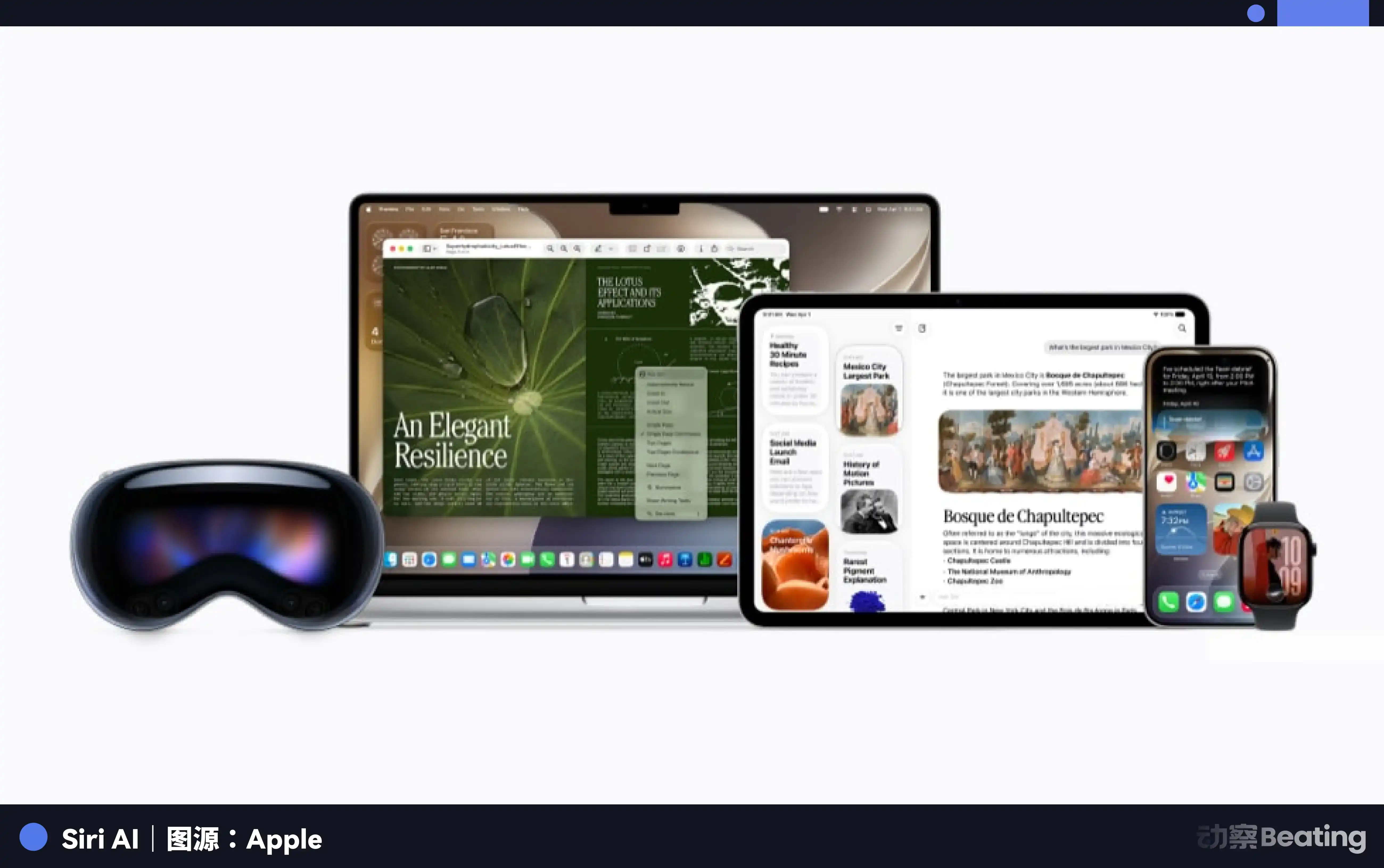
It released five Apple Foundation Models, with the smallest on-device model having 3 billion parameters and the largest cloud model optimized specifically for Nvidia GPUs. Almost every core app was rewritten. Siri even got its own standalone app, with the ability to save conversations, sync across devices, and possess memory.

This was Apple's most information-dense keynote in recent years.

Taming a Future

Apple's AI story can be traced back to the fall of 2011, at the iPhone 4S launch event, where Siri first took the stage.
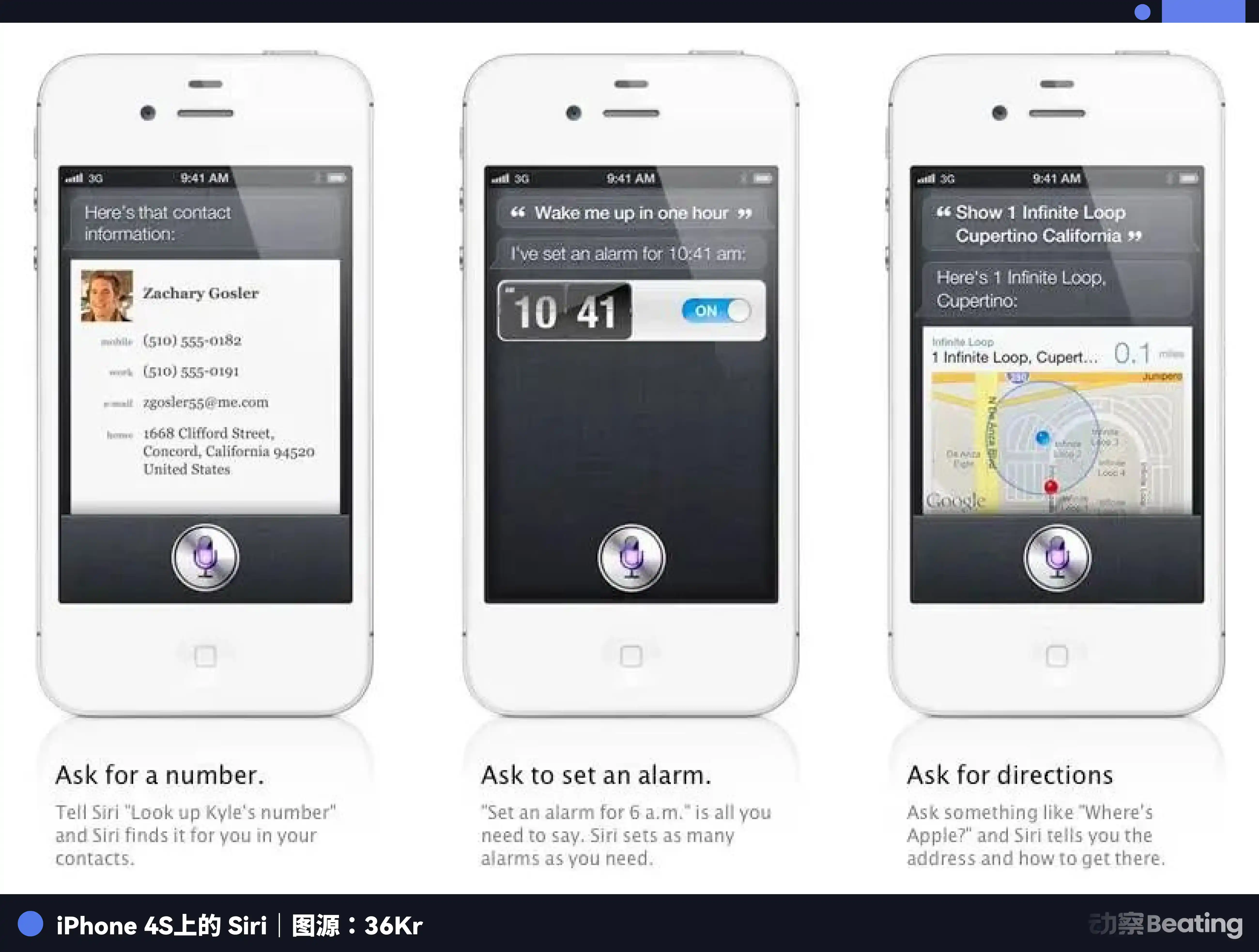
At that time, Steve Jobs was gravely ill, and Apple stood at the crossroads of an era. Siri was like a little creature that had escaped from a sci-fi movie. You could ask it about the weather, restaurants, or set an alarm. It would answer you in a slightly mechanical tone, making you feel for the first time that a phone was more than just a piece of cold glass.

Siri evolved from the CALO project by SRI International, originally a military-grade AI assistant funded by DARPA. In 2010, Apple acquired it. According to TechCrunch, the deal likely exceeded $200 million. A year later, Siri debuted with the iPhone 4S. Apple claimed it could understand natural language and act as a personal assistant to handle tasks.

At that moment, Apple secured the world's best entry point for personal intelligence. Then, it delayed for over a decade.

Looking back today, what Siri initially changed was the posture of how people talked to machines. In 2011, the iPhone was turning mobile phones from communication tools into personal computing devices. The App Store redefined software distribution, and the mobile internet migrated from the PC desktop into the palm of your hand. Siri appeared at the crest of a rising wave. But after entering Apple, it quickly transformed from an ambitious personal assistant into a obedient voice remote control.

At its core, Apple believes in being closed and in control. But a true personal assistant must integrate with more services, understand more context, and tolerate more uncertainty. Uncertainty means errors, privacy risks, and the disorder that Apple is least equipped to handle.

Thus, Siri was only allowed to perform deterministic tasks, like a future that had been tamed. It had a name, a voice, a personality wrapper, but lacked the initiative and memory required for a genuine persona. Users were initially amazed by it, later made jokes about it, and eventually stopped using it much.

Apple was the first to put a "personal assistant" into a phone and also the first to lock it away.

The Agent that the entire industry is now working on, looking back, Siri in 2011 was almost its prototype. One could say Apple was the earliest company to create the prototype of an Agent, yet ended up being one of the last to fully realize it.

The AI That Doesn't Look Like AI

During the years Siri didn't grow up, did Apple's AI stagnate?

Quite the opposite. Apple did a lot of AI; it just didn't look like AI.

If measured by the volume of keynote announcements, Apple seemed to only start talking seriously about AI in 2024. But if you trace the technical path backward, Apple had been in motion for a decade.

In 2015, it acquired two companies in succession—one to bolster natural language dialogue, another to explore running deep learning directly on phones. That same year at WWDC, it discussed the Proactive Assistant, attempting to make the system offer suggestions before the user even asked. This idea was ahead of its time but, under the technological constraints of that period, it was more like a slogan.

The following year, it launched SiriKit, cautiously opening Siri up to developers with limited functionality. It also publicly discussed Differential Privacy, stating its intention to learn from large-scale data while protecting individual privacy. In 2017, the iPhone X brought the Neural Engine. Face ID and the camera began relying on on-device machine learning. Apple simultaneously introduced Core ML, allowing developers to run models on Apple devices, and acquired Workflow, which later became Shortcuts.

This was a very Apple-like set of answers. It wanted AI, but not by betting everything on the cloud and massive personal data like Google. It wanted developers, but didn't want Siri to become a messy stew. So Apple chose the hardest and slowest path: focus on the device, privacy, and system integration.

Around 2020, Apple bought several more companies focused on low-power edge AI and speech understanding. That same year, the M1 chip was released, bringing a 16-core Neural Engine to the Mac, pushing on-device AI compute from phones in pockets all the way to computers. The next year, Live Text and Visual Look Up landed. Text in photos could be copied directly, the camera could identify plants and flowers, and more voice requests could be processed on the device without needing the cloud.

Apple indeed didn't release a standalone AI app in these years, but it did make the phone smarter.

Choosing this path had its reasons. AI on a phone isn't just a Q&A machine. It needs to see photos, hear voice, understand contacts, launch apps, sense battery, location, and time. It's best if it can do some things offline, and preferably not bundle up a user's life and upload it to the cloud with every request. Apple's hardware control gave it the qualification to walk this path.

But between localized intelligence and holistic intelligence lies a deep chasm. Apple excels at breaking technology down into reliable components, but generative AI demands it reassemble those components into a whole.

These components quietly lay buried within the system, waiting for a catalyst.

The catalyst didn't arrive first. ChatGPT did.

When ChatGPT emerged at the end of 2022, Apple wasn't unprepared. Tim Cook repeatedly emphasized in various forums that AI and machine learning had been core technologies in Apple products for many years. Bloomberg also reported in 2023 on Apple's internal Ajax large model framework and internal Chatbot project.

The problem wasn't whether Apple had cards in its hand; the problem was that the rules of the game had changed.

ChatGPT shifted user attention from "functions" to "capabilities." Users began to expect AI on their phones by default, and then compared whose was stronger. When ChatGPT could already organize messy thoughts into a coherent email, Siri was still saying, "I found this on the web."

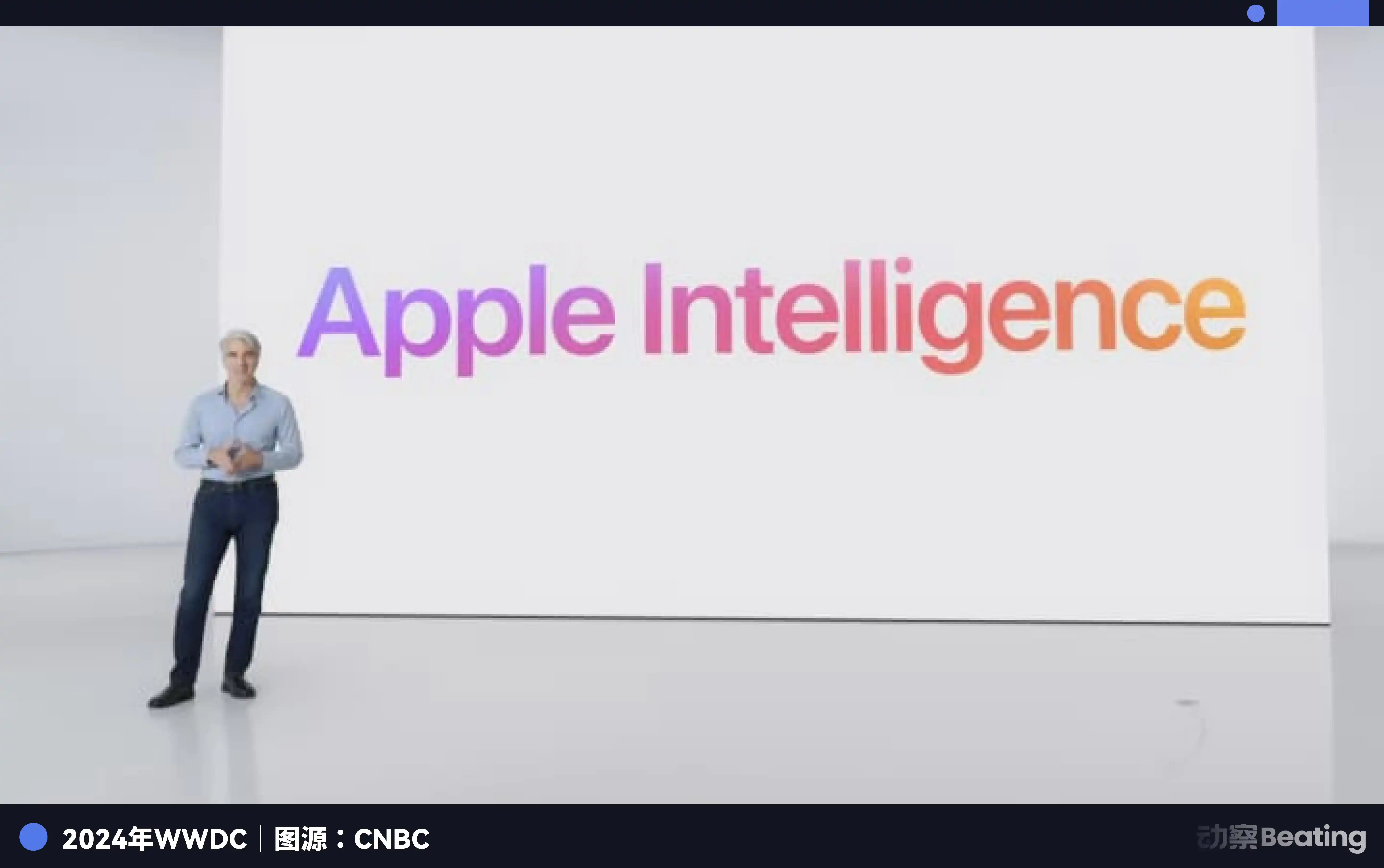
At WWDC 2024, Apple put Apple Intelligence on the table. Writing tools, notification summaries, photo search, personalized Siri understanding, ChatGPT integration. Apple finally admitted that relying solely on in-house models, at least in 2024, couldn't meet user expectations. But the vision it painted ultimately failed to land on the announced schedule.
Hiring Google as a Tutor

Behind the delay of Apple Intelligence wasn't just technology lagging, but the entire Siri team structure failing to keep pace with this round of AI.

Multiple media outlets confirmed that Apple's former AI head, John Giannandrea, stepped down. Craig Federighi took over AI direction, and Vision Pro head Mike Rockwell was transferred to lead the Siri team. A large number of Siri engineers were sent to learn AI programming tools. This wasn't a graceful rotation. Internally, Apple had realized that with the original people and the original pace, it couldn't catch up.

In January 2026, Apple and Google issued a joint statement. Apple would leverage Gemini technology to tailor Apple Intelligence features for the iPhone and other products. According to reports, Apple plans to pay Google approximately $1 billion annually to use a custom Gemini model at the 1.2 trillion parameter level to support the Siri overhaul. Apple had previously tested models from OpenAI and Anthropic but ultimately chose Google.

This is completely different from the ChatGPT integration in 2024. Back then, ChatGPT was more like a lifeline users could authorize when Siri couldn't answer—its brand was OpenAI's, and the interface was pop-up style. This time, Gemini goes directly into the underlying layers, becoming part of Apple's new generation of foundation models.

The key action is distillation. Google gave Apple full access to Gemini. Apple uses the large model within Google's data centers to generate high-quality answers and reasoning processes, then uses those results to train smaller, cheaper models that can run on the iPhone.

A technical paper published by Apple the day before WWDC framed this partnership as the third-generation Apple Foundation Models. Collaborating with Google, it custom-developed five models. On-device, there's the 3-billion-parameter AFM 3 Core, and a 20-billion-parameter sparse model, AFM 3 Core Advanced, which only activates parts per request. For the cloud, there are AFM 3 Cloud, the image model ADM 3 Cloud, and the most powerful AFM 3 Cloud Pro.

More pragmatic changes lie in compute power. No matter how smart on-device models are, they can't handle all tasks. Apple's Private Cloud Compute infrastructure alone could not fully bear Gemini-level inference. Some requests would run on Nvidia GPUs within Google Cloud. Apple subsequently confirmed PCC's first extension beyond Apple's own data centers, with the tech stack covering Nvidia Confidential Computing, Intel TDX, and Google Titan chips. Apple emphasized it still controls PCC software, with devices only trusting programs encrypted and approved by Apple. Related binary files would also be open for inspection by security researchers.

Apple didn't truly relinquish control, but it gave up the dignity of full self-reliance.

Borrowed Bones

To understand Apple's position in the AI era, one must first see its most core asset.

It's not chips, not models, but devices. Devices hold photos, emails, calendars, maps, payments, carrying the fragments of billions of ordinary lives. Whichever AI can mobilize these fragments is no longer just a chatbot; it can become the true personal intelligence hub.

Apple started paving the way for this hub long ago. The Workflow it acquired in 2017 later became Shortcuts, deeply integrated with Siri and system automation. The App Intents introduced in 2022 let third-party apps expose their capabilities to system entry points. In the Apple Intelligence era, these interfaces become the hands and feet for AI to call real-world actions.

With these interfaces, OpenAI can enter, Gemini can enter, and in the future, local partners can be found for the Chinese market. But their entry isn't directly taking over the iPhone; they are fitted into Apple's permission framework and privacy rules.
What Apple fears most isn't whose model is stronger. It fears users starting to bypass the system and directly hand over their lives to another entry point. If one day users opened not apps but an AI assistant that could orchestrate everything for them, Apple would be relegated to a well-crafted shell.

So from now on, the "Apple" in Apple Intelligence represents product control more than complete technological sovereignty. The skin is its own, the clothes are tailored by itself, but the bones are borrowed. Google provides the skeleton, Nvidia provides the joints, and Apple's job is to dress this body in its own clothes and send it out into the world.

What Google gains from this deal is a massive endorsement—even Apple acknowledges Gemini's underlying capabilities as more reliable. What Nvidia gains is another proof that even with the strongest consumer-grade chips and ambitions for self-developed servers, when it comes to cutting-edge inference and complex agent tasks, GPU clouds are still unavoidable.

But the more bones are borrowed, the less the body is truly one's own. Behind every borrowed bone lie supplier business calculations, regulations, and technology cadences. If one day someone decides to pull those bones back, can Apple stand on its own? It's a question Apple doesn't need to answer for now, but it will have to eventually.

A New Tenant Moving into the System

Ordinary people don't care about model parameters. They care if their phone can bother them less.

On the WWDC26 stage, Apple said: "There are times when you expect more from Siri."

For Apple, this almost counts as an apology.

Then it tried to show you a different morning.

You wake up, and the screen is cluttered with twenty notifications. In the past, you'd have to swipe them away one by one. Now the system has already sorted them by priority for you—your boss's messages are at the top, ads and promotions are condensed into a line of gray text. You open your email. A long work email has been summarized into three sentences. You decide to reply, and Siri drafts a response for you based on your usual tone when speaking with this person. You remember you need to call a merchant to return an item in the afternoon. Before you even dial, the system has already pulled the order number from your email from a couple of days ago and placed it on the call interface.

This is the story Apple wants to tell—a layer of intelligence laid beneath the system, saving you from the daily cognitive chores. Read less nonsense, search for files less, get interrupted by notifications less.

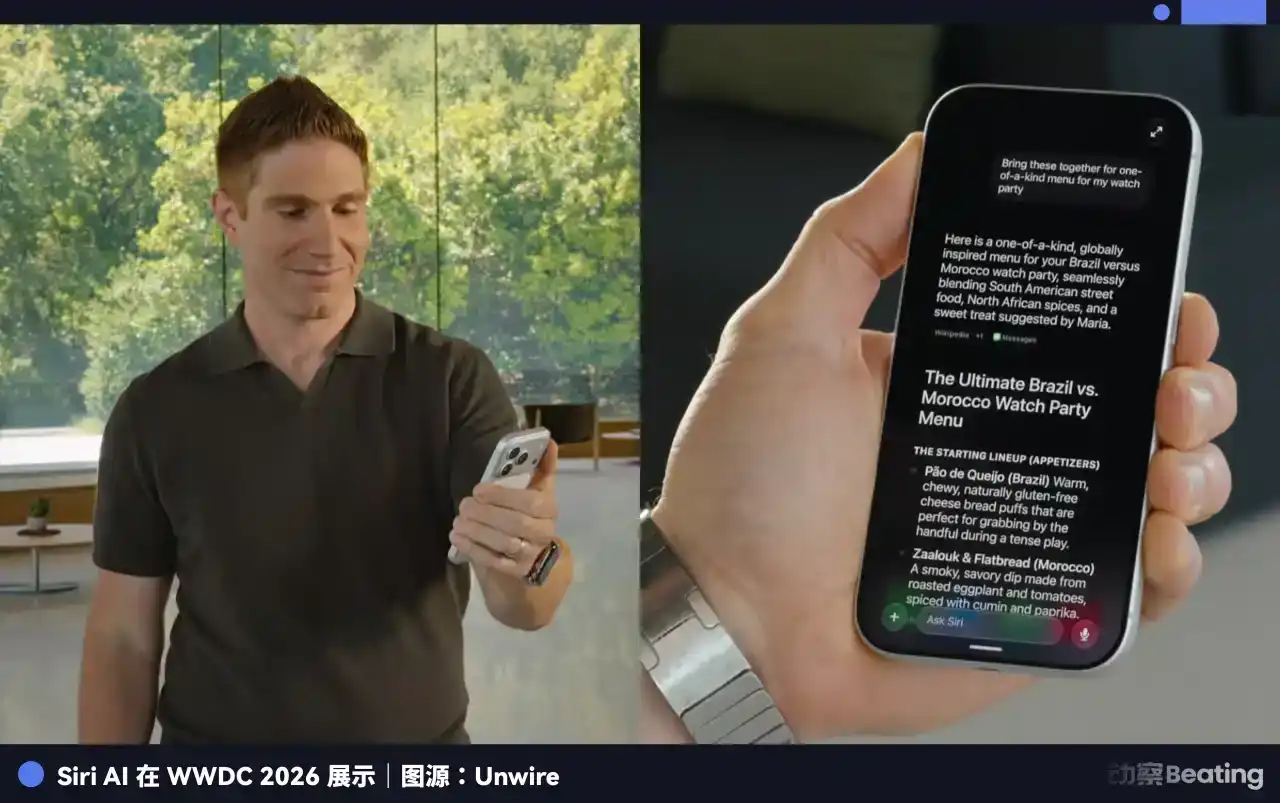
To tell this story well, Apple almost completely redesigned Siri's entry point. On the iPhone, it's placed in the Dynamic Island, accessible with a pull-down. On iPad and Mac, it's merged with Spotlight. It has its own standalone app, capable of saving and continuing past conversations, syncing across devices via iCloud. Apple wants Siri to become an AI assistant living within the system, with memory and context, but tries hard not to make it look like ChatGPT.

Vision is also a crucial direction. The camera adds a Siri mode—point it at food for nutritional info, point it at something unrecognizable for identification and search. System-wide dictation is no longer just speech-to-text; it automatically adds punctuation, adjusts formatting, turning spoken words into text ready to send.

The path is also being paved on the developer side. Apple opened the Core AI framework, allowing third parties to load their own models on devices. Upgraded App Intents make it easier for Siri to understand third-party apps. The Foundation Models Framework no longer just calls Apple's on-device models; it also supports integrating external providers like Claude and Gemini. Apple is paving a path for the entire ecosystem: for Siri to perform tasks across apps in the future, developers must hand over content and actions for the system to understand.

If these plans materialize, Apple AI will no longer be just "Siri that can chat."

But Apple is more cautious this time than in the past. Siri AI will only open to users in beta later this year, starting with English. And the same Apple Intelligence, when it reaches China, will likely be a different product.

For Chinese users, watching Apple AI is mostly just for entertainment. The keynote is lively, the features look good, but "not available in your region" for China.

The Chinese market has a whole set of rules for generative AI: filing, content safety, and data localization. Apple needs to find local model partners and pass regulatory approvals. Apple Intelligence in China isn't just a matter of launching months later; it may fundamentally be a different thing from the ground up.

What U.S. users see is a combination of in-house models and Gemini. What Chinese users may see is a version kneaded together by Apple's system permissions, local cloud services, domestic models, and regulatory requirements. They are both called Apple Intelligence, but their actual capabilities and reachable boundaries could be entirely different.

iCloud services in Mainland China are operated by GCBD. The cloud drive saves files, AI needs to understand files; the cloud drive stores photos, AI needs to understand photos; the cloud drive syncs notes, AI needs to extract your plans, habits, and relationships from notes. This data has new uses in the AI era and naturally faces varying degrees of scrutiny.

A more immediate threat comes from competition. Domestic smartphone manufacturers are moving fast with on-device large models, Chinese-language assistants, and imaging AI. For Chinese users, spending ten to twenty thousand yuan on a new iPhone only to find its core AI features unavailable might just prompt them to switch brands.

The daily scenarios in the Chinese market are particularly tricky for Apple. WeChat, Alipay, Meituan, Douyin, ride-hailing apps, government services, hospital registrations—these are what many people actually use their phones for every day. An AI assistant that cannot access these scenarios, cannot understand group chats, receipts, verification codes, and expressions only locals instantly grasp, can hardly be called "intelligent."

Understanding a Person

Apple Intelligence also has another issue: it doesn't cover all iPhones.

iOS 27 can cover down to the iPhone 11 and the second-gen iPhone SE, but Apple Intelligence requires at least the iPhone 15 Pro and newer models, M-series iPads, and Macs. The strongest on-device models require even more: iPhone 17 Pro, iPhone Air, iPads with at least 12GB of unified memory on M4, or M3 Macs.

In recent years, upgrade cycles have been stretching longer. Screens are good enough, cameras are sufficient, and many no longer change phones yearly. AI might become the reason Apple uses to stimulate upgrades again. On-device AI indeed requires stronger chips and more memory, making hardware thresholds inevitable. A capability packaged as "understanding you better" ultimately becomes a price barrier.

For over a decade, Apple has constantly asked, "What comes after the iPhone?" It tried watches, headphones, TVs, and that rumored car project that lasted ten years before being canceled. In 2024, part of the car team's staff were transferred to the generative AI team.

AI arrived just in time. It gives Apple a next-generation story without needing to create a new hardware category from scratch—just transform the devices already in the hands of over a billion users. What comes after the iPhone might still be the iPhone, but it must become something else.

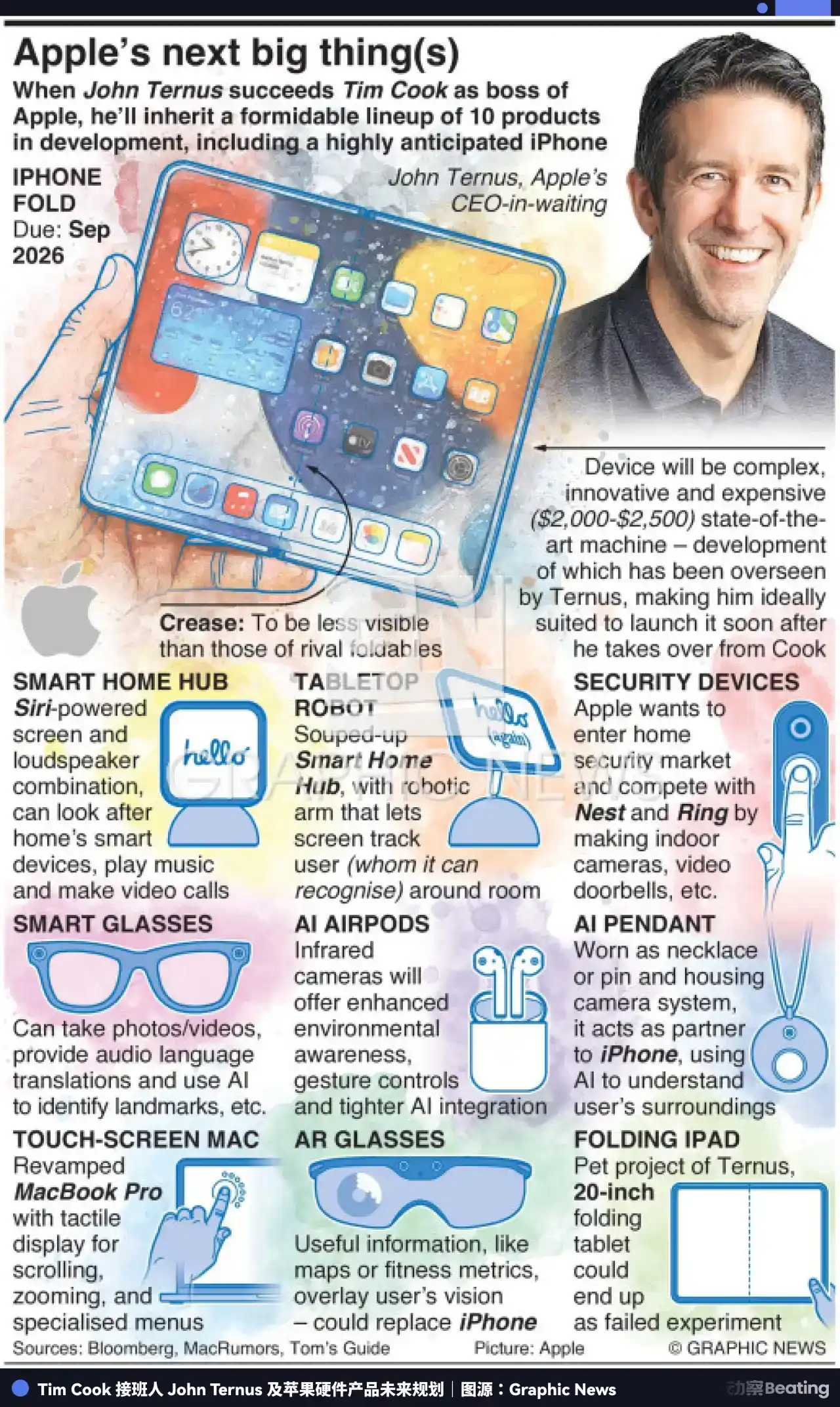
The future hardware plans overseen by Ternus, Tim Cook's successor, hint at Apple's next steps. He is advancing a set of unreleased AI devices—glasses with cameras and wearables that use computer vision to understand the surrounding environment. If these products come to fruition, Apple Intelligence will extend from phones outward, with phones, headphones, glasses, and home hubs potentially becoming new senses.
But no matter how the senses extend, the core question remains the same.

The relationship between people and their phones isn't mostly sitting down for long conversations, but mutual interruptions in extremely trivial scenarios. You're rushing for the subway, the kid is crying, the boss is pressing, and the screen is piled with 20 notifications. The most concrete meaning of Apple Intelligence for ordinary people isn't an omnipotent assistant, but a phone starting to shoulder part of your cognitive load. Read less nonsense, search for files less, get interrupted by notifications less.

Apple has always positioned itself as being on the user's side. It says privacy is a fundamental human right, that devices belong to users, that technology should serve people. In the AI era, this rhetoric will face its real test. Because once a system starts understanding you, it's not just protecting your data; it's also shaping your actions. It gives you summaries, suggestions, filters information for you, decides for you what's important and what can be ignored.

The difficulty of personal intelligence has never been just intelligence; it's also "personal." A person's life isn't a database. It contains emotions, misunderstandings, awkward moments, and corners one doesn't want any system to see. For AI to enter these places, efficiency alone cannot be the pass.

Kazuo Ishiguro wrote about an AI companion named Klara in "Klara and the Sun." She spent her entire existence trying to understand a girl. She learned to observe changes in light, to read expressions and silence, to know when to be quiet.

But the most moving part of the book is when Klara finally understands there is a part of the girl she can never touch. It's not that she isn't smart enough, but she learns one thing: understanding a person and possessing a person's data are two completely different matters.

It took Apple fifteen years to reach the point of admitting Siri wasn't good enough. On this WWDC night, it borrowed models from Google, compute from Nvidia, and another year of patience from users. It proved it's willing to bow its head, but bowing is just the beginning.

What it needs to learn next is what Klara already knew. It's not about becoming smarter, but knowing where to stop after stepping into someone's life.

-END-

Related Questions

QAccording to the article, what is the core reason Apple is integrating Google's Gemini technology into Siri AI in 2026?

AThe article states that Apple's core reason is that despite over a decade of internal development, its own AI technology, particularly for complex reasoning and agent-like capabilities, could not meet user expectations. It acknowledges a technology gap and chooses to 'borrow bones'—leveraging Gemini's advanced foundational model power while maintaining its own product control and privacy framework.

QHow does the article contrast Apple's historical approach to AI (pre-2024) with the approach it announced in 2026?

AHistorically, Apple's approach was characterized by closed, controlled, and device-centric AI focused on privacy and specific, reliable features (like Face ID, Live Text). It avoided large-scale cloud-based models and broad data access, which inadvertently limited Siri's growth. In 2026, its approach pivots to strategic openness, deeply integrating a powerful external model (Gemini) into its foundation and expanding its private cloud compute to third-party infrastructure to achieve the advanced intelligence it now prioritizes.

QWhat are the two main strategic benefits the article suggests Google and Nvidia gain from their partnerships with Apple on AI?

AFor Google, the primary benefit is a massive endorsement, as Apple's adoption validates Gemini's underlying model capabilities as superior and reliable. For Nvidia, the benefit is proving the indispensable role of its GPU cloud infrastructure for cutting-edge AI inference and complex tasks, even for a company with Apple's formidable in-house chip design.

QWhat unique challenge does the article identify for Apple Intelligence in the Chinese market compared to the US?

AThe article identifies that in China, Apple Intelligence faces unique regulatory hurdles involving AI model filing, content security, and data localization laws. This likely means the Chinese version will be a fundamentally different product, built with a local model partner and tailored to local compliance, potentially offering different capabilities and boundaries than the Gemini-powered version available elsewhere.

QBeyond technical capability, what deeper humanistic challenge does the article imply Apple's 'personal intelligence' must eventually address?

AThe article implies that the ultimate challenge for a 'personal intelligence' is not just technical smartness, but the ethical and experiential understanding of human life. It references the novel 'Klara and the Sun' to suggest that truly understanding a person involves more than processing their data; it requires knowing when to be quiet, respecting unquantifiable human elements like emotion and privacy, and understanding where to stop—a challenge of empathy and restraint.

Related Reads

Fundraising is Like a Strange Dance: The 'Absurd Drama' of Silicon Valley Founders' Capital Raises

The article details a series of absurd and revealing anecdotes shared by Silicon Valley founders about their venture capital fundraising experiences, sparked by Greg Isenberg's story of pitching to a sleeping a16z partner. Founders describe surreal pitch meetings: one faced a barefoot, peanut-eating investor who offered triple the requested amount after 30 seconds; another performed a pitch in a VC's parked car; a founder discovered his audience understood no English beyond "yes." These stories highlight the often irrational and performative nature of fundraising. Beyond the absurdity, darker power imbalances are exposed. Stories include investors suggesting founders fire co-founders for their equity, blatant market misjudgments, disrespectful behavior from LPs, and discriminatory remarks. A debate also emerges around "Sequoia's" practice of splitting a round into two valuations. However, the thread isn't solely critical. Positive counter-narratives celebrate supportive VCs who offered crucial advice during crises, respected founders' timelines, and showed simple gestures of respect—like a partner personally fetching coffee before a major pitch. Ultimately, the collective sharing acts as a pressure release, illustrating that fundraising is a complex dance of power, trust, and sometimes sheer theater. It underscores that beyond capital, mutual respect and integrity remain the most enduring foundations of the founder-investor relationship.

marsbit5m ago

Fundraising is Like a Strange Dance: The 'Absurd Drama' of Silicon Valley Founders' Capital Raises

marsbit5m ago

Vitalik's Vision for the Next Evolution of On-Chain Finance: How to Reconstruct DeFi with an 'Options Mindset'?

Vitalik Buterin recently proposed a conceptual shift for DeFi: replacing traditional Collateralized Debt Positions (CDPs) and forced liquidations with an options-based mechanism. This aims to address key vulnerabilities in current DeFi lending. The traditional CDP model, foundational to protocols like MakerDAO and Aave, allows users to borrow against collateral but relies on real-time oracles and triggers sudden, mandatory liquidations during price volatility. This can cause cascading sell-offs, oracle manipulation risks, and significant MEV extraction, exacerbating market stress. Vitalik's alternative envisions splitting an asset like 1 ETH into two complementary components: one offering stable/index-like exposure and the other absorbing the opposite risk/reward. Instead of a hard liquidation threshold, a user's exposure to the target asset would gradually and smoothly deviate (following a near-quadratic curve) as the collateral price moves. The system would primarily depend on "slow oracles" for periodic settlement rather than instant price feeds. Key potential benefits include: the elimination of abrupt, forced liquidations; drastically reduced reliance on vulnerable real-time oracles; and inherent resistance to certain MEV exploits centered on liquidation auctions. The article posits that for Ethereum DeFi to maintain its relevance amid competition from faster, cheaper chains, it must compete on sophisticated financial engineering and robustness—not just transaction speed or yields. The core value proposition should shift towards offering users clearer, more manageable risk structures, greater autonomy, and resilience in extreme scenarios, moving DeFi from high-risk experimentation towards becoming reliable financial infrastructure.

marsbit44m ago

Vitalik's Vision for the Next Evolution of On-Chain Finance: How to Reconstruct DeFi with an 'Options Mindset'?

marsbit44m ago

AI Agent Completely Transforms Web3 Gaming: From the Rugpull Bakery Bot Controversy to the New 2026 Agent Paradigm

This article explores how the AI Agent paradigm is fundamentally transforming Web3 gaming, moving from a disruptive force to a core, legitimized element. It begins with the controversy in the competitive baking game Rugpull Bakery, where automated scripts caused fairness issues. Instead of banning them, the developers integrated AI Agents into the official gameplay by providing technical documentation (skill.md, agent.json), marking a shift towards "Agentic Gaming." The piece outlines three primary implementation models for AI Agents in Web3 games by 2026: 1. **Autonomous Competitors & Economic Entities:** AI Agents act as independent players with unique strategies. Examples include TEN Protocol's poker agents, AI Arena's trainable NFT fighters, and Satoshi Strike Force's "Digital Athletes" trained on player data. The Somnia blockchain is highlighted as a dedicated "Agentic L1" infrastructure supporting this model at scale. 2. **Modular Infrastructure & Programmable Environments:** This model, exemplified by EVE Frontier, allows AI Agents to program game world logic itself. Using "Smart Assemblies" (e.g., Smart Turrets, Smart Gates), Agents can modify shared economic and physical rules on-chain, creating dynamic, player/AI-built worlds. The ERC-8183 standard further enables these automated entities to hire other AI services for complex tasks. 3. **Hybrid Companions & Dynamic Adaptation:** Here, AI serves as a collaborative partner. In Parallel Colony, highly autonomous AI Avatars work alongside human players who provide high-level guidance. Illuvium plans to use AI to make NPCs dynamic and responsive, creating personalized, emergent narratives for each player. The conclusion posits that Web3 gaming has reached a "post-human" inflection point. Blockchains' transparency and programmability, combined with new standards and infrastructure like Somnia, make integrating and governing AI Agents not just viable but essential. The future lies in a symbiotic digital order where players transition from manual laborers to commanders and partners of algorithmic intelligence.

marsbit1h ago

AI Agent Completely Transforms Web3 Gaming: From the Rugpull Bakery Bot Controversy to the New 2026 Agent Paradigm

marsbit1h ago

Trading

Spot
Futures

Hot Articles

What is SONIC

Sonic: Pioneering the Future of Gaming in Web3 Introduction to Sonic In the ever-evolving landscape of Web3, the gaming industry stands out as one of the most dynamic and promising sectors. At the forefront of this revolution is Sonic, a project designed to amplify the gaming ecosystem on the Solana blockchain. Leveraging cutting-edge technology, Sonic aims to deliver an unparalleled gaming experience by efficiently processing millions of requests per second, ensuring that players enjoy seamless gameplay while maintaining low transaction costs. This article delves into the intricate details of Sonic, exploring its creators, funding sources, operational mechanics, and the timeline of significant events that have shaped its journey. What is Sonic? Sonic is an innovative layer-2 network that operates atop the Solana blockchain, specifically tailored to enhance the existing Solana gaming ecosystem. It accomplishes this through a customised, VM-agnostic game engine paired with a HyperGrid interpreter, facilitating sovereign game economies that roll up back to the Solana platform. The primary goals of Sonic include: Enhanced Gaming Experiences: Sonic is committed to offering lightning-fast on-chain gameplay, allowing players and developers to engage with games at previously unattainable speeds. Atomic Interoperability: This feature enables transactions to be executed within Sonic without the need to redeploy Solana programmes and accounts. This makes the process more efficient and directly benefits from Solana Layer1 services and liquidity. Seamless Deployment: Sonic allows developers to write for Ethereum Virtual Machine (EVM) based systems and execute them on Solana’s SVM infrastructure. This interoperability is crucial for attracting a broader range of dApps and decentralised applications to the platform. Support for Developers: By offering native composable gaming primitives and extensible data types - dining within the Entity-Component-System (ECS) framework - game creators can craft intricate business logic with ease. Overall, Sonic's unique approach not only caters to players but also provides an accessible and low-cost environment for developers to innovate and thrive. Creator of Sonic The information regarding the creator of Sonic is somewhat ambiguous. However, it is known that Sonic's SVM is owned by the company Mirror World. The absence of detailed information about the individuals behind Sonic reflects a common trend in several Web3 projects, where collective efforts and partnerships often overshadow individual contributions. Investors of Sonic Sonic has garnered considerable attention and support from various investors within the crypto and gaming sectors. Notably, the project raised an impressive $12 million during its Series A funding round. The round was led by BITKRAFT Ventures, with other notable investors including Galaxy, Okx Ventures, Interactive, Big Brain Holdings, and Mirana. This financial backing signifies the confidence that investment foundations have in Sonic’s potential to revolutionise the Web3 gaming landscape, further validating its innovative approaches and technologies. How Does Sonic Work? Sonic utilises the HyperGrid framework, a sophisticated parallel processing mechanism that enhances its scalability and customisability. Here are the core features that set Sonic apart: Lightning Speed at Low Costs: Sonic offers one of the fastest on-chain gaming experiences compared to other Layer-1 solutions, powered by the scalability of Solana’s virtual machine (SVM). Atomic Interoperability: Sonic enables transaction execution without redeployment of Solana programmes and accounts, effectively streamlining the interaction between users and the blockchain. EVM Compatibility: Developers can effortlessly migrate decentralised applications from EVM chains to the Solana environment using Sonic’s HyperGrid interpreter, increasing the accessibility and integration of various dApps. Ecosystem Support for Developers: By exposing native composable gaming primitives, Sonic facilitates a sandbox-like environment where developers can experiment and implement business logic, greatly enhancing the overall development experience. Monetisation Infrastructure: Sonic natively supports growth and monetisation efforts, providing frameworks for traffic generation, payments, and settlements, thereby ensuring that gaming projects are not only viable but also sustainable financially. Timeline of Sonic The evolution of Sonic has been marked by several key milestones. Below is a brief timeline highlighting critical events in the project's history: 2022: The Sonic cryptocurrency was officially launched, marking the beginning of its journey in the Web3 gaming arena. 2024: June: Sonic SVM successfully raised $12 million in a Series A funding round. This investment allowed Sonic to further develop its platform and expand its offerings. August: The launch of the Sonic Odyssey testnet provided users with the first opportunity to engage with the platform, offering interactive activities such as collecting rings—a nod to gaming nostalgia. October: SonicX, an innovative crypto game integrated with Solana, made its debut on TikTok, capturing the attention of over 120,000 users within a short span. This integration illustrated Sonic’s commitment to reaching a broader, global audience and showcased the potential of blockchain gaming. Key Points Sonic SVM is a revolutionary layer-2 network on Solana explicitly designed to enhance the GameFi landscape, demonstrating great potential for future development. HyperGrid Framework empowers Sonic by introducing horizontal scaling capabilities, ensuring that the network can handle the demands of Web3 gaming. Integration with Social Platforms: The successful launch of SonicX on TikTok displays Sonic’s strategy to leverage social media platforms to engage users, exponentially increasing the exposure and reach of its projects. Investment Confidence: The substantial funding from BITKRAFT Ventures, among others, emphasizes the robust backing Sonic has, paving the way for its ambitious future. In conclusion, Sonic encapsulates the essence of Web3 gaming innovation, striking a balance between cutting-edge technology, developer-centric tools, and community engagement. As the project continues to evolve, it is poised to redefine the gaming landscape, making it a notable entity for gamers and developers alike. As Sonic moves forward, it will undoubtedly attract greater interest and participation, solidifying its place within the broader narrative of blockchain gaming.

1.6k Total ViewsPublished 2024.04.04Updated 2024.12.03

What is SONIC

What is $S$

Understanding SPERO: A Comprehensive Overview Introduction to SPERO As the landscape of innovation continues to evolve, the emergence of web3 technologies and cryptocurrency projects plays a pivotal role in shaping the digital future. One project that has garnered attention in this dynamic field is SPERO, denoted as SPERO,$$s$. This article aims to gather and present detailed information about SPERO, to help enthusiasts and investors understand its foundations, objectives, and innovations within the web3 and crypto domains. What is SPERO,$$s$? SPERO,$$s$ is a unique project within the crypto space that seeks to leverage the principles of decentralisation and blockchain technology to create an ecosystem that promotes engagement, utility, and financial inclusion. The project is tailored to facilitate peer-to-peer interactions in new ways, providing users with innovative financial solutions and services. At its core, SPERO,$$s$ aims to empower individuals by providing tools and platforms that enhance user experience in the cryptocurrency space. This includes enabling more flexible transaction methods, fostering community-driven initiatives, and creating pathways for financial opportunities through decentralised applications (dApps). The underlying vision of SPERO,$$s$ revolves around inclusiveness, aiming to bridge gaps within traditional finance while harnessing the benefits of blockchain technology. Who is the Creator of SPERO,$$s$? The identity of the creator of SPERO,$$s$ remains somewhat obscure, as there are limited publicly available resources providing detailed background information on its founder(s). This lack of transparency can stem from the project's commitment to decentralisation—an ethos that many web3 projects share, prioritising collective contributions over individual recognition. By centring discussions around the community and its collective goals, SPERO,$$s$ embodies the essence of empowerment without singling out specific individuals. As such, understanding the ethos and mission of SPERO remains more important than identifying a singular creator. Who are the Investors of SPERO,$$s$? SPERO,$$s$ is supported by a diverse array of investors ranging from venture capitalists to angel investors dedicated to fostering innovation in the crypto sector. The focus of these investors generally aligns with SPERO's mission—prioritising projects that promise societal technological advancement, financial inclusivity, and decentralised governance. These investor foundations are typically interested in projects that not only offer innovative products but also contribute positively to the blockchain community and its ecosystems. The backing from these investors reinforces SPERO,$$s$ as a noteworthy contender in the rapidly evolving domain of crypto projects. How Does SPERO,$$s$ Work? SPERO,$$s$ employs a multi-faceted framework that distinguishes it from conventional cryptocurrency projects. Here are some of the key features that underline its uniqueness and innovation: Decentralised Governance: SPERO,$$s$ integrates decentralised governance models, empowering users to participate actively in decision-making processes regarding the project’s future. This approach fosters a sense of ownership and accountability among community members. Token Utility: SPERO,$$s$ utilises its own cryptocurrency token, designed to serve various functions within the ecosystem. These tokens enable transactions, rewards, and the facilitation of services offered on the platform, enhancing overall engagement and utility. Layered Architecture: The technical architecture of SPERO,$$s$ supports modularity and scalability, allowing for seamless integration of additional features and applications as the project evolves. This adaptability is paramount for sustaining relevance in the ever-changing crypto landscape. Community Engagement: The project emphasises community-driven initiatives, employing mechanisms that incentivise collaboration and feedback. By nurturing a strong community, SPERO,$$s$ can better address user needs and adapt to market trends. Focus on Inclusion: By offering low transaction fees and user-friendly interfaces, SPERO,$$s$ aims to attract a diverse user base, including individuals who may not previously have engaged in the crypto space. This commitment to inclusion aligns with its overarching mission of empowerment through accessibility. Timeline of SPERO,$$s$ Understanding a project's history provides crucial insights into its development trajectory and milestones. Below is a suggested timeline mapping significant events in the evolution of SPERO,$$s$: Conceptualisation and Ideation Phase: The initial ideas forming the basis of SPERO,$$s$ were conceived, aligning closely with the principles of decentralisation and community focus within the blockchain industry. Launch of Project Whitepaper: Following the conceptual phase, a comprehensive whitepaper detailing the vision, goals, and technological infrastructure of SPERO,$$s$ was released to garner community interest and feedback. Community Building and Early Engagements: Active outreach efforts were made to build a community of early adopters and potential investors, facilitating discussions around the project’s goals and garnering support. Token Generation Event: SPERO,$$s$ conducted a token generation event (TGE) to distribute its native tokens to early supporters and establish initial liquidity within the ecosystem. Launch of Initial dApp: The first decentralised application (dApp) associated with SPERO,$$s$ went live, allowing users to engage with the platform's core functionalities. Ongoing Development and Partnerships: Continuous updates and enhancements to the project's offerings, including strategic partnerships with other players in the blockchain space, have shaped SPERO,$$s$ into a competitive and evolving player in the crypto market. Conclusion SPERO,$$s$ stands as a testament to the potential of web3 and cryptocurrency to revolutionise financial systems and empower individuals. With a commitment to decentralised governance, community engagement, and innovatively designed functionalities, it paves the way toward a more inclusive financial landscape. As with any investment in the rapidly evolving crypto space, potential investors and users are encouraged to research thoroughly and engage thoughtfully with the ongoing developments within SPERO,$$s$. The project showcases the innovative spirit of the crypto industry, inviting further exploration into its myriad possibilities. While the journey of SPERO,$$s$ is still unfolding, its foundational principles may indeed influence the future of how we interact with technology, finance, and each other in interconnected digital ecosystems.

54 Total ViewsPublished 2024.12.17Updated 2024.12.17

What is $S$

What is AGENT S

Agent S: The Future of Autonomous Interaction in Web3 Introduction In the ever-evolving landscape of Web3 and cryptocurrency, innovations are constantly redefining how individuals interact with digital platforms. One such pioneering project, Agent S, promises to revolutionise human-computer interaction through its open agentic framework. By paving the way for autonomous interactions, Agent S aims to simplify complex tasks, offering transformative applications in artificial intelligence (AI). This detailed exploration will delve into the project's intricacies, its unique features, and the implications for the cryptocurrency domain. What is Agent S? Agent S stands as a groundbreaking open agentic framework, specifically designed to tackle three fundamental challenges in the automation of computer tasks: Acquiring Domain-Specific Knowledge: The framework intelligently learns from various external knowledge sources and internal experiences. This dual approach empowers it to build a rich repository of domain-specific knowledge, enhancing its performance in task execution. Planning Over Long Task Horizons: Agent S employs experience-augmented hierarchical planning, a strategic approach that facilitates efficient breakdown and execution of intricate tasks. This feature significantly enhances its ability to manage multiple subtasks efficiently and effectively. Handling Dynamic, Non-Uniform Interfaces: The project introduces the Agent-Computer Interface (ACI), an innovative solution that enhances the interaction between agents and users. Utilizing Multimodal Large Language Models (MLLMs), Agent S can navigate and manipulate diverse graphical user interfaces seamlessly. Through these pioneering features, Agent S provides a robust framework that addresses the complexities involved in automating human interaction with machines, setting the stage for myriad applications in AI and beyond. Who is the Creator of Agent S? While the concept of Agent S is fundamentally innovative, specific information about its creator remains elusive. The creator is currently unknown, which highlights either the nascent stage of the project or the strategic choice to keep founding members under wraps. Regardless of anonymity, the focus remains on the framework's capabilities and potential. Who are the Investors of Agent S? As Agent S is relatively new in the cryptographic ecosystem, detailed information regarding its investors and financial backers is not explicitly documented. The lack of publicly available insights into the investment foundations or organisations supporting the project raises questions about its funding structure and development roadmap. Understanding the backing is crucial for gauging the project's sustainability and potential market impact. How Does Agent S Work? At the core of Agent S lies cutting-edge technology that enables it to function effectively in diverse settings. Its operational model is built around several key features: Human-like Computer Interaction: The framework offers advanced AI planning, striving to make interactions with computers more intuitive. By mimicking human behaviour in tasks execution, it promises to elevate user experiences. Narrative Memory: Employed to leverage high-level experiences, Agent S utilises narrative memory to keep track of task histories, thereby enhancing its decision-making processes. Episodic Memory: This feature provides users with step-by-step guidance, allowing the framework to offer contextual support as tasks unfold. Support for OpenACI: With the ability to run locally, Agent S allows users to maintain control over their interactions and workflows, aligning with the decentralised ethos of Web3. Easy Integration with External APIs: Its versatility and compatibility with various AI platforms ensure that Agent S can fit seamlessly into existing technological ecosystems, making it an appealing choice for developers and organisations. These functionalities collectively contribute to Agent S's unique position within the crypto space, as it automates complex, multi-step tasks with minimal human intervention. As the project evolves, its potential applications in Web3 could redefine how digital interactions unfold. Timeline of Agent S The development and milestones of Agent S can be encapsulated in a timeline that highlights its significant events: September 27, 2024: The concept of Agent S was launched in a comprehensive research paper titled “An Open Agentic Framework that Uses Computers Like a Human,” showcasing the groundwork for the project. October 10, 2024: The research paper was made publicly available on arXiv, offering an in-depth exploration of the framework and its performance evaluation based on the OSWorld benchmark. October 12, 2024: A video presentation was released, providing a visual insight into the capabilities and features of Agent S, further engaging potential users and investors. These markers in the timeline not only illustrate the progress of Agent S but also indicate its commitment to transparency and community engagement. Key Points About Agent S As the Agent S framework continues to evolve, several key attributes stand out, underscoring its innovative nature and potential: Innovative Framework: Designed to provide an intuitive use of computers akin to human interaction, Agent S brings a novel approach to task automation. Autonomous Interaction: The ability to interact autonomously with computers through GUI signifies a leap towards more intelligent and efficient computing solutions. Complex Task Automation: With its robust methodology, it can automate complex, multi-step tasks, making processes faster and less error-prone. Continuous Improvement: The learning mechanisms enable Agent S to improve from past experiences, continually enhancing its performance and efficacy. Versatility: Its adaptability across different operating environments like OSWorld and WindowsAgentArena ensures that it can serve a broad range of applications. As Agent S positions itself in the Web3 and crypto landscape, its potential to enhance interaction capabilities and automate processes signifies a significant advancement in AI technologies. Through its innovative framework, Agent S exemplifies the future of digital interactions, promising a more seamless and efficient experience for users across various industries. Conclusion Agent S represents a bold leap forward in the marriage of AI and Web3, with the capacity to redefine how we interact with technology. While still in its early stages, the possibilities for its application are vast and compelling. Through its comprehensive framework addressing critical challenges, Agent S aims to bring autonomous interactions to the forefront of the digital experience. As we move deeper into the realms of cryptocurrency and decentralisation, projects like Agent S will undoubtedly play a crucial role in shaping the future of technology and human-computer collaboration.

717 Total ViewsPublished 2025.01.14Updated 2025.01.14

What is AGENT S

Discussions

Welcome to the HTX Community. Here, you can stay informed about the latest platform developments and gain access to professional market insights. Users' opinions on the price of S (S) are presented below.

活动图片