Editor's Note: When many people use Claude Code, the most intuitive feeling is that Token consumption is too fast, and long sessions can easily eat up the quota. But from the perspective of an Anthropic engineer, what truly affects cost is often not how much code you write, but whether the system consistently reuses context that has already been processed.
The core of this article is how to save Tokens through caching mechanisms. The author reused over 300 million Tokens through caching in one week, with a single-day cache hit reaching 91 million. Since the cost of a cached Token is only 10% of a regular input Token, this means 91 million cached Tokens are billed roughly equivalent to 9 million regular Tokens. The reason Claude Code long sessions seem more "durable" isn't because the model works for free, but because a large amount of repeated context is successfully reused.
The key to prompt caching is "don't break the cache." Claude Code caches system prompts, tool definitions, CLAUDE.md, project rules, and conversation history in layers; as long as the prefix of subsequent requests remains consistent, Claude can directly read from the cache instead of reprocessing the entire context. Anthropic internally also monitors prompt cache hit rates because it affects not only user quotas but also directly impacts model service costs and operational efficiency.
For ordinary users, you don't need to understand all the underlying details, just master a few key habits: don't let a session sit idle for more than 1 hour; perform a clean session handoff when switching tasks; avoid frequently switching models; put large documents into Projects instead of repeatedly pasting them into the conversation.
This article is less about a Token-saving trick and more about providing a Claude Code usage approach closer to an engineer's mindset: treat context as an asset to manage, let the cache be continuously reused, and make long sessions do less repetitive computation.
The following is the original text:
I saved 300 million Tokens this week, 91 million in a single day, over 300 million in a week.
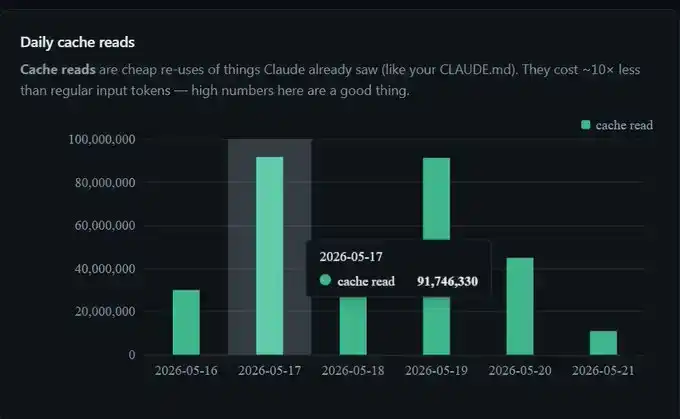
I didn't change any settings. This is just prompt caching working normally in the background.
But after I truly understood what caching is and how to avoid "breaking" it, with the same usage quota, my sessions could last longer. So, here is a compiled 80/20 introductory guide to Claude Code prompt caching, without delving into deep API-level details.
TL;DR
Cached Tokens cost only 10% of regular input Tokens. 91 million cached Tokens are billed approximately equivalent to 9 million Tokens.
Claude Code subscription cache TTL is 1 hour; API default is 5 minutes; Sub-agent is always 5 minutes.
Caching is divided into three layers: system, project, and conversation.
Switching models mid-conversation breaks the cache, including enabling "opus plan" mode.
How is caching actually billed?
Every cached Token costs 10% of a regular input Token.
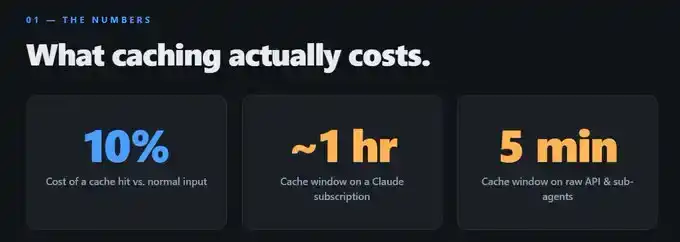
So, when my dashboard shows 91 million Tokens hitting cache on a particular day, the actual billing is roughly equivalent to processing only 9 million Tokens. This is also why, compared to having no cache, using Claude Code for long periods makes the session feel almost "free" to extend.
Two numbers on the dashboard are worth focusing on:
Cache create: The one-time cost incurred when writing content to the cache. It starts to take effect in the next round of conversation.
Cache read: Tokens Claude reuses from the cache, such as your CLAUDE.md, tool definitions, previous messages, etc. Cost is 10 times cheaper compared to reprocessing them as input.
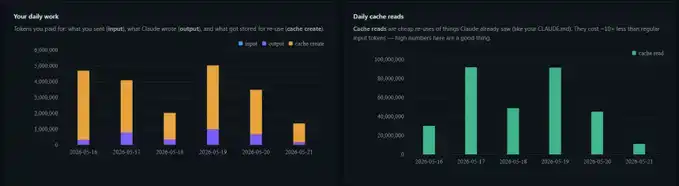
If your Cache read number is high, it means you are effectively utilizing the cache; if this number is low, it means you are repeatedly paying for the same context.
Anthropic's Thariq once said something that left a deep impression on me: "We actually monitor prompt cache hit rates, and if the hit rate gets too low, it triggers an alert, even declaring a SEV-level incident."
He also wrote a great X article. When cache hit rates are high, four things happen simultaneously: Claude Code feels faster, Anthropic's service costs decrease, your subscription quota seems more durable, and long coding sessions become more realistic.
But if the hit rate is low, everyone loses.
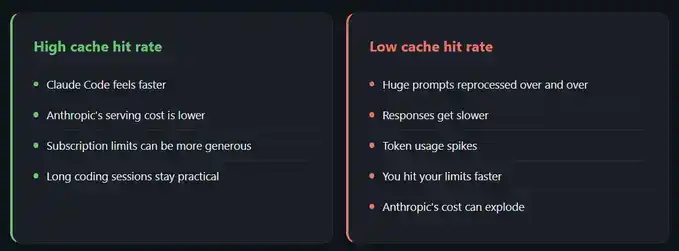
So, the incentives are actually aligned: Anthropic wants your cache hit rate higher, and you yourself want the hit rate higher. What truly holds things back are some seemingly insignificant habits that quietly reset the cache.
How does the cache grow with each conversation turn?
Caching relies on prefix matching.
Without getting too deep into technical details, you just need to understand one thing: as long as the content before a certain position is completely identical to what's already cached, Claude can reuse those cached Tokens.
A brand new session typically unfolds like this:
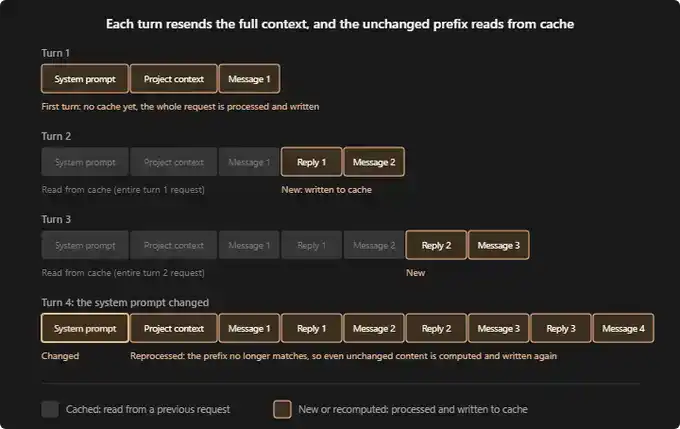
According to Claude Code documentation, a fresh session usually runs like this:
First conversation turn: No cache exists yet. The system prompt, your project context (like CLAUDE.md, memory, rules), and your first message are all processed from scratch and written to the cache.
Second conversation turn: All content from the first turn is now cached. Claude only needs to process your new reply and the next message. This round is much cheaper.
Third conversation turn: Same logic. Previous conversation remains in the cache, only the latest round of interaction needs reprocessing.
The cache itself can be divided into three layers:
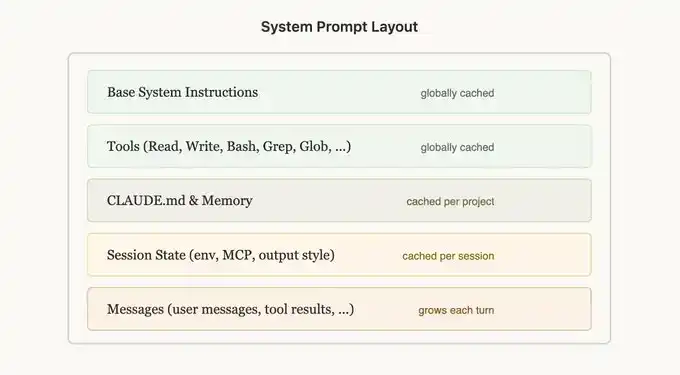
From Thariq's X article:
System layer: Includes base instructions, tool definitions (read, write, bash, grep, glob), and output style. This layer is cached globally.
Project layer: Includes CLAUDE.md, memory, project rules. This layer is cached per project.
Conversation layer: Includes replies and messages, growing with each conversation turn.
If anything in the system or project layer changes mid-session, everything must be recached from scratch. This is the most "expensive" operation. Imagine: you're already on the 16th message, then suddenly change the system prompt, or pause for an hour, all Tokens from message 1 onward need to be reprocessed.
The confusion between 1 hour and 5 minutes
This is the most easily misunderstood point.
Claude Code subscription: Default TTL is 1 hour.
Claude API: Default TTL is 5 minutes. You can pay a higher cost to increase it to 1 hour.
Sub-agent on any plan: Always 5 minutes.
Claude.ai web chat: Not officially documented. Likely same as subscription, but I haven't confirmed.
A few months ago, many people complained that Claude subscription quotas were being consumed too quickly. Some thought Anthropic had quietly reduced TTL from 1 hour to 5 minutes without notifying users. But that wasn't the case; Claude Code's TTL remains 1 hour.
The problem is, Claude Code and API documentation are kept separate, and these are two completely different things, leading to much confusion.
If you're running many Sub-agent workflows, or using the API directly, the 5-minute figure is important. But for 95% of Claude Code users, what really matters is that 1-hour window.
Three habits that cover 95% of users
The following are parts I find truly useful for daily use.
Don't pause too long
If you've been idle for more than an hour, previous content has mostly expired from the cache. Your next message will rebuild the cache. In such cases, instead of resuming an old session that has "gone cold," it's often cheaper to do a clean handoff and start a new session.
When switching tasks, just start fresh
/compact or /clear inherently break the cache, so it's better to use that moment for a true reset.
I made a session handoff skill to replace /compact. It summarizes what we've completed, what pending decisions remain, which files are most important, and where to continue next. Then I run /clear, paste this summary in, and can proceed as if nothing was interrupted.
The compact command sometimes runs slowly too. This handoff skill usually finishes in under a minute.
In Claude chat, put large documents into Projects
The caching mechanism on Claude.ai isn't officially documented in great detail, but Projects clearly use different optimizations compared to regular chat threads. So, if you need to paste large documents, it's better to put them in a Project rather than directly into the chat.
Which operations quietly break the cache?
A few things can completely reset the cache without obvious warning.
Switching models: Because caching relies on prefix matching, and each model has its own cache. Switching models means the next request will read the full history with no cache hits.
"Opus plan" mode: This setting uses Opus for planning and Sonnet for execution. I recommended it in some token optimization videos for a reason. But it's important to understand that each plan switch is essentially a model switch, meaning the cache must be rebuilt. In the long run, it still helps extend session quota, but you need to know what's happening under the hood.
Editing CLAUDE.md mid-session is okay: This change doesn't take effect immediately; it applies on the next restart. Therefore, the currently running cache isn't affected.
My free Token dashboard
The screenshot I showed earlier is from a token dashboard.

It's a simple GitHub repo. You give the link to Claude Code, have it deploy locally on localhost, and it will read all your past session records instead of starting statistics from scratch. You immediately see daily input, output, cache create, and cache read data.
One thing to note: this dashboard counts Token data on your local device. If you switch from desktop to laptop, the numbers won't match exactly. Each device has its own statistical view.
Summary
Prompt caching is something you can research deeply. Thariq's article covers it more completely than here; if you want the full picture, it's worth reading.
But you don't need to understand all the details to benefit. You just need to grasp the key 80/20: cached Tokens are 10 times cheaper than regular Tokens; Claude Code TTL is 1 hour; switching models breaks the cache; making a clean handoff between tasks is usually more cost-effective than forcing an old session back to life after it "expires."