The Market Size of Risk-Weighted Assets (RWA) Exceeds 38 Billion Dollars, but the Next Challenge Will Be Liquidity

cryptonews.ruPublished on 2026-09-15Last updated on 2026-09-15

Abstract

The market for tokenized real-world assets (RWA) has surpassed $38 billion, but the next major challenge is liquidity. While U.S. Treasury bonds form the largest portion of this market, the ability for these assets to move freely between exchanges, serve as loan collateral, and trade with high liquidity is more critical for the sector's future than simply listing more assets. The market is fragmented across blockchains like Ethereum, BNB Chain, and Solana, contributing to liquidity issues. Reports from Castle Labs and others argue that while asset tokenization has expanded access, its true utility depends on composability and seamless movement within the financial ecosystem. Major institutions are increasingly involved, and regulatory frameworks for stablecoins are advancing globally. However, analysis from Pantera Capital and the OECD indicates that liquidity infrastructure is lagging. Many tokenized assets still behave like their traditional counterparts, with market makers, robust pricing mechanisms, and interoperability between systems remaining key hurdles. The future of the sector hinges not on the total value tokenized, but on whether that value can flow and be utilized effectively across the financial landscape.

The volume of tokenized real-world assets (RWA) on the blockchain has exceeded 38 billion dollars, yet this figure is less significant than what awaits us in the future. In a report published on Monday, September 14, 2026, Castle Labs argued that the industry's future depends not on the number of listings, but on whether tokenized assets can move between exchanges, serve as loan collateral, and be traded with high liquidity.

This distinction is of paramount importance for institutions exploring tokenization, as well as DeFi protocols seeking profitable collateral. It will determine whether tokenized assets can bring meaningful benefit or remain merely digital shells within traditional financial systems.

Treasury Bonds Form the Foundation of the 38 Billion Dollar Base

As of September 15, 2026, RWA.xyz reported a distributed asset value of $38.86 billion, up 1.00% over 30 days, and approximately 4.24 million holders. According to Castle Labs, U.S. government debt accounts for over $15.9 billion. Other asset types include: commodities worth $4.9 billion, active strategies worth $3.6 billion, asset-backed loans worth $2.56 billion, and tokenized equities worth $2.52 billion.

The market is also segmented by the blockchains where transactions occur. According to RWA.xyz's ranking as of September 14, the top three networks are Ethereum with $17.3 billion, BNB Chain with $5.6 billion, and Solana with $4.3 billion. The provided information indicates a persistent issue of tokenized assets being distributed across various blockchains, leading to liquidity problems.
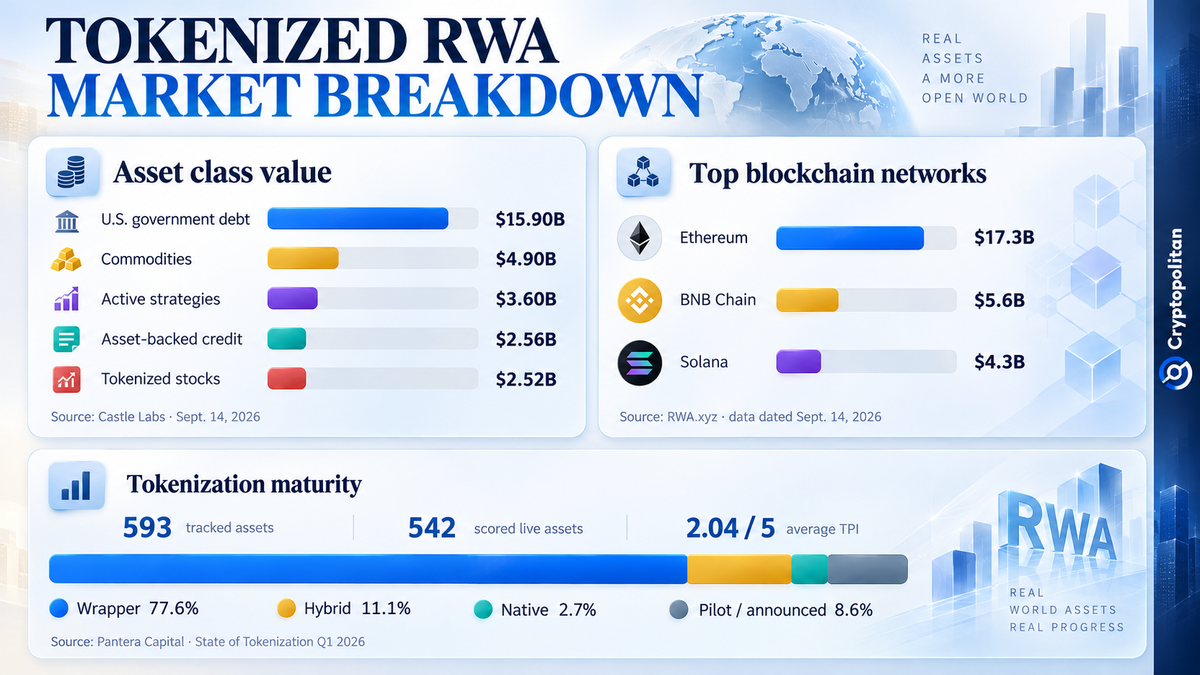
Analysis of the Risk-Weighted Asset (RWA) Tokenized Market: Asset Classes, Blockchains, and Maturities in 2026

According to a 2026 CoinGecko report, the volume of risk-weighted tokenized assets (RWA) exceeded $19.3 billion by the end of the first quarter, more than tripling since January 2025.

Listing Assets Has Now Become a Simple Task

Castle Labs claims the supply-side problem is no longer relevant. Companies such as Kraken, Robinhood, Ondo, Securitize, Franklin Templeton, and BlackRock can already provide tokenized access in one way or another.

A more important question is what asset holders can actually do with their assets. Castle Labs divides utility into two categories: accessibility and composability. Tokenization has expanded access to trading venues, but assets become useful only when they can move between different venues, be traded with high liquidity, be used as collateral, and efficiently interact with blockchain transactions.

This has become especially relevant with the extension of trading venue operating hours, which, fortunately, deprives traditional markets of the 24/7 access advantage they have held for the past few years.

Regulation and Institutions Take Action

The sector has found favorable state policies that support its long-term growth. According to TRM Labs, stablecoin regulation had advanced in over 70% of 30 jurisdictions by 2025, and approximately 80% of financial institutions made statements about their digital asset initiatives.

The implications for the banking sector are manifesting at a structural level. In a note published by the IMF in April 2026, economist Tobias Adrian noted that tokenization could enable atomic settlement, continuous liquidity management, and the implementation of regulatory requirements. However, without a proper legal framework and secure settlement assets, tokenization could increase instability by accelerating banking runs and increasing concentration and fragmentation.

A May report from BCG stated that today, risk-weighted digital assets (RWA) are small in scale; however, in the coming decade, digital RWAs are likely to have the greatest structural significance in the banking sector.

Why Does Liquidity Still Lag Behind?

In its Q1 report, Pantera Capital recorded a total of 593 assets, of which 542 were active. The average tokenization progress index for the quarter was only 2.04 out of 5. According to Pantera, of the tracked assets, 77.6% were classified as 'Wrapper', 11.1% as Hybrid, and only 2.7% as Native.

Pantera compared the RWA market to the early phase of the internet when "newspapers were placed on websites": meaning known products moved to another technological platform, though most have yet to fully leverage their potential. In practice, many tokenized assets still behave much like their traditional counterparts, which partly explains why liquidity and market infrastructure are struggling to keep pace with developments.

The Organisation for Economic Co-operation and Development (OECD) reached the same conclusion, identifying insufficient liquidity, a lack of payment networks, gaps in securities custody, legal uncertainty, and lack of interoperability as factors hindering wider adoption.

Cryptopolitan also noted that tokenization alone is insufficient to ensure liquidity, and that market makers, two-way order flow, and a reliable price discovery process will still be necessary.

The future of tokenization will no longer be solely about how much value is tokenized, but whether that value can truly move and be utilized within the financial context.


Related Questions

QAccording to the article, what has surpassed $38 billion, and what is presented as the next major challenge for this sector?

AThe market for tokenized real-world assets (RWA) has surpassed $38 billion. The next major challenge identified is liquidity, specifically whether these assets can move across exchanges, serve as loan collateral, and trade with high liquidity.

QWhat are the top three blockchain networks by value of tokenized assets mentioned in the report from September 14, 2026?

AThe top three blockchain networks by value of tokenized assets are Ethereum with $17.3 billion, BNB Chain with $5.6 billion, and Solana with $4.3 billion.

QHow does Castle Labs differentiate the current focus in tokenization from the more important future challenge?

ACastle Labs states that the initial problem of supply (listing assets) is now largely solved. The more important future challenge is utility, specifically the composability and accessibility of assets—moving them across platforms, trading them with high liquidity, and using them as collateral.

QWhat did Pantera Capital's Q1 report compare the current RWA market phase to, and what does this imply about the technology's use?

APantera Capital compared the RWA market to the early 'newspapers on websites' phase of the internet. This implies that while assets are being ported to a new technological platform (blockchain), most have not yet fully leveraged its potential and still behave similarly to their traditional counterparts.

QWhat regulatory progress and institutional engagement regarding digital assets are highlighted in the article?

AThe article notes that by 2025, stablecoin regulation had advanced in over 70% of 30 jurisdictions surveyed by TRM Labs. Furthermore, around 80% of financial institutions had made statements about their digital asset initiatives.

Related Reads

Crypto Stocks Weekly丨Strategy Adds 1,036 BTC but Holdings Fall Below Cost Basis; Bitmine Holds 4.97% of ETH Supply (November 10)

The article begins by noting that Democrats swept both chambers of Congress, ushering in a divided-government phase, after which markets shifted focus to AI regulation and capex payback cycles, with Anthropic's IPO seen as a bellwether for AI stocks. US equities fell sharply (Nasdaq -5.52% and Philadelphia Semiconductor Index -12.24% on Nov 5) before a Monday rebound driven by falling oil prices and oversold buying—characterized as a repair, not a new high. Macro data showed October nonfarm payrolls +165k and unemployment at 4.1%, keeping 10-year Treasury yields near 4.86% and rate-hike expectations alive. Citi cut US equities and global tech to neutral while upgrading Europe ex-UK, citing unstable AI sentiment; Goldman noted AI stocks are ~40% of the S&P 500 versus ~15% of STOXX 600. Crypto diverged from the equity rebound: US spot Bitcoin ETFs saw $1.282B in weekly net outflows (BlackRock's IBIT -$12.09B... actually $1.209B), Ethereum ETFs -$365M for a sixth straight weekly outflow, with continued outflows on Nov 9. NYSE-affiliated tokenized securities platform chose Avalanche for settlement infrastructure. Corporate treasury updates: Strategy bought 1,036 BTC at ~$79,012 (total 850,364 BTC, average cost ~$75,456, now above spot), funded partly by ATM share sales, with most proceeds used to repurchase STRC preferred shares. Strive added 29 BTC (total 43,153). Listed companies now hold over 6% of Bitcoin's supply (1.2664M BTC across 199 firms). Bitmine added 9,587 ETH, holding 6,070,092 ETH (~4.97% of supply, ~99% of its 5% goal). DeFi Development Corp's SOL rose to 2,609,829. Hyperliquid Strategies raised $911M in Q3, bought ~9.1M HYPE (holdings up to 38.5M, ~16% of circulating supply), and repurchased ~2.7M PURR shares.

marsbit15m ago

Crypto Stocks Weekly丨Strategy Adds 1,036 BTC but Holdings Fall Below Cost Basis; Bitmine Holds 4.97% of ETH Supply (November 10)

marsbit15m ago

When Will the Chip Stock 'Capitulation-Style Selling' End? BofA: Perhaps in Early 2027, Stock Price Pullbacks Typically Lead Fundamental Inflection Points by 6-9 Months

The SOX semiconductor index has fallen 38% (from 14,634 to 9,011) since its June 22, 2026 peak, over 136 days—exceeding the average historical peak-to-trough decline of 32% but less than half the average 253-day duration of past downturns (2011, 2015, 2018, 2022). BofA analyst Vivek Arya expects this "indiscriminate selling," driven by AI capex slowdown fears, to end around early 2027. Historically, SOX declines lead actual semiconductor sales declines by 6–9 months, implying real EPS cuts may emerge from Q1 2027, with capex reductions reflected in H2 2027—though stocks may already price in much of the bad news. SOX currently trades at 13.7x forward P/E versus 17.7x for the S&P 500 (a 22% discount, down from a 15% premium at the AI peak), leaving roughly 12% downside to the historical trough valuation of ~12x. US cloud capex runs at ~$300B/quarter (~$1.2T annualized) versus $1.555T consensus for 2027—about 23% below expectations if spending holds steady, equating to ~30 GW of compute deployment versus BofA's 40+ GW base case. A 20% capex cut would pressure AI semiconductor revenue by 20%+ and EPS by 35–40%. BofA outlines three scenarios: base case ( ~10% downside, bottoming Q1 2027, favor segment leaders), bear case (pressure into mid-2027, favor EDA, high-FCF analog, low-AI-exposure names), and bull case (favor memory, optics, quantum, CPUs). Potential stabilizers include policy clarity in Q1 2027, buybacks (Lam $25B, Nvidia, Micron starting Dec 9), and slower capex extending the upcycle.

marsbit35m ago

When Will the Chip Stock 'Capitulation-Style Selling' End? BofA: Perhaps in Early 2027, Stock Price Pullbacks Typically Lead Fundamental Inflection Points by 6-9 Months

marsbit35m ago

TSMC: October Revenue Up 60%, with Month-over-Month Growth Still Accelerating

TSMC reported October consolidated revenue of NT$586.89 billion, up 59.7% year-over-year and 14.7% month-over-month, signaling accelerating momentum. Converted to RMB, that is about RMB 119.4 billion, with cumulative revenue for the first ten months reaching NT$4.49 trillion, up 43.3% year-over-year. The near-60% growth came on top of an already high base, while the sequential acceleration confirms strengthening demand rather than a slowdown. The report arrived at a delicate moment. The Philadelphia Semiconductor Index had plunged 12.25% over two sessions, its worst single-day drop since March 2020, as political changes in the U.S. prompted new governors in Texas and Ohio to pause approvals for new data center projects. Markets pessimistically priced in a halt across the AI data center supply chain. Sentiment rebounded sharply on November 9, with the semiconductor index jumping 6.86%, and Taiwan's weighted index surging 1,960.06 points, its second-largest single-day gain on record, supported by government stabilization funds and short-selling restrictions. TSMC stands apart from other AI assets. As the only foundry capable of mass-producing 3nm and 2nm chips, it holds about 90% of the global AI chip foundry market, with advanced-node capacity booked through 2028. Its diversified revenue mix—68% high-performance computing, 21% smartphones, 4% automotive and 4% IoT—provides a buffer, allowing it to reallocate capacity to flagship phone chips, automotive computing, and edge AI if data center approvals slow. October's results validate management's guidance of roughly 44% full-year dollar revenue growth and capital spending of US$60-64 billion. Expansion continues, with 2nm ramping and Arizona's second fab moved up to Q3 2027; Goldman Sachs raised its 12-month target price to NT$3,300. Google's expanded eighth-generation TPU lineup adds further demand, with TSMC and other Taiwanese suppliers in the ecosystem. TSMC's ADR trades at about 24x trailing earnings, low relative to its growth. Risks include a prolonged U.S. data center approval freeze and geopolitical or oil-price shocks. In A-shares, domestic substitution names such as SMIC and NAURA remain driven by rising localization rather than Texas approvals.

marsbit35m ago

TSMC: October Revenue Up 60%, with Month-over-Month Growth Still Accelerating

marsbit35m ago

Trading

Spot
活动图片