On June 3rd, India's IT sector crashed.
TCS plummeted 9%, Infosys fell 4.3%, and Wipro dropped 3.7%. India's IT index fell 5.8% in a single day, setting a four-month record for the largest decline.
It wasn't a bad earnings report or a sudden policy change. The only two words that sent the market into a panic: AI.
Over the past year, the world's attention has been focused on the US and China — with OpenAI, Anthropic, and DeepSeek taking turns in the spotlight. But AI's first major blow has landed on India.
If AI can really write code, perform testing, create documentation, and handle customer service, what will happen to the country most dependent on 'selling programmers' to the world?
India is the answer.
Multiple industry insiders told Pencil News: this dramatic change suddenly accelerated in the second half of 2025, marked by the emergence of Agentic AI. AI can help complete 70% to 80% of the work for a SaaS software.
Kouting Intelligence, an AI programming company that has raised three rounds of funding, told Pencil News: "The impact of AI programming on the IT outsourcing economy is not an 'influence', but potentially a 'killer blow'.
01
30 Years of National Fortune, Hinged on a Line of Code
A single industry has sustained India for 30 years.
Many don't know that India's most profitable industry is not manufacturing, nor is it the internet. It's IT outsourcing.
According to data from the National Association of Software and Service Companies (NASSCOM), in the 2025 fiscal year, India's technology industry's total revenue reached approximately $282.6 billion (about ¥2 trillion), of which IT service revenue was about $137 billion, accounting for nearly half of the entire industry.
More importantly, exports. In FY 2025, India's technology industry's export revenue reached $224 billion, representing nearly 80% of total revenue.
What does this mean? Simply put, one of India's most lucrative businesses is working for American and European companies.
Kedi Chuhai CEO Luan Tianyi cut to the essence: "Software outsourcing is essentially 'selling people'. Charging by headcount and man-hours, very similar to the construction industry."
Over the past 30 years, India has almost rewritten its national fortune with this single industry. American companies need software development, European banks need system maintenance, Global 500 companies need digital transformation. What to do? Send the work to India, which then organizes thousands upon thousands of engineers to take the orders.
Thus, a classic model formed: more clients, more projects, more engineers, higher revenue.
Today, India's major leading IT service companies are representatives of this model.
In FY 2025, TCS's annual revenue exceeded $30 billion, with a workforce approaching 600,000; Infosys's annual revenue was about $19.3 billion, with over 320,000 employees; Wipro's annual revenue was about $10.5 billion, with over 230,000 employees.
Just these three companies alone have over 1.15 million employees.
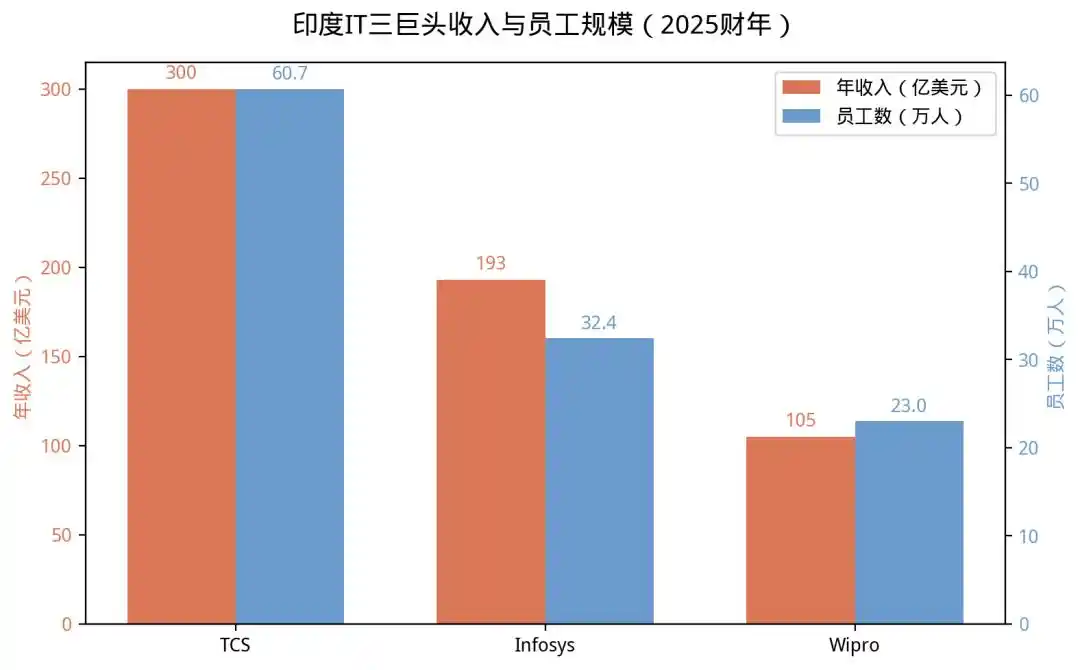
Revenue and Employee Scale of India's IT Big Three (FY 2025) Source: NASSCOM
More importantly, the growth logic of these companies has long been highly consistent: hire more engineers, take on more projects, earn more revenue. For decades, an important metric for capital markets evaluating Indian IT companies was not AI capability, but employee headcount.
According to Reuters data, the scale of India's IT industry has reached approximately $283 billion. Many international investors even call India: "The World's Back Office".
But this logic is changing. A key factor, related to AI: the IT outsourcing business is being dismantled by AI programming.
Su Wen said: "New technologies rarely kill directly in existing markets. A more common way is: in emerging markets, making you completely unqualified to participate. Like the person specialized in catching the ball under the basketball hoop, does that position still exist? No matter how good you are at catching, it's meaningless now."
02
Single-Day 5.8% Plunge: Capital is Voting with its Feet
Therefore, the capital market is starting to worry about one thing.
This past February, India's IT sector evaporated $22.5 billion (about ¥160 billion) in market value in one week. The market at the time thought it was an overreaction. But by June, panic reappeared.
On June 3, India's IT index plunged 5.8% in a single day, the biggest drop in 4 months; India's largest software exporter TCS plummeted 9%, Infosys fell 4.3%, Wipro dropped 3.7%.

TCS Headquarters Building Source: Forbes India
More notably, this is no longer an isolated incident. As of early June, India's IT index has fallen 22% cumulatively so far in 2026; while it fell 26% for the entirety of 2025. In other words, this star sector that once supported India's economic growth has been one of the worst-performing industries in the market for two consecutive years.
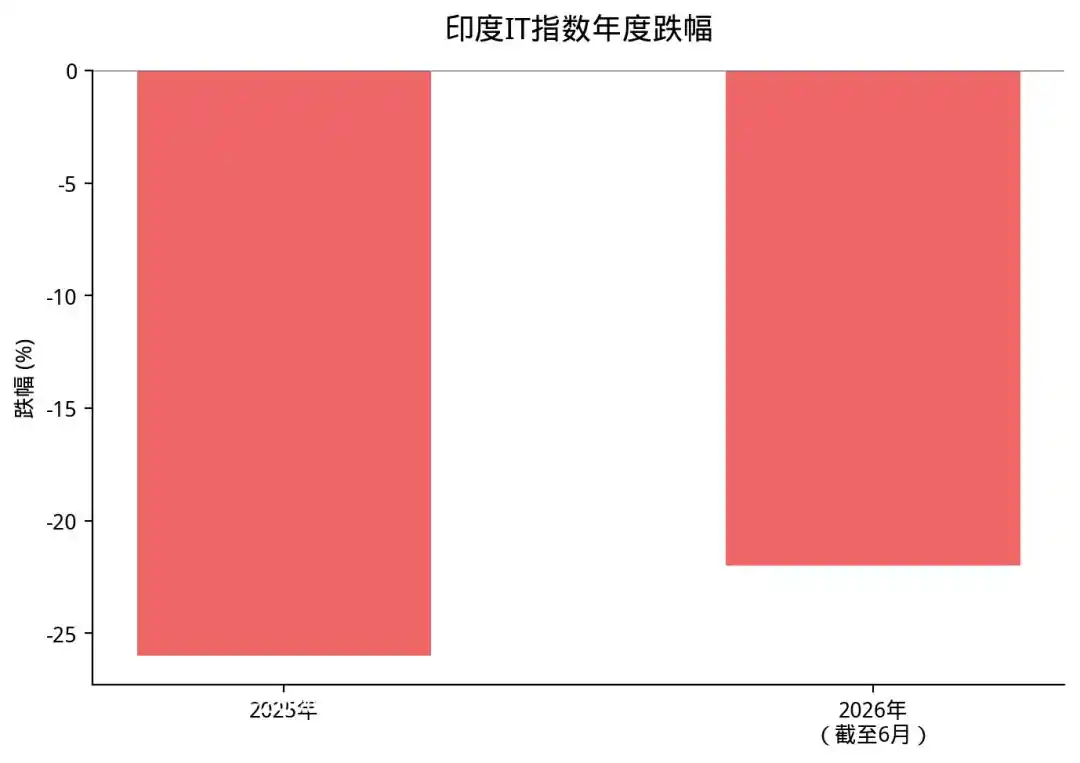
India's IT Index Plunges for Two Consecutive Years Source: Economic Times
The reason is simple. More and more investment institutions are realizing: what AI is replacing is precisely India's core business. Such as writing code, testing software, operations support, documentation, customer service support. These tasks used to require a large number of engineers, but now more and more companies are starting to try letting AI handle them.
What's more terrifying is that the capital market is not worried about "all programmers becoming unemployed." Rather, it's that: India's most profitable business model will become obsolete.
The past logic was: a client has a project, an Indian company sends 100 people, earns money for 100 people. The future may become: a client has a project, AI completes 80% of the work, only 20 people are needed.
Kouting Intelligence, an AI programming company that has raised three rounds of funding, provided Pencil News with a set of data: a development team that needed 100 people in the past can now be completed by 2-3 people; an e-commerce website that might have cost hundreds of thousands or even millions to develop can now have its cost compressed to $6-8.
Even more frightening is the average order value. "The average order value for software development companies may face a 70%-90% decline," Su Wen told Pencil News.
Brokerage research reports show that the overall net profit margin of the software outsourcing industry has dropped from nearly 10% to about 0.1% (not specifically referring to India). This means the profit margins of Indian IT companies are being squeezed out by AI.
The global perspective is even more staggering.
Mordor Intelligence data shows that the global IT outsourcing market size in 2025 was about $618 billion. Of this, about 40%-60% relies on labor-intensive delivery, roughly $250 billion to $450 billion — about ¥3 trillion — facing the risk of being directly replaced or having prices slashed by AI.
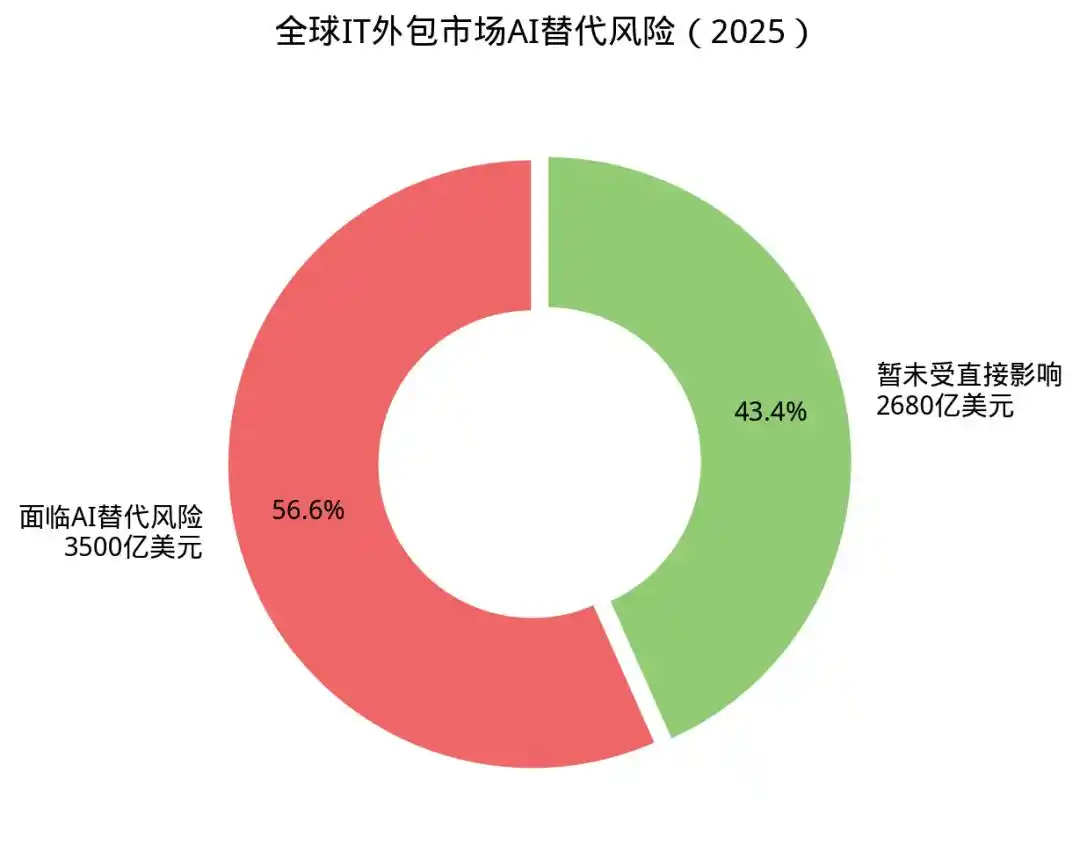
Global IT Outsourcing Market AI Substitution Risk (2025) Source: Mordor Intelligence
For a $280 billion industry, this is a nuclear-level alarm.
03
Leading Companies are Laying Off
More dangerous signals are emerging.
If it were just stock prices falling, it wouldn't be a big deal. What is truly noteworthy is hiring. More direct changes are already appearing in the headcounts of leading companies.
Su Wen's judgment is more radical: "A 20x reduction in engineering personnel is the bare minimum."
The judgment of veteran programmer Meisi, with over ten years of experience at large companies, is similar: "The future trend is a 10:1 compression. An engineering team of two to three thousand people might ultimately need only two to three hundred."
India's largest IT service company, TCS, had a total employee count of about 607,000 in FY 2025, a decrease of about 13,000 compared to the previous fiscal year. Infosys's total employee count was about 324,000, a year-on-year decrease of about 15,000.
This is a rare phenomenon in India's IT industry over many past years. For 30 years, the headcounts of these companies have almost only increased. Growth was the norm, contraction the exception. And today, this 30-year growth curve is turning downward.
ANSR Founder & CEO Lalit Ahuja stated plainly: "There is an air of caution in the market, companies are reducing their hiring numbers."
The entire Indian tech sector's hiring market is shrinking sharply. In June 2026, active tech job openings in India had fallen to 93,000, the lowest point in 28 months. Job openings for technical positions with less than 2 years of experience plummeted 44% year-on-year — nearly half of the entry-level positions vanished.
Su Wen explained the logic behind it: "Development with a complexity score of 4 or below can be completely replaced. A team that needed 100 people before now only needs 2-3."
In past growth cycles, increased projects often meant increased hiring; now, revenue growth and employee growth are gradually decoupling.
The biggest worry for Indian tech companies used to be: not enough people. Today, they are starting to wonder: are there too many people?
When leaders like TCS and Infosys simultaneously start "downsizing," the direction of an era has already changed.
04
India Hit in the Heart by AI
Why is India in more danger than others?
Because what AI has hit in India is not a peripheral industry, but a core industry.
Take a simple example. If AI impacts an e-commerce company, the effect is limited. If AI impacts the advertising industry, the effect is limited. But India is different; IT services are one of India's most important export industries. India's IT industry's total revenue has surpassed $315 billion, accounting for over 7% of India's GDP, employing over 6 million people. Behind these 6 million people are 6 million families, the livelihoods of tens of millions.
More importantly, this is not an isolated industry. IT outsourcing supports India's training industry, real estate industry (office buildings and residences in Bangalore, Hyderabad), service industry, and education industry. One IT job supports at least 3-5 related jobs. This means the impact of AI on the IT industry could ultimately affect the employment ecosystem of 20 to 30 million people in India.
And India itself faces an even harsher reality. Reuters data shows: India's urban youth unemployment rate remains high at 13.6%.
Huge numbers of young people are already looking for jobs. The unemployment rate for Indian university graduates has soared to 29.1%, with 40% of young graduates under 25 unable to find work. Over 1.5 million computer science graduates flood the job market every year, but only 42.6% meet the employable standards of companies.
Now AI is starting to squeeze employment further. Employment pressure + skill mismatch + AI substitution — these are not three separate problems, but a mutually reinforcing death spiral.
Su Wen put it bluntly: "The new market is already bypassing you. You're not losing to peers; this segment is being erased by technology."
An Everest Group analyst stated plainly: "AI will no longer require L1 and L2 level engineers." And these L1 and L2 engineers are precisely the foundation of India's IT industry, the first stop for the 1.5 million annual computer graduates, the entry point for millions of families to change their fortunes.
05
India's Opportunity: 80% of Employees Use AI, Ranked First Globally
Of course, India could also become the biggest winner.
The story isn't over. Because India has another set of data.
According to Boston Consulting Group's (BCG) latest "AI at Work 2026" report, India has become one of the most proactive countries globally in AI application, ranking first worldwide in employee and manager AI adoption rates.
Another survey by ADP, covering 34 countries, "People at Work 2026," shows: 80% of Indian employees use AI tools multiple times a week; 41% of Indian employees use AI daily; the global averages are only 50% and 20% respectively.
That means: globally, on average, about 1 in 5 people use AI daily; but in India, about 2 in 5 people use AI daily.
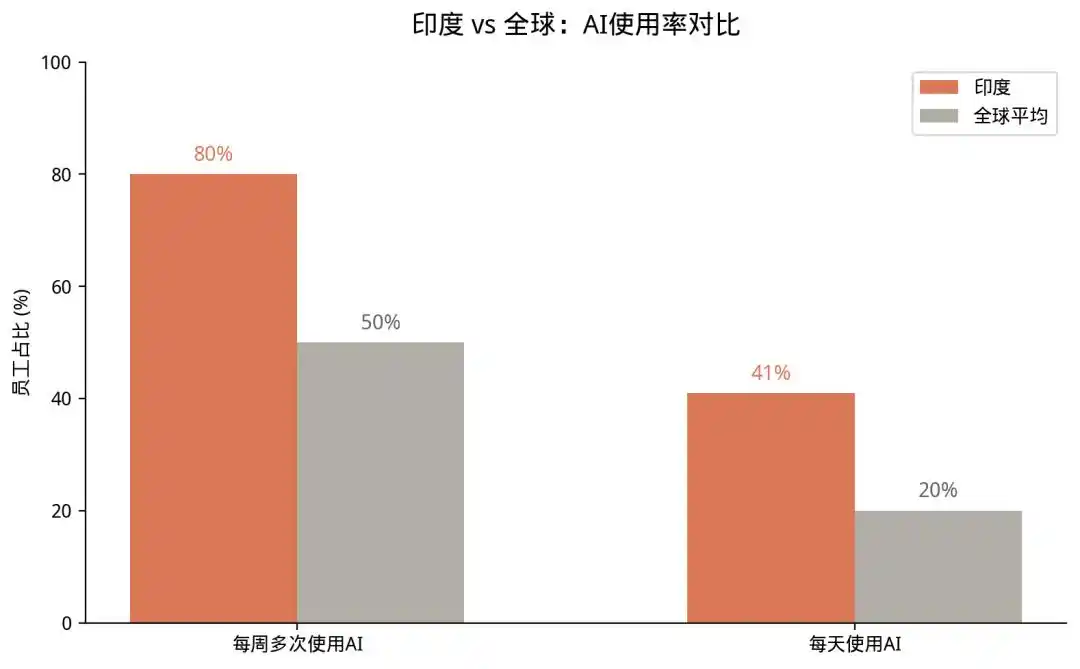
India vs Global AI Usage Comparison Source: BCG/ADP 2026
Not only are employees using it, but companies are also deploying it on a large scale. At the end of May, Microsoft disclosed a set of data: TCS, Infosys, and Wipro have each deployed over 100,000 Microsoft 365 Copilot licenses; the combined deployment scale of the three companies exceeds 300,000 seats, referred to by Microsoft as one of the world's largest enterprise-grade AI deployment cases.
In other words, two things are happening simultaneously in India: on one side, AI is impacting traditional outsourcing jobs; on the other side, AI is penetrating enterprises at an unprecedented rate.
This is also why Microsoft's India head recently stated publicly: India has become one of the fastest-growing AI markets globally.
06
The New Paradigm
What might the new paradigm for IT outsourcing in India be?
In fact, while the capital market is still worried about India's IT outsourcing model being dismantled by AI, India's largest tech companies have already started looking for new ways to make money: no longer selling engineers, but selling AI productivity.
The most typical is TCS. In Q1 2026, TCS disclosed that its annualized order book for AI-related business has reached $2.3 billion, up from $1.8 billion the previous quarter — a growth of about 28% in one quarter.
At the same time, TCS's new order wins for the quarter reached $12 billion, still maintaining a historical high. This indicates an interesting phenomenon: clients have not stopped spending money, only the way they spend it has changed.
In the past, clients bought 100 programmers. Today, clients buy AI solutions, Agent systems, and automation capabilities.
Many people think India's biggest future opportunity is to emulate the US and create something like Cursor. But a mainstream view is: India's real opportunity lies in becoming the world's largest AI implementation center.
In foundational models, the US already has a batch of monopolistic-level companies: OpenAI, Anthropic, Google, Meta, etc. But models are just the beginning; the real complexity lies in implementation.
As of 2026, India already has over 2,100 Global Capability Centers (GCCs), serving multinationals like Microsoft, JPMorgan Chase, Goldman Sachs, Walmart, Pfizer, generating about $100 billion in revenue and directly employing over 2.36 million people.
These Global Capability Centers essentially undertake: software development, system integration, enterprise digitization, data management, IT operations, etc. These tasks require massive engineering implementation capabilities, which is precisely the area where India has accumulated its deepest expertise over the past 30 years.
According to IDC predictions, by 2028, global enterprise AI spending will exceed $630 billion. And India's biggest opportunity may not be to compete in the model market, but to compete in the deployment market.
If for the past 30 years, India exported engineers to the world. Then for the next 10 years, India might export to the world: Agent deployment capabilities, AI operations capabilities, and AI productivity.
Perhaps, this is India's true new paradigm.
This article is from WeChat public account "Pencil News" (ID: pencilnews), author: Aiyu, editor: Wang Fang