Goldman Sachs, Bank of America, and 21 Other Giants Enter Stablecoin Market: Joining Forces to Launch a Coin, Attempting to Shake Up the Established Fortress of Tether and Circle?

marsbitPublished on 2026-09-03Last updated on 2026-09-03

Abstract

On September 1, a coalition of 21 major traditional financial institutions, including Goldman Sachs, Bank of America, and Citigroup, announced a rare alliance to launch a US dollar stablecoin by 2027. The move sent Circle's stock price down 6.35%, signaling a direct challenge to the dominant native incumbents, Tether and Circle. The coalition aims to later expand into euro and other G7 currency stablecoins, targeting cross-border payments and digital asset settlement markets. Notably, JPMorgan is absent from the alliance, likely due to its existing JPM Coin project. The primary motivation for this Wall Street push is the lucrative, low-risk profit model of stablecoins. Issuers earn substantial revenue by investing user deposits in high-yield assets like US Treasuries without paying interest to holders—a model traditional banks now seek to capture. However, the path for "bank-issued" stablecoins appears challenging. A cautionary example is Societe Generale's USDCV, which, despite the bank's strong credibility, has achieved a circulation of only $12.6 million nearly a year after launch. Tether and Circle have built deep liquidity moats within the crypto-native ecosystem, making integration into DeFi protocols and exchange trading pairs a significant hurdle for new entrants. A stablecoin offering only "better compliance" risks remaining a tool for internal settlement among traditional institutions. The coalition faces a tight timeline, with a key US regulatory deadline for no...

Author: Claude, Deep Tide TechFlow

Deep Tide Guide: On September 1st, 21 traditional financial giants including Goldman Sachs, Bank of America, and Citigroup formed a rare alliance, announcing plans to launch a US dollar stablecoin by 2027. The news caused Circle's stock price to fall by 6.35%. However, can Wall Street's 'regular army' truly shake the established fortress of the crypto-native market? Looking back at Societe Generale's high-profile entry earlier, its issued USDCV has been live for nearly a year, yet its circulating supply remains a dismal $12.6 million. Facing the extremely high barriers of the crypto market and the battle over compliance nodes, this seemingly luxurious financial alliance might end up being all talk and little action.
21 Institutions Ally to Issue a Coin: Why Is JPMorgan Missing?

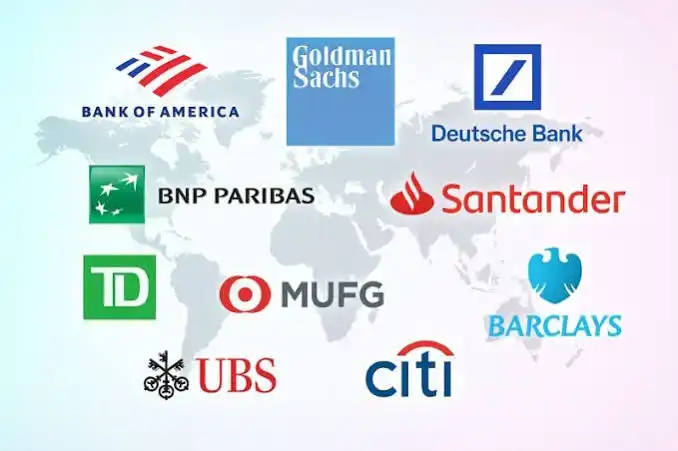
On September 1st, a joint statement released by Brunswick Group dropped a bombshell in both traditional finance and crypto circles: 21 top-tier financial institutions have decided to join forces, planning to establish a joint venture specifically for issuing stablecoins in the second half of 2026.

According to the current blueprint, the alliance's first product is a US dollar stablecoin slated for release in the first half of 2027, with plans to extend its reach to G7 currencies like the Euro thereafter, targeting cross-border payments and digital asset settlement markets. It's noteworthy that in this list of giants spanning five regions—including Goldman Sachs, Citi, UBS, and Deutsche Bank—the king of Wall Street, JPMorgan, is conspicuously absent. Considering that JPM Coin is already operational within its internal settlement network, JPMorgan clearly isn't keen on sharing its pie with this massive consortium.

Sniper on 'Interest-Free Capital': The Stablecoin Printing Press That Wall Street Covets

Why are traditional banking giants forming such a dense alliance now? The answer lies within the terrifying balance sheets of Tether and Circle.

Under the current stablecoin business model, issuers take users' fiat currency as reserves, invest it in high-interest Treasury markets, yet pay almost no interest to the users holding the stablecoins. This 'legally interest-free money' has evolved, in the current high-interest environment, into a profit-generating machine with astonishing, virtually risk-free returns. Watching stablecoin issuers, with minimal manpower, rake in net profits surpassing those of many Wall Street investment banks, these 21 financial giants clearly can no longer remain bystanders. They aim to seize this most lucrative profit territory through alliance.

Grim Precedent: Can the Compliance Alliance Shake the Native Fortress?

However, does entering with a Wall Street halo guarantee buying liquidity in the crypto market?

Looking back at the first report card for 'banking stablecoins,' the reality is starkly unforgiving. Previously, Societe Generale had high-profile launched its stablecoin USDCV. Despite the credit backing of a top-tier European bank, its circulating supply was a dismal $12.6 million nearly a year after launch. In the trading habits of crypto natives, Tether (USDT) and Circle (USDC) have long built deep liquidity moats. Faced with the integration inertia of DeFi protocols and the trading pair dominance of exchanges, a compliant stablecoin issued by Wall Street, if it's merely 'more compliant,' will most likely become an internal settlement tool for traditional institutions to amuse themselves.

The Decisive Battle: July 2028 – The Final Window Before a Major Reshuffle

Time is not plentiful for this alliance. According to the current regulatory countdown, July 18, 2028, will be a critical juncture for U.S. platforms to collectively clean up a batch of non-compliant stablecoins.
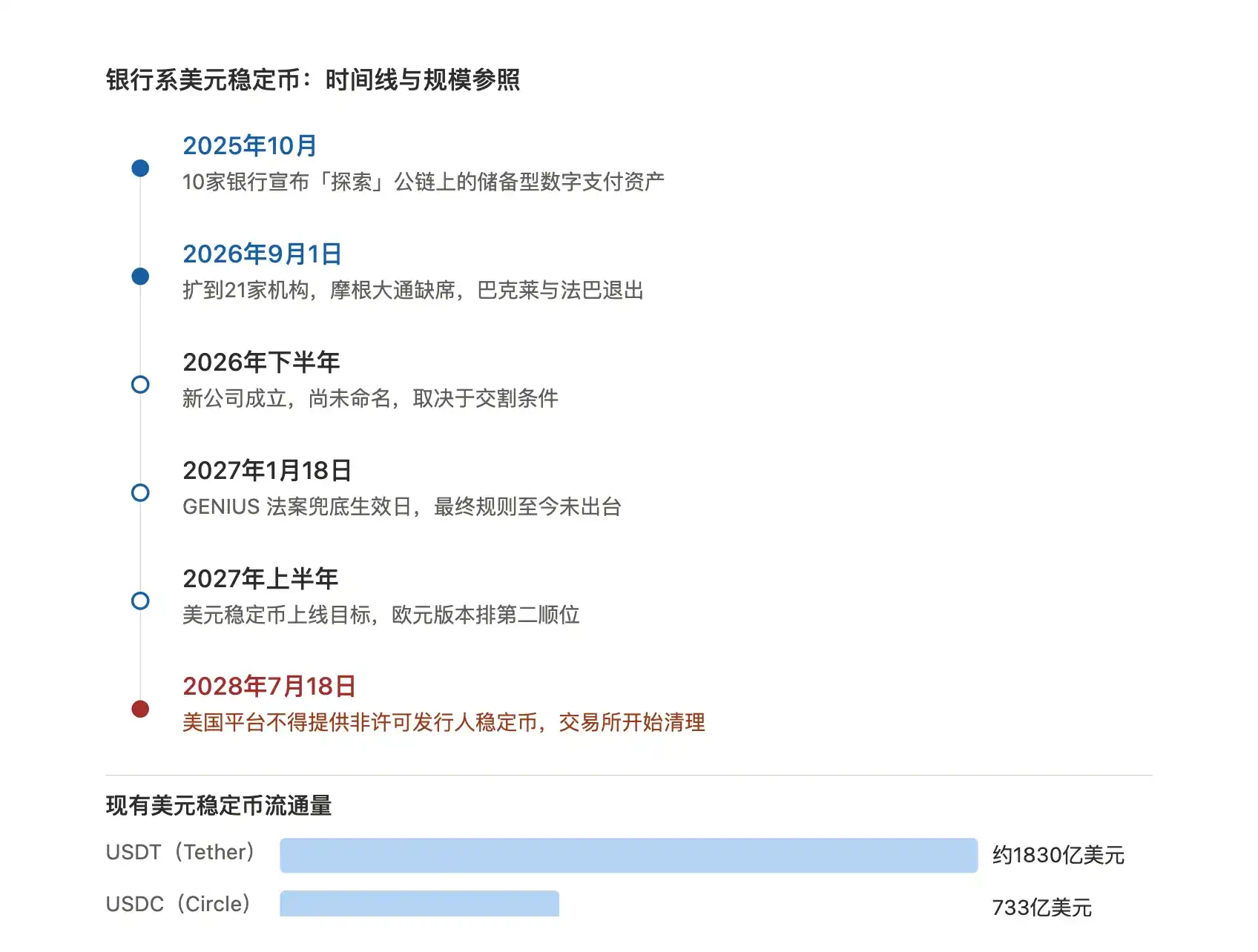
From the dismal $12.6 million pilot test to the massive size of the entire stablecoin market exceeding $100 billion, what lies between is not just the compliance test of July 2028, but also a close-quarters battle between traditional finance and Web3 native capital. When the 21 giants truly launch their product to the market in 2027, they will face a red ocean already carved up by native giants and characterized by extremely concentrated liquidity. Will this high-profile alliance be the game-changer that reshapes the stablecoin landscape, or just another traditional financial experiment struggling to adapt? The market will soon price in the answer.

Trending Cryptos

Related Questions

QWhy are 21 traditional financial giants, including Goldman Sachs and Bank of America, forming an alliance to launch a stablecoin?

AThe alliance aims to enter the profitable stablecoin market, which currently allows issuers like Tether and Circle to generate significant profits by investing user deposits in high-yield instruments like U.S. Treasuries without paying interest to users. These traditional institutions seek to capture a share of this lucrative business.

QWhich major U.S. bank is notably absent from the 21-member financial alliance to issue a stablecoin, and why?

AJPMorgan Chase is absent from the alliance. This is likely because JPMorgan already has its own internal settlement solution, JPM Coin, and may not want to share its market or technology with a competing consortium.

QWhat does the example of Societe Generale's USDCV stablecoin indicate about the challenge for traditional banks entering the stablecoin market?

ASociete Generale's USDCV stablecoin has achieved only a meager circulation of $12.6 million after nearly a year, despite the bank's strong reputation. This indicates that having traditional financial credibility alone is insufficient to break into a market where native players like Tether (USDT) and Circle (USDC) have deep liquidity moats and strong integration with DeFi protocols and exchanges.

QWhat is the significance of the July 18, 2028 deadline mentioned in the article for the stablecoin market?

AJuly 18, 2028, is presented as a key regulatory deadline by which U.S. platforms are expected to clear out a batch of non-compliant stablecoins. This creates a window of opportunity and pressure for new, compliant entrants like the financial alliance to establish themselves before the market potentially undergoes a significant reshuffle.

QAccording to the article, what is the primary potential obstacle for the new alliance's stablecoin, beyond just being 'more compliant'?

AThe primary potential obstacle is overcoming the entrenched liquidity and user habits in the crypto-native market. Stablecoins like USDT and USDC have deep integration with DeFi ecosystems and dominate trading pairs on exchanges. A new stablecoin that offers only better compliance risks becoming a tool only for internal settlement among the traditional institutions themselves, failing to gain widespread adoption.

Related Reads

Asia's Largest XRP Conference "XRP Seoul 2026" Concludes Successfully with Over 5,000 Attendees

The "XRP Seoul 2026" conference, Asia's largest XRP event, concluded successfully on October 3rd at the Grand Hyatt Seoul in Yongsan-gu. Hosted by XRPL Korea and title-sponsored by Ripple, the event saw attendance surge to over 5,000 participants, a significant increase from the previous year's 3,000. The conference featured keynote speeches from major ecosystem figures. Ripple President Monica Long announced a forthcoming credit pilot program using XRP as collateral. Ripple's engineering leadership also previewed upcoming XRP Ledger features, including confidential transfers and AI agent infrastructure. A key announcement was the launch of XRP Asia, a Singapore-based organization backed by Ripple and the XRP Ledger Foundation, aimed at supporting developer education and community growth across the Asia-Pacific region. Multiple panel discussions explored financial institution adoption of blockchain for cross-border payments, tokenized deposits, stablecoins, and real-world asset tokenization, with participation from major Korean banks and securities firms. Robinhood's senior executive discussed the transformative potential of tokenized stocks for 24/7 trading. The event included an exhibition area for sponsor demonstrations and concluded with a celebratory light show at the N Seoul Tower. Organizers stated the growing attendance reflects strong market interest in the XRP ecosystem and reaffirmed their commitment to fostering global connections and partnerships.

marsbit39m ago

Asia's Largest XRP Conference "XRP Seoul 2026" Concludes Successfully with Over 5,000 Attendees

marsbit39m ago

Trading

Spot

Hot Articles

What is $BANK

Bank AI: A Revolutionary Step in the Future of Banking Introduction In an era marked by rapid advancements in technology, Bank AI stands at the intersection of artificial intelligence (AI) and banking services. This innovative project seeks to redefine the financial landscape, enhancing operational efficiency, security measures, and customer experiences through the power of AI. As we embark on this exploration of Bank AI, we will delve into what the project entails, its operational dynamics, its historical context, and significant milestones. What is Bank AI? At its core, Bank AI represents a transformative initiative aimed at integrating artificial intelligence into various banking operations. This project harnesses the capabilities of AI to automate processes, improve risk management protocols, and enhance customer interaction through personalised services. The primary objectives of Bank AI include: Automation of Banking Functions: By leveraging AI technologies, Bank AI aims to automate routine tasks, reducing the burden on human resources and enhancing efficiency. Enhanced Risk Management: The project utilises AI algorithms to predict and identify risks, thereby fortifying security measures against fraud and other threats. Personalisation of Banking Services: Bank AI focuses on offering tailored financial products and services by analysing customer data and behaviours. Improving Customer Experience: The implementation of AI-driven solutions, such as chatbots and virtual assistants, aims to provide users with more human-like interactions, revolutionising the way customers engage with banks. With these goals, Bank AI positions itself as a crucial player in rendering banking more efficient, secure, and user-centric. Who is the Creator of Bank AI? Details regarding the creator of Bank AI remain unknown. As such, no specific individual or organisation has been identified in the available information. The anonymity surrounding the project's inception raises questions but does not detract from its ambitious vision and objectives. Who are the Investors of Bank AI? Similar to the project's creator, specific information regarding the investors or supporting organisations of Bank AI has not been disclosed. Without this information, it is challenging to outline the financial backing and institutional support that might be propelling the project forward. Nevertheless, the importance of having a robust investment foundation is pivotal for sustaining development in such an innovative field. How Does Bank AI Work? Bank AI operates on several innovative fronts, focusing on unique factors that differentiate it from traditional banking frameworks. Below are key operational features: Automation: By applying machine learning algorithms, Bank AI automates various manual processes within banks. This results in reduced operational costs and allows human workers to redirect their efforts towards more strategic activities. Advanced Risk Management: The integration of AI into risk management practices equips banks with tools to accurately predict potential threats such as fraud, ensuring that customer information and assets remain secure. Tailored Financial Recommendations: Through continuous learning from customer interactions, the AI systems develop a nuanced understanding of user needs, enabling them to offer tailored advice on financial decisions. Enhanced Customer Interactions: Utilizing chatbots and virtual assistants powered by AI, Bank AI enables a more engaging customer experience, allowing users to have their queries resolved quickly, thus reducing wait times and improving satisfaction levels. Together, these operational features position Bank AI as a pioneer in the banking sector, establishing new benchmarks for service delivery and operational excellence. Timeline of Bank AI Understanding the trajectory of Bank AI requires a look at its historical context. Below is a timeline highlighting important milestones and developments: Early 2010s: The conceptualisation of AI integration into banking services began to gain attention as banking institutions recognised the potential benefits. 2018: A marked increase in the implementation of AI technologies occurred when banks started using AI tools like chatbots for basic customer service and risk management systems for improved security handling. 2023: The sophistication of AI continued to advance, with generative AI being introduced for more complex tasks such as document processing and real-time investment analysis. This year marked a significant leap in the capabilities afforded to banks by AI technology. 2024-Current Status: As of this year, Bank AI is on an upward trajectory, with ongoing research and developments poised to further enhance capabilities in banking operations. Continued exploration of AI applications hints at exciting developments yet to come. Key Points About Bank AI Integration of AI in Banking: Bank AI focuses on adopting artificial intelligence to streamline banking processes and improve user experiences. Automation and Risk Management Focus: The project strongly emphasises these areas, aiming to shift the burden of routine tasks while enhancing security frameworks through predictive analytics. Personalised Banking Solutions: By harnessing customer data, Bank AI enables tailored banking services that cater to individual user needs. Commitment to Development: Bank AI remains committed to ongoing research and development efforts, ensuring its adaptability and ongoing relevance as technology continues to evolve. Conclusion In summary, Bank AI exemplifies a crucial step forward in the banking industry, leveraging artificial intelligence to reshape operational paradigms, enhance security, and promote customer satisfaction. Despite gaps in information surrounding the creator and investors, the clear objectives and functional mechanisms of Bank AI provide a strong foundation for its ongoing evolution. As AI technology continues to advance and merge with the banking sector, Bank AI is well-positioned to significantly impact the future of financial services, enhancing the way we understand and interact with banking.

651 Total ViewsPublished 2024.04.06Updated 2024.12.03

What is $BANK

Discussions

Welcome to the HTX Community. Here, you can stay informed about the latest platform developments and gain access to professional market insights. Users' opinions on the price of BANK (BANK) are presented below.

活动图片