Morgan Stanley Report Analysis: Foldable iPhone Expected to Contribute $14 Billion, Pro Models to See Price Increase Over $200

marsbitPublished on 2026-09-04Last updated on 2026-09-04

Abstract

Morgan Stanley Research Report Summary: Foldable iPhone and Pro Price Hikes Morgan Stanley's pre-iPhone 18 launch report maintains an Overweight rating on Apple with a $360 target. The key takeaway is the introduction of a foldable iPhone, seen as the most significant hardware change since the iPhone X, set to contribute approximately $14 billion in revenue in its first December quarter. The Pro models are expected to see their largest price increases in years, driven by rising memory costs, with the iPhone 18 Pro starting at $1,299—a $200 increase. The foldable iPhone, with a predicted base price of $2,399, is forecast to have strong initial demand. It features design trade-offs like an in-display fingerprint sensor instead of Face ID and a dual-camera system. The hardware launch coincides with new CEO John Ternus's debut as the keynote presenter. For the iPhone 18 Pro series, the core upgrade is the move to a 2nm A20 Pro chip, promising significant performance and efficiency gains to support advanced on-device AI. However, memory supply constraints pose a potential risk to production volumes. Overall, Morgan Stanley believes the combination of a lengthening iPhone upgrade cycle, global AI feature rollout, and the new foldable form factor will accelerate iPhone growth. The report highlights Ternus's presentation, the foldable's user experience, and Apple's pricing strategy as critical factors for the stock's performance post-launch.

Author: Rita

Apple's September 9th event will unveil its first foldable iPhone, while the Pro series sees its largest price hike in years. On September 1st, Morgan Stanley released its iPhone 18 launch preview report, maintaining an Overweight rating with a $360 price target. Morgan Stanley considers this the most significant iPhone hardware transformation since the iPhone X. The foldable model is projected to have initial production of 7 to 8 million units in the second half of 2026, with its first product cycle potentially reaching 20 million units, contributing approximately $14 billion in revenue in the December quarter alone.

This event holds another layer of significance: Tim Cook will no longer host, marking the first stage appearance for new CEO John Ternus. Morgan Stanley believes that Ternus's performance, the user experience of the foldable device, and how Apple balances price increases with market demand will determine the direction of Apple's stock price through the end of the year.

Foldable: The Biggest Hardware Shift Since iPhone X

Apple is entering the foldable phone market seven years later than Samsung. Morgan Stanley views this as the most significant change in hardware form factor since the iPhone X and the greatest test of Apple's pricing power. Market expectations for the foldable's starting price range from $2300 to $2500, with Morgan Stanley's base case forecast at $2399 (for the 512GB model). Every 1% penetration of the foldable model in overall iPhone shipments is expected to lift the Average Selling Price (ASP) by about 1.5 percentage points.

The foldable model makes some hardware trade-offs: it replaces Face ID with a fingerprint sensor, and the rear camera system includes only wide and ultra-wide lenses, omitting a telephoto lens. Its thickness when folded is thinner than the iPhone Air, and advanced hinge and screen technology nearly eliminate the crease.

Morgan Stanley's consumer survey indicates significant interest in foldable devices among iPhone users, particularly in the Chinese market. Market feedback for the Samsung Galaxy Z Fold 8 (starting at $1899) also suggests genuine demand for the book-style foldable form factor. Morgan Stanley expects the foldable iPhone to sell out quickly, with strong demand and constrained initial supply.

2nm Chip is the Real Upgrade for Pro Series

Hardware changes for the iPhone 18 Pro series are relatively conservative. The biggest upgrade comes from the chip: the first application processor, the A20 Pro, manufactured using TSMC's 2nm process. TSMC data indicates that the 2nm process offers a 10% to 15% performance increase at the same power consumption, or a 25% to 30% power reduction at the same performance level.

Apple's recently released M6 chip (also using 2nm) provides a reference point. Compared to the 3nm M5, the M6 adds two "super CPU cores" for the first time, increases GPU cores by two, and boosts Neural Engine peak performance by up to 100%. The A20 Pro is confirmed to use Wafer-Level Chip-on-Wafer (WLC) packaging technology, offering greater design flexibility, improved speed, and better thermal management compared to the Integrated Fan-Out (InFO) packaging used over the past decade.

Morgan Stanley believes the computational power boost from the 2nm chip will support two key Apple narratives: more powerful on-device AI capabilities (Siri AI) and higher product pricing.

Largest Price Hike, Memory Cost is Core Variable
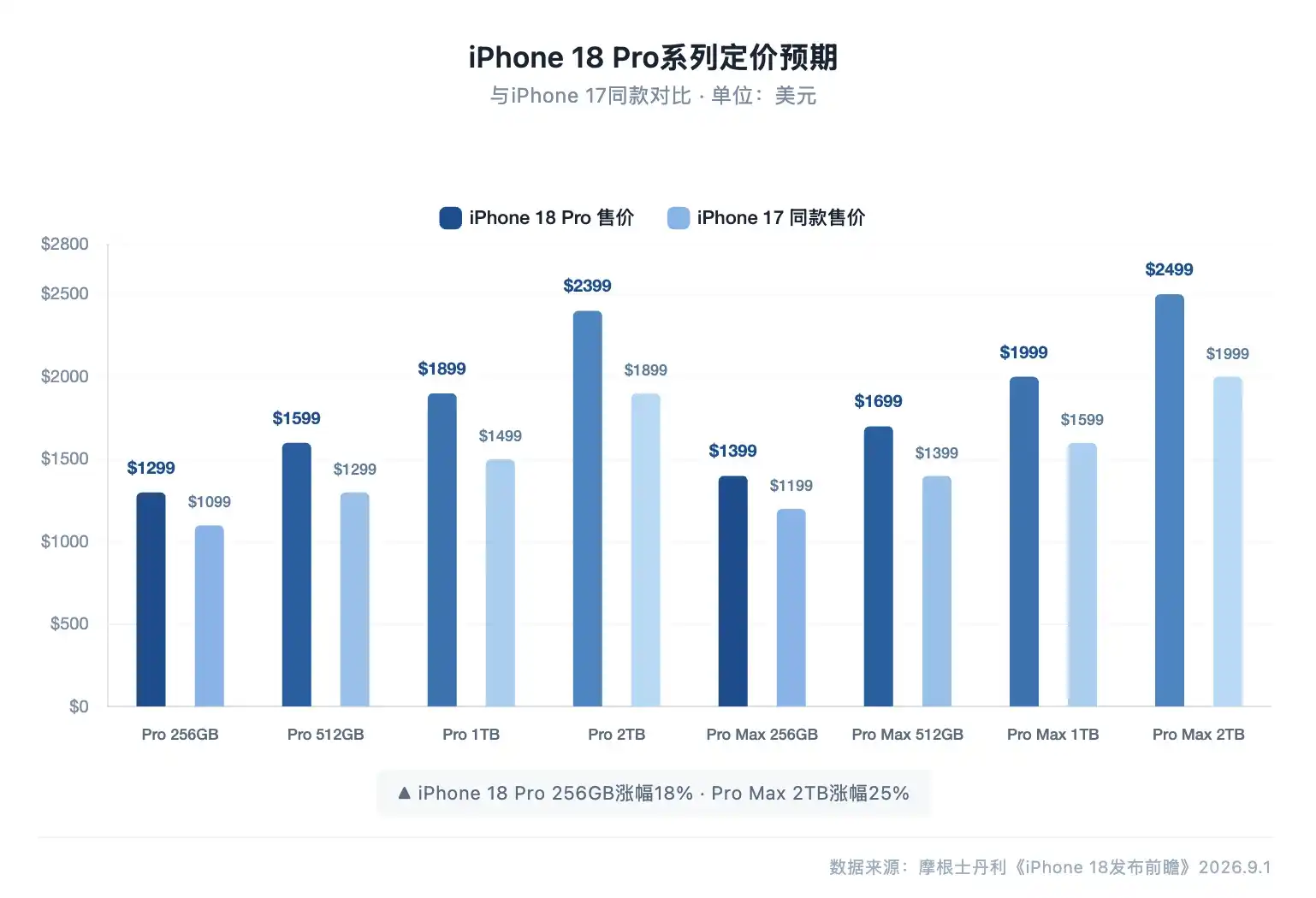
The Pro series is set for its most substantial same-model price increase in years. Morgan Stanley expects the iPhone 18 Pro (256GB) to start at $1299, a $200 (18%) increase from the iPhone 17 Pro's $1099 starting price. The iPhone 18 Pro Max (256GB) is forecast to start at $1399, also a $200 (17%) increase from the previous generation's $1199. Price hikes for the 1TB and 2TB models are even larger, with the Pro Max 2TB seeing a 25% increase.

The primary driver of the price increase is rising memory costs. Apple's DRAM consumption for iPhone production in the first half of 2026 grew nearly 50% year-over-year, while NAND consumption grew over 30%. Morgan Stanley calculates that the $200 price increase is sufficient to cover the memory cost inflation and maintain a gross margin of approximately 40%.

Morgan Stanley acknowledges the price hike is not without risk. Consumer price sensitivity, changes in trade-in values, and the prevalence of installment payment plans will all impact demand elasticity. Apple's supply chain plans suggest the company is currently more concerned about securing enough components than finding enough buyers.

Supply is the Bottleneck, Memory May Constrain Production

Apple's total component orders for 2026 iPhones are projected at 265 to 270 million units, representing 5% to 7% year-over-year growth. Combined production for the iPhone 18 Pro, Pro Max, and foldable models in the second half is estimated at around 81 million units. In the past week, TSMC's 2nm wafer orders saw a slight increase and pull-in, equivalent to adding an extra 2 to 3 million iPhone units to production. It is uncommon to increase supply chain forecasts before a product launch, especially when existing plans already reflect the company's internal "bull case" scenario.

Memory supply remains the biggest uncertainty. If Apple fully executes its current component order plan, DRAM consumption in the second half of 2026 would increase by about 15% year-over-year, and NAND by about 25%. This is an aggressive target given that the consumer memory market is already tight. Morgan Stanley has not yet incorporated the recent wafer order increase into its iPhone shipment forecasts, awaiting post-launch sales data for confirmation.

Recommendations and Risks

Morgan Stanley maintains an Overweight rating on Apple with a $360 price target, based on a price-to-earnings ratio of approximately 35x on its fiscal year 2027 earnings per share estimate of $10.30. The longest iPhone replacement cycle, the global rollout of AI features, and the new hardware form factor are expected to jointly drive accelerated iPhone growth.

Upside risks include the iPhone 18 exceeding expectations, higher-than-expected adoption of Apple Intelligence, new product line launches, and re-acceleration in services growth. Downside risks include consumer spending weakness limiting replacement rates, rising memory costs, slow progress in AI features, geopolitical tensions, and tighter App Store regulation.

The September 9th event carries narrative significance beyond hardware, marking the debut of the Ternus era. Morgan Stanley will closely watch three variables: Ternus's performance under the spotlight, whether the foldable's software and hardware experience can catalyze demand, and how Apple balances price increases, profit margins, and demand for new versus legacy models.

Disclaimer

This article is a compilation and interpretation by ChaoXiang Research of a third-party brokerage research report (Morgan Stanley, September 1, 2026), combined with publicly available market information. The ratings, price targets, earnings forecasts, and related judgments cited herein represent the views of the respective brokerage analysts, reflecting their institutional positions. They do not represent the views of ChaoXiang Research and do not constitute any investment advice.

The market involves risks, and decisions should be made independently. This article should not serve as the basis for buying or selling any securities.


Related Questions

QAccording to the Morgan Stanley report, what are the key factors that will determine Apple's stock price trajectory through the end of the year following the September 9th event?

AAccording to the Morgan Stanley report, the key factors are: 1) The performance of new CEO John Ternus in his first keynote presentation. 2) The user experience of the new foldable iPhone hardware and software. 3) How Apple balances the significant price increases with market demand.

QWhat is Morgan Stanley's rationale for the iPhone 18 Pro series price increase of over $200?

AMorgan Stanley states the primary driver of the price increase is rising memory costs. Apple's DRAM consumption for iPhone production in H1 2026 grew nearly 50% year-over-year, and NAND grew over 30%. The $200 price hike is calculated to cover these increased memory costs while maintaining Apple's gross margin around 40%.

QWhat does Morgan Stanley identify as the single biggest hardware form factor change for the iPhone since the iPhone X?

AMorgan Stanley identifies Apple's entry into the foldable phone market with the new foldable iPhone as the single biggest hardware form factor change since the iPhone X.

QWhat is the potential revenue contribution Morgan Stanley forecasts for the foldable iPhone in its first product cycle, specifically for the December quarter?

AMorgan Stanley forecasts that the foldable iPhone could contribute approximately $14 billion in revenue in just the December quarter of its first product cycle.

QWhat specific technological advancement is highlighted as the core upgrade for the iPhone 18 Pro series, and what are its expected benefits?

AThe core upgrade is the A20 Pro application processor, which will be Apple's first chip built on TSMC's 2nm process. TSMC data suggests the 2nm process offers a 10-15% performance increase at the same power, or a 25-30% power reduction at the same performance. This advancement is seen as foundational for more powerful on-device AI capabilities and justifying higher product pricing.

Related Reads

OpenAI launches AI payments in ChatGPT with Visa, Mastercard and Amex

OpenAI launched a feature letting AI agents make purchases for users directly within ChatGPT through existing payment networks, in partnership with American Express, Mastercard, and Visa. The wallet uses biometric verification like facial recognition or fingerprints to authorize transactions, and payment networks generate tokenized card credentials for each approved purchase, keeping users' actual card details from merchants and AI agents. The service is rolling out to ChatGPT Pro subscribers in the US with eligible US-issued cards, with plans to eventually support purchases within preset spending limits and other restrictions without requiring approval for each transaction. The launch reflects AI companies moving beyond product recommendations into executing transactions, potentially changing how consumers interact with online merchants. OpenAI is working with payment processors and fraud prevention firms to support AI purchases through existing checkout systems. It joins a growing field: Google introduced its Agent Payments Protocol in 2025, Visa and Mastercard have launched AI transaction initiatives, and crypto companies like Coinbase (x402 protocol), Circle (Agent Stack), and Crossmint are building payment infrastructure for AI agents. Global agentic commerce transaction value is expected to reach $1.5 trillion by 2030, up from an estimated $8 billion in 2026, according to Juniper Research.

cointelegraph2h ago

OpenAI launches AI payments in ChatGPT with Visa, Mastercard and Amex

cointelegraph2h ago

Kraken parent Payward gains market share as slower trading weighs on earnings

Kraken parent Payward nearly doubled its share of global crypto spot trading to 6.5% in September from 3.3% a year earlier, even as weaker trading activity weighed on earnings. The market-share gain reflects a larger portion of spot trading relative to competitors rather than increased activity; the company handled $353 billion in transactions in Q3, down 30% year over year. Adjusted EBITDA fell to $60 million from $178.6 million a year earlier, and total platform margin fell 12% to $487 million. Payward has spent two years expanding beyond its core exchange through acquisitions in derivatives, proprietary trading, tokenized assets and payments, including NinjaTrader, Breakout, Bitnomial and Reap. Derivatives contracts with per-contract fees rose 84% to 66 million, and margin from subscriptions and other paid services rose 59% to $125 million. Results improved from Q2, with total transaction volume up 22% and platform margin up 12% to $487 million from $436 million. Margin from customer-held assets, including staking, rose 26% to $128 million, accounting for roughly half the quarterly increase. Adjusted EBITDA climbed to $60 million from $23 million, though it remained down 66% year over year. Asset- and access-based services accounted for 52% of total platform margin, up from 46%. Payward confidentially filed for a US IPO in November 2025 but paused plans in March; the earliest potential listing window under consideration was Q2 2027.

cointelegraph3h ago

Kraken parent Payward gains market share as slower trading weighs on earnings

cointelegraph3h ago

Metaplanet swings to $170M loss as Bitcoin sale hits earnings

Metaplanet, the world's second-largest publicly traded corporate Bitcoin holder, reported a net loss of 27.16 billion yen (about $170 million) in the first nine months of 2026, compared with a profit of 13.53 billion yen ($84.6 million) a year earlier. The loss was driven by a 19.17 billion yen ($119.8 million) loss on the sale of 10,000 BTC and an 8.04 billion yen ($50.3 million) loss from a decline in the value of its Bitcoin holdings, which outweighed gains in its operating business. During the quarter, Metaplanet sold 10,000 BTC for 124.7 billion yen, temporarily held the proceeds in cash, stablecoins and other liquid assets, then spent 149.9 billion yen to buy 11,000 BTC at an average price 9.3% higher per coin. The company said the sale was intended to demonstrate to rating agencies and bond investors that it could convert Bitcoin into cash to meet financing obligations. Holdings ended September at 44,000 BTC, a net increase of 1,000 coins. Metaplanet borrowed against its Bitcoin during the quarter, raising its credit line debt to $649.5 million at the end of September from $414 million at the end of June. It funded purchases from the second quarter onward with borrowed funds, bond proceeds, exercised stock acquisition rights and revenue from its Bitcoin options business. Interest expense rose 56% quarter over quarter to 1.36 billion yen ($8.5 million), and short-term borrowings and bonds payable totaled 110.5 billion yen ($691 million). For the nine months through September, revenue rose 30.5% to 5.9 billion yen ($36.9 million) and operating profit increased 26.5% to 3.48 billion yen ($21.8 million). The company cut its full-year revenue forecast to 6.5 billion yen ($40.6 million) from 16 billion yen ($100 million). The results come as Bitcoin treasury companies face pressure from falling prices and index removals; MSCI confirmed Strategy, Metaplanet and Upexi will be removed from its equity indexes at the Nov. 30 market close. Bitcoin fell below $70,000 on Friday, trading around $68,600, down about 9% over the previous week.

cointelegraph5h ago

Metaplanet swings to $170M loss as Bitcoin sale hits earnings

cointelegraph5h ago

Trading

Spot
活动图片