Just now, the words written by ChatGPT are starting to have 'secret codes' embedded word by word!
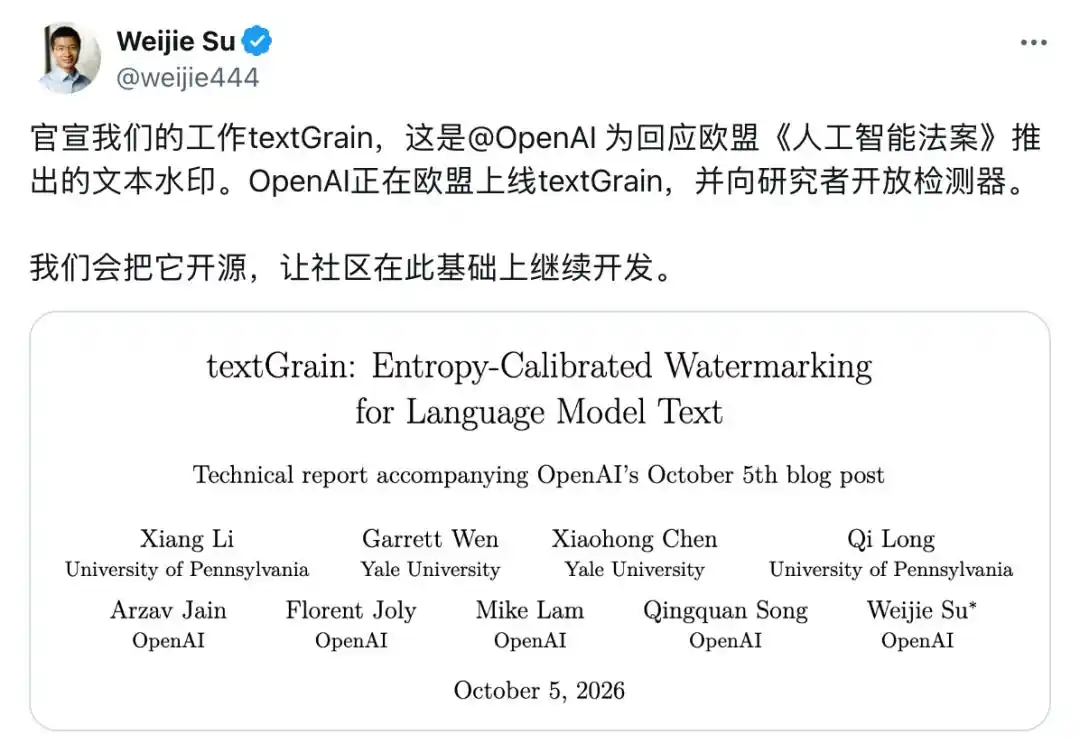
This watermark is called textGrain. Each time the model chooses a word, it secretly mixes in a key that only OpenAI knows.
It’s invisible to the naked eye, reads exactly the same as before, but once a detector scans it, it can immediately identify whether this text originated from OpenAI’s model.
From now on, if you copy and paste the homework, resume, or weekly report ghostwritten by AI as is, it might be caught on the spot.
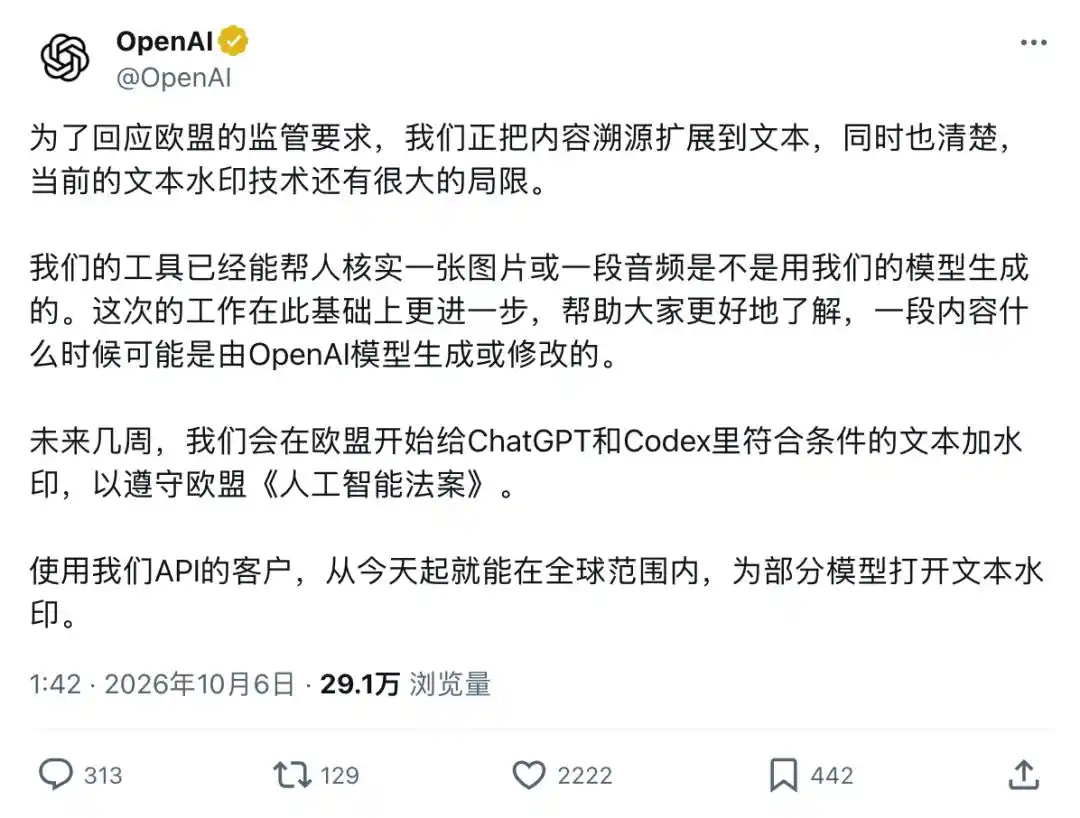
Key points, the most crucial aspects of this release are four.
1. Effective Immediately: Global API clients can enable the watermark themselves starting today; ChatGPT and Codex will also be integrated in the coming weeks.
2. High Detection Rate: With a false positive rate controlled at 1%, over 90% of a 400-token psychology-related answer can be detected. OpenAI also issued a bold statement, claiming the performance matches or even surpasses Google’s SynthID.
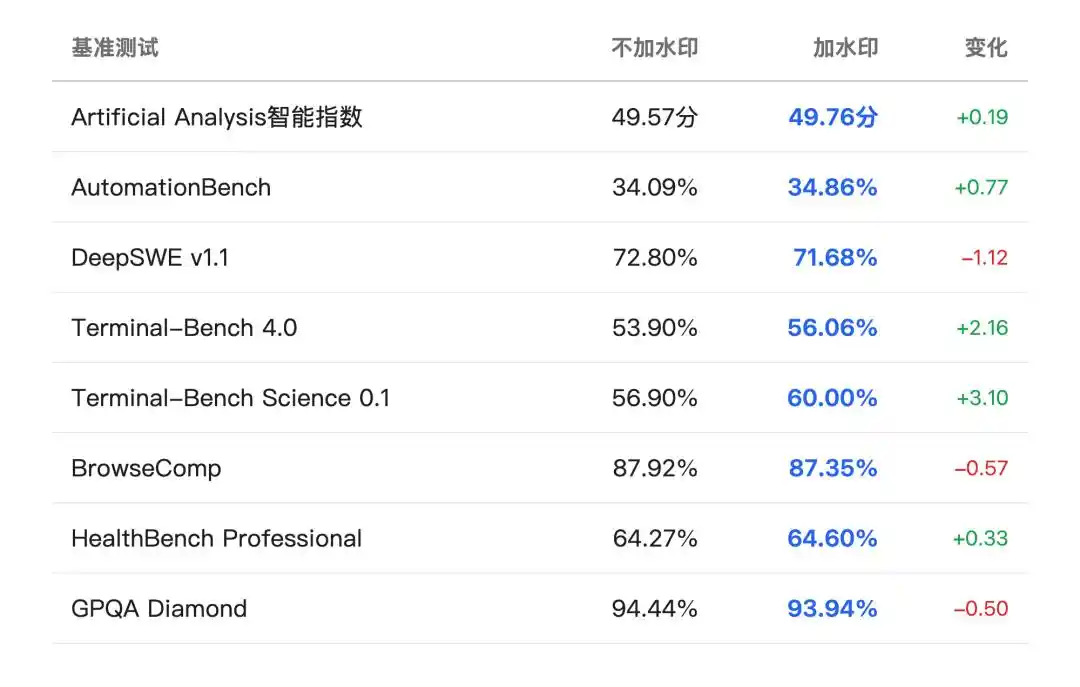
3. Virtually No Performance Loss: The flagship model GPT-6 Astra, after adding the watermark, shows essentially the same scores on 8 core benchmarks, with 5 even slightly improved.
4. Controlled Detection Access: The detector is not publicly available for now; it will only be distributed to approved researchers and professional institutions, while textGrain itself will be open-sourced.
The era of 'real-name system' for AI writing has officially begun.
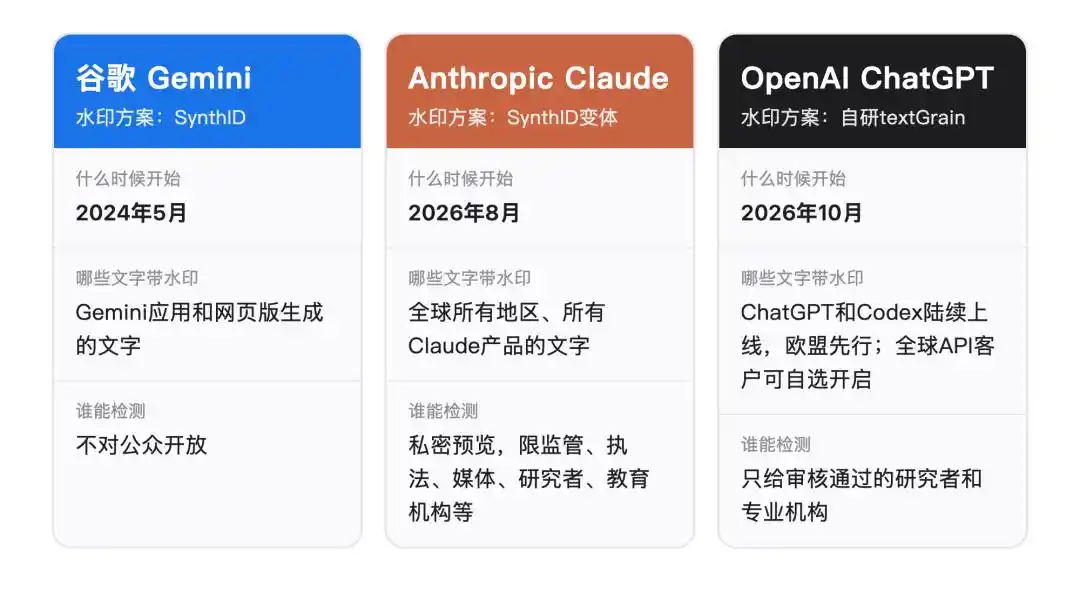
Thus, the three giants—Google, Anthropic, and OpenAI—have all equipped AI-generated text with an 'ID card'.
The 1781 Earth-Moving Problem Has Been Brought Into ChatGPT
When a large language model writes, it outputs only one word at a time. Before outputting, it assigns a probability to each candidate word, then samples one according to these probabilities.
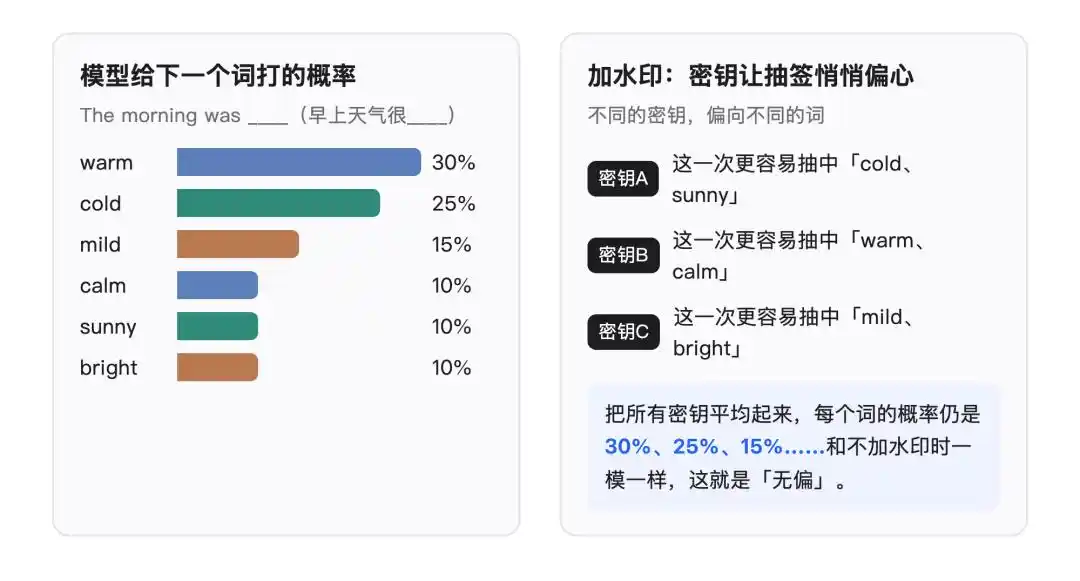
For example, after "The morning was ___", "warm" might have a 30% probability, "cold" 25%, with the rest distributed among a few other words.
What the watermark does is make this sampling secretly obey a key.
But there is an iron law that cannot be broken, called 'unbiased'. Averaged over all possible keys, the probability of each word being selected must remain exactly the same as before.
This way, someone without the key sees completely normal, random text, and the model's intended message remains unchanged.
The first version of the watermark, created by Scott Aaronson at OpenAI, satisfied unbiasedness but left a flaw—
For the same prompt and the same key, the model would choose the same word at each step; asking the same question ten times could yield identical responses.
The solution for textGrain, however, comes from a mathematical problem nearly 250 years old: Optimal Transport.
Its origin is literally about 'moving earth'.
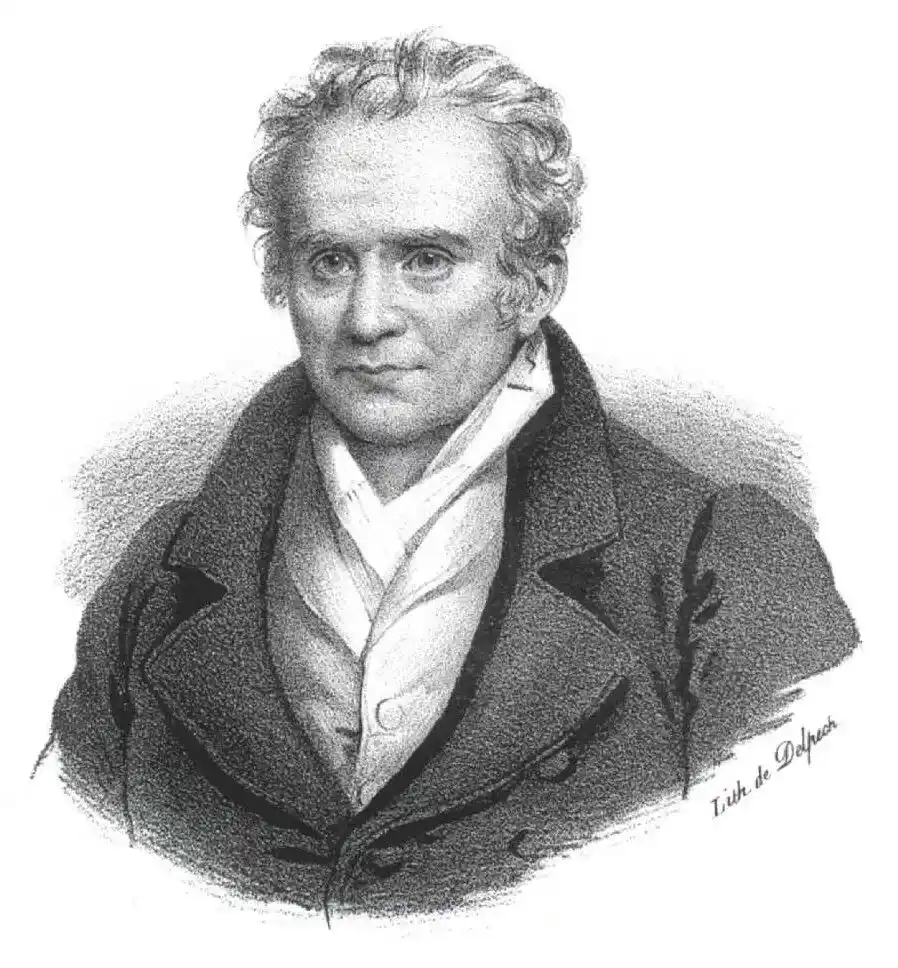
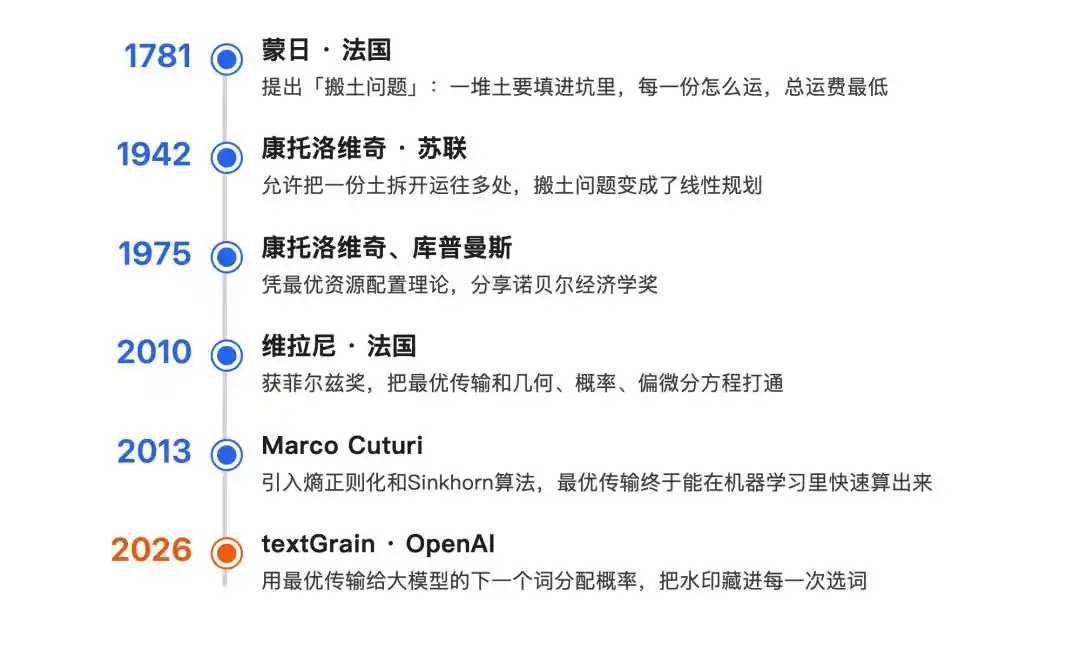
In 1781, French mathematician Gaspard Monge pondered a very concrete problem. A pile of earth needs to be moved to fill another pit; where should each portion of earth be transported to minimize the total cost?
By the 1940s, Soviet mathematician Leonid Kantorovich relaxed the problem: a portion of earth could be split and transported to multiple destinations, as long as the total amounts at both ends matched. The earth-moving problem thus became linear programming.
Kantorovich later shared the 1975 Nobel Prize in Economics with Tjalling Koopmans for his theory of optimal resource allocation.
Coincidentally, Koopmans was an economist at Yale, and one of the authors of this technical report, Xiaohong Chen, now holds a professorship named after him at Yale.
Later, Cédric Villani, the 2010 Fields Medalist, connected optimal transport with geometry, probability, and partial differential equations.
In 2013, Marco Cuturi introduced entropy regularization and the Sinkhorn algorithm, dramatically speeding up the originally expensive computations, making optimal transport a common tool in machine learning.
Two centuries later, textGrain brought this mathematical chain into large language models. This time, what's being moved around is the probability of the next word.
The core idea of textGrain is to set a 'randomness budget' for the watermark.
The paper proves an identity. The extra correlation introduced by the watermark between word selection and the key precisely equals the average randomness lost by the model; they are the same quantity.
How much statistical correlation the watermark gains, it must pay for with how much randomness, not a fraction off.
Thus, OpenAI can preset a ratio, defining how much of the original randomness the watermark can spend at most. For example, setting it to 0.2 means preserving at least 80% randomness on average, leaving room for answer diversity.
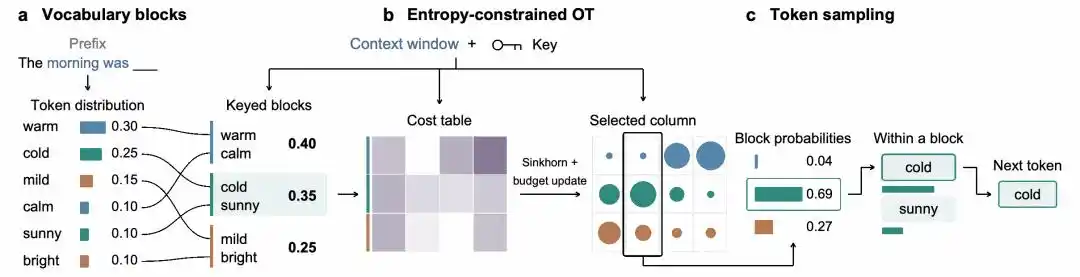
The specific process involves three steps.
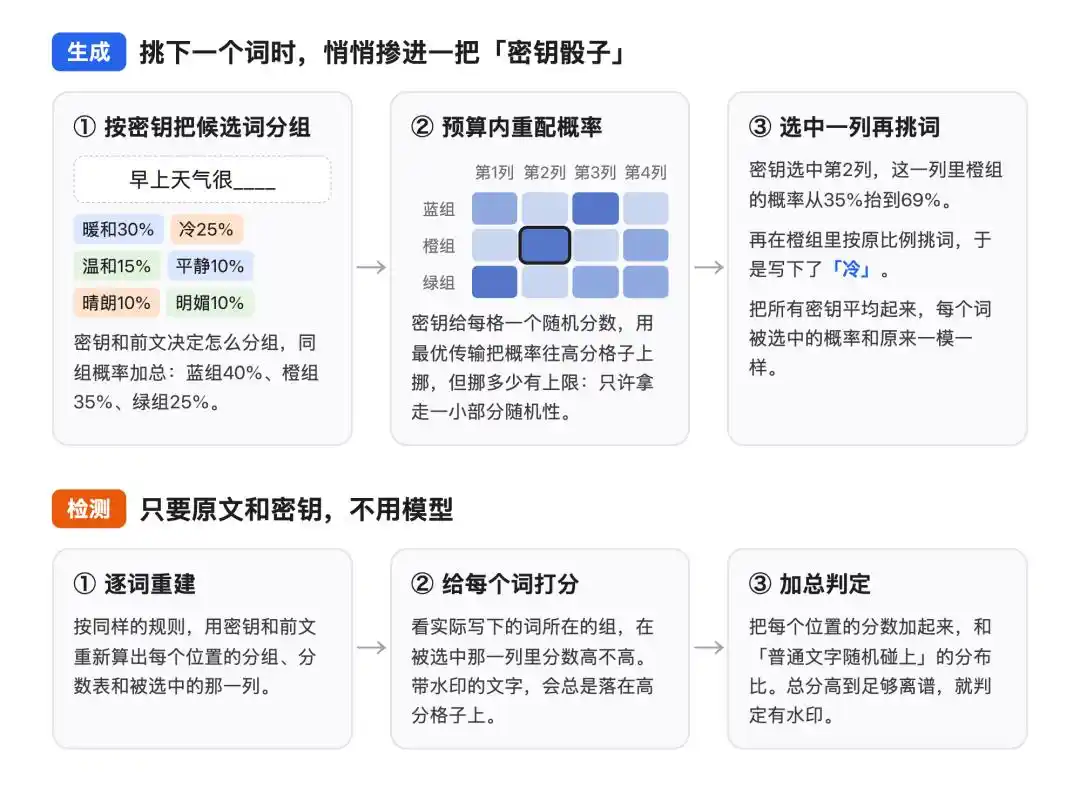
Step 1: The key, together with the preceding context, randomly divides the candidate words into several groups, summing the probabilities for each group.
In the diagram, six words are divided into three groups: "warm, calm" at 0.40, "cold, sunny" at 0.35, "mild, bright" at 0.25. After grouping, probabilities only need to be allocated among the groups.
Step 2: OpenAI essentially prepares 4 sets of 'biased' plans; the 4 columns in the diagram represent these 4 plans.
The key generates a random score for each 'group × plan' cell. Then, using optimal transport with entropy constraints and the Sinkhorn algorithm, it iteratively adjusts rows and columns, moving probabilities as much as possible towards high-scoring cells, until the budget is used up.
Each plan favors a different group on average; when averaged over the 4 plans, each group's probability remains 0.40, 0.35, 0.25—unbiased.
Step 3: The key selects one of these plans. In the diagram, the 2nd column is selected, raising the probability of the "cold, sunny" group from 0.35 to 0.69.
Then, within the group, a word is chosen according to the original 25-to-10 ratio, writing "cold".
Someone without the key sees a normal sampling process; someone with the key knows which group this step was supposed to favor.
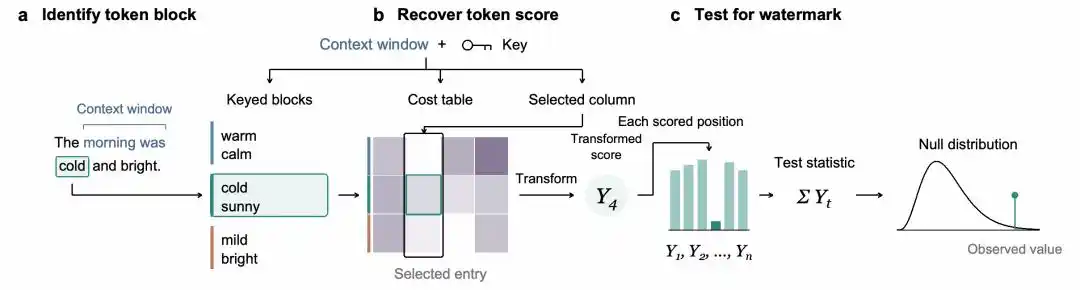
During detection, the question to answer is essentially one: is the word selection in this text always 'coincidentally' hitting the preferences specified by the key?
Text written by an ordinary person has no relation to the key; the score at each position is purely random, and the total score falls within a range that can be precisely calculated using an existing probability distribution.
Text with a watermark, however, will land on high-scoring cells, resulting in a total score that is outrageously high.
The entire detection requires only the original text and the key; it doesn't need to invoke the model or know what budget was set during generation.
It's worth noting that this watermark does not make the model dumber.
Among the 8 benchmarks for GPT-6 Astra, 5 showed slight improvement with the watermark added, and the worst drop was only 1.12 points; tests within ChatGPT also showed almost no change in users' 'thumbs-down' rates.
Led by Peking University School of Mathematical Sciences Alumni, Penn and Yale Collaborate with OpenAI
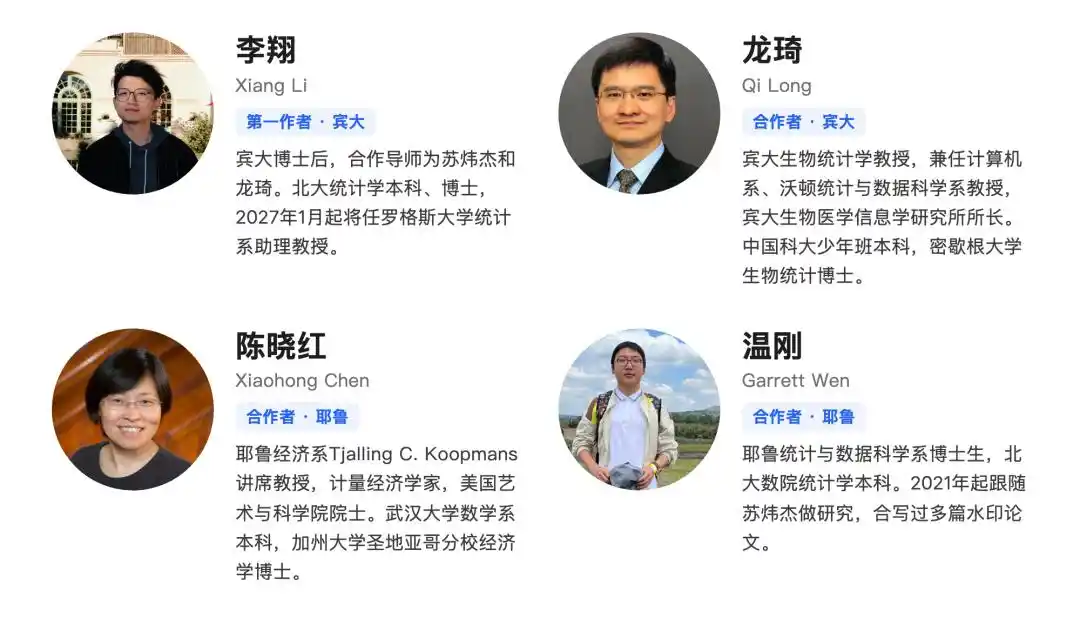
Among the authors of this 20-page technical report are 4 scholars from universities. The backgrounds of the 9 authors span statistics, economics, optimization, and machine learning.
The first author, Xiang Li, completed his undergraduate and PhD in Statistics at Peking University under the supervision of Zhihua Zhang. In recent years, he has specialized in large language model text watermarking and evaluation. He will join the Rutgers University Statistics Department as an assistant professor in January next year.
Qi Long from the University of Pennsylvania is a biostatistician, a graduate of the University of Science and Technology of China's Special Class for the Gifted Young, and now heads the Institute for Biomedical Informatics at Penn.
From Yale, Xiaohong Chen is a member of the American Academy of Arts and Sciences and, together with Gregory Chow, received the 2017 China Economics Prize.
Gang Wen is a fifth-year PhD student in Yale's Department of Statistics and Data Science, an undergraduate alumnus of Peking University's School of Mathematical Sciences, focusing on high-dimensional probability and random matrices, and has been conducting research under Weijie Su since 2021.
Among the OpenAI authors, Qingquan Song is from the base model team and is one of the authors of the open-source tool Auto-Keras; Arzav Jain and Florent Joly have both been involved in ChatGPT search development.
The corresponding author, Weijie Su, is the one who brought this team together.
He officially joined OpenAI in May this year while remaining a professor in the Statistics and Data Science Department at the Wharton School, University of Pennsylvania.
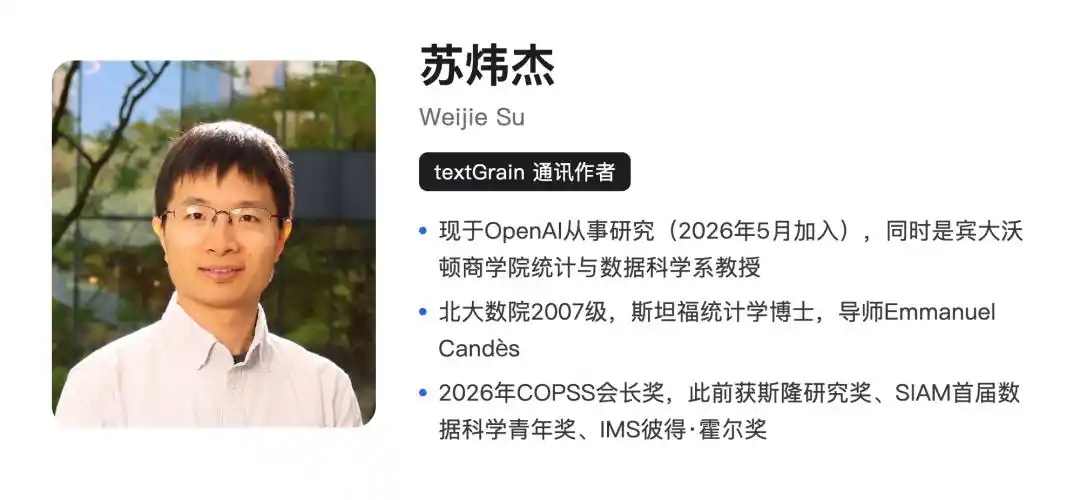
Weijie Su is from the class of 2007 at Peking University's School of Mathematical Sciences. At Peking University, he ranked first in his major and also won the inaugural S.T. Yau College Student Mathematics Contest All-Around Gold Medal. He then went to Stanford for a PhD in Statistics under the supervision of Emmanuel Candès.
His research spans statistical machine learning, high-dimensional inference, optimization, and privacy protection. ICML 2023 even conducted an experiment using his proposed 'incentive mechanism', asking authors to rank their own submissions to calibrate review scores.
When he won the COPSS Presidents' Award in February this year, the first line of the citation mentioned the statistical foundations of generative AI, including research on watermarking.
'I Wrote This' Begins to Require Proof
After explaining the principles, let's return to the question everyone cares about most: will things written with AI be detected?
Those copied verbatim are indeed at risk. A few hundred words strung together are enough for the detector to identify.
However, those who can check are not currently your teachers or your HR.
According to the official announcement, OpenAI's detector is only for approved researchers, and Anthropic's is only open to regulators, media, researchers, and educational institutions.
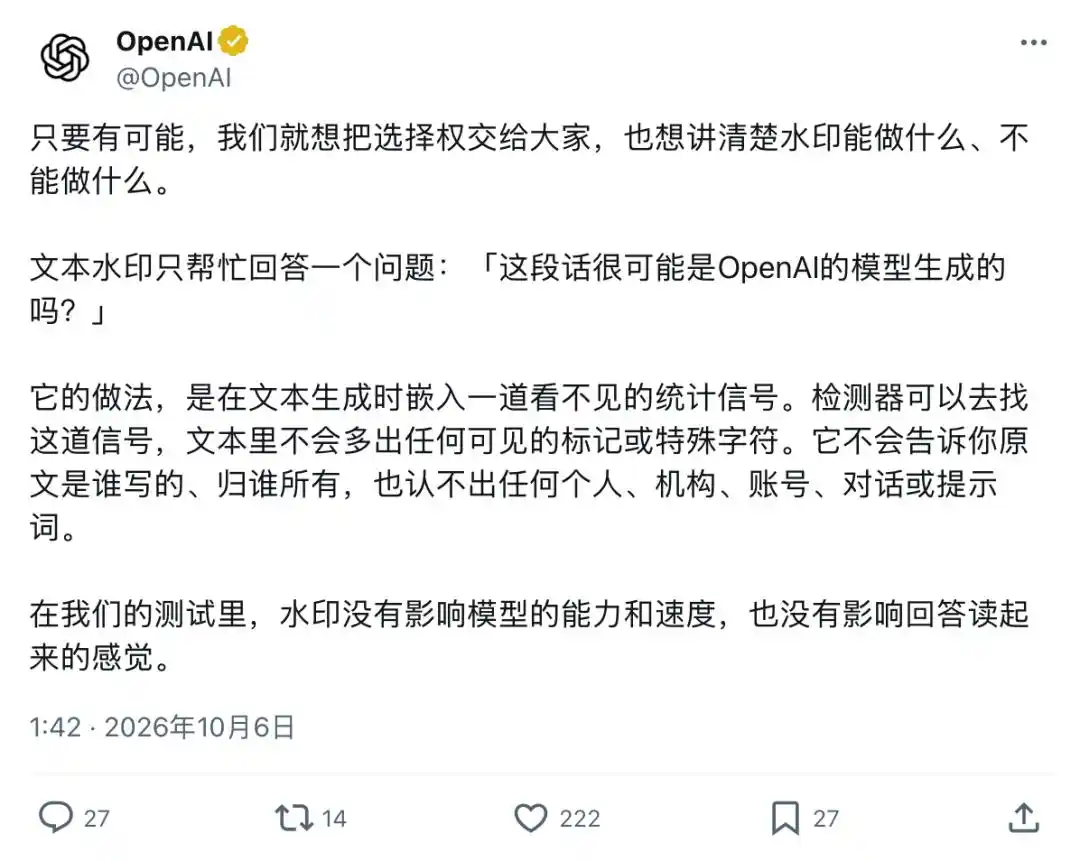
The door isn't open yet, but the direction is clear.
ChatGPT is used by 1.2 billion people weekly; more and more text originates from models. Google, Anthropic, and OpenAI have all chosen the same path: embedding the origin directly into the text itself.
Mathematics used over two hundred years ago to calculate costs for earthmoving projects is now being used to label the origin of machine-written words.
But a watermark can only prove a passage came from AI; it cannot prove a passage came from you.
In the future, the statement 'I wrote this' might also require evidence.
References:
https://openai.com/index/eu-text-provenance/
https://cdn.openai.com/pdf/e9508624-d767-41b6-a26d-e34ca798ada6/textgrain-entropy-calibrated-watermarking-for-language-model-text.pdf
This article is from the WeChat public account "新智元" (New Wisdom Era), author: ASI启示录, editor: Moses