Author: Kyle, DefiLlama Researcher
Compiled by: Jiahuan, ChainCatcher
In the 2026 cycle, the market might finally start to favor tokens with fundamental support. This judgment is not new. When the first smart contract was born, the earliest DeFi proponents envisioned moving infrastructure for financial institutions onto the blockchain. However, cycle after cycle proved that the timing was still too early; market participants wanted only price increases.
Especially in the 2025 cycle, many market participants believed we had reached a "turning point": Trump had just been elected, Gary Gensler had stepped down, and the White House had a "Crypto Affairs Director." But the anticipated events did not happen.
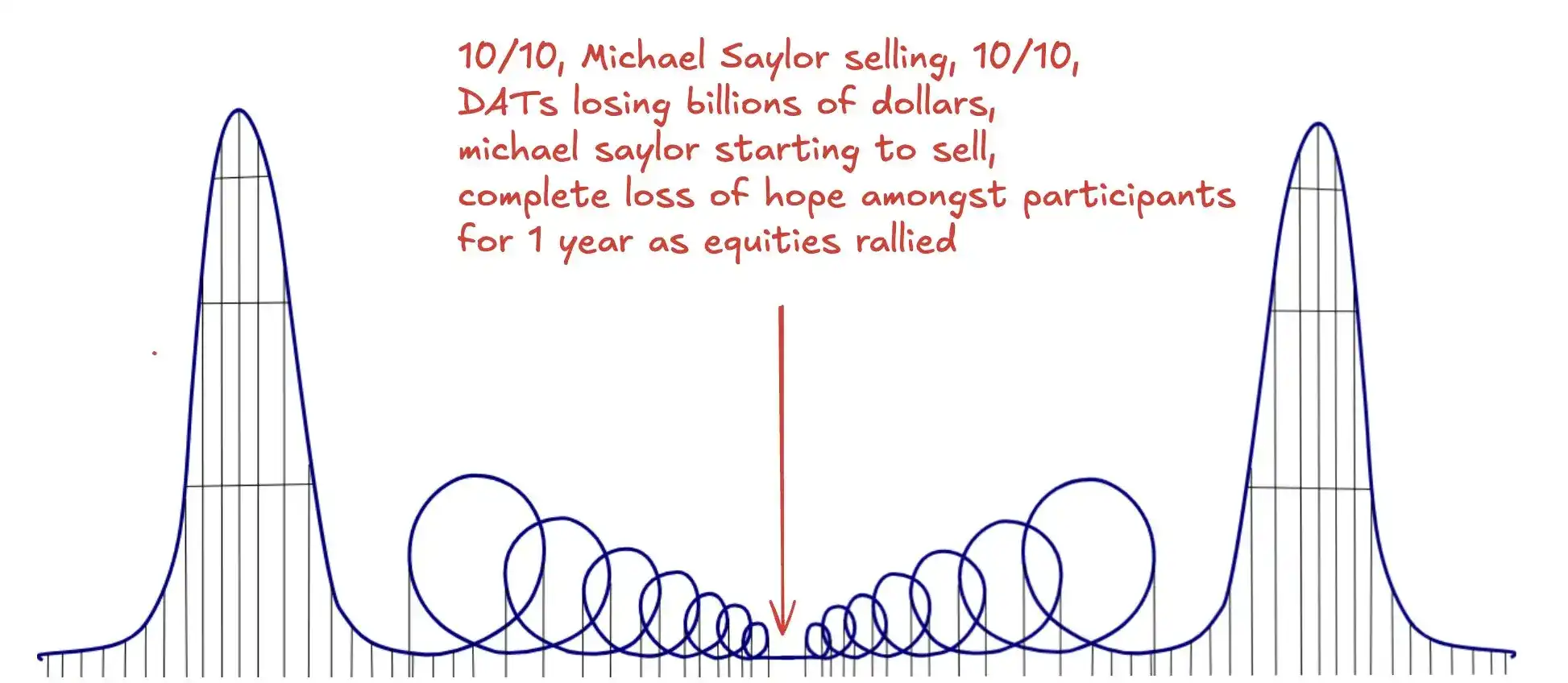
Instead, what we got was Trump tokens draining tens of billions of dollars from the crypto market, Digital Asset Treasury (DAT) companies pushing the market into a double-top pattern with two pump-and-dumps, and the final blow on October 10th: the largest liquidation event in history, which happened almost without warning.
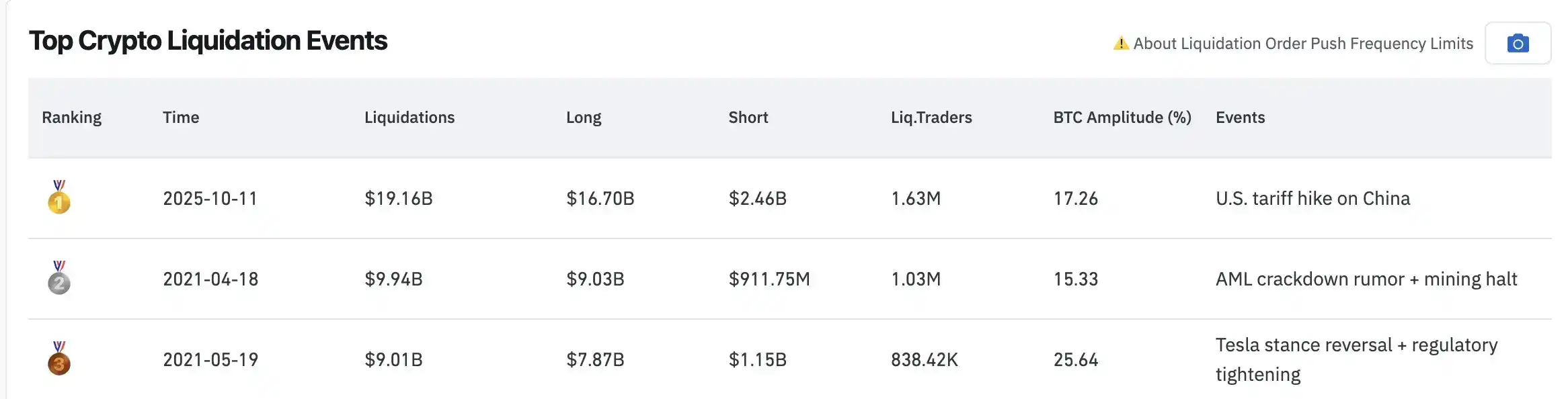
Meanwhile, the stock market was rising, especially semiconductor and memory chip stocks; the S&P index kept hitting new all-time highs, and overall market sentiment towards the economy was relatively optimistic. The natural result was that many old players in the crypto industry left the market, myself included.
Looking back, depressed token prices, a wave of project closures, continuous DeFi hacks, and the departure of many fund managers clearly marked the bottom of the bear market. But what made this bear market even more brutal was the complete shattering of hope. We were all expecting "traditional finance to come in," but what we got instead was a president harvesting the market via tokens, and crypto people putting on the cloak of traditional finance, using Nasdaq-listed holding companies to sell assets to another group of crypto people.
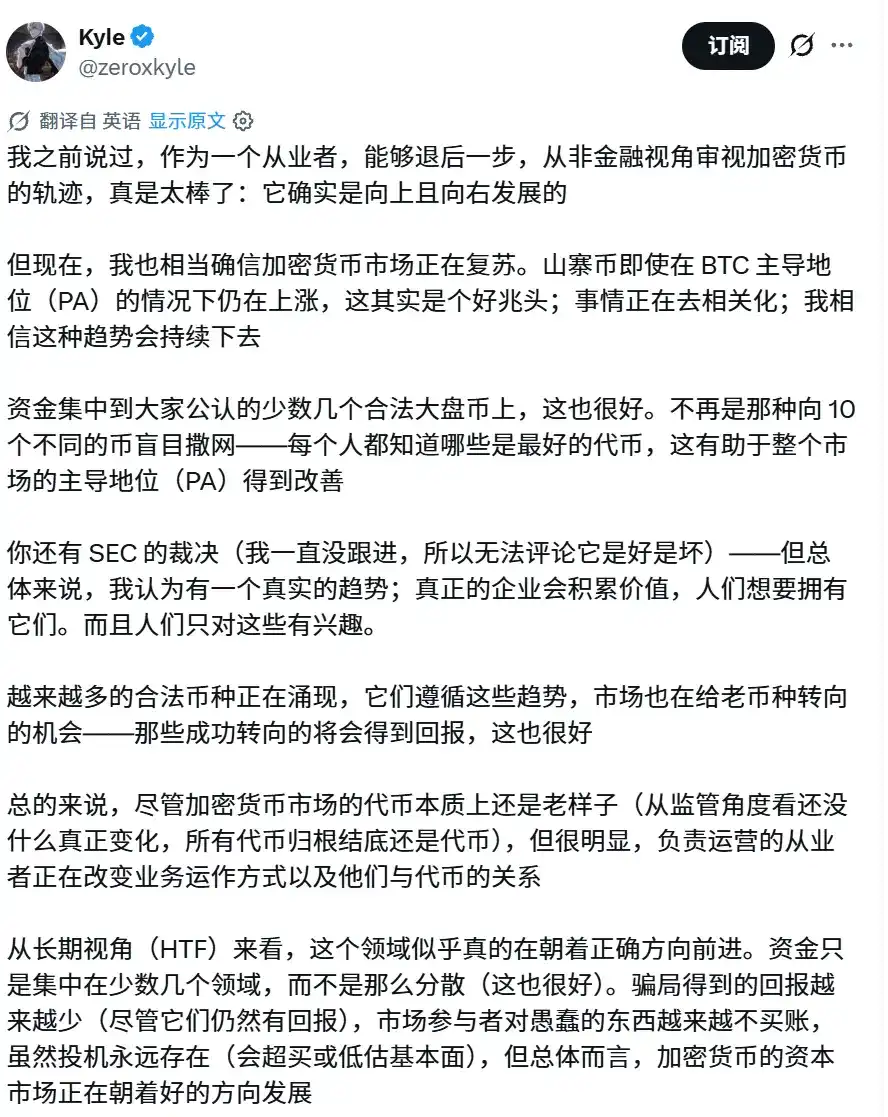
Therefore, I believe it is precisely this experience that has left market participants still burdened with past trauma (PTSD) when facing today's crypto market. Fortunately, I had some good friends who persuaded me to return to crypto. At that time, I wrote these words:
After the bull market began, I wrote this:
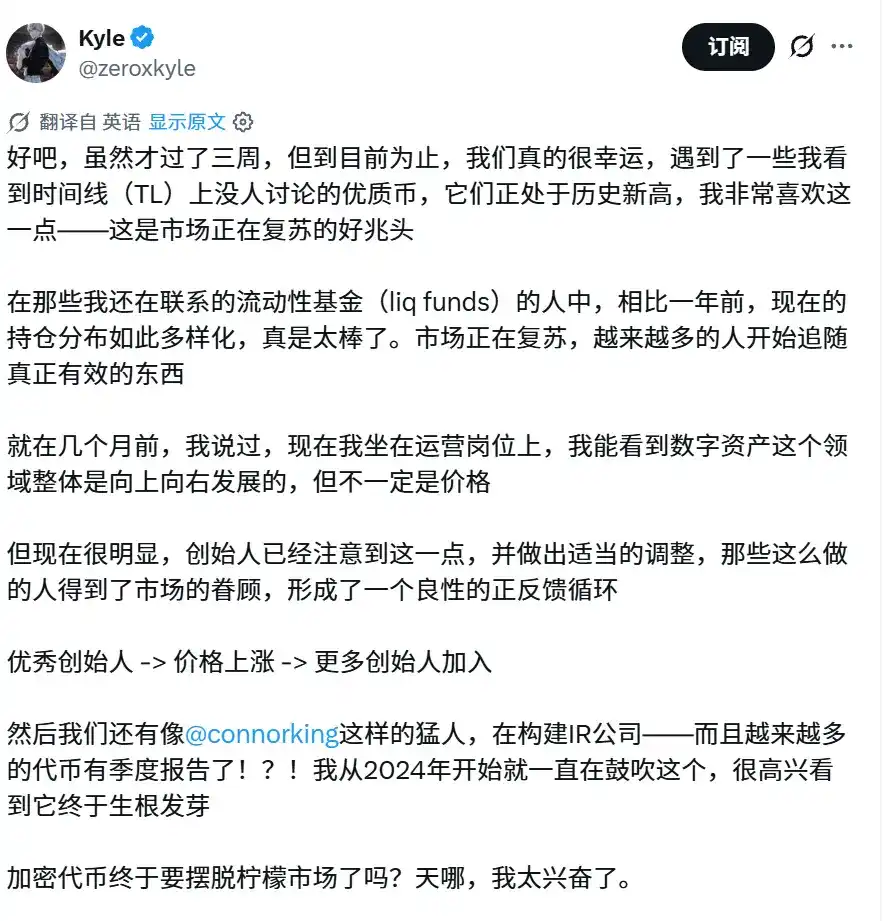
So, I think, in a way, we were all too early back then. The old players in the crypto market have experienced too many disappointments to easily rebuild confidence. From a market perspective, every rally must start amidst skepticism and worry, climbing over this "wall of worry."
But at the end of the tunnel is the dream we've been waiting for, the golden road, the last frontier. Seriously, the era we know is ending, and a new one is beginning. Frankly, I believe the "Internet Capital Market" is already taking shape. The focus of the next few cycles will be on how traditional financial markets integrate with internet-native assets that have equity attributes.
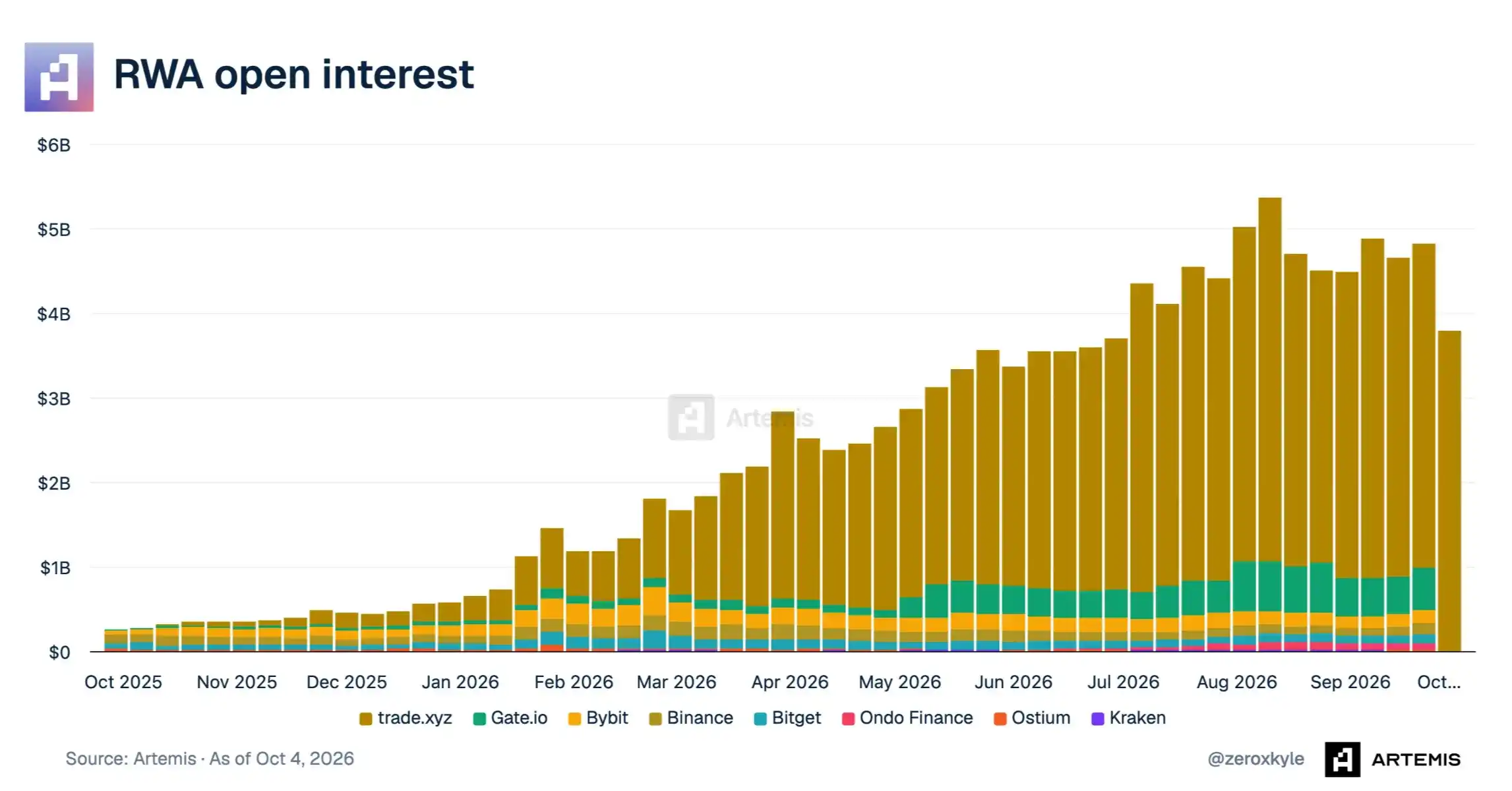
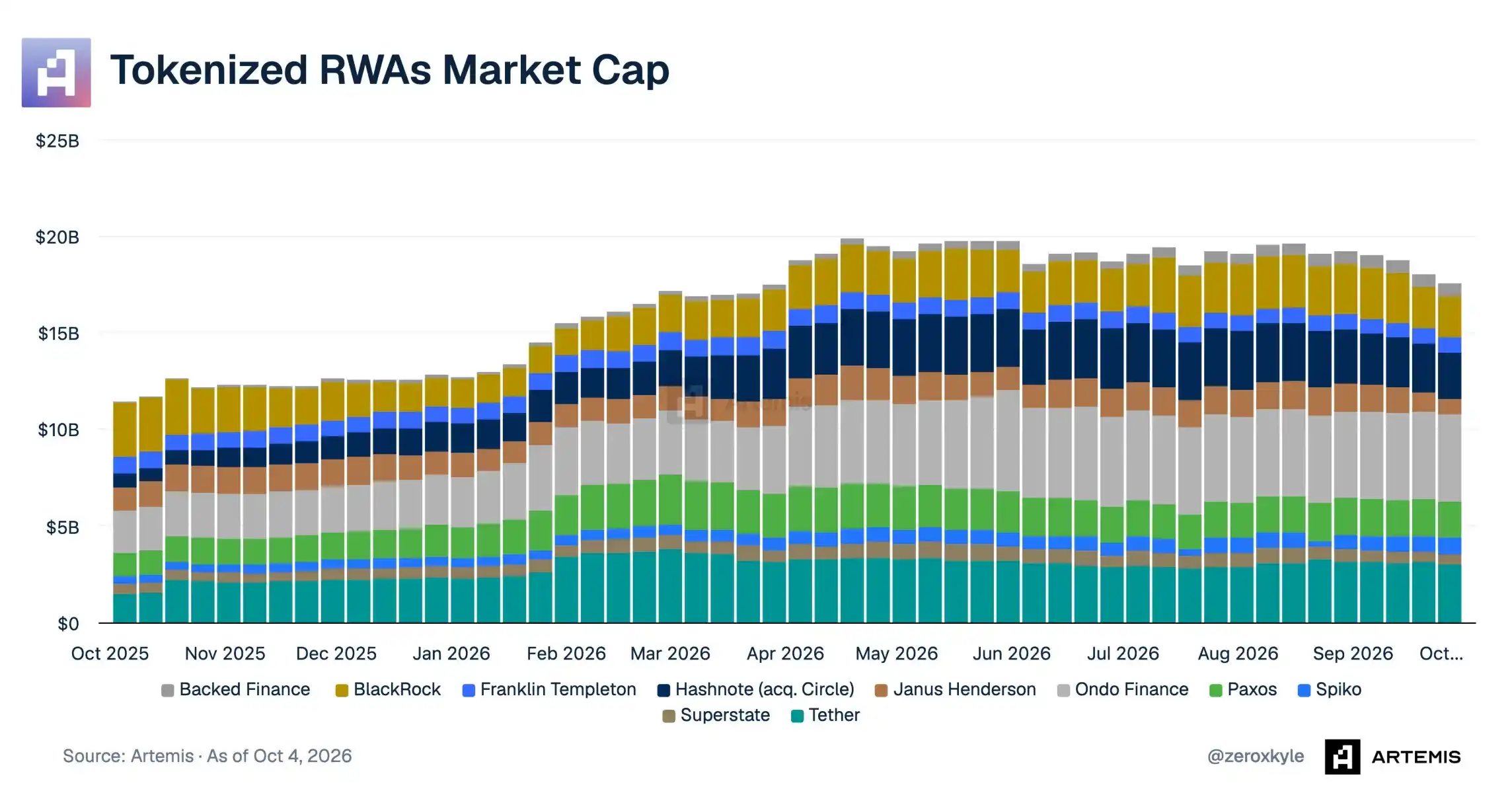
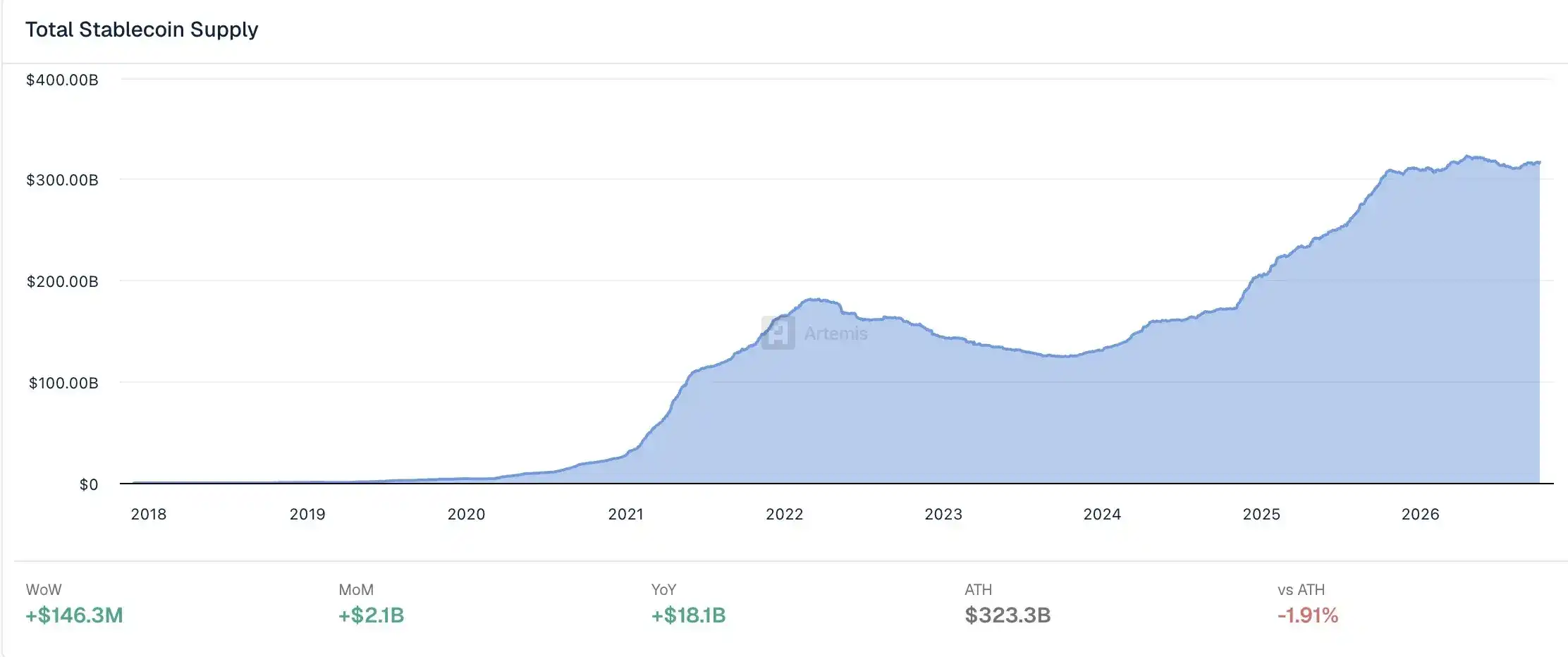
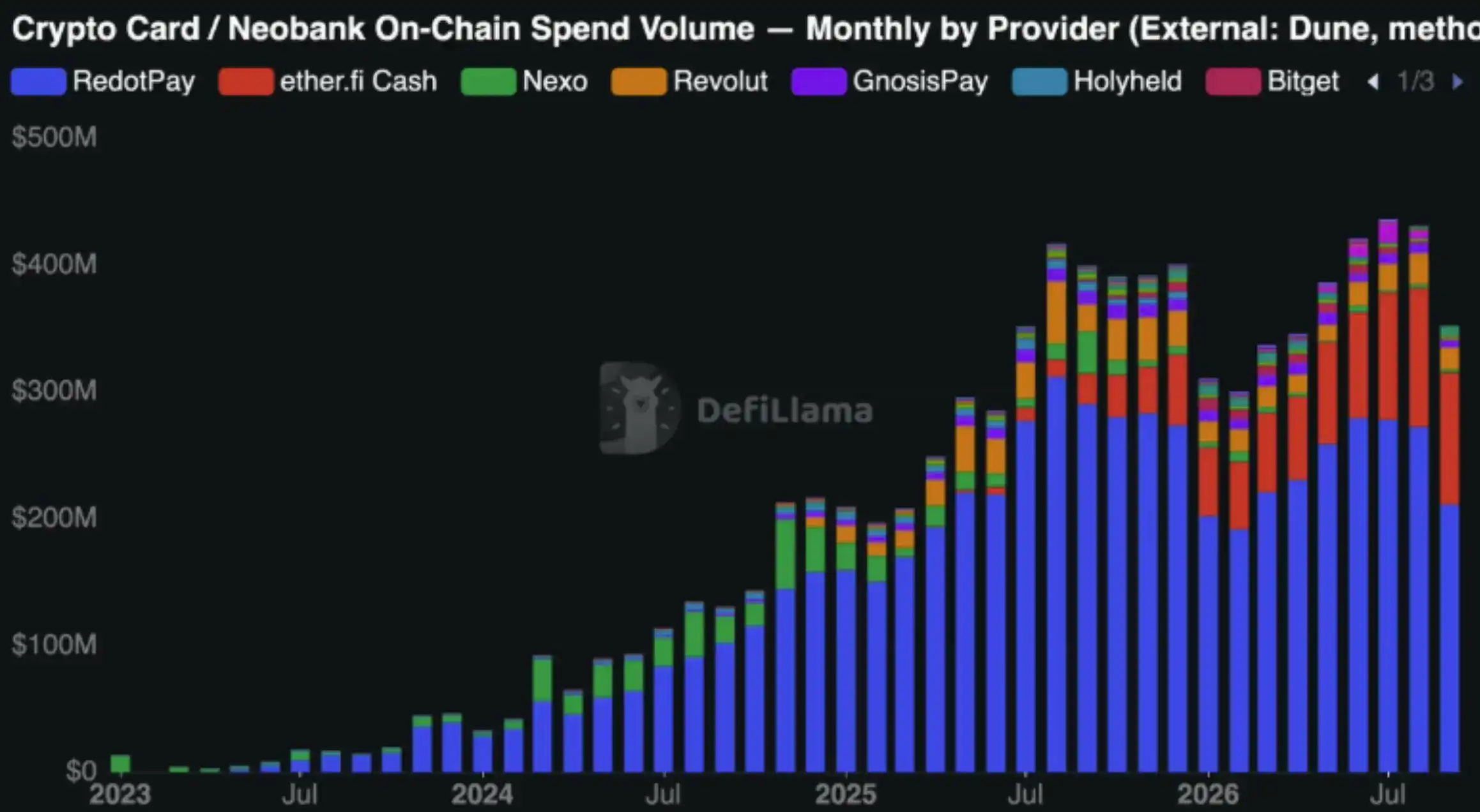
Of course, none of this is new. I'm pretty sure I said similar things in 2025. Since the birth of smart contracts, we have been steadily moving in this direction. It has always been more a matter of timing than growth. All indicators point to the same thing: even if prices haven't risen, the actual use of crypto technology continues to grow.
Investment Strategy: Choose the Right Assets, Lengthen the Time Horizon
However, as mentioned above, the problem is more about timing than a lack of real-world application. Therefore, as an investor entering this market, the first thing I want to emphasize is: lengthen your investment horizon and prepare for more violent volatility than before.
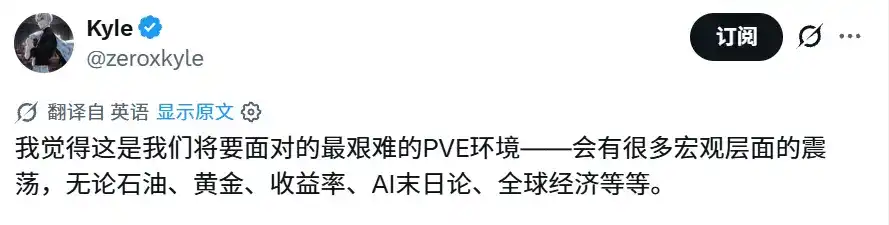
In times like these, the investment experience accumulated in the traditional stock market over the past year can be very helpful. Many on X know that the whole world is increasingly resembling a speculative game. Various markets are gradually dominated by speculative asset bubbles, while the Benjamin Graham-era value investing approach that focuses on fundamentals and finding undervalued assets is taking a back seat.
Regarding this, I highly recommend reading this article by 0xSmac: "Let The Bubble Wash Over You."
In such a market, more and more macroeconomic news affects prices. New developments emerge almost weekly: Trump strikes a deal with Iran, the 10-year Treasury yield rising to "levels not seen since 1990," currency crises, likely related to the yen, pessimistic or accelerationist arguments about AI prospects, and geopolitical uncertainty.
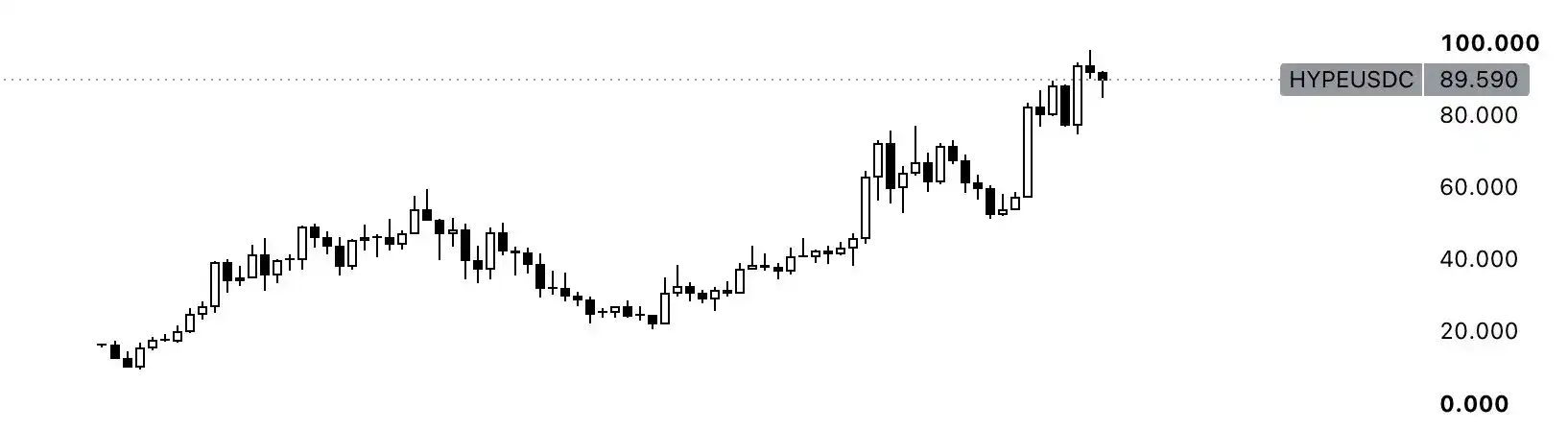
Therefore, it's worthwhile to lengthen your time horizon and reduce the impact of short-term noise. There has always been a lot of noise in the market, and there will continue to be, but this strategy has worked quite well in the stock market. I believe it will also become a primary strategy for crypto investing in the future. Hyperliquid's HYPE is the first real case of a token that gives you a chance to "profit from dollar-cost averaging."
Why Are Most Tokens Not Suitable for Long-term Investment?
The importance of asset selection in the crypto market cannot be overemphasized. Crypto market participants have long held an underlying belief: "Everything is a scam, and it will eventually go to zero, so you have to sell." For most of crypto's history, this assessment has been correct. But Hyperliquid has charted a new path: there are assets you can indeed invest in continuously and profit from.
This is more important than many think because it will dramatically change how the market functions. A major reason many altcoins are not suitable for long-term investment is simple: no one wants to continuously DCA into an asset that might drop 90%. In the stock market, time is on your side because the underlying businesses are expected to grow over time. The logic of continuously buying the S&P index is that the US economy grows, so you keep buying.
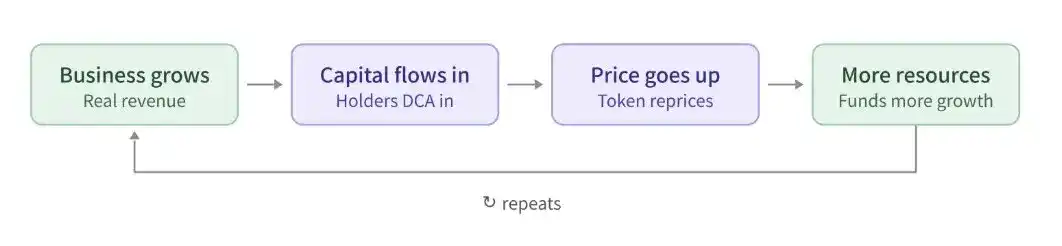
Therefore, when businesses capable of sustainable growth emerge in crypto, digital assets begin to have a real foundation suitable for long-term investment. This creates a positive feedback loop: business growth → attracts investment capital → price appreciation → drives further business growth. This is how an Internet Capital Market forms.
Additionally, there are structural reasons why the crypto market has long been in a "lemon market" state, where buyers struggle to distinguish quality and bad projects crowd out good ones:
Tokens with low circulating supply and high fully diluted valuations (FDV), accompanied by massive unlock schedules and sell pressure. New supply keeps flowing into the market for years. Even if the project itself performs well, there's always a cohort of sellers waiting to exit.
Inability to generate profit. The product doesn't truly meet market needs, thus cannot grow sustainably, relying only on short-term narratives fit for bubble markets, here today, gone tomorrow.
Misalignment of interests between token holders and company shareholders. The value created by the business goes to shareholders, while tokens are basically marketing tools. Holding tokens doesn't mean you have a real right to the money the business makes.
Lack of disclosure and accountability. In the stock market, companies must disclose revenues, insider stock sales, and risks; falsification has consequences. In crypto, insiders, VCs, and market makers hold the unlock schedules, OTC deals, and real data. Teams can dump tokens, fake metrics, or quietly exit, with investors having little recourse. When buyers cannot tell good from bad, they assume everything is bad.
What Conditions Must a Good Token Meet?
These problems have accumulated to a point where it seems we've finally reached a turning point: the crypto market is beginning to find solutions to the "lemon market" problem. Most market participants are demanding stricter criteria for investment targets, giving project founders and operators clear feedback on what needs to change. For example:
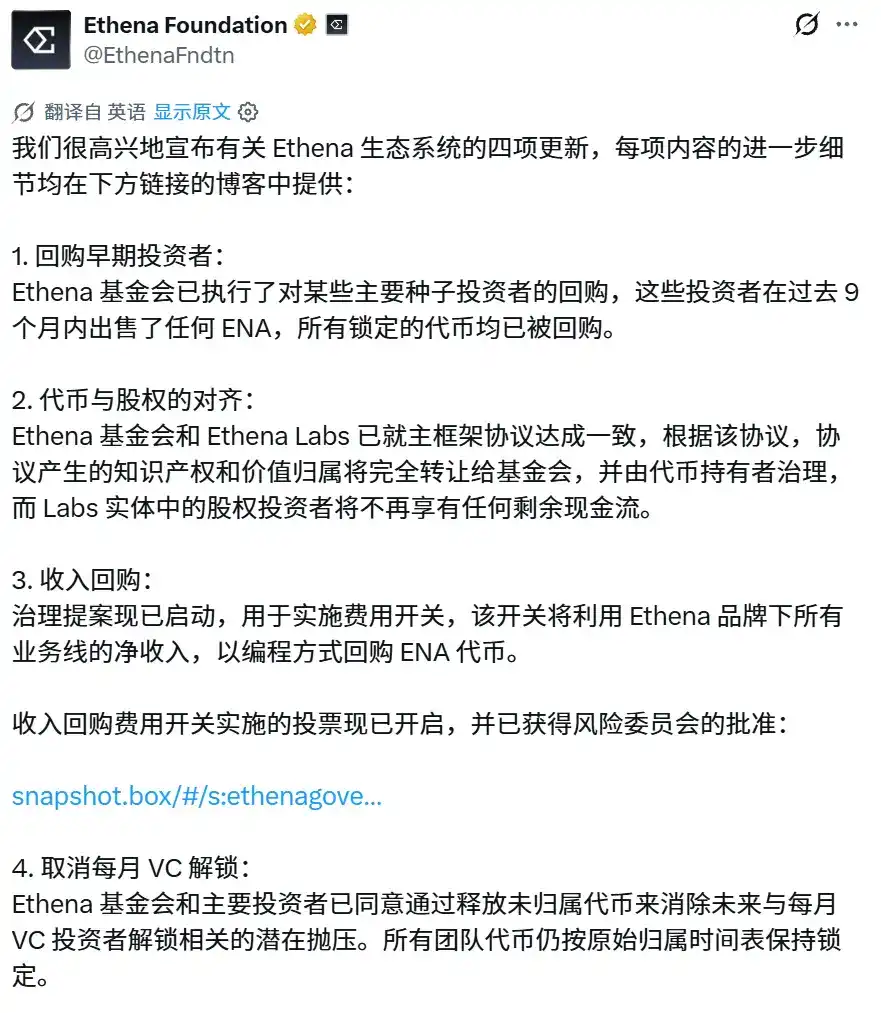
The Ethena team has done the following:
Bought back tokens from some early investors who had sold.
Aligned the interests of token holders with company shareholders: the protocol's IP and the value it creates belong to the foundation and are governed by token holders.
Revenue buybacks: proposed a governance proposal to use protocol revenue to automatically buy back ENA tokens.
Eliminated monthly VC unlocks: The Ethena Foundation and major investors have agreed to release tokens not yet vested to investors, ending the previous monthly unlock schedule, thus removing the continuous pressure from future monthly unlocks.
The market has rewarded Ethena for this: ENA is up 95% in the past 14 days. Thus, a positive feedback loop is formed.
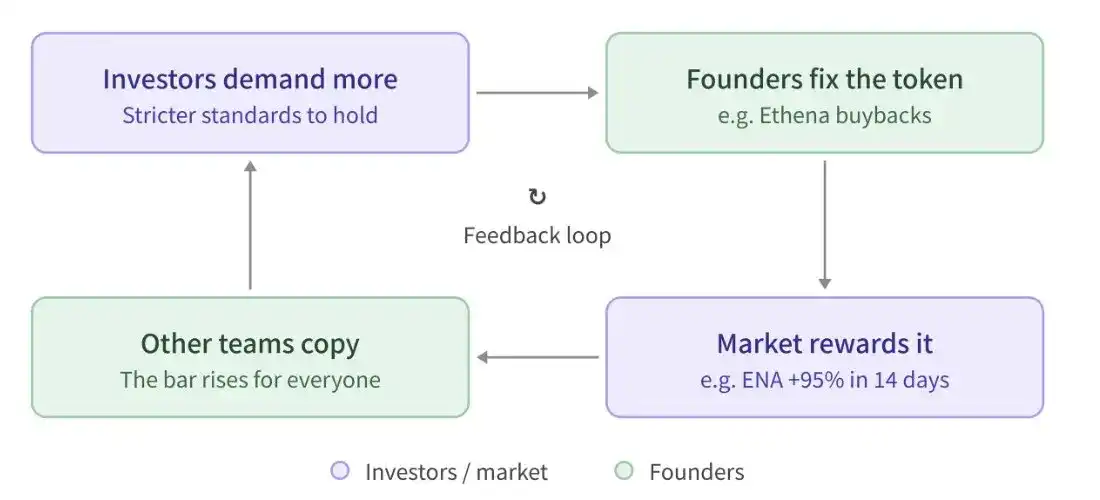
So, the idea for asset selection is clear: buy into projects that have solved the "lemon market" problems, avoid those that haven't. Below is my screening checklist. These aren't absolute rules, but from my observation, teams should at least meet most of these requirements, preferably all:
Enable token holders to share in the value created by the business. There are interesting experiments in the market; as long as the interest arrangement is reasonable, investors can also accept projects having equity alongside tokens. Venice is a good example. At a minimum, market participants need to see two things: A) The team values the token; B) The team does not divert value that should accrue to the token to company shareholders.
The product genuinely meets market needs and is profitable. Sustainable growth and profitability are key to attracting capital to a project. Intuitively, people only want to buy assets that will go up, and price appreciation comes from either multiple expansion or earnings growth. For a business, the valuation multiple is largely out of its control; it depends on market sentiment, narratives, and interest rates. Consistently growing earnings are the basis for accumulating value over time and compounding. Market narratives rotate quickly, but growing earnings give people a reason to continue holding.
Token supply. There's no one-size-fits-all answer here. Some tokens with minimal overhang perform poorly; some with some overhang perform well. But generally, excessive potential selling pressure is not good, as it caps upside. A certain degree of overhang seems acceptable. The best teams go further, proactively solving this issue, like Ethena buying back investor tokens.
Some bonus points:
Buybacks. I don't think the buyback amount matters much, unless it's as large as Hyperliquid's. For most protocols, reinvesting that money into the business might be better. Buybacks mainly signal to market participants: the founders value the token. Buybacks need the right magnitude: too small, you spend money to no effect; too large, they crowd out capital needed for business growth. And buybacks alone are basically worthless. Markets can usually see through this.
Transparency and Investor Relations (IR). In my view, this should be a requirement. The reasoning is simple: if you want people to hold your token, you should clearly communicate its use and value. Public companies already do this, e.g., releasing quarterly reports, holding investor calls. If you want investors to entrust you with capital, you should provide corresponding disclosure and communication.
There might be other factors I've missed, but these are what come to mind first. Overall, the crypto market is healing: real businesses are emerging, teams are improving token value accrual and supply dynamics, and the market is finally starting to reward quality over hype. Digital assets are beginning to have value as long-term holds for the first time, not just trading vehicles. But the prerequisite is that you hold the right assets. There are still plenty of bad projects in the market, so asset selection is more important than ever. However, for those with discernment, the strategy is simple:
Buy good assets, hold on through the noise, let time work.
Finding Investment Opportunities: Look at Sectors First, Then Teams
Now onto the best part: what I think are the most worthwhile dishes at this buffet. There's a pile of sashimi on the table; one piece is bluefin tuna cheek meat, the rest are just ordinary tuna from a gas station. My job is to figure out which one is the bluefin tuna.
It's easier to start with sectors, then specific projects. From an investment theme perspective, only a few sectors have proven their products genuinely meet market demand. Therefore, below is my tiered ranking. I haven't included sectors that currently have no tokens tradable on secondary markets or are not directly investable, like prediction markets.
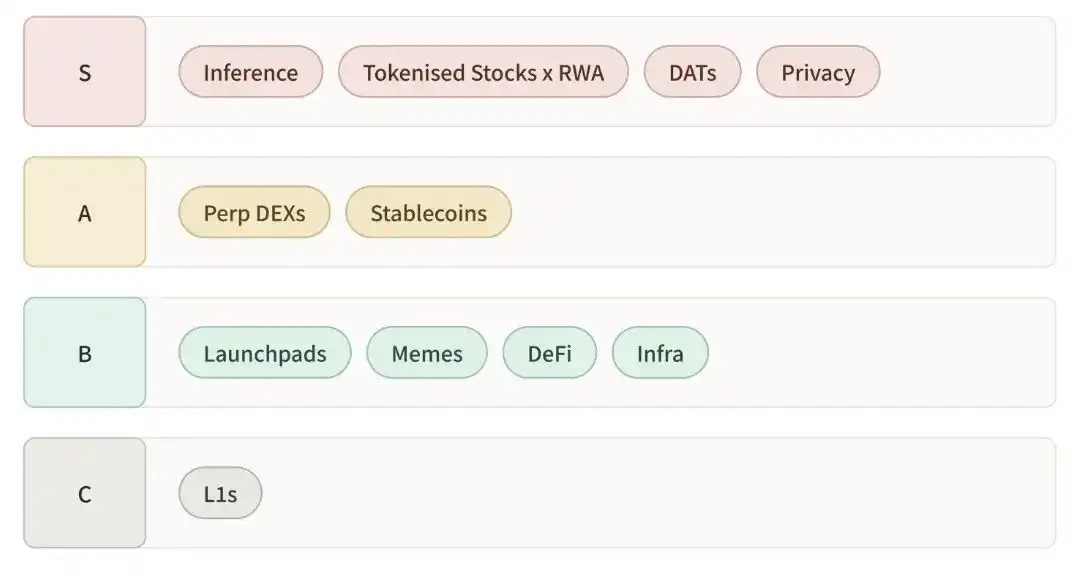
Additionally, I've written a separate section on my views about on-chain markets. In short, I think except for a few good tokens, other on-chain projects aren't even worth the time. I've already written about this in the tweet below, but I'll repeat it here so it's not overlooked:
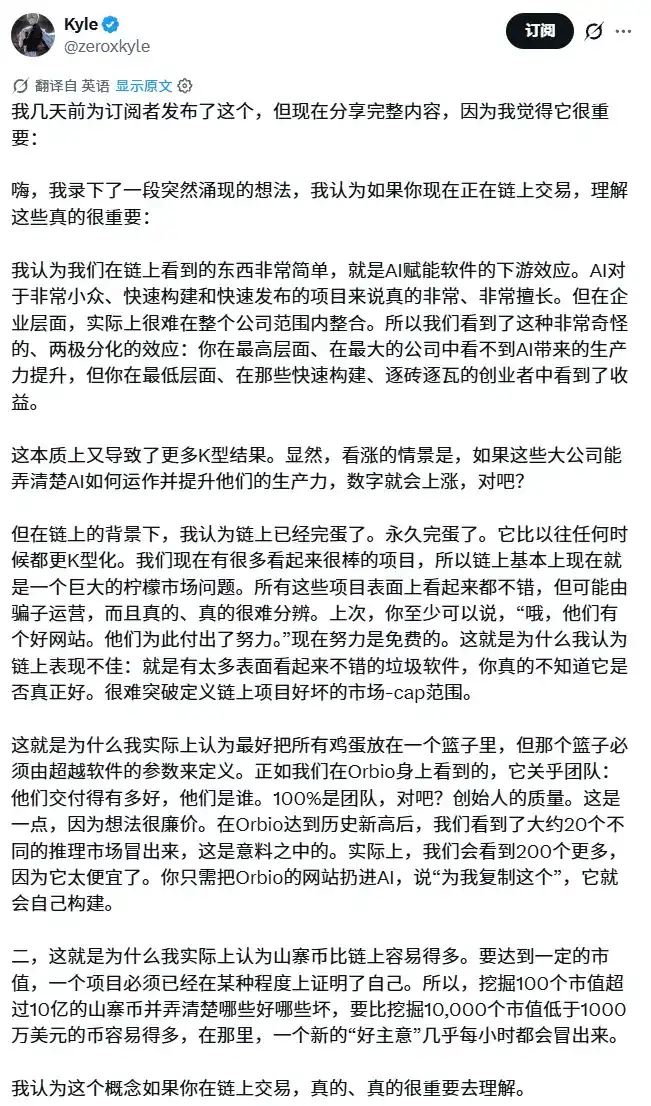
Simply put, what we see on-chain is the impact of AI-assisted software development. AI is great for small, niche projects that can be developed and launched quickly, but much harder to roll out across large enterprises. Thus, a strange contrast emerges: large enterprises don't yet show obvious productivity gains, while small startup teams are already leveraging AI to launch products rapidly. The result, again, is a K-shaped divergence: increasingly uneven productivity gains across different groups.
On-chain, this makes the "lemon market" problem worse than ever. Before, you could at least say, "Their website is well done; they obviously put in effort." Now, achieving that surface polish costs almost nothing. Every token with a market cap below $10 million is superficially well-packaged, making it nearly impossible to distinguish between real teams and scammers. Ideas have become cheap too. After Orbio hit an all-time high, we saw 20 different prediction markets pop up; there will probably be 200 more soon, because anyone can feed Orbio's website to an AI and say, "Copy this for me."
Therefore, the edge in on-chain investing can no longer come from software alone; it must come from the team: who they are, their ability to deliver. The founder's capability and quality decide everything. This is also why I think it's easier now to invest in other, already-established tokens than to fish for small caps on-chain. For a project to reach a certain market cap, it has somewhat proven itself. Studying 100 tokens with a market cap over $1 billion to find the good ones is much easier than studying 10,000 tokens with a market cap under $10 million, each with a "great idea" launching hourly.
Six Key Sectors and Investment Targets
AI Inference: Real Demand from Outside Crypto
AI inference refers to the process where a trained model processes requests and generates results. It is the only crypto sector that truly has demand from outside the crypto industry. Individuals and businesses pay for AI because they need it, not for token incentives. As open-weight models (models with publicly available parameters) become increasingly capable and cheaper to use, providing AI services becomes more affordable, allowing businesses to compete with large AI companies on price and privacy.
It's also an investment theme the average retail investor can grasp immediately. Everyone is using AI, and the explosive growth exhibited by some related assets indicates that the product here genuinely meets market demand. I believe current inference demand exemplifies the "Jevons Paradox": cost declines stimulate more usage, driving total demand growth. All data points to this. Data also shows people moving from frontier models to other types of AI, including open-source models.
While open-source models may face regulatory scrutiny, there's no doubt many models are capable enough for 99% of work tasks. So, honestly, people don't strictly need frontier models. People want to use AI; they don't care which model they use.
I can't believe I'm saying this either: connecting these factors, if you want to invest in a good AI product while betting on inference demand growth, the only direct investment vehicles, practically speaking, are crypto tokens. Semiconductors benefit indirectly from demand growth, but this expectation is already priced in. Anthropic and OpenAI are not yet public. You can certainly go long on Zhipu, but the Hong Kong market doesn't give the same valuation premium. Meanwhile, some tokens let you directly participate in this investment theme. The crypto market happens to offer one of the best tools for betting on inference demand growth.
Top picks: VVV and ORBIO Other choices: NEAR and CHIP
Recommended reading: this report by galaxy.
Tokenized Stocks & RWA: How Big Is the Market Opportunity?
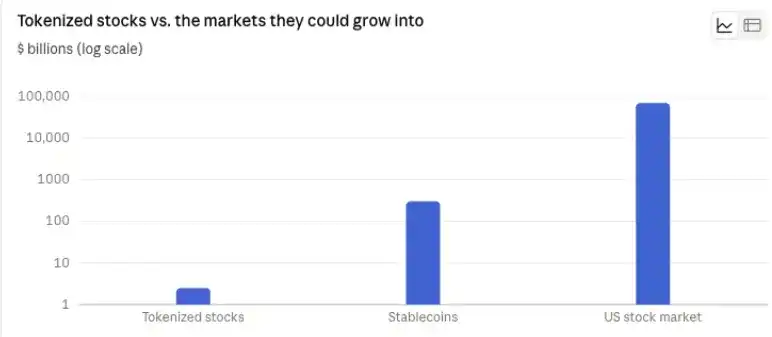
This is currently the biggest opportunity among all directions, for a simple reason: its current size is still tiny. The US expanded global dollar usage via stablecoins; the stablecoin market is around $300 billion. Tokenized stocks are only about $2.5 billion, while the US stock market is $69 trillion. Regulation is opening doors, a wave of large IPOs is coming, and there is huge demand from countries where investing in US stocks is not easily accessible.
Top pick: BP
Recommended reading: this report by frictionless.capital.
DAT: Opportunities from Discounts and Improving Fundamentals
For this section, I'll directly quote Evan. The following is from Evan's article:
I think a good opportunity fitting this investment logic should have the following characteristics:
Significant discount to the value of held assets; at the summer lows, mNAV was around 0.15x.
Operating in sectors like stablecoins, perpetuals, etc., with a top-tier team that continues to ship products even though related tokens are down over 95% from all-time highs.
Fundamentals set to improve over the next few years as token vesting and unlock schedules conclude. For example, increased USDe circulation, recovery in basis trade yields, expansion of spot vs. derivative hedging strategies capturing spreads and funding rates into stock perpetuals, and more institutional partnerships driving TVL and protocol revenue growth.
Ultimately, I think DAT companies in the Ethena ecosystem best fit these criteria. Since then, new digital banking products have launched, and USDe circulation has increased by over $10 billion.
Top pick: USDE
Privacy Sector: Keep an Eye on ZEC
For this section, let's borrow Lee Goon Wang's style. The privacy sector is not my expertise; I don't hold a single ZEC, so I'll just drop a few links to Taiki's videos.
Top pick: ZEC
Recommended viewing: video.
Perpetual DEX: Growth Opportunities Heading Mainstream
Perpetual decentralized exchanges (DEXs) have one of the highest product-market fits in the entire crypto industry: real users, real trading volume, real fee revenue. It's placed in Tier A rather than S only because the market already knows this. Hyperliquid's success is priced in, and competition is heating up. The next phase of growth will come from perpetuals going mainstream via apps like Robinhood and Interactive Brokers (IBKR), expanding the entire market.
Top picks: LIT / HYPE
Stablecoins: How to Participate in Market Growth?
Stablecoins are the most successful product in crypto so far and will continue growing. It's placed in Tier A because the biggest winners, Tether and Circle, don't have tokens that can be bought on-chain to share in their business growth, so there are few avenues for direct investment in this sector's growth. Ethena is a rare exception: it's a stablecoin issuer with a token that allows holders to benefit from the business's growth.
Top pick: USDE
I believe crypto assets are finally investable again. Bad projects are slowly being separated from real businesses, and the market is finally starting to reward teams that build seriously. Old players still carry past trauma, but every real bull market starts amidst such skepticism and worry.
Lengthen your time horizon, prepare for more volatility, and be stringent in your portfolio selection. The investment edge this cycle is not in finding the next moonshot from a token with a market cap under $10 million, written by someone over the weekend with AI, but in finding projects with real revenue, token value accrual, and reliable teams, and having the confidence to hold on when others are shaken out by volatility from the latest news.
Buy good assets, hold on through the noise, let time work.